REVIEW 4 major objections 3 minor 31 references
Quantum-Optimized Selective State Space Model for Efficient Time Series Prediction
T0 review · 4 major / 3 minor · reviewed 2026-08-05 · deepseek-v4-flash
Pith's one-line read Q-SSM claims a one-qubit expectation gate stabilizes long-horizon forecasting in linear time and outperforms S-Mamba and Transformer baselines on ETT, Traffic, and Exchange.
desk verdict The paper's own equations defeat its main claim: the quantum gate is input-independent, so the model is a fixed-leak filter, not a selective SSM; the baseline table also looks copied. read the letter →
The pith
A machine-rendered reading of the paper's core claim, the machinery that carries it, and where it could break.
The reading
What carries the argument
The central object is the RY-RX ansatz with a Z-basis measurement. Starting from |0>, the circuit applies RY(theta) then RX(phi), and the measured observable has expectation z = <Z> = cos(theta)cos(phi) in [-1, 1]. Two such expectations are combined as s = w1*z1 + w2*z2 + bg, then g = clip(sigma(s), 0.05, 0.95). This g is the 'quantum gate' that interpolates the state-space update ht = (1-g)ht-1 + g*ut. Its load-bearing properties are: (i) the derivatives dz/dtheta = -sin(theta)cos(phi) and dz/dphi = -cos(theta)sin(phi) are each bounded by 1, making the whole gate 1-Lipschitz per parameter when combined with sigma' <= 1/4; and (ii) clipping keeps g inside (0,1), so ||dht/dht-1|| = |1-g| < 1,
What would settle it
On a fixed test set (e.g., ETTm1, H=96), take the trained Q-SSM and replace the two cosine expectations with the constants 1 and 0, then re-optimize only w1, w2, bg so g is a single trainable leak; if MSE/MAE remain within run-to-run noise of the full model, the quantum circuit's parameter geometry is not what produces the gains. A second decisive check: rerun S-Mamba and Q-SSM from the same random seeds on the exact same 60/20/20 split and report error bars; if the reported margins of about 2% swap signs under reseeding, the claimed state-of-the-art status rests on borrowed baseline numbers.
Extended reading notes
Core claim
On its own terms, Q-SSM's discovery is that a minimal variational quantum gate can replace the classical pre-activation of an SSM's update gate and thereby stabilize long-horizon forecasting without quadratic attention. The core recurrence is ht = (1-g)ht-1 + g*LN(W(P(xt)) + b + alpha*c); the gate is g = clip(sigma(w1 cos(theta1)cos(phi1) + w2 cos(theta2)cos(phi2) + bg), 0.05, 0.95), where each cos(theta)cos(phi) is the Z-expectation of a one-qubit circuit |psi> = RX(phi)RY(theta)|0>. Because the quantum expectation has derivatives bounded by 1 and sigma' <= 1/4, the gate is Lipschitz in its parameters, and because g is clipped away from 0 and 1, the recurrence's Jacobian has norm |1-g| < 1,
Load-bearing premise
The load-bearing premise is that a gate value computed only from learned parameters, never from the current input x_t, still counts as an 'adaptive' or 'selective' memory controller; at inference g is the same scalar for every time step and every feature, so the recurrence is a fixed-leak linear filter, and the claimed quantum-adaptive memory control and the comparison to S-Mamba's selective updates rest on that premise.
Editorial extensions
If this is right
- A fixed backbone width (k=d=128) with the same hyperparameters transfers across six benchmarks, so Q-SSM implies that minimal recurrent capacity plus a bounded quantum gate is enough to compete with much larger attention stacks.
- Because the recurrence Jacobian is bounded by 1-g < 1, Q-SSM implies that hidden state information is neither amplified nor erased over thousands of steps, which is exactly what makes 720-step forecasts stable.
- The quantum gate's cost is two single-qubit expectation values per step, so Q-SSM preserves linear-time inference O(W(Fk+kd)+HdF), avoiding the O(W log W) of Autoformer and the O(Wd^2) hidden-dimension cost of Mamba.
- On the normalized benchmarks, Q-SSM reports 32/36 best MSE/MAE cells, with the residual decoder predicting deviations from the last observed value rather than absolute values; this supports the claim that grounding forecasts in the last observation prevents long-horizon drift.
Reading between the lines
- Because g in Eq. (15) does not depend on x_t, a straightforward test is to feed the same gate parameters different input windows; the model's per-step leakage is unchanged, so the paper's 'adaptive' language is currently a training-time property only. Making theta and phi functions of the input would turn the fixed-leak filter into a genuinely selective recurrence, and the reported margins over S-
- The bounded oscillatory pre-activation cos(theta)cos(phi) is classical; replacing the two single-qubit expectations with a classical sinusoidal nonlinearity of the same Lipschitz constant would isolate whether the benefit is quantum-specific or simply the bounded, non-saturating gating geometry.
- At the longest horizons on ETTh2 and Traffic, S-Mamba outperforms Q-SSM by about 2%; a split-matched head-to-head with multiple seeds would show whether the fixed-leak recurrence hits a horizon-dependent ceiling that an input-conditional gate could lift.
Editorial analysis
A structured set of objections, weighed in public.
Referee Report
Summary. The manuscript proposes Q-SSM, a hybrid quantum-classical recurrent model for long-horizon multivariate time series forecasting. The architecture combines a linear-time gated state-space recurrence with a gate produced by a single-qubit variational circuit (RY-RX rotations and a Pauli-Z expectation), followed by a sigmoid and clipping. The authors claim that this quantum gate adaptively regulates memory updates, improves stability, and yields state-of-the-art accuracy on ETT, Traffic, and Exchange benchmarks relative to Transformer, RNN, TCN, and S-Mamba baselines.
Significance. If the central claims were true, the paper would make a useful contribution: an O(T)-complexity forecasting model with a simple, classically simulable quantum gate improving over strong baselines would be of interest to both the time-series and quantum-machine-learning communities. The paper also offers explicit formulas for the gate, Lipschitz bounds, and contraction of the recurrence, which are transparent. However, the central architectural claim is undermined by the gate's lack of input dependence, and the empirical evaluation is compromised by apparent data errors and an incompatible evaluation protocol. The positive aspects are the explicit mathematical presentation and the reproducibility attempt via a code link, but these do not offset the load-bearing flaws.
major comments (4)
- [Sec. III-B, III-C, Eqs. (9), (12)-(15)] The gate g as defined in Eq. (15) has no dependence on the input x_t, the hidden state h_{t-1}, or any time-varying quantity. From Eqs. (12)-(15), s = w1 cos(theta1) cos(phi1) + w2 cos(theta2) cos(phi2) + b_g, and g = clip(sigma(s), gmin, gmax), so after training g is a single constant scalar applied at every time step and every feature. The recurrence (9) is therefore a linear time-invariant fixed-leak filter, not a selective state space model in the sense of Mamba/S-Mamba, where selection requires input-dependent B, C, and Delta. The claimed 'adaptive quantum memory control' and the model's central selective-SSM framing collapse. The stability bounds in Eqs. (16)-(21) are mathematically correct but only show that a parameter-dependent gate is Lipschitz and contractive; they do not establish input adaptivity.
- [Table I] The baseline results contain identical rows across different datasets, which is not plausible. For example, Informer reports 0.365/0.453 at H=96 for both ETTm2 and ETTh1, and the entire block of LogTrans, Reformer, LSTNet, LSTM, and TCN values is identical for many rows across ETT variants. Since these datasets have different statistics and lengths, such duplication indicates a data-handling error or copying of published tables without corresponding re-runs. This undermines the empirical comparison and the claim that Q-SSM 'consistently' outperforms baselines.
- [Sec. IV-B vs. Sec. V] The evaluation protocol uses a 60/20/20 chronological split, whereas the standard splits in the long-horizon forecasting literature (e.g., for ETT, Traffic, and Exchange) are typically different, often 70/20/10 or 12/4/4 months. Comparing Q-SSM results obtained on one split with published baseline numbers obtained on another split is methodologically invalid. The 'wins' and relative improvement percentages in Section V are therefore not strictly interpretable. The authors should re-run all baselines under the same data split, or clearly justify why the published numbers remain comparable.
- [Sec. V-g (Overall assessment)] The paper states that Q-SSM achieves 'statistically significant improvements over established baselines,' but no error bars, confidence intervals, significance tests, or repeated-seed experiments are reported. Several claimed wins over S-Mamba are extremely small (e.g., ETTm1 H=96: 0.330 vs 0.333; ETTh2 H=192: 0.372 vs 0.376), well within typical run-to-run variation. Without statistical evidence, the significance claim is unsupported.
minor comments (3)
- [References] References [11] and [19] are duplicates of the same S4 paper (Gu, Goel, and Re, ICLR 2021). One should be removed or replaced with the appropriate distinct citation.
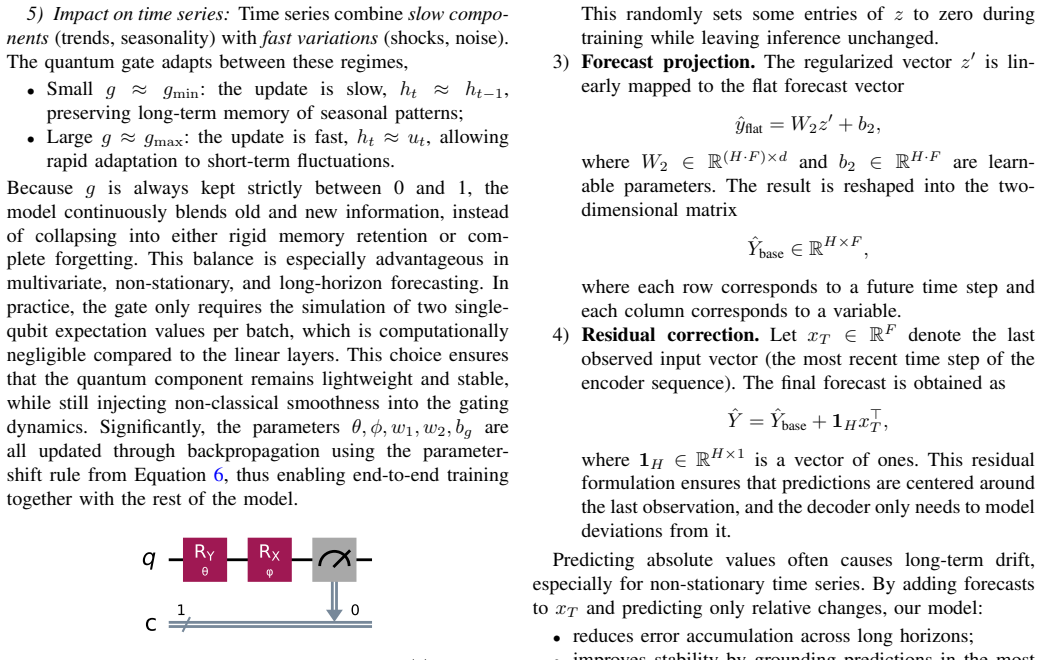
- [Fig. 1 caption] The description of the classical wire c and 'measurement outcome stored in a one-bit classical register' is confusing because the paper explicitly uses the expectation value <Z>, not the discrete outcome. This could be clarified.
- [Sec. III-C4] The paragraph argues that the quantum pre-activation creates 'a richer family of input distributions for the sigmoid.' Since the pre-activation s in Eq. (14) contains no input, there are no input distributions; the wording should be corrected or the gate must be redesigned.
Circularity Check
No circular derivation: Q-SSM's gate is fixed at inference, which undermines the 'selective' claim but is not a circularity.
full rationale
I examined the claimed derivation chain: the quantum gate g is defined by Eqs. (12)-(15) as a bounded sigmoid of a constant combination of trainable parameters, and the stability/contractivity bounds in Eqs. (16)-(21) follow directly from those explicit definitions. No fitted constant is renamed as a prediction; the empirical evaluation is checked against external baselines; and the reference to the authors' own earlier work [20] is not load-bearing. The central weakness—that g has no dependence on the input x_t, making the recurrence a fixed-leak linear filter rather than an input-adaptive selective SSM—is a substantive architectural validity and interpretation concern, but it is not a circularity of the derivation. Similarly, the duplicated baseline rows and missing significance tests are reproducibility/correctness concerns, not evidence that the paper's conclusions are equivalent to its inputs by construction. Therefore the circularity score is 0.
Assumptions & free parameters
free parameters (5)
- RY-RX rotation angles (theta1, phi1, theta2, phi2)
- Gate combination weights and bias (w1, w2, b_g)
- Clipping bounds (gmin, gmax) =
0.05, 0.95
- Calendar influence scalar alpha
- Training hyperparameters (Adam lr=1e-3, weight decay=1e-4, early stopping patience=10, dropout=0.1, k=d=128) =
as listed
assumptions (5)
- standard math Single-qubit expectation value: <Z> = cos(theta)cos(phi) for RX(phi)RY(theta)|0>
- standard math Parameter-shift rule (Eq. 6) gives exact gradients for single-qubit expectations
- domain assumption The 60/20/20 chronological split yields numbers comparable to published baseline numbers
- domain assumption Calendar sin/cos encodings capture relevant periodic structure for ETT and Traffic
- ad hoc to paper Classical simulation of a one-qubit expectation value is meaningfully 'quantum' for forecasting
invented entities (1)
-
Variational quantum gate (two single-qubit RY-RX circuits)
Cite this review
Pith. "Pith review of Quantum-Optimized Selective State Space Model for Efficient Time Series Prediction." pith.science (2026). https://pith.science/paper/BXHUWWTR
@misc{pith2026250900259,
  author       = {Pith},
  title        = {Pith review of: Quantum-Optimized Selective State Space Model for Efficient Time Series Prediction},
  year         = {2026},
  howpublished = {\url{https://pith.science/paper/BXHUWWTR}},
  note         = {Machine review of arXiv:2509.00259}
}
read the original abstract
Long-range time series forecasting remains challenging, as it requires capturing non-stationary and multi-scale temporal dependencies while maintaining noise robustness, efficiency, and stability. Transformer-based architectures such as Autoformer and Informer improve generalization but suffer from quadratic complexity and degraded performance on very long time horizons. State space models, notably S-Mamba, provide linear-time updates but often face unstable training dynamics, sensitivity to initialization, and limited robustness for multivariate forecasting. To address such challenges, we propose the Quantum-Optimized Selective State Space Model (Q-SSM), a hybrid quantum-optimized approach that integrates state space dynamics with a variational quantum gate. Instead of relying on expensive attention mechanisms, Q-SSM employs a simple parametrized quantum circuit (RY-RX ansatz) whose expectation values regulate memory updates adaptively. This quantum gating mechanism improves convergence stability, enhances the modeling of long-term dependencies, and provides a lightweight alternative to attention. We empirically validate Q-SSM on three widely used benchmarks, i.e., ETT, Traffic, and Exchange Rate. Results show that Q-SSM consistently improves over strong baselines (LSTM, TCN, Reformer), Transformer-based models, and S-Mamba. These findings demonstrate that variational quantum gating can address current limitations in long-range forecasting, leading to accurate and robust multivariate predictions.
Figures


Reference graph
Works this paper leans on
-
[1]
D. C. Montgomery, C. L. Jennings, and M. Kulahci, Introduction to time series analysis and forecasting . John Wiley & Sons, 2015
work page 2015
-
[2]
G. E. Box, G. M. Jenkins, G. C. Reinsel, and G. M. Ljung, Time Series Analysis: Forecasting and Control, 5th ed. John Wiley & Sons, 2015
work page 2015
-
[3]
G. E. Box and G. M. Jenkins, Time Series Analysis: Forecasting and Control. Holden-Day, 1970
work page 1970
-
[4]
Long short-term memory,
S. Hochreiter and J. Schmidhuber, “Long short-term memory,” Neural Computation, vol. 9, no. 8, pp. 1735–1780, 1997
1997
-
[5]
Learning phrase representations using rnn encoder–decoder for statistical machine translation,
K. Cho, B. van Merri ¨enboer, C. Gulcehre, D. Bahdanau, F. Bougares, H. Schwenk, and Y . Bengio, “Learning phrase representations using rnn encoder–decoder for statistical machine translation,” in EMNLP, 2014, pp. 1724–1734
work page 2014
-
[6]
An empirical evaluation of generic convolutional and recurrent networks for sequence modeling,
S. Bai, J. Z. Kolter, and V . Koltun, “An empirical evaluation of generic convolutional and recurrent networks for sequence modeling,” arXiv preprint arXiv:1803.01271, 2018
arXiv 2018
-
[7]
A. Vaswani, N. Shazeer, N. Parmar, J. Uszkoreit, L. Jones, A. N. Gomez, Ł. Kaiser, and I. Polosukhin, “Attention is all you need,” in Advances in Neural Information Processing Systems , vol. 30, 2017
work page 2017
-
[8]
Autoformer: Decomposition transformers with auto-correlation for long-term series forecasting,
H. Wu, J. Xu, J. Wang, and M. Long, “Autoformer: Decomposition transformers with auto-correlation for long-term series forecasting,” in NeurIPS, 2021, pp. 22 419–22 430
work page 2021
Show all 31 references
-
[9]
Informer: Beyond efficient transformer for long sequence time-series forecasting,
H. Zhou, S. Zhang, J. Peng, S. Zhang, J. Li, H. Xiong, and W. Zhang, “Informer: Beyond efficient transformer for long sequence time-series forecasting,” in AAAI, vol. 35, no. 12, 2021, pp. 11 106–11 115
2021
-
[10]
Fedformer: Frequency enhanced decomposed transformer for long-term series fore- casting,
Y . Zhou, Z. Ma, Q. Wen, L. Sun, R. Jin, and M. Long, “Fedformer: Frequency enhanced decomposed transformer for long-term series fore- casting,” in ICML, 2022, pp. 27 268–27 286
2022
-
[11]
Efficiently modeling long sequences with structured state spaces,
A. Gu, K. Goel, and C. R ´e, “Efficiently modeling long sequences with structured state spaces,” in ICLR, 2022
2022
-
[12]
Is mamba effective for time series forecasting?
Z. Wang, F. Kong, S. Feng, M. Wang, X. Yang, H. Zhao, D. Wang, and Y . Zhang, “Is mamba effective for time series forecasting?” arXiv preprint arXiv:2403.11144, 2024
2024 arXiv
-
[13]
Reformer: The efficient transformer,
N. Kitaev, L. Kaiser, and A. Levskaya, “Reformer: The efficient transformer,” in International Conference on Learning Representations (ICLR), 2020. [Online]. Available: https://openreview.net/forum?id= rkgNKkHtvB
2020
-
[14]
Mamba: Linear-time sequence modeling with selective state spaces,
A. Gu and T. Dao, “Mamba: Linear-time sequence modeling with selective state spaces,” arXiv preprint arXiv:2312.00752 , 2023
2023 arXiv
-
[15]
Macroeconomics and reality,
C. A. Sims, “Macroeconomics and reality,” Econometrica, vol. 48, no. 1, pp. 1–48, 1980
1980
-
[16]
R. J. Hyndman, A. B. Koehler, J. K. Ord, and R. D. Snyder, Forecasting with Exponential Smoothing: The State Space Approach . Springer, 2008
2008
-
[17]
Learning repre- sentations by back-propagating errors,
D. E. Rumelhart, G. E. Hinton, and R. J. Williams, “Learning repre- sentations by back-propagating errors,” Nature, vol. 323, no. 6088, pp. 533–536, 1986
1986
-
[18]
Time-series forecasting with deep learning: a survey,
B. Lim and S. Zohren, “Time-series forecasting with deep learning: a survey,” Philosophical Transactions of the Royal Society A , vol. 379, no. 2194, p. 20200209, 2021
2021
-
[19]
Efficiently modeling long sequences with structured state spaces,
A. Gu, K. Goel, and C. R ´e, “Efficiently modeling long sequences with structured state spaces,” in International Conference on Learning Representations, 2021
2021
-
[20]
Design for dependability in emerging technologies,
L. Prodan, M. Udrescu, O. Boncalo, and M. Vladutiu, “Design for dependability in emerging technologies,” J. Emerg. Technol. Comput. Syst. , vol. 3, no. 2, p. 6–es, Jul. 2007. [Online]. Available: https://doi.org/10.1145/1265949.1265952
2007
-
[21]
M. A. Nielsen and I. L. Chuang, Quantum Computation and Quantum Information: 10th Anniversary Edition . Cambridge, UK: Cambridge University Press, 2010
2010
-
[22]
Lecture notes for physics 229: Quantum information and computation,
J. Preskill, “Lecture notes for physics 229: Quantum information and computation,” California Institute of Technology, 1998. [Online]. Available: http://theory.caltech.edu/∼preskill/ph229/
1998
-
[23]
Quantum machine learning in feature hilbert spaces,
M. Schuld and N. Killoran, “Quantum machine learning in feature hilbert spaces,” Physical review letters, vol. 122, no. 4, p. 040504, 2019
2019
-
[24]
Quantum machine learning,
J. Biamonte, P. Wittek, N. Pancotti, P. Rebentrost, N. Wiebe, and S. Lloyd, “Quantum machine learning,” Nature, vol. 549, no. 7671, pp. 195–202, 2017
2017
-
[25]
Circuit-centric quantum classifiers,
M. Schuld, A. Bocharov, K. Svore, and N. Wiebe, “Circuit-centric quantum classifiers,” Physical Review A , vol. 101, no. 3, p. 032308, 2020
2020
-
[26]
Variational quantum algorithms,
M. Cerezo, A. Arrasmith, R. Babbush, S. C. Benjamin, S. Endo, K. Fujii, J. R. McClean, K. Mitarai, X. Yuan, L. Cincio, and P. J. Coles, “Variational quantum algorithms,” Nature Reviews Physics, vol. 3, no. 9, pp. 625–644, 2021
2021
-
[27]
Long-term time series forecasting based on decomposition and neural ODEs,
S. Lim, Y . Nam, Y . Kee, and J. Lee, “Long-term time series forecasting based on decomposition and neural ODEs,” in 2023 IEEE International Conference on Big Data (BigData) , 2023, pp. 4614–4623
2023
-
[28]
Informer: Beyond efficient transformer for long sequence time-series forecasting,
H. Zhou, S. Zhang, J. Peng, S. Zhang, J. Li, H. Xiong, and W. Zhang, “Informer: Beyond efficient transformer for long sequence time-series forecasting,” in Proceedings of the AAAI Conference on Artificial Intelligence, vol. 35, no. 12, 2021, pp. 11 106–11 115
2021
-
[29]
Etdataset: Electricity transformer dataset,
H. Zhou, “Etdataset: Electricity transformer dataset,” https://github.com/ zhouhaoyi/ETDataset, 2021, accessed 26 Aug 2025
2021
-
[30]
Modeling long- and short- term temporal patterns with deep neural networks,
G. Lai, W.-C. Chang, Y . Yang, and H. Liu, “Modeling long- and short- term temporal patterns with deep neural networks,” in Proceedings of SIGIR, 2018
2018
-
[31]
Multivariate time series data repository,
G. Lai, “Multivariate time series data repository,” https://github.com/ laiguokun/multivariate-time-series-data, 2018, accessed 26 Aug 2025
2018
Reviewed August 5, 2026 · model on record in the stance chip above.
Discussion (0). Continue with ORCID to comment.