REVIEW 3 major objections 5 minor 219 references
Intelligent Spectrum Management in Satellite Communications
T0 review · 3 major / 5 minor · reviewed 2026-08-05 · deepseek-v4-flash
Pith's one-line read Cognitive satellite networks—satellites that sense and reuse idle licensed spectrum—can relieve the satellite spectrum squeeze, provided regulators and standardization bodies catch up.
desk verdict Broad, honest survey of satellite spectrum management; fixable cataloging errors, real but explicitly flagged transferability concerns. read the letter →
The pith
A machine-rendered reading of the paper's core claim, the machinery that carries it, and where it could break.
The reading
What carries the argument
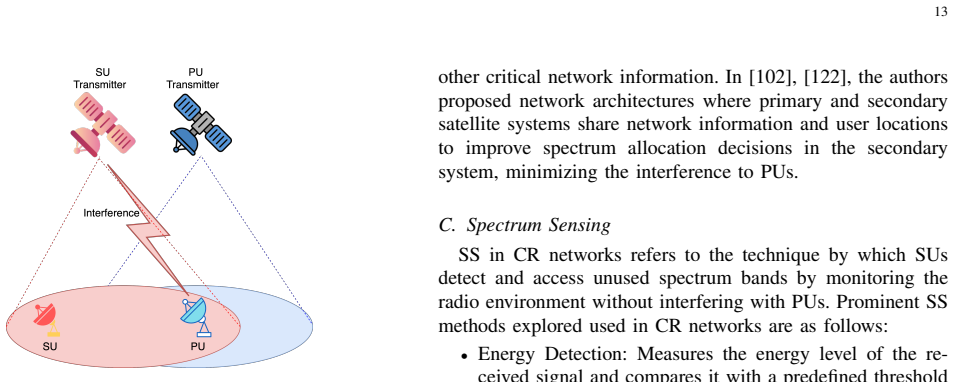
The CogSat network concept: the integration of cognitive radio into satellite communications, carried by the primary-user/secondary-user hierarchy and the DSM toolbox—opportunistic spectrum access (reuse of spectrum holes), concurrent spectrum access (underlay sharing under an interference temperature), spectrum sensing, and radio-environment-map databases. AI/ML supplies the learning layer; SDR, SDN, and NFV supply the reconfigurability. The paper's taxonomy of these techniques organizes the entire survey and its reading of the literature.
What would settle it
A concrete test: equip a LEO constellation to sense and reuse a GEO downlink band at scale and measure interference against the ITU's 20-25% noise-margin budget. If secondary transmissions push GEO link outage beyond that margin under realistic traffic—or if a WRC session explicitly rejects secondary access in those bands—the paper's central claim fails.
Extended reading notes
Core claim
The paper's central claim is that the spectrum scarcity constraining satellite communications is substantially artificial—caused by rigid, long-term, exclusive allocations—and that dynamic spectrum management through cognitive satellite networks can relieve it. CogSat networks adapt cognitive radio to space: secondary users detect and reuse temporarily unused licensed spectrum without harmful interference to primary users. The survey organizes the full enabling stack—network integration across orbits and with terrestrial 5G, SDR/SDN/NFV virtualizations, AI/ML for sensing, allocation, and interference mitigation, and database/REM approaches—and reads each against the regulatory landscape. It
Load-bearing premise
Terrestrial cognitive-radio techniques—sensing, opportunistic access, underlay sharing—transfer to satellite networks with equivalent benefit, although no cognitive satellite network has actually been built and satellite channels differ in delay, dynamics, and regulation.
Editorial extensions
If this is right
- If CogSat works, LEO constellations can reuse GEO-allocated bands by sensing and avoiding inline interference, multiplying effective capacity without new spectrum.
- AI/ML-based sensing can push detection into the low-SINR regime (near -20 dB) that long satellite links require, making opportunistic access practical.
- KPIs such as spectrum utilization factor, detection/false-alarm probabilities, and service retainability would become the standard yardsticks for spectrum-sharing arrangements.
- Regulatory bodies (ITU, 3GPP, ETSI) would need flexible licensing, machine-readable policies, and defined interference margins before any of this deploys.
- The choice between onboard, on-ground, and hybrid ML training determines whether cognitive decisions can keep up with LEO dynamics and delay.
Reading between the lines
- The terrestrial TV-white-space experience suggests a plausible near-term path: start with database-driven sharing in one band, then layer sensing once interference behavior is understood.
- The paper's own admission that no CogSat system has been built implies the strongest evidence would be a live multi-orbit testbed rather than further simulations.
- Federated/distributed learning, which the paper flags as an open gap, may be the natural fit for constellations because it keeps training data grounded and shares only model updates.
- If regulatory consensus fails, the 'artificial scarcity' may persist regardless of technical progress—making standardization the true control variable.
Signed reviews
Editorial analysis
A structured set of objections, weighed in public.
Referee Report
Summary. The paper is a survey of dynamic spectrum management (DSM) for satellite communications, organized around the proposition that cognitive satellite (CogSat) networks, empowered by AI/ML, can relieve artificial spectrum scarcity. It reviews enablers (satellite/terrestrial integration, cognitive radio, SDR/SDN/NFV, edge computing, blockchain), regulatory and standardization bodies (IEEE, ITU, 3GPP, ETSI, national authorities), DSM techniques (OSA, CSA, spectrum sensing, REM/databases, frequency reuse, power allocation, beam pointing/hopping/forming), ML methods for sensing, allocation, interference mitigation, and resource management, as well as training, resilience, performance metrics, and open challenges. It provides taxonomy tables (Tables I–IV) and identifies future research directions.
Significance. As a survey, the paper's value lies in its breadth and organization: it compiles a large corpus of recent work and structures it along multiple dimensions, including regulation, architecture, and KPIs. This is useful as a reference, particularly for readers entering the CogSat area. The paper also gives concrete attention to recent industry integrations (e.g., 5G NTN trials, GEO–LEO operators) and to performance metrics that are rarely collected in one place. If the central promise is treated as a research agenda, the survey is credible. However, the paper is mostly descriptive; it offers no machine-checked results, no quantitative feasibility analysis, and its central claim that CogSat provides 'feasible solutions' rests on an unexamined transfer of terrestrial cognitive-radio assumptions to satellite dynamics.
major comments (3)
- [Table II, [105] row] Reference [105] is listed under DSM Technique = 'Frequency Reuse' with the contribution 'Improved algorithms for frequency reuse in satellite communication.' However, the cited paper is titled 'A novel cognitive scheme based on dual-threshold energy detection in satellite systems,' and it is correctly cited in Section IV-C for energy detection. This is a factual misclassification in the central taxonomy. The authors should correct this row and audit the other rows in Table II for similar mismatches.
- [Sections IV-A, IV-B, V-B, VII-B-b, and VIII] The survey asserts that OSA/CSA techniques developed for terrestrial cognitive radio can be transplanted to SatCom, but it does not address the time-scale mismatch that is load-bearing for the feasibility claim made in the Conclusion. GEO one-way propagation is on the order of 125 ms; LEO passes over a protection zone last seconds to minutes; and the full sense-decide-act loop must complete before the spectrum hole closes or the geometry changes. The DRL channel-allocation results surveyed in [176]–[178] are evaluated without these delays, as the paper itself hints in Section VII-B-b. Since Section VIII calls CogSat 'feasible solutions,' the authors should either provide a quantitative or analytical discussion of this constraint, or soften the claim and frame the surveyed results as an open research hypothesis.
- [Section VII-C-c and Section VIII] Section VII-C-c states that 'CogSat networks have not been realized, thus adding the requirement of converting/REModeling data captured in current satellite deployments.' This admission conflicts with the absolute wording of the Conclusion, which says intelligent DSM approaches 'provide feasible solutions.' It also means the ML-based methods reviewed in Sections V-B and V-D cannot yet be trained on real CogSat data, and the simulation-only evaluations (e.g., [176]–[178]) provide limited evidence for the central claim. The authors should clarify the epistemological status of the claim: either present CogSat DSM explicitly as an open research agenda with illustrative results, or supply a separate analysis of what is needed to close the data and deployment gap.
minor comments (5)
- [Table IV, [183] row] Reference [183] is the same paper as [177] (Hu, Liu, Chen, Wang, Wang, 'A Deep Reinforcement Learning-Based Framework for Dynamic Resource Allocation in Multibeam Satellite Systems,' IEEE Commun. Lett. 2018). The duplicate row should be removed or replaced with the intended distinct reference.
- [Section II-C3] The sentence 'The formal model of ML is the Markov Decision Process' is technically incorrect: the MDP is a formal model for reinforcement learning, not for ML in general. Please rephrase, e.g., 'RL problems are often formalized as Markov Decision Processes.'
- [Sections V-D and VI-G] Minor typos: 'Very High Throughput Satellites (VITS)' should be 'VHTS'; 'Rount Trip Time' should be 'Round Trip Time'; 'Sectrum Sensing' in the Table II caption should be 'Spectrum Sensing'; 'two-way-really aided' in Table II should likely be 'two-way relay aided'; 'PU precedencetechniques' in Table III needs a space.
- [Section IV-E1] The phrase 'based on the spectrum presidence' contains a typo: 'presidence' should be 'precedence' or 'priority.'
- [References] Several references are inconsistently formatted or incomplete: [29] has no author list, [171] appears as 'IEEE TIEEE Commun. Mag.' which is malformed, and many URL entries lack access dates. A careful reference cleanup is needed.
Circularity Check
No significant circularity: survey claims are not derived from fitted inputs or self-citations.
full rationale
This is a literature survey, not a derivation. It surveys DSM techniques and ML methods for CogSat; its central claim is that DSM/CogSat 'presents a promising solution' to spectrum scarcity, and the paper itself concedes in Sec. VII-C-c that 'CogSat networks have not been realized' and notes latency/delay challenges in Sec. VII-B-b. No equation in the paper is fitted to data and then renamed a prediction; no quantity is defined in terms of its own conclusion. The only author self-citations are [8] (Kandeepan) and [102] (Pokhrel). [102] is cited as one example among many of GEO-LEO DSA/frequency-reuse modeling (Sec. IV-F.1 and Table II), and [8] is cited for the observation that training location affects decision latency (Sec. V-E). Neither citation carries the survey's central 'promising solution' claim, and neither is used to forbid alternative approaches or to import a uniqueness theorem. The paper's acknowledged limitations—unrealized CogSat deployment, regulatory gaps, latency, data scarcity, and ML generalization—show that the survey does not claim to have derived a working system. Therefore there is no self-definitional, fitted-prediction, or self-citation circularity.
Assumptions & free parameters
assumptions (3)
- domain assumption Cognitive radio PU/SU hierarchy and dynamic spectrum access concepts transfer from terrestrial to satellite networks.
- domain assumption Spectrum scarcity in SatCom is primarily an artifact of exclusive static licensing.
- domain assumption ML methods will improve spectrum decisions in satellite networks despite limited data and compute constraints.
Cite this review
Pith. "Pith review of Intelligent Spectrum Management in Satellite Communications." pith.science (2026). https://pith.science/paper/I5QWKQKN
@misc{pith2026250900286,
  author       = {Pith},
  title        = {Pith review of: Intelligent Spectrum Management in Satellite Communications},
  year         = {2026},
  howpublished = {\url{https://pith.science/paper/I5QWKQKN}},
  note         = {Machine review of arXiv:2509.00286}
}
read the original abstract
Satellite Communication (SatCom) networks represent a fundamental pillar in modern global connectivity, facilitating reliable service and extensive coverage across a plethora of applications. The expanding demand for high-bandwidth services and the proliferation of mega satellite constellations highlight the limitations of traditional exclusive satellite spectrum allocation approaches. Cognitive Radio (CR) leading to Cognitive Satellite (CogSat) networks through Dynamic Spectrum Management (DSM), which enables the dynamic adaptability of radio equipment to environmental conditions for optimal performance, presents a promising solution for the emerging spectrum scarcity. In this survey, we explore the adaptation of intelligent DSM methodologies to SatCom, leveraging satellite network integrations. We discuss contributions and hurdles in regulations and standardizations in realizing intelligent DSM in SatCom, and deep dive into DSM techniques, which enable CogSat networks. Furthermore, we extensively evaluate and categorize state-of-the-art Artificial Intelligence (AI)/Machine Learning (ML) methods leveraged for DSM while exploring operational resilience and robustness of such integrations. In addition, performance evaluation metrics critical for adaptive resource management and system optimization in CogSat networks are thoroughly investigated. This survey also identifies open challenges and outlines future research directions in regulatory frameworks, network architectures, and intelligent spectrum management, paving the way for sustainable and scalable SatCom networks for enhanced global connectivity.
Figures


Figures from the paper (6 more)



Reference graph
Works this paper leans on
-
[105]
A novel cognitive scheme based on dual-threshold energy detection in satellite systems,
R. Ren, H. Wang, G. Zhang, and C. Zhang, “A novel cognitive scheme based on dual-threshold energy detection in satellite systems,” in IEEE WCNCW. IEEE, 2021, pp. 1–6
2021
-
[183]
X. Hu, S. Liu, R. Chen, W. Wang, and C. Wang, “A Deep Reinforce- ment Learning-Based Framework for Dynamic Resource Allocation in Multibeam Satellite Systems,” IEEE Commun. Lett. , vol. 22, no. 8, pp. 1612–1615, 2018
work page 2018
-
[177]
X. Hu, S. Liu, R. Chen, W. Wang, and C. Wang, “A deep reinforcement learning-based framework for dynamic resource allocation in multibeam satellite systems,” IEEE Commun. Lett. , vol. 22, no. 8, pp. 1612–1615, 2018
work page 2018
-
[176]
B. Zhao, J. Liu, Z. Wei, and I. You, “A deep reinforcement learning based approach for energy-efficient channel allocation in satellite inter- net of things,” IEEE Access, vol. 8, pp. 62 197–62 206, 2020
work page 2020
-
[178]
S. Liu, X. Hu, and W. Wang, “Deep reinforcement learning based dynamic channel allocation algorithm in multibeam satellite systems,” IEEE Access, vol. 6, pp. 15 733–15 742, 2018
work page 2018
-
[1]
An updated comparison of four low earth orbit satellite constellation systems to provide global broadband,
N. Pachler, I. Del Portillo, E. F. Crawley, and B. G. Cameron, “An updated comparison of four low earth orbit satellite constellation systems to provide global broadband,” in ICC workshops. IEEE, 2021, pp. 1–7
2021
-
[2]
Liang, Dynamic spectrum management: From cognitive radio to blockchain and artificial intelligence
Y .-C. Liang, Dynamic spectrum management: From cognitive radio to blockchain and artificial intelligence . Springer Nature, 2020
2020
-
[3]
Spectrum sharing in the sky and space: A survey,
L. Zhang, Z. Wei, L. Wang, X. Yuan, H. Wu, and W. Xu, “Spectrum sharing in the sky and space: A survey,” Sensors, vol. 23, no. 1, p. 342, 2022
2022
Show all 219 references
-
[4]
Smallsats by the Numbers 2025,
B. Tech, “Smallsats by the Numbers 2025,” May. 2025. [Online]. Available: https://brycetech .com/reports/report-documents/ smallsats-2025/BryceTech Smallsats-by-the-Numbers-2025 .pdf
2025
-
[5]
Satellite communications in the new space era: A survey and future challenges,
O. Kodheli, E. Lagunas, N. Maturo, S. K. Sharma, B. Shankar, J. F. M. Montoya, J. C. M. Duncan, D. Spano, S. Chatzinotas, S. Kisseleff et al., “Satellite communications in the new space era: A survey and future challenges,” IEEE Commun. Surv. Tutor. , vol. 23, no. 1, pp. 70–109, 2020
2020
-
[6]
Cognitive dual satellite systems,
S. Gupta, A. V ´azquez-Castro, and R. Alegre-Godoy, “Cognitive dual satellite systems,” in Cooperative and Cognitive Satellite Systems . El- sevier, 2015, pp. 373–413
2015
-
[7]
A survey on technologies, standards and open challenges in satellite iot,
M. Centenaro, C. E. Costa, F. Granelli, C. Sacchi, and L. Vangelista, “A survey on technologies, standards and open challenges in satellite iot,” IEEE Commun. Surv. Tutor., vol. 23, no. 3, pp. 1693–1720, 2021
2021
-
[8]
Artificial intelligence tech- niques for next-generation massive satellite networks,
B. Al Homssi, K. Dakic, K. Wang, T. Alpcan, B. Allen, R. Boyce, S. Kandeepan, A. Al-Hourani, and W. Saad, “Artificial intelligence tech- niques for next-generation massive satellite networks,” IEEE Commun. Mag., vol. 62, no. 4, pp. 66–72, 2023
2023
-
[9]
Artificial intelligence for satellite communication: A survey,
G. Fontanesi, F. Ort ´ız, E. Lagunas, L. M. Garc ´es-Socarr´as, V . M. Baeza, M. ´A. V ´azquez, J. A. V ´asquez-Peralvo, M. Minardi, H. N. Vu, P. J. Honnaiah et al. , “Artificial intelligence for satellite communication: A survey,” IEEE Commun. Surv. Tutor., 2025
2025
-
[10]
Review of cognitive satellite communication technology,
R. Liu, S. Zhu, and C. Li, “Review of cognitive satellite communication technology,” in IEEE ITAIC, vol. 9. IEEE, 2020, pp. 1378–1385
2020
-
[11]
A survey on spectrum management for unmanned aerial vehicles (uavs),
M. A. Jasim, H. Shakhatreh, N. Siasi, A. H. Sawalmeh, A. Aldalbahi, and A. Al-Fuqaha, “A survey on spectrum management for unmanned aerial vehicles (uavs),” IEEE Access, vol. 10, pp. 11 443–11 499, 2021
2021
-
[12]
Spectrum sharing and inter- ference management for 6g leo satellite-terrestrial network integration,
N. Heydarishahreza, T. Han, and N. Ansari, “Spectrum sharing and inter- ference management for 6g leo satellite-terrestrial network integration,” IEEE Commun. Surv. Tutor., 2024
2024
-
[13]
Machine learning for radio resource management in multibeam geo satellite systems,
F. G. Ortiz-Gomez, L. Lei, E. Lagunas, R. Martinez, D. Tarchi, J. Querol, M. A. Salas-Natera, and S. Chatzinotas, “Machine learning for radio resource management in multibeam geo satellite systems,” Electronics, vol. 11, no. 7, p. 992, 2022
2022
-
[14]
Geo and leo collaborative architecture evolution in future integrated satellite- terrestrial network,
H. Wang, W. Qi, X. Xia, Y . Liu, Y . Xing, and C. Mei, “Geo and leo collaborative architecture evolution in future integrated satellite- terrestrial network,” in IEEE BMSB, 2023, pp. 1–6
2023
-
[15]
Integrating leo and geo observations: Toward optimal summertime satellite precipitation retrieval,
e. Afzali Gorooh, “Integrating leo and geo observations: Toward optimal summertime satellite precipitation retrieval,” J. Hydrometeorol., vol. 24, no. 11, pp. 1939–1954, 2023
1939
-
[16]
Intelsat and OneWeb Demo Global Multi-Orbit Satellite Service to U.S. Department of Defense,
INTELSAT, “Intelsat and OneWeb Demo Global Multi-Orbit Satellite Service to U.S. Department of Defense,” Nov. 2021. [Online]. Avail- able: https://www .intelsat.com/newsroom/intelsat-and-oneweb-demo- global-multi-orbit-satellite-service-/to-u-s-department-of-defense/
2021
-
[17]
Eutelsat and OneWeb combination heralds new era in space connectivity as world’s first GEO-LEO operator,
E. Group, “Eutelsat and OneWeb combination heralds new era in space connectivity as world’s first GEO-LEO operator,” Sep. 2023. [Online]. Available: https://oneweb .net/resources/eutelsat-and-oneweb- combination-heralds-new-era-space-/connectivity-worlds-first-geo-leo
2023
-
[18]
SES, Starlink team to set new benchmark with first integrated MEO-LEO service,
SeatradeCruseNews, “SES, Starlink team to set new benchmark with first integrated MEO-LEO service,” Mar. 2024. [Online]. Available: https://www .seatrade-cruise.com/information-technology/ ses-starlink-team-set-new-benchmark-first-integrated-meo-leo-service
2024
-
[19]
Key drivers and research challenges for 6g ubiquitous wireless intelligence,
M. Latva-Aho, K. Lepp ¨anen et al., “Key drivers and research challenges for 6g ubiquitous wireless intelligence,” 2019
2019
-
[20]
Telstra and OneWeb begin world’s largest deployment of LEO backhaul with first voice call,
Telstra, “Telstra and OneWeb begin world’s largest deployment of LEO backhaul with first voice call,” Feb. 2024. [Online]. Available: https://www .telstra.com.au/aboutus/media/media- releases/telstra-and-oneweb-first-voice-call
2024
-
[21]
Ericsson, Qualcomm, and Thales Alenia Space reach milestone in space-based connectivity,
Ericsson, “Ericsson, Qualcomm, and Thales Alenia Space reach milestone in space-based connectivity,” Mat. 2025. [Online]. Available: https://www .ericsson.com/en/press-releases/3/2025/ericsson- qualcomm-thales-achieve-space-connectivity-milestone
2025
-
[22]
V odafone and AST SpaceMobile com- plete world’s first space-based 5G call us- ing a conventional smartphone,
V odafone, “V odafone and AST SpaceMobile com- plete world’s first space-based 5G call us- ing a conventional smartphone,” Sep. 2023. [Online]. Available: https://www .vodafone.com/news/technology/vodafone-ast- spacemobile-world-first-space-based-5g-call-conventional-smartphone
2023
-
[23]
Sateliot Works With AWS On Innovative Cloud Native 5G Satellite Network To Connect IoT Devices Directly To Satellites,
Sateliot, “Sateliot Works With AWS On Innovative Cloud Native 5G Satellite Network To Connect IoT Devices Directly To Satellites,” Sep
-
[24]
ESA, Telesat and Amarisoft achieve world-first 5G 3GPP Non-Terrestrial Network link over LEO,
T. E. S. Agency, “ESA, Telesat and Amarisoft achieve world-first 5G 3GPP Non-Terrestrial Network link over LEO,” Dec. 2024. [Online]. Available: https://connectivity .esa.int/news/esa-telesat-and-amarisoft- achieve-worldfirst-5g-3gpp-nonterrestrial-network-link-over-leo
2024
-
[25]
Successful Japan-Europe Joint Experiment on Integra- tion of Satellite Links in Japan-Europe Long Distance 5G Network,
S. P. J. Group, “Successful Japan-Europe Joint Experiment on Integra- tion of Satellite Links in Japan-Europe Long Distance 5G Network,” Jun. 2022. [Online]. Available: https://www .skyperfectjsat.space/en/ news/detail/ beyond 5g Japan Europe trial.html
2022
-
[26]
Survey on advanced spectrum sharing using cognitive radio technique,
M. Hassan, M. Singh, and K. Hamid, “Survey on advanced spectrum sharing using cognitive radio technique,” in ICT Systems and Sustain- ability: Proceedings of ICT4SD 2020, Volume 1 . Springer, 2021, pp. 639–647. 27
2020
-
[27]
Spectrum sensing for cognitive radio: Recent advances and future challenge,
A. Nasser, H. Al Haj Hassan, J. Abou Chaaya, A. Mansour, and K.-C. Yao, “Spectrum sensing for cognitive radio: Recent advances and future challenge,” Sensors, vol. 21, no. 7, 2021
2021
-
[28]
Zhang, J
Y . Zhang, J. Zheng, and H.-H. Chen, Cognitive radio networks: archi- tectures, protocols, and standards . CRC press, 2016
2016
-
[29]
Artificial intelligence inspired energy and spectrum aware cluster based routing protocol for cognitive radio sensor networks,
“Artificial intelligence inspired energy and spectrum aware cluster based routing protocol for cognitive radio sensor networks,” J. Parallel Distrib. Comput., vol. 142, pp. 90–105, 2020
2020
-
[30]
Preference aware user pairing in cognitive radio networks: A coalition game-theoretic approach,
X. Deng, C. Li, B. Guo, L. Zheng, and H. Qiu, “Preference aware user pairing in cognitive radio networks: A coalition game-theoretic approach,” in IEEE martIoT, 2019, pp. 459–463
2019
-
[31]
Intelligent algorithms for dynamic spectrum access a secondary user in cognitive radio systems,
E. O. Kandaurova and D. S. Chirov, “Intelligent algorithms for dynamic spectrum access a secondary user in cognitive radio systems,” in SYNCHROINFO, 2021, pp. 1–6
2021
-
[32]
Application of cognitive radio techniques to satellite communication,
M. H ¨oyhty¨a, J. Kyr ¨ol¨ainen, A. Hulkkonen, J. Ylitalo, and A. Roivainen, “Application of cognitive radio techniques to satellite communication,” in IEEE DySPAN. IEEE, 2012, pp. 540–551
2012
-
[33]
Cooperative resource management for cognitive satellite-aerial-terrestrial integrated networks towards iot,
Y . Ruan, Y . Li, R. Zhang, W. Cheng, and C. Liu, “Cooperative resource management for cognitive satellite-aerial-terrestrial integrated networks towards iot,” IEEE Access, vol. 8, pp. 35 759–35 769, 2020
2020
-
[34]
A survey of dynamic spectrum allocation based on reinforcement learning algorithms in cognitive radio networks,
Y . Wang, Z. Ye, P. Wan, and J. Zhao, “A survey of dynamic spectrum allocation based on reinforcement learning algorithms in cognitive radio networks,” Artif. Intell. Rev., vol. 51, no. 3, pp. 493–506, Mar 2019
2019
-
[35]
Ieee 802 lan/man standards committee 802.22 wg on wrans (wireless regional area networks),
IEEE, “Ieee 802 lan/man standards committee 802.22 wg on wrans (wireless regional area networks),” Jul 2019
2019
-
[36]
Ieee 802.15 wpan task group 2 (tg2),
——, “Ieee 802.15 wpan task group 2 (tg2),” Aug 2024
2024
-
[37]
Dynamic spectrum alliance,
DSA, “Dynamic spectrum alliance,” Aug 2024. [Online]. Available: https://dynamicspectrumalliance.org/newsletter4/index.html
2024
-
[38]
Tv white space solution for affordable internet in india,
M. Khaturia, S. B. Belur, and A. Karandikar, “Tv white space solution for affordable internet in india,” The book TV White Space Communi- cations and Networks , 2018
2018
-
[39]
A survey of cognitive radio access to tv white spaces, ultra modern telecommunications & workshops, 2009. icumt’09,
M. Nekovee, “A survey of cognitive radio access to tv white spaces, ultra modern telecommunications & workshops, 2009. icumt’09,” in International Conference on, IEEE , 2009
2009
-
[40]
Next generation (xg),
D. XG, “Next generation (xg),” Aug 2024. [Online]. Available: https://www.csl.sri.com/projects/xg/
2024
-
[41]
Cognitive radio-trends, scope and challenges in radio network technology,
T. Mukherjee and A. Nath, “Cognitive radio-trends, scope and challenges in radio network technology,” International Journal, vol. 3, no. 6, 2015
2015
-
[42]
Son function performance prediction in a cognitive son management system,
S. Lohm ¨uller, F. Rabe, A. Fendt, B. Bauer, and L. C. Schmelz, “Son function performance prediction in a cognitive son management system,” in IEEE WCNCW, 2018, pp. 13–18
2018
-
[43]
Multiobjective reinforcement learning for cognitive satellite communications using deep neural network ensembles,
P. V . R. Ferreira, R. Paffenroth, A. M. Wyglinski, T. M. Hackett, S. G. Bil ´en, R. C. Reinhart, and D. J. Mortensen, “Multiobjective reinforcement learning for cognitive satellite communications using deep neural network ensembles,” IEEE J. Sel. Areas Commun., vol. 36, no. 5...
2018
-
[44]
Space-based reconfigurable software defined radio test bed aboard international space station,
R. Reinhart and J. P. Lux, “Space-based reconfigurable software defined radio test bed aboard international space station,” in SpaceOps 2014 conference, 2014, p. 1612
2014
-
[45]
Machine learning algorithms-a review,
B. Mahesh, “Machine learning algorithms-a review,” IJSR, vol. 9, no. 1, pp. 381–386, 2020
2020
-
[46]
A survey on the explainability of supervised machine learning,
N. Burkart and M. F. Huber, “A survey on the explainability of supervised machine learning,” J. Artif. Intell. Res. , vol. 70, pp. 245– 317, 2021
2021
-
[47]
Artificial intelligence for satellite commu- nication: A review,
F. Fourati and M.-S. Alouini, “Artificial intelligence for satellite commu- nication: A review,” Intelligent and Converged Networks , vol. 2, no. 3, pp. 213–243, 2021
2021
-
[48]
Overview of use of decision tree algorithms in machine learning,
A. Navada, A. N. Ansari, S. Patil, and B. A. Sonkamble, “Overview of use of decision tree algorithms in machine learning,” in IEEE ICSGRC. IEEE, 2011, pp. 37–42
2011
-
[49]
New machine learning algorithm: Random forest,
Y . Liu, Y . Wang, and J. Zhang, “New machine learning algorithm: Random forest,” in ICICA. Springer, 2012, pp. 246–252
2012
-
[50]
Deep learning using support vector machines,
Y . Tang, “Deep learning using support vector machines,” CoRR, abs/1306.0239, vol. 2, no. 1, 2013
2013 arXiv
-
[51]
A comparison of regularization techniques in deep neural networks,
I. Nusrat and S.-B. Jang, “A comparison of regularization techniques in deep neural networks,” Symmetry, vol. 10, no. 11, p. 648, 2018
2018
-
[52]
A survey on ensemble learning,
X. Dong, Z. Yu, W. Cao, Y . Shi, and Q. Ma, “A survey on ensemble learning,” Frontiers of Computer Science , vol. 14, pp. 241–258, 2020
2020
-
[53]
K-nearest neighbour (knn) algorithm based cooperative spectrum sensing in cognitive radio networks,
L. R. Somula and M. Meena, “K-nearest neighbour (knn) algorithm based cooperative spectrum sensing in cognitive radio networks,” in IEEE ICCCMLA, 2022, pp. 1–6
2022
-
[54]
A survey on supervised and unsu- pervised learning techniques,
K. Sindhu Meena and S. Suriya, “A survey on supervised and unsu- pervised learning techniques,” in AISGSC 2019 . Springer, 2020, pp. 627–644
2019
-
[55]
Milp for- mulation improvement with k-means clustering for the beam layout optimization in multibeam satellite systems,
J.-T. Camino, C. Artigues, L. Houssin, and S. Mourgues, “Milp for- mulation improvement with k-means clustering for the beam layout optimization in multibeam satellite systems,” Comput. Ind. Eng. , vol. 158, p. 107228, 2021
2021
-
[56]
An improved apriori algorithm for association rules,
M. Al-Maolegi and B. Arkok, “An improved apriori algorithm for association rules,” arXiv preprint arXiv:1403.3948 , 2014
2014 arXiv
-
[57]
Anomaly detection in satellite communications systems using lstm networks,
L. Gunn, P. Smet, E. Arbon, and M. D. McDonnell, “Anomaly detection in satellite communications systems using lstm networks,” in IEEE MilCIS. IEEE, 2018, pp. 1–6
2018
-
[58]
Convolutional autoencoders for non- geostationary satellite interference detection,
A. SAIFALDAWLA AW AD HASSAN, F. d. G. ORTIZ GOMEZ, E. Lagunas, and S. Chatzinotas, “Convolutional autoencoders for non- geostationary satellite interference detection,” in IEEE ICC . IEEE, 2024
2024
-
[59]
Machine learning for satellite communications operations,
M. ´A. V´azquez, P. Henarejos, I. Pappalardo, E. Grechi, J. Fort, J. C. Gil, and R. M. Lancellotti, “Machine learning for satellite communications operations,” IEEE Commun. Mag. , vol. 59, no. 2, pp. 22–27, 2021
2021
-
[60]
A scalable association rule learning heuristic for large datasets,
H. Li and P. C.-Y . Sheu, “A scalable association rule learning heuristic for large datasets,” Journal of Big Data , vol. 8, no. 1, p. 86, 2021
2021
-
[61]
A comprehensive survey on machine learning approaches for dynamic spectrum access in cognitive radio networks,
A. Kaur and K. Kumar, “A comprehensive survey on machine learning approaches for dynamic spectrum access in cognitive radio networks,” J. Exp. Theor. Artif. Intell. , vol. 34, no. 1, pp. 1–40, 2022
2022
-
[62]
Graesser and W
L. Graesser and W. L. Keng, Foundations of deep reinforcement learn- ing: theory and practice in Python. Addison-Wesley Professional, 2019
2019
-
[63]
A survey on distributed machine learning,
J. Verbraeken, M. Wolting, J. Katzy, J. Kloppenburg, T. Verbelen, and J. S. Rellermeyer, “A survey on distributed machine learning,” ACM Computing Surveys, vol. 53, no. 2, pp. 1–33, 2020
2020
-
[64]
Ground-assisted federated learning in leo satellite constellations,
N. Razmi, B. Matthiesen, A. Dekorsy, and P. Popovski, “Ground-assisted federated learning in leo satellite constellations,” IEEE Wirel. Commun. Lett., vol. 11, no. 4, pp. 717–721, 2022
2022
-
[65]
On-board federated learning for satellite clusters with inter- satellite links,
——, “On-board federated learning for satellite clusters with inter- satellite links,” IEEE Trans. Commun. , 2024
2024
-
[66]
A survey on large language model (llm) security and privacy: The good, the bad, and the ugly,
Y . Yao, J. Duan, K. Xu, Y . Cai, Z. Sun, and Y . Zhang, “A survey on large language model (llm) security and privacy: The good, the bad, and the ugly,” High-Confid. Comput., p. 100211, 2024
2024
-
[67]
Chatgpt and open-ai models: A preliminary review,
K. I. Roumeliotis and N. D. Tselikas, “Chatgpt and open-ai models: A preliminary review,” Future Internet, vol. 15, no. 6, p. 192, 2023
2023
-
[68]
Llama: Open and efficient foundation language models,
H. Touvron, T. Lavril, G. Izacard, X. Martinet, M.-A. Lachaux, T. Lacroix, B. Rozi `ere, N. Goyal, E. Hambro, F. Azhar et al. , “Llama: Open and efficient foundation language models,” arXiv preprint arXiv:2302.13971, 2023
2023 arXiv
-
[69]
Generative adversarial networks,
I. Goodfellow, J. Pouget-Abadie, M. Mirza, B. Xu, D. Warde-Farley, S. Ozair, A. Courville, and Y . Bengio, “Generative adversarial networks,” Commu. ACM, vol. 63, no. 11, pp. 139–144, 2020
2020
-
[70]
An introduction to variational autoencoders,
D. P. Kingma, M. Welling et al. , “An introduction to variational autoencoders,” Found. Trends Mach. Learn. , vol. 12, no. 4, pp. 307– 392, 2019
2019
-
[71]
Palm-e: An embodied multimodal language model,
D. Driess, F. Xia, M. S. Sajjadi, C. Lynch, A. Chowdhery, B. Ichter, A. Wahid, J. Tompson, Q. Vuong, T. Yu et al., “Palm-e: An embodied multimodal language model,” arXiv preprint arXiv:2303.03378 , 2023
2023 arXiv
-
[72]
Evolutionary-scale prediction of atomic- level protein structure with a language model,
Z. Lin, H. Akin, R. Rao, B. Hie, Z. Zhu, W. Lu, N. Smetanin, R. Verkuil, O. Kabeli, Y . Shmueli et al., “Evolutionary-scale prediction of atomic- level protein structure with a language model,” Science, vol. 379, no. 6637, pp. 1123–1130, 2023
2023
-
[73]
Netllm: Adapting large language models for networking,
D. Wu, X. Wang, Y . Qiao, Z. Wang, J. Jiang, S. Cui, and F. Wang, “Netllm: Adapting large language models for networking,” in ACM SIGCOMM, 2024, pp. 661–678
2024
-
[74]
Software-defined radio—basics and evolution to cog- nitive radio,
F. K. Jondral, “Software-defined radio—basics and evolution to cog- nitive radio,” EURASIP J. Wirel. Commun. Netw. , vol. 2005, pp. 1–9, 2005
2005
-
[75]
Softran: Software defined radio access network,
A. Gudipati, D. Perry, L. E. Li, and S. Katti, “Softran: Software defined radio access network,” in ACM SIGCOMM HotSDN , 2013, pp. 25–30
2013
-
[76]
Software defined satellite networks: A survey,
W. Jiang, “Software defined satellite networks: A survey,” Digit. Com- mun. Netw., vol. 9, no. 6, pp. 1243–1264, 2023
2023
-
[77]
Using sdn and nfv to implement satellite communication networks,
T. Li, H. Zhou, H. Luo, Q. Xu, and Y . Ye, “Using sdn and nfv to implement satellite communication networks,” in IEEE NaNA. IEEE, 2016, pp. 131–134
2016
-
[78]
Sdn- based dynamic multi-path routing strategy for satellite networks,
H. Qi, Y . Guo, D. Hou, Z. Xing, W. Ren, L. Cong, and X. Di, “Sdn- based dynamic multi-path routing strategy for satellite networks,” Future Gener. Comput. Syst., vol. 133, pp. 254–265, 2022. 28
2022
-
[79]
An icn/sdn-based network architecture and efficient content retrieval for future satellite-terrestrial integrated networks,
J. Li, K. Xue, J. Liu, Y . Zhang, and Y . Fang, “An icn/sdn-based network architecture and efficient content retrieval for future satellite-terrestrial integrated networks,” IEEE Network, vol. 34, no. 1, pp. 188–195, 2020
2020
-
[80]
Vnf-based service provision in software defined leo satellite networks,
Z. Jia, M. Sheng, J. Li, D. Zhou, and Z. Han, “Vnf-based service provision in software defined leo satellite networks,” IEEE Trans. Wireless Commun., vol. 20, no. 9, pp. 6139–6153, 2021
2021
-
[81]
Traffic- aware resource management in sdn/nfv-based satellite networks for remote and urban areas,
I. Maity, G. Giambene, T. X. Vu, C. Kesha, and S. Chatzinotas, “Traffic- aware resource management in sdn/nfv-based satellite networks for remote and urban areas,” IEEE Trans. Veh. Technol., 2024
2024
-
[82]
Orbital edge offload- ing on mega-leo satellite constellations for equal access to computing,
P. Cassar ´a, A. Gotta, M. Marchese, and F. Patrone, “Orbital edge offload- ing on mega-leo satellite constellations for equal access to computing,” IEEE Commun. Mag. , vol. 60, no. 4, pp. 32–36, 2022
2022
-
[83]
Satellite mobile edge computing: Improving qos of high-speed satellite-terrestrial networks using edge computing techniques,
Z. Zhang, W. Zhang, and F.-H. Tseng, “Satellite mobile edge computing: Improving qos of high-speed satellite-terrestrial networks using edge computing techniques,” IEEE Network, vol. 33, no. 1, pp. 70–76, 2019
2019
-
[84]
Satellite- terrestrial integrated edge computing networks: Architecture, challenges, and open issues,
R. Xie, Q. Tang, Q. Wang, X. Liu, F. R. Yu, and T. Huang, “Satellite- terrestrial integrated edge computing networks: Architecture, challenges, and open issues,” IEEE Network, vol. 34, no. 3, pp. 224–231, 2020
2020
-
[85]
Blockchain structure electromagnetic spectrum database in distributed cognitive radio monitoring system,
Z. Chen, L. Wang, and Y . Zhang, “Blockchain structure electromagnetic spectrum database in distributed cognitive radio monitoring system,” IEEE Trans. Cogn. Commun. Netw., vol. 8, no. 4, pp. 1647–1664, 2022
2022
-
[86]
A survey on blockchain for dynamic spectrum sharing,
L. Perera, P. Ranaweera, S. Kusaladharma, S. Wang, and M. Liyanage, “A survey on blockchain for dynamic spectrum sharing,” IEEE Open J. Commun. Soc., 2024
2024
-
[87]
R. M. Gagliardi, Satellite communications . Springer Science & Business Media, 2012
2012
-
[88]
Satellite and terrestrial network convergence on the way toward 6g,
I.-K. Fu, G. Charbit, A. Medles, D. Lin, S.-C. Hung, C.-C. Chen, S. Liao, and D. Calin, “Satellite and terrestrial network convergence on the way toward 6g,” IEEE Wirel. Commun., vol. 30, no. 1, pp. 6–8, 2023
2023
-
[89]
IEEE 802.16 Working Group on Broadband Wireless Access Standards,
IEEE, “IEEE 802.16 Working Group on Broadband Wireless Access Standards,” Feb 2025
2025
-
[90]
IEEE 802.22 Working Group on Wireless Regional Area Net- works,
——, “IEEE 802.22 Working Group on Wireless Regional Area Net- works,” Feb 2025
2025
-
[91]
ITU-R: Managing the radio-frequency spectrum for the world,
ITU, “ITU-R: Managing the radio-frequency spectrum for the world,” Feb 2025
2025
-
[92]
Satellite cognitive communications and spectrum regulation,
S. K. Sharma, S. Chatzinotas, and B. Ottersten, “Satellite cognitive communications and spectrum regulation,” 978-2-8044-5527-9, 2013
2013
-
[93]
P.618 : Propagation data and prediction methods required for the design of Earth-space telecommunication systems,
ITU, “P.618 : Propagation data and prediction methods required for the design of Earth-space telecommunication systems,” Dec. 2017
2017
-
[94]
P.681 : Propagation data required for the design of Earth-space land mobile telecommunication systems,
——, “P.681 : Propagation data required for the design of Earth-space land mobile telecommunication systems,” Dec. 2017
2017
-
[95]
Master international frequency register (mifr),
——, “Master international frequency register (mifr),” Aug 2024. [Online]. Available: https://www .itu.int/en/ITU-R/terrestrial/broadcast/ Pages/MIFR.aspx
2024
-
[96]
World Radiocommunication Conference revises the ITU Radio Regulations to support spectrum sharing and technological innovation,
——, “World Radiocommunication Conference revises the ITU Radio Regulations to support spectrum sharing and technological innovation,” Feb 2025
2025
-
[97]
Release 18,
3GPP, “Release 18,” Oct. 2022
2022
-
[98]
38.811: Study on New Radio (NR) to support non-terrestrial networks,
——, “38.811: Study on New Radio (NR) to support non-terrestrial networks,” Oct. 2020
2020
-
[99]
5g and beyond 5g non-terrestrial networks: trends and research challenges,
A. Vanelli-Coralli, A. Guidotti, T. Foggi, G. Colavolpe, and G. Mon- torsi, “5g and beyond 5g non-terrestrial networks: trends and research challenges,” in IEEE 5GWF. IEEE, 2020, pp. 163–169
2020
-
[100]
Non-Terrestrial Networks (NTN),
3GPP, “Non-Terrestrial Networks (NTN),” May 2024. [Online]. Available: https://www.3gpp.org/technologies/ntn-overview
2024
-
[101]
Dynamic cooperative spectrum sharing in a multi-beam leo-geo co-existing satellite system,
P. Gu, R. Li, C. Hua, and R. Tafazolli, “Dynamic cooperative spectrum sharing in a multi-beam leo-geo co-existing satellite system,” IEEE Trans. Wireless Commun., vol. 21, no. 2, pp. 1170–1182, 2021
2021
-
[102]
A Novel Frequency Reuse Model for Co-Existing LEO and GEO Satellites,
B. Li, J. Park, A. Al-Hourani, S. R. Pokhrel, and J. Choi, “A Novel Frequency Reuse Model for Co-Existing LEO and GEO Satellites,” IEEE Wirel. Commun. Letters , pp. 1–1, 2024
2024
-
[103]
Underlay based spectrum sharing algorithm in cognitive satellite-5g networks,
L. Yixuan, Y . Shuai, Y . Mingchuan, X. Guanchang, and S. Yanyong, “Underlay based spectrum sharing algorithm in cognitive satellite-5g networks,” in IEEE ISNCC. IEEE, 2022, pp. 1–5
2022
-
[104]
Unauthorized access detection in underlay cognitive satellite networks,
F. Benedetto, G. Giunta, and L. Pallotta, “Unauthorized access detection in underlay cognitive satellite networks,” IEEE Networking Letters , vol. 3, no. 4, pp. 181–185, 2021
2021
-
[106]
Green integrated cooperative spectrum sensing for cognitive satellite terrestrial networks,
R. Yao, Y . Yu, P. Wang, Y . Fan, X. Li, X. Zuo, N. Qi, N. I. Miridakis, and T. A. Tsiftsis, “Green integrated cooperative spectrum sensing for cognitive satellite terrestrial networks,” IET Communications , vol. 17, no. 14, pp. 1665–1682, 2023
2023
-
[107]
Radio map-based cognitive satellite-uav networks towards 6g on-demand coverage,
W. Feng, Y . Lin, Y . Wang, J. Wang, Y . Chen, N. Ge, S. Jin, and H. Zhu, “Radio map-based cognitive satellite-uav networks towards 6g on-demand coverage,” IEEE Trans. Cogn. Commun. Netw. , 2023
2023
-
[108]
Intelligent spectrum management based on radio map for cloud-based satellite and terrestrial spectrum shared networks,
X. Zhang, M. Jia, X. Gu, and Q. Guo, “Intelligent spectrum management based on radio map for cloud-based satellite and terrestrial spectrum shared networks,” China Communications, vol. 18, no. 12, pp. 108–118, 2021
2021
-
[109]
Joint beam management and resource allocation in a geo and leo spectrum-sharing system for effective interference avoidance,
D. Zhao, B. Song, and X. Du, “Joint beam management and resource allocation in a geo and leo spectrum-sharing system for effective interference avoidance,” IEEE Trans. Cogn. Commun. Netw. , 2024
2024
-
[110]
L-band spectral opportunities for cogni- tive geo-leo dual satellite networks,
K. Weththasinghe, N. Clark, Q. T. Ngo, B. Jayawickrama, Y . He, E. Dutkiewicz, and R. P. Liu, “L-band spectral opportunities for cogni- tive geo-leo dual satellite networks,” in IEEE ISCIT. IEEE, 2023, pp. 48–51
2023
-
[111]
Optimising beam size in multibeam leo satellite networks: Addressing interbeam interference, doppler shift, and frequency reuse,
K. Weththasinghe, Q. T. Ngo, Y . He, and B. Jayawickrama, “Optimising beam size in multibeam leo satellite networks: Addressing interbeam interference, doppler shift, and frequency reuse,” IEEE Trans. Aerosp. Electron. Syst., 2024
2024
-
[112]
Cognitive geo-leo dual satellite networks: Multibeam sensing,
K. Weththasinghe, Q. T. Ngo, Y . He, B. Jayawickrama, and E. Dutkiewicz, “Cognitive geo-leo dual satellite networks: Multibeam sensing,” in IEEE ISCIT. IEEE, 2024, pp. 105–109
2024
-
[113]
Joint design of beam hopping and multiple access based on cognitive radio for integrated satellite-terrestrial network,
Z. Li, S. Wang, S. Han, W. Meng, and C. Li, “Joint design of beam hopping and multiple access based on cognitive radio for integrated satellite-terrestrial network,” IEEE Network , vol. 37, no. 1, pp. 36–43, 2023
2023
-
[114]
Pattern design and power management for cognitive leo beaming hopping satellite-terrestrial networks,
T. Li, R. Yao, Y . Fan, X. Zuo, N. I. Miridakis, and T. A. Tsiftsis, “Pattern design and power management for cognitive leo beaming hopping satellite-terrestrial networks,” IEEE Trans. Cogn. Commun. Netw., 2023
2023
-
[115]
Robust se- cure beamforming for wireless powered cognitive satellite-terrestrial networks,
Z. Lin, M. Lin, W.-P. Zhu, J.-B. Wang, and J. Cheng, “Robust se- cure beamforming for wireless powered cognitive satellite-terrestrial networks,” IEEE Trans. Cogn. Commun. Netw. , vol. 7, no. 2, pp. 567– 580, 2020
2020
-
[116]
Opportunistic spectrum access: Challenges, architecture, protocols,
C. Santivanez, R. Ramanathan, C. Partridge, R. Krishnan, M. Condell, and S. Polit, “Opportunistic spectrum access: Challenges, architecture, protocols,” in EAI WICON, 2006, pp. 13–es
2006
-
[117]
Employing sensor network based opportunistic spec- trum utilization for agricultural monitoring,
M. E. Bayrakdar, “Employing sensor network based opportunistic spec- trum utilization for agricultural monitoring,” Sustain. Comput. Informat- ics Syst., vol. 27, p. 100404, 2020
2020
-
[118]
A comprehensive survey on spectrum sharing techniques for 5g/b5g intelligent wireless networks: Opportunities, challenges and future research directions,
A. Patil, S. Iyer, O. L. L ´opez, R. J. Pandya, K. Pai, A. Kalla, and R. Kallimani, “A comprehensive survey on spectrum sharing techniques for 5g/b5g intelligent wireless networks: Opportunities, challenges and future research directions,” Computer Networks, p. 110697, 2024
2024
-
[119]
Machine-learning-based op- portunistic spectrum access in cognitive radio networks,
P. Zhu, J. Li, D. Wang, and X. You, “Machine-learning-based op- portunistic spectrum access in cognitive radio networks,” IEEE Wirel. Commun., vol. 27, no. 1, pp. 38–44, 2020
2020
-
[120]
Feasibility assessment of license-shared access in 600˜ 700 mhz and 2.3˜ 2.4 ghz bands: A case study,
Y .-C. Chan, D.-B. Lin, and C.-T. Chou, “Feasibility assessment of license-shared access in 600˜ 700 mhz and 2.3˜ 2.4 ghz bands: A case study,” in CrownCom. Springer, 2015, pp. 417–426
2015
-
[121]
Spectrum sharing for unlicensed bands,
R. Etkin, A. Parekh, and D. Tse, “Spectrum sharing for unlicensed bands,” IEEE J. Sel. Areas Commun., vol. 25, no. 3, pp. 517–528, 2007
2007
-
[122]
Cognitive radio techniques for satellite communication systems,
S. K. Sharma, S. Chatzinotas, and B. Ottersten, “Cognitive radio techniques for satellite communication systems,” in VTC Fall , 2013, pp. 1–5
2013
-
[123]
Satellite cognitive communications: Interference modeling and techniques selection,
——, “Satellite cognitive communications: Interference modeling and techniques selection,” in IEEE SPSC. IEEE, 2012, pp. 111–118
2012
-
[124]
Machine learning-based cyclostationary spectrum sensing in cognitive dual satel- lite networks,
Q. T. Ngo, B. Jayawickrama, Y . He, and E. Dutkiewicz, “Machine learning-based cyclostationary spectrum sensing in cognitive dual satel- lite networks,” in IEEE ISCIT. IEEE, 2023, pp. 1–5
2023
-
[125]
Spectrum sensing for cognitive radio: Recent advances and future challenge,
A. Nasser, H. Al Haj Hassan, J. Abou Chaaya, A. Mansour, and K.-C. Yao, “Spectrum sensing for cognitive radio: Recent advances and future challenge,” Sensors, vol. 21, no. 7, p. 2408, 2021
2021
-
[126]
A survey of spectrum sensing algorithms for cognitive radio applications,
T. Yucek and H. Arslan, “A survey of spectrum sensing algorithms for cognitive radio applications,” IEEE Commun. Surv. Tutor., vol. 11, no. 1, pp. 116–130, 2009
2009
-
[127]
Compressed sensing-based satellite spectrum scanning under realistic link condi- tions,
J. P. Heimerl, A. H. Lin, J. W. Teng, and J. D. Cressler, “Compressed sensing-based satellite spectrum scanning under realistic link condi- tions,” in IEEE AeroConf. IEEE, 2024, pp. 1–9
2024
-
[128]
Fast sensing-time and hardware- efficient eigenvalue-based blind spectrum sensors for cognitive radio network,
R. B. Chaurasiya and R. Shrestha, “Fast sensing-time and hardware- efficient eigenvalue-based blind spectrum sensors for cognitive radio network,” IEEE Trans. Circuits Syst. I, Reg. Papers , vol. 67, no. 4, pp. 1296–1308, 2019. 29
2019
-
[129]
Spectrum sensing based on deep learning classification for cognitive radios,
S. Zheng, S. Chen, P. Qi, H. Zhou, and X. Yang, “Spectrum sensing based on deep learning classification for cognitive radios,” China Com- munications, vol. 17, no. 2, pp. 138–148, 2020
2020
-
[130]
IEEE 802.22: the first worldwide wireless standard based on cognitive radios,
C. Cordeiro, K. Challapali, D. Birru, and S. Shankar, “IEEE 802.22: the first worldwide wireless standard based on cognitive radios,” inDySPAN. IEEE, 2005, pp. 328–337
2005
-
[131]
Cog- nitive radio systems specific for imt systems: Operator’s view and perspectives,
B. Sayrac, H. Uryga, W. Bocquet, P. Cordier, and S. Grimoud, “Cog- nitive radio systems specific for imt systems: Operator’s view and perspectives,” Telecommunications Policy, vol. 37, no. 2-3, pp. 154–166, 2013
2013
-
[132]
Applying radio environment maps to cognitive wireless regional area networks,
Y . Zhao, L. Morales, J. Gaeddert, K. K. Bae, J.-S. Um, and J. H. Reed, “Applying radio environment maps to cognitive wireless regional area networks,” in IEEE DySPAN. IEEE, 2007, pp. 115–118
2007
-
[133]
System architecture in cognitive radio networks using a radio environment map,
A. Vizziello and J. Perez-Romero, “System architecture in cognitive radio networks using a radio environment map,” in IEEE CogART, 2011, pp. 1–5
2011
-
[134]
Distributed spectrum sensing using radio environment maps in cognitive radio networks,
N. Ezzati and H. Taheri, “Distributed spectrum sensing using radio environment maps in cognitive radio networks,” Wirel. Pers. Commun., vol. 101, pp. 2241–2254, 2018
2018
-
[135]
Overhead analysis for radio environment map enabled cognitive radio networks,
Y . Zhao, J. H. Reed, S. Mao, and K. K. Bae, “Overhead analysis for radio environment map enabled cognitive radio networks,” in IEEE Workshop Netw. Technol. Softw. Def. Radio Netw. IEEE, 2006, pp. 18–25
2006
-
[136]
Radio environment maps: The survey of construction methods,
M. Pesko, T. Javornik, A. Kosir, M. Stular, and M. Mohorcic, “Radio environment maps: The survey of construction methods,” KSII Trans. Internet Inf. Syst. , vol. 8, no. 11, pp. 3789–3809, 2014
2014
-
[137]
Applying radio environment maps to cognitive wireless regional area networks,
Y . Zhao, L. Morales, J. Gaeddert, K. K. Bae, J.-S. Um, and J. H. Reed, “Applying radio environment maps to cognitive wireless regional area networks,” in IEEE DySPAN, 2007, pp. 115–118
2007
-
[138]
On the performance of cognitive satellite-terrestrial networks,
O. Y . Kolawole, S. Vuppala, M. Sellathurai, and T. Ratnarajah, “On the performance of cognitive satellite-terrestrial networks,” IEEE Trans. Cogn. Commun. Netw., vol. 3, no. 4, pp. 668–683, 2017
2017
-
[139]
Cognitive region design for overlay cognitive satellite terrestrial networks,
X. Wen, Y . Ruan, Y . Li, and R. Zhang, “Cognitive region design for overlay cognitive satellite terrestrial networks,” IEEE Commun. Lett. , vol. 25, no. 1, pp. 244–248, 2021
2021
-
[140]
Integrated satellite-terrestrial networks toward 6g: Architectures, applications, and challenges,
X. Zhu and C. Jiang, “Integrated satellite-terrestrial networks toward 6g: Architectures, applications, and challenges,” IEEE Internet Things J., vol. 9, no. 1, pp. 437–461, 2021
2021
-
[141]
Optimal cooperative transmis- sion for overlay cognitive satellite terrestrial networks,
X. Wen, Y . Ruan, Y . Li, and R. Zhang, “Optimal cooperative transmis- sion for overlay cognitive satellite terrestrial networks,” IEEE Commun. Lett., vol. 26, no. 2, pp. 419–423, 2022
2022
-
[142]
Resource allocation for cognitive satellite communications with incum- bent terrestrial networks,
E. Lagunas, S. K. Sharma, S. Maleki, S. Chatzinotas, and B. Ottersten, “Resource allocation for cognitive satellite communications with incum- bent terrestrial networks,” IEEE Trans. Cogn. Commun. Netw. , vol. 1, no. 3, pp. 305–317, 2015
2015
-
[143]
Energy efficient power allocation for delay constrained cognitive satellite terrestrial net- works under interference constraints,
Y . Ruan, Y . Li, C.-X. Wang, R. Zhang, and H. Zhang, “Energy efficient power allocation for delay constrained cognitive satellite terrestrial net- works under interference constraints,” IEEE Trans. Wireless Commun. , vol. 18, no. 10, pp. 4957–4969, 2019
2019
-
[144]
Performance evaluation for underlay cognitive satellite-terrestrial cooperative networks,
——, “Performance evaluation for underlay cognitive satellite-terrestrial cooperative networks,” Sci. China Inf. Sci. , vol. 61, pp. 1–11, 2018
2018
-
[145]
Effective capacity analysis for underlay cognitive satellite- terrestrial networks,
——, “Effective capacity analysis for underlay cognitive satellite- terrestrial networks,” in IEEE ICC. IEEE, 2017, pp. 1–6
2017
-
[146]
Enabling noma in overlay spectrum sharing in hybrid satellite-terrestrial systems,
A.-T. Le, N.-D. X. Ha, D.-T. Do, S. Yadav, and B. M. Lee, “Enabling noma in overlay spectrum sharing in hybrid satellite-terrestrial systems,” IEEE Access, vol. 9, pp. 56 616–56 629, 2021
2021
-
[147]
Underlay cognitive hybrid satellite-terrestrial networks with cooperative-noma,
V . Singh, V . Bankey, and P. K. Upadhyay, “Underlay cognitive hybrid satellite-terrestrial networks with cooperative-noma,” in IEEE WCNC . IEEE, 2020, pp. 1–6
2020
-
[148]
On the performance of noma- assisted overlay multiuser cognitive satellite-terrestrial networks,
V . Singh, P. K. Upadhyay, and M. Lin, “On the performance of noma- assisted overlay multiuser cognitive satellite-terrestrial networks,” IEEE Wirel. Commun. Letters, vol. 9, no. 5, pp. 638–642, 2020
2020
-
[149]
Cognitive radio based resource allocation for sum rate maximization in dual satellite systems,
D. Nguyen, M. T. Nguyen, and L. B. Le, “Cognitive radio based resource allocation for sum rate maximization in dual satellite systems,” in IEEE VTC-Fall. IEEE, 2017, pp. 1–5
2017
-
[150]
Non-geo systems—where have all the satellites gone?
E. W. Ashford, “Non-geo systems—where have all the satellites gone?” Acta Astronautica, vol. 55, no. 3-9, pp. 649–657, 2004
2004
-
[151]
Frequency sharing for satellite communication system,
J. R. Stuart, M. A. Sturza, and D. P. Patterson, “Frequency sharing for satellite communication system,” Oct. 13 1998, uS Patent 5,822,680
1998
-
[152]
Frequency reuse techniques for attaining both coverage and high spectral efficiency in ofdma cellular systems,
Z. Xie and B. Walke, “Frequency reuse techniques for attaining both coverage and high spectral efficiency in ofdma cellular systems,” in IEEE WCNC. IEEE, 2010, pp. 1–6
2010
-
[153]
Radio resource management techniques for multibeam satellite sys- tems,
S. Kisseleff, E. Lagunas, T. S. Abdu, S. Chatzinotas, and B. Ottersten, “Radio resource management techniques for multibeam satellite sys- tems,” IEEE Commun. Lett. , vol. 25, no. 8, pp. 2448–2452, 2020
2020
-
[154]
Ka band enabling technologies for high throughput satellite (hts) communications,
M. Hasan and C. Bianchi, “Ka band enabling technologies for high throughput satellite (hts) communications,” Int. J. Satell. Commun. Netw., vol. 34, no. 4, pp. 483–501, 2016
2016
-
[155]
Research on the performance of frequency allocation algorithm based on fractional frequency reuse,
J. Luo, “Research on the performance of frequency allocation algorithm based on fractional frequency reuse,” in IEEE ICISCAE. IEEE, 2022, pp. 518–522
2022
-
[156]
Non-Terrestrial Networks in the 6G Era: Challenges and Opportunities,
M. Giordani and M. Zorzi, “Non-Terrestrial Networks in the 6G Era: Challenges and Opportunities,” IEEE Network, vol. 35, no. 2, pp. 244– 251, 2020
2020
-
[157]
A power allocation strategy using game theory in cognitive radio networks,
E. Del Re, G. Gorni, L. Ronga, and R. Suffritti, “A power allocation strategy using game theory in cognitive radio networks,” in IEEE Int. Conf. Game Theory Networks . IEEE, 2009, pp. 117–123
2009
-
[158]
Joint user pairing and power allocation for noma-based geo and leo satellite network,
R. Ge, D. Bian, J. Cheng, K. An, J. Hu, and G. Li, “Joint user pairing and power allocation for noma-based geo and leo satellite network,” IEEE Access, vol. 9, pp. 93 255–93 266, 2021
2021
-
[159]
Multi-agent deep reinforcement learning based transmission latency minimization for delay-sensitive cognitive satellite- uav networks,
S. Guo and X. Zhao, “Multi-agent deep reinforcement learning based transmission latency minimization for delay-sensitive cognitive satellite- uav networks,” IEEE Trans. Commun., vol. 71, no. 1, pp. 131–144, 2022
2022
-
[160]
Dynamic power allocation for broadband multi-beam satellite communication networks,
A. Destounis and A. D. Panagopoulos, “Dynamic power allocation for broadband multi-beam satellite communication networks,” IEEE Commun. Lett., vol. 15, no. 4, pp. 380–382, 2011
2011
-
[161]
Computing energy efficiency for a cogni- tive heterogeneous satellite network based on interference management,
P. Hajipour and A. Shahzadi, “Computing energy efficiency for a cogni- tive heterogeneous satellite network based on interference management,” Int. J. Inf. Commun. Technol. Res. , vol. 12, no. 3, pp. 1–8, 2020
2020
-
[162]
Interference situational aware beam pointing optimization for dense leo satellite communication system,
M. He, G. Cui, W. Wang, X. Cheng, and L. Xu, “Interference situational aware beam pointing optimization for dense leo satellite communication system,” Electronics, vol. 13, no. 6, p. 1096, 2024
2024
-
[163]
Deep learning (dl)-based channel prediction and hybrid beamforming for leo satellite massive mimo system,
Y . Zhang, A. Liu, P. Li, and S. Jiang, “Deep learning (dl)-based channel prediction and hybrid beamforming for leo satellite massive mimo system,” IEEE Internet Things J. , vol. 9, no. 23, pp. 23 705–23 715, 2022
2022
-
[164]
Joint beam power and pointing management in multi-beam low earth orbit and low earth orbit co- existing satellite system,
M. He, G. Cui, M. Wu, and W. Wang, “Joint beam power and pointing management in multi-beam low earth orbit and low earth orbit co- existing satellite system,” Int. J. Satell. Commun. Netw. , vol. 42, no. 3, pp. 217–231, 2024
2024
-
[165]
Outage constrained robust secure beamforming in cognitive satellite-aerial net- works,
B. Zhao, M. Lin, M. Cheng, W.-P. Zhu, and N. Al-Dhahir, “Outage constrained robust secure beamforming in cognitive satellite-aerial net- works,” IEEE Commun. Lett. , vol. 25, no. 8, pp. 2708–2712, 2021
2021
-
[166]
A review of the state of the art and future challenges of deep learning-based beamforming,
H. Al Kassir, Z. D. Zaharis, P. I. Lazaridis, N. V . Kantartzis, T. V . Yioultsis, and T. D. Xenos, “A review of the state of the art and future challenges of deep learning-based beamforming,” IEEE Access, vol. 10, pp. 80 869–80 882, 2022
2022
-
[167]
5g beamforming techniques for the coverage of intended directions in modern wireless communication: in-depth review,
L. Rao, M. Pant, L. Malviya, A. Parmar, and S. V . Charhate, “5g beamforming techniques for the coverage of intended directions in modern wireless communication: in-depth review,” Int. J. Microw. Wirel. Technol., vol. 13, no. 10, pp. 1039–1062, 2021
2021
-
[168]
Deep learning for satellites based spectrum sensing systems: A low computational complexity perspective,
X. Ding, T. Ni, Y . Zou, and G. Zhang, “Deep learning for satellites based spectrum sensing systems: A low computational complexity perspective,” IEEE Trans. Veh. Technol., vol. 72, no. 1, pp. 1366–1371, 2023
2023
-
[169]
Spectrum prediction for satellite based spectrum-sensing systems using deep learning,
X. Ding, Q. Lv, Y . Zou, and G. Zhang, “Spectrum prediction for satellite based spectrum-sensing systems using deep learning,” in IEEE GLOBECOM, 2022, pp. 3472–3477
2022
-
[170]
Deep learning-based spectrum sensing in space-air-ground integrated networks,
R. Liu, Y . Ma, X. Zhang, and Y . Gao, “Deep learning-based spectrum sensing in space-air-ground integrated networks,” J. Commun. Inf. Netw., vol. 6, no. 1, pp. 82–90, 2021
2021
-
[171]
Deep learning aided spectrum prediction for satellite communication systems,
X. Ding, L. Feng, Y . Zou, and G. Zhang, “Deep learning aided spectrum prediction for satellite communication systems,” IEEE TIEEE Commun. Mag., vol. 69, no. 12, pp. 16 314–16 319, 2020
2020
-
[172]
Multi-agent drl-based ris-assisted spectrum sensing in cognitive satellite-terrestrial networks,
Q. T. Ngo, B. A. Jayawickrama, Y . He, and E. Dutkiewicz, “Multi-agent drl-based ris-assisted spectrum sensing in cognitive satellite-terrestrial networks,” IEEE Wirel. Commun. Letters , 2023
2023
-
[173]
Gnss interference detection using machine learning algorithms on ads-b data,
Z. Liu, S. Lo, and T. Walter, “Gnss interference detection using machine learning algorithms on ads-b data,” in ION GNSS+ 2021 , 2021, pp. 4305–4315
2021
-
[174]
Collaborative Interference Avoidance Technology in GEO-LEO Co-existing Satellite System,
M. He, G. Cui, M. Wu, and W. Wang, “Collaborative Interference Avoidance Technology in GEO-LEO Co-existing Satellite System,” Int. J. Satell. Commun. Netw. , 2024. 30
2024
-
[175]
Deep reinforcement learning for multi-user access control in non-terrestrial networks,
Y . Cao, S.-Y . Lien, and Y .-C. Liang, “Deep reinforcement learning for multi-user access control in non-terrestrial networks,” IEEE Trans. Commun., vol. 69, no. 3, pp. 1605–1619, 2021
2021
-
[179]
Realizing intelligent spectrum management for integrated satellite and terrestrial networks,
Y .-C. Liang, J. Tan, H. Jia, J. Zhang, and L. Zhao, “Realizing intelligent spectrum management for integrated satellite and terrestrial networks,” J. Commun. Inf. Netw. , vol. 6, no. 1, pp. 32–43, 2021
2021
-
[180]
Traffic offloading and resource alloca- tion enabled hybrid satellite-terrestrial networks in cognitive integrated systems using a recurrent neuro-fuzzy model,
M. K. Mishra and R. K. Mishra, “Traffic offloading and resource alloca- tion enabled hybrid satellite-terrestrial networks in cognitive integrated systems using a recurrent neuro-fuzzy model,” Int. J. Satell. Commun. Netw., vol. 42, no. 6, pp. 461–480, 2024
2024
-
[181]
The next generation heterogeneous satellite communication networks: Integration of resource management and deep reinforcement learning,
B. Deng, C. Jiang, H. Yao, S. Guo, and S. Zhao, “The next generation heterogeneous satellite communication networks: Integration of resource management and deep reinforcement learning,” IEEE Wirel. Commun. , vol. 27, no. 2, pp. 105–111, 2020
2020
-
[182]
A deep learning based acceleration of complex satellite resource management problem,
T. S. Abdu, S. Kisseleff, L. Lei, E. Lagunas, J. Grotz, and S. Chatzinotas, “A deep learning based acceleration of complex satellite resource management problem,” in IEEE EUSIPCO . IEEE, 2022, pp. 1092– 1096
2022
-
[184]
Distributed intelligence: A verification for multi-agent drl- based multibeam satellite resource allocation,
X. Liao, X. Hu, Z. Liu, S. Ma, L. Xu, X. Li, W. Wang, and F. M. Ghannouchi, “Distributed intelligence: A verification for multi-agent drl- based multibeam satellite resource allocation,” IEEE Commun. Lett. , vol. 24, no. 12, pp. 2785–2789, 2020
2020
-
[185]
Supervised machine learning for power and bandwidth management in very high throughput satellite systems,
F. G. Ortiz-G ´omez, D. Tarchi, R. Martinez, A. Vanelli-Coralli, M. A. Salas-Natera, and S. Landeros-Ayala, “Supervised machine learning for power and bandwidth management in very high throughput satellite systems,” Int. J. Satell. Commun. Netw. , vol. 40, no. 6, pp. 392–407, 2022
2022
-
[186]
Machine learning-aided real-time optimized multibeam for 6g integrated satellite-terrestrial networks: Global coverage for mobile services,
T. Q. Duong, L. D. Nguyen, T. T. Bui, K. D. Pham, and G. K. Karagiannidis, “Machine learning-aided real-time optimized multibeam for 6g integrated satellite-terrestrial networks: Global coverage for mobile services,” IEEE Network, vol. 37, no. 2, pp. 86–93, 2023
2023
-
[187]
Genai-based models for ngso satellites interference detection,
A. Saifaldawla, F. Ortiz, E. Lagunas, A. B. Adam, and S. Chatzinotas, “Genai-based models for ngso satellites interference detection,” IEEE Trans. Mach. Learn. Commun. Netw. , 2024
2024
-
[188]
Link scheduling in satellite networks via machine learning over riemannian manifolds,
J. J. Sadique, I. Nasim, and A. S. Ibrahim, “Link scheduling in satellite networks via machine learning over riemannian manifolds,” Open J. Commu. Soc., 2025
2025
-
[189]
Csl-sfnet for cooperative spectrum sensing in cognitive satellite network with geo and leo satellites,
K. Yang, S. Hu, X. Zhang, T. Yan, and M. Zhu, “Csl-sfnet for cooperative spectrum sensing in cognitive satellite network with geo and leo satellites,” IET Signal Processing, vol. 2024, no. 1, p. 5897908, 2024
2024
-
[190]
A dynamic and collaborative spectrum sharing strategy based on multi-agent drl in satellite-terrestrial converged networks,
C. Tang, Y . Chen, G. Chen, L. Du, and H. Liu, “A dynamic and collaborative spectrum sharing strategy based on multi-agent drl in satellite-terrestrial converged networks,” TVT, 2024
2024
-
[191]
Machine learning for cooperative spectrum sensing and sharing: A survey,
D. Janu, K. Singh, and S. Kumar, “Machine learning for cooperative spectrum sensing and sharing: A survey,” Trans. Emerg. Telecommun. Technol., vol. 33, no. 1, p. e4352, 2022
2022
-
[192]
Deep q network-based spectrum sensing for cognitive radio,
N. M. Kumar and P. Polasi, “Deep q network-based spectrum sensing for cognitive radio,” in ESIC 2021. Springer, 2022, pp. 731–738
2021
-
[193]
Dynamic down- link interference management in leo satellite networks without direct communications,
J. Yun, T. An, H. Jo, B.-J. Ku, D. Oh, and C. Joo, “Dynamic down- link interference management in leo satellite networks without direct communications,” IEEE Access, vol. 11, pp. 24 137–24 148, 2023
2023
-
[194]
Spectrum prediction and interfer- ence detection for satellite communications,
L. Pellaco, N. Singh, and J. Jald ´en, “Spectrum prediction and interfer- ence detection for satellite communications,” in ICSSC, 2019, pp. 1–18
2019
-
[195]
Satellite-5g integration: A network perspective,
G. Giambene, S. Kota, and P. Pillai, “Satellite-5g integration: A network perspective,” IEEE Network, vol. 32, no. 5, pp. 25–31, 2018
2018
-
[196]
Cooperative multi-agent deep reinforcement learning for resource management in full flexible vhts systems,
F. G. Ortiz-Gomez, D. Tarchi, R. Mart ´ınez, A. Vanelli-Coralli, M. A. Salas-Natera, and S. Landeros-Ayala, “Cooperative multi-agent deep reinforcement learning for resource management in full flexible vhts systems,” IEEE Trans. Cogn. Commun. Netw. , vol. 8, no. 1, pp. 335– 349, 2022
2022
-
[197]
The interaction between the leo satellite constellation and the space debris environment,
S. Ren, X. Yang, R. Wang, S. Liu, and X. Sun, “The interaction between the leo satellite constellation and the space debris environment,” Applied Sciences, vol. 11, no. 20, p. 9490, 2021
2021
-
[198]
Reducing power consumption in leo satellite network,
M. Hussein, A. Abu-Issa, I. Tumar, and A. Awad, “Reducing power consumption in leo satellite network,” Int. J. Elect. Comput. Eng. , vol. 11, no. 3, pp. 2256–2265, 2021
2021
-
[199]
Onboard processing in satellite communications using ai accelerators,
F. Ortiz, V . Monzon Baeza, L. M. Garces-Socarras, J. A. V ´asquez- Peralvo, J. L. Gonzalez, G. Fontanesi, E. Lagunas, J. Querol, and S. Chatzinotas, “Onboard processing in satellite communications using ai accelerators,” Aerospace, vol. 10, no. 2, p. 101, 2023
2023
-
[200]
Towards the use of artificial intelligence on the edge in space systems: Challenges and opportunities,
G. Furano, G. Meoni, A. Dunne, D. Moloney, V . Ferlet-Cavrois, A. Tavoularis, J. Byrne, L. Buckley, M. Psarakis, K.-O. V oss et al. , “Towards the use of artificial intelligence on the edge in space systems: Challenges and opportunities,” IEEE Aerosp. Electron. Syst. Mag. , vo...
2020
-
[201]
Mitigation of space radiation effects on satellites at low earth orbit (leo),
N. Ya’acob, A. Zainudin, R. Magdugal, and N. F. Naim, “Mitigation of space radiation effects on satellites at low earth orbit (leo),” in IEEE ICCSCE. IEEE, 2016, pp. 56–61
2016
-
[202]
Computation offloading optimization in satellite-terrestrial integrated networks via offline deep reinforcement learning,
B. Xie, H. Cui, P. Cao, Y . He, and M. Guizani, “Computation offloading optimization in satellite-terrestrial integrated networks via offline deep reinforcement learning,” IEEE Internet Things J. , 2024
2024
-
[203]
Delay-aware model-based reinforcement learning for continuous control,
B. Chen, M. Xu, L. Li, and D. Zhao, “Delay-aware model-based reinforcement learning for continuous control,” Neurocomputing, vol. 450, pp. 119–128, 2021
2021
-
[204]
Reinforcement learning-based downlink transmit precoding for mitigating the impact of delayed csi in satellite systems,
Y . Omid, M. Aristodemou, S. Lambotharan, M. Derakhshani, and L. Hanzo, “Reinforcement learning-based downlink transmit precoding for mitigating the impact of delayed csi in satellite systems,” arXiv preprint arXiv:2410.21489, 2024
2024 arXiv
-
[205]
Delay sensitive beam hopping for satellite communication systems relying on fully decentralized soft actor-critics,
Y . Zhao, A. Xiao, S. Wu, Y . Ou, C. Jiang, and L. Kuang, “Delay sensitive beam hopping for satellite communication systems relying on fully decentralized soft actor-critics,” in IEEE WCSP. IEEE, 2023, pp. 707–712
2023
-
[206]
Definition of Spectrum Use and Efficiency of a Radio System,
ITU, “Definition of Spectrum Use and Efficiency of a Radio System,” Nov 2017. [Online]. Available: https://www .itu.int/dms pubrec/itu-r/ rec/sm/R-REC-SM .1046-3-201709-I!!PDF-E .pdf
2017
-
[207]
RECOMMENDATION ITU-R S.1323-2,
——, “RECOMMENDATION ITU-R S.1323-2,” Mar. 2019
2019
-
[208]
Fundamental capacity limits of cognitive radio in fading environments with imperfect channel information,
L. Musavian and S. A ¨ıssa, “Fundamental capacity limits of cognitive radio in fading environments with imperfect channel information,” IEEE Trans. Commun., vol. 57, no. 11, pp. 3472–3480, 2009
2009
-
[209]
Implementation issues in spectrum sensing for cognitive radios,
D. Cabric, S. M. Mishra, and R. W. Brodersen, “Implementation issues in spectrum sensing for cognitive radios,” in Conf. Rec. Thirty-Eighth Asilomar Conf. Signals Syst. Comput. , vol. 1. Ieee, 2004, pp. 772–776
2004
-
[210]
Channel availability analysis of spectrum handoff in cognitive radio networks,
D.-J. Lee and W.-Y . Yeo, “Channel availability analysis of spectrum handoff in cognitive radio networks,” IEEE Commun. Lett. , vol. 19, no. 3, pp. 435–438, 2015
2015
-
[211]
Performance analysis in the presence of channel failure in cognitive radio networks with dynamic spectrum reservation,
M. M. Abdelgalel, H. N. Kheirallah, M. R. Rizk, and N. M. El Azaly, “Performance analysis in the presence of channel failure in cognitive radio networks with dynamic spectrum reservation,” IEEE Access, 2024
2024
-
[212]
On reliability in the performance analysis of cognitive radio networks,
M. Tanveer, W. U. Khan et al. , “On reliability in the performance analysis of cognitive radio networks,” J. King Saud Univ. Comput. Inf. Sci., vol. 34, no. 10, pp. 8750–8756, 2022
2022
-
[213]
Energy efficiency and satellite networking: A holistic overview,
F. Alagoz and G. Gur, “Energy efficiency and satellite networking: A holistic overview,” Proceedings of the IEEE , vol. 99, no. 11, pp. 1954– 1979, 2011
1954
-
[214]
Chapter 4 - satellite power subsystems and noise in power electronics,
R. Perez, “Chapter 4 - satellite power subsystems and noise in power electronics,” in Space Interference. Academic Press, 1998, vol. 1, pp. 97–140
1998
-
[215]
A review of leo satellite communication payloads for integrated communi- cation, navigation, and remote sensing: Opportunities, challenges, future directions,
M. Hui, S. Zhai, D. Wang, T. Hui, W. Wang, P. Du, and F. Gong, “A review of leo satellite communication payloads for integrated communi- cation, navigation, and remote sensing: Opportunities, challenges, future directions,” IEEE Internet of Things Journal , 2025
2025
-
[216]
The role of regulatory frameworks in balancing between national security and competition in leo satellite market,
M. Pedram and E. Georgiades, “The role of regulatory frameworks in balancing between national security and competition in leo satellite market,” J. Nat’l Sec. L. & Pol’y , vol. 14, p. 179, 2023
2023
-
[217]
Rate-splitting multiple access-enabled security analysis in cognitive satellite terrestrial networks,
X. Li, Y . Fan, R. Yao, P. Wang, N. Qi, N. I. Miridakis, and T. A. Tsiftsis, “Rate-splitting multiple access-enabled security analysis in cognitive satellite terrestrial networks,” IEEE Trans. Veh. Technol., vol. 71, no. 11, pp. 11 756–11 771, 2022
2022
-
[218]
Starlink 1010,
NASA, “Starlink 1010,” Aug 2024. [Online]. Available: https: //nssdc.gsfc.nasa.gov/nmc/spacecraft/display.action?id=2019-074D
2024
-
[2022]
Available: https://sateliot .space/2022/09/26/sateliot- works-with-aws-on-innovative-cloud-native-5g-satellite-network-to- connect-iot-devices-directly-to-satellites/
[Online]. Available: https://sateliot .space/2022/09/26/sateliot- works-with-aws-on-innovative-cloud-native-5g-satellite-network-to- connect-iot-devices-directly-to-satellites/
2022
Reviewed August 5, 2026 · model on record in the stance chip above.
Discussion (0). Continue with ORCID to comment.