REVIEW 4 major objections 6 minor 21 references
Are We Really Learning the Score Function? Reinterpreting Diffusion Models Through Wasserstein Gradient Flow Matching
T0 review · 4 major / 6 minor · reviewed 2026-08-05 · deepseek-v4-flash
Pith's one-line read The paper argues that diffusion training actually performs flow matching to the Wasserstein gradient flow velocity, not score learning.
desk verdict Useful empirical observation and a clean re-derivation of known equivalence, but the load-bearing null-kernel claim rests on an intractable marginal score and is not established. read the letter →
The pith
A machine-rendered reading of the paper's core claim, the machinery that carries it, and where it could break.
The reading
What carries the argument
The load-bearing object is the WGF velocity v_WGF(x,t) = -x - grad log rho(x,t), the steepest-descent direction for an energy combining quadratic potential and negative entropy; it is the target of the flow-matching regression. The second mechanism is the Stein-type operator acting on the approximation error e(x,t) = s(x,t) - NN(x,t): the condition 0 = div e + s^T e defines the null kernel in which a non-conservative error leaves the marginal density unchanged.
What would settle it
Take a trained model, compute the true marginal score s(x,t) by a high-accuracy method for representative forward samples, and evaluate the Stein expression div(s-NN) + s^T(s-NN) pointwise. If it is non-zero well beyond Monte Carlo error while sampling quality remains high, the null-kernel explanation fails; if the closed-loop integral (11) is zero to numerical precision, the empirical premise that networks are non-conservative collapses.
Extended reading notes
Core claim
The central claim is that "existing diffusion modeling is better understood as modeling a normalizing flow, through performing flow matching to the WGF velocity (9), rather than learning the reverse stochastic differential equation established by [2]." Concretely, the training objective is an L2 regression of the neural field v_theta(t,x) against v_WGF(x,t) = -x - grad log rho(x,t), and sampling integrates dx/dtau = x + NN(x,-tau) backward in time. Because this is deterministic transport of the marginal density, Anderson's reverse-time SDE [2] is only needed for path-level equivalence, not for the marginals that generation cares about. The paper also derives a sufficient condition for exact
Load-bearing premise
The analysis assumes the true marginal score of the noisy data is known for each forward sample and that averaging the Stein condition over 256 samples tests the pointwise condition; if the score used is only the conditional score, the null-kernel error bound no longer controls marginal density transport.
Editorial extensions
If this is right
- Sampling from a diffusion model can be a deterministic ODE; the reverse-time SDE of [2] is not required for marginal-level generation.
- A neural field that fails the conservative constraints of a true score can still be a perfect generative model, provided its error stays in the Stein-null kernel.
- The uniform time weighting used in DDPM-style training [10] is natural: it is the flow-matching objective, not a variation of a likelihood bound.
- The 'probability flow' of [20] is intrinsic to WGF theory; identifying diffusion training as WGF flow matching gives a variational basis for it.
Reading between the lines
- A testable corollary: explicitly enforcing the null-kernel condition as a regularizer should not hurt generation if the condition is what makes non-conservative transport work; if it hurts, the residual is being absorbed elsewhere in the dynamics.
- The same non-conservative-but-null-kernel argument likely applies to other interpolant-based generative models, so similar violations of conservative constraints may be expected there too.
- If training is really flow matching with uniform time weights, then reweighting the loss by likelihood-based importance or by noise level may be unnecessary for sample quality; this could simplify schedule design.
Signed reviews
Editorial analysis
A structured set of objections, weighed in public.
Referee Report
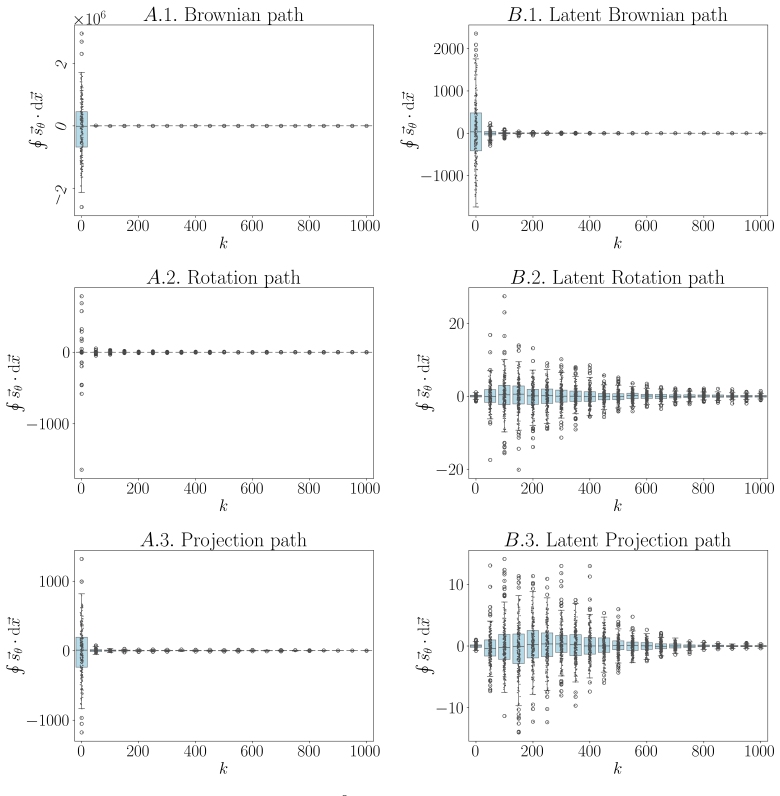
Summary. The paper challenges the standard interpretation of diffusion models as learning the score function. It presents numerical evidence (MNIST, latent MNIST, and CIFAR-10) that trained diffusion networks violate both integral and differential constraints that true score functions must satisfy, and argues that the learned vector fields are non-conservative. To explain why such networks still generate good samples, the paper advocates viewing diffusion training as flow matching to the velocity field of a Wasserstein Gradient Flow (WGF), rather than as learning the reverse-time SDE. The authors derive a sufficient condition—Equation (20)—under which a non-conservative error field e(x,t) does not affect the marginal density transport, and report in Figure 3 that the error field of a trained latent diffusion model is approximately confined to the null kernel of the associated Stein operator. The central conceptual claim is that diffusion models are better understood as deterministic flow matching on the WGF, with the reverse-time SDE being unnecessary at the level of marginal densities.
Significance. If the central claim holds, the paper offers a principled explanation for a puzzling observation: neural networks that fail to be conservative can still generate high-quality samples. The WGF/flow-matching perspective is elegant, connects diffusion models to a well-developed mathematical framework, and shifts attention from path-wise reverse-time SDE theory to marginal density transport. The derivation of the error-transport condition is straightforward and correct, and the numerical tests for non-conservativity are a valuable falsifiable check on common assumptions. However, the empirical support for the key null-kernel claim currently depends on a quantity—the true marginal score—that is intractable for real data and is not clearly defined in the manuscript. The paper's contribution is therefore promising but not yet fully established.
major comments (4)
- [Section 3, item 2; Figure 3; Eq. (20)] The paper states that the OU process is used to 'compute analytically exact s(x,t)' for matching the neural velocity field. This is only true for the conditional score ∇ log p_t(x|x0). For a data distribution that is an empirical mixture (MNIST, CIFAR-10, VAE latent), the marginal score s(x,t) = ∇ log ∫ p_t(x|x0) dµ0(x0) is intractable. If the error e in Figure 3 and Eq. (20) is computed against the conditional score—the actual DDPM regression target—then Eq. (20) no longer governs marginal density transport. The manuscript must specify exactly which score was used and how it was computed. If only the conditional score is available, the null-kernel conclusion is not supported.
- [Section 3, Eq. (15)] There is a mismatch between the stated WGF velocity and the flow-matching objective. Eq. (9) defines v_WGF = -x - s(x,t), but Eq. (15) minimizes E ||v_θ - s||^2. If v_θ is the full velocity field, the target should be -x - s; if v_θ is the score network, then the connection to WGF velocity is incomplete. This inconsistency affects the central formulation and needs to be corrected or clarified.
- [Footnote 5, Eq. (20)] Eq. (20) is a pointwise condition that must hold for each x,t to guarantee exact density transport. Footnote 5 concedes that for each sample the condition 'does not seem to be met' and only the average over 256 samples agrees. The claim that trained networks are 'statistically confined in the null kernel' is therefore not established. The authors should report the distribution of the Stein-operator value, the fraction of samples that satisfy the condition within a tolerance, and how violations affect the transported density.
- [Figure 3; Section 3] The empirical evidence for the null-kernel claim lacks baselines and error bars. A comparison with a random non-conservative field, or with a field constructed to satisfy Eq. (20), would show whether the observed average behavior is meaningful. As written, the figure only demonstrates that the average Stein value is small relative to the error magnitude; it does not show that the trained network is special in this respect.
minor comments (6)
- [Eq. (17)] In Eq. (17), '∇ x log(x(τ), −τ)' is missing the density argument; it should be ∇ log ρ(x(τ), −τ) or similar.
- [Section 2, introduction] Typo: 'wether' should be 'whether'.
- [Eq. (8)-Eq. (9)] After Eq. (8), '∇x log(·, t)' should read '∇x log ρ(·, t)' for clarity.
- [Figure 2 and Figure 3] Error bars or confidence intervals should be reported; currently the figures show only point statistics, which makes it difficult to judge the significance of the reported violations.
- [Appendix; reference [17]] Reference [17] is a Hugging Face Spaces link, not a stable archival source. Please provide an archival reference or versioned code release for reproducibility.
- [Section 3, paragraph after Eq. (15)] The statement that DDPM's uniform time weighting 'effectively solves a flow-matching problem' is plausible but needs a more careful citation or derivation; the connection between time weighting and flow-matching loss is asserted rather than shown.
Circularity Check
No significant circularity; the paper's key equations are mathematical identities and its empirical findings are post hoc measurements, not predictions derived from fitted assumptions.
full rationale
The paper's central mathematical content consists of exact identities derived from the Fokker–Planck equation and the generalized Liouville equation: the WGF velocity (9) is obtained from the chosen energy functional (4) by standard functional calculus, and equation (10) confirms that this velocity reproduces the OU diffusion. The error analysis leading to equations (19)–(20) is also an algebraic rearrangement of the continuity equation; the condition (20) is a necessary and sufficient condition for the error to have no effect on marginal density transport, not an empirically fitted relation. The numerical demonstrations that trained networks violate the integral and differential constraints of a conservative score (Section 2) are independent measurements. The claim that the error field is 'statistically confined in the null kernel' (Fig. 3) is a post hoc empirical observation about a trained model, not a prediction that is forced by the theory, and the paper explicitly notes in footnote 5 that the condition is only met on average. Self-citations ([16], [21]) are used for a discrete-time schedule mapping and as related work on Stein operators; they are not load-bearing for the main derivation. Any concern about whether the 'analytically exact' score used for image/latent data is the true marginal score or the conditional score is a correctness or validation issue, not circularity, because the paper does not define its conclusions in terms of that choice. Thus no derivation step reduces to its own inputs, and no fitted parameter is renamed as a prediction.
Assumptions & free parameters
assumptions (4)
- ad hoc to paper The matching target in (15) is the marginal score s(x,t) = ∇ log ρ(x,t), and this target is 'analytically exact' during training and for error evaluation.
- standard math The generalized Liouville equation (7) is the valid deterministic representation of the density evolution for the neural velocity field.
- domain assumption Anderson's reverse-time SDE theory is required for path measures, but generative tasks only need marginal densities.
- standard math The JKO scheme and Otto calculus provide the WGF energy (4) and velocity (9).
Cite this review
Pith. "Pith review of Are We Really Learning the Score Function? Reinterpreting Diffusion Models Through Wasserstein Gradient Flow Matching." pith.science (2026). https://pith.science/paper/PLMJKDTC
@misc{pith2026250900336,
  author       = {Pith},
  title        = {Pith review of: Are We Really Learning the Score Function? Reinterpreting Diffusion Models Through Wasserstein Gradient Flow Matching},
  year         = {2026},
  howpublished = {\url{https://pith.science/paper/PLMJKDTC}},
  note         = {Machine review of arXiv:2509.00336}
}
read the original abstract
Diffusion models are commonly interpreted as learning the score function, i.e., the gradient of the log-density of noisy data. However, this assumption implies that the target of learning is a conservative vector field, which is not enforced by the neural network architectures used in practice. We present numerical evidence that trained diffusion networks violate both integral and differential constraints required of true score functions, demonstrating that the learned vector fields are not conservative. Despite this, the models perform remarkably well as generative mechanisms. To explain this apparent paradox, we advocate a new theoretical perspective: diffusion training is better understood as flow matching to the velocity field of a Wasserstein Gradient Flow (WGF), rather than as score learning for a reverse-time stochastic differential equation. Under this view, the "probability flow" arises naturally from the WGF framework, eliminating the need to invoke reverse-time SDE theory and clarifying why generative sampling remains successful even when the neural vector field is not a true score. We further show that non-conservative errors from neural approximation do not necessarily harm density transport. Our results advocate for adopting the WGF perspective as a principled, elegant, and theoretically grounded framework for understanding diffusion generative models.
Figures


Figures from the paper (7 more)


Reference graph
Works this paper leans on
-
[1]
Gradient Flows: In Metric Spaces and in the Space of Probability Measures
Luigi Ambrosio, Nicola Gigli, and Giuseppe Savar ´e. Gradient Flows: In Metric Spaces and in the Space of Probability Measures . 2nd ed. Basel: Birkh ¨auser, 2008. ISBN : 978-3-7643- 8722-8
work page 2008
-
[2]
Reverse-time diffusion equation models
Brian D.O. Anderson. “Reverse-time diffusion equation models”. en. In: Stochastic Processes and their Applications 12.3 (May 1982), pp. 313–326. ISSN : 03044149. DOI: 10 . 1016 / 0304-4149(82)90051-5
work page 1982
-
[3]
bot66. MNISTDiffusion: Implement a MNIST (also minimal) version of denoising diffusion probabilistic model from scratch. https://github.com/bot66/MNISTDiffusion. 2022
work page 2022
-
[4]
Projected Stein Variational Gradient Descent
Peng Chen and Omar Ghattas. Projected Stein Variational Gradient Descent . June 2020. arXiv: 2002.03469 [cs]
work page Pith review arXiv 2020
-
[5]
Ricky T. Q. Chen et al. Neural Ordinary Differential Equations . Dec. 2019. arXiv: 1806 . 07366 [cs, stat]
work page 2019
-
[6]
Path-Guided Particle-based Sampling
Mingzhou Fan et al. “Path-Guided Particle-based Sampling”. In: Proceedings of the 41st International Conference on Machine Learning. PMLR, July 2024, pp. 12916–12934
work page 2024
-
[7]
An Invitation to Optimal Transport, Wasserstein Dis- tances, and Gradient Flows
Alessio Figalli and Federico Glaudo. An Invitation to Optimal Transport, Wasserstein Dis- tances, and Gradient Flows. Second edition. Berlin, Germany: EMS Press, 2023. ISBN : 978- 3-98547-550-6
work page 2023
-
[8]
Diffusion Models and Gaussian Flow Matching: Two Sides of the Same Coin
Ruiqi Gao et al. “Diffusion Models and Gaussian Flow Matching: Two Sides of the Same Coin”. In: The Fourth Blogpost Track at ICLR 2025. Feb. 2025
work page 2025
Show all 21 references
-
[9]
Die verallgemeinerte Liouville-Gleichung
G. Gerlich. “Die verallgemeinerte Liouville-Gleichung”. en. In: Physica 69.2 (Nov. 1973), pp. 458–466. ISSN : 0031-8914. DOI: 10.1016/0031-8914(73)90083-9
1973 doi
-
[10]
Denoising Diffusion Probabilistic Models
Jonathan Ho, Ajay Jain, and Pieter Abbeel. Denoising Diffusion Probabilistic Models . Dec. 16, 2020. arXiv: 2006.11239 [cs, stat]
2020 arXiv
-
[11]
The Variational Formulation of the Fokker–Planck Equation
Richard Jordan, David Kinderlehrer, and Felix Otto. “The Variational Formulation of the Fokker–Planck Equation”. In: SIAM Journal on Mathematical Analysis 29.1 (Jan. 1998), pp. 1–17. ISSN : 0036-1410. DOI: 10.1137/S0036141096303359
1998 doi
-
[12]
Flow Matching for Generative Modeling
Yaron Lipman et al. “Flow Matching for Generative Modeling”. en. In: Sept. 2022. URL: https://openreview.net/forum?id=PqvMRDCJT9t
2022
-
[13]
Stein Variational Gradient Descent: A General Purpose Bayesian Inference Algorithm
Qiang Liu and Dilin Wang. “Stein Variational Gradient Descent: A General Purpose Bayesian Inference Algorithm”. In: Advances in Neural Information Processing Systems. Ed. by D. Lee et al. V ol. 29. Curran Associates, Inc., 2016
2016
-
[14]
Improved Denoising Diffusion Probabilistic Models
Alex Nichol and Prafulla Dhariwal. Improved Denoising Diffusion Probabilistic Models . Feb. 18, 2021. arXiv: 2102.09672 [cs, stat]
2021 arXiv
-
[15]
The Geometry of Dissipative Evolution Equations: The Porous Medium Equa- tion
Felix Otto. “The Geometry of Dissipative Evolution Equations: The Porous Medium Equa- tion”. In: Communications in Partial Differential Equations26.1-2 (2001), pp. 101–174. DOI: 10.1081/PDE-100002243
2001 doi
-
[16]
Santos and Yen Ting Lin
Javier E. Santos and Yen Ting Lin. Understanding Denoising Diffusion Probabilistic Models and their Noise Schedules via the Ornstein–Uhlenbeck Process . Oct. 2023. arXiv: 2311 . 17673 [stat,cond-mat, cs,math-ph]
2023
-
[17]
Simple Latent Diffusion Model
Won Seong. Simple Latent Diffusion Model . https : / / huggingface . co / spaces / JuyeopDang/KoFace-AI. 2024
2024
-
[18]
A CNN Variational Autoencoder in PyTorch
sksq96. A CNN Variational Autoencoder in PyTorch . https : / / github . com / sksq96 / pytorch-vae/blob/master/vae.py. 2018
2018
-
[19]
Deep Unsupervised Learning Using Nonequilibrium Thermody- namics
Jascha Sohl-Dickstein et al. Deep Unsupervised Learning Using Nonequilibrium Thermody- namics. Nov. 18, 2015. arXiv: 1503.03585 [cond-mat, q-bio, stat]
2015 arXiv
-
[20]
Score-Based Generative Modeling through Stochastic Differential Equa- tions
Yang Song et al. Score-Based Generative Modeling through Stochastic Differential Equa- tions. Comment: ICLR 2021 (Oral). Feb. 10, 2021. arXiv: 2011.13456 [cs, stat]
2021 arXiv
-
[21]
Liouville Flow Importance Sampler
Yifeng Tian, Nishant Panda, and Yen Ting Lin. “Liouville Flow Importance Sampler”. In: Forty-First International Conference on Machine Learning. June 2024. 9 Figure 4: (MNIST) Summary statistics of H ⃗ sθ · d⃗ xcalculated by different path-generating mecha- nisms, in normal an...
2024
Reviewed August 5, 2026 · model on record in the stance chip above.
Discussion (0). Continue with ORCID to comment.