REVIEW 4 major objections 6 minor 3 references
Autonomous Aggregate Sorting in Construction and Mining via Computer Vision-Aided Robotic Arm Systems
T0 review · 4 major / 6 minor · reviewed 2026-08-05 · deepseek-v4-flash
Pith's one-line read A vision-guided robotic arm can sort four types of construction aggregate with 97.5% average success in a lab setting.
desk verdict A plausible but thin feasibility study; the 97.5% headline is undercut by an internally inconsistent 40-trial table and missing detection metrics. read the letter →
The pith
A machine-rendered reading of the paper's core claim, the machinery that carries it, and where it could break.
The reading
What carries the argument
The system is carried by a perception-to-action chain: an attention-augmented object-detection network (a modified YOLOv8) identifies lithology and 2D position; stereo matching over left and right infrared images produces a depth map and hence 3D coordinates; a minimum-enclosing-rectangle calculation estimates particle size; hand-eye calibration maps camera coordinates into the arm's coordinate frame; and a standard four-parameter kinematic link model converts the target pose into servo joint angles. The design choice that makes the claim credible is the tight coupling of these modules: each step feeds directly into the next, so the measured end-to-end success rate reflects the whole chain r
What would settle it
Run the same system on 100 or more randomly selected aggregates per type, in varied lighting and with aggregates overlapping or dusty, and record per-type grasp and classification counts. If the average success rate falls clearly below 97.5%, or if granite-versus-limestone confusion reappears at high rate, the paper's claim is not robust. Also report per-class precision and recall from the detector alone.
Extended reading notes
Core claim
The central claim is that a complete, modular aggregate-sorting robot—perception, localization, size measurement, motion control, and classification—can be assembled from off-the-shelf components and a custom-trained deep detector, and that this integrated system reaches high accuracy in a controlled lab setting: 10/10 grasps for limestone, granite, and marble; 9/10 for sandstone; and classification accuracy of 100% for all types except granite at 90%. The one misclassification was granite read as limestone on a small, texture-poor piece, and the one grasp failure was a 1 cm aggregate too small for the gripper. The authors take this as evidence that the approach can sort typical aggregates a
Load-bearing premise
The headline success rate rests on only 10 trials per aggregate type in a controlled lab setting, so a single misclassification shifts the average by 2.5 percentage points; if those trials are not representative of real sorting conditions, the claimed reliability does not carry over.
Editorial extensions
If this is right
- If the 97.5% figure holds beyond the lab, sorting can be automated for tasks where manual sorting is slow, costly, or hazardous.
- Because classification is learned rather than rule-based, the same pipeline can be retrained for other material types.
- The failure pattern points to concrete improvements: gripper redesign for small aggregates and stronger texture features for visually similar rocks.
- Since end-to-end accuracy depends on detection, localization, and motion, improving any one module should raise the total success rate.
Reading between the lines
- The 97.5% figure rests on only 10 trials per category with no confidence intervals; under variable lighting, dust, overlapping rocks, or unseen aggregate types, real-world performance is likely lower.
- A natural testable extension is to run the same system on crowded, mixed piles and measure both grasp cycles per hour and failure modes; if small-particle failures dominate, a two-stage gripper or suction end-effector would be the first fix.
- The texture-sensitive deep features suggest transfer to recycling sorting, such as separating glass, metal, and plastic, but that would require a new dataset and a different gripper.
- Adding per-class precision and recall for the detector would make the claimed near-perfect recognition accuracy reproducible.
Signed reviews
Editorial analysis
A structured set of objections, weighed in public.
Referee Report
Summary. The manuscript describes an integrated autonomous aggregate sorting system built from a six-degree-of-freedom Hiwonder JetArm, an Orbbec Gemini binocular stereo camera, and a ROS-based control stack. The claimed contributions are an attention-augmented YOLOv8 detector for lithology classification, stereo matching for 3D localization, minimum-enclosing-rectangle particle-size estimation, Denavit–Hartenberg kinematic modeling, and hand–eye calibration. Four aggregate types (limestone, granite, sandstone, marble) were physically tested with 10 grasping trials per type. The abstract and conclusion report an average grasping and sorting success rate of 97.5% and comparable classification accuracy. The paper also asserts in §3.5 that recognition accuracy is 'close to 100%.' The central empirical claim is a high lab-demonstrated success rate for a low-cost robotic sorting pipeline.
Significance. If the 97.5% result were rigorously supported, the paper would offer a useful integration example for construction and mining automation using commercially available hardware. The authors do perform physical trials rather than only simulation and create a labeled image dataset of 1219 aggregate images, which are positive aspects. However, the methodological novelty is incremental: attention-augmented YOLOv8, stereo matching, DH kinematics, and hand–eye calibration are standard techniques, and no ablation or baseline comparison is provided. More importantly, the experimental evidence for the headline number is internally inconsistent and statistically very thin. The promise of the system is therefore not established in the present manuscript, and the significance as written is limited.
major comments (4)
- [§3.5, experimental results table] The table is internally inconsistent. For sandstone it reports 10 trials, 9 successfully captured, but 10/10 correctly classified/placed. The text defines classification success as 'the correct rate of each type being placed in the specified position.' A trial in which the arm fails to grasp cannot result in a correct placement. If the sandstone classification count is corrected to at most 9, the classification average falls from 97.5% to at best 95% (and the combined average to 96.25%). The authors must provide per-trial records and clarify whether classification was scored at the vision level or at final physical placement; as printed, the headline 97.5% lacks a valid per-trial basis.
- [§3.5 and §5] The claim that recognition accuracy is 'close to 100%' is unsupported by any detection metric. No precision, recall, mAP, confusion matrix, or training/validation split is reported for the attention-augmented YOLOv8 model. Without this, vision classification performance cannot be separated from manipulation success. The 97.5% mean is based on 40 total trials, with one failure in a category moving the mean by 2.5 percentage points; no confidence interval or significance test is given. This is insufficient statistical support for the paper's central quantitative claim.
- [§4.2 and §5.2] The kinematic and calibration derivations are not verifiable as printed. Equations (4.4)–(4.9) are garbled and partially illegible in the manuscript, the D-H parameter table (Table 2) lists only five rows for a claimed 6-DOF arm, and the forward/inverse kinematics verification is described only as 'basically consistent' with no numerical error. Hand–eye calibration reports no transformation error or residual. Since these components are load-bearing for the claimed grasping precision, the technical support for the 97.5% success rate is incomplete.
- [§3.4–§3.5 and §5.1] Experimental conditions are under-specified: no lighting protocol, camera height, gripper geometry, or aggregate pose distribution are described; there is no baseline comparison with manual or mechanical sorting and no throughput or cycle-time data. The conclusion claims productivity, cost, and safety benefits, but the experiments do not measure these. The limited lab setup and the absence of robustness metrics make the generalization claim disproportionate to the evidence.
minor comments (6)
- [Throughout] There are numerous typos and grammatical errors, e.g., 'limeston', 'capture process', 'Jeson' instead of Jetson, and inconsistent use of 'grabbing' vs 'grasping'. The manuscript needs careful language editing.
- [§3.2–§3.3] The software section states Ubuntu 20.04, while the hardware section states Ubuntu 18.04 on the Jetson Nano. Please clarify the actual OS versions used.
- [Table 2] The D-H table has only five rows for a six-degree-of-freedom arm. Either a joint is missing or the kinematic model is for a reduced set; this should be explained.
- [§5.2] The text says the 'eyes on the hand' configuration is 'as shown in Fig. 17', but Fig. 17 is the calibration checkerboard; the correct reference appears to be Fig. 22.
- [§3.1.1 and references] Equation (1) is referenced but the displayed equation is missing from the manuscript. Also, reference [16] on irrational numbers is not an appropriate citation for the Pythagorean theorem; a standard geometry reference would be more suitable.
- [Abstract and §3.5] The phrase 'comparable classification accuracy' is ambiguous. The abstract should state classification accuracy explicitly and consistently with the experimental table and text.
Circularity Check
No significant circularity: the 97.5% result is a measured physical outcome, not a value reconstructed from fitted parameters or self-citations.
full rationale
The paper's central claim is an experimental grasping and sorting success rate measured over 40 physical trials (10 per aggregate type), as recorded in the Section 3.5 table. That rate is not derived from the trained YOLOv8 weights, the hand-eye calibration, or the D-H kinematic model by construction; a failed grasp or misplacement is an external physical event, not a fitted quantity. The vision model is trained on the authors' own labeled dataset, but the sorting endpoint is evaluated separately in the physical experiment, so the headline number is not a renamed training metric. The kinematic forward/inverse solutions are verified against MATLAB/Robotics Toolbox, which is internal consistency checking rather than circularity. There are no load-bearing self-citations in the derivation chain: references such as [29] are external prior work. The sandstone-row inconsistency (9 successful captures but 10 correctly classified) is a reporting/validity concern that undermines the table's internal coherence, but it is not a circular reduction of a prediction to its input. Thus the derivation chain is self-contained with respect to circularity; the empirical weaknesses are matters of experimental rigor, not definitional circularity.
Assumptions & free parameters
free parameters (1)
- YOLOv8 attention-augmented detector weights =
not provided
assumptions (5)
- domain assumption The trained YOLOv8 model generalizes from the 1219-image dataset to the physical grasping scene
- domain assumption The D-H parameters in Table 2 accurately model the 6-DOF Hiwonder JetArm
- domain assumption Zhang camera calibration and hand-eye calibration matrices remain valid during the grasping experiments
- domain assumption Four rock types and the 1-4 cm particle size range are representative of aggregate sorting applications
- standard math Standard linear algebra for rotations, translations, and homogeneous transforms is valid
Cite this review
Pith. "Pith review of Autonomous Aggregate Sorting in Construction and Mining via Computer Vision-Aided Robotic Arm Systems." pith.science (2026). https://pith.science/paper/GPG3PZC4
@misc{pith2026250900339,
  author       = {Pith},
  title        = {Pith review of: Autonomous Aggregate Sorting in Construction and Mining via Computer Vision-Aided Robotic Arm Systems},
  year         = {2026},
  howpublished = {\url{https://pith.science/paper/GPG3PZC4}},
  note         = {Machine review of arXiv:2509.00339}
}
read the original abstract
Traditional aggregate sorting methods, whether manual or mechanical, often suffer from low precision, limited flexibility, and poor adaptability to diverse material properties such as size, shape, and lithology. To address these limitations, this study presents a computer vision-aided robotic arm system designed for autonomous aggregate sorting in construction and mining applications. The system integrates a six-degree-of-freedom robotic arm, a binocular stereo camera for 3D perception, and a ROS-based control framework. Core techniques include an attention-augmented YOLOv8 model for aggregate detection, stereo matching for 3D localization, Denavit-Hartenberg kinematic modeling for arm motion control, minimum enclosing rectangle analysis for size estimation, and hand-eye calibration for precise coordinate alignment. Experimental validation with four aggregate types achieved an average grasping and sorting success rate of 97.5%, with comparable classification accuracy. Remaining challenges include the reliable handling of small aggregates and texture-based misclassification. Overall, the proposed system demonstrates significant potential to enhance productivity, reduce operational costs, and improve safety in aggregate handling, while providing a scalable framework for advancing smart automation in construction, mining, and recycling industries.
Figures

Reference graph
Works this paper leans on
-
[1]
IntroductionThe blistering pace of development of automation technologies and in specific the technologies of robotics and computer vision fundamentally altered the way industrial operation in general should take place, as it allows previously unfathomed levels of efficiency, precision, and even flexibility in an industrial operation. One of the most infl...
-
[2]
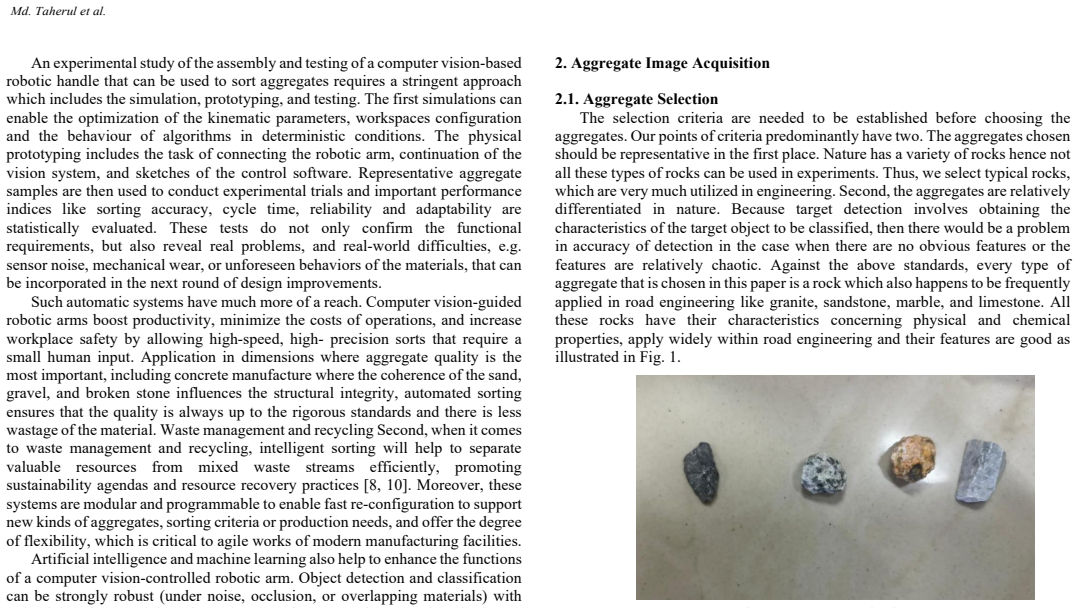
Aggregate Image Acquisition 2.1. Aggregate Selection The selection criteria are needed to be established before choosing the aggregates. Our points of criteria predominantly have two. The aggregates chosen should be representative in the first place. Nature has a variety of rocks hence not all these types of rocks can be used in experiments. Thus, we sele...
work page 1920
-
[28]
Otoo, L., Hybrid Charging Station for Autonomous Robot Using Real Time Kinematics. 2024. 29. Lou, H., et al., DC-YOLOv8: small-size object detection algorithm based on camera sensor. Electronics, 2023. 12(10): p. 2323. 30. Yuan, C., et al., Lithology identification by adaptive feature aggregation under scarce labels. Journal of Petroleum Science and Engin...
work page 2024
Reviewed August 5, 2026 · model on record in the stance chip above.
Discussion (0). Continue with ORCID to comment.