REVIEW 3 major objections 5 minor 73 references
Make me an Expert: Distilling from Generalist Black-Box Models into Specialized Models for Semantic Segmentation
T0 review · 3 major / 5 minor · reviewed 2026-08-05 · deepseek-v4-flash
Pith's one-line read This paper introduces Black-Box Distillation for semantic segmentation, training a specialized local model from only one-hot outputs of an open-vocabulary API, and shows that picking the API’s input scale with DINOv2 attention-map entropy b
desk verdict A realistic new black-box distillation setting with a modest, honest, but incompletely validated scale-selection trick; worth refereeing, but the core entropy proxy needs quantitative support. read the letter →
The pith
A machine-rendered reading of the paper's core claim, the machinery that carries it, and where it could break.
The reading
What carries the argument
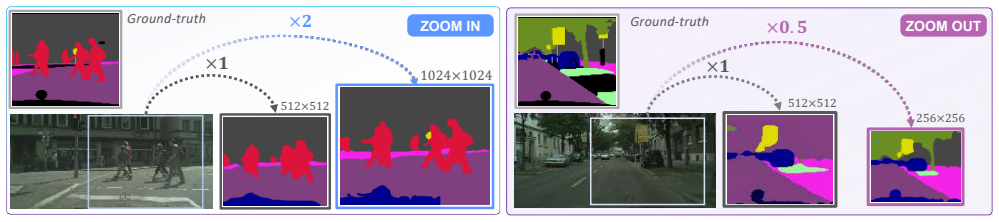
ATGC (ATtention-Guided sCaler) is a plug-and-play scale selector. For each crop it computes DINOv2 attention maps at N scales, treats each averaged [CLS]-patch attention map as a spatial probability distribution, and picks s* = argmin of its Shannon entropy; the API is queried at that scale and the pseudo-labels are rescaled to the original crop. The load-bearing logic is that a low-entropy, peaked attention map indicates a scale where the encoder recognizes objects, and—via the Platonic Representation Hypothesis—that recognition is treated as a proxy for the black-box API’s own segmentation quality.
What would settle it
Take a labeled set of target images; for each crop compute ATGC’s argmin-entropy scale and the oracle-best scale (the one whose API pseudo-labels have the highest pixel accuracy against ground truth). If the entropy-selected scale’s accuracy is not positively correlated with the oracle-best scale’s accuracy, or if students trained on entropy-selected pseudo-labels do not beat students trained on fixed scale-1 pseudo-labels on average, the central claim is falsified.
Extended reading notes
Core claim
ATGC establishes that open-vocabulary black-box teachers are strongly scale-dependent in segmentation: per-class IoU peaks vary from low scales for large context classes like “road” to high scales for small distant classes like “traffic sign”. Given an unlabeled target image crop, ATGC rescales it to each candidate scale, extracts DINOv2’s [CLS]-to-patch attention maps averaged over heads, normalizes each map as a distribution, and selects the scale with minimal entropy. That scale is then used to query the API and produce one-hot pseudo-labels, which are rescaled back and used as hard supervision for a student network, with a pixel-level agreement filter between API and student predictions.
Load-bearing premise
The method bets that DINOv2 attention entropy reliably predicts which input zoom will make the black-box API label a crop most accurately; when that correlation fails, the selected scale can produce worse pseudo-labels than the original crop, as the paper’s own failure figures show.
Editorial extensions
If this is right
- If B2D holds, segmentation APIs that return only one-hot outputs can still be distilled into deployable local models; no logit access is required.
- Because the teacher is open-vocabulary, the same pipeline can specialize a student to any user-chosen class vocabulary, rather than a fixed pretraining label set.
- Pseudo-label quality in black-box segmentation distillation can be improved more by choosing the query scale than by confidence thresholding; ATGC’s scale mining plus a simple consistency filter captures much of the gap to the Oracle bound in the paper’s experiments.
- Attention maps can be computed once per dataset, independent of the API model, so the scale-selection step can be amortized offline rather than costing extra API queries during training.
- The domain-generalization results—training on Cityscapes and evaluating on ACDC outperforming direct ACDC training—suggest that larger unlabeled pools can outweigh noisy pseudo-labels under adverse-condition shifts.
Reading between the lines
- Editorial inference: because ATGC selects one scale per crop rather than per class, it will systematically favor whatever class dominates the attention map; a natural extension is class-level or region-level scale mixing, and the paper’s own failure cases point in this direction.
- Editorial inference: if DINOv2 entropy is a reliable proxy for API labeling quality, the same selector should transfer to other dense-prediction tasks such as depth estimation, panoptic segmentation, or instance segmentation, and to other frozen self-supervised encoders.
- Editorial inference: a direct correlation test—measuring DINOv2 attention entropy against API pseudo-label pixel accuracy across scales on a labeled validation set—would sharpen the Platonic Representation Hypothesis from a heuristic into a quantitative design rule; the paper gives qualitative examples but not a systematic correlation.
- Editorial inference: the offline caching of attention maps means ATGC can be cost-aware in practice—only the selected scale is ever sent to the paid API—though the paper does not formally measure API-call budgets.
Editorial analysis
A structured set of objections, weighed in public.
Referee Report
Summary. The paper formalizes Black-Box Distillation (B2D) for semantic segmentation, in which a local student model is trained using only one-hot pseudo-labels from a black-box open-vocabulary API teacher, without access to logits or internal representations. The authors identify a 'curse of resolution': different object classes are segmented best at different input scales. Their method, ATGC, uses a frozen DINOv2 student encoder to compute attention-map entropy at multiple scales and selects the scale with lowest entropy as the query scale for the API; pseudo-labels are then filtered by agreement with the student and used to train the student via cross-entropy. Experiments on Cityscapes and ACDC with SAN and CLIP-DINOiser as APIs show that ATGC outperforms Naive Transfer, Random, Average, and a reimplemented CoRTE baseline, while being below an Oracle that selects the best pseudo-labels using ground truth. The paper openly discusses limitations and shows failure cases.
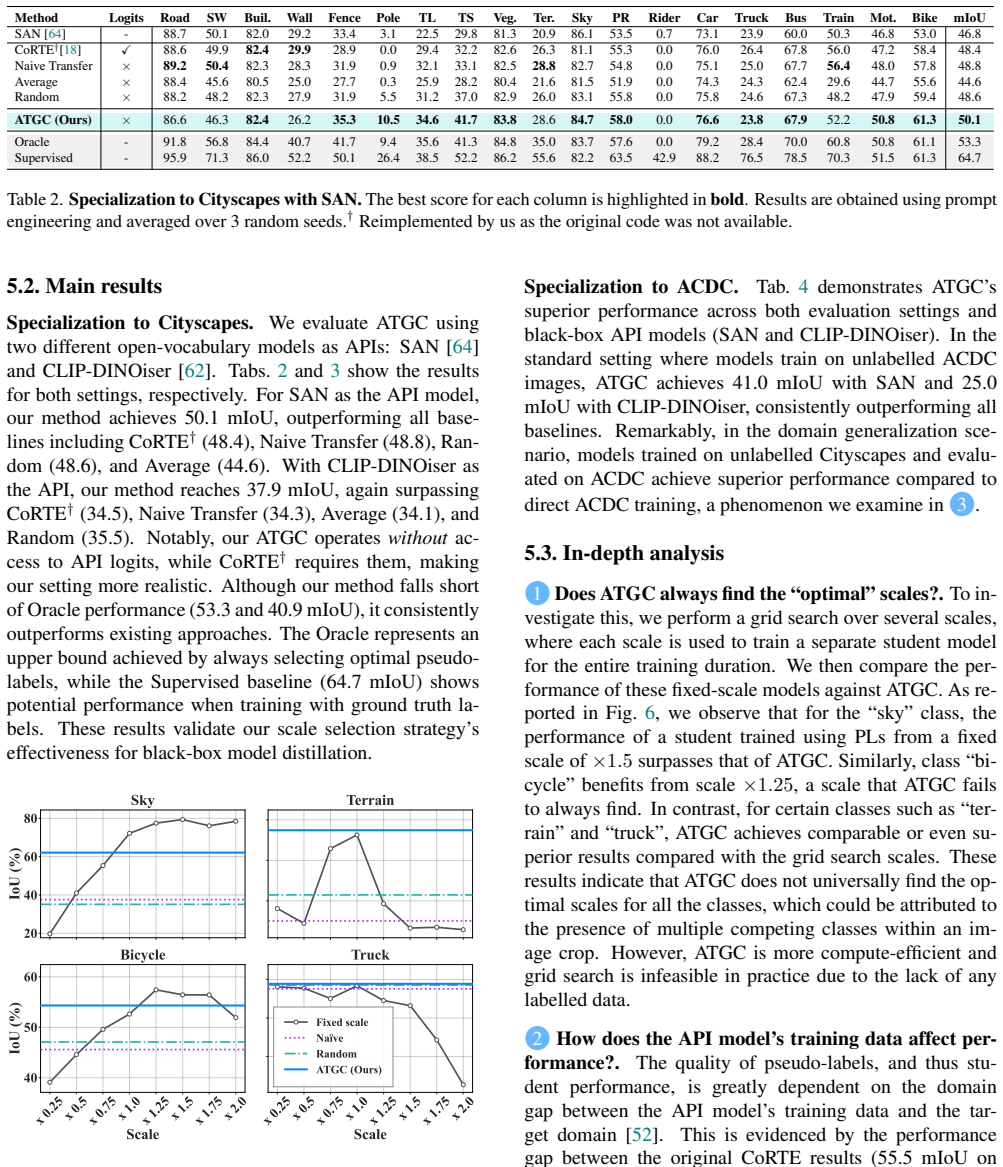
Significance. If the core mechanism is validated, the paper makes a useful practical contribution: it addresses a realistic constrained setting (API returns only hard labels), provides a reproducible pipeline (code released), and introduces a scale-selection method that does not require any API-internal information. The comparison against an Oracle and the inclusion of two different API models are commendable, as is the candid reporting of failure cases in App. C.5. However, the main empirical gains are modest (1.3-2.4 mIoU over Random on Cityscapes), and the central proxy assumption that DINOv2 attention entropy ranks pseudo-label quality is supported only by qualitative examples and an appeal to the Platonic Representation Hypothesis, not by a quantitative correlation. The hyperparameters (tau and the scale grid S) are selected on the same validation sets used for evaluation, and no variance across seeds is reported. These issues currently leave the central claim under-supported, though the approach is plausible and the gaps are addressable.
major comments (3)
- [Sec. 4.1, Eq. (3)] The method's load-bearing assumption is that the scale minimizing attention entropy also minimizes pseudo-label error. This is not validated quantitatively. Figs. 5 and 12 show selected examples, but the paper itself documents counterexamples in Fig. 13 and App. C.5 where the entropy-selected scale yields worse pseudo-labels than the original crop. The appeal to the Platonic Representation Hypothesis is not a substitute for a direct measurement. Please report, on a labeled validation set (e.g., Cityscapes val), a per-image and per-scale correlation between attention entropy and API pseudo-label accuracy (pixel accuracy or mIoU), and the fraction of images where argmin entropy matches argmax accuracy. Additionally, to show that the ranking—not just the induced scale distribution—matters, ablate Eq. (3) by replacing it with a random selection from the same per-image scale distribution (i.e
- [Sec. 5.1 and App. C.1, Tables 2-3] The filtering threshold tau=0.7 is chosen by an ablation on the same Cityscapes/CLIP-DINOiser validation set used for the main results, and the scale grid S is hand-specified with no sensitivity analysis. Moreover, although Tables 2-3 state results are averaged over 3 random seeds, no per-seed values, standard deviations, or confidence intervals are provided. With margins of only 1.3-2.4 mIoU over Random, the statistical significance of the improvement is unclear. Please provide per-seed results or error bars, and report sensitivity to tau and to the composition of S (e.g., a coarser or finer grid). If possible, select tau on a separate validation split or use a procedure that does not reuse the test/validation set for hyperparameter choice.
- [Sec. 4.2, Algorithm 2, and Sec. 5.1 baselines] It is unclear whether the pixel-level consistency filter (IoU >= tau) is applied to all baselines or only to ATGC. Algorithm 2 describes the filtering as part of ATGC's training, but the definitions of Naive Transfer, Random, and Average in Sec. 5.1 do not explicitly state that they use the same filtering. If the baselines are trained without filtering while ATGC is trained with it, the comparison conflates scale selection with filtering. Please state explicitly whether each baseline uses the same tau and the same filtering procedure. In addition, provide an ablation isolating the contributions: ATGC with and without filtering, and Random with and without filtering. This is important because the student model used for the consistency filter is itself trained on API pseudo-labels, so the filter is not independent of the teacher.
minor comments (5)
- [Sec. 5.3] In the sentence 'a phenomenon we examine in 3', the cross-reference is incomplete; it should point to the relevant subsection or appendix.
- [Fig. 5 caption] The caption says 'The resolution with the highest spatially averaged attention score is selected', but the method (Sec. 4.1, Eq. 3) selects the scale with the lowest entropy. Please align the caption with the method.
- [Sec. 5.1, Oracle baseline] The Oracle uses ground truth to select the pseudo-label with the highest pixel accuracy, while evaluation is mIoU. Pixel accuracy can favor larger classes; this mismatch should be noted so readers do not interpret the Oracle as an upper bound on mIoU.
- [App. C.1] The tau ablation is reported only for CLIP-DINOiser. Reporting it for SAN as well would help confirm that tau=0.7 is not API-specific.
- [General] The paper would benefit from stating explicitly for each baseline whether the same scale grid S and the same prompt ensembling are used. Currently the experimental setup gives details for ATGC but is less explicit for baselines.
Circularity Check
No significant circularity: ATGC's entropy-based scale selection and consistency filtering do not reduce to the reported mIoU, and the API teacher is independent of the DINOv2 proxy.
full rationale
The derivation chain is self-contained and is evaluated against external benchmarks (Cityscapes, ACDC) with multiple baselines. The 'curse of resolution' is an empirical observation (Sec. 4, Fig. 3) obtained by measuring class-wise IoU of a fixed API model across scales; it is not built into ATGC by construction. ATGC's scale choice s* = argmin_j S(A_j) (Eq. 3) is computed from frozen DINOv2 attention maps, while pseudo-label quality comes from a disjoint open-vocabulary API; neither quantity is defined in terms of the other, so there is no self-definitional reduction. The consistency filter (Algorithm 2, lines 9-11) uses student predictions to gate API pseudo-labels, which is a standard self-training mechanism and does not by construction force the reported ground-truth mIoU. The Random baseline uses the same scale support, so ATGC's gain is not statistically forced. The main weakness is empirical: the entropy-to-pseudo-label-quality proxy is supported only qualitatively (Figs. 5 and 12), and the paper itself documents counterexamples (Fig. 13, App. C.5), making this a correctness/validity risk rather than a circularity. The only author self-citation is Ref. [52] for a generic domain-gap statement and is not load-bearing. No fitted parameter is renamed as a prediction, and no uniqueness theorem from the authors is invoked. Therefore the circularity score is 0.
Assumptions & free parameters
free parameters (3)
- Scale grid S =
{0.25, 0.28, 0.34, 0.38, 0.44, 0.47, 0.5, 0.75, 1.0, 1.25, 1.5, 1.75, 2.0}
- Filtering threshold tau =
0.7
- Distillation weight alpha =
0
assumptions (4)
- ad hoc to paper DINOv2 attention maps indicate the scale at which the black-box API will produce better pseudo-labels (Platonic Representation Hypothesis)
- domain assumption Shannon entropy of the normalized CLS-to-patch attention map is a valid objectness score
- domain assumption Open-vocabulary API can be prompted with template embeddings to produce usable one-hot segmentation labels for arbitrary class vocabularies
- domain assumption Resolution sensitivity is the dominant controllable factor in pseudo-label quality
Cite this review
Pith. "Pith review of Make me an Expert: Distilling from Generalist Black-Box Models into Specialized Models for Semantic Segmentation." pith.science (2026). https://pith.science/paper/AMIHPEZK
@misc{pith2026250900509,
  author       = {Pith},
  title        = {Pith review of: Make me an Expert: Distilling from Generalist Black-Box Models into Specialized Models for Semantic Segmentation},
  year         = {2026},
  howpublished = {\url{https://pith.science/paper/AMIHPEZK}},
  note         = {Machine review of arXiv:2509.00509}
}
read the original abstract
The rise of Artificial Intelligence as a Service (AIaaS) democratizes access to pre-trained models via Application Programming Interfaces (APIs), but also raises a fundamental question: how can local models be effectively trained using black-box models that do not expose their weights, training data, or logits, a constraint in which current domain adaptation paradigms are impractical ? To address this challenge, we introduce the Black-Box Distillation (B2D) setting, which enables local model adaptation under realistic constraints: (1) the API model is open-vocabulary and trained on large-scale general-purpose data, and (2) access is limited to one-hot predictions only. We identify that open-vocabulary models exhibit significant sensitivity to input resolution, with different object classes being segmented optimally at different scales, a limitation termed the "curse of resolution". Our method, ATtention-Guided sCaler (ATGC), addresses this challenge by leveraging DINOv2 attention maps to dynamically select optimal scales for black-box model inference. ATGC scores the attention maps with entropy to identify informative scales for pseudo-labelling, enabling effective distillation. Experiments demonstrate substantial improvements under black-box supervision across multiple datasets while requiring only one-hot API predictions. Our code is available at https://github.com/yasserben/ATGC.
Figures


Figures from the paper (10 more)




Reference graph
Works this paper leans on
-
[1]
Josh Achiam, Steven Adler, Sandhini Agarwal, Lama Ahmad, Ilge Akkaya, Florencia Leoni Aleman, Diogo Almeida, Janko Altenschmidt, Sam Altman, Shyamal Anadkat, et al. Gpt-4 technical report. arXiv preprint arXiv:2303.08774, 2023. 1, 3
arXiv 2023
-
[2]
Deep vit features as dense visual descriptors
Shir Amir, Yossi Gandelsman, Shai Bagon, and Tali Dekel. Deep vit features as dense visual descriptors. In ECCV, 2022. 5
work page 2022
-
[3]
Foundation models defining a new era in vision: a sur- vey and outlook
Muhammad Awais, Muzammal Naseer, Salman Khan, Rao Muhammad Anwer, Hisham Cholakkal, Mubarak Shah, Ming-Hsuan Yang, and Fahad Shahbaz Khan. Foundation models defining a new era in vision: a sur- vey and outlook. PAMI, 2025. 3
work page 2025
-
[4]
Explaining neural scaling laws
Yasaman Bahri, Ethan Dyer, Jared Kaplan, Jaehoon Lee, and Utkarsh Sharma. Explaining neural scaling laws. Proceedings of the National Academy of Sci- ences, 121(27):e2311878121, 2024. 1
work page 2024
-
[5]
Knowledge distillation: A good teacher is patient and consistent
Lucas Beyer, Xiaohua Zhai, Am ´elie Royer, Larisa Markeeva, Rohan Anil, and Alexander Kolesnikov. Knowledge distillation: A good teacher is patient and consistent. In CVPR, pages 10925–10934, 2022. 3
work page 2022
-
[6]
On the opportunities and risks of foundation models
Rishi Bommasani, Drew A Hudson, Ehsan Adeli, Russ Altman, Simran Arora, Sydney von Arx, Michael S Bernstein, Jeannette Bohg, Antoine Bosse- lut, Emma Brunskill, et al. On the opportunities and risks of foundation models. arXiv preprint arXiv:2108.07258, 2021. 1, 3
arXiv 2021
-
[7]
Language models are few-shot learners
Tom Brown, Benjamin Mann, Nick Ryder, Melanie Subbiah, Jared D Kaplan, Prafulla Dhariwal, Arvind Neelakantan, Pranav Shyam, Girish Sastry, Amanda Askell, et al. Language models are few-shot learners. NeurIPS, 2020. 1
work page 2020
-
[8]
Coco-stuff: Thing and stuff classes in context
Holger Caesar, Jasper Uijlings, and Vittorio Ferrari. Coco-stuff: Thing and stuff classes in context. In CVPR, 2018. 6
work page 2018
Show all 73 references
-
[9]
All about structure: Adapting struc- tural information across domains for boosting seman- tic segmentation
Wei-Lun Chang, Hui-Po Wang, Wen-Hsiao Peng, and Wei-Chen Chiu. All about structure: Adapting struc- tural information across domains for boosting seman- tic segmentation. In CVPR, pages 1900–1909, 2019. 3
1900
-
[10]
Zero-shot domain generalization of foundational models for 3d medical image segmen- tation: An experimental study
Soumitri Chattopadhyay, Basar Demir, and Marc Niethammer. Zero-shot domain generalization of foundational models for 3d medical image segmen- tation: An experimental study. arXiv preprint arXiv:2503.22862, 2025. 3
2025 arXiv
-
[11]
Frugal- gpt: How to use large language models while reduc- ing cost and improving performance
Lingjiao Chen, Matei Zaharia, and James Zou. Frugal- gpt: How to use large language models while reduc- ing cost and improving performance. arXiv preprint arXiv:2305.05176, 2023. 1
2023 arXiv
-
[12]
Deeplab: Semantic image segmentation with deep convolutional nets, atrous convolution, and fully connected crfs
Liang-Chieh Chen, George Papandreou, Iasonas Kokkinos, Kevin Murphy, and Alan L Yuille. Deeplab: Semantic image segmentation with deep convolutional nets, atrous convolution, and fully connected crfs. PAMI, 40(4):834–848, 2017. 2
2017
-
[13]
Reproducible scaling laws for contrastive language-image learning
Mehdi Cherti, Romain Beaumont, Ross Wightman, Mitchell Wortsman, Gabriel Ilharco, Cade Gordon, Christoph Schuhmann, Ludwig Schmidt, and Jenia Jitsev. Reproducible scaling laws for contrastive language-image learning. In CVPR, 2023. 1
2023
-
[14]
Cat-seg: Cost aggregation for open-vocabulary semantic segmentation
Seokju Cho, Heeseong Shin, Sunghwan Hong, Anurag Arnab, Paul Hongsuck Seo, and Seungryong Kim. Cat-seg: Cost aggregation for open-vocabulary semantic segmentation. In CVPR, 2024. 6
2024
-
[15]
Gemini 2.5: Pushing the frontier with advanced reasoning, multimodality, long context, and next generation agentic capabilities
Gheorghe Comanici, Eric Bieber, Mike Schaek- ermann, Ice Pasupat, Noveen Sachdeva, Inderjit Dhillon, Marcel Blistein, Ori Ram, Dan Zhang, Evan Rosen, et al. Gemini 2.5: Pushing the frontier with advanced reasoning, multimodality, long context, and next generation agentic capab...
2025 arXiv
-
[16]
The cityscapes dataset for semantic urban scene under- standing
Marius Cordts, Mohamed Omran, Sebastian Ramos, Timo Rehfeld, Markus Enzweiler, Rodrigo Benenson, Uwe Franke, Stefan Roth, and Bernt Schiele. The cityscapes dataset for semantic urban scene under- standing. In CVPR, 2016. 2, 6, 3
2016
-
[17]
Semantic image segmentation: Two decades of research
Gabriela Csurka, Riccardo V olpi, Boris Chidlovskii, et al. Semantic image segmentation: Two decades of research. Foundations and Trends® in Computer Graphics and Vision, 14(1-2):1–162, 2022. 8
2022
-
[18]
Cross-domain transfer learning with corte: Consistent and reliable transfer from black-box to lightweight segmentation model
Claudia Cuttano, Antonio Tavera, Fabio Cermelli, Giuseppe Averta, and Barbara Caputo. Cross-domain transfer learning with corte: Consistent and reliable transfer from black-box to lightweight segmentation model. In CVPR, 2023. 2, 3, 4, 6, 7, 8, 5
2023
-
[19]
Bert: Pre-training of deep bidirec- tional transformers for language understanding
Jacob Devlin. Bert: Pre-training of deep bidirec- tional transformers for language understanding. arXiv preprint arXiv:1810.04805, 2018. 1
2018 arXiv
-
[20]
Uncertainty reduction for model adaptation in semantic segmentation
Francois Fleuret et al. Uncertainty reduction for model adaptation in semantic segmentation. In CVPR, pages 9613–9623, 2021. 3
2021
-
[21]
Greg Heinrich, Mike Ranzinger, Hongxu Yin, Yao Lu, Jan Kautz, Andrew Tao, Bryan Catanzaro, and Pavlo Molchanov. Radiov2. 5: Improved baselines for agglomerative vision foundation models. In CVPR, pages 22487–22497, 2025. 3
2025
-
[22]
Distill- ing the knowledge in a neural network
Geoffrey Hinton, Oriol Vinyals, and Jeff Dean. Distill- ing the knowledge in a neural network. arXiv preprint arXiv:1503.02531, 2015. 1
2015 arXiv
-
[23]
Dis- tilling the knowledge in a neural network, 2015
Geoffrey Hinton, Oriol Vinyals, and Jeff Dean. Dis- tilling the knowledge in a neural network, 2015. 3, 4
2015
-
[24]
Large language models are reasoning teachers
Namgyu Ho, Laura Schmid, and Se-Young Yun. Large language models are reasoning teachers. arXiv preprint arXiv:2212.10071, 2022. 2
2022 arXiv
-
[25]
Cycada: Cycle-consistent adversarial domain adaptation
Judy Hoffman, Eric Tzeng, Taesung Park, Jun-Yan Zhu, Phillip Isola, Kate Saenko, Alexei Efros, and 9 Trevor Darrell. Cycada: Cycle-consistent adversarial domain adaptation. In ICML, pages 1989–1998, 2018. 3
1989
-
[26]
Fcns in the wild: Pixel-level adversar- ial and constraint-based adaptation
Judy Hoffman, Dequan Wang, Fisher Yu, and Trevor Darrell. Fcns in the wild: Pixel-level adversar- ial and constraint-based adaptation. arXiv preprint arXiv:1612.02649, 2016. 1, 3
2016 arXiv
-
[27]
Conditional generative adversarial net- work for structured domain adaptation
Weixiang Hong, Zhenzhen Wang, Ming Yang, and Junsong Yuan. Conditional generative adversarial net- work for structured domain adaptation. In CVPR, pages 1335–1344, 2018. 3
2018
-
[28]
Daformer: Improving network architectures and train- ing strategies for domain-adaptive semantic segmen- tation
Lukas Hoyer, Dengxin Dai, and Luc Van Gool. Daformer: Improving network architectures and train- ing strategies for domain-adaptive semantic segmen- tation. In CVPR, pages 9924–9935, 2022. 4, 6
2022
-
[29]
Hrda: Context-aware high-resolution domain-adaptive se- mantic segmentation
Lukas Hoyer, Dengxin Dai, and Luc Van Gool. Hrda: Context-aware high-resolution domain-adaptive se- mantic segmentation. In ECCV, 2022. 2, 4, 6
2022
-
[30]
The platonic representation hypothesis
Minyoung Huh, Brian Cheung, Tongzhou Wang, and Phillip Isola. The platonic representation hypothesis. arXiv preprint arXiv:2405.07987, 2024. 6
2024 arXiv
-
[31]
Adaptive mixtures of local experts
Robert A Jacobs, Michael I Jordan, Steven J Nowlan, and Geoffrey E Hinton. Adaptive mixtures of local experts. Neural computation, 3(1):79–87, 1991. 1
1991
-
[32]
Tiny- BERT: Distilling BERT for natural language under- standing
Xiaoqi Jiao, Yichun Yin, Lifeng Shang, Xin Jiang, Xiao Chen, Linlin Li, Fang Wang, and Qun Liu. Tiny- BERT: Distilling BERT for natural language under- standing. In Findings of the Association for Computa- tional Linguistics, 2020. 2
2020
-
[33]
Dinov2 meets text: A unified framework for image-and pixel-level vision-language alignment
Cijo Jose, Th ´eo Moutakanni, Dahyun Kang, Fed- erico Baldassarre, Timoth´ee Darcet, Hu Xu, Daniel Li, Marc Szafraniec, Micha ¨el Ramamonjisoa, Maxime Oquab, et al. Dinov2 meets text: A unified framework for image-and pixel-level vision-language alignment. In CVPR, pages 24905...
2025
-
[34]
Adam: A method for stochastic gradient descent
Diederik P Kingma and Jimmy Lei Ba. Adam: A method for stochastic gradient descent. In ICLR: international conference on learning representations, pages 1–15, 2015. 1
2015
-
[35]
Berg, Wan-Yen Lo, Piotr Doll´ar, and Ross B
Alexander Kirillov, Eric Mintun, Nikhila Ravi, Hanzi Mao, Chloe Rolland, Laura Gustafson, Tete Xiao, Spencer Whitehead, Alexander C. Berg, Wan-Yen Lo, Piotr Doll´ar, and Ross B. Girshick. Segment anything. ICCV, 2023. 1, 3
2023
-
[36]
General- ize then adapt: Source-free domain adaptive semantic segmentation
Jogendra Nath Kundu, Akshay Kulkarni, Amit Singh, Varun Jampani, and R Venkatesh Babu. General- ize then adapt: Source-free domain adaptive semantic segmentation. In ICCV, pages 7046–7056, 2021. 3
2021
-
[37]
Testing knowledge distilla- tion theories with dataset size
Giulia Lanzillotta, Felix Sarnthein, Gil Kur, Thomas Hofmann, and Bobby He. Testing knowledge distilla- tion theories with dataset size. InNeurIPS 2024 Work- shop on Scientific Methods for Understanding Deep Learning, 2024. 8
2024
-
[38]
Dine: Domain adaptation from single and multiple black-box predictors
Jian Liang, Dapeng Hu, Jiashi Feng, and Ran He. Dine: Domain adaptation from single and multiple black-box predictors. In CVPR, 2022. 3
2022
-
[39]
Tinygsm: achieving 80% on gsm8k with small language models
Bingbin Liu, Sebastien Bubeck, Ronen Eldan, Ja- nardhan Kulkarni, Yuanzhi Li, Anh Nguyen, Rachel Ward, and Yi Zhang. Tinygsm: achieving 80% on gsm8k with small language models. arXiv preprint arXiv:2312.09241, 2023. 2
2023 arXiv
-
[40]
Visual instruction tuning
Haotian Liu, Chunyuan Li, Qingyang Wu, and Yong Jae Lee. Visual instruction tuning. NeurIPS,
-
[41]
Early-learning reg- ularization prevents memorization of noisy labels
Sheng Liu, Jonathan Niles-Weed, Narges Razavian, and Carlos Fernandez-Granda. Early-learning reg- ularization prevents memorization of noisy labels. NeurIPS, 33:20331–20342, 2020. 5
2020
-
[42]
Adaptive multi-teacher multi-level knowledge distillation
Yuang Liu, Wei Zhang, and Jun Wang. Adaptive multi-teacher multi-level knowledge distillation. Neu- rocomputing, 415:106–113, 2020. 3
2020
-
[43]
Source-free domain adaptation for semantic segmentation
Yuang Liu, Wei Zhang, and Jun Wang. Source-free domain adaptation for semantic segmentation. In CVPR, 2021. 3
2021
-
[44]
Improved knowledge distillation via teacher assistant
Seyed Iman Mirzadeh, Mehrdad Farajtabar, Ang Li, Nir Levine, Akihiro Matsukawa, and Hassan Ghasemzadeh. Improved knowledge distillation via teacher assistant. In AAAI, pages 5191–5198, 2020. 3
2020
-
[45]
Orca: Progressive learning from com- plex explanation traces of gpt-4
Subhabrata Mukherjee, Arindam Mitra, Ganesh Jawa- har, Sahaj Agarwal, Hamid Palangi, and Ahmed Awadallah. Orca: Progressive learning from com- plex explanation traces of gpt-4. arXiv preprint arXiv:2306.02707, 2023. 2
2023 arXiv
-
[46]
Maxime Oquab, Timoth ´ee Darcet, Theo Moutakanni, Huy V . V o, Marc Szafraniec, Vasil Khalidov, Pierre Fernandez, Daniel Haziza, Francisco Massa, Alaaeldin El-Nouby, Russell Howes, Po-Yao Huang, Hu Xu, Vasu Sharma, Shang-Wen Li, Wojciech Galuba, Mike Rabbat, Mido Assran, Nicol...
2023
-
[47]
Unsupervised intra-domain adaptation for semantic segmentation through self- supervision
Fei Pan, Inkyu Shin, Francois Rameau, Seokju Lee, and In So Kweon. Unsupervised intra-domain adaptation for semantic segmentation through self- supervision. arXiv preprint arXiv:2004.07703, 2020. 3
2004 arXiv
-
[48]
Learning transferable visual models from natu- ral language supervision
Alec Radford, Jong Wook Kim, Chris Hallacy, Aditya Ramesh, Gabriel Goh, Sandhini Agarwal, Girish Sas- try, Amanda Askell, Pamela Mishkin, Jack Clark, et al. Learning transferable visual models from natu- ral language supervision. In ICML, pages 8748–8763. PmLR, 2021. 3, 1
2021
-
[49]
Am-radio: Agglomerative vision foun- dation model reduce all domains into one
Mike Ranzinger, Greg Heinrich, Jan Kautz, and Pavlo Molchanov. Am-radio: Agglomerative vision foun- dation model reduce all domains into one. In CVPR, pages 12490–12500, 2024. 3 10
2024
-
[50]
Raspberry Pi 4 Model B
Raspberry Pi Foundation. Raspberry Pi 4 Model B. https : / / www . raspberrypi . com / products / raspberry - pi - 4 - model - b/,
-
[51]
Playing for data: Ground truth from computer games
Stephan R Richter, Vibhav Vineet, Stefan Roth, and Vladlen Koltun. Playing for data: Ground truth from computer games. In Computer Vision–ECCV 2016: 14th European Conference, Amsterdam, The Nether- lands, October 11-14, 2016, Proceedings, Part II 14 , pages 102–118. Springer, 2016. 4
2016
-
[52]
Curriculum graph co- teaching for multi-target domain adaptation
Subhankar Roy, Evgeny Krivosheev, Zhun Zhong, Nicu Sebe, and Elisa Ricci. Curriculum graph co- teaching for multi-target domain adaptation. InCVPR, pages 5351–5360, 2021. 7
2021
-
[53]
Acdc: The adverse conditions dataset with correspon- dences for semantic driving scene understanding
Christos Sakaridis, Dengxin Dai, and Luc Van Gool. Acdc: The adverse conditions dataset with correspon- dences for semantic driving scene understanding. In CVPR, 2021. 2, 6
2021
-
[54]
Unic: Universal classification models via multi-teacher dis- tillation
Mert B ¨ulent Sarıyıldız, Philippe Weinzaepfel, Thomas Lucas, Diane Larlus, and Yannis Kalantidis. Unic: Universal classification models via multi-teacher dis- tillation. In ECCV, pages 353–371. Springer, 2024. 3
2024
-
[55]
Bbox-adapter: Lightweight adapting for black-box large language models
Haotian Sun, Yuchen Zhuang, Wei Wei, Chao Zhang, and Bo Dai. Bbox-adapter: Lightweight adapting for black-box large language models. arXiv preprint arXiv:2402.08219, 2024. 2, 3
2024 arXiv
-
[56]
Dime-fm: Distilling multimodal and efficient foundation models
Ximeng Sun, Pengchuan Zhang, Peizhao Zhang, Hardik Shah, Kate Saenko, and Xide Xia. Dime-fm: Distilling multimodal and efficient foundation models. In ICCV, pages 15521–15533, 2023. 1, 3, 4
2023
-
[57]
Scal- ing laws vs model architectures: How does inductive bias influence scaling? In Findings of the Association for Computational Linguistics: EMNLP 2023 , 2023
Yi Tay, Mostafa Dehghani, Samira Abnar, Hyung Chung, William Fedus, Jinfeng Rao, Sharan Narang, Vinh Tran, Dani Yogatama, and Donald Metzler. Scal- ing laws vs model architectures: How does inductive bias influence scaling? In Findings of the Association for Computational Ling...
2023
-
[58]
Llama 2: Open foundation and fine- tuned chat models
Hugo Touvron, Louis Martin, Kevin Stone, Peter Albert, Amjad Almahairi, Yasmine Babaei, Nikolay Bashlykov, Soumya Batra, Prajjwal Bhargava, Shruti Bhosale, et al. Llama 2: Open foundation and fine- tuned chat models. arXiv preprint arXiv:2307.09288,
-
[59]
Ensemble adversarial training: Attacks and defenses
Florian Tram `er, Alexey Kurakin, Nicolas Papernot, Ian Goodfellow, Dan Boneh, and Patrick McDaniel. Ensemble adversarial training: Attacks and defenses. arXiv preprint arXiv:1705.07204, 2017. 3
2017 arXiv
-
[60]
Contrastive learning rivals masked image modeling in fine-tuning via feature distillation
Yixuan Wei, Han Hu, Zhenda Xie, Zheng Zhang, Yue Cao, Jianmin Bao, Dong Chen, and Baining Guo. Contrastive learning rivals masked image modeling in fine-tuning via feature distillation. arXiv preprint arXiv:2205.14141, 2022. 3
2022 arXiv
-
[61]
Stronger fewer & superior: Harness- ing vision foundation models for domain generalized semantic segmentation
Zhixiang Wei, Lin Chen, Yi Jin, Xiaoxiao Ma, Tianle Liu, Pengyang Ling, Ben Wang, Huaian Chen, and Jinjin Zheng. Stronger fewer & superior: Harness- ing vision foundation models for domain generalized semantic segmentation. In CVPR, 2024. 6
2024
-
[62]
Clip-dinoiser: Teaching clip a few dino tricks for open-vocabulary semantic segmentation
Monika Wysocza ´nska, Oriane Sim ´eoni, Micha ¨el Ra- mamonjisoa, Andrei Bursuc, Tomasz Trzci ´nski, and Patrick P´erez. Clip-dinoiser: Teaching clip a few dino tricks for open-vocabulary semantic segmentation. In ECCV, pages 320–337. Springer, 2024. 7, 8, 1
2024
-
[63]
Open- vocabulary panoptic segmentation with text-to-image diffusion models
Jiarui Xu, Sifei Liu, Arash Vahdat, Wonmin Byeon, Xiaolong Wang, and Shalini De Mello. Open- vocabulary panoptic segmentation with text-to-image diffusion models. In CVPR, 2023. 2
2023
-
[64]
Side adapter network for open- vocabulary semantic segmentation
Mengde Xu, Zheng Zhang, Fangyun Wei, Han Hu, and Xiang Bai. Side adapter network for open- vocabulary semantic segmentation. In CVPR, 2023. 4, 6, 7, 8, 1
2023
-
[65]
Knowledge distillation using hierar- chical self-supervision augmented distribution
Chuanguang Yang, Zhulin An, Linhang Cai, and Yongjun Xu. Knowledge distillation using hierar- chical self-supervision augmented distribution. IEEE transactions on neural networks and learning systems, 35(2):2094–2108, 2022. 2
-
[66]
A gift from knowledge distillation: Fast opti- mization, network minimization and transfer learning
Junho Yim, Donggyu Joo, Jihoon Bae, and Junmo Kim. A gift from knowledge distillation: Fast opti- mization, network minimization and transfer learning. In CVPR, pages 4133–4141, 2017. 3
2017
-
[67]
Learning from multiple teacher networks
Shan You, Chang Xu, Chao Xu, and Dacheng Tao. Learning from multiple teacher networks. In Proceed- ings of the 23rd ACM SIGKDD international confer- ence on knowledge discovery and data mining , pages 1285–1294, 2017. 3
2017
-
[68]
Os- prey: Pixel understanding with visual instruction tun- ing
Yuqian Yuan, Wentong Li, Jian Liu, Dongqi Tang, Xinjie Luo, Chi Qin, Lei Zhang, and Jianke Zhu. Os- prey: Pixel understanding with visual instruction tun- ing. In CVPR, 2024. 1
2024
-
[69]
Paying more attention to attention: Improving the perfor- mance of convolutional neural networks via attention transfer
Sergey Zagoruyko and Nikos Komodakis. Paying more attention to attention: Improving the perfor- mance of convolutional neural networks via attention transfer. arXiv preprint arXiv:1612.03928, 2016. 3
2016 arXiv
-
[70]
Unsupervised domain adaptation of black-box source models
Haojian Zhang, Yabin Zhang, Kui Jia, and Lei Zhang. Unsupervised domain adaptation of black-box source models. arXiv preprint arXiv:2101.02839, 2021. 2, 3
2021 arXiv
-
[71]
Black-box unsupervised domain adapta- tion with bi-directional atkinson-shiffrin memory
Jingyi Zhang, Jiaxing Huang, Xueying Jiang, and Shijian Lu. Black-box unsupervised domain adapta- tion with bi-directional atkinson-shiffrin memory. In ICCV, 2023. 3
2023
-
[72]
road, street, highway
Yuanbing Zhu, Bingke Zhu, Zhen Chen, Huan Xu, Ming Tang, and Jinqiao Wang. Mrovseg: Breaking the resolution curse of vision-language models in open- vocabulary semantic segmentation. arXiv preprint arXiv:2408.14776, 2024. 4 11 Make me an Expert: Distilling from Generalist Blac...
2024 arXiv
-
[2019]
Accessed: 2025-07-16. 3
2025
Reviewed August 5, 2026 · model on record in the stance chip above.
Discussion (0). Sign in to comment.