REVIEW 3 major objections 4 minor 26 references
At a live art exhibition, a voice chatbot kept 60% of answers grounded in exhibit content even though only a fifth of visitor questions were on-topic.
Reviewed by Pith at T0; open to challenge. T0 means a machine referee read the full paper against a public rubric. the ladder, T0–T4 →
A field deployment of a RAG-based voice chatbot at an art exhibition shows that retrieval-grounded answers stay on-topic (60% relevant) despite most user questions being off-topic.
T0 review reviewed 2026-08-05 challenge →
load-bearing objection Useful deployment story with open code, but the central 60% relevance claim is unsupported by the unvalidated LLM judge and internally inconsistent tables. the 3 major comments →
How to Make Museums More Interactive? Case Study of Artistic Chatbot
The pith
A machine-rendered reading of the paper's core claim, the machinery that carries it, and where it could break.
The reading
Core claim
The central claim is that a retrieval-augmented voice chatbot deployed in a public exhibition can keep its answers grounded in the exhibition's curated content even when visitors ask unpredictable, off-topic questions. Over 727 logged interactions, 60.5% of responses were judged directly relevant to the exhibition, while only 19.5% of the questions were fully on-topic. This indicates that the RAG pipeline's context selection, rather than the user's adherence to the intended topic, is what keeps a museum chatbot useful and engaging.
What carries the argument
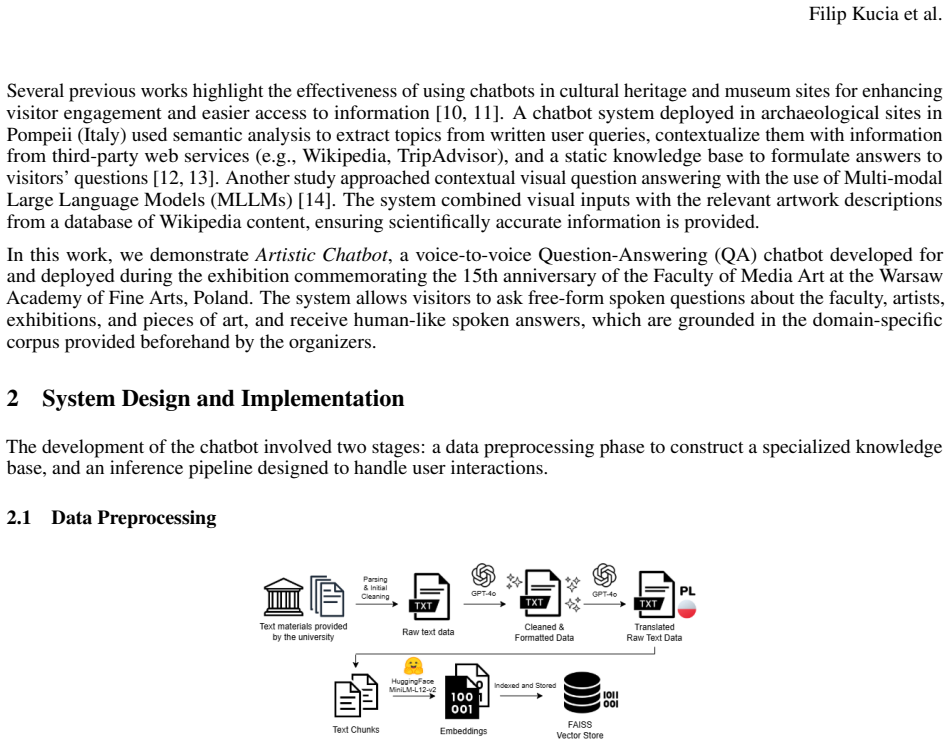
The load-bearing component is a voice-to-voice retrieval-augmented generation pipeline. A curated knowledge base of 226 organizer-supplied documents is split into 11,596 overlapping chunks, embedded, and indexed with FAISS for fast similarity search. Each query retrieves the top 20 chunks, which are re-ranked by a CrossEncoder model, and the top 3 are passed as context to GPT-4o-mini along with a randomly selected response style ('normal', 'academic', or 'laid-back'). The fixed curated corpus plus the retrieve-then-rerank step is what keeps answers tethered to the exhibition.
Load-bearing premise
The headline 60% relevance figure rests on an LLM judge's ratings that the paper does not validate against human judgment, and the two relevance tables in the paper are not internally consistent (440 vs. 404).
What would settle it
Human-annotate a random sample of about 100 logged question-response pairs from the 727; if agreement with the LLM judge is low or the human relevance rate is well below 60%, the central grounding claim fails. Also run a direct consistency check: count ratings >=3 in Table 2 (404) versus 'Yes' in Table 1 (440); a single metric should yield the same count.
If this is right
- Cultural venues can deploy LLM chatbots without letting visitors derail the content, because retrieval grounding preserves topical focus even for out-of-domain questions.
- Interaction design, not model choice, is the main bottleneck: silence-based end-of-utterance detection cut nearly one-third of queries short, so fixing input handling would raise the effective interaction rate.
- Real-world museum traffic consists mostly of simple factual questions, so a single-turn trigger-based interaction model is sufficient for a first public deployment.
- The moderate mean relevance score of 2.66 on a 1-5 scale shows that curated RAG reduces but does not eliminate vague or off-target answers, especially for ambiguous queries.
- The system ran for a full month on a nearby PC with commercial APIs, indicating a low technical barrier for similar cultural heritage sites.
Where Pith is reading between the lines
- The 60% grounding figure is likely tied to the curated 226-document corpus supplied by the organizers; venues without such a knowledge base should expect weaker grounding unless retrieval quality compensates.
- The paper's two relevance tables are not internally consistent (440 binary 'Yes' responses vs. 404 ratings >= 3), so the 60% number should be revalidated with a small human-annotated sample before being cited as a benchmark.
- A physical push-to-talk button or a learned end-of-utterance detector would recover many of the 230 incomplete queries and could raise effective engagement without changing the underlying model.
- The same retrieve-rerank pattern can be extended to cross-lingual settings by retrieving in the original language and translating only the top chunks, which would preserve art-historical terminology better than full-corpus translation.
Editorial analysis
A structured set of objections, weighed in public.
Referee Report
Summary. The paper presents Artistic Chatbot, a voice-to-voice retrieval-augmented generation (RAG) system deployed at a month-long art exhibition at the Warsaw Academy of Fine Arts. The system uses a curated knowledge base of 226 documents, chunked and embedded, with FAISS retrieval and a CrossEncoder re-ranker, and GPT-4o-mini for answer generation. The authors report interaction logs from 727 real-world user queries, analyze question completeness and relevance, and claim that 60% of responses remained directly relevant to the exhibition despite only about 20% of questions being fully on-topic. The paper contributes a practical case study of LLM-based chatbots in a public cultural-heritage setting, including system architecture, deployment issues, and lessons for future design.
Significance. The paper has practical value as a rare real-world deployment study of a voice-based RAG chatbot in a museum-like setting, with 727 authentic user interactions logged over a month. The system description is concrete and the open GitHub page supports reproducibility. The main empirical claim—that RAG grounding keeps responses relevant even when user questions are off-topic—is plausible and of interest to the HCI and cultural-heritage chatbot communities. However, the evidence for this claim rests entirely on a single LLM-as-a-judge evaluation with no human validation, and the reported numbers contain an internal inconsistency that directly affects the headline 60% statistic. These issues are fixable but currently weaken the paper's central conclusion.
major comments (3)
- [Section 3, Tables 1 and 2] The headline claim of 60.52% relevant responses (Table 1, R. relevance: 440 Yes out of 727) is not reconciled with the score distribution in Table 2. The number of responses with score >=3 is 169+110+125 = 404 (55.6%), and the number with score >=2 is 37+169+110+125 = 441 (60.7%), but neither equals 440. If the binary 'relevant' label corresponds to a threshold applied to the 1–5 scores, the threshold must be stated and the counts must match. If the two metrics were produced by different prompts or rating tasks, that should also be stated explicitly. As written, the abstract's '60% directly relevant' claim and the corresponding conclusion in Section 5 are not supported by the tabulated data in a transparent way.
- [Section 3, LLM-as-a-judge evaluation] The relevance evaluation is performed entirely by an LLM-as-a-judge, but the judge model, the evaluation prompt, and the rating instructions are not reported. Since the generator is GPT-4o-mini, using a GPT-family model as the judge creates a risk of systematic self-preference bias. The lack of any human-annotated validation sample is a serious issue for the central claim: the paper should report at least a small human-judge agreement analysis (e.g., Cohen's kappa or proportional agreement) on a random subset of the 727 interactions, and should identify the judge model and prompt. Without this, the empirical basis for 'responses grounded in exhibition content' is unverifiable.
- [Section 3 and Section 5] Even setting aside the counting inconsistency, the interpretation of the relevance scores overstates the results. The mean relevance is 2.66 on a 1–5 scale, and 286 responses (39.4%) receive the lowest score of 1. The phrase 'effectively maintain responses grounded in exhibition content' is hard to reconcile with a distribution in which nearly 40% of responses are rated as not relevant at all and the average is below the midpoint. The authors should either soften the claim to match the actual score distribution or provide additional evidence (e.g., separate groundedness judgments, examples of off-topic questions with on-topic answers) that the RAG grounding is working as claimed.
minor comments (4)
- [Section 3] The counts in the question-category sentence ('about 600 simple factual, about 150 casual and confirmation, and 24 hypothetical') sum to roughly 774, exceeding the total of 727 interactions. The categories should be defined as mutually exclusive or the counts reconciled.
- [Table 2 caption and text] The paper uses 'directly relevant' and 'grounded in exhibition content' without defining what constitutes 'relevance' in the LLM-judge rubric. A precise definition, or at least the exact instruction given to the judge, would improve interpretability.
- [Section 2.2] The statement that the response style is 'chosen randomly at the start of the session' is unclear because interactions are described as single-turn with no session state. Please clarify whether the style is fixed per user visit or randomized per query.
- [Section 2.1] The translation of source documents by GPT-4o is mentioned as a preprocessing step, but there is no discussion of how translation errors might affect retrieval quality, especially for the 8% of content that was originally non-Polish. A short note in the limitations would be sufficient.
Circularity Check
No significant circularity: the empirical evaluation is self-contained; LLM-as-a-judge validity concerns are measurement risks, not circular reductions.
full rationale
The paper's derivation chain is empirical and self-contained. The headline 60% figure comes from counting 440 of 727 logged responses judged relevant by an LLM-as-a-judge protocol (Section 3, Table 1), following an external survey [18] with no author overlap. No parameter is fitted to the evaluation outcome and then reported as a prediction; no equation defines the headline statistic in terms of the system's own weights, prompts, or retrieved chunks; and no load-bearing claim rests on a self-citation, uniqueness theorem, or ansatz imported from the authors' prior work. The use of an LLM to judge LLM outputs is a possible bias source, and the binary relevance counts in Table 1 do not perfectly reconcile with the 1-5 distribution in Table 2, but these are validity and reporting concerns, not a reduction of the claimed result to its own inputs. The paper itself acknowledges 'moderate overall response relevance (mean score: 2.66)' and calls for 'further development and measurements in input handling and the relevance of responses,' which further indicates the conclusions are not forced by construction. Under the required standard of quoting a specific reduction or fitted-parameter-renamed-as-prediction, no circular step is present.
Axiom & Free-Parameter Ledger
free parameters (4)
- Chunk size =
5,000 characters
- Chunk overlap =
200 characters
- Initial retrieval count =
20
- Re-ranked context count =
3
axioms (3)
- domain assumption The curated knowledge base (226 documents) contains accurate and sufficient information to answer exhibition-related questions.
- domain assumption The LLM-as-a-judge produces valid relevance judgments comparable to human ratings.
- domain assumption The silence-based end-of-utterance detection captures the intended question, with minor corrections (average 3.4 characters).
Cite this review
Pith. "Pith review of How to Make Museums More Interactive? Case Study of Artistic Chatbot." pith.science (2026). https://pith.science/paper/22QYY6NC
@misc{pith2026250900572,
  author       = {Pith},
  title        = {Pith review of: How to Make Museums More Interactive? Case Study of Artistic Chatbot},
  year         = {2026},
  howpublished = {\url{https://pith.science/paper/22QYY6NC}},
  note         = {Machine review of arXiv:2509.00572}
}
read the original abstract
Conversational agents powered by Large Language Models (LLMs) are increasingly utilized in educational settings, in particular in individual closed digital environments, yet their potential adoption in the physical learning environments like cultural heritage sites, museums, and art galleries remains relatively unexplored. In this study, we present Artistic Chatbot, a voice-to-voice RAG-powered chat system to support informal learning and enhance visitor engagement during a live art exhibition celebrating the 15th anniversary of the Faculty of Media Art at the Warsaw Academy of Fine Arts, Poland. The question answering (QA) chatbot responded to free-form spoken questions in Polish using the context retrieved from a curated, domain-specific knowledge base consisting of 226 documents provided by the organizers, including faculty information, art magazines, books, and journals. We describe the key aspects of the system architecture and user interaction design, as well as discuss the practical challenges associated with deploying chatbots at public cultural sites. Our findings, based on interaction analysis, demonstrate that chatbots such as Artistic Chatbot effectively maintain responses grounded in exhibition content (60\% of responses directly relevant), even when faced with unpredictable queries outside the target domain, showing their potential for increasing interactivity in public cultural sites. GitHub project page: https://github.com/cinekucia/artistic-chatbot-cikm2025
Figures


Reference graph
Works this paper leans on
-
[1]
Michael McTear and Marina Ashurkina.Transforming Conversational AI: Exploring the Power of Large Language Models in Interactive Conversational Agents. Apress, Berkeley, CA, 2024
work page 2024
-
[2]
A conversational agent for creating automations exploiting large language models
Simone Gallo, Fabio Paternò, and Alessio Malizia. A conversational agent for creating automations exploiting large language models. Personal and Ubiquitous Computing, 28(6):931–946, December 2024
work page 2024
-
[3]
Enhancing Pipeline-Based Conversational Agents with Large Language Models
Mina Foosherian, Hendrik Purwins, Purna Rathnayake, Touhidul Alam, Rui Teimao, and Klaus-Dieter Thoben. En- hancing Pipeline-Based Conversational Agents with Large Language Models, September 2023. arXiv:2309.03748 [cs]. 5 Filip Kucia et al
work page internal anchor Pith review Pith/arXiv arXiv 2023
-
[4]
Role of AI chatbots in education: systematic literature review
Lasha Labadze, Maya Grigolia, and Lela Machaidze. Role of AI chatbots in education: systematic literature review. International Journal of Educational Technology in Higher Education, 20(1):56, October 2023
work page 2023
-
[5]
Adding Chit-Chat to Enhance Task-Oriented Dialogues
Kai Sun, Seungwhan Moon, Paul Crook, Stephen Roller, Becka Silvert, Bing Liu, Zhiguang Wang, Honglei Liu, Eunjoon Cho, and Claire Cardie. Adding Chit-Chat to Enhance Task-Oriented Dialogues, May 2021. arXiv:2010.12757 [cs]
work page internal anchor Pith review Pith/arXiv arXiv 2021
-
[6]
EduChat: A Large-Scale Language Model-based Chatbot System for Intelligent Education, August 2023
Yuhao Dan, Zhikai Lei, Yiyang Gu, Yong Li, Jianghao Yin, Jiaju Lin, Linhao Ye, Zhiyan Tie, Yougen Zhou, Yilei Wang, Aimin Zhou, Ze Zhou, Qin Chen, Jie Zhou, Liang He, and Xipeng Qiu. EduChat: A Large-Scale Language Model-based Chatbot System for Intelligent Education, August 2023. arXiv:2308.02773 [cs]
Pith/arXiv arXiv 2023
-
[7]
LearnMate: Enhancing Online Education with LLM-Powered Personalized Learning Plans and Support
Xinyu Jessica Wang, Christine Lee, and Bilge Mutlu. LearnMate: Enhancing Online Education with LLM-Powered Personalized Learning Plans and Support, March 2025. arXiv:2503.13340 [cs]
work page internal anchor Pith review Pith/arXiv arXiv 2025
-
[8]
Designing reenacted chatbots to enhance museum experience
Yeo-Gyeong Noh and Jin-Hyuk Hong. Designing reenacted chatbots to enhance museum experience. Applied Sciences, 11(16), 2021
work page 2021
-
[9]
Mario Casillo, Fabio Clarizia, Giuseppe D’Aniello, Massimo De Santo, Marco Lombardi, and Domenico Santaniello. Chat-bot: A cultural heritage aware teller-bot for supporting touristic experiences.Pattern Recognition Letters, 131:234–243, 2020
work page 2020
-
[10]
A deep learning based chatbot for cultural heritage
Giancarlo Sperlí. A deep learning based chatbot for cultural heritage. In Proceedings of the 35th Annual ACM Symposium on Applied Computing, SAC ’20, page 935–937, New York, NY , USA, 2020. Association for Computing Machinery
work page 2020
-
[11]
Recbot: Virtual museum navigation through a chatbot assistant and personalized recommendations
Konstantinos Tsitseklis, Georgia Stavropoulou, Anastasios Zafeiropoulos, Athina Thanou, and Symeon Papavas- siliou. Recbot: Virtual museum navigation through a chatbot assistant and personalized recommendations. In Adjunct Proceedings of the 31st ACM Conference on User Modeling, Adaptation and Personalization, UMAP ’23 Adjunct, page 388–396, New York, NY ...
work page 2023
-
[12]
M. Lombardi, F. Pascale, and D. Santaniello. An application for cultural heritage using a chatbot. In 2019 2nd International Conference on Computer Applications & Information Security (ICCAIS), pages 1–5, 2019
work page 2019
-
[13]
A cultural heritage framework using a deep learning based chatbot for supporting tourist journey
Giancarlo Sperlí. A cultural heritage framework using a deep learning based chatbot for supporting tourist journey. Expert Systems with Applications, 183:115277, 2021
work page 2021
-
[14]
Context-aware chatbot using MLLMs for Cultural Heritage
Pavan Kartheek Rachabatuni, Filippo Principi, Paolo Mazzanti, and Marco Bertini. Context-aware chatbot using MLLMs for Cultural Heritage. In Proceedings of the 15th ACM Multimedia Systems Conference, MMSys ’24, pages 459–463, New York, NY , USA, 2024. Association for Computing Machinery
work page 2024
-
[15]
OpenAI. Hello gpt-4o. https://openai.com/index/hello-gpt-4o/ , 2025. Accessed April 12, 2025
work page 2025
-
[16]
Retrieval-augmented generation for knowledge-intensive nlp tasks, 2021
Patrick Lewis, Ethan Perez, Aleksandra Piktus, Fabio Petroni, Vladimir Karpukhin, Naman Goyal, Heinrich Küttler, Mike Lewis, Wen tau Yih, Tim Rocktäschel, Sebastian Riedel, and Douwe Kiela. Retrieval-augmented generation for knowledge-intensive nlp tasks, 2021
2021
-
[17]
The Faiss library, February 2025
Matthijs Douze, Alexandr Guzhva, Chengqi Deng, Jeff Johnson, Gergely Szilvasy, Pierre-Emmanuel Mazaré, Maria Lomeli, Lucas Hosseini, and Hervé Jégou. The Faiss library, February 2025. arXiv:2401.08281 [cs]
Pith/arXiv arXiv 2025
-
[18]
Jiawei Gu, Xuhui Jiang, Zhichao Shi, Hexiang Tan, Xuehao Zhai, Chengjin Xu, Wei Li, Yinghan Shen, Shengjie Ma, Honghao Liu, et al. A survey on llm-as-a-judge. arXiv preprint arXiv:2411.15594, 2024
Pith/arXiv arXiv 2024
-
[19]
Understanding visitors’ curiosity in a science centre with deep question processing network
Zhaozhen Xu, Amelia Howarth, Nicole Briggs, and Nello Cristianini. Understanding visitors’ curiosity in a science centre with deep question processing network. International Journal of Artificial Intelligence in Education, 34(3):1072–1101, September 2024
work page 2024
-
[20]
Michael Shen, Muhammad Umar, Kiwan Maeng, G. Edward Suh, and Udit Gupta. Towards understanding systems trade-offs in retrieval-augmented generation model inference, 2024
work page 2024
-
[21]
Introducing a new hyper-parameter for rag: Context window utilization, 2024
Kush Juvekar and Anupam Purwar. Introducing a new hyper-parameter for rag: Context window utilization, 2024
work page 2024
-
[22]
On the influence of context size and model choice in retrieval-augmented generation systems, 2025
Juraj Vladika and Florian Matthes. On the influence of context size and model choice in retrieval-augmented generation systems, 2025
work page 2025
-
[23]
Multilingual retrieval-augmented generation for knowledge-intensive task, 2025
Leonardo Ranaldi, Barry Haddow, and Alexandra Birch. Multilingual retrieval-augmented generation for knowledge-intensive task, 2025
work page 2025
-
[24]
Oswald Zink, Yosuke Higuchi, Carlos Mullov, Alexander Waibel, and Tetsunori Kobayashi. Predictive Speech Recognition and End-of-Utterance Detection Towards Spoken Dialog Systems, September 2024. arXiv:2409.19990 [eess]
Pith/arXiv arXiv 2024
-
[25]
Cheng Niu, Yuanhao Wu, Juno Zhu, Siliang Xu, Kashun Shum, Randy Zhong, Juntong Song, and Tong Zhang. Ragtruth: A hallucination corpus for developing trustworthy retrieval-augmented language models, 2024. 6 Case Study of Artistic Chatbot
work page 2024
-
[26]
Xinxi Chen, Li Wang, Wei Wu, Qi Tang, and Yiyao Liu. Honest ai: Fine-tuning "small" language models to say "i don’t know", and reducing hallucination in rag, 2024. 7
work page 2024
This paper was first reviewed by deepseek-v4-flash on August 5, 2026.
discussion (0)
Sign in with ORCID, Apple, or X to comment. Anyone can read and Pith papers without signing in.