REVIEW 4 major objections 6 minor 77 references
Pinching of ICME Flux Rope: Unprecedented Multipoint Observations of Internal Magnetic Reconnection during Gannon's Superstorm
T0 review · 4 major / 6 minor · reviewed 2026-08-05 · deepseek-v4-flash
Pith's one-line read Multipoint spacecraft data show quasi-steady magnetic reconnection raging inside the ICME flux rope during the May 2024 superstorm.
desk verdict Solid multipoint detection of internal reconnection in an ICME flux rope, but the 203 RE extent claim leans on a magnetometer-only Aditya-L1 crossing with a poorly constrained normal; the core result survives, the headline number does not. read the letter →
The pith
A machine-rendered reading of the paper's core claim, the machinery that carries it, and where it could break.
The reading
What carries the argument
The central mechanism is an internal current sheet formed inside a compressed ICME flux rope. The authors invoke the relaxed minimum-energy magnetic state (Taylor state) as the rope's reference configuration; when compression by a trailing magnetic cloud deforms the rope, the departure from that state triggers reconnection between nested magnetic surfaces. To diagnose the geometry, they use Minimum Variance Analysis (MVA) to construct a boundary-normal (LMN) coordinate frame, and they identify reconnection by the exhaust jet, the |B| dip, particle flux enhancements, and suprathermal electron pitch-angle changes.
What would settle it
A direct comparison of high-cadence plasma and field data from two spacecraft separated along the dawn-dusk direction during such an event: if the By reversal and |B| dip are not ordered by a single boundary-normal frame and single X-line timing, or if a magnetospheric-scale mission crossing the sheet sees no Hall fields or electron agyrotropy, the single-quasi-steady-current-sheet model is falsified.
Extended reading notes
Core claim
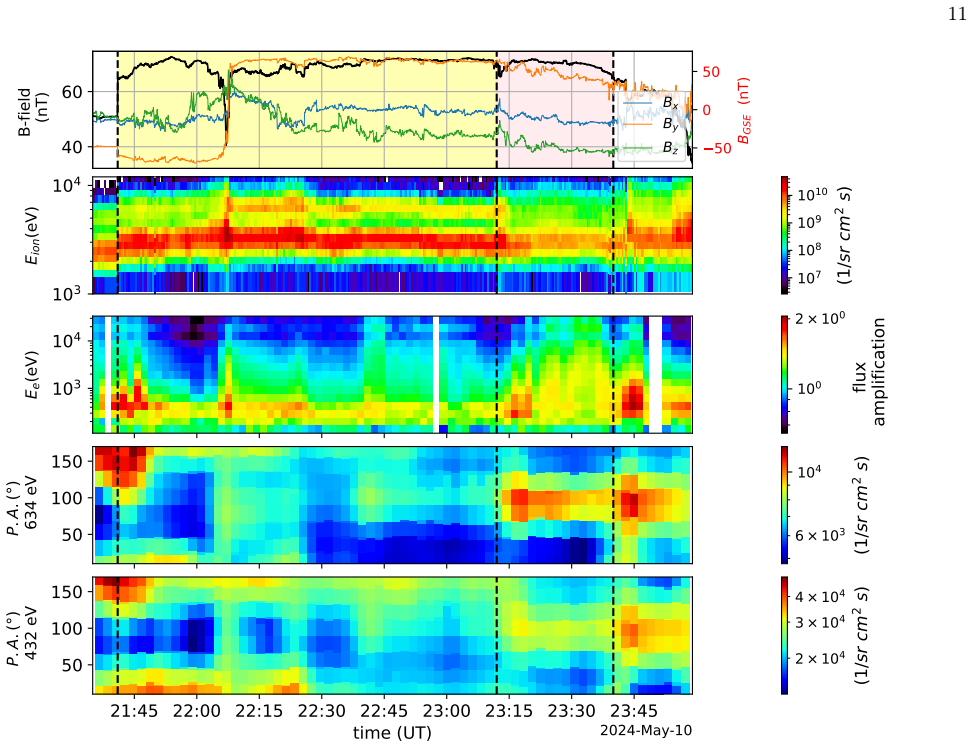
During Gannon's superstorm (May 10–11, 2024), multiple spacecraft observed the same large-scale reconnection exhaust inside the ICME magnetic cloud. The signatures are a ~150 nT reversal of IMF By, a deep dip in |B|, outflow velocities reaching 200 km/s, order-of-magnitude density and temperature enhancements in the jet, and isotropic suprathermal electron pitch-angle distributions at the current sheet, indicating disconnected field lines. The authors locate the current sheet inside the flux rope, oriented nearly along GSE-y, with a dawn-dusk extent of approximately 203 Earth radii (1.3 million km). They propose that the interaction and merging of two magnetic clouds, E1 and E2, compressed t
Load-bearing premise
All six upstream spacecraft crossed, and measured, the same single, quasi-steady current sheet that stayed contiguous across 203 Earth radii; if the magnetometer-only Aditya-L1 signature is a different structure, or the reconnection was intermittent, the reconstructed geometry collapses.
Editorial extensions
If this is right
- ICME magnetic clouds can be structurally rewritten from the inside by reconnection, so single-spacecraft crossings with a sharp By jump may indicate internal current sheets rather than distinct structures.
- Internal reconnection provides a new pathway for ICME-ICME interaction to alter the magnetic field that drives geomagnetic storms, beyond shock compression and erosion.
- The roughly 203 Earth-radius dawn-dusk extent of the exhaust shows that reconnection can operate coherently on scales far larger than a typical spacecraft separation, making multipoint timing observations diagnostic of such sheets.
- Particle energization up to about 10 keV inside the cloud indicates that internal reconnection is a local particle acceleration source in the solar wind.
- Future flux-rope models of magnetic clouds will need to include internal current sheets and reconnection when predicting the IMF orientation that governs storm intensity.
Reading between the lines
- If internal reconnection is common in merged ICMEs, some previously 'disconnected' or fragmented magnetic clouds in archival data may be reinterpreted as products of internal reconnection rather than separate eruptions.
- The same signature—a By reversal co-located with a |B| dip and a velocity jet—could be searched for systematically in other strong storms to estimate how often ICME-ICME compression triggers internal reconnection.
- A dedicated in-situ pass through such a current sheet with Hall-field measurements would test the reconnection interpretation directly; the predicted X-line orientation, inclined roughly 12 degrees from the negative Z-axis, gives a target geometry.
- If external compression is the trigger, similar internal current sheets should appear when high-speed streams or sheaths compress any large flux rope, broadening the setting beyond ICME pairs.
Editorial analysis
A structured set of objections, weighed in public.
Referee Report
Summary. The paper presents a multi-spacecraft case study of the May 10–11, 2024 extreme geomagnetic storm (Gannon's storm) and argues that the sharp IMF B_y reversal observed near L1 is due to quasi-steady magnetic reconnection inside the ICME flux rope. Using Wind, ACE, DSCOVR, ARTEMIS-P2, MMS, STEREO-A, and Aditya-L1, the authors identify a current sheet with signatures including |B| dips, B_L rotations, ion outflow jets, density/temperature jumps, particle energization, and suprathermal electron PAD isotropization. They attribute the reconnection to interaction and merging of two magnetic clouds (E1 and E2), and claim the exhaust extends ~203 R_E along GSE-y. The manuscript explicitly concedes that the geometry is not unique and depends on underlying assumptions.
Significance. If fully established, this would be a notable observation of large-scale internal magnetic reconnection inside an ICME, with implications for flux-rope evolution and space-weather forecasting. The paper's strengths are its use of seven spacecraft, the several independent reconnection signatures at plasma-bearing spacecraft (Wind, ACE, DSCOVR), and its candid discussion of caveats. The core reconnection detection is well supported at the L1 point; however, the headline quantitative claim of a 203 R_E exhaust is substantially less secure because it rests on a magnetometer-only crossing at Aditya-L1. The study is valuable as an observational report, but the spatial-extent claim needs strengthening or appropriate qualification.
major comments (4)
- [§3.2, Fig. 5c, Table 3] The 203 R_E GSE-y extent is anchored by Aditya-L1, which has only magnetometer data. Table 2 shows that the Aditya-L1 MVA was performed over the full E1&E2 interval (21:37–23:57), not over the current-sheet crossing, and gives <Bn>/<B>=0.76, indicating a poorly constrained normal; no uncertainties are provided. The paper must demonstrate, beyond the shared |B| dip and B_y/B_L reversal, that Aditya-L1 crossed the same quasi-steady current sheet as Wind/ACE/DSCOVR—e.g., via a multi-spacecraft timing fit with advection, comparison of crossing durations and field signatures, and avoidance of the alternative that Aditya-L1 observed a different boundary or a transient structure.
- [§4, quasi-steady claim] The statement that reconnection was 'quasi-steady for at least 35 minutes' is based on the temporal sequence of crossings (Aditya-L1, ACE, DSCOVR, Wind, ARTEMIS-P2) without a quantitative timing model. The spacecraft are separated in GSE-x as well as GSE-y, and the solar wind advection speed is ~700–800 km/s; a simple ordered list does not rule out spatially separated, intermittent reconnection episodes. Provide an explicit timing analysis—including uncertainties in structure orientation and spacecraft separation—or soften the claim to 'consistent with a single extended current sheet, within timing uncertainties.'
- [§3.2, Fig. 2] The widths of the reconnection outflow jets (26, 30, and 13 R_E for DSCOVR, ACE, and Wind) are used to infer the current-sheet geometry and the location of the diffusion region, but the calculation is not described. Which time intervals were used? What velocity was assumed for the spacecraft-frame crossing? How were errors propagated? Without this information, the geometry inferred from these widths cannot be independently evaluated.
- [Appendix B, Fig. 4] The trigger mechanism (compression of E1 by trailing MC E2) rests on identifying E1 and E2 as distinct magnetic clouds at STEREO-A using only magnetic field and MVA, with the text noting that plasma data are unavailable and classification is not definitive. The alternative—a single distorted flux rope—is acknowledged but not quantitatively tested. Since the causal narrative depends on E2 being a separate MC, please provide a more rigorous separation test (e.g., field-line twist signatures, boundary orientation, or comparison with numerical ICME-interaction simulations) or explicitly present the trigger as one possible scenario rather than a conclusion.
minor comments (6)
- [§1 and §3.2] The value of 1 R_E is inconsistent: the introduction gives 6371 km, while §3.2 gives 6317 km. Please unify.
- [Table 3] The caption says 'on 10th May 2025', but the event is May 10, 2024. Please correct the typo.
- [Appendix A.2] The eigenvalue ratio for MVA quality is defined as R = λ2/λ1 in the text, but Table 2 reports λ2/λ3. Clarify which ratio is intended and use consistent notation.
- [Figure 2] The panel labels (e.g., subpanel 'k' in the caption) are not visible or explained in the figure; please match labels to panels for readability.
- [Appendix B] The duration comparison between STEREO-A and ACE E1/E2 (approximately 2:20 hours) is qualitative; please provide actual start/end times and a quantitative similarity metric.
- [References] The reference 'Burt & Smith 2012' is incomplete (no article title or DOI). Also, the citation to 'Weiler et al. 2025' appears without a year in the text (it is in the reference list); please check.
Circularity Check
No significant circularity: the 203 RE extent is a geometric multipoint measurement, not a fitted prediction; the self-citations are methodological and not load-bearing.
full rationale
The paper is an observational multipoint case study, not a derivation whose output is encoded in its inputs. The headline spatial extent (~203 RE along GSE-y) is obtained by comparing the Y positions of Wind (Y≈+100.99 RE) and Aditya-L1 (Y≈−102.12 RE; Table 3) after identifying the same magnetic-field reversal/dip at both spacecraft. This is an operational measurement using known spacecraft separation, not a fitted parameter renamed as a prediction, and it is explicitly conditional on the assumption that Aditya-L1 crossed the same current sheet ('the solution is not unique and depends on underlying assumptions', Sec. 4). The core reconnection evidence—outflow jets, density/temperature jumps, particle energization, and suprathermal electron PAD isotropization—comes from plasma-bearing spacecraft (DSCOVR, ACE, Wind) and is independent of the extent claim. The self-citations (Raghav et al. 2019, 2023; Shaikh et al. 2017, 2018) are used for MVA methodology and for the pancaking/flattening interpretation; they do not carry the load of the reconnection detection, and no uniqueness theorem or ansatz is imported from them. No equation is defined in terms of its conclusion, and no fitted value is presented as a prediction. The underdetermination of the Aditya-L1 crossing (magnetometer-only, <Bn>/<B>=0.76, no MVA uncertainties) is a correctness/evidential weakness, not circularity.
Assumptions & free parameters
free parameters (1)
- Hand-selected MVA and event time intervals =
Table 2 intervals, e.g., ACE E1/E2 2024-05-10 21:39-23:59 UT, STEREO-A E1 18:15-19:40 UT, Wind 21:45-23:40 UT
assumptions (6)
- domain assumption Taylor minimum-energy (force-free) state with Nabla x B = lambda B is the reference equilibrium for ICME flux ropes, and deviation from it triggers reconnection
- domain assumption MVA returns the correct boundary-normal (LMN) frame for the reconnection current sheet
- domain assumption The combination of |B| dip, BL rotation, VL decrease, density and temperature jumps, particle energization, and PAD isotropization uniquely implies magnetic reconnection
- domain assumption Quasi-steadiness and spatial continuity of the reconnection site over 35 minutes and about 203 RE between Wind and Aditya-L1
- ad hoc to paper E1 and E2 are two distinct magnetic clouds at STEREO-A, identified by magnetic field and MVA alone, and they merge at L1
- ad hoc to paper Compression of E1 by the trailing MC E2 caused the deviation from the Taylor state and triggered the internal reconnection
Cite this review
Pith. "Pith review of Pinching of ICME Flux Rope: Unprecedented Multipoint Observations of Internal Magnetic Reconnection during Gannon's Superstorm." pith.science (2026). https://pith.science/paper/4QTTZLZF
@misc{pith2026250900577,
  author       = {Pith},
  title        = {Pith review of: Pinching of ICME Flux Rope: Unprecedented Multipoint Observations of Internal Magnetic Reconnection during Gannon's Superstorm},
  year         = {2026},
  howpublished = {\url{https://pith.science/paper/4QTTZLZF}},
  note         = {Machine review of arXiv:2509.00577}
}
read the original abstract
The extreme solar storm of May 10, 2024, during the 25th solar cycle, which recorded a symmetric H component index (Sym-H) reaching -500 nT, was the strongest since the 2003 Halloween storm. This event offered a unique opportunity for unprecedented multipoint observation of the complex interaction of Interplanetary Coronal Mass Ejections (ICME) from different vantage points. Utilizing NASA's Wind, ACE, DSCOVR, THEMIS-C, STEREO-A, MMS, and ISRO's recently launched Aditya-L1 spacecraft, we comprehensively investigated the spatio-temporal variations in interplanetary plasma and magnetic field parameters. Our study reveals large-scale quasi-steady magnetic reconnection within the interior of the ICME flux rope, possibly triggered by interactions between multiple ICMEs. A current sheet (CS) forms within the flux rope, enabling internal magnetic reconnection between concentric magnetic surfaces, which leads to a sharp reversal of the IMF By component, as observed at the L1 point. Concurrently, reconnection exhaust and enhanced electron and ion fluxes were detected with the CS, extending over 200 RE (1.3 million km) along the GSE-y direction. This finding sheds new light on the role of internal reconnection in ICME evolution, highlighting its pivotal role in modifying the morphology of the ICME magnetic structure and exerting severe space weather effects on Earth.
Figures


Figures from the paper (4 more)



Reference graph
Works this paper leans on
-
[2]
2008, Space Science Reviews, 136, 203, 10.1007/978-0-387-09649-0_8
Acu \ n a, M., Curtis, D., Scheifele, J., et al. 2008, Space Science Reviews, 136, 203, 10.1007/978-0-387-09649-0_8
-
[3]
Al-Haddad, N., Roussev, I. I., M \"o stl, C., et al. 2011, The Astrophysical Journal Letters, 738, L18, 10.1088/2041-8205/738/2/L18
-
[4]
2008, Space Science Reviews, 141, 5, 10.1007/978-0-387-89820-9_2
Angelopoulos, V. 2008, Space Science Reviews, 141, 5, 10.1007/978-0-387-89820-9_2
-
[5]
2024, Journal of Geophysical Research: Space Physics, 129, e2023JA031687, 10.1029/2023ja031687
Ashna, V., Bhaskar, A., Manju, G., & Sini, R. 2024, Journal of Geophysical Research: Space Physics, 129, e2023JA031687, 10.1029/2023ja031687
-
[6]
2008, Space science reviews, 141, 235, 10.1007/978-0-387-89820-9_11
Auster, H., Glassmeier, K., Magnes, W., et al. 2008, Space science reviews, 141, 235, 10.1007/978-0-387-89820-9_11
-
[7]
Burlaga, L., Sittler, E., Mariani, F., & Schwenn, a. R. 1981, Journal of Geophysical Research: Space Physics, 86, 6673, 10.1029/ja086ia08p06673
- [8]
-
[9]
Carcaboso, F., G \'o mez-Herrero, R., Lara, F. E., et al. 2020, Astronomy & Astrophysics, 635, A79, 10.1051/0004-6361/201936601
Show all 77 references
-
[10]
2017, Journal of Geophysical Research: Space Physics, 122, 2574, 10.1002/2016ja022781
Chakrabarty, D., Hui, D., Rout, D., et al. 2017, Journal of Geophysical Research: Space Physics, 122, 2574, 10.1002/2016ja022781
2017 doi
-
[11]
2023, The Astrophysical Journal, 953, 15, 10.3847/1538-4357/acdcf7
Farrugia, C., Vasquez, B., Lugaz, N., et al. 2023, The Astrophysical Journal, 953, 15, 10.3847/1538-4357/acdcf7
2023 doi
-
[12]
L., Opher, M., & Drake, J
Fermo, R. L., Opher, M., & Drake, J. F. 2014, Physical Review Letters, 113, 031101, 10.1103/physrevlett.113.031101
2014 doi
-
[13]
2025, Geophysical Research Letters, 52, e2024GL114040, 10.1029/2024gl114040
Fu, W., Fu, H., Zhang, W., Yu, Y., & Cao, J. 2025, Geophysical Research Letters, 52, e2024GL114040, 10.1029/2024gl114040
2025 doi
-
[14]
2017, The Astrophysical Journal, 840, 85, 10.3847/1538-4357/aa6c5c
G \'o mez-Herrero, R., Dresing, N., Klassen, A., et al. 2017, The Astrophysical Journal, 840, 85, 10.3847/1538-4357/aa6c5c
2017 doi
-
[15]
1994, Journal of Geophysical Research: Space Physics, 99, 5771, 10.1029/93ja02867
Gonzalez, W., Joselyn, J.-A., Kamide, Y., et al. 1994, Journal of Geophysical Research: Space Physics, 99, 5771, 10.1029/93ja02867
1994 doi
-
[16]
2016, Astrophysics and space science library, 427, 10, 10.1007/978-3-319-26432-5
Gonzalez, W., & Parker, E. 2016, Astrophysics and space science library, 427, 10, 10.1007/978-3-319-26432-5
2016 doi
-
[17]
D., Echer, E., Tsurutani, B
Gonzalez, W. D., Echer, E., Tsurutani, B. T., Cl \'u a de Gonzalez, A. L., & Dal Lago, A. 2011, Space science reviews, 158, 69, 10.1007/s11214-010-9715-2
2011 doi
-
[18]
2016, Geoscience Letters, 3, 1, 10.1186/s40562-016-0039-2
Gopalswamy, N. 2016, Geoscience Letters, 3, 1, 10.1186/s40562-016-0039-2
2016 doi
-
[19]
M., McComas, D., & Forsyth, R
Gosling, J., Eriksson, S., Skoug, R. M., McComas, D., & Forsyth, R. 2006, The Astrophysical Journal, 644, 613, 10.1086/503544
2006 doi
-
[20]
1974, Journal of Geophysical Research, 79, 4581, 10.1029/ja079i031p04581
Gosling, J., Hildner, E., MacQueen, R., et al. 1974, Journal of Geophysical Research, 79, 4581, 10.1029/ja079i031p04581
1974 doi
-
[21]
Gosling, J., Pizzo, V., & Bame, S. J. 1973, Journal of Geophysical Research, 78, 2001, 10.1029/ja078i013p02001
1973 doi
-
[22]
M., McComas, D., & Smith, C
Gosling, J., Skoug, R. M., McComas, D., & Smith, C. 2005, Journal of Geophysical Research: Space Physics, 110, 10.1029/2004ja010809
2005 doi
-
[23]
2017, Space weather (IOP Publishing), 10.1088/978-0-7503-1372-8ch1
Hapgood, M. 2017, Space weather (IOP Publishing), 10.1088/978-0-7503-1372-8ch1
2017 doi
-
[24]
M., et al
Hayakawa, H., Ribeiro, P., Vaquero, J. M., et al. 2020, The Astrophysical Journal Letters, 897, L10, 10.3847/2041-8213/ab6a18
2020 doi
-
[25]
2025, The Astrophysical Journal, 979, 49, 10.3847/1538-4357/ad9335
Hayakawa, H., Ebihara, Y., Mishev, A., et al. 2025, The Astrophysical Journal, 979, 49, 10.3847/1538-4357/ad9335
2025 doi
-
[26]
1970, Journal of Geophysical Research, 75, 1, 10.1029/ja075i001p00001
Hirshberg, J., Alksne, A., Colburn, D., Bame, S., & Hundhausen, A. 1970, Journal of Geophysical Research, 75, 1, 10.1029/ja075i001p00001
1970 doi
-
[27]
2020, Geophysical Research Letters, 47, e2019GL086676, 10.1029/2019gl086676
Holappa, L., Asikainen, T., & Mursula, K. 2020, Geophysical Research Letters, 47, e2019GL086676, 10.1029/2019gl086676
2020 doi
-
[28]
2021, Journal of Geophysical Research: Space Physics, 126, e2021JA029202, 10.1029/2021ja029202
Holappa, L., Robinson, R., Pulkkinen, A., Asikainen, T., & Mursula, K. 2021, Journal of Geophysical Research: Space Physics, 126, e2021JA029202, 10.1029/2021ja029202
2021 doi
-
[29]
L., & Adams, W
Kaiser, M. L., & Adams, W. J. 2007, IEEE, 1, 10.1109/aero.2007.352745
2007
-
[30]
L., Kucera, T., Davila, J., et al
Kaiser, M. L., Kucera, T., Davila, J., et al. 2008, Space Science Reviews, 136, 5, 10.1007/978-0-387-09649-0_2
2008 doi
-
[31]
2015, The Astrophysical Journal, 808, 181, 10.1088/0004-637x/808/2/181
Khabarova, O., Zank, G., Li, G., et al. 2015, The Astrophysical Journal, 808, 181, 10.1088/0004-637x/808/2/181
2015 doi
-
[32]
2021, Space Science Reviews, 217, 38, 10.1007/s11214-021-00814-x
Khabarova, O., Malandraki, O., Malova, H., et al. 2021, Space Science Reviews, 217, 38, 10.1007/s11214-021-00814-x
2021 doi
-
[33]
V., Zank, G
Khabarova, O. V., Zank, G. P., Li, G., et al. 2016, The Astrophysical Journal, 827, 122, 10.3847/0004-637x/827/2/122
2016 doi
-
[34]
E., & Pulkkinen, T
Kilpua, E., Koskinen, H. E., & Pulkkinen, T. I. 2017, Living Reviews in Solar Physics, 14, 1, 10.1007/s41116-017-0009-6
2017 doi
-
[35]
1982, Journal of Geophysical Research: Space Physics, 87, 613, 10.1029/ja087ia02p00613
Klein, L., & Burlaga, L. 1982, Journal of Geophysical Research: Space Physics, 87, 613, 10.1029/ja087ia02p00613
1982 doi
-
[36]
2024, The Astrophysical Journal Letters, 970, L13, 10.3847/2041-8213/ad5da6
Kruparova, O., Krupar, V., Szabo, A., et al. 2024, The Astrophysical Journal Letters, 970, L13, 10.3847/2041-8213/ad5da6
2024 doi
-
[37]
2024, Journal of Astronomy and Space Sciences, 41, 171, 10.5140/jass.2024.41.3.171
Kwak, Y.-S., Kim, J.-H., Kim, S., et al. 2024, Journal of Astronomy and Space Sciences, 41, 171, 10.5140/jass.2024.41.3.171
2024 doi
-
[38]
1990, Journal of Geophysical Research: Space Physics, 95, 11957, 10.1029/ja095ia08p11957
Lepping, R., Jones, J., & Burlaga, L. 1990, Journal of Geophysical Research: Space Physics, 95, 11957, 10.1029/ja095ia08p11957
1990 doi
-
[39]
1995, Space Science Reviews, 71, 207
Lepping, R., Ac \ u na, M., Burlaga, L., et al. 1995, Space Science Reviews, 71, 207
1995
-
[40]
1995, Space Science Reviews, 71, 125, 10.1007/bf00751328
Lin, R., Anderson, K., Ashford, S., et al. 1995, Space Science Reviews, 71, 125, 10.1007/bf00751328
1995 doi
-
[41]
2005, The Astrophysical Journal, 622, 1225, 10.1086/427768
Manchester IV, W., Gombosi, T., De Zeeuw, D., et al. 2005, The Astrophysical Journal, 622, 1225, 10.1086/427768
2005 doi
-
[42]
B., Gombosi, T
Manchester IV, W. B., Gombosi, T. I., Roussev, I., et al. 2004, Journal of Geophysical Research: Space Physics, 109, 10.1029/2002JA009672
2004 doi
-
[43]
1998, The advanced composition explorer mission, 563, 10.1007/978-94-011-4762-0_20
McComas, D., Bame, S., Barker, P., et al. 1998, The advanced composition explorer mission, 563, 10.1007/978-94-011-4762-0_20
1998 doi
-
[44]
1993, Solar physics, 147, 169, 10.1007/bf00675493
Nakagawa, T. 1993, Solar physics, 147, 169, 10.1007/bf00675493
1993 doi
-
[45]
1989, Journal of Geophysical Research: Space Physics, 94, 11761, 10.1029/ja094ia09p11761
Nakagawa, T., Nishida, A., & Saito, T. 1989, Journal of Geophysical Research: Space Physics, 94, 11761, 10.1029/ja094ia09p11761
1989 doi
-
[46]
1993, Journal of Geophysical Research: Space Physics, 98, 9383, 10.1029/93ja00216
Neugebauer, M., Clay, D., & Gosling, J. 1993, Journal of Geophysical Research: Space Physics, 98, 9383, 10.1029/93ja00216
1993 doi
-
[47]
F., & Cant \'o , J
Niembro, T., Lara, A., Gonz \'a lez, R. F., & Cant \'o , J. 2019, Journal of Space Weather and Space Climate, 9, A4, 10.1051/swsc/2018049
2019
-
[48]
2025, Journal of Geophysical Research: Space Physics, 130, e2024JA033691, 10.1029/2024ja033691
Ohtani, S., Zou, Y., Merkin, V., et al. 2025, Journal of Geophysical Research: Space Physics, 130, e2024JA033691, 10.1029/2024ja033691
2025 doi
-
[49]
2009, Solar Physics, 260, 207, 10.1007/s11207-009-9442-6
Owens, M. 2009, Solar Physics, 260, 207, 10.1007/s11207-009-9442-6
2009 doi
-
[50]
2017, Scientific Reports, 7, 4152, 10.1038/s41598-017-04546-3
Owens, M., Lockwood, M., & Barnard, L. 2017, Scientific Reports, 7, 4152, 10.1038/s41598-017-04546-3
2017 doi
-
[51]
J., Cargill, P., Pagel, C., Siscoe, G., & Crooker, N
Owens, M. J., Cargill, P., Pagel, C., Siscoe, G., & Crooker, N. 2005, Journal of Geophysical Research: Space Physics, 110, 10.1029/2004ja010814
2005 doi
-
[52]
2020, Geophysical Research Letters, 47, e2019GL086372, 10.1029/2019GL086372
Pal, S., Dash, S., & Nandy, D. 2020, Geophysical Research Letters, 47, e2019GL086372, 10.1029/2019GL086372
2020 doi
-
[53]
1978, Journal of Geophysical Research: Space Physics, 83, 75, 10.1029/ja083ia01p00075
Palmer, I., Allum, F., & Singer, S. 1978, Journal of Geophysical Research: Space Physics, 83, 75, 10.1029/ja083ia01p00075
1978 doi
-
[54]
K., & Savani, N
Palmerio, E., Kilpua, E. K., & Savani, N. P. 2016, Annales Geophysicae, 10.5194/angeo-34-313-2016
2016 doi
-
[55]
2016, Space Science Reviews, 199, 331, 10.1007/s11214-016-0245-4
Pollock, C., Moore, T., Jacques, A., et al. 2016, Space Science Reviews, 199, 331, 10.1007/s11214-016-0245-4
2016 doi
-
[56]
2023, Solar Physics, 298, 64, 10.1007/s11207-023-02157-y
Raghav, A., Shaikh, Z., Vemareddy, P., et al. 2023, Solar Physics, 298, 64, 10.1007/s11207-023-02157-y
2023 doi
-
[57]
N., Choraghe, K., & Shaikh, Z
Raghav, A. N., Choraghe, K., & Shaikh, Z. I. 2019, Monthly Notices of the Royal Astronomical Society, 488, 910, 10.1093/mnras/stz1608
2019 doi
-
[58]
D., et al
Riley, P., Baker, D., Liu, Y. D., et al. 2018, Space Science Reviews, 214, 1, 10.1007/s11214-017-0456-3
2018 doi
-
[59]
2005, Solar Physics, 229, 323, 10.1007/s11207-005-8777-x
Russell, C., & Shinde, A. 2005, Solar Physics, 229, 323, 10.1007/s11207-005-8777-x
2005 doi
-
[60]
2016, Space Science Reviews, 199, 189, 10.1007/s11214-014-0057-3
Russell, C., Anderson, B., Baumjohann, W., et al. 2016, Space Science Reviews, 199, 189, 10.1007/s11214-014-0057-3
2016 doi
-
[61]
2017, The Astrophysical Journal, 844, 121, 10.3847/1538-4357/aa729f
Shaikh, Z., Raghav, A., & Bhaskar, A. 2017, The Astrophysical Journal, 844, 121, 10.3847/1538-4357/aa729f
2017 doi
-
[62]
I., Raghav, A
Shaikh, Z. I., Raghav, A. N., Vichare, G., Bhaskar, A., & Mishra, W. 2018, The Astrophysical Journal, 866, 118, 10.3847/1538-4357/aae1b1
2018 doi
-
[63]
W., L’Heureux, J., Ness, N
Smith, C. W., L’Heureux, J., Ness, N. F., et al. 1998, The advanced composition explorer mission, 613, 10.1007/978-94-011-4762-0_21
1998 doi
-
[64]
Sonnerup, B. U. ., & Cahill, L. J. 1967, Journal of Geophysical Research, 72, 171, 10.1029/jz072i001p00171
1967 doi
-
[65]
Cyr, O., Howard, R., Sheeley Jr, N., et al
St. Cyr, O., Howard, R., Sheeley Jr, N., et al. 2000, Journal of Geophysical Research: Space Physics, 105, 18169, 10.1029/1999ja000381
2000 doi
-
[66]
Taylor, J. B. 1974, Physical Review Letters, 33, 1139, 10.1103/physrevlett.33.1139
1974 doi
-
[67]
1986, Reviews of Modern Physics, 58, 741, 10.1103/revmodphys.58.741
---. 1986, Reviews of Modern Physics, 58, 741, 10.1103/revmodphys.58.741
1986 doi
-
[68]
2024, Nature Communications, 15, 9198, 10.1038/s41467-024-53538-1
Teng, W., Su, Y., Ji, H., & Zhang, Q. 2024, Nature Communications, 15, 9198, 10.1038/s41467-024-53538-1
2024 doi
-
[69]
V., Bhaskar, A., Mayank, P., Vaidya, B., & Venugopal, I
Thampi, S. V., Bhaskar, A., Mayank, P., Vaidya, B., & Venugopal, I. 2025, The Astrophysical Journal, 981, 76, 10.3847/1538-4357/ada93c
2025 doi
-
[70]
2022, Proceedings of the International Astronomical Union, 18, 17–27, 10.1017/S1743921323001230
Tripathi, D., Chakrabarty, D., Nandi, A., et al. 2022, Proceedings of the International Astronomical Union, 18, 17–27, 10.1017/S1743921323001230
2022 doi
-
[71]
V., & Bhaskar, A
Venugopal, I., Thampi, S. V., & Bhaskar, A. 2025, Scientific Reports, 15, 26551, 10.1038/s41598-025-08843-0
2025 doi
-
[72]
Vichare, G., & Bagiya, M. S. 2024, Geophysical Research Letters, 51, e2024GL112569, 10.1029/2024gl112569
2024 doi
-
[73]
2016, Journal of Geophysical Research: Space Physics, 121, 7423, 10.1002/2016ja022924
Wang, Y., Zhang, Q., Liu, J., et al. 2016, Journal of Geophysical Research: Space Physics, 121, 7423, 10.1002/2016ja022924
2016 doi
-
[74]
F., & Howard, T
Webb, D. F., & Howard, T. A. 2012, Living Reviews in Solar Physics, 9, 1
2012
-
[75]
E., et al
Weiler, E., M \"o stl, C., Davies, E. E., et al. 2025, Space Weather, 23, e2024SW004260, 10.1029/2024sw004260
2025 doi
-
[76]
2023, Journal of Atmospheric and Solar-Terrestrial Physics, 252, 106154
Xie, H., Gopalswamy, N., Akiyama, S., Yashiro, S., & Makela, P. 2023, Journal of Atmospheric and Solar-Terrestrial Physics, 252, 106154
2023
-
[77]
K., Vijaya, Y., Krishnam Prasad, B., et al
Yadav, V. K., Vijaya, Y., Krishnam Prasad, B., et al. 2025, Solar Physics, 300, 10.1007/s11207-025-02440-0
2025 doi
-
[78]
2025, AGU Advances, 6, e2025AV001688, 10.1029/2025AV001688
Zhang, Y., Motoba, T., Paxton, L., & Schaefer, R. 2025, AGU Advances, 6, e2025AV001688, 10.1029/2025AV001688
2025 doi
Reviewed August 5, 2026 · model on record in the stance chip above.
Discussion (0). Continue with ORCID to comment.