REVIEW 3 major objections 4 minor 31 references
Bimorph Lithium Niobate Piezoelectric Micromachined Ultrasonic Transducer
T0 review · 3 major / 4 minor · reviewed 2026-08-05 · deepseek-v4-flash
Pith's one-line read The paper reports a prototype bimorph lithium niobate PMUT whose opposite-poled layers convert a lateral electric field into a 1-MHz flexural vibration, with 3.6% simulated coupling and measured displacement the authors read as validation.
desk verdict A real bimorph P3F LN PMUT prototype, but the headline coupling is simulated, not measured, and the LDV displacement numbers contradict each other by a factor of ~23. read the letter →
The pith
A machine-rendered reading of the paper's core claim, the machinery that carries it, and where it could break.
The reading
What carries the argument
The bimorph P3F X-cut LN stack is the central object: two 10-µm lithium niobate layers rotated 180° in-plane (opposite Z polarizations) bonded over a buried oxide on a silicon carrier, with top platinum electrodes applying lateral field excitation. The reversed polarization makes the stress in the two layers opposite in sign under the same field, so bending displacements add across the thickness; the strong e11 coefficient (4.65 C/m²) provides the lateral piezoelectric drive. This mechanism carries the argument by converting a lateral electric field into a large out-of-plane flexural response while suppressing charge-cancelling overtones. The simulated coupling (3.6%) and displacement (3.27
What would settle it
De-embed the feedthrough from the measured admittance and extract the coupling from the resonance-antiresonance spacing; if the extracted coupling is well below 3.6%, or a calibrated LDV scan does not show the simulated flexural mode at ~1 MHz, the central claims fail.
Extended reading notes
Core claim
The central discovery is that a bimorph periodically poled piezoelectric film (P3F) stack of X-cut lithium niobate can convert a lateral electric field into a strong out-of-plane flexural mode. In the stack, two 10-µm X-cut LN layers are rotated 180° in-plane so their Z-polarization axes point opposite ways; the same lateral field then produces stresses of opposite sign in the two layers, which bend the membrane in the same direction and suppress charge-cancelling overtones. Finite-element analysis predicts a resonance near 1.1 MHz, a dynamic displacement of 3.27 nm/V, and an effective electromechanical coupling of 3.6%, which the authors say is higher than reported ScAlN PMUTs. The fabricat
Load-bearing premise
The argument assumes the finite-element model—using literature lithium niobate constants and a quality factor of 20—faithfully represents the fabricated device, even though the measured electrical signal contains feedthrough and the measured displacement values disagree.
Editorial extensions
If this is right
- The bimorph stack would turn lateral-field excitation into a large flexural deflection without a DC bias, a direct advantage for low-voltage drive electronics.
- At 3.6% simulated coupling, the LN bimorph would exceed the cited ScAlN PMUTs while retaining the low dielectric loss that makes LN attractive as a receiver.
- The same transferred-film P3F process can be extended to multi-layer LN stacks and arrays, so the design is a platform rather than a single device.
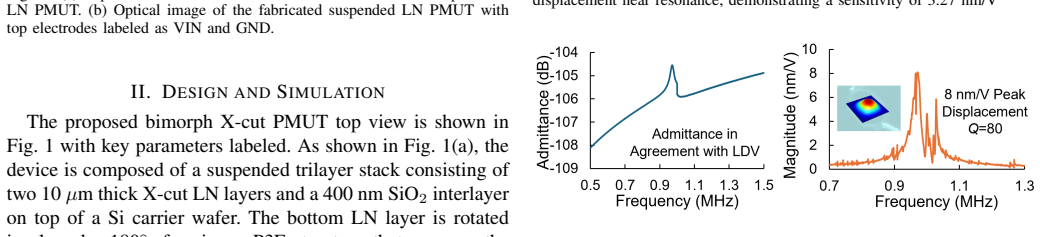
- Matching the measured resonance (0.97 MHz) to the simulated one (1.1 MHz) through electrode mass-loading and parasitics, as the paper argues, would make the design's frequency predictable from FEA.
Reading between the lines
- The 3.6% coupling number is a simulation value; the measured admittance is not de-embedded, so the realized coupling of this specific prototype is still unknown.
- The paper's two displacement figures (8 nm/V in the full text and 340 pm/V in the abstract) are inconsistent by a factor of roughly 24, so the claimed LDV validation becomes quantitative only after that discrepancy is resolved.
- If feedthrough parasitics are the main loss mechanism, a differential excitation or shielded electrode layout could recover the simulated performance—an inexpensive next experiment.
Editorial analysis
A structured set of objections, weighed in public.
Referee Report
Summary. The paper reports a prototype bimorph piezoelectric micromachined ultrasonic transducer (PMUT) made from transferred periodically poled X-cut lithium niobate (P3F LN), with two LN layers of opposite in-plane polarization to enable constructive lateral-field excitation of a flexural mode. Design, COMSOL FEA, fabrication, and electrical/admittance and laser Doppler vibrometry (LDV) measurements are presented. The abstract and conclusion claim that the fabricated PMUT demonstrates an out-of-plane mode near 1 MHz with 3.6% electromechanical coupling and that LDV validates the FEA. However, the 3.6% value appears only in the COMSOL simulation (Fig. 2c), with quality factor Q manually set to 20; the measured admittance spectrum is not fitted or de-embedded, and the LDV displacement values are internally inconsistent (8 nm/V vs. 340 pm/V). The paper itself defers 'modeling of the measured data' and feedthrough mitigation to future work.
Significance. If the claims were fully supported, the paper would introduce a promising bimorph P3F LN PMUT with a material-level figure of merit that could exceed ScAlN and PZT alternatives, and the constructive opposite-polarization actuation scheme would be a meaningful device concept. The authors should be credited for fabricating a working suspended LN PMUT, using literature constants in the FEA without recycling fitted parameters, and providing direct LDV data. However, the central quantitative claim—demonstrated 3.6% electromechanical coupling—is not extracted from any measurement, and the displacement validation is contradicted by the numbers reported. The significance is therefore currently conditional on the authors closing the gap between simulation and measurement.
major comments (3)
- [Abstract; Section II, Fig. 2(c); Section III, Fig. 3(a)] The claim that the 'fabricated PMUT demonstrates ... an electromechanical coupling of 3.6%' is not supported by the presented data. The 3.6% value is a COMSOL result computed with Q manually set to 20 and literature LN constants. The measured admittance spectrum in Fig. 3(a) is not fitted to an equivalent circuit or otherwise processed to extract kt^2; the text explicitly states that the admittance is higher than FEA 'indicating feedthrough' and that modeling of measured data is left to future work. Please report a measured coupling coefficient (e.g., from a fitted Butterworth–Van Dyke model or a de-embedded resonance/anti-resonance analysis) or revise the abstract/conclusion to state that 3.6% is the simulated value only.
- [Abstract; Section III, Fig. 3(b)] The LDV displacement values are internally contradictory. The abstract states a 'peak center displacement of 340 pm/V', while Section III and Fig. 3(b) report a measured displacement of 'approximately 8 nm/V'. These differ by a factor of about 23.5. Furthermore, the text says 'The reduced displacement is potentially caused by the substrate feedthrough parasitics,' which is inconsistent with a measured 8 nm/V value that is larger than the simulated 3.27 nm/V (Fig. 2d), whereas 340 pm/V is smaller. As written, the 'LDV further validates the finite element analysis' claim cannot be assessed. Please correct the numbers and explicitly reconcile the measured and simulated displacement sensitivities.
- [Section III] The measured resonance is 0.97 MHz versus the simulated 1.1 MHz (about 13% lower), attributed to backside-alignment offset and electrode mass loading, but no quantitative model or calibration is provided to support this. More importantly, the measured admittance is not de-embedded or modeled, so the resonant frequency, damping, and any extracted coupling are not grounded in a fitted response. The statement that 'future work will focus on ... modeling of the measured data' confirms that the measured electrical response is not yet understood. This gap directly bears on the central claim of demonstrated coupling.
minor comments (4)
- [Section II] The stack description is inconsistent: the text first states a '400 nm SiO2 interlayer' and later 'the film stack, consisting of 10 µm LN and 2µm SiO2'. Please clarify the SiO2 thickness and the total stack geometry.
- [Abstract and Section III] The displacement unit is written as '8nm /V' and '340 pm/V'; please use consistent spacing (e.g., '8 nm/V') and ensure the figure axis labels match the text.
- [Section I, references] Reference [27] is a related preprint by the same group; the P3F transfer process is not independently verified here. A brief statement about the transfer yield or a comparison with other reported LiNbO3 transfer methods would strengthen the fabrication section.
- [Section V] The heading 'ACKOWLEDGEMENT' is misspelled; should be 'ACKNOWLEDGMENT' or 'ACKNOWLEDGEMENTS'.
Circularity Check
No significant circularity; the derivation chain is self-contained. The main weakness is an evidence gap (the headline 3.6% coupling is simulated, not extracted from measured admittance), not circular reasoning.
full rationale
The paper's derivation chain is not circular. The COMSOL FEA in Sec. II uses literature lithium-niobate constants and a hand-set Q=20 to predict a ~1.1 MHz resonance, 3.6% effective coupling, and 3.27 nm/V displacement; these are not fitted to the later measurements and then reissued as predictions. The measured admittance resonance (~0.97 MHz, Fig. 3a) and LDV displacement (Fig. 3b) are independent observations. The abstract and conclusion claim the fabricated PMUT 'demonstrates' a 3.6% coupling, but that number only appears in the simulation; no measured kt^2 is extracted from the admittance spectrum. This is a correctness/evidence gap, not a circular reduction. The paper also explicitly states that feedthrough 'will be studied in future works' and that future work will focus on 'modeling of the measured data,' which confirms the measurement is not yet fully understood but does not make the claim circular. The only self-citation of note is [27], used to support the P3F bimorph configuration; however, the same sentence cites the external reference [28] (Naumenko), and the central validation rests on measured resonance/displacement rather than on that citation chain. There is also an internal inconsistency in the reported LDV amplitude (abstract/full text state 340 pm/V vs. the body's 8 nm/V), but that is an internal-consistency problem, not a definitional recycling of inputs into outputs. Overall, no fitted parameter is renamed as a prediction and no result is equivalent to its inputs by construction; score 2 reflects only the minor, non-load-bearing self-citation and the lack of independent verification of the transferred-P3F process.
Assumptions & free parameters
free parameters (1)
- Quality factor Q in FEA =
20
assumptions (4)
- domain assumption The transferred P3F stack from NGK has the assumed 180-degree-rotated X-cut crystal orientations and uniform poling across the two 10 µm LN layers.
- domain assumption COMSOL FEA with bulk lithium niobate constants from ref [26] and the chosen boundary conditions reproduces the fabricated diaphragm.
- domain assumption The measured LDV displacement peak is the intended flexural mode rather than a feedthrough or parasitic artifact.
- standard math Standard electromagnetic and mechanical equations solved by COMSOL are correct.
Cite this review
Pith. "Pith review of Bimorph Lithium Niobate Piezoelectric Micromachined Ultrasonic Transducer." pith.science (2026). https://pith.science/paper/HB564G3C
@misc{pith2026250900600,
  author       = {Pith},
  title        = {Pith review of: Bimorph Lithium Niobate Piezoelectric Micromachined Ultrasonic Transducer},
  year         = {2026},
  howpublished = {\url{https://pith.science/paper/HB564G3C}},
  note         = {Machine review of arXiv:2509.00600}
}
read the original abstract
This work demonstrates a prototype bi-layer piezoelectric micromachined ultrasonic transducer (PMUT) based on transferred periodically poled piezoelectric film (P3F) X-cut lithium niobate (LN). Opposite in-plane polarizations in the piezoelectric film stack are employed to enable efficient lateral field excitation of the flexural mode. Thanks to its high piezoelectric coefficient and low dielectric loss, the X-cut LN exhibits high figure of merits (FoMs) as both sensors and transducers. The fabricated PMUT demonstrates an out-of-plane mode near 1 MHz with an electromechanical coupling of 3.6\%. Laser Doppler vibrometry further validates the finite element analysis, showing a peak center displacement of 340 pm/V. These results establish bi-layer P3F LN PMUTs as a promising platform for compact and high-performance ultrasonic transducers. Future work will focus on theoretical analysis, modeling of the measured data, improving the design of the transducer topology, and mitigating feedthrough effects.
Figures

Reference graph
Works this paper leans on
-
[20]
Zhao, Xiaoxi and Pertijs, Michiel and Manzaneque, Tom ´as,Piezoelectric Micromachined Ultrasonic Transducer (PMUT) Based on Bilayer X- Cut Lithium Niobate, 2025 23rd International Conference on Solid- State Sensors, Actuators and Microsystems (Transducers), pp. 530–533, (2025)
work page 2025
-
[27]
Yao, Ziqian and Daniel, Clarissa and Matto, Lezli and Chang, Heather and Chuluhadze, Vakhtang and Liao, Michael and Kramer, Jack and Stolt, Eric and Goorsky, Mark S and Rivas-Davila, Juan and others, Periodically Poled Piezoelectric Lithium Niobate Resonator for Piezo- electric Power Conversion, arXiv preprint arXiv:2508.09407, (2025)
arXiv 2025
-
[1]
Helmerich, Jan and Wich, Manfred and Hofmann, Annika and Schaech- tle, Thomas and Rupitsch, Stefan Johann,Multiple Ring Electrode-Based PMUT with Tunable Deflections, Micromachines, vol. 16, no. 6, pp. 623, (2025)
work page 2025
-
[2]
Moisello, Elisabetta and Novaresi, Lara and Sarkar, Eshani and Mal- covati, Piero and Costa, Tiago L and Bonizzoni, Edoardo,PMUT and CMUT devices for biomedical applications: A review, Ieee Access, vol. 12, pp. 18640–18657, (2024)
work page 2024
-
[3]
Akiyama, Morito and Kano, Kazuhiko and Teshigahara, Akihiko,Influ- ence of growth temperature and scandium concentration on piezoelectric response of scandium aluminum nitride alloy thin films, Applied Physics Letters, vol. 95, no. 16, (2009)
work page 2009
-
[4]
Wingqvist, Gunilla and Tasnadi, Ferenc and Zukauskaite, Agne and Birch, Jens and Arwin, Hans and Hultman, Lars,Increased electrome- chanical coupling in w- ScxAl1- xN, Applied Physics Letters, vol. 97, no. 11, (2010)
work page 2010
-
[5]
Unknown,Surface morphology and microstructure of pulsed DC mag- netron sputtered piezoelectric AlN and AlScN thin films, physica status solidi (a), vol. 215, no. 9, pp. 1700559, (2018)
work page 2018
-
[6]
Wall, Jacob M and Yan, Feng,Sputtering process of ScxAl1- xN thin films for ferroelectric applications, Coatings, vol. 13, no. 1, pp. 54, (2022)
work page 2022
Show all 31 references
-
[7]
246–249, (2019)
Liu, Ziyi and Yoshida, Shinya and Horie, Toshiaki and Okamoto, Shoji and Takayama, Ryouichi and Tanaka, Shuji,Characterization of epitaxial-PZT/Si piezoelectric micromachined ultrasonic transducer (PMUT) and its phased array system, 2019 20th International Confer- ence on Soli...
2019
-
[8]
Lin, YC and Chuang, HA and Shen, JH,PZT thin film preparation by pulsed DC magnetron sputtering, Vacuum, vol. 83, no. 6, pp. 921–926, (2009)
2009
-
[9]
Thongrit, Pakinee and Chananonnawathorn, Chanunthorn and Hor- prathum, Mati and Triamnak, Narit and Lertvanithphol, Tossaporn and Eitssayeam, Sukum and Pengpat, Kamonpan and Bintachitt, Patamas, Improving the microstructure and properties of PZT thin films via annealing prepar...
-
[10]
Liu, Ziyi and Yoshida, Shinya and Horsley, David A and Tanaka, Shuji, Fabrication and characterization of row-column addressed pMUT array with monocrystalline PZT thin film toward creating ultrasonic imager, Sensors and Actuators A: Physical, vol. 342, pp. 113666, (2022)
2022
-
[11]
Atheeth, S and Krishnan, Kajoli and Arora, Manish,Review of pMUTs for medical imaging: Towards high frequency arrays, Biomedical Physics & Engineering Express, vol. 9, no. 2, pp. 022001, (2023)
2023
-
[12]
1–4, (2018)
Pop, Flavius V and Herrera, Bernard and Cassella, Cristian and Chen, Guofeng and Demirors, Emrecan and Guida, Raffaele and Melodia, Tommaso and Rinaldi, Matteo,Novel pmut-based acoustic duplexer for underwater and intrabody communication, 2018 IEEE International Ultrasonics Sy...
2018
-
[13]
1–9, (2018)
Wang, Max L and Baltsavias, Spyridon and Chang, Ting Chia and Weber, Marcus J and Charthad, Jayant and Arbabian, Amin,Wireless data links for next-generation networked micro-implantables, 2018 IEEE Custom Integrated Circuits Conference (CICC), pp. 1–9, (2018)
2018
-
[14]
Jiang, Xiaoyue and Lu, Yipeng and Tang, Hao-Yen and Tsai, Julius M and Ng, Eldwin J and Daneman, Michael J and Boser, Bernhard E and Horsley, David A,Monolithic ultrasound fingerprint sensor, Microsystems & nanoengineering, vol. 3, no. 1, pp. 1–8, (2017)
2017
-
[15]
Jiang, Xiaoyue and Tang, Hao-Yen and Lu, Yipeng and Ng, Eldwin J and Tsai, Julius M and Boser, Bernhard E and Horsley, David A, Ultrasonic fingerprint sensor with transmit beamforming based on a PMUT array bonded to CMOS circuitry, IEEE transactions on ultrason- ics, ferroelec...
2017
-
[16]
Seo, Yoonho and Kim, Donghwan and Hall, Neal A,Piezoelectric pressure sensors for hypersonic flow measurements, Journal of Micro- electromechanical Systems, vol. 28, no. 2, pp. 271–278, (2019)
2019
-
[17]
Xiu, Xueying and Yang, Haolin and Ji, Meilin and Lv, Haochen and Zhang, Songsong,Development of mems airflow volumetric flow sensing system with single piezoelectric micromachined ultrasonic transducer (pmut) array, Micromachines, vol. 13, no. 11, pp. 1979, (2022)
1979
-
[18]
1–1, (2017)
Muralt, Paul,Which is the best thin film piezoelectric material?, 2017 IEEE International Ultrasonics Symposium (IUS), pp. 1–1, (2017)
2017
-
[19]
Xia, Fan and Peng, Yande and Yue, Wei and Luo, Mingze and Teng, Megan and Chen, Chun-Ming and Pala, Sedat and Yu, Xiaoyang and Ma, Yuanzheng and Acharya, Megha and others,High sound pressure piezo- electric micromachined ultrasonic transducers using sputtered potassium sodium ...
2024
-
[21]
Gong, Songbin and Piazza, Gianluca,Figure-of-merit enhancement for laterally vibrating lithium niobate MEMS resonators, IEEE transactions on electron devices, vol. 60, no. 11, pp. 3888–3894, (2013)
2013
-
[22]
Bhugra, Harmeet and Piazza, Gianluca,Piezoelectric MEMS resonators, (2017), Springer
2017
-
[23]
Lu, Ruochen and Breen, Michael and Hassanien, Ahmed E and Yang, Yansong and Gong, Songbin,A piezoelectric micromachined ultrasonic transducer using thin-film lithium niobate, Journal of Microelectrome- chanical Systems, vol. 29, no. 6, pp. 1412–1414, (2020)
2020
-
[24]
Baek, SH and Park, J and Kim, DM and Aksyuk, V A and Das, RR and Bu, SD and Felker, DA and Lettieri, J and Vaithyanathan, V and Bharadwaja, SSN and others,Giant piezoelectricity on Si for hyperactive MEMS, Science, vol. 334, no. 6058, pp. 958–961, (2011)
2011
-
[25]
1–4, (2017)
Mertin, Stefan and Pashchenko, Vladimir and Parsapour, Fazel and Nyffeler, Clemens and Sandu, Cosmin S and Heinz, Bernd and Rat- tunde, Oliver and Christmann, Gabriel and Dubois, Marc-Alexandre and Muralt, Paul,Enhanced piezoelectric properties of c-axis textured aluminium sca...
2017
-
[26]
28, (2002), IET
Wong, Ka-Kha,Properties of lithium niobate, no. 28, (2002), IET
2002
-
[28]
Naumenko, Natalya F,Enhancement of high-frequency harmonics in resonators using multilayered structures with polarity-inverted layers, Results in Physics, vol. 65, pp. 107998, (2024)
2024
-
[29]
Wang, Qi and Lu, Yipeng and Mishin, Sergey and Oshmyansky, Yury and Horsley, David A,Design, fabrication, and characterization of scan- dium aluminum nitride-based piezoelectric micromachined ultrasonic transducers, Journal of microelectromechanical systems, vol. 26, no. 5, pp...
2017
-
[30]
Solid-State Sens., Actuators, Microsyst
Wang, Qi and Lu, Yipeng and Fung, Stephanie and Jiang, Xiaoyue and Mishin, Sergey and Oshmyansky, Yury and Horsley, David A,Scandium doped aluminum nitride based piezoelectric micromachined ultrasound transducers, Proc. Solid-State Sens., Actuators, Microsyst. Workshop, pp. 43...
2016
-
[48]
O3 target, Ceramics International, vol. 49, no. 8, pp. 12912–12924, (2023)
2023
Reviewed August 5, 2026 · model on record in the stance chip above.
Discussion (0). Sign in to comment.