REVIEW 4 major objections 6 minor 3 cited by
An Inexact Low-Rank Source Iteration for Steady-State Radiative Transfer Equation with Diffusion Synthetic Acceleration
T0 review · 4 major / 6 minor · reviewed 2026-08-05 · deepseek-v4-flash
Pith's one-line read The paper proposes an inexact low-rank source iteration with diffusion synthetic acceleration that solves multidimensional steady-state radiative transfer in second-order form, representing the even-parity flux in low-rank matrix or hierarc
desk verdict A promising and genuinely new low-rank SI-DSA framework with strong benchmarks, but the written discrete operator has a sign error that breaks the SPD justification; needs major revision. read the letter →
The pith
A machine-rendered reading of the paper's core claim, the machinery that carries it, and where it could break.
The reading
What carries the argument
The central object is the discrete second-order even-parity equation: (T+σt)ψ+ = σsφ + G, with T defined through the operator -(ΩΩ^T):(∇(σt^{-1}∇)^T). After central-difference spatial discretization and discrete-ordinates angular discretization, the matrix has Kronecker-product structure. The method stores ψ+ as a low-rank product X B V^T (matrix format) or in the hierarchical Tucker tensor (HTT) format, applies each Kronecker term in low-rank form with truncated sums, and solves each SI inner system with a preconditioned low-rank CG method. The two-level diffusion preconditioner is M = I ⊗ (-(1/3)(D_xx^σt + D_yy^σt) + Σa), with an AMG approximation at its second level. An adaptive schedule
What would settle it
Assemble the matrix for the discrete even-parity operator in Eq. (14) on a small vacuum-boundary grid (for example 2x2 spatial cells with σt>0, σa=0, σs=100, and one or two quadrature directions) and compute its eigenvalues; if any eigenvalue is nonpositive, the asserted SPD property fails and the low-rank CG inner solver loses its justification. A second check is to run the diffusion-dominated benchmark at the finest reported mesh and compare the l2 error and the speedup over full-rank DPC to the reported values around 1e-4 and 90x.
Extended reading notes
Core claim
The paper's central claim is that a low-rank SI-DSA solver can solve multidimensional steady-state RTE benchmarks accurately and cheaply. Concretely: using central-difference discretization of the second-order even-parity equation, representing the even-parity flux in low-rank matrix or HTT format, applying the diffusion operator as a Kronecker-structured preconditioner, and letting the inner CG tolerance relax adaptively, the method achieves l2 errors of about 1e-4 to 1e-5 against full-rank references in diffusion-dominated, transport-dominated, multiscale, pin-cell, and lattice problems. It reduces solution degrees of freedom by up to two orders of magnitude (for example to about 1% of the
Load-bearing premise
The load-bearing assumption is that the discrete second-order operator in Eq. (14) is symmetric positive definite; the paper asserts this without proof and does not state how vacuum boundary conditions are discretized, and on that property rides the validity of the conjugate-gradient inner solve and the entire low-rank iteration.
Editorial extensions
If this is right
- Steady-state RTE calculations in 2D can be run with a fraction of the full-rank memory while keeping errors around 1e-4 to 1e-5, making finer meshes or finer angular quadratures practical.
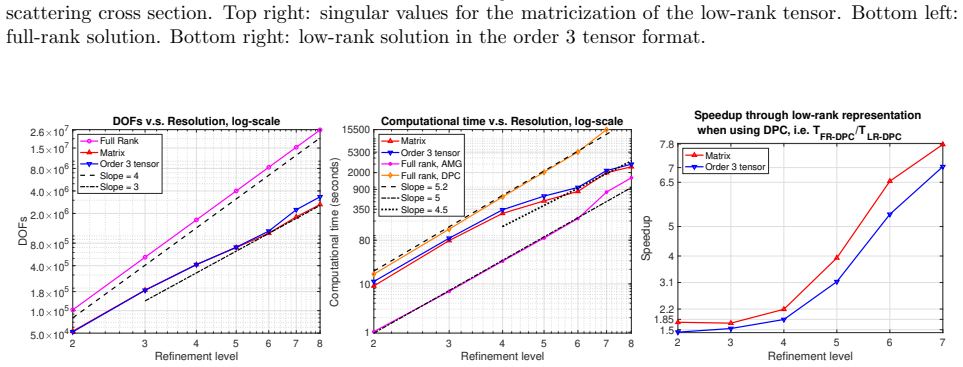
- Diffusion-dominated problems, where the even-parity solution has nearly constant rank under refinement, become dramatically cheaper: roughly 25x over full-rank AMG and 90x over full-rank DPC at the finest reported mesh.
- Even when the effective rank grows with resolution, as in transport-dominated and variable-scattering tests, the low-rank DOF count scales as O(L^3) rather than O(L^4), keeping the method competitive while storing 10-50% of the full-rank data.
- The DSA-based preconditioning naturally generalizes to higher dimensions and can, in principle, be combined with other synthetic-acceleration preconditioners such as quasi-diffusion or S2SA.
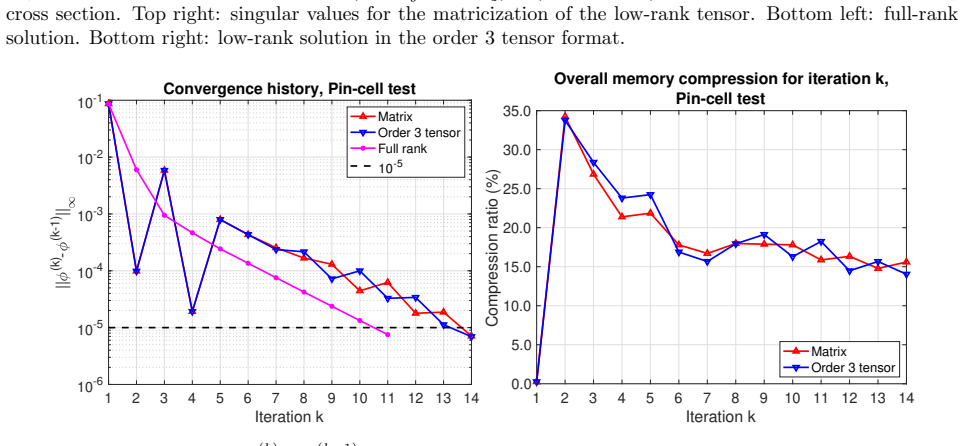
- The inexactness strategy—starting inner CG with a loose tolerance and tightening it as outer iterations progress—preserves accuracy in the tested settings and substantially reduces runtime.
Reading between the lines
- The SPD assertion for the discrete operator is load-bearing: the paper says it can be checked but gives no proof, and it does not specify how vacuum boundary conditions enter the second-order operator; if that boundary treatment breaks symmetry, the CG inner solve and the whole low-rank iteration would need a different justification.
- The observation that inexact low-rank SI-DSA is more reliable and faster than inexact full-rank SI-DSA under the same relaxation schedule suggests that truncation is acting as a regularizer on error accumulation; a testable extension would be to quantify how truncation noise and inexactness interact.
- Since the two-level DPC is less efficient than standalone AMG, the low-rank method's speed advantage in transport- and multiscale-dominated settings depends on developing a low-rank preconditioner with AMG-like efficiency, which the authors identify as space-angle multigrid.
- The benchmarks use separable tensor-product grids and CL quadrature; applying the same framework to 3D or non-tensor-product meshes would test how well the compression and speedups survive outside the separable setting.
Editorial analysis
A structured set of objections, weighed in public.
Referee Report
Summary. The paper proposes an inexact low-rank source iteration with diffusion synthetic acceleration (SI-DSA) for the multidimensional steady-state radiative transfer equation in second-order even-parity form. The solution is stored in low-rank matrix or hierarchical Tucker tensor (HTT) format; each source iteration solves the inner even-parity system with a preconditioned low-rank conjugate gradient method, using a two-level diffusion preconditioner (DPC) with AMG for the diffusion solves. An adaptive strategy relaxes the inner CG tolerance in early iterations. Numerical experiments in 2D2V cover diffusion-dominated, transport-dominated, multiscale, pin-cell, and lattice benchmarks, reporting l2 errors of order 1e-4 to 1e-5 against full-rank references, compression ratios, rank growth, and timings, including speedups up to about 90x over full-rank DPC in the diffusion-dominated case. The paper also claims to provide the first low-rank SI-DSA framework for multidimensional steady-state RTE.
Significance. If the deficiencies described below are corrected, the paper would be a useful contribution: it extends low-rank iterative techniques from 1D1V steady-state settings to multidimensional problems, introduces a Kronecker-product-compatible diffusion preconditioner, and provides a broad set of benchmarks with independent full-rank references. The authors are also honest about the limitations, explicitly reporting that the low-rank DPC solver can be slower than a full-rank AMG solver on transport-dominated and multiscale problems. The rank-scaling studies against spatial and angular resolution are informative. However, the written algorithm and discrete operator contain sign/index inconsistencies that are load-bearing: the asserted SPD property of the system matrix appears false as displayed, the boundary discretization is not specified, and the DSA and CG updates contain indexing errors. These issues must be fixed before the numerical evidence can be evaluated.
major comments (4)
- [Sec. 2.2.2, Eqs. (12)-(14)] The claim that the matrix in Eq. (14) is SPD is contradicted by the displayed stencils. For constant sigma_t, Eq. (13a) gives D_xx = h^{-2} tridiag(1,2,1), which is positive definite. With Omega=(1,0), Eq. (14) reduces to I otimes (-D_xx + Sigma_t). In the diffusion-dominated test at 32x32 on [-1,1]^2, h=0.0625 and sigma_t=100, so the diagonal of -D_xx is -512 and the matrix is not SPD. The assertion "One can check ... is SPD" is therefore false as written. Since the low-rank CG inner solver and the DPC preconditioner both rely on SPD, this is a load-bearing error. The authors should correct the stencil signs or the minus signs in Eq. (12), and then verify SPD explicitly for the resulting matrix.
- [Sec. 2.2.2, boundary conditions] The paper states the vacuum inflow boundary condition only for the first-order equation (1c). No discrete treatment is specified for the second-order even-parity equation at the boundary. The central finite-difference stencils (13a)-(13d) require ghost values or one-sided closures, and the matrix in Eq. (14) is not fully defined without this specification. The SPD property and the numerical results depend on the boundary treatment. The authors should state the discrete boundary conditions used for the even-parity variable and confirm that the resulting matrix A is SPD.
- [Sec. 3.2, Algorithm 1 lines 9-11 and Eq. (22)] The DSA update is indexed inconsistently. At line 4 the current previous scalar flux is phi^(k-1); Eq. (22) and line 9 use phi^(k), which has not been computed yet. Line 10 then sets phi^(k+1) = phi^(k,*) + delta phi^(k), so the indexing is off by one or circular. In standard DSA, the correction is formulated using the already available previous scalar flux (e.g., phi^(k,*) - phi^(k-1)), followed by phi^(k) = phi^(k,*) + delta phi^(k). The algorithm as written cannot be executed; this needs to be corrected and the corresponding description in Sec. 2.3 (Eq. (16)) reconciled with Algorithm 1.
- [Sec. 3.3, Algorithm 2 line 8] The solution update in the low-rank CG algorithm is written as x(k) = TruncatedSum(r(k-1) - alpha q(k-1)). In conjugate gradient the update is x(k) = TruncatedSum(x(k-1) + alpha p(k-1)), while the residual update is r(k) = r(k-1) - alpha q(k-1). As written, the method is not CG and the residual norm at line 9 is not updated. This is likely a typographical error, but it affects the definition of the core inner solver and must be fixed.
minor comments (6)
- [Eq. (17)] There is a stray comma in the display 'psi_+(x,Omega) approx sum_l B_l X_l(x) V_l(Omega),,'.
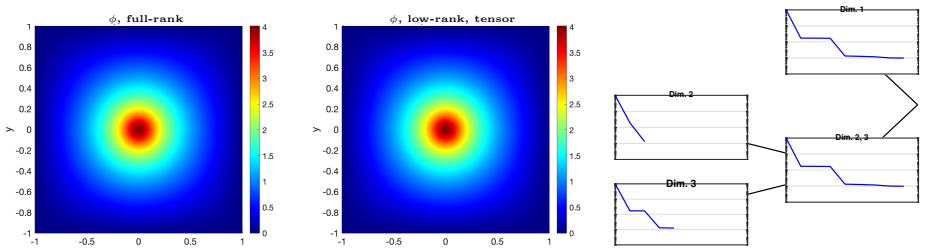
- [Fig. 3 caption / Sec. 4.1, left panel] The text says 'N_x = O(N_x N_y)' where it should say 'the number of DOFs of the low-rank solution is O(N_x N_y)'. This is a notation slip.
- [Eq. (29)] In the denominator of the compression ratio, the first term is written as DOF(x_LR) but should almost certainly be DOF(x_FR). As written, the ratio uses a low-rank count in the denominator, which is inconsistent with the definition of a compression ratio.
- [Table 3] The last column is labeled N_x = N_y = 81 with no explanation; presumably this is a typo for N_x = N_y = 80 or an extra refinement level. Please clarify.
- [Fig. 5 caption] The caption refers to 'the transport dominant problem in Sec. 4.1', but this problem is in Sec. 4.2.
- [Sec. 4.3, Eq. (30)] There is a stray semicolon in the formula: '99r^4(r^2 - 2)^2 + 1;, if ...'.
Circularity Check
No significant circularity: the algorithm, benchmarks, and central claims are self-contained; flagged weaknesses (unproven SPD/boundary treatment, open theory question) are correctness/rigor issues, not circular reasoning.
full rationale
Walked the paper's derivation chain. The method is constructed from an explicit second-order even-parity RTE discretization (Eqs. 12-14), low-rank matrix/HTT representations (Sec. 3.1), a standard SI-DSA outer iteration (Eqs. 21-22), and a low-rank CG inner solver with a diffusion preconditioner (Alg. 2, Eq. 25). The central accuracy claim is validated by comparing low-rank solutions against an independently computed full-rank FR-AMG reference solution (Eq. 27); no fitted parameter is renamed as a prediction, and the reported 10^-4-10^-5 errors are measured discrepancies, not reproductions of the chosen truncation or CG tolerances. The adaptive inexact tolerance in Alg. 1 (step 11) is an algorithmic schedule determined by the current residual, not a parameter fitted to the benchmark outputs. Self-citations (e.g., [24], [47], [58]) are used only as background or as references for standard low-rank truncation and summation algorithms; they are not load-bearing in the sense of supplying an unverified premise that forces the result. No uniqueness theorem from the authors' prior work is invoked, and no ansatz is smuggled in via citation: the low-rank format and DPC are explicitly proposed and tested in this paper. Several limitations and missing justifications are present but are not circular: Eq. (14) asserts 'One can check that ... is SPD' without a proof and without specifying how vacuum boundary conditions are discretized for the second-order equation, which is an unsupported assumption that could invalidate CG/DPC if false; Remark 3.3/Sec. 4.1 explicitly leaves the theoretical basis of the inexact low-rank robustness as an open question; and Sec. 5 notes the sigma_t > 0 restriction of the second-order formulation. These are correctness/rigor concerns, not cases where a prediction reduces to an input by construction. Therefore the circularity score is 0.
Assumptions & free parameters
free parameters (5)
- truncation tolerance =
1e-6
- outer SI stopping tolerance =
1e-5
- initial inner CG tolerance epsilon_CG^(1) =
1e-2
- decay rate gamma =
0.1
- maximum inner CG iterations =
200
assumptions (4)
- domain assumption The discrete second-order operator in Eq. (14) is SPD.
- domain assumption The second-order even-parity formulation is equivalent to the original RTE when sigma_t > 0 and includes a valid discretization of the vacuum boundary condition.
- domain assumption DSA error correction is a valid two-level preconditioner for the discrete second-order system.
- standard math The inexact fixed-point iteration converges when inner inexactness tends to zero.
Cite this review
Pith. "Pith review of An Inexact Low-Rank Source Iteration for Steady-State Radiative Transfer Equation with Diffusion Synthetic Acceleration." pith.science (2026). https://pith.science/paper/O7T63LAZ
@misc{pith2026250900805,
  author       = {Pith},
  title        = {Pith review of: An Inexact Low-Rank Source Iteration for Steady-State Radiative Transfer Equation with Diffusion Synthetic Acceleration},
  year         = {2026},
  howpublished = {\url{https://pith.science/paper/O7T63LAZ}},
  note         = {Machine review of arXiv:2509.00805}
}
abstract
We propose an inexact low-rank source iteration with diffusion synthetic acceleration (SI-DSA) for solving the multidimensional steady-state radiative transfer equation (RTE) in the second-order formulation. The angular flux is represented in either a low-rank matrix or hierarchical Tucker tensor (HTT) format, enabling substantial reductions in computational resources. Each SI step is solved using a preconditioned low-rank conjugate gradient (CG) method with a diffusion preconditioner. To further improve efficiency, we introduce an adaptive inexact strategy that dynamically relaxes the inner CG tolerance during early SI iterations. The method exploits the tensor-product structure of the discretized operators to perform all matrix-vector operations in low-rank form. Numerical experiments on 2D2V benchmark problems, including diffusion-dominated, transport-dominated, and multiscale problems, demonstrate that the proposed approach achieves errors on the order of $10^{-4}$ to $10^{-5}$ relative to full-rank reference solutions, while reducing the degrees of freedom by up to two orders of magnitude. In the diffusion-dominated case, the low-rank solver achieves speedups exceeding $90\times$ over its full-rank counterpart and remains competitive in solving challenging transport-dominated and multiscale problems while providing substantial storage savings. To our knowledge, this work provides the first low-rank SI-DSA framework for multidimensional steady-state RTE.
Figures


Figures from the paper (12 more)






Forward citations
Cited by 3 Pith papers
-
Highly Efficient Rank-Adaptive Sweep-based SI-DSA for the Radiative Transfer Equation via Mild Space Augmentation
Rank-adaptive sweep-based SI-DSA with mild space augmentation matches full-rank accuracy and outer iterations while cutting memory and runtime for steady-state RTE even at 30–45% effective rank.
-
An Asymptotic-Preserving Dynamical Low-Rank Semi-Lagrangian Method for Multiscale Linear Kinetic Transport Equations
An asymptotic-preserving dynamical low-rank semi-Lagrangian solver with QDEIM angular sampling cuts the cost of multiscale kinetic transport simulations while preserving the diffusion limit.
-
Synthetic Acceleration Preconditioners for Parametric Radiative Transfer Equations based on Trajectory-Aware Reduced Order Models
A trajectory-aware reduced-order preconditioner fixes the offline-online residual mismatch in ROMSAD and solves parametric RTE in 2-3 online iterations on a lattice test.
Reference graph
Works this paper leans on
-
[1]
K. M. Case, P. F. Zweifel, G. Pomraning, Linear transport theor y (1968)
work page 1968
-
[2]
M. L. Adams, E. W. Larsen, Fast iterative methods for discrete -ordinates particle transport calculations, Progress in Nuclear Energy 40 (2002) 3–159
work page 2002
-
[3]
H. Kopp, Synthetic method solution of the transport equation, Nuclear Science and Engineering 17 (1) (1963) 65–74
work page 1963
-
[4]
R. Alcouffe, Dittusion Synthetic Acceleration Methods For the Dia mond-Ditterenced Discrete-Ordinotes Equations, Nuclear science and engineering 64 (1977) 344–355. 24 AMG DPC Nx ×Ny NSI ¯NInner-CG NSI ¯NInner-CG ¯NIPC 32 × 32 3 2.41 3 3.70 3.00 48 × 48 3 2.63 3 3.87 3.00 64 × 64 3 2.75 3 4.00 3.00 80 × 80 3 2.76 3 4.14 3.00 (a) Diffusion dominant problem. A...
work page 1977
-
[5]
M. L. Adams, W. R. Martin, Diffusion synthetic acceleration of disc ontinuous finite element transport iterations, Nuclear science and engineering 111 (2) (1992) 145–16 7
work page 1992
-
[6]
E. W. Larsen, J. E. Morel, Advances in discrete-ordinates meth odology, Nuclear computational science: A century in review (2009) 1–84
work page 2009
- [7]
-
[8]
J. S. Warsa, T. A. Wareing, J. E. Morel, Krylov iterative methods and the degraded effectiveness of diffu- sion synthetic acceleration for multidimensional SN calculations in pro blems with material discontinuities, Nuclear science and engineering 147 (3) (2004) 218–248
work page 2004
Show all 65 references
-
[9]
Z. Peng, R. G. McClarren, M. Frank, A low-rank method for two- dimensional time-dependent radiation transport calculations, Journal of Computational Physics 421 (2 020) 109735
-
[10]
Z. Peng, R. G. McClarren, A sweep-based low-rank method for the discrete ordinate transport equation, Journal of Computational Physics 473 (2023) 111748
2023
-
[11]
Einkemmer, J
L. Einkemmer, J. Hu, Y. Wang, An asymptotic-preserving dyna mical low-rank method for the multi-scale multi-dimensional linear transport equation, Journal of Computat ional Physics 439 (2021) 110353
2021
-
[12]
Einkemmer, J
L. Einkemmer, J. Hu, J. Kusch, Asymptotic-preserving and en ergy stable dynamical low-rank approxi- mation, SIAM Journal on Numerical Analysis 62 (1) (2024) 73–92
2024
-
[13]
Ceruti, N
G. Ceruti, N. Crouseilles, L. Einkemmer, A Galerkin Alternating Pr ojection Method for Kinetic Equations in the Diffusive Limit, arXiv preprint arXiv:2505.19929 (2025)
2025 arXiv
-
[14]
Z. Peng, R. G. McClarren, A high-order/low-order (HOLO) algo rithm for preserving conservation in time-dependent low-rank transport calculations, Journal of Com putational Physics 447 (2021) 110672
2021
-
[15]
Z. Ding, L. Einkemmer, Q. Li, Dynamical low-rank integrator for the linear Boltzmann equation: error analysis in the diffusion limit, SIAM Journal on Numerical Analysis 59 (4) (2021) 2254–2285
2021
-
[16]
P. Yin, E. Endeve, C. Hauck, S. Schnake, Towards dynamical lo w-rank approximation for neutrino kinetic equations. Part I: Analysis of an idealized relaxation model, Mathema tics of Computation 94 (353) (2025) 1199–1233
2025
-
[17]
C. D. Hauck, S. Schnake, A predictor-corrector strategy f or adaptivity in dynamical low-rank approxima- tions, SIAM Journal on Matrix Analysis and Applications 44 (3) (2023 ) 971–1005
2023
-
[18]
Baumann, L
L. Baumann, L. Einkemmer, C. Klingenberg, J. Kusch, Energy s table and conservative dynamical low- rank approximation for the Su–Olson problem, SIAM Journal on Scie ntific Computing 46 (2) (2024) B137–B158
2024
-
[19]
Frank, J
M. Frank, J. Kusch, C. Patwardhan, Asymptotic-preserving and energy stable dynamical low-rank ap- proximation for thermal radiative transfer equations, Multiscale M odeling & Simulation 23 (1) (2025) 278–312
2025
-
[20]
Ceruti, J
G. Ceruti, J. Kusch, C. Lubich, A parallel rank-adaptive integr ator for dynamical low-rank approximation, SIAM Journal on Scientific Computing 46 (3) (2024) B205–B228
2024
-
[21]
Baumann, L
L. Baumann, L. Einkemmer, C. Klingenberg, J. Kusch, An adapt ive dynamical low-rank optimizer for solving kinetic parameter identification inverse problems, arXiv prep rint arXiv:2506.21405 (2025)
2025 arXiv
-
[22]
Kusch, P
J. Kusch, P. Stammer, A robust collision source method for ran k adaptive dynamical low-rank approxi- mation in radiation therapy, arXiv preprint arXiv:2111.07160 (2021) . 26
2021 arXiv
-
[23]
Kusch, B
J. Kusch, B. Whewell, R. McClarren, M. Frank, A low-rank power iteration scheme for neutron transport criticality problems, Journal of Computational Physics 470 (2022) 111587
2022
-
[24]
Guo, J.-M
W. Guo, J.-M. Qiu, A low rank tensor representation of linear tra nsport and nonlinear Vlasov solutions and their associated flow maps, Journal of Computational Physics 458 (2022) 111089
2022
-
[25]
Nakao, J.-M
J. Nakao, J.-M. Qiu, L. Einkemmer, Reduced augmentation implicit low-rank (rail) integrators for advection-diffusion and fokker–planck models, SIAM Journal on Sc ientific Computing 47 (2) (2025) A1145–A1169
2025
-
[26]
W. A. Sands, W. Guo, J.-M. Qiu, T. Xiong, High-order adaptive ra nk integrators for multi-scale linear kinetic transport equations in the hierarchical Tucker format, ar Xiv preprint arXiv:2406.19479 (2024)
2024 arXiv
-
[27]
Bachmayr, R
M. Bachmayr, R. Schneider, Iterative methods based on soft thresholding of hierarchical tensors, Foun- dations of Computational Mathematics 17 (4) (2017) 1037–1083
2017
-
[28]
Ballani, L
J. Ballani, L. Grasedyck, A projection method to solve linear sys tems in tensor format, Numerical linear algebra with applications 20 (1) (2013) 27–43
2013
-
[29]
Hackbusch, Solution of linear systems in high spatial dimension s, Computing and visualization in science 17 (3) (2015) 111–118
W. Hackbusch, Solution of linear systems in high spatial dimension s, Computing and visualization in science 17 (3) (2015) 111–118
2015
-
[30]
Bachmayr, R
M. Bachmayr, R. Bardin, M. Schlottbom, Low-rank tensor pro duct Richardson iteration for radiative transfer in plane-parallel geometry, arXiv preprint arXiv:2403.142 29 (2024)
2024
-
[31]
A. L. Alberti, T. S. Palmer, Reduced-order modeling of nuclear r eactor kinetics using proper generalized decomposition, Nuclear Science and Engineering 194 (10) (2020) 83 7–858
2020
-
[32]
K. A. Dominesey, W. Ji, Reduced-order modeling of neutron tra nsport separated in space and angle via proper generalized decomposition, Nuclear Science and Engineering (2022)
2022
-
[33]
K. A. Dominesey, W. Ji, Reduced-order modeling of neutron tra nsport eigenvalue problems separated in energy by Proper Generalized Decomposition, Journal of Computa tional Physics 486 (2023) 112137
2023
-
[34]
Einkemmer, K
L. Einkemmer, K. Kormann, J. Kusch, R. G. McClarren, J.-M. Qiu , A review of low-rank methods for time-dependent kinetic simulations, Journal of Computational Phy sics (2025) 114191
2025
-
[35]
Holtz, T
S. Holtz, T. Rohwedder, R. Schneider, The alternating linear sc heme for tensor optimization in the tensor train format, SIAM Journal on Scientific Computing 34 (2) (2012) A 683–A713
2012
-
[36]
S. V. Dolgov, D. V. Savostyanov, Alternating minimal energy me thods for linear systems in higher di- mensions, SIAM Journal on Scientific Computing 36 (5) (2014) A224 8–A2271
2014
-
[37]
H. G. Matthies, E. Zander, Solving stochastic systems with low- rank tensor compression, Linear Algebra and its Applications 436 (10) (2012) 3819–3838
2012
-
[38]
Kressner, C
D. Kressner, C. Tobler, Low-rank tensor Krylov subspace me thods for parametrized linear systems, SIAM Journal on Matrix Analysis and Applications 32 (4) (2011) 1288–131 6
2011
-
[39]
S. V. Dolgov, TT-GMRES: solution to a linear system in the struct ured tensor format, Russian Journal of Numerical Analysis and Mathematical Modelling 28 (2) (2013) 149– 172
2013
-
[40]
Kressner, M
D. Kressner, M. Steinlechner, B. Vandereycken, Preconditio ned low-rank Riemannian optimization for linear systems with tensor product structure, SIAM Journal on S cientific Computing 38 (4) (2016) A2018– A2044
2016
-
[41]
Braess, W
D. Braess, W. Hackbusch, Approximation of 1 /x by exponential sums in [1, ∞), IMA journal of numerical analysis 25 (4) (2005) 685–697. 27
2005
-
[42]
Hackbusch, B
W. Hackbusch, B. N. Khoromskij, Low-rank Kronecker-prod uct approximation to multi-dimensional non- local operators. Part I. Separable approximation of multi-variate functions, Computing 76 (3) (2006) 177–202
2006
-
[43]
Beylkin, L
G. Beylkin, L. Monz´ on, Approximation by exponential sums rev isited, Applied and Computational Har- monic Analysis 28 (2) (2010) 131–149
2010
-
[44]
El Kahza, J.-M
H. El Kahza, J.-M. Qiu, L. Chacon, W. Taitano, Sylvester-Prec onditioned Adaptive-Rank Implicit Time Integrators for Advection-Diffusion Equations with Inhomogeneo us Coefficients, arXiv e-prints (2024) arXiv–2410
2024
-
[45]
S. Meng, D. Appelo, Y. Cheng, Preconditioning low rank generaliz ed minimal residual method (gmres) for implicit discretizations of matrix differential equations, arXiv pre print arXiv:2410.07465 (2024)
2024 arXiv
-
[46]
Appelo, Y
D. Appelo, Y. Cheng, lraa: Low-rank anderson acceleration, a rXiv preprint arXiv:2503.03909 (2025)
2025 arXiv
-
[47]
Bachmayr, Low-rank tensor methods for partial different ial equations, Acta Numerica 32 (2023) 1–121
M. Bachmayr, Low-rank tensor methods for partial different ial equations, Acta Numerica 32 (2023) 1–121
2023
-
[48]
Grasedyck, Hierarchical singular value decomposition of ten sors, SIAM journal on matrix analysis and applications 31 (4) (2010) 2029–2054
L. Grasedyck, Hierarchical singular value decomposition of ten sors, SIAM journal on matrix analysis and applications 31 (4) (2010) 2029–2054
2010
-
[49]
V. Y. Gol’din, A quasi-diffusion method of solving the kinetic equatio n, Zhurnal Vychislitel’noi Matematiki i Matematicheskoi Fiziki 4 (6) (1964) 1078–1087
1964
-
[50]
D. Y. Anistratov, V. Y. Gol’Din, Nonlinear methods for solving par ticle transport problems, Transport Theory and Statistical Physics 22 (2-3) (1993) 125–163
1993
-
[51]
Olivier, W
S. Olivier, W. Pazner, T. S. Haut, B. C. Yee, A family of independe nt Variable Eddington Factor methods with efficient preconditioned iterative solvers, Journal of Computa tional Physics 473 (2023) 111747
2023
-
[52]
L. J. Lorence Jr, J. Morel, E. W. Larsen, An S2 synthetic acceleration scheme for the one-dimensional sn equations with linear discontinuous spatial differencing, Nuclear Scie nce and Engineering 101 (4) (1989) 341–351
1989
-
[53]
R. G. McClarren, T. S. Haut, Data-driven acceleration of ther mal radiation transfer calculations with the dynamic mode decomposition and a sequential singular value decompo sition, Journal of Computational Physics 448 (2022) 110756
2022
-
[54]
Peng, Reduced order model enhanced source iteration with synthetic acceleration for parametric ra- diative transfer equation, Journal of Computational Physics 517 (2024) 113303
Z. Peng, Reduced order model enhanced source iteration with synthetic acceleration for parametric ra- diative transfer equation, Journal of Computational Physics 517 (2024) 113303
2024
-
[55]
Z. Peng, A flexible GMRES solver with reduced order model enhan ced synthetic acceleration precondi- tioner for parametric radiative transfer equation, Journal of Co mputational Physics 534 (2025) 114004
2025
-
[56]
Lewis, Second-order neutron transport methods, in: Nuc lear Computational Science: A Century in Review, Springer, 2009, pp
E. Lewis, Second-order neutron transport methods, in: Nuc lear Computational Science: A Century in Review, Springer, 2009, pp. 85–115
2009
-
[57]
G. C. Pomraning, The equations of radiation hydrodynamics, Co urier Corporation, 2005
2005
-
[58]
Kressner, C
D. Kressner, C. Tobler, htucker—A MATLAB toolbox for tenso rs in hierarchical Tucker format, Mathicse, EPF Lausanne (2012) 11
2012
-
[59]
Birken, Termination criteria for inexact fixed-point schemes , Numerical Linear Algebra with Applica- tions 22 (4) (2015) 702–716
P. Birken, Termination criteria for inexact fixed-point schemes , Numerical Linear Algebra with Applica- tions 22 (4) (2015) 702–716
2015
-
[60]
J. E. Morel, T. Manteuffel, An angular multigrid acceleration tech nique for Sn equations with highly forward-peaked scattering, Nuclear Science and Engineering 107 (4) (1991) 330–342. 28
1991
-
[61]
H. Gao, H. Zhao, A fast-forward solver of radiative transfer equation, Transport Theory and Statistical Physics 38 (3) (2009) 149–192
2009
-
[62]
Lee, A Multigrid Framework for Sn Discretizations of the Boltzmann Transport Equation, SIAM Journal on Scientific Computing 34 (4) (2012) A2018–A2047
B. Lee, A Multigrid Framework for Sn Discretizations of the Boltzmann Transport Equation, SIAM Journal on Scientific Computing 34 (4) (2012) A2018–A2047
2012
-
[63]
Chen, An integrated finite element method package in MATLAB , California: University of California at Irvine 10 (2009)
L. Chen, An integrated finite element method package in MATLAB , California: University of California at Irvine 10 (2009)
2009
-
[64]
Ohlberger, S
M. Ohlberger, S. Rave, Reduced basis methods: Success, limita tions and future challenges, arXiv preprint arXiv:1511.02021 (2015)
2015 arXiv
-
[65]
Greif, K
C. Greif, K. Urban, Decay of the Kolmogorov N-width for wave p roblems, Applied Mathematics Letters 96 (2019) 216–222. 29
2019
Reviewed August 5, 2026 · model on record in the stance chip above.
Discussion (0). Continue with ORCID to comment.