Emergence of non-Markovian Decoherent Histories in Integrable Environment: A "Tape Recorder" Model for Local Quantum Observables
Pith reviewed 2026-05-18 19:45 UTC · model grok-4.3
The pith
In integrable non-Markovian environments, environmental modes emerge sequentially to record the past of a local quantum system and enable decoherent histories.
A machine-rendered reading of the paper's core claim, the machinery that carries it, and where it could break.
Core claim
In the tape recorder model, environmental degrees of freedom that irreversibly store records of the system's past emerge sequentially in time and define the projectors required for decoherent histories. Numerical evidence shows that the off-diagonal elements of the decoherence functional are exponentially suppressed relative to a significance threshold.
What carries the argument
The tape recorder model, in which environmental modes sequentially and irreversibly capture records of the local system's past to define history projectors.
If this is right
- Multi-time decoherent histories become constructible in a controlled manner for non-Markovian integrable systems.
- Environmental modes can be identified that define the projectors for histories without requiring Markovian approximations.
- The method supplies an explicit coarse-grained description of quantum evolution under local quenches.
- The decoherence functional can be evaluated directly from the sequentially emerging modes.
Where Pith is reading between the lines
- The sequential recording picture could be tested in solvable integrable models such as free-fermion chains to check dependence on quench strength.
- This mechanism suggests how classical-like records can arise from memory-bearing quantum environments without full decoherence.
- The approach might help analyze local observables in many-body systems where exact diagonalization of the environment is feasible.
Load-bearing premise
The noninteracting integrable environment permits a discrete set of modes that store records irreversibly without significant back-action or recurrences that would invalidate the sequential emergence picture.
What would settle it
A calculation or simulation in which recurrences or back-action prevent sequential mode emergence, or in which off-diagonal decoherence functional elements fail to show exponential suppression below the threshold.
Figures



read the original abstract
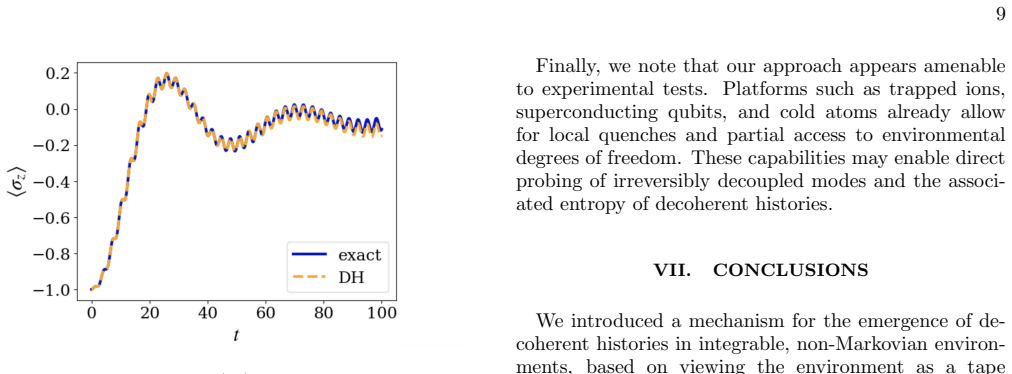
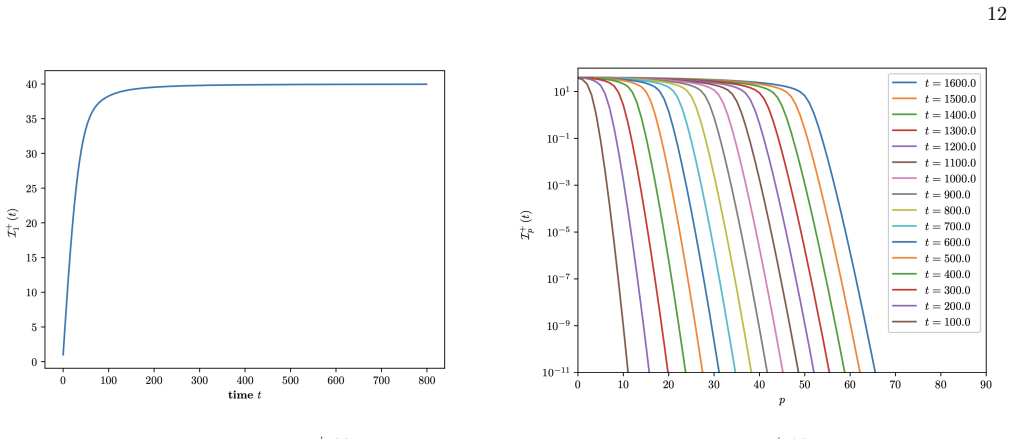
We propose a new approach to coarse-grained description of quantum evolution that provides an explicit recipe to construct and evaluate multi-time decoherent histories in a controlled way, applicable to non-Markovian and integrable systems. Specifically, we study local interaction quench of a local degree of freedom (an open quantum system) within a noninteracting integrable environment. This setting allows us to identify the environmental degrees of freedom that irreversibly store records of the system's past. These modes emerge sequentially in time and define the projectors required for decoherent histories. We show numerically that the off-diagonal elements of the decoherence functional are exponentially suppressed relative to a significance threshold.
Editorial analysis
A structured set of objections, weighed in public.
Referee Report
Summary. The paper proposes a 'tape recorder' model for constructing multi-time decoherent histories in a local quantum system coupled to a noninteracting integrable environment via local interaction quench. Sequentially emerging environmental modes are identified as irreversibly storing records of the system's past; these define the projectors for the histories. Numerical evidence is presented that off-diagonal elements of the decoherence functional are exponentially suppressed relative to a significance threshold.
Significance. If the suppression result holds and is robust, the work would offer a concrete, explicit construction for decoherent histories in non-Markovian integrable settings, providing a controlled route to coarse-graining without Markovian assumptions. The numerical demonstration of mode emergence and suppression, if properly documented, would be a useful strength for falsifiable predictions in this framework.
major comments (2)
- [Abstract] Abstract (tape-recorder model paragraph): the claim that modes 'irreversibly store records' and produce sustained exponential suppression of off-diagonal decoherence-functional elements is load-bearing for the central claim, yet no analysis addresses long-time recurrences expected from quasi-periodic evolution in finite integrable environments; this leaves open whether the sequential-emergence picture survives beyond the simulated window.
- [Numerical demonstration] Numerical demonstration (as described in abstract): the reported exponential suppression lacks any information on system size, time scales, fitting procedures, or error bars, so it is impossible to assess whether the result is robust or sensitive to the specific numerical choices that could affect the suppression conclusion.
minor comments (2)
- [Model construction] Clarify the precise mathematical definition of how the projectors are extracted from the identified environmental modes, including any orthogonality or completeness conditions.
- [Introduction] Add a brief comparison to standard decoherent-histories literature to highlight the novelty of the integrable-environment construction.
Simulated Author's Rebuttal
We thank the referee for their thorough review and valuable feedback on our manuscript. We address each of the major comments in detail below, indicating where revisions will be made to improve clarity and completeness.
read point-by-point responses
-
Referee: [Abstract] Abstract (tape-recorder model paragraph): the claim that modes 'irreversibly store records' and produce sustained exponential suppression of off-diagonal decoherence-functional elements is load-bearing for the central claim, yet no analysis addresses long-time recurrences expected from quasi-periodic evolution in finite integrable environments; this leaves open whether the sequential-emergence picture survives beyond the simulated window.
Authors: We agree with the referee that finite integrable environments exhibit quasi-periodic dynamics, leading to potential recurrences at long times. Our current numerical results focus on intermediate time scales where the sequential emergence of modes and the suppression of off-diagonal elements are observed. In the revised manuscript, we will add an analysis of the recurrence time scales, estimated from the finite size of the environment and the integrability, and qualify the 'irreversible' nature of the record storage as holding within the relevant decoherence time window. We will also discuss the approach to the thermodynamic limit where such recurrences are delayed indefinitely. revision: yes
-
Referee: [Numerical demonstration] Numerical demonstration (as described in abstract): the reported exponential suppression lacks any information on system size, time scales, fitting procedures, or error bars, so it is impossible to assess whether the result is robust or sensitive to the specific numerical choices that could affect the suppression conclusion.
Authors: The referee correctly points out the lack of detailed numerical information. We will revise the manuscript to include the specific system sizes (number of bath modes), the range of simulation times, the methods used for fitting the exponential decay (including any functional forms and fitting windows), and error bars derived from numerical precision or ensemble averaging. These additions will enable a better assessment of the robustness of the exponential suppression result. revision: yes
Circularity Check
No significant circularity; numerical evidence is independent of projector construction
full rationale
The paper constructs projectors from environmental modes identified in the integrable bath model and then computes the decoherence functional numerically to demonstrate exponential suppression of off-diagonals. This is a direct dynamical calculation on the chosen modes rather than a reduction by definition, fitting, or self-citation chain; the mode selection follows from the non-interacting Hamiltonian structure and the suppression result is an output of the time evolution, not an input. The approach remains self-contained against external benchmarks because the numerical check is falsifiable within the finite-time, finite-size regime reported.
Axiom & Free-Parameter Ledger
axioms (2)
- standard math Quantum mechanics with unitary evolution on the combined system-plus-bath Hilbert space
- domain assumption The environment is noninteracting and integrable, allowing exact identification of modes that store records without recurrences on relevant timescales
invented entities (1)
-
Tape-recorder environmental modes
no independent evidence
Reference graph
Works this paper leans on
-
[1]
Consistent histories and the interpreta- tion of quantum mechanics,
R. B. Griffiths, “Consistent histories and the interpreta- tion of quantum mechanics,” J. Stat. Phys. 36, 219–272 (1984)
work page 1984
-
[2]
Classical equations for quantum systems,
M. Gell-Mann, J. B. Hartle, “Classical equations for quantum systems,” Phys. Rev. D 47, 3345–3382 (1993)
work page 1993
-
[3]
Interpretation of quantum mechanics,
R. Omnes, “Interpretation of quantum mechanics,” Phys. Lett. A 125, 169-172 (1987)
work page 1987
-
[4]
A Review of the Decoherent Histories Approach to Quantum Mechanics,
J. J. Halliwell, “A Review of the Decoherent Histories Approach to Quantum Mechanics,” Ann. N.Y. Acad. Sci. 755, 726-740 (1995)
work page 1995
-
[5]
Consistent interpretations of quantum me- chanics,
R. Omn` es, “Consistent interpretations of quantum me- chanics,” Rev. Mod. Phys. 64, 339–382 (1992)
work page 1992
-
[6]
On the Consistent Histories Ap- proach to Quantum Mechanics,
F. Dowker, A. Kent, “On the Consistent Histories Ap- proach to Quantum Mechanics,” J. Stat. Phys. 82, 1575–1646 (1996)
work page 1996
-
[7]
Colloquium: An Introduction to Con- sistent Quantum Theory,
P. C. Hohenberg, “Colloquium: An Introduction to Con- sistent Quantum Theory,” Rev. Mod. Phys. 82, 2835 (2010)
work page 2010
-
[8]
The Consistent Histories Approach to Quantum Mechanics,
R. B. Griffiths, “The Consistent Histories Approach to Quantum Mechanics,” In The Stanford Encyclopedia of Philosophy (Fall 2024 Edition), edited by Edward N. Zalta and Uri Nodelman
work page 2024
-
[9]
D. Schmidtke, J. Gemmer, “Numerical evidence for ap- proximate consistency and Markovianity of some quan- tum histories in a class of finite closed spin systems,” Phys. Rev. E 93, 012125 (2016)
work page 2016
-
[10]
When Is a Non-Markovian Quantum Process Classical?
S. Milz, D. Egloff, P. Taranto, T. Theurer, M. B. Plenio, A. Smirne, S. F. Huelga, “When Is a Non-Markovian Quantum Process Classical?” Phys. Rev. X 10, 041049 (2020)
work page 2020
-
[11]
Entropy increase in K-step Markovian and consistent dynamics of closed quantum systems,
J. Gemmer, R. Steinigeweg, “Entropy increase in K-step Markovian and consistent dynamics of closed quantum systems,” Phys. Rev. E 89, 042113 (2014)
work page 2014
-
[12]
Objectivity of classical quantum stochastic processes,
P. Sza´ nkowski, L. Cywi´ nski, “Objectivity of classical quantum stochastic processes,” Quantum 8, 1390 (2024)
work page 2024
-
[13]
Objective past of a quantum universe: Redundant records of consistent histories,
C. J. Riedel, W. H. Zurek, M. Zwolak, “Objective past of a quantum universe: Redundant records of consistent histories,” Phys. Rev. A 93, 032126 (2016)
work page 2016
-
[14]
P. Strasberg, “Classicality with(out) decoherence: Con- cepts, relation to Markovianity, and a random matrix theory approach,” SciPost Physics 15, 024 (2023)
work page 2023
-
[15]
Classical quantum stochastic processes,
P. Strasberg, M. G. D´ ıaz, “Classical quantum stochastic processes,” Phys. Rev. A 100, 022120 (2019)
work page 2019
-
[16]
D. Lonigro, F. Sakuldee, L. Cywi´ nski, D. Chru´ sci´ nski, P. Sza´ nkowski, “Double or nothing: a Kolmogorov exten- sion theorem for multitime (bi)probabilities in quantum mechanics,” Quantum 8, 1447 (2024)
work page 2024
-
[17]
Coherence and non-classicality of quantum Markov processes,
A. Smirne, D. Egloff, M. G. Dıaz, M. B. Plenio, S. F. Hulega, “Coherence and non-classicality of quantum Markov processes,” Quantum Sci. Technol. 4, 01LT01 (2018)
work page 2018
-
[18]
Consistent Interpretations of Quan- tum Mechanics Using Quantum Trajectories
R. B. Griffiths, “Consistent Interpretations of Quan- tum Mechanics Using Quantum Trajectories”, Phys. Rev. Lett. 70, 2201 (1993)
work page 1993
-
[19]
Quantum mechanics of history: The decoherence functional in quantum me- chanics,
H. F. Dowker and J. J. Halliwell, “Quantum mechanics of history: The decoherence functional in quantum me- chanics,” Phys. Rev. D 46, 1580–1609 (1992)
work page 1992
-
[20]
Quasiclassical coarse grain- ing and thermodynamic entropy,
M. Gell-Mann, J. B. Hartle, “Quasiclassical coarse grain- ing and thermodynamic entropy,” Phys. Rev. A 76, 022104 (2007)
work page 2007
-
[21]
Decoherent histories and hydrodynamic equations,
J. J. Halliwell, “Decoherent histories and hydrodynamic equations,” Phys. Rev. D 48, 2739 (1993)
work page 1993
-
[22]
Somewhere in the universe: Where is the information stored when histories decohere?,
J. J. Halliwell, “Somewhere in the universe: Where is the information stored when histories decohere?,” Phys. Rev. D 60, 105031 (1999)
work page 1999
-
[23]
First- principles numerical demonstration of emergent decoher- ent histories,
P. Strasberg, T. E. Reinhard, J. Schindler, “First- principles numerical demonstration of emergent decoher- ent histories,” Phys. Rev. X 14, 041027 (2024)
work page 2024
-
[24]
Decoherence of histories: Chaotic versus integrable systems,
J. Wang, P. Strasberg, “Decoherence of histories: Chaotic versus integrable systems,” Phys. Rev. Lett. 134, 220401 (2025)
work page 2025
-
[25]
W. H. Zurek, “Decoherence, einselection, and the quan- tum origins of the classical,“ Rev. Mod. Phys. 75, 715 (2003)
work page 2003
-
[26]
Decoherent histo- ries with(out) objectivity in a (broken) apparatus,
B. Fert´ e, D. Farci, X. Cao, “Decoherent histo- ries with(out) objectivity in a (broken) apparatus,” arXiv:2508.16482[quant-ph] (2025)
-
[27]
Continuous measurements, quantum tra- jectories, and decoherent histories,
T. A. Brun, “Continuous measurements, quantum tra- jectories, and decoherent histories,” Phys. Rev. A 61, 042107 (2000)
work page 2000
-
[28]
Environment-induced decoher- ence and the transition from quantum to classical,
J. P. Paz, W. H. Zurek, “Environment-induced decoher- ence and the transition from quantum to classical,” Phys. Rev. D 48, 2728 (1993)
work page 1993
-
[29]
Decoher- ent Histories and Quantum State Diffusion,
L. Diosi, N. Gisin, J. Halliwell, I. C. Percival, “Decoher- ent Histories and Quantum State Diffusion,” Phys. Rev. Lett. 74, 203–207 (1995)
work page 1995
-
[30]
An example of the decoherence approach to quantum dissipative chaos
T. A. Brun, “An example of the decoherence approach to quantum dissipative chaos”, Phys. Lett. A 206 167 (1995)
work page 1995
-
[31]
Quantum Jumps as Decoherent Histories,
T. A. Brun, “Quantum Jumps as Decoherent Histories,” Phys. Rev. Lett. 78, 1833–1837 (1997)
work page 1997
-
[32]
Quantum chaos in open systems: a quantum state diffusion analysis
T. A. Brun, I. C. Percival, R. Schack, “Quantum chaos in open systems: a quantum state diffusion analysis”, J. Phys. A 29 2077 (1996)
work page 2077
-
[33]
Path integral approach to quantum Brownian motion,
A. O. Caldeira, A. J. Leggett, “Path integral approach to quantum Brownian motion,” Physica A 121, 587 (1983)
work page 1983
-
[34]
Quantum and classical fluctuation theorems from a decoherent histories, open-system anal- ysis,
Y. Suba¸ sı, B. L. Hu, “Quantum and classical fluctuation theorems from a decoherent histories, open-system anal- ysis,” Phys. Rev. E 85, 011112 (2012)
work page 2012
-
[35]
Classical Dynamics of the Quantum Harmonic Chain,
T. A. Brun, J. B. Hartle, “Classical Dynamics of the Quantum Harmonic Chain,” Phys. Rev. D 60, 123503 (1999)
work page 1999
-
[36]
Approximate decoherence of histories and ’t Hooft’s deterministic quantum theory,
J. J. Halliwell, “Approximate decoherence of histories and ’t Hooft’s deterministic quantum theory,” Phys. Rev. D 63, 085013 (2001)
work page 2001
-
[37]
Decoherence of hydrody- namic histories: A simple spin model,
T. A. Brun, J. J. Halliwell, “Decoherence of hydrody- namic histories: A simple spin model,” Phys. Rev. D 54, 2899 (1996)
work page 1996
-
[38]
Varia- tional consistent histories as a hybrid algorithm for quan- tum foundations,
A. Arrasmith, L. Cincio, A. T. Sornborger, et al. “Varia- tional consistent histories as a hybrid algorithm for quan- tum foundations,” Nat. Commun. 10, 3438 (2019)
work page 2019
-
[39]
Probing quantum chaos with the entropy of decoherent histories,
E. Polyakov, N. Arefyeva, “Probing quantum chaos with the entropy of decoherent histories,” Phys. Rev. A 109, 062204 (2024)
work page 2024
-
[40]
Objective proper- ties from subjective quantum states: Environment as a witness,
H. Ollivier, D. Poulin, W. H. Zurek, “Objective proper- ties from subjective quantum states: Environment as a witness,” Phys. Rev. Lett. 93, 220401 (2004)
work page 2004
- [41]
-
[42]
A. W. Chin, A. Rivas, S. F. Huelga, M. B. Plenio, “Exact mapping between system-reservoir quantum models and 11 semi-infinite discrete chains using orthogonal polynomi- als,” J. Math. Phys. 51, 092109 (2010)
work page 2010
-
[43]
The finite group velocity of quantum spin systems,
E. H. Lieb, D. W. Robinson, “The finite group velocity of quantum spin systems,” Comm. Math. Phys. 28 251-257 (1972)
work page 1972
-
[44]
E. A. Polyakov, “Beyond The Fermi’s Golden Rule: Discrete-Time Decoherence Of Quantum Mesoscopic Devices Due To Bandlimited Quantum Noise”, arXiv:2206.02952 [quant-ph] (2022)
-
[45]
See https://github.com/evgenii-poliakoff/lightcones for programs. Appendix A: Justification of the Lieb-Robinson metric We want to provide a convergence of the method. Let us demonstrate that the modes outside the light cone are neglected for the evolution. We consider the evolution eq. (16-17) on the interval [0, t]. The coupling site to the modes that o...
discussion (0)
Sign in with ORCID, Apple, or X to comment. Anyone can read and Pith papers without signing in.