REVIEW 3 major objections 4 minor 18 references
Emulating Global 21 cm Cosmology Observations from the Lunar Far Side to Achieve Quick and Reliable Physical Constraints
T0 review · 3 major / 4 minor · reviewed 2026-08-05 · deepseek-v4-flash
Pith's one-line read The paper demonstrates that two neural-network emulators—one LSTM-based, one KAN-based—can replace slow physics simulations of the global 21 cm signal and recover unbiased cosmological parameters from mock lunar far-side observations, with
desk verdict A useful proceedings summary of the authors' own 21 cm emulators, not new science; the validation is honest but internal to 21CMGEM, so the real payoff depends on a careful foreground pipeline. read the letter →
The pith
A machine-rendered reading of the paper's core claim, the machinery that carries it, and where it could break.
The reading
What carries the argument
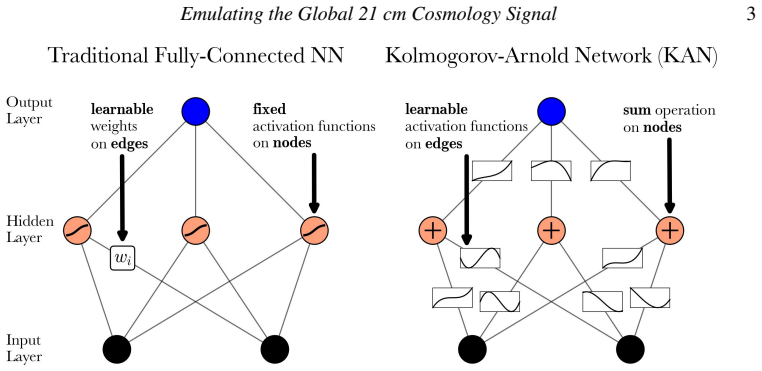
The global 21 cm signal is a 1D function of frequency, so the key machinery is choosing network architectures that respect that structure. 21CMLSTM is a recurrent Long Short-Term Memory network whose gated memory cells propagate information across adjacent frequency bins, capturing temporal correlation; its accuracy comes at the cost of sequential training. 21CMKAN is a Kolmogorov-Arnold Network, which replaces fixed node activations with learned activation functions on the edges and sums them at nodes; it explicitly learns the smooth functional transformations of the 21 cm curve with far fewer parameters. The emulators act as surrogate models in nested-sampling likelihood calls, converting
What would settle it
Take a set of global 21 cm spectra generated by a different simulation code or by an independent instrument simulator that includes calibration errors and residual foregrounds, then run the published 21CMKAN training and nested-sampling pipeline on them; if the recovered posterior distributions exclude the true parameters by more than the expected statistical scatter, the unbiased-constraint claim is falsified.
Extended reading notes
Core claim
The central claim is that 21CMLSTM and 21CMKAN provide state-of-the-art speed and accuracy for emulating the global 21 cm signal, with 21CMKAN reducing the training bottleneck to minutes. The paper demonstrates this by training on a suite of global 21 cm spectra generated by a semi-numerical simulation, comparing emulation error across trials against an existing variational-autoencoder emulator, and performing nested-sampling fits of mock signals with added 5, 10, and 25 mK noise. In those fits the posteriors are unbiased and the emulator's signal realizations bracket the true signal within 1σ. Because the emulators are publicly available and architecture-agnostic to the underlying signal mo
Load-bearing premise
That a mock signal drawn from the same simulation suite the emulator was trained on, with simple additive noise, is representative of real lunar far-side observations once foregrounds and instrument systematics are removed.
Editorial extensions
If this is right
- Upcoming lunar far-side radio experiments can run end-to-end Bayesian parameter constraints in under 30 minutes per model, making emulator training a non-bottleneck step in the analysis pipeline.
- The unbiased-recovery result at noise levels from 5 to 25 mK means the emulators are positioned for the signal-to-noise conditions expected in global 21 cm measurements.
- Because each theoretical model of cosmic dawn and reionization requires its own emulator, the 10-minute training time of 21CMKAN makes it practical to compare many models and parameterizations.
- The transparent, interpretable KAN architecture allows users to inspect which physical parameters most strongly shape the signal, aiding model validation beyond point predictions.
Reading between the lines
- A stress test not reported in the paper: train on one simulation suite and attempt to recover parameters from signals generated by an independent 21 cm code or with a different foreground model; if posteriors shift, the unbiased claim is specific to the training distribution.
- The KAN architecture's speed and functional-learning design likely transfer to other smooth 1D summary statistics in cosmology and astrophysics, such as galaxy luminosity functions or matter power spectra, where expensive simulations currently bottleneck inference.
- If the mock-noise validation holds with real instrument calibration, real-time Bayesian fits during lunar observations become feasible, allowing observing strategy to adapt to the data.
- A direct comparison on public data against the previous variational-autoencoder emulator is already suggestive; an end-to-end reanalysis of existing ground-based 21 cm measurements would test whether the unbiased-recovery performance persists under unmodeled foregrounds.
Editorial analysis
A structured set of objections, weighed in public.
Referee Report
Summary. This proceedings paper describes two neural-network emulators for the global 21 cm signal: 21CMLSTM, a recurrent LSTM-based emulator, and 21CMKAN, a Kolmogorov-Arnold-network-based emulator. The authors claim that 21CMLSTM is the most accurate global 21 cm emulator to date, leveraging the temporal correlation of the signal, and that 21CMKAN achieves comparable accuracy while training about 75 times faster and evaluating about 5 times faster. They present an error histogram comparing these emulators with 21CMVAE, and a posterior-recovery demonstration in which 21CMKAN fits three 21CMGEM mock signals with added Gaussian noise of 5, 10, and 25 mK. The paper concludes that the emulators enable quick and reliable physical parameter constraints for upcoming lunar far-side experiments, with 21CMKAN able to complete end-to-end training and inference in under 30 minutes.
Significance. If the stated performance is correct, these emulators would be practically valuable for Bayesian inference pipelines with expensive physical simulations, particularly for LuSEE-Night and FarView. The manuscript's strengths are its clear motivation, the public availability of both emulator codes, and the direct comparison to an existing community emulator (21CMVAE). The qualitative architectural argument for using LSTM and KAN for the global 21 cm signal is reasonable. However, the evidence presented in this manuscript alone is thin: the accuracy comparison is qualitative, the unbiased-constraints claim rests on only three noise realizations, and all validation is internal to the 21CMGEM simulation suite. The paper is best read as a summary of the companion papers (Dorigo Jones et al. 2024, 2025), and the reader must consult those for the details needed to verify the central claims.
major comments (3)
- [Section 2 / Figure 3] The claim of 'unbiased physical parameter posterior distributions' is supported by only three mock signals with added Gaussian noise. Three noise realizations are insufficient to establish unbiasedness or correct coverage over the prior volume. Please report quantitative bias metrics (e.g., mean/median difference between true and posterior values), credible-interval coverage on a larger held-out test set, and statistics over many noise realizations. Alternatively, rephrase the claim as 'recovered input parameters for three example signals.'
- [Section 1 / Figure 3] The validation is entirely internal to the 21CMGEM simulation suite: training and test signals come from the same simulator. Real lunar far-side observations will include foreground residuals, beam chromaticity, calibration errors, and possibly non-white noise. The manuscript's own caveat 'assuming systematic effects are properly addressed' acknowledges this limitation. The title's 'Reliable Physical Constraints' and the abstract's 'unbiased physical parameter constraints' overreach. Either add a systematics-inclusive validation (e.g., foreground-plus-instrument simulations) or explicitly scope the claims to noise-only mock observations.
- [Section 2 / Figure 2] The accuracy comparison is qualitative. The text states that 21CMLSTM is 'the most accurate emulator' and that 21CMKAN has 'similar accuracy,' but no numerical error statistics are given in this manuscript. The speed figures (3.7 ms, 75x, 5x) are point estimates with no uncertainty. Please report the mean/median and scatter of the relative RMS errors, training times, and evaluation times, or cite specific tables in the companion papers, so the headline claims can be checked without rereading the full papers.
minor comments (4)
- [Abstract and Section 2] The code names are typeset inconsistently: '21CMLSTM' vs '21 CMLSTM' and '21CMKAN' vs '21 CMKAN'. Please use exttt consistently throughout.
- [Figure 2] The red histogram is described as 'approximate error' for 21CMVAE. Please specify the source of the approximation (e.g., digitized values from Bye et al. 2022) and how much uncertainty that introduces.
- [Section 2] The statement that 21CMKAN can complete 'end-to-end training and inference in under 30 minutes' should specify what is included (training, nested sampling, number of live points, hardware) and ideally report a range over runs.
- [Section 2] The factors '75 times faster' and '5 times faster' depend on hardware and stopping criteria. Please state the GPU model and whether the comparison uses matched training epochs, early stopping, or target accuracy.
Circularity Check
No circularity: the emulators' accuracy and unbiased-recovery claims rest on held-out 21CMGEM test signals and are attributed to prior published work, not fitted to the targets they predict.
full rationale
The paper is a proceedings summary whose load-bearing quantitative claims (21CMLSTM's accuracy, 21CMKAN's 75x training speedup, unbiased posterior recovery) are explicitly attributed to two prior papers by the same group (Dorigo Jones et al. 2024, 2025) and are illustrated with figures taken from those papers. This is self-citation, but it is not circular in the logical sense: the cited prior work benchmarks the emulators on a held-out 21CMGEM test set (Figure 2) and fits three 21CMGEM test signals with added noise (Figure 3), neither of which is used to fit the emulator parameters. The emulator is a surrogate trained on 21CMGEM simulations; validating on distinct 21CMGEM test signals is interpolation within one simulation suite, not a fitted input renamed as a prediction. There is no equation in which the predicted quantity is defined in terms of the input, and no uniqueness theorem or ansatz is imported from a self-citation to force the choice of architecture. The paper explicitly brackets real-data systematics with 'assuming systematic effects are properly addressed' (Section 1), so the step from mock recovery to lunar far-side observations is a stated generalization, not a definitional equivalence. Accordingly, no specific circular step can be quoted and exhibited, and the appropriate finding is no significant circularity.
Assumptions & free parameters
free parameters (3)
- Neural network trainable parameters (weights/biases and KAN activation coefficients) =
Not specified in this paper; trained on 21CMGEM simulations
- Emulator architecture hyperparameters (e.g., hidden sizes, grid size for KAN) =
Not specified
- Training time and evaluation speed measurements =
10 min training, 3.7 ms evaluation on A100
assumptions (3)
- domain assumption The 21CMGEM simulation code provides a physically faithful model of the global 21 cm signal.
- domain assumption Held-out test signals from the same simulation distribution are representative of real observations, so 'unbiased' posterior constraints on mock data indicate reliability.
- domain assumption KANs and LSTMs can learn the functional relationship between input physical parameters and the 21 cm brightness temperature across the considered parameter space.
Cite this review
Pith. "Pith review of Emulating Global 21 cm Cosmology Observations from the Lunar Far Side to Achieve Quick and Reliable Physical Constraints." pith.science (2026). https://pith.science/paper/FTSQNRJ6
@misc{pith2026250900976,
  author       = {Pith},
  title        = {Pith review of: Emulating Global 21 cm Cosmology Observations from the Lunar Far Side to Achieve Quick and Reliable Physical Constraints},
  year         = {2026},
  howpublished = {\url{https://pith.science/paper/FTSQNRJ6}},
  note         = {Machine review of arXiv:2509.00976}
}
abstract
Efforts are underway to measure the global 21 cm signal from neutral hydrogen, which is a powerful probe of the early universe, using NASA radio telescopes on the far side of the Moon. Physics-based models of the signal are computationally expensive to perform Bayesian multi-parameter inferences, for which we have developed novel, publicly-available neural network emulators utilizing a Long Short-Term Memory (LSTM) network and a Kolmogorov-Arnold Network (KAN). $\texttt{21cmLSTM}$ is currently the most accurate emulator in the community by leveraging the signal's temporally-correlated structure, and $\texttt{21cmKAN}$ maintains similar accuracy while training 75 times faster, by learning expressive functional transformations. Each emulator can fit realistic mock signals and obtain unbiased physical parameter constraints, with $\texttt{21cmKAN}$ able to complete end-to-end training and inference in under 30 minutes. The implementation of machine learning tools like these in data analysis pipelines is important to fully exploit upcoming measurements of the cosmological 21 cm signal.
Figures

Reference graph
Works this paper leans on
-
[1]
Bale, S. D., Bassett, N., Burns, J. O., et al. 2023, in XXXVth General Assembly and Scientific Symposium of the International Union of Radio Science (URSI GASS)
work page 2023
-
[2]
Bevins, H. T. J., Handley, W. J., Fialkov, A., de Lera Acedo, E., & Javid, K. 2021, GLOBALEMU: a novel and robust approach for emulating the sky-averaged 21-cm signal from the cosmic dawn and epoch of Emulating the Global 21 cm Cosmology Signal 5 reionization, MNRAS, 508, 2923, doi: 10.1093/mnras/stab2737
-
[3]
Bevins, H. T. J., Heimersheim, S., Abril-Cabezas, I., et al. 2024, Joint analysis constraints on the physics of the first galaxies with low-frequency radio astronomy data, MNRAS, 527, 813, doi: 10.1093/ mnras/stad3194
work page 2024
-
[4]
Bowman, J. D., Rogers, A. E. E., Monsalve, R. A., Mozdzen, T. J., & Mahesh, N. 2018, An absorp- tion profile centred at 78 megahertz in the sky-averaged spectrum, Nature, 555, 67, doi: 10.1038/ nature25792
work page 2018
-
[5]
Bye, C. H., Portillo, S. K. N., & Fialkov, A. 2022, 21cmV AE: A Very Accurate Emulator of the 21 cm Global Signal, ApJ, 930, 79, doi: 10.3847/1538-4357/ac6424
-
[6]
Cohen, A., Fialkov, A., Barkana, R., & Monsalve, R. A. 2020, Emulating the global 21-cm signal from Cosmic Dawn and Reionization, MNRAS, 495, 4845, doi: 10.1093/mnras/staa1530 de Lera Acedo, E., de Villiers, D. I. L., Razavi-Ghods, N., et al. 2022, The REACH radiometer for detect- ing the 21-cm hydrogen signal from redshift z ≈ 7.5-28, Nature Astronomy, 6...
work page Pith review arXiv doi:10.48550/arxiv.2508.11752 2020
-
[7]
Fialkov, A., Barkana, R., & Visbal, E. 2014, The observable signature of late heating of the Universe during cosmic reionization, Nature, 506, 197, doi: 10.1038/nature12999
-
[8]
Furlanetto, S. R., Oh, S. P., & Briggs, F. H. 2006, Cosmology at low frequencies: The 21 cm transition and the high-redshift Universe, Physics Reports, 433, 181, doi: 10.1016/j.physrep.2006.08.002
Show all 18 references
-
[9]
A., Schmidhuber, J., & Cummins, F
Gers, F. A., Schmidhuber, J., & Cummins, F. 2000, Learning to Forget: Continual Prediction with LSTM, Neural Computation, 12, 2451, doi: 10.1162/089976600300015015
2000 doi
-
[10]
1997, Long Short-Term Memory, Neural Computation, 9, 1735, doi:10
Hochreiter, S., & Schmidhuber, J. 1997, Long Short-Term Memory, Neural Computation, 9, 1735, doi:10. 1162/neco.1997.9.8.1735
1997
-
[11]
2025, in The Thirteenth International Conference on Learning Representations
Liu, Z., Wang, Y ., Vaidya, S., et al. 2025, in The Thirteenth International Conference on Learning Representations. https://openreview.net/forum?id=Ozo7qJ5vZi
2025
-
[12]
2011, 21CMFAST: a fast, seminumerical simulation of the high- redshift 21-cm signal, MNRAS, 411, 955, doi: 10.1111/j.1365-2966.2010.17731.x
Mesinger, A., Furlanetto, S., & Cen, R. 2011, 21CMFAST: a fast, seminumerical simulation of the high- redshift 21-cm signal, MNRAS, 411, 955, doi: 10.1111/j.1365-2966.2010.17731.x
2011
-
[13]
R., & Sun, G
Mirocha, J., Furlanetto, S. R., & Sun, G. 2017, The global 21-cm signal in the context of the high- z galaxy luminosity function, MNRAS, 464, 1365, doi: 10.1093/mnras/stw2412
2017 doi
-
[14]
S., Burns, J
Polidan, R. S., Burns, J. O., Ignatiev, A., et al. 2024, FarView: An in-situ manufactured lunar far side radio array concept for 21-cm Dark Ages cosmology, Advances in Space Research, 74, 528, doi:10.1016/ j.asr.2024.04.008
2024
-
[15]
Qin, Y ., Mesinger, A., Park, J., Greig, B., & Mu ˜noz, J. B. 2020, A tale of two sites - I. Inferring the properties of minihalo-hosted galaxies from current observations, MNRAS, 495, 123, doi: 10.1093/ mnras/staa1131
2020
-
[16]
Rapetti, D., Tauscher, K., Mirocha, J., & Burns, J. O. 2020, Global 21 cm Signal Extraction from Foreground and Instrumental Effects. II. Efficient and Self-consistent Technique for Constraining Nonlinear Signal Models, ApJ, 897, 174, doi: 10.3847/1538-4357/ab9b29
2020 doi
-
[17]
D., de Lera Acedo, E., Handley, W., & Koopmans, L
Saxena, A., Meerburg, P. D., de Lera Acedo, E., Handley, W., & Koopmans, L. V . E. 2023, Sky-averaged 21-cm signal extraction using multiple antennas with an SVD framework: the REACH case, MNRAS, 522, 1022, doi: 10.1093/mnras/stad1047
2023 doi
-
[18]
T., Subrahmanyan, R., et al
Singh, S., Jishnu, N. T., Subrahmanyan, R., et al. 2022, On the detection of a cosmic dawn signal in the radio background, Nature Astronomy, 6, 607, doi: 10.1038/s41550-022-01610-5
2022 doi
Reviewed August 5, 2026 · model on record in the stance chip above.
Discussion (0). Sign in to comment.