REVIEW 3 major objections 4 minor 38 references
Is Noisy Data a Blessing in Disguise? A Distributionally Robust Optimization Perspective
T0 review · 3 major / 4 minor · reviewed 2026-08-05 · deepseek-v4-flash
Pith's one-line read This paper claims that explicitly modeling the noise process in distributionally robust optimization yields a provably higher worst-case utility than treating noisy data as clean, under mean-preserving noise, via an inverse-image ambiguity
desk verdict The inverse-image Wasserstein DRO idea is good and the statistical section looks sound, but Lemma 4.1 is false and the paper's main claims rest on it. read the letter →
The pith
A machine-rendered reading of the paper's core claim, the machinery that carries it, and where it could break.
The reading
What carries the argument
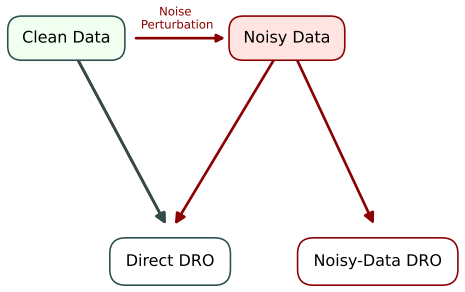
The load-bearing object is the inverse-image ambiguity set B_{ε,O}(F̂⋆) = {F ∈ M(X) : d(T_O(F), F̂⋆) ≤ ε}, where T_O(F) = ∫ O(·|x)dF(x) is the noise operator pushing a latent distribution through a known noise kernel. Lemma 4.1 converts the max-min problem over this set into a semi-infinite convex program whose per-observation cost kernel is c_j(x) = ∫_{X⋆}∥x⋆ − x̂⋆_j∥ dO(x⋆|x); the dominance theorem then applies Jensen's inequality to this kernel under the mean-preserving assumption, showing the noisy kernel dominates the direct one pointwise.
What would settle it
Enumerate the original max-min problem (5) on a small discretized instance — two or three latent states, two noisy samples, a two-point mean-preserving noise kernel — and compare the true worst-case value with the value of the convex reformulation (8). If any gap appears, or if the optimal coupling's components cannot all be written as T_O(α_j) for latent measures α_j, the reformulation is inexact and the proof of Theorem 4.2 no longer goes through. The same enumeration, run with a biased noise kernel of bias δ, would also check Proposition 4.1's bound g*_noise,δ(ε) ≥ g*(ε) − λ*δ.
Extended reading notes
Core claim
The paper's central claim is that the standard practice of applying DRO directly to noisy observations throws away information: because every norm is convex, a mean-preserving noise kernel inflates the expected transport cost to each observed sample, E_{O(·|x)}[∥X⋆ − x̂⋆_j∥] ≥ ∥x − x̂⋆_j∥, so each constraint of the direct model is relaxed pointwise and the feasible decision set grows. Consequently, for every radius ε > 0 the noisy-data DRO's worst-case optimal value dominates the direct model's, g*_noise(ε) ≥ g*(ε), and its price of ambiguity is no larger. The construction works by defining the latent ambiguity set as the pre-image of a Wasserstein ball through the noise operator, a pull-bac
Load-bearing premise
The proof of the convex reformulation assumes that any transport coupling between the noisy empirical distribution and the noise-perturbed latent distribution can be split, one piece per observation, with each piece expressible as the noise-image of some latent component measure. This is shown to be sufficient but not necessary; if an optimal coupling requires pieces the noise operator cannot produce, the reformulation — and the dominance theorem built on it — might overstate
Editorial extensions
If this is right
- Decision makers with mean-preserving noisy observations can guarantee weakly higher worst-case utility by modeling the noise explicitly than by applying standard DRO to the noisy data.
- The price of ambiguity — the relative utility loss from insisting on robustness — is no larger under noisy-data DRO, making robustness cheaper when noise is present.
- The noiseless Wasserstein DRO becomes a special case (Dirac noise kernel), so the framework is a strict generalization of a widely used data-driven method.
- Finite-sample out-of-sample guarantees at confidence 1−β and almost-sure convergence to the true stochastic optimum make the pull-back construction statistically sound for deployment.
- In fair allocation, raising the ambiguity radius ε moves allocations toward equitable solutions while preserving more aggregate utility than raising the fairness parameter α, giving a lever for equity that does not sacrifice as much efficiency.
Reading between the lines
- The Jensen-inequality mechanism is generic: any mean-preserving spread inside a norm-based transport cost relaxes the same pointwise constraints, so the 'blessing of noise' should extend to other Wasserstein-based robust problems such as regression with noisy features or portfolio selection with noisy returns, even though the paper only demonstrates it for fair allocation.
- The size of the blessing should be measurable and monotone in noise dispersion: for two mean-preserving noise kernels with the same mean but different variance, the gap g*_noise(ε) − g*(ε) should be larger for the higher-variance kernel; this is a direct testable corollary the paper does not state.
- If the reformulation's decomposition step turns out to be inexact, the practical effect is that the numerical optimal values and POA gaps reported in Section 5 would be optimistic bounds rather than exact values; the dominance direction is plausible but the magnitudes would need re-derivation.
- The ambiguity–fairness parallel hints at a broader design principle: a platform that cannot impose fairness constraints directly could deliberately inject calibrated ambiguity or noise into the robust model to steer allocations toward equity, a recipe the example suggests but the paper does not claim.
Editorial analysis
A structured set of objections, weighed in public.
Referee Report
Summary. The paper proposes a distributionally robust optimization framework for decision-making under noisy data. The ambiguity set is defined as the inverse image, under a known noise kernel, of a Wasserstein ball centered at the noisy empirical distribution. The central claims are: (i) the resulting noisy-data DRO admits a tractable convex reformulation; (ii) under mean-preserving noise it is less conservative than a direct DRO that treats noisy observations as clean, i.e., g*_noise(ε) ≥ g*(ε); (iii) this implies a lower price of ambiguity; and (iv) finite-sample guarantees and asymptotic consistency hold. The paper also presents a fair-resource-allocation application. The main proof of the reformulation rests on a false 'without loss of generality' assumption about the structure of optimal transport couplings, and the dominance theorem is therefore unsupported.
Significance. The inverse-image construction is a natural and potentially useful idea, and the statistical results in Section 3 appear to be largely independent of the disputed reformulation. If the dominance theorem were correct, it would be a surprising and practically relevant result. However, the central mathematical claim is not established: the proof of Lemma 4.1 contains a load-bearing error, and the counterexample in this report shows that the reformulated program can be unbounded while the original problem is finite. The numerical study solves the restricted surrogate, not the original noisy-data DRO, so it does not provide empirical support for the paper's main conclusion. Because the key comparison results (Theorem 4.2, Lemma 4.2, and the 'blessing in disguise' interpretation) all rely on the invalid reformulation, the paper's central contribution is not currently supported.
major comments (3)
- [Appendix A.2, proof of Lemma 4.1] The proof replaces the marginal constraint (1/N)Σ_j G⋆_j = T_O(F) with the componentwise condition G⋆_j = T_O(α_j), where F = (1/N)Σ_j α_j. The text calls this 'a sufficient way' but then treats it as an equivalence by reparameterizing the entire optimization over α_j. This is not without loss of generality: feasible couplings may have components G⋆_j outside the image of T_O. Concretely, take X=[0,1], E uniform on {-1,1} (mean-preserving), N=2, observed samples 0 and 2, ε=0.5, U(w,x)=wx with w≥0. The latent F=δ_1 with G⋆_1=δ_0 and G⋆_2=δ_2 satisfies the original coupling constraints with zero transport cost, so the original inner problem is feasible and finite. In the reformulation, c_1(x)=1 for all x∈[0,1] and c_2(x)=2−x, so the average cost is at least 1; the constraint (1/N)Σ_j∫c_j dα_j ≤ 0.5 is infeasible and the dual is unbounded. Lemma 4.1 is therefore false as stated.
- [Theorem 4.2 / Lemma 4.2] The dominance result g*_noise(ε) ≥ g*(ε) is proved entirely through the reformulated program (8). Since Lemma 4.1 is invalid, the theorem does not compare the original noisy-data DRO problem (5) with the direct DRO. In fact, the reformulation is a restriction of the original problem: it imposes G⋆_j = T_O(α_j), so its inner infimum is no smaller than the original inner infimum. Thus even the inequality g_surrogate ≥ g_direct is in the wrong direction to imply g_original ≥ g_direct; the original problem could have a smaller value. The numerical experiments in §5.2.2 solve the restricted surrogate, not Problem 2.1, so they cannot confirm Theorem 4.2 for the original model. The price-of-ambiguity dominance in Lemma 4.2 inherits the same unsupported conclusion.
- [Section 4.1 / Theorem 4.1] The tractability claim for Problem 2.1, as well as the sensitivity result dg*_noise/dε = −λ*(ε), depends on the dual program derived in Lemma 4.1. Once Lemma 4.1 is rejected, the 'shadow price of robustness' interpretation is not justified for the original problem. The paper does not provide an alternative derivation of a convex reformulation for the original coupling problem, so the proposed framework lacks a verified tractable formulation.
minor comments (4)
- [Abstract / Figure 4] There are several typos, including 'p aper' in the abstract, and in Figure 4 the labels 'P ice of F ai ness', 'F AIR', and 'Optimal Value unde Va ying ε' are corrupted. Please proofread the text and figure labels.
- [Theorem 3.1] The statement says 'for all N ≥ 1, n ≠ 2' and then uses max{n,2}; for n=2 the exponent is the same as for n<2, so the exclusion of n=2 is unexplained. Either justify it or remove it.
- [Section 5.2] The numerical section says the DRO_noise model applies Lemma 4.1, but since Lemma 4.1 is invalid, the reported numbers are for the restricted surrogate. If the authors propose a corrected reformulation, the experiments should be rerun for the original problem. Also, details such as the solver, seeds, and code availability are not provided, which limits reproducibility.
- [Theorem 3.3 / Appendix A.1] The notation P⋆,∞ is used without a definition. It appears to denote the infinite product measure for the noisy sample path, but this should be stated explicitly.
Circularity Check
No circular derivation: the dominance result is obtained by a Jensen-inequality comparison of feasible sets, not by defining the conclusion into the model.
full rationale
The paper's central claim, g*_noise(ε) ≥ g*(ε), is established in Theorem 4.2 by showing that every feasible triplet of the direct DRO satisfies the noisy-data DRO constraints because mean-preserving noise gives E[||X⋆−x̂⋆_j|| | X=x] ≥ ||x−x̂⋆_j||. This is a substantive analytic comparison, not a definitional equivalence; the conclusion is not used to construct the ambiguity set. The inverse-image ambiguity set is defined independently of the dominance result. Statistical guarantees use external concentration results and characteristic-function arguments. The only self-citations (Hsieh 2024; Hsieh and Yu 2024) are introductory literature pointers and are not load-bearing. The potential gap in Lemma 4.1 — replacing the marginal coupling constraint by the sufficient componentwise condition G⋆_j = T_O(α_j) — is a soundness issue (the reformulation may not be equivalent to the original problem), not a circularity: it does not reduce the claimed output to the input by construction. Per the hard rules, no circularity score is assigned for that gap.
Assumptions & free parameters
assumptions (6)
- domain assumption The noise kernel O is known to the decision maker.
- domain assumption The noise model is additive and independent: X* = X + E with E independent of X.
- domain assumption The noise is mean-preserving for Theorem 4.2 and Proposition 4.1.
- domain assumption The characteristic function of the noise has zero set of Lebesgue measure zero.
- domain assumption The supports X and X* are compact and convex.
- ad hoc to paper In Lemma 4.1, the coupling components G*_j can be assumed to equal T_O(α_j) for some latent measures α_j without loss of optimality.
Cite this review
Pith. "Pith review of Is Noisy Data a Blessing in Disguise? A Distributionally Robust Optimization Perspective." pith.science (2026). https://pith.science/paper/IIJVAZ3A
@misc{pith2026250901076,
  author       = {Pith},
  title        = {Pith review of: Is Noisy Data a Blessing in Disguise? A Distributionally Robust Optimization Perspective},
  year         = {2026},
  howpublished = {\url{https://pith.science/paper/IIJVAZ3A}},
  note         = {Machine review of arXiv:2509.01076}
}
read the original abstract
Noisy data are often viewed as a challenge for decision-making. This paper studies a distributionally robust optimization (DRO) that shows how such noise can be systematically incorporated. Rather than applying DRO to the noisy empirical distribution, we construct ambiguity sets over the \emph{latent} distribution by centering a Wasserstein ball at the noisy empirical distribution in the observation space and taking its inverse image through a known noise kernel. We validate this inverse-image construction by deriving a tractable convex reformulation and establishing rigorous statistical guarantees, including finite-sample performance and asymptotic consistency. Crucially, we demonstrate that, under mild conditions, noisy data may be a ``blessing in disguise." Our noisy-data DRO model is less conservative than its direct counterpart, leading to provably higher optimal values and a lower price of ambiguity. In the context of fair resource allocation problems, we demonstrate that this robust approach can induce solutions that are structurally more equitable. Our findings suggest that managers can leverage uncertainty by harnessing noise as a source of robustness rather than treating it as an obstacle, producing more robust and strategically balanced decisions.
Figures


Figures from the paper (1 more)

Reference graph
Works this paper leans on
-
[1]
Aliprantis, C. D. and Border, K. C. (2006). Infinite Dimensional Analysis: a Hitchhiker’s Guide . Springer
work page 2006
-
[2]
Altman, E., Avrachenkov, K., and Garnaev, A. (2008). Generalized -Fair Resource Allocation in Wireless Networks . In Proceedings of the IEEE Conference on Decision and Control , pages 2414--2419. IEEE
work page 2008
-
[3]
Banerjee, S. and Green, B. (2015). Signal or Noise? Uncertainty and Learning about Whether Other Traders Are Informed . Journal of Financial Economics , 117(2):398--423
work page 2015
-
[4]
Ben-Tal, A., Den Hertog, D., De Waegenaere, A., Melenberg, B., and Rennen, G. (2013). Robust Solutions of Optimization Problems Affected by Uncertain Probabilities . Management Science , 59(2):341--357
work page 2013
-
[5]
Ben-Tal, A., El Ghaoui, L., and Nemirovski, A. (2009). Robust Optimization . Princeton University Press
work page 2009
-
[6]
Bertsimas, D., Farias, V. F., and Trichakis, N. (2011). The Price of Fairness . Operations Research , 59(1):17--31
work page 2011
-
[7]
Bertsimas, D. and Sim, M. (2004). The Price of Robustness . Operations Research , 52(1):35--53
work page 2004
-
[8]
Black, F. (1986). Noise. The Journal of Finance , 41(3):528--543
work page 1986
Show all 38 references
-
[9]
Blanchet, J., Chen, L., and Zhou, X. Y. (2022). Distributionally Robust Mean-Variance Portfolio Selection with Wasserstein Distances . Management Science , 68(9):6382--6410
2022
-
[10]
Blanchet, J., Li, J., Lin, S., and Zhang, X. (2024). Distributionally Robust Optimization and Robust Statistics . arXiv preprint arXiv:2401.14655
2024 arXiv
-
[11]
Y.-M., and Mao, T
Cai, J., Li, J. Y.-M., and Mao, T. (2025). Distributionally Robust Optimization under Distorted Expectations . Operations Research , 73(2):969--985
2025
-
[12]
Durrett, R. (2019). Probability: Theory and Examples . Cambridge University Press
2019
-
[13]
Dwork, C., Kenthapadi, K., McSherry, F., Mironov, I., and Naor, M. (2006). Our Data, Ourselves: Privacy via Distributed Noise Generation . In Advances in cryptology-EUROCRYPT 2006: 24th annual international conference on the theory and applications of cryptographic techniques,...
2006
-
[14]
Farokhi, F. (2022). Distributionally-Robust Machine Learning Using Locally Differentially-Private Data . Optimization Letters , 16(4):1167--1179
2022
-
[15]
Farokhi, F. (2023). Distributionally-Robust Optimization with Noisy Data for Discrete Uncertainties Using Total Variation Distance . IEEE Control Systems Letters
2023
-
[16]
Gao, R. (2023). Finite-Sample guarantees for Wasserstein Distributionally Robust Optimization: Breaking the Curse of Dimensionality . Operations Research , 71(6):2291--2306
2023
-
[17]
and Kleywegt, A
Gao, R. and Kleywegt, A. (2023). Distributionally Robust Stochastic Optimization with Wasserstein Distance . Mathematics of Operations Research , 48(2):603--655
2023
-
[18]
Hsieh, C.-H. (2024). On Solving Robust Log-Optimal Portfolio: A Supporting Hyperplane Approximation Approach . European Journal of Operational Research , 313(3):1129--1139
2024
-
[19]
and Yu, X.-R
Hsieh, C.-H. and Yu, X.-R. (2024). On Cost-Sensitive Distributionally Robust Log-Optimal Portfolio . arXiv preprint arXiv:2410.23536
2024 arXiv
-
[20]
and Hong, L
Hu, Z. and Hong, L. J. (2013). Kullback-Leibler Divergence Constrained Distributionally Robust Optimization . Available at Optimization Online , 1(2):9
2013
-
[21]
and Guan, Y
Jiang, R. and Guan, Y. (2018). Risk-Averse Two-Stage Stochastic Program with Distributional Ambiguity . Operations Research , 66(5):1390--1405
2018
-
[22]
Kuhn, D., Shafiee, S., and Wiesemann, W. (2025). Distributionally Robust Optimization . Acta Numerica , 34:579--804
2025
-
[23]
C., and Sidford, A
Levy, D., Carmon, Y., Duchi, J. C., and Sidford, A. (2020). Large-Scale Methods for Distributionally Robust Optimization . Advances in Neural Information Processing Systems , 33:8847--8860
2020
-
[24]
Li, J. Y. and Kwon, R. H. (2013). Portfolio Selection under Model Uncertainty: A Penalized Moment-Based Optimization Approach . Journal of Global Optimization , 56:131--164
2013
-
[25]
Li, J. Y.-M. (2023). Wasserstein-Kelly Portfolios: A Robust Data-Driven Solution to Optimize Portfolio Growth . arXiv preprint arXiv:2302.13979
2023 arXiv
-
[26]
and Kuhn, D
Mohajerin Esfahani, P. and Kuhn, D. (2018). Data-Driven Distributionally Robust Optimization using the Wasserstein Metric: Performance Guarantees and Tractable Reformulations . Mathematical Programming , 171(1-2):115--166
2018
-
[27]
Muralidhar, K., Parsa, R., and Sarathy, R. (1999). A General Additive Data Perturbation Method for Database Security . Management Science , 45(10):1399--1415
1999
-
[28]
Peyr \'e , G., Cuturi, M., et al. (2019). Computational optimal Transport: With Applications to Data Science . Foundations and Trends in Machine Learning , 11(5-6):355--607
2019
-
[29]
and Mehrotra, S
Rahimian, H. and Mehrotra, S. (2022). Frameworks and Results in Distributionally Robust Optimization . Open Journal of Mathematical Optimization , 3:1--85
2022
-
[30]
Smith, J. E. and Winkler, R. L. (2006). The Optimizer’s Curse: Skepticism and Postdecision Surprise in Decision Analysis . Management Science , 52(3):311--322
2006
-
[31]
Syds ter, K., Seierstad, A., and Strom, A. (2008). Further Mathematics for Economic Analysis . Pearson Education
2008
-
[32]
Van Parys, B. P. (2024). Efficient Data-Driven Optimization with Noisy Data . Operations Research Letters , 54:107089
2024
-
[33]
Villani, C. (2008). Optimal Transport: Old and New , volume 338. Springer
2008
-
[34]
Wiesemann, W., Kuhn, D., and Sim, M. (2014). Distributionally Robust Convex Optimization . Operations Research , 62(6):1358--1376
2014
-
[35]
and Hooker, J
Xinying Chen, V. and Hooker, J. N. (2023). A Guide to Formulating Fairness in an Optimization Model . Annals of Operations Research , 326(1):581--619
2023
-
[36]
Zhang, L., Yang, J., and Gao, R. (2024). A Short and General Duality Proof for Wasserstein Distributionally Robust Optimization . Operations Research
2024
-
[37]
Zhang, L., Yang, J., and Gao, R. (2025). A short and general duality proof for wasserstein distributionally robust optimization. Operations Research , 73(4):2146--2155
2025
-
[38]
Social-Aware Resource Allocation Dataset
ZIYA (2025). Social-Aware Resource Allocation Dataset . https://www.kaggle.com/datasets/ziya07/social-aware-resource-allocation-dataset. Kaggle, CC0: Public Domain License
2025
Reviewed August 5, 2026 · model on record in the stance chip above.
Discussion (0). Sign in to comment.