REVIEW 2 major objections 6 minor 81 references
MVTrajecter: Multi-View Pedestrian Tracking with Trajectory Motion Cost and Trajectory Appearance Cost
T0 review · 2 major / 6 minor · reviewed 2026-08-05 · deepseek-v4-flash
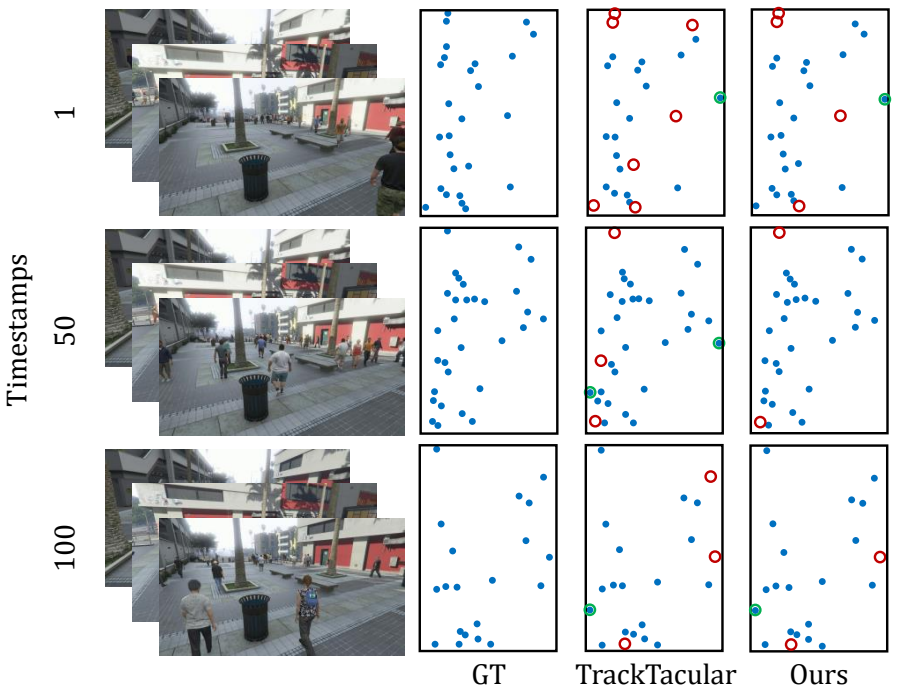
Pith's one-line read Multi-view pedestrian tracking becomes more reliable when identity association sums motion and appearance evidence over several past timestamps instead of one; MVTrajecter's 7-frame window reports new state-of-the-art results on three bench
desk verdict A credible multi-timestamp association mechanism for end-to-end MVPT, with a real gap in how missing detections are handled and a minor test-set leak. read the letter →
The pith
A machine-rendered reading of the paper's core claim, the machinery that carries it, and where it could break.
The reading
What carries the argument
The two load-bearing objects are trajectory motion cost (TMC) and trajectory appearance cost (TAC). TMC(i,j) = Σ_k ||p^t_i − (p^{t−k}_j + m^{t−k}_j)|| sums, over all past timestamps in the window, the distance between the current detected position and the position reached by propagating each past position with its predicted motion. TAC(i,j) = −Σ_k Pr^{t−k}(j|i) sums the softmax identity probability from appearance-feature dot products. Summing turns the association into a vote over the track: one bad timestamp can be outweighed by the others. A shared attention mechanism, with sinusoidal temporal embeddings added to pedestrian features, produces the motions and appearance features so that ea
What would settle it
Run MVTrajecter on a sequence where a substantial fraction of pedestrians are undetectable for stretches longer than the K=7 window, or where t−1 is synthetically occluded; if IDF1 with K=7 does not exceed K=1 under these conditions — or if the network cannot even produce the required past features — the redundancy argument fails. Also, a direct check of the α=0.98 weighting: setting TAC's contribution to zero (relying on TMC alone) should drop performance measurably if the appearance term is truly load-bearing rather than a numerical rounding error given the reported ranges.
Extended reading notes
Core claim
The paper proposes that an end-to-end multi-view pedestrian tracker should associate a current detection with a past track by aggregating association evidence across the whole track window. For a candidate pair (current pedestrian i, past trajectory j), it computes the trajectory motion cost, the sum over k = 1..K of the Euclidean distance between i's detected position and the position j had at t−k advanced by a predicted motion; and the trajectory appearance cost, the negative sum over k of the probability that i is j's identity given dot-product similarity of appearance features at t and t−k. The two costs are weighted and solved with Hungarian matching. Training is end-to-end with losses
Load-bearing premise
The association costs assume every pedestrian has an appearance and motion feature at every past timestamp in the window; the paper says a missing location is handled by a Kalman filter, but it never specifies how the network produces the features (Eqs. 5–7) that feed the costs for a pedestrian who was not detected at a past timestamp, which is exactly the common occlusion case.
Editorial extensions
If this is right
- If the central claim holds, end-to-end multi-view trackers should treat history length K as a tunable axis: the paper's ablation shows MOTA rising from 74.2 (K=1) to 78.1 (K=7) on GMVD.
- Motion and appearance evidence are complementary: adding TMC to a motion-only baseline raises IDF1 from 67.8 to 71.8, adding TAC to an appearance-only baseline raises it from 64.7 to 72.3, and both together reach 77.2.
- Attention-based motion prediction beats a Kalman-filter alternative (IDF1 77.2 vs 76.0), supporting the view that multi-timestamp relational context improves motion forecasting.
- The association mechanism transfers across datasets of different camera counts and density levels (Wildtrack, MultiviewX, GMVD), suggesting the costs generalize rather than overfitting one benchmark.
Reading between the lines
- Windowed voting is a general principle: the same accumulate-costs-over-a-trajectory trick could transfer to monocular trackers or graph-based global association, where the single-frame cost is the usual bottleneck — the paper only demonstrates it in BEV multi-view tracking.
- The α=0.98 weighting plus the reported value ranges (CTMC on the order of 10^3, CTAC near 10^−25) implies the motion term practically decides the Hungarian assignment; expect that improving motion prediction quality matters more than refining appearance similarity.
- The paper's K=7 ceiling is a memory limit and its own conclusion admits failure when detection fails for more than 7 consecutive frames; a natural testable extension is per-trajectory adaptive window length, or a recurrent/compressed memory that extends history beyond 7 frames.
- A stress test for the claim: deliberately occlude the adjacent-past timestamp (t−1) in a fraction of frames; the multi-timestamp method should degrade much less than K=1 baselines if the redundancy argument is right.
Editorial analysis
A structured set of objections, weighed in public.
Referee Report
Summary. The paper proposes MVTrajecter, an end-to-end multi-view pedestrian tracking method that extends association beyond the adjacent past timestamp by using information from K past timestamps. It introduces a trajectory motion cost (TMC) and a trajectory appearance cost (TAC), each formed by summing per-timestamp motion/appearance evidence over the past K timestamps, and combines them with a weighting parameter before Hungarian matching. The architecture uses attention layers to predict motions and appearance features from BEV pedestrian features. Experiments on GMVD, Wildtrack, and MultiviewX report state-of-the-art results, supported by ablations on trajectory length, cost components, attention versus Kalman filtering, and inference speed.
Significance. The paper addresses a clear gap in end-to-end MVPT, where previous methods restrict association to the current and adjacent past timestamp. The proposed aggregation over multiple timestamps is simple, well-motivated by analogous developments in monocular tracking, and the empirical gains in Tables 5 and 6 are substantial (e.g., +6.2 IDF1 from K=1 to K=7). The authors provide thorough ablations, including HOTA and inference speed, and make the comparison fair by re-implementing previous methods on GMVD and also testing with identical detections. If the missing-detection handling is resolved, this would be a solid contribution that could influence future MVPT design.
major comments (2)
- [Sec. 3.3-3.5 (Eqs. 5-7, 9-10)] The paper defines p^{t-k}_j = ∅ for missing detections (Sec. 3.1) and reports detection recall of only 79.4% on GMVD (Table 10), so missing detections are common. However, the procedure is undefined for missing pedestrians. Pedestrian features f^{t-k}_j are extracted only at detected locations (Sec. 3.4: f^n_t = B^t(p^n_t)). Eqs. 5 and 7 require f^{t-k}_j to compute m^{t-k}_j and d^{t-k}_j; the Kalman-filter fallback for TMC in Sec. 3.3 does not provide m^{t-k}_j to the motion branch, nor does it specify how attention handles a missing token. The training losses (Eqs. 9-10) sum over all n,k and are undefined when p^{t-k}_n=∅. This is a load-bearing gap because the central claim is that aggregation over K > 1 timestamps improves association, and missing detections are more likely with larger K. Please specify the actual handling (masking, imputation, dropping) and evaluate its impact; the
- [Sec. 4.3 and Tables 3-4] The hyperparameters (K, α, detection and Hungarian thresholds) are tuned on the MultiviewX validation set, which is the validation data for GMVD experiments (Sec. 4.1: 'Following Vora et al., we use MultiviewX as the validation data in the experiments on GMVD'). The same hyperparameters are then used to report MultiviewX test results in Table 4. Consequently, the MultiviewX result is not an independent test of generalization; it may be optimistic because model selection used validation data from the same distribution. I recommend disclosing this explicitly and ideally reporting MultiviewX results with hyperparameters chosen without access to MultiviewX (e.g., from GMVD validation), or at least discussing the optimism. The GMVD claims (Tables 1-2) are not affected.
minor comments (6)
- [Sec. 3.4, Eqs. 5/7] The notation {f^{t-k}_1,...,f^{t-k}_N}^K_{k=0} is ambiguous; please define it as the concatenation of all pedestrian features across timestamps t-K,...,t.
- [Sec. 4.3] State for each dataset which split was used for hyperparameter tuning; 'validation data' is ambiguous because GMVD's validation is MultiviewX.
- [Supp. E] The reported value range for CTAC, from -6.2 to -4.7e-25, is surprising: Eq. 2 gives probabilities in [0,1], so a sum of K=7 terms should lie in [-7,0]; a minimum of -4.7e-25 appears to be a typo or numerical artifact. Please verify.
- [Table 2] Please clarify how the 'same detection results as ours' condition was implemented (e.g., feeding MVTrajecter's detections to all trackers).
- [Sec. 3.1] The formulation assumes a fixed number N of pedestrians at all timestamps, but in tracking N changes over time (entries/exits). Please explain how the association matrix is formed when the number of past trajectories differs from the number of current detections.
- [Author affiliation] Typo: 'Laboratries' should be 'Laboratories'.
Circularity Check
No significant circularity: the multi-timestamp association gains are empirical and externally benchmarked; the sole self-citation is a non-load-bearing related-work mention.
full rationale
The paper's central claim is that aggregating motion and appearance association evidence over multiple past timestamps (TMC and TAC) improves multi-view pedestrian tracking. This claim is supported by controlled experiments on held-out test splits of GMVD, Wildtrack, and MultiviewX, with ablations over K, TMC/TAC, attention vs. Kalman filter, and EMA aggregation. The training losses LTMC and LTAC minimize the same per-timestamp motion and appearance objectives used in the inference costs, but that is standard supervised consistency rather than circular derivation: the reported MOTA/IDF1 numbers are measured against ground-truth tracks on test data, not by the training loss. Hyperparameters such as α and detection thresholds are tuned on validation data, not fitted to the test metrics. The only author self-citation is [61] (Suzuki, Tora, Masumura) in a related-work list of data augmentations; it is not used to justify the proposed architecture or to establish the SOTA claim, so it is not load-bearing. The paper also states a genuine limitation: past information is limited to 7 timestamps due to GPU memory, and it cannot track someone whose detection continuously fails for more than 7 timestamps. A related robustness gap is that the handling of p^{t-k}_j = ∅ is underspecified for the attention branches (Eqs. 5 and 7 require f^{t-k}_j, but features are only extracted at detected locations). These are correctness/robustness concerns, not circularity, and do not raise the circularity score beyond the minor self-citation tier.
Assumptions & free parameters
free parameters (4)
- alpha =
0.98
- K (trajectory length) =
7
- detection threshold =
0.4
- Hungarian matching threshold =
0.1
assumptions (5)
- domain assumption Calibrated cameras and ground-plane homographies are available for all datasets.
- domain assumption BEV features at detected pedestrian locations contain sufficient appearance and motion information for identity association over K timestamps.
- domain assumption The attention mechanism can capture temporal changes and identity matching from pedestrian features.
- domain assumption The softmax normalization in Eq. 2 over all N pedestrians at each timestamp yields valid identity probabilities.
- domain assumption Ground-truth occupancy maps and trajectories are available for training and evaluation on all three datasets.
Cite this review
Pith. "Pith review of MVTrajecter: Multi-View Pedestrian Tracking with Trajectory Motion Cost and Trajectory Appearance Cost." pith.science (2026). https://pith.science/paper/WBVAKOFN
@misc{pith2026250901157,
  author       = {Pith},
  title        = {Pith review of: MVTrajecter: Multi-View Pedestrian Tracking with Trajectory Motion Cost and Trajectory Appearance Cost},
  year         = {2026},
  howpublished = {\url{https://pith.science/paper/WBVAKOFN}},
  note         = {Machine review of arXiv:2509.01157}
}
read the original abstract
Multi-View Pedestrian Tracking (MVPT) aims to track pedestrians in the form of a bird's eye view occupancy map from multi-view videos. End-to-end methods that detect and associate pedestrians within one model have shown great progress in MVPT. The motion and appearance information of pedestrians is important for the association, but previous end-to-end MVPT methods rely only on the current and its single adjacent past timestamp, discarding the past trajectories before that. This paper proposes a novel end-to-end MVPT method called Multi-View Trajectory Tracker (MVTrajecter) that utilizes information from multiple timestamps in past trajectories for robust association. MVTrajecter introduces trajectory motion cost and trajectory appearance cost to effectively incorporate motion and appearance information, respectively. These costs calculate which pedestrians at the current and each past timestamp are likely identical based on the information between those timestamps. Even if a current pedestrian could be associated with a false pedestrian at some past timestamp, these costs enable the model to associate that current pedestrian with the correct past trajectory based on other past timestamps. In addition, MVTrajecter effectively captures the relationships between multiple timestamps leveraging the attention mechanism. Extensive experiments demonstrate the effectiveness of each component in MVTrajecter and show that it outperforms the previous state-of-the-art methods.
Figures


Figures from the paper (5 more)



Reference graph
Works this paper leans on
-
[1]
BoT-SORT: Robust associations multi-pedestrian tracking
Nir Aharon, Roy Orfaig, and Ben-Zion Bobrovsky. BoT-SORT: Robust associations multi-pedestrian tracking. arXiv:2206.14651, 2022. 3, 4
arXiv 2022
-
[2]
Enhancing multi-view pedestrian detection through generalized 3D feature pulling
Sithu Aung, Haesol Park, Hyungjoo Jung, and Junghyun Cho. Enhancing multi-view pedestrian detection through generalized 3D feature pulling. In WACV, 2024. 3, 2
2024
-
[3]
Deep oc- clusion reasoning for multi-camera multi-target detection
Pierre Baqu ´e, Franc ¸ois Fleuret, and Pascal Fua. Deep oc- clusion reasoning for multi-camera multi-target detection. In ICCV, 2017. 3
work page 2017
-
[4]
J. Berclaz, F. Fleuret, and P. Fua. Robust people tracking with global trajectory optimization. In CVPR, 2006. 1, 3
work page 2006
-
[5]
Learning a neural solver for multiple object tracking
Guillem Bras ´o and Laura Leal-Taix ´e. Learning a neural solver for multiple object tracking. In CVPR, 2020. 3
work page 2020
-
[6]
End-to- end object detection with transformers
Nicolas Carion, Francisco Massa, Gabriel Synnaeve, Nicolas Usunier, Alexander Kirillov, and Sergey Zagoruyko. End-to- end object detection with transformers. In ECCV, 2020. 3
work page 2020
-
[7]
Uni- fying short and long-term tracking with graph hierarchies
Orcun Cetintas, Guillem Bras ´o, and Laura Leal-Taix´e. Uni- fying short and long-term tracking with graph hierarchies. In CVPR, 2023. 3
work page 2023
-
[8]
Deep multi- camera people detection
Tatjana Chavdarova and Franc ¸ois Fleuret. Deep multi- camera people detection. In ICMLA, 2017. 3
work page 2017
Show all 81 references
-
[9]
Wildtrack: A multi-camera hd dataset for dense unscripted pedestrian detection
Tatjana Chavdarova, Pierre Baqu ´e, St ´ephane Bouquet, An- drii Maksai, Cijo Jose, Timur Bagautdinov, Louis Lettry, Pascal Fua, Luc Van Gool, and Franc ¸ois Fleuret. Wildtrack: A multi-camera hd dataset for dense unscripted pedestrian detection. In CVPR, 2018. 1, 2, 6, 3
2018
-
[10]
ReST: A reconfigurable spatial-temporal graph model for multi-camera multi-object tracking
Cheng-Che Cheng, Min-Xuan Qiu, Chen-Kuo Chiang, and Shang-Hong Lai. ReST: A reconfigurable spatial-temporal graph model for multi-camera multi-object tracking. In ICCV, 2023. 3, 6, 7
2023
-
[11]
Online multi- camera people tracking with spatial-temporal mechanism and anchor-feature hierarchical clustering
Riu Cherdchusakulchai, Sasin Phimsiri, Visarut Trairat- tanapa, Suchat Tungjitnob, Wasu Kudisthalert, Pornprom Ki- awjak, Ek Thamwiwatthana, Phawat Borisuitsawat, Teep- akorn Tosawadi, Pakcheera Choppradi, et al. Online multi- camera people tracking with spatial-temporal mecha...
2024
-
[12]
SportsMOT: A large multi- object tracking dataset in multiple sports scenes
Yutao Cui, Chenkai Zeng, Xiaoyu Zhao, Yichun Yang, Gangshan Wu, and Limin Wang. SportsMOT: A large multi- object tracking dataset in multiple sports scenes. In ICCV,
-
[13]
Learning a proposal classifier for multiple object tracking
Peng Dai, Renliang Weng, Wongun Choi, Changshui Zhang, Zhangping He, and Wei Ding. Learning a proposal classifier for multiple object tracking. In CVPR, 2021. 3
2021
-
[14]
Resource-efficient multiview percep- tion: Integrating semantic masking with masked autoen- coders
Kosta Dakic, Kanchana Thilakarathna, Rodrigo N Calheiros, and Teng Joon Lim. Resource-efficient multiview percep- tion: Integrating semantic masking with masked autoen- coders. arXiv:2410.04817, 2024. 2, 3, 7, 8
2024
-
[15]
MOT20: A benchmark for multi object tracking in crowded scenes
Patrick Dendorfer, Hamid Rezatofighi, Anton Milan, Javen Shi, Daniel Cremers, Ian Reid, Stefan Roth, Konrad Schindler, and Laura Leal-Taix´e. MOT20: A benchmark for multi object tracking in crowded scenes. arXiv:2003.09003,
2003 arXiv
-
[16]
ImageNet: A large-scale hierarchical image database
Jia Deng, Wei Dong, Richard Socher, Li-Jia Li, Kai Li, and Li Fei-Fei. ImageNet: A large-scale hierarchical image database. In CVPR, 2009. 6
2009
-
[17]
GIAOTracker: A compre- hensive framework for mcmot with global information and optimizing strategies in visdrone 2021
Yunhao Du, Junfeng Wan, Yanyun Zhao, Binyu Zhang, Zhi- hang Tong, and Junhao Dong. GIAOTracker: A compre- hensive framework for mcmot with global information and optimizing strategies in visdrone 2021. In ICCV, 2021. 2, 3, 4
2021
-
[18]
StrongSORT: Make deepsort great again
Yunhao Du, Zhicheng Zhao, Yang Song, Yanyun Zhao, Fei Su, Tao Gong, and Hongying Meng. StrongSORT: Make deepsort great again. IEEE Transactions on Multimedia ,
-
[19]
Multi-object detection and track- ing (MODT) machine learning model for real-time video surveillance systems
Mohamed Elhoseny. Multi-object detection and track- ing (MODT) machine learning model for real-time video surveillance systems. CSSP, 2020. 1
2020
-
[20]
Multi-view tracking using weakly supervised human motion prediction
Martin Engilberge, Weizhe Liu, and Pascal Fua. Multi-view tracking using weakly supervised human motion prediction. In WACV, 2023. 1, 2, 3, 7, 4, 5
2023
-
[21]
Two-level data augmentation for calibrated multi-view de- tection
Martin Engilberge, Haixin Shi, Zhiye Wang, and Pascal Fua. Two-level data augmentation for calibrated multi-view de- tection. In WACV, 2023. 3
2023
-
[22]
Homography based multiple camera detection and tracking of people in a dense crowd
Ran Eshel and Yael Moses. Homography based multiple camera detection and tracking of people in a dense crowd. In CVPR, 2008. 1
2008
-
[23]
Unveiling the power of self-supervision for multi-view multi-human association and tracking
Wei Feng, Feifan Wang, Ruize Han, Yiyang Gan, Zekun Qian, Junhui Hou, and Song Wang. Unveiling the power of self-supervision for multi-view multi-human association and tracking. TPAMI, 2024. 1, 3
2024
-
[24]
PETS2009: Dataset and challenge
James Ferryman and Ali Shahrokni. PETS2009: Dataset and challenge. In PETS, 2009. 1
2009
-
[25]
Multicamera people tracking with a probabilistic occupancy map
Francois Fleuret, Jerome Berclaz, Richard Lengagne, and Pascal Fua. Multicamera people tracking with a probabilistic occupancy map. TPAMI, 2007. 1, 3
2007
-
[26]
Multi-object tracking as attention mechanism
Hiroshi Fukui, Taiki Miyagawa, and Yusuke Morishita. Multi-object tracking as attention mechanism. InICIP, 2023. 5
2023
-
[27]
Multiple human association and tracking from ego- centric and complementary top views
Ruize Han, Wei Feng, Yujun Zhang, Jiewen Zhao, and Song Wang. Multiple human association and tracking from ego- centric and complementary top views. TPAMI, 2021. 1
2021
-
[28]
Benchmarking the complementary- view multi-human association and tracking
Ruize Han, Wei Feng, Feifan Wang, Zekun Qian, Haomin Yan, and Song Wang. Benchmarking the complementary- view multi-human association and tracking. IJCV, 2024. 1
2024
-
[29]
Deep residual learning for image recognition
Kaiming He, Xiangyu Zhang, Shaoqing Ren, and Jian Sun. Deep residual learning for image recognition. In CVPR,
-
[30]
Hyper- graphs for joint multi-view reconstruction and multi-object tracking
Martin Hofmann, Daniel Wolf, and Gerhard Rigoll. Hyper- graphs for joint multi-view reconstruction and multi-object tracking. In CVPR, 2013. 1
2013
-
[31]
Multiview detection with shadow transformer (and view-coherent data augmentation)
Yunzhong Hou and Liang Zheng. Multiview detection with shadow transformer (and view-coherent data augmentation). In ACMMM, 2021. 3, 2
2021
-
[32]
Multiview detection with feature perspective transformation
Yunzhong Hou, Liang Zheng, and Stephen Gould. Multiview detection with feature perspective transformation. In ECCV,
-
[33]
Principal axis-based correspon- dence between multiple cameras for people tracking.TPAMI,
Weiming Hu, Min Hu, Xue Zhou, Tieniu Tan, Jianguang Lou, and Steve Maybank. Principal axis-based correspon- dence between multiple cameras for people tracking.TPAMI,
-
[34]
Multiple target tracking by learning-based hierarchical association of detection responses
Chang Huang, Yuan Li, and Ramakant Nevatia. Multiple target tracking by learning-based hierarchical association of detection responses. TPAMI, 2012. 3
2012
-
[35]
Hao Jiang, Sidney Fels, and James J. Little. A linear pro- gramming approach for multiple object tracking. In CVPR,
-
[36]
A new approach to linear filtering and prediction problems
Rudolph Emil Kalman. A new approach to linear filtering and prediction problems. J Fluids Eng, 1960. 2, 5, 8
1960
-
[37]
Framework for performance evaluation of face, text, and vehicle detection and tracking in video: Data, metrics, and protocol
Rangachar Kasturi, Dmitry Goldgof, Padmanabhan Soundararajan, Vasant Manohar, John Garofolo, Rachel Bowers, Matthew Boonstra, Valentina Korzhova, and Jing Zhang. Framework for performance evaluation of face, text, and vehicle detection and tracking in video: Data, metrics, and...
2008
-
[38]
Multi-task learning using uncertainty to weigh losses for scene geome- try and semantics
Alex Kendall, Yarin Gal, and Roberto Cipolla. Multi-task learning using uncertainty to weigh losses for scene geome- try and semantics. In CVPR, 2018. 6
2018
-
[39]
The hungarian method for the assignment problem
Harold W Kuhn. The hungarian method for the assignment problem. Naval research logistics quarterly, 1955. 4
1955
-
[40]
Multi- view target transformation for pedestrian detection
Wei-Yu Lee, Ljubomir Jovanov, and Wilfried Philips. Multi- view target transformation for pedestrian detection. In WACVW, 2023. 3
2023
-
[41]
Cou- pled detection and trajectory estimation for multi-object tracking
Bastian Leibe, Konrad Schindler, and Luc Van Gool. Cou- pled detection and trajectory estimation for multi-object tracking. In ICCV, 2007. 3
2007
-
[42]
Loshchilov and F
I. Loshchilov and F. Hutter. Decoupled weight decay regu- larization. In ICLR, 2018. 7, 2
2018
-
[43]
HOTA: A higher order metric for evaluating multi-object tracking
Jonathon Luiten, Aljosa Osep, Patrick Dendorfer, Philip Torr, Andreas Geiger, Laura Leal-Taix´e, and Bastian Leibe. HOTA: A higher order metric for evaluating multi-object tracking. IJCV, 2021. 4
2021
-
[44]
TrackFormer: Multi-object track- ing with transformers
Tim Meinhardt, Alexander Kirillov, Laura Leal-Taixe, and Christoph Feichtenhofer. TrackFormer: Multi-object track- ing with transformers. In CVPR, 2022. 5
2022
-
[45]
MOT16: A benchmark for multi-object tracking
Anton Milan, Laura Leal-Taixe, Ian Reid, Stefan Roth, and Konrad Schindler. MOT16: A benchmark for multi-object tracking. arXiv:1603.00831, 2016. 1, 3
2016 arXiv
-
[46]
LMGP: Lifted multicut meets geometry projections for multi-camera multi-object tracking
Duy MH Nguyen, Roberto Henschel, Bodo Rosenhahn, Daniel Sonntag, and Paul Swoboda. LMGP: Lifted multicut meets geometry projections for multi-camera multi-object tracking. In CVPR, 2022. 1
2022
-
[47]
MCTR: Multi camera tracking transformer
Alexandru Niculescu-Mizil, Deep Patel, and Iain Melvin. MCTR: Multi camera tracking transformer. arXiv:2408.13243, 2024. 3
2024
-
[48]
A bayesian filter for multi-view 3D multi- object tracking with occlusion handling
Jonah Ong, Ba-Tuong V o, Ba-Ngu V o, Du Yong Kim, and Sven Nordholm. A bayesian filter for multi-view 3D multi- object tracking with occlusion handling. TPAMI, 2020. 1
2020
-
[49]
Multi-object tracking through simultaneous long occlusions and split-merge conditions
AG Amitha Perera, Chukka Srinivas, Anthony Hoogs, Glen Brooksby, and Wensheng Hu. Multi-object tracking through simultaneous long occlusions and split-merge conditions. In CVPR, 2006. 3
2006
-
[50]
From a bird’s eye view to see: Joint camera and subject registration without the camera calibration
Zekun Qian, Ruize Han, Wei Feng, and Song Wang. From a bird’s eye view to see: Joint camera and subject registration without the camera calibration. In CVPR, 2024. 1
2024
-
[51]
MotionTrack: Learning robust short- term and long-term motions for multi-object tracking
Zheng Qin, Sanping Zhou, Le Wang, Jinghai Duan, Gang Hua, and Wei Tang. MotionTrack: Learning robust short- term and long-term motions for multi-object tracking. In CVPR, 2023. 2, 3
2023
-
[52]
3D random occlusion and multi-layer projection for deep multi-camera pedestrian localization
Rui Qiu, Ming Xu, Yuyao Yan, Jeremy S Smith, and Xi Yang. 3D random occlusion and multi-layer projection for deep multi-camera pedestrian localization. In ECCV, 2022. 3
2022
-
[53]
DyGLIP: A dynamic graph model with link prediction for accurate multi-camera multiple object tracking
Kha Gia Quach, Pha Nguyen, Huu Le, Thanh-Dat Truong, Chi Nhan Duong, Minh-Triet Tran, and Khoa Luu. DyGLIP: A dynamic graph model with link prediction for accurate multi-camera multiple object tracking. In CVPR, 2021. 1, 3
2021
-
[54]
Faster R-CNN: Towards real-time object detection with re- gion proposal networks
Shaoqing Ren, Kaiming He, Ross Girshick, and Jian Sun. Faster R-CNN: Towards real-time object detection with re- gion proposal networks. In NIPS, 2015. 1, 3
2015
-
[55]
Performance measures and a data set for multi-target, multi-camera tracking
Ergys Ristani, Francesco Solera, Roger Zou, Rita Cucchiara, and Carlo Tomasi. Performance measures and a data set for multi-target, multi-camera tracking. In ECCV, 2016. 6
2016
-
[56]
Conditional random fields for multi-camera object de- tection
Gemma Roig, Xavier Boix, Horesh Ben Shitrit, and Pascal Fua. Conditional random fields for multi-camera object de- tection. In ICCV, 2011. 3
2011
-
[57]
U- Net: Convolutional networks for biomedical image segmen- tation
Olaf Ronneberger, Philipp Fischer, and Thomas Brox. U- Net: Convolutional networks for biomedical image segmen- tation. In MICCAI, 2015. 6
2015
-
[58]
Stacked homography transformations for multi-view pedestrian detection
Liangchen Song, Jialian Wu, Ming Yang, Qian Zhang, Yuan Li, and Junsong Yuan. Stacked homography transformations for multi-view pedestrian detection. In ICCV, 2021. 3
2021
-
[59]
OCMCTrack: Online multi-target multi- camera tracking with corrective matching cascade
Andreas Specker. OCMCTrack: Online multi-target multi- camera tracking with corrective matching cascade. In CVPRW, 2024. 1
2024
-
[60]
DanceTrack: Multi-object track- ing in uniform appearance and diverse motion
Peize Sun, Jinkun Cao, Yi Jiang, Zehuan Yuan, Song Bai, Kris Kitani, and Ping Luo. DanceTrack: Multi-object track- ing in uniform appearance and diverse motion. In CVPR,
-
[61]
Scene generalized multi-view pedestrian detection with rotation- based augmentation and regularization
Satoshi Suzuki, Shotaro Tora, and Ryo Masumura. Scene generalized multi-view pedestrian detection with rotation- based augmentation and regularization. In ICIP, 2024. 3
2024
-
[62]
EarlyBird: Early-fusion for multi- view tracking in the bird’s eye view
Torben Teepe, Philipp Wolters, Johannes Gilg, Fabian Her- zog, and Gerhard Rigoll. EarlyBird: Early-fusion for multi- view tracking in the bird’s eye view. In WACVW, 2024. 2, 3, 5, 6, 7, 8, 4
2024
-
[63]
Lifting multi-view detection and tracking to the bird’s eye view
Torben Teepe, Philipp Wolters, Johannes Gilg, Fabian Her- zog, and Gerhard Rigoll. Lifting multi-view detection and tracking to the bird’s eye view. In CVPRW, 2024. 2, 3, 6, 7, 4, 5, 8, 9
2024
-
[64]
Vaswani, N
A. Vaswani, N. Shazeer, N. Parmar, J. Uszkoreit, L. Jones, A. N. Gomez, Ł. Kaiser, and I. Polosukhin. Attention is all you need. In NIPS, 2017. 2, 3, 5, 7
2017
-
[65]
Bringing generalization to deep multi-view pedestrian detection
Jeet V ora, Swetanjal Dutta, Kanishk Jain, Shyamgopal Karthik, and Vineet Gandhi. Bringing generalization to deep multi-view pedestrian detection. In WACV, 2023. 2, 5, 6, 1, 3
2023
-
[66]
BEV- SUSHI: Multi-target multi-camera 3d detection and tracking in bird’s-eye view
Yizhou Wang, Tim Meinhardt, Orcun Cetintas, Cheng-Yen Yang, Sameer Satish Pusegaonkar, Benjamin Missaoui, Su- jit Biswas, Zheng Tang, and Laura Leal-Taix ´e. BEV- SUSHI: Multi-target multi-camera 3d detection and tracking in bird’s-eye view. arXiv:2412.00692, 2024. 1, 3, 7
2024 arXiv
-
[67]
Towards real-time multi-object tracking
Zhongdao Wang, Liang Zheng, Yixuan Liu, Yali Li, and Shengjin Wang. Towards real-time multi-object tracking. In ECCV, 2020. 2, 3, 4
2020
-
[68]
A multi modal people tracker for real time human robot interaction
Tim Wengefeld, Steffen M ¨uller, Benjamin Lewandowski, and Horst-Michael Gross. A multi modal people tracker for real time human robot interaction. In RO-MAN, 2019. 1
2019
-
[69]
Multi-view people tracking via hierarchical trajectory com- position
Yuanlu Xu, Xiaobai Liu, Yang Liu, and Song-Chun Zhu. Multi-view people tracking via hierarchical trajectory com- position. In CVPR, 2016. 1
2016
-
[70]
TransCenter: Transformers with dense representations for multiple-object tracking
Yihong Xu, Yutong Ban, Guillaume Delorme, Chuang Gan, Daniela Rus, and Xavier Alameda-Pineda. TransCenter: Transformers with dense representations for multiple-object tracking. TPAMI, 2022. 5
2022
-
[71]
An end-to-end tracking framework via multi- view and temporal feature aggregation
Yihan Yang, Ming Xu, Jason F Ralph, Yuchen Ling, and Xi- aonan Pan. An end-to-end tracking framework via multi- view and temporal feature aggregation. CVIU, 2024. 2, 3, 6, 7, 4, 5
2024
-
[72]
Real-time 3D deep multi- camera tracking
Quanzeng You and Hao Jiang. Real-time 3D deep multi- camera tracking. arxiv:2003.11753, 2020. 1
2003 arXiv
-
[73]
Towards dis- criminative representation: Multi-view trajectory contrastive learning for online multi-object tracking
En Yu, Zhuoling Li, and Shoudong Han. Towards dis- criminative representation: Multi-view trajectory contrastive learning for online multi-object tracking. In CVPR, 2022. 2, 3, 4
2022
-
[74]
MOTR: End-to-end multiple- object tracking with transformer
Fangao Zeng, Bin Dong, Yuang Zhang, Tiancai Wang, Xi- angyu Zhang, and Yichen Wei. MOTR: End-to-end multiple- object tracking with transformer. In ECCV, 2022. 5
2022
-
[75]
Global data as- sociation for multi-object tracking using network flows
Li Zhang, Yuan Li, and Ramakant Nevatia. Global data as- sociation for multi-object tracking using network flows. In CVPR, 2008. 3
2008
-
[76]
Cross-view cross- scene multi-view crowd counting
Qi Zhang, Wei Lin, and Antoni B Chan. Cross-view cross- scene multi-view crowd counting. In CVPR, 2021. 2
2021
-
[77]
Mahalanobis distance-based multi-view optimal transport for multi-view crowd localization
Qi Zhang, Kaiyi Zhang, Antoni B Chan, and Hui Huang. Mahalanobis distance-based multi-view optimal transport for multi-view crowd localization. In ECCV, 2024. 3
2024
-
[78]
FairMOT: On the fairness of detection and re-identification in multiple object tracking
Yifu Zhang, Chunyu Wang, Xinggang Wang, Wenjun Zeng, and Wenyu Liu. FairMOT: On the fairness of detection and re-identification in multiple object tracking. IJCV, 2021. 6
2021
-
[79]
Ob- jects as points
Xingyi Zhou, Dequan Wang, and Philipp Kr ¨ahenb¨uhl. Ob- jects as points. arXiv:1904.07850, 2019. 1, 3, 5
1904 arXiv
-
[80]
Global tracking transformers
Xingyi Zhou, Tianwei Yin, Vladlen Koltun, and Philipp Kr¨ahenb¨uhl. Global tracking transformers. In CVPR, 2022. 2, 3, 5
2022
-
[81]
Online multi-object tracking with dual matching attention networks
Ji Zhu, Hua Yang, Nian Liu, Minyoung Kim, Wenjun Zhang, and Ming-Hsuan Yang. Online multi-object tracking with dual matching attention networks. In ECCV, 2018. 5 MVTrajecter: Multi-View Pedestrian Tracking with Trajectory Motion Cost and Trajectory Appearance Cost Supplementar...
2018
Reviewed August 5, 2026 · model on record in the stance chip above.
Discussion (0). Continue with ORCID to comment.