REVIEW 4 major objections 4 minor 51 references
PRINTER:Deformation-Aware Adversarial Learning for Virtual IHC Staining with In Situ Fidelity
T0 review · 4 major / 4 minor · reviewed 2026-08-05 · deepseek-v4-flash
Pith's one-line read PRINTER claims that jointly optimizing a generator with a deformable registration network yields virtual IHC stains that beat six baselines on four biomarkers.
desk verdict PRINTER is a cleverly assembled virtual staining method with a nice cyclic registration/adversarial trick, but the SOTA claim is selective and the discriminator's input (R(G(X))) vs. deployed output (G(X)) needs an explicit ablation. read the letter →
The pith
A machine-rendered reading of the paper's core claim, the machinery that carries it, and where it could break.
The reading
What carries the argument
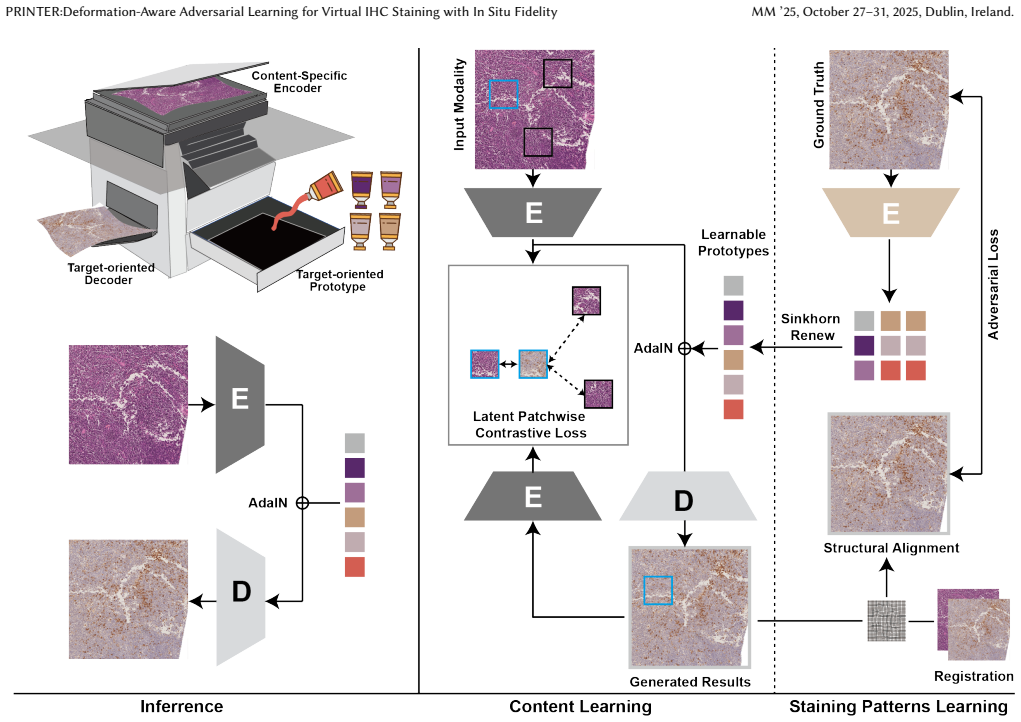
GapBridge is the load-bearing mechanism: a cyclic registration-synthesis loop. A VoxelMorph deformable network predicts a spatial warp from the synthesized pseudo-IHC image to the real IHC target, constrained by a normalized mutual information similarity term plus a deformation smoothness penalty; the warped image then enters the adversarial loss (Eq. 8) alongside a style-focused discriminator. Around this loop sit two supporting structures: a dictionary of K learnable prototypes that soft-quantize IHC style vectors via Sinkhorn optimal transport, and AdaIN layers that fuse quantized style with H&E content features. The registration removes the structural differences that would otherwise let
What would settle it
Create test pairs by taking registered real IHC images and applying synthetic deformations of known shape, then check whether PRINTER's registration recovers those deformations and whether generated positive-cell positions coincide with the true IHC signal. If the recovered warp does not match the applied deformation, the claimed registration-synthesis synergy is not doing the alignment work.
Extended reading notes
Core claim
On the paper's own terms, the discovery is that structural misalignment and staining-pattern learning can be resolved in one loop instead of being traded off. The generator produces a pseudo-IHC image from H&E using style prototypes quantized by Sinkhorn transport; a VoxelMorph-style registration network warps that image toward the real but shifted IHC target; and the warped image is fed to an adversarial discriminator together with real IHC. The generator and registration network jointly minimize the adversarial loss, so the discriminator is forced to focus on stain patterns rather than global geometry, while the registration is refined by how well it lets the generator fool the discriminat
Load-bearing premise
The method assumes the registration step can match up the right tissue regions between the synthesized and real IHC images even though the two staining methods highlight different cells; if it instead locks onto overall color statistics, the adversarial training could succeed without learning true staining.
Editorial extensions
If this is right
- Laboratories could derive CD3, PAX5, ER, and HER2 readouts computationally from a single H&E slide, saving tissue and reagent costs, if the reported metrics transfer to routine clinical data.
- The framework requires no manual annotations and no perfectly paired sections: only consecutive H&E and IHC slices, which are already produced in many pathology pipelines, so it can be trained on historical archives.
- Because stain patterns are fixed in a prototype dictionary at inference, no reference IHC image is needed when running on a new H&E image.
- The same registration-synthesis adversarial loop should generalize to other image-to-image tasks where data come in loosely paired, misaligned views, such as cross-modal medical imaging.
Reading between the lines
- One test the paper leaves implicit is whether NMI is the right similarity measure: replacing it with a learned patch-based correspondence could show whether the registration needs to be domain-specific per marker, since IHC-positive cells are sparse and may dominate the mutual information.
- The prototype dictionary points to a natural extension the authors do not develop: sharing and recombining prototypes across markers could turn one H&E slide into a virtual multiplexed IHC panel, with each marker rendering independently.
- A downstream experiment with pathologist scoring or automated cell counting would clarify whether the FID and SSIM improvements translate into clinically usable biomarker localization, which image metrics alone do not establish.
Editorial analysis
A structured set of objections, weighed in public.
Referee Report
Summary. The paper proposes PRINTER, a weakly-supervised framework for virtual IHC staining from H&E images. The method combines (1) prototype-driven style quantization via Sinkhorn optimal transport and AdaIN-based injection, (2) a dual-path 'GapBridge' alignment module that uses a VoxelMorph-style registration network to warp generated images toward the target, and (3) a deformation-aware adversarial objective in which the discriminator sees the registration-warped generated image rather than the raw generator output. The authors report experiments on four datasets (CD3, PAX5, ER, HER2) and compare against six baselines, with additional ablations. The central claim is that PRINTER outperforms state-of-the-art methods in both H&E content preservation and IHC staining fidelity.
Significance. If the method works as claimed, this would be a useful contribution to computational pathology: virtual IHC staining from serial H&E sections is clinically relevant, and the idea of using deformable registration inside the adversarial loop to decouple structure from staining is interesting. The paper is generally clearly written, the losses are explicitly given (Eqs. 1, 4, 5, 6, 7, 8), and the ablation study is informative. The four-dataset evaluation and comparison with six baselines are substantial. However, the central claim of 'superior performance' is only partially supported by the numbers, and there is a structural train/test mismatch in the adversarial objective that currently undermines the validity of the reported gains. These issues are fixable, but they require nontrivial additional experiments or architectural changes.
major comments (4)
- [§3.3, Eq. (8); §3.2, R(X,Y) definition] The adversarial objective trains the discriminator on R(G(X)), but the reported test-time outputs are G(X) (Tables 1–4, Figure 3). The registration network R is defined in §3.2 as R(X,Y), i.e., it takes the target Y as input, which is unavailable at inference. If R uses Y during training to warp G(X) toward the target, the discriminator's feedback is about a different image than the deployed generator output. The paper does not state that R is removed at test time, nor does it ablate the discriminator path D(G(X)) versus D(R(G(X))). This is load-bearing: the claimed benefit of 'deformation-aware adversarial learning' for the generator may be an artifact of the registration network's access to the target. Please provide an ablation with the discriminator applied directly to G(X), and clarify the training/inference roles of R.
- [§3.2.2, Eq. (6); Table 4] The registration loss Lreg uses NMI between the warped generated image \tilde{Y} and the target Y. Because H&E and IHC stains highlight different structures, NMI may not find true anatomical correspondence, and a degenerate solution could be for R to 'copy' statistics from Y or to produce a trivial deformation that maximizes NMI without meaningful alignment. Table 4 reports SSIM/PSNR/LPIPS/FID between \tilde{Y} and Y, but those metrics are also explicitly optimized by Lalign (Eq. 5), so they are not independent evidence of registration quality. The paper should validate the deformation fields (e.g., visual inspection, landmark/segmentation agreement, or comparison against a fixed identity mapping) to rule out degenerate solutions. Without this, the claim that the registration network improves staining-pattern transfer is not fully supported.
- [Table 1, ER and PAX5 rows; Abstract] The abstract claims 'superior performance' and 'outperforming state-of-the-art methods,' but the ER dataset results do not support this: Ours ranks third in Avg. Rank (3.3 vs 3.0 for ASP and PPT), content SSIM is 0.6708 (vs 0.7304 for ASP), and staining SSIM is 0.1675 (vs 0.1828 for PPT). For PAX5, staining SSIM is 0.3146 vs 0.3320 for PSP. For HER2, FID is 42.12 vs 38.71 for PSP. The claim should be qualified to specific metrics/datasets, or the paper should provide statistical significance tests (e.g., confidence intervals or paired tests) to support the 'superior' wording.
- [§3.1, Eq. (1) and Eq. (4)] The prototype vector p_k is defined as a scalar in R^8 (p_k ∈ R^8), and the quantized style s_q is a weighted sum of these 8-dimensional vectors. However, Eq. (4) applies AdaIN as AdaIN(f_c, s_q) = γ s_q ⊙ ((f_c - μ)/σ) + β s_q, where f_c is a multi-channel deep feature map. The dimensions of γ, β, and s_q are not specified, and the broadcast semantics of multiplying an 8-dim vector with a feature map are unclear. Please specify how the 8-dim prototype is expanded to the feature-map channel dimension, and how γ, β are derived. This is necessary for reproducibility of the central style-transfer mechanism.
minor comments (4)
- [Title/Abstract] Typographical issues: 'PRINTER:Deformation' should be 'PRINTER: Deformation'; in the abstract, 'We propose' should be lowercase after a semicolon; 'micronutrability' (Sec. 3.1.1) appears to be a typo for 'differentiability' (or 'differentiable').
- [§3.2, Eq. (5) and §4.3] The paper describes 'cyclic registration-synthesis framework GapBridge' but no explicit cycle-consistency loss is defined; the forward/backward synergy is described only qualitatively. Please either state the cycle formulation explicitly or soften the 'cyclic' terminology.
- [§4.1 Implementation details] The paper says 'For detailed hyperparameter configurations, please refer to our GitHub repository' but no URL is given. Provide the repository link or list key hyperparameters (e.g., K, τ, momentum, λ values, optimizer settings) in the paper.
- [Tables 2–4] The 'Baseline' row in Tables 2 and 3 is not explicitly defined; it likely corresponds to PPT [45] based on Table 1. Please clarify in the caption or text. Also, in Table 4, 'Baseline' has no entries; indicate that registration is not applicable for the baseline.
Circularity Check
No significant circularity; the method is a self-contained empirical training pipeline.
full rationale
PRINTER is an empirical image-translation method. Its training objectives (prototype quantization via Sinkhorn, AdaIN generation, L_cont, L_align, L_reg, and the adversarial loss in Eq. 8) are all standard losses over real data; no parameter is fitted to the evaluation metric and then reported as a prediction. The reference list contains no self-citations by the authors, and no uniqueness theorem or ansatz is imported from prior author work. The evaluation in Tables 1-3 uses external datasets and standard metrics (SSIM/PSNR/FID/LPIPS) that are not identical to any training loss. The only notable concern is that Eq. 8 feeds R(G(X)) to the discriminator while the reported outputs are G(X); since R is conditioned on the target Y and is absent at inference, the adversarial signal may not fully reflect the deployed generator. This is a potential train/test mismatch and correctness risk, but it is not a circular definition or a fitted-parameter-called-prediction, because G is still optimized through R and the content/alignment losses constrain G. Accordingly, no circular step is established.
Assumptions & free parameters
free parameters (6)
- Number of prototypes K =
not specified
- Sinkhorn temperature tau =
0.1
- Prototype momentum coefficient =
0.9
- Loss weights lambda_cont, lambda_align, lambda_reg =
1.0 each
- Training epochs =
200
- Input resolution =
512x512
assumptions (5)
- standard math Sinkhorn optimal transport yields a differentiable, balanced assignment for style quantization.
- domain assumption Stain style can be transferred by aligning first-order statistics via AdaIN (Eq. 4).
- domain assumption Consecutive tissue sections share sufficient anatomical structure that a deformation field can align them.
- domain assumption Normalized Mutual Information (NMI) is a valid similarity measure between generated pseudo-IHC and real IHC images.
- domain assumption The joint adversarial training converges to a solution where the discriminator focuses on staining pattern rather than structure.
Cite this review
Pith. "Pith review of PRINTER:Deformation-Aware Adversarial Learning for Virtual IHC Staining with In Situ Fidelity." pith.science (2026). https://pith.science/paper/C37DWFFE
@misc{pith2026250901214,
  author       = {Pith},
  title        = {Pith review of: PRINTER:Deformation-Aware Adversarial Learning for Virtual IHC Staining with In Situ Fidelity},
  year         = {2026},
  howpublished = {\url{https://pith.science/paper/C37DWFFE}},
  note         = {Machine review of arXiv:2509.01214}
}
read the original abstract
Tumor spatial heterogeneity analysis requires precise correlation between Hematoxylin and Eosin H&E morphology and immunohistochemical (IHC) biomarker expression, yet current methods suffer from spatial misalignment in consecutive sections, severely compromising in situ pathological interpretation. In order to obtain a more accurate virtual staining pattern, We propose PRINTER, a weakly-supervised framework that integrates PRototype-drIven content and staiNing patTERn decoupling and deformation-aware adversarial learning strategies designed to accurately learn IHC staining patterns while preserving H&E staining details. Our approach introduces three key innovations: (1) A prototype-driven staining pattern transfer with explicit content-style decoupling; and (2) A cyclic registration-synthesis framework GapBridge that bridges H&E and IHC domains through deformable structural alignment, where registered features guide cross-modal style transfer while synthesized outputs iteratively refine the registration;(3) Deformation-Aware Adversarial Learning: We propose a training framework where a generator and deformation-aware registration network jointly adversarially optimize a style-focused discriminator. Extensive experiments demonstrate that PRINTER effectively achieves superior performance in preserving H&E staining details and virtual staining fidelity, outperforming state-of-the-art methods. Our work provides a robust and scalable solution for virtual staining, advancing the field of computational pathology.
Figures


Figures from the paper (1 more)

Reference graph
Works this paper leans on
-
[13]
Joel Honkamaa, Umair Khan, Sonja Koivukoski, Mira Valkonen, Leena Latonen, Pekka Ruusuvuori, and Pekka Marttinen. 2023. Deformation equivariant cross- modality image synthesis with paired non-aligned training data. Medical Image Analysis 90 (2023), 102940
work page 2023
-
[1]
Guha Balakrishnan, Amy Zhao, Mert R Sabuncu, John Guttag, and Adrian V Dalca. 2019. Voxelmorph: a learning framework for deformable medical image registration. IEEE transactions on medical imaging 38, 8 (2019), 1788–1800
work page 2019
-
[2]
Tim Brooks, Aleksander Holynski, and Alexei A Efros. 2023. Instructpix2pix: Learning to follow image editing instructions. In Proceedings of the IEEE/CVF conference on computer vision and pattern recognition . 18392–18402
work page 2023
-
[3]
Fuqiang Chen, Ranran Zhang, Boyun Zheng, Yiwen Sun, Jiahui He, and Wenjian Qin. 2024. Pathological semantics-preserving learning for H&E-to-IHC virtual staining. In International Conference on Medical Image Computing and Computer- Assisted Intervention. Springer, 384–394
work page 2024
-
[4]
Zekang Chen, Jia Wei, and Rui Li. 2022. Unsupervised multi-modal medical image registration via discriminator-free image-to-image translation. arXiv preprint arXiv:2204.13656 (2022)
arXiv 2022
-
[5]
Marco Cuturi. 2013. Sinkhorn distances: Lightspeed computation of optimal transport. Advances in neural information processing systems 26 (2013)
work page 2013
-
[6]
Kevin de Haan, Yijie Zhang, Jonathan E Zuckerman, Tairan Liu, Anthony E Sisk, Miguel FP Diaz, Kuang-Yu Jen, Alexander Nobori, Sofia Liou, Sarah Zhang, et al
-
[7]
Qihua Dong, Hao Du, Ying Song, Yan Xu, and Jing Liao. 2023. Preserving tu- mor volumes for unsupervised medical image registration. In Proceedings of the IEEE/CVF International Conference on Computer Vision . 21208–21218
work page 2023
Show all 51 references
-
[8]
Morteza Ghahremani, Mohammad Khateri, Bailiang Jian, Benedikt Wiestler, Ehsan Adeli, and Christian Wachinger. 2024. H-vit: A hierarchical vision trans- former for deformable image registration. In Proceedings of the IEEE/CVF Confer- ence on Computer Vision and Pattern Recognit...
2024
-
[9]
Xianchao Guan, Yifeng Wang, Yiyang Lin, Xi Li, and Yongbing Zhang. 2024. Unsupervised multi-domain progressive stain transfer guided by style encoding dictionary. IEEE Transactions on Image Processing 33 (2024), 767–779
2024
-
[10]
Mengjie Guo. 2024. Unsupervised Multi-modal Medical Image Registration via Invertible Translation. In European Conference on Computer Vision . Springer, 22–38
2024
-
[11]
Kaiming He, Xinlei Chen, Saining Xie, Yanghao Li, Piotr Dollár, and Ross Girshick
-
[12]
Martin Heusel, Hubert Ramsauer, Thomas Unterthiner, Bernhard Nessler, and Sepp Hochreiter. 2017. Gans trained by a two time-scale update rule converge to a local nash equilibrium. Advances in neural information processing systems 30 (2017)
2017
-
[14]
Xun Huang and Serge Belongie. 2017. Arbitrary style transfer in real-time with adaptive instance normalization. In Proceedings of the IEEE international conference on computer vision . 1501–1510
2017
-
[15]
Phillip Isola, Jun-Yan Zhu, Tinghui Zhou, and Alexei A Efros. 2017. Image-to- image translation with conditional adversarial networks. In Proceedings of the IEEE conference on computer vision and pattern recognition . 1125–1134
2017
-
[16]
Yuxin Jiang, Liming Jiang, Shuai Yang, and Chen Change Loy. 2023. Scenimefy: Learning to craft anime scene via semi-supervised image-to-image translation. In Proceedings of the IEEE/CVF International Conference on Computer Vision . 7357– 7367
2023
-
[17]
Chanyong Jung, Gihyun Kwon, and Jong Chul Ye. 2022. Exploring patch-wise semantic relation for contrastive learning in image-to-image translation tasks. In Proceedings of the IEEE/CVF conference on computer vision and pattern recognition . 18260–18269
2022
-
[18]
Mohamad Kassab, Muhammad Jehanzaib, Kayhan Başak, Derya Demir, G Evren Keles, and Mehmet Turan. 2024. FFPE++: Improving the quality of formalin- fixed paraffin-embedded tissue imaging via contrastive unpaired image-to-image translation. Medical Image Analysis 91 (2024), 102992
2024
-
[19]
Hee Guan Khor, Guochen Ning, Yihua Sun, Xu Lu, Xinran Zhang, and Hongen Liao. 2023. Anatomically constrained and attention-guided deep feature fusion for joint segmentation and deformable medical image registration.Medical Image Analysis 88 (2023), 102811
2023
-
[20]
Bo Li, Kaitao Xue, Bin Liu, and Yu-Kun Lai. 2023. Bbdm: Image-to-image trans- lation with brownian bridge diffusion models. In Proceedings of the IEEE/CVF conference on computer vision and pattern Recognition . 1952–1961
2023
-
[21]
Fangda Li, Zhiqiang Hu, Wen Chen, and Avinash Kak. 2023. Adaptive super- vised patchnce loss for learning h&e-to-ihc stain translation with inconsistent groundtruth image pairs. InInternational Conference on Medical Image Computing and Computer-Assisted Intervention. Springer, 632–641
2023
-
[22]
Jiahan Li, Jiuyang Dong, Shenjin Huang, Xi Li, Junjun Jiang, Xiaopeng Fan, and Yongbing Zhang. 2024. Virtual immunohistochemistry staining for histological images assisted by weakly-supervised learning. In Proceedings of the IEEE/CVF Conference on Computer Vision and Pattern R...
2024
-
[23]
Yuzhu Li, Nir Pillar, Jingxi Li, Tairan Liu, Di Wu, Songyu Sun, Guangdong Ma, Kevin de Haan, Luzhe Huang, Yijie Zhang, et al. 2024. Virtual histological staining of unlabeled autopsy tissue. Nature Communications 15, 1 (2024), 1684
2024
-
[24]
Kechun Liu, Beibin Li, Wenjun Wu, Caitlin May, Oliver Chang, Stevan Knezevich, Lisa Reisch, Joann Elmore, and Linda Shapiro. 2023. Vsgd-net: Virtual staining guided melanocyte detection on histopathological images. In Proceedings of the IEEE/CVF Winter Conference on Applicatio...
2023
-
[25]
Shengjie Liu, Chuang Zhu, Feng Xu, Xinyu Jia, Zhongyue Shi, and Mulan Jin. 2022. Bci: Breast cancer immunohistochemical image generation through pyramid pix2pix. In Proceedings of the IEEE/CVF conference on computer vision and pattern recognition. 1815–1824
2022
-
[26]
Zhijie Liu, Lingchao Chen, Haixia Cheng, Jianpeng Ao, Ji Xiong, Xing Liu, Yaxin Chen, Ying Mao, and Minbiao Ji. 2024. Virtual formalin-fixed and paraffin- embedded staining of fresh brain tissue via stimulated Raman CycleGAN model. Science Advances 10, 13 (2024), eadn3426
2024
-
[27]
Mingyuan Meng, Dagan Feng, Lei Bi, and Jinman Kim. 2024. Correlation-aware coarse-to-fine mlps for deformable medical image registration. In Proceedings of the IEEE/CVF Conference on Computer Vision and Pattern Recognition . 9645–9654
2024
-
[28]
Tony CW Mok, Zi Li, Yunhao Bai, Jianpeng Zhang, Wei Liu, Yan-Jie Zhou, Ke Yan, Dakai Jin, Yu Shi, Xiaoli Yin, et al . 2024. Modality-agnostic structural image representation learning for deformable multi-modality medical image registration. In Proceedings of the IEEE/CVF Confe...
2024
-
[29]
Kutsev Bengisu Ozyoruk, Sermet Can, Berkan Darbaz, Kayhan Başak, Derya Demir, Guliz Irem Gokceler, Gurdeniz Serin, Uguray Payam Hacisalihoglu, Emirhan Kurtuluş, Ming Y Lu, et al . 2022. A deep-learning model for trans- forming the style of tissue images from cryosectioned to f...
2022
-
[30]
Taesung Park, Alexei A Efros, Richard Zhang, and Jun-Yan Zhu. 2020. Contrastive learning for unpaired image-to-image translation. InComputer Vision–ECCV 2020: 16th European Conference, Glasgow, UK, August 23–28, 2020, Proceedings, Part IX
2020
-
[31]
Pushpak Pati, Sofia Karkampouna, Francesco Bonollo, Eva Compérat, Martina Radić, Martin Spahn, Adriano Martinelli, Martin Wartenberg, Marianna Kruithof- de Julio, and Marianna Rapsomaniki. 2024. Accelerating histopathology work- flows with generative AI-based virtually multipl...
2024
-
[32]
Saksham Suri, Moustafa Meshry, Larry S Davis, and Abhinav Shrivastava. 2024. GRIT: GAN Residuals for Paired Image-to-Image Translation. In Proceedings of the IEEE/CVF Winter Conference on Applications of Computer Vision . 4965–4975
2024
-
[33]
Laurens Van der Maaten and Geoffrey Hinton. 2008. Visualizing data using t-SNE. Journal of machine learning research 9, 11 (2008)
2008
-
[34]
Haiqiao Wang, Dong Ni, and Yi Wang. 2024. Recursive deformable pyramid network for unsupervised medical image registration. IEEE Transactions on Medical Imaging 43, 6 (2024), 2229–2240
2024
-
[35]
Ting-Chun Wang, Ming-Yu Liu, Jun-Yan Zhu, Andrew Tao, Jan Kautz, and Bryan Catanzaro. 2018. High-resolution image synthesis and semantic manipulation with conditional gans. In Proceedings of the IEEE conference on computer vision and pattern recognition. 8798–8807
2018
-
[36]
Zhou Wang, Alan C Bovik, Hamid R Sheikh, and Eero P Simoncelli. 2004. Image quality assessment: from error visibility to structural similarity.IEEE transactions on image processing 13, 4 (2004), 600–612
2004
-
[37]
Georg Wölflein, In Hwa Um, David J Harrison, and Ognjen Arandjelović. 2023. Hoechstgan: Virtual lymphocyte staining using generative adversarial networks. In Proceedings of the IEEE/CVF Winter Conference on Applications of Computer Vision. 4997–5007
2023
-
[38]
Sidi Wu, Yizi Chen, Samuel Mermet, Lorenz Hurni, Konrad Schindler, Nicolas Gonthier, and Loic Landrieu. 2024. Stegogan: Leveraging steganography for non- bijective image-to-image translation. In Proceedings of the IEEE/CVF Conference on Computer Vision and Pattern Recognition ...
2024
-
[39]
Renao Yan, Qiming He, Yiqing Liu, Peng Ye, Lianghui Zhu, Shanshan Shi, Jizhou Gou, Yonghong He, Tian Guan, and Guangde Zhou. 2023. Unpaired virtual histological staining using prior-guided generative adversarial networks. Com- puterized Medical Imaging and Graphics 105 (2023), 102185
2023
-
[40]
Xilin Yang, Bijie Bai, Yijie Zhang, Yuzhu Li, Kevin de Haan, Tairan Liu, and Aydogan Ozcan. 2022. Virtual stain transfer in histology via cascaded deep neural networks. ACS Photonics 9, 9 (2022), 3134–3143
2022
-
[41]
Songsen Yu, Shiqi Wu, Yifan Lin, and Jun Liang. 2024. Unpaired Multi-scenario Sketch Synthesis via Texture Enhancement. In Chinese Conference on Pattern Recognition and Computer Vision (PRCV) . Springer, 181–194. MM ’25, October 27–31, 2025, Dublin, Ireland. et al
2024
-
[42]
Ranran Zhang, Yankun Cao, Yujun Li, Zhi Liu, Jianye Wang, Jiahuan He, Chenyang Zhang, Xiaoyu Sui, Pengfei Zhang, Lizhen Cui, et al . 2022. MVF- Stain: multiple virtual functional stain histopathology images generation based on specific domain mapping. Medical Image Analysis 80...
2022
-
[43]
Richard Zhang, Phillip Isola, Alexei A Efros, Eli Shechtman, and Oliver Wang
-
[44]
Tianyang Zhang, Shaoming Zheng, Jun Cheng, Xi Jia, Joseph Bartlett, Xinxing Cheng, Zhaowen Qiu, Huazhu Fu, Jiang Liu, Aleš Leonardis, et al. 2024. Structure and Intensity Unbiased Translation for 2D Medical Image Segmentation. IEEE Transactions on Pattern Analysis and Machine ...
2024
-
[45]
Wei Zhang, Tik Ho Hui, Pui Ying Tse, Fraser Hill, Condon Lau, and Xinyue Li
-
[46]
Haifeng Zhao, Chi Zhang, Deyin Liu, and Lin Wu. 2025. Deformation Field Fusion for Medical Image Registration. ACM Transactions on Multimedia Computing, Communications and Applications (2025)
2025
-
[47]
Jun-Yan Zhu, Taesung Park, Phillip Isola, and Alexei A Efros. 2017. Unpaired image-to-image translation using cycle-consistent adversarial networks. In Pro- ceedings of the IEEE international conference on computer vision . 2223–2232
2017
-
[2018]
In Proceedings of the IEEE conference on computer vision and pattern recognition
The unreasonable effectiveness of deep features as a perceptual metric. In Proceedings of the IEEE conference on computer vision and pattern recognition . 586–595
-
[2021]
Nature communications 12, 1 (2021), 4884
Deep learning-based transformation of H&E stained tissues into special stains. Nature communications 12, 1 (2021), 4884
2021
-
[2022]
In Proceedings of the IEEE/CVF conference on computer vision and pattern recognition
Masked autoencoders are scalable vision learners. In Proceedings of the IEEE/CVF conference on computer vision and pattern recognition . 16000–16009
-
[2024]
In International Conference on Medical Image Computing and Computer-Assisted Intervention
High-Resolution Medical Image Translation via Patch Alignment-Based Bidirectional Contrastive Learning. In International Conference on Medical Image Computing and Computer-Assisted Intervention. Springer, 178–188
Reviewed August 5, 2026 · model on record in the stance chip above.
Discussion (0). Continue with ORCID to comment.