REVIEW 3 major objections 6 minor 1 cited by
Meta-learning with one context vector per task factor—updating only the vector for the factor that changed—yields OOD robustness and zero-shot context recombination, shown in sine regression and quadruped stair climbing.
Reviewed by Pith at T0; open to challenge. T0 means a machine referee read the full paper against a public rubric. the ladder, T0–T4 →
DMCM learns one context vector per task factor and updates only the relevant vector, improving out-of-distribution robustness in sine regression and quadruped locomotion via context sharing.
T0 review reviewed 2026-08-05 challenge →
load-bearing objection A useful CAVIA extension with a promising real-world quadruped result, but the sine OOD gain isn't yet pinned to disentanglement rather than the task curriculum; worth refereeing for the robot work alone. the 3 major comments →
Disentangled Multi-Context Meta-Learning: Unlocking robust and Generalized Task Learning
The pith
A machine-rendered reading of the paper's core claim, the machinery that carries it, and where it could break.
The reading
Core claim
DMCM is a meta-learning algorithm built on CAVIA's context-parameter idea but with K separate context vectors instead of one. Each vector is assigned to a declared factor of variation (amplitude vs phase; terrain vs robot-specific properties). Task sampling is constrained so that consecutive tasks share all factors except one, and the inner loop updates only the context vector belonging to that changed factor. After B warm-up tasks, the outer loop updates shared weights, and an optional recombination loop trains the network to work with context vectors that were never adapted together, which the paper reports is necessary for zero-shot recombination (loss drops from 3.66 to 0.069 with the lo
What carries the argument
The central object is the set of K disentangled context vectors {φ1,...,φK}, each initialized to zero and concatenated into the network (in the robot task, 20 parameters per vector at layer inputs). The load-bearing mechanism is the conditional task sampler p(Ti | Ti−1) in Algorithm 1: it guarantees that the only difference between consecutive tasks is the single labeled factor s, so the inner-loop gradient ∇φs is, by construction, attributed to that factor alone; the other vectors are frozen. The recombination loop then teaches the shared network to accept independently adapted vectors by computing a meta-gradient on test data drawn with stored context vectors from K−1 different past adapta
Load-bearing premise
The entire scheme rests on being given, for every training task, a correct hand-labeled grouping of task variation into separate factors, and on being able to sequence tasks so consecutive tasks differ in exactly one of those factors; if real variation mixes factors (low gains plus payload plus rough terrain) or the labels misattribute a change, the selective inner-loop updates cannot align context vectors with the true causes.
What would settle it
Train DMCM with the two factors deliberately confounded (e.g., in the sine task sample amplitude and phase from a joint distribution that makes low amplitude almost always co-occur with a particular phase, or in the robot task always pair high payload with low Kp), then evaluate on the anti-correlated OOD combinations. If the model's loss or policy success does not degrade relative to the factor-balanced training case, or if swapping one context vector while holding the other fixed fails to change predictions/behavior in the factor-consistent direction, then the selective-update mechanism is n
If this is right
- Under the paper's results, robustness to missing factor combinations does not require seeing all combinations: with 40–80% of amplitude–phase ranges excluded from sine training, DMCM's loss stays lower and less variable than MAML/ANIL/CAVIA.
- Context vectors become portable assets: a terrain context from one source and a robot context from another can be combined at deployment, so real stair climbing can be achieved with no real stair data for the robot-property context.
- A policy trained with contexts that are randomly mixed across tasks sharing the same factor outperforms a policy given exact task-matched contexts under OOD conditions (simulation success 602 vs 151 in OOD robot properties), implying that context diversity during RL training is itself a regularizer.
- Correct-factor context combinations consistently beat wrong-factor combinations in dynamics prediction, giving a diagnostic handle on sim-to-real discrepancies: mismatches between sim and real show up mainly in the robot-specific context, not the terrain context.
- If the disentanglement is real, meta-learning's interpretability increases: body height and front-foot probing behavior shift in predictable directions when payload or terrain contexts are deliberately wrong.
Where Pith is reading between the lines
- My inference: the actual disentanglement engine is the one-factor-at-a-time task sequencing, not the network architecture; if that is right, the same selective-update rule should work with automatically detected change factors (e.g., labeling which input statistics shifted between consecutive tasks), replacing the manual labels the paper's Limitations section says are currently required.
- My inference: the paper's experiments are consistent with contexts acting as low-dimensional control modes, so one testable implication is that learned robot-context vectors should cluster by physical property (mass, Kp, delay) in a way that survives dimensionality reduction; the paper does not report such an analysis.
- My inference: a boundary condition worth probing is factor interaction—if terrain difficulty changes how much payload matters, independent vectors may not compose; testing on tasks with multiplicative factor interactions would show whether the method generalizes beyond additive factor combinations.
- My inference: the real-world 80% result depends on selecting complementary contexts (sim stair terrain + real flat robot). The paper's dynamics-level wrong-combination results suggest the policy would degrade if both contexts came from the same flat real dataset; a deployment-level ablation replacing the sim terrain context with a real flat terrain context would make the orthogonality claim direct
Editorial analysis
A structured set of objections, weighed in public.
Referee Report
Summary. The paper proposes DMCM, a CAVIA-style meta-learning algorithm that maintains K factor-specific context vectors rather than a single unified context. During meta-training, tasks are sampled conditionally so that consecutive tasks differ in exactly one labeled factor, and the inner loop updates only the context vector associated with that factor. An optional recombination loop trains the model to use context vectors adapted separately, enabling zero-shot recombination. The method is evaluated on sine regression (OOD robustness, zero-shot recombination) and on a Go1 quadruped pipeline in which contexts are first extracted by a dynamics model and then used to condition an RL policy. The authors report improved OOD robustness over MAML/CAVIA/ANIL in sine tasks and successful real-world stair climbing with 20 seconds of flat-terrain data by combining a simulated terrain context with a real-world robot-property context.
Significance. If the central claim holds, DMCM offers an interpretable, factor-aligned alternative to monolithic task embeddings in meta-learning and a practical route to sim-to-real context reuse in legged locomotion. The real-world deployment is ambitious and the context-sharing idea is genuinely useful. However, the current evidence does not isolate the proposed selective-update mechanism from the conditional task-sampling curriculum, and the test-time protocol for unknown factor changes is underspecified. These gaps are load-bearing for the paper's main claims. The authors are also candid about manual context labeling and other limitations, which is a strength.
major comments (3)
- [§3.2, Alg. 1 (lines 8 and 12), Figs. 3–4, App. A.2] The OOD robustness comparison does not include a CAVIA baseline trained on the same conditional chain p(Ti | Ti-1). DMCM is trained on a specially organized sequence in which consecutive tasks differ in exactly one labeled factor, while CAVIA is trained on i.i.d. tasks. The gains in Figs. 3–4 could therefore be due to the task curriculum itself rather than to the selective update of only phi_s. This is not a purely hypothetical concern: in the 5-shot results (App. A.2), DMCM and CAVIA perform similarly under exclusion, and in the mislabeling experiment (Table 4) both methods degrade comparably. To support the mechanistic claim, add ablations with (i) CAVIA trained on the same conditional chain, and (ii) a multi-context variant with the same chain but updating all context vectors, with matched context-parameter counts and compute.
- [§3.5, §4.1.1] The test-time adaptation protocol is underspecified. In sine OOD evaluation, test tasks are sampled with both amplitude and phase varying, so the model is not told which factor 'changed'. 'Sequential adaptation is done from context c1 to cK' does not explain how the relevant factor is chosen. If only one context is updated, the method needs an unstated label or inference mechanism; if all contexts are updated, DMCM's selective mechanism is not exercised at evaluation. Please state the exact evaluation algorithm (which contexts are updated, with what data, and for how many steps) and discuss how the method behaves when multiple factors change simultaneously.
- [§4.2.2, Table 3 (main text)] The headline real-world result is based on 5 trials per condition, so the 80% vs. 40% success rates for Multi-DMCM and Vanilla are not statistically distinguishable. In addition, the single-CAVIA policy is evaluated separately with each context dataset, but no baseline is provided for a unified context adapted on a combined dataset that contains both the simulated stair information and the real flat-terrain payload information. Please increase the number of trials, report confidence intervals or individual trial outcomes, and include a combined-context CAVIA baseline where feasible.
minor comments (6)
- [Alg. 1] The pseudocode specifies initialization of only phi_s but does not state how the non-selected context vectors are carried from the previous task. Please clarify the bookkeeping, especially in the basic (non-recombination) loop.
- [App. A.2] The 5-shot result, where DMCM loses its OOD advantage, is only in the appendix and is not discussed in the main text. This qualification should appear wherever the 10-shot OOD advantage is claimed.
- [Table 4, App. A.4] DMCM's clean-data loss (0.0225) is notably worse than CAVIA's (0.0135), and both methods degrade by similar proportions under mislabeling. This should be discussed as evidence about sensitivity to label noise, not as a robustness success.
- [General] There are duplicate table numbers: the main-text Table 3 and the Appendix Table 3 both exist. Please renumber.
- [§4.1.1] The phrase 'identical conditions (10 inner steps, same learning rate)' is misleading because DMCM also uses warm-up tasks and a conditional sampling chain. Please specify exactly which hyperparameters are matched and which are not.
- [Fig. 2] The diagram for K=2 is very small and does not convey the sequential adaptation and recombination procedure. A larger, annotated figure would help readers.
Circularity Check
Disentanglement is imposed by the labeled task curriculum and selective update rule, but the OOD and real-robot results are external; partial circularity in the central mechanism claim.
specific steps
-
self definitional
[§3.2 Inner Loop Training; Algorithm 1 lines 8, 12, 20; §3.1 Eq. (4); §6 Limitations]
"At each step, only the context vector φsi corresponding to the changing factor cs is updated, while the others remain unchanged. Specifically, task Ci is chosen to differ from Ci−1 only in cs, with the other contexts identical. ... Sample Ti ∼ p(Ti | Ti−1); ... φsi ← φsi − α∇φs ..."
The claimed ‘disentanglement’ of context vectors is not derived or discovered; it is hard-wired by the training procedure. Algorithm 1 line 8 supplies the label s of the changing factor through the conditional task distribution p(Ti|Ti−1), and line 12 updates exactly that φs. Thus φs is forced to align with factor cs by construction, and the statement ‘the context vector corresponding to the changing factor is updated’ is a restatement of the update rule plus hand-defined labels, not an empirical finding. The paper’s own limitation (‘relies on manually defined, meaningful context labels’) concedes that the factor decomposition is an input. The OOD robustness and real-robot successes are externally measured and not circular, but the mechanistic attribution ‘robustness stems from disentangli
full rationale
The only substantial circularity is in the claim that DMCM ‘learns’ disentangled context vectors: the factor identity s is supplied by the conditional task sampler and the same s selects the updated vector, so the alignment of φs with factor cs is true by construction. This is a self-definitional property of the algorithm, explicitly acknowledged in the Limitations. However, the paper does not rely on self-citations, and its main empirical contributions—sine OOD loss, sim-to-real stair climbing with 20 s of flat data, payload/gain robustness—are external benchmarks with real evaluation, not quantities fitted from the same labels. The missing CAVIA-with-same-curriculum ablation is a confound for the mechanism, not a circularity. Overall score 4 reflects a central mechanistic claim that is partly by construction while the headline OOD results retain independent content.
Axiom & Free-Parameter Ledger
free parameters (5)
- Number of contexts K (per factor) =
2 for sine/locomotion, 3 for the three-factor sine test
- Context vector dimension per factor =
3 (sine), 20 (dynamics)
- Warm-up tasks B =
10 or 20
- Adaptation depth Sadapt =
3 to 10 depending on task
- Inner/outer learning rates, decay, meta-batch size =
Inner LR 0.1 or 0.05 with 0.92 decay; meta LR 0.001 or 0.00033; batch 25 or 45
axioms (4)
- domain assumption Task labels (which factor changes) are known and correct
- ad hoc to paper Consecutive training tasks can be sampled conditionally so that only one factor varies between them
- domain assumption The learned dynamics-model context vectors remain valid when transferred as priors into the RL policy
- domain assumption Gradient-based inner-loop optimization on the selected context vector converges to a factor-aligned representation
invented entities (1)
-
Factor-specific context vectors (c1..cK)
no independent evidence
Cite this review
Pith. "Pith review of Disentangled Multi-Context Meta-Learning: Unlocking robust and Generalized Task Learning." pith.science (2026). https://pith.science/paper/PQDX4TSI
@misc{pith2026250901297,
  author       = {Pith},
  title        = {Pith review of: Disentangled Multi-Context Meta-Learning: Unlocking robust and Generalized Task Learning},
  year         = {2026},
  howpublished = {\url{https://pith.science/paper/PQDX4TSI}},
  note         = {Machine review of arXiv:2509.01297}
}
read the original abstract
In meta-learning and its downstream tasks, many methods rely on implicit adaptation to task variations, where multiple factors are mixed together in a single entangled representation. This makes it difficult to interpret which factors drive performance and can hinder generalization. In this work, we introduce a disentangled multi-context meta-learning framework that explicitly assigns each task factor to a distinct context vector. By decoupling these variations, our approach improves robustness through deeper task understanding and enhances generalization by enabling context vector sharing across tasks with shared factors. We evaluate our approach in two domains. First, on a sinusoidal regression task, our model outperforms baselines on out-of-distribution tasks and generalizes to unseen sine functions by sharing context vectors associated with shared amplitudes or phase shifts. Second, in a quadruped robot locomotion task, we disentangle the robot-specific properties and the characteristics of the terrain in the robot dynamics model. By transferring disentangled context vectors acquired from the dynamics model into reinforcement learning, the resulting policy achieves improved robustness under out-of-distribution conditions, surpassing the baselines that rely on a single unified context. Furthermore, by effectively sharing context, our model enables successful sim-to-real policy transfer to challenging terrains with out-of-distribution robot-specific properties, using just 20 seconds of real data from flat terrain, a result not achievable with single-task adaptation.
Figures



Forward citations
Cited by 1 Pith paper
-
Autonomous Aerial Manipulation via Contextual Contrastive Meta Reinforcement Learning
Aco2 trains a quadrotor policy in simulation that adapts to diverse payload dynamics via latent context encoding and contrastive structuring, enabling zero-shot real-world deployment for autonomous aerial delivery.
Reference graph
Works this paper leans on
-
[1]
S. Thrun and L. Pratt. Learning to learn: Introduction and overview. In Learning to learn , pages 3–17. Springer, 1998. 2
work page 1998
-
[2]
C. Finn, T. Yu, T. Zhang, P. Abbeel, and S. Levine. One-shot visual imitation learning via meta-learning. In Conference on robot learning, pages 357–368. PMLR, 2017. 2
work page 2017
-
[3]
R. Kaushik, T. Anne, and J.-B. Mouret. Fast online adaptation in robotics through meta- learning embeddings of simulated priors. In 2020 IEEE/RSJ International Conference on In- telligent Robots and Systems (IROS), pages 5269–5276. IEEE, 2020
work page 2020
-
[4]
A. Nagabandi, I. Clavera, S. Liu, R. S. Fearing, P. Abbeel, S. Levine, and C. Finn. Learning to adapt in dynamic, real-world environments through meta-reinforcement learning. arXiv preprint arXiv:1803.11347, 2018
Pith/arXiv arXiv 2018
-
[5]
M. O’Connell, G. Shi, X. Shi, K. Azizzadenesheli, A. Anandkumar, Y . Yue, and S.-J. Chung. Neural-fly enables rapid learning for agile flight in strong winds. Science Robotics, 7(66): eabm6597, 2022. 2
work page 2022
-
[6]
A. A. Rusu, D. Rao, J. Sygnowski, O. Vinyals, R. Pascanu, S. Osindero, and R. Hadsell. Meta- learning with latent embedding optimization. arXiv preprint arXiv:1807.05960, 2018. 2
Pith/arXiv arXiv 2018
-
[7]
L. Zintgraf, K. Shiarli, V . Kurin, K. Hofmann, and S. Whiteson. Fast context adaptation via meta-learning. In International conference on machine learning , pages 7693–7702. PMLR,
-
[8]
A. Raghu, M. Raghu, S. Bengio, and O. Vinyals. Rapid learning or feature reuse? towards understanding the effectiveness of maml. arXiv preprint arXiv:1909.09157, 2019. 2, 4
Pith/arXiv arXiv 1909
-
[9]
Z. Li, F. Zhou, F. Chen, and H. Li. Meta-sgd: Learning to learn quickly for few-shot learning. arXiv preprint arXiv:1707.09835, 2017
Pith/arXiv arXiv 2017
-
[10]
A. Nichol and J. Schulman. Reptile: a scalable metalearning algorithm. arXiv preprint arXiv:1803.02999, 2(3):4, 2018. 2 9
Pith/arXiv arXiv 2018
-
[11]
C. Finn, P. Abbeel, and S. Levine. Model-agnostic meta-learning for fast adaptation of deep networks. In International conference on machine learning, pages 1126–1135. PMLR, 2017. 2, 4
work page 2017
-
[12]
F. Alet, T. Lozano-P´erez, and L. P. Kaelbling. Modular meta-learning. In Conference on robot learning, pages 856–868. PMLR, 2018. 2
work page 2018
-
[13]
K. Rakelly, A. Zhou, C. Finn, S. Levine, and D. Quillen. Efficient off-policy meta- reinforcement learning via probabilistic context variables. In International conference on ma- chine learning, pages 5331–5340. PMLR, 2019. 2
work page 2019
-
[14]
H. Yao, Y . Wei, J. Huang, and Z. Li. Hierarchically structured meta-learning. In International conference on machine learning, pages 7045–7054. PMLR, 2019. 2
work page 2019
-
[15]
R. Vuorio, S.-H. Sun, H. Hu, and J. J. Lim. Multimodal model-agnostic meta-learning via task-aware modulation. Advances in neural information processing systems, 32, 2019. 2
work page 2019
-
[16]
M. W. Gondal, M. Wuthrich, D. Miladinovic, F. Locatello, M. Breidt, V . V olchkov, J. Akpo, O. Bachem, B. Sch ¨olkopf, and S. Bauer. On the transfer of inductive bias from simulation to the real world: a new disentanglement dataset. Advances in Neural Information Processing Systems, 32, 2019. 2
work page 2019
-
[17]
K. Hsu, J. I. Hamid, K. Burns, C. Finn, and J. Wu. Tripod: Three complementary inductive biases for disentangled representation learning. arXiv preprint arXiv:2404.10282, 2024
work page internal anchor Pith review Pith/arXiv arXiv 2024
-
[18]
M. F. Mathieu, J. J. Zhao, J. Zhao, A. Ramesh, P. Sprechmann, and Y . LeCun. Disentan- gling factors of variation in deep representation using adversarial training. Advances in neural information processing systems, 29, 2016
work page 2016
-
[19]
X. Chen, Y . Duan, R. Houthooft, J. Schulman, I. Sutskever, and P. Abbeel. Infogan: Inter- pretable representation learning by information maximizing generative adversarial nets. Ad- vances in neural information processing systems, 29, 2016
work page 2016
- [20]
-
[21]
I. Higgins, L. Matthey, A. Pal, C. Burgess, X. Glorot, M. Botvinick, S. Mohamed, and A. Ler- chner. beta-vae: Learning basic visual concepts with a constrained variational framework. In International conference on learning representations, 2017
work page 2017
-
[22]
I. Higgins, A. Pal, A. Rusu, L. Matthey, C. Burgess, A. Pritzel, M. Botvinick, C. Blundell, and A. Lerchner. Darla: Improving zero-shot transfer in reinforcement learning. In International conference on machine learning, pages 1480–1490. PMLR, 2017. 2
work page 2017
-
[23]
L. P. Kaelbling, M. L. Littman, and A. R. Cassandra. Planning and acting in partially observ- able stochastic domains. Artificial Intelligence, 101(1-2):99–134, 1998. 3
work page 1998
-
[24]
A. Kumar, Z. Fu, D. Pathak, and J. Malik. Rma: Rapid motor adaptation for legged robots. arXiv preprint arXiv:2107.04034, 2021. 3
Pith/arXiv arXiv 2021
-
[25]
I. M. A. Nahrendra, B. Yu, and H. Myung. Dreamwaq: Learning robust quadrupedal lo- comotion with implicit terrain imagination via deep reinforcement learning. In 2023 IEEE International Conference on Robotics and Automation (ICRA), pages 5078–5084. IEEE, 2023. 3
work page 2023
- [26]
-
[27]
Z. Xiao, X. Zhang, X. Zhou, and Q. Zhang. Pa-loco: Learning perturbation-adaptive locomo- tion for quadruped robots. In 2024 IEEE/RSJ International Conference on Intelligent Robots and Systems (IROS), pages 9110–9115. IEEE, 2024. 3
work page 2024
-
[28]
V . Makoviychuk, L. Wawrzyniak, Y . Guo, M. Lu, K. Storey, M. Macklin, D. Hoeller, N. Rudin, A. Allshire, A. Handa, et al. Isaac gym: High performance gpu-based physics simulation for robot learning. arXiv preprint arXiv:2108.10470, 2021. 6, 16, 18 10
Pith/arXiv arXiv 2021
-
[29]
J. Hwangbo, J. Lee, and M. Hutter. Per-contact iteration method for solving contact dynamics. IEEE Robotics and Automation Letters, 3(2):895–902, 2018. 18
work page 2018
-
[30]
J. Schulman, F. Wolski, P. Dhariwal, A. Radford, and O. Klimov. Proximal policy optimization algorithms. arXiv preprint arXiv:1707.06347, 2017. 18
Pith/arXiv arXiv 2017
-
[31]
G. Ji, J. Mun, H. Kim, and J. Hwangbo. Concurrent training of a control policy and a state estimator for dynamic and robust legged locomotion. IEEE Robotics and Automation Letters, 7(2):4630–4637, 2022. 19
work page 2022
- [32]
-
[33]
G. B. Margolis and P. Agrawal. Walk these ways: Tuning robot control for generalization with multiplicity of behavior. Conference on Robot Learning (PMLR), pages 22–31, 2023. 19 11 Appendix A Sine Task A.1 Hyperparameter and Experiment Settings To ensure a fair comparison across MAML, ANIL, CA VIA, and DMCM, we align the hyperparam- eters as closely as po...
work page 2023
-
[34]
Detailed input and hyperparameters are in Table 7, 8
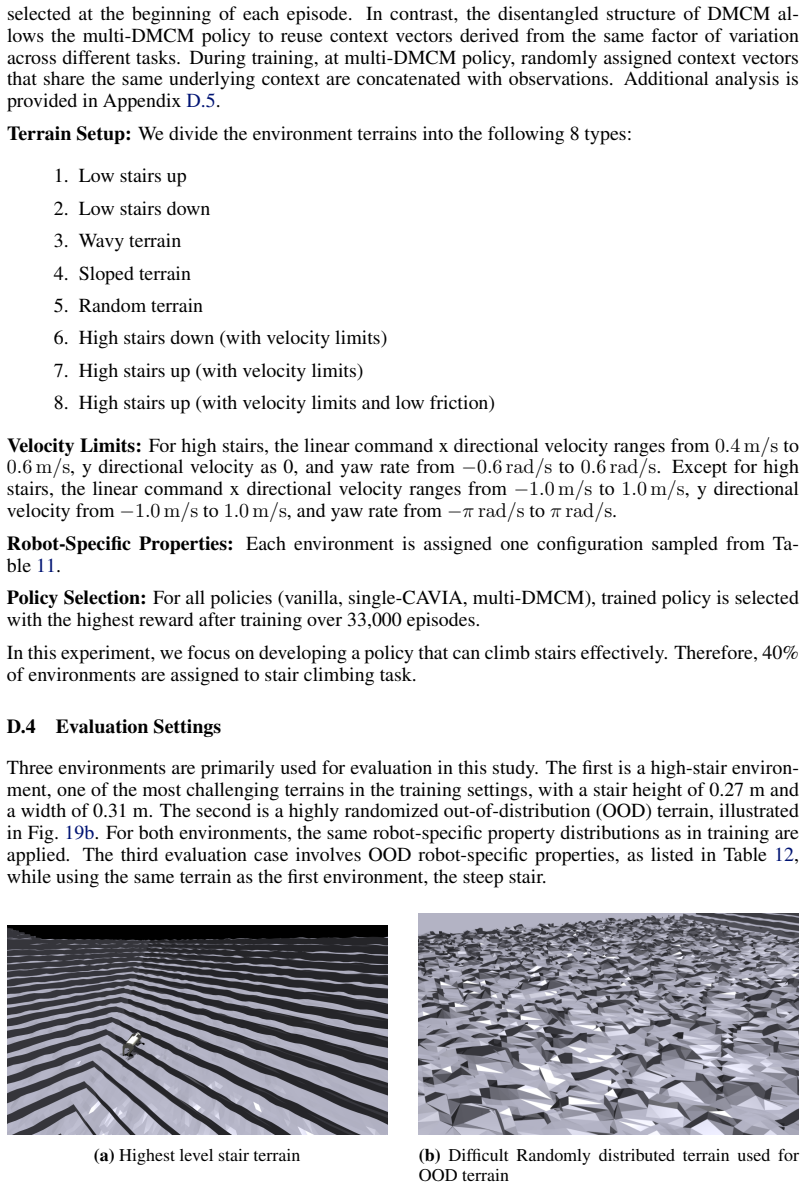
to enable robust sim-to-real transfer. Detailed input and hyperparameters are in Table 7, 8. Observation Type Input Dim. Proprioception Linear body velocity estimation 3Angular body velocity 3Body height estimation 1Foot height estimation 4Contact probability estimation 4Command 3Projected gravity vector 3Action 12Joint position 12Joint velocity 12Action ...
work page 2000
-
[35]
Flat terrain with 1.5kg payload
-
[36]
Climbing stairs (17cm depth)
-
[37]
Wavy terrain with 1.5kg payload
-
[38]
Flat terrain with 1.5kg payload and water bottle on legs
-
[39]
These datasets are used for adapting the CA VIA and DMCM dynamics models
Flat terrain with 16N · m Kp (low gain) and 1.5kg payload Data collection on stairs with a 1.5 kg payload was not possible, as the naive policy was unable to successfully complete the task. These datasets are used for adapting the CA VIA and DMCM dynamics models. The adapted contexts are then applied in the single-CA VIA and multi-DMCM policies for real-w...
-
[40]
High stairs down (with velocity limits)
-
[41]
High stairs up (with velocity limits)
-
[42]
High stairs up (with velocity limits and low friction) Velocity Limits: For high stairs, the linear command x directional velocity ranges from 0.4 m/s to 0.6 m/s, y directional velocity as 0, and yaw rate from −0.6 rad/s to 0.6 rad/s. Except for high stairs, the linear command x directional velocity ranges from −1.0 m/s to 1.0 m/s, y directional velocity ...
work page 2000
This paper was first reviewed by deepseek-v4-flash on August 5, 2026.
discussion (0)
Sign in with ORCID, Apple, or X to comment. Anyone can read and Pith papers without signing in.