REVIEW 2 major objections 5 minor 29 references
Robust Knowledge Editing via Explicit Reasoning Chains for Distractor-Resilient Multi-Hop QA
T0 review · 2 major / 5 minor · reviewed 2026-08-05 · deepseek-v4-flash
Pith's one-line read One-pass reasoning chains make edited LLMs ignore distractors
desk verdict Useful one-pass knowledge-editing recipe, but the headline 6.3% drop figure is misleading: on the 38% of MQuAKE-CF-3K where answers are not leaked, the drop is ~16 points. read the letter →
The pith
A machine-rendered reading of the paper's core claim, the machinery that carries it, and where it could break.
The reading
What carries the argument
The load-bearing object is a fixed four-stage reasoning trace—acknowledge, relevance determination, apply-or-ignore, final reasoning—used as supervised fine-tuning data. The training set augments editing sets with distractors at a 90/5/5 mix of 0, 2, and 4 irrelevant facts per relevant fact, teaching the model to discard noise while composing the answer chain. The whole trace is generated in a single forward pass, replacing the iterative retrieval-and-revise loops used by baselines such as EditCoT, RAE, MeLLo, and PokeMQA.
What would settle it
Split MQuAKE-CF-3K into the 1,852 answer-exposed and 1,148 non-exposed questions and run Reason-KE and RAE on each half under 0, 2, and 4 distractors. If Reason-KE's edge over RAE disappears or falls sharply on the non-exposed half, the paper's central claim of distractor-resilient reasoning fails; if the edge persists, the claim is supported.
Extended reading notes
Core claim
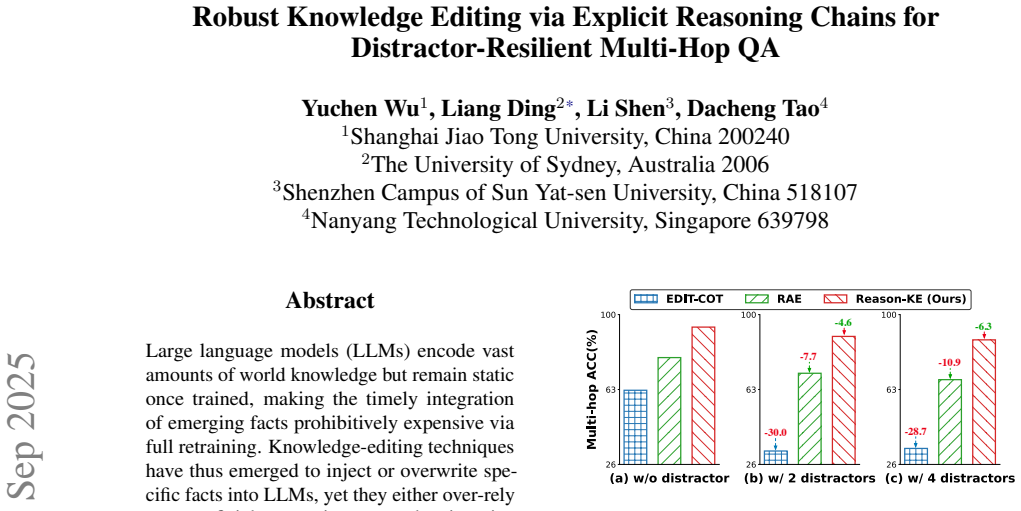
Reason-KE's central discovery is that noise resistance in knowledge editing can be trained in directly. The paper builds 9,218 step-by-step reasoning traces over MQuAKE-CF editing sets, mixes in 0, 2, or 4 distractors per relevant fact at a 90/5/5 ratio, and vanilla-fine-tunes Qwen2.5-7B to reproduce the four stages—acknowledge, determine relevance, apply-or-ignore, final reasoning—in one pass. The resulting model reaches 90.2% average multi-hop accuracy on MQuAKE-CF-3K, outperforming the retrieval-augmented baseline RAE by 17.6 points; with two or four distractors per fact, it drops only about 0.3 and 6.3 points from its no-distractor accuracy, and on the 1,852 test questions where the answ
Load-bearing premise
The test set mostly exposes the final answer verbatim among the edited facts, and the paper only reports distractor robustness on those exposed items, so the claim of learned distractor-filtering may not hold for questions where the answer is hidden.
Editorial extensions
If this is right
- Knowledge editing can be cast as fine-tuning a reasoning skill: a fixed prompt protocol, no per-example search or parameter localization.
- Robustness to irrelevant facts is achievable without retrieval; one forward pass filters distractors, which also cuts inference time relative to iterative baselines.
- Editing behavior becomes inspectable in the generated trace because the model states which facts it judged relevant and which it ignored.
- The recipe transfers across base models and benchmarks, suggesting the four-stage protocol, not a specific architecture, carries the effect.
- A cheaper teacher model suffices for generating training traces, lowering the barrier to applying the method.
Reading between the lines
- The paper's robustness numbers are reported only for the 1,852 answer-exposed questions; the natural next experiment is to report non-leaked accuracy separately. If the 17.6-point edge over RAE mostly lives in the leaked subset, the claim of distractor-resilient reasoning would need to be narrowed to answer-copying resilience.
- Because the model explicitly outputs 'apply or ignore' decisions, those decisions could be scored or verified during inference, offering a cheap way to catch wrong relevance judgments without full iterative loops.
- The fixed 90/5/5 distractor mix is a training choice, not an optimized curriculum; adversarially selected or progressively harder distractors would test whether the robustness ceiling is set by data diversity.
Editorial analysis
A structured set of objections, weighed in public.
Referee Report
Summary. The paper introduces Reason-KE, a single-pass knowledge-editing method. An LLM is fine-tuned on MQuAKE-CF with DeepSeek-R1-generated four-stage reasoning traces (acknowledgment, relevance determination, selective application, final reasoning) and with 0/2/4 distractors added to 90%/5%/5% of training cases. At inference, the model processes the editing set and question in one pass, filtering irrelevant facts. On the stated non-overlapping MQuAKE-CF-3K test set, Qwen2.5-7B-Instruct reaches 90.2% average multi-hop accuracy, 17.6 pp above RAE, with a 6.3% average drop under added distractors and <1% drop on answer-exposed items. Additional experiments cover Llama-3-8B, DUNE subsets, ablations of training components, teacher-model dependence, and inference-time comparisons. Code, generated training data, and the fine-tuned model are publicly released.
Significance. If the main result holds, Reason-KE is a strong and simple alternative to iterative retrieval-based editing pipelines, and the public release of code/data/model is a concrete reproducibility asset. The external test set, explicitly stated to be non-overlapping with training, and the answer-exposure analysis are genuine strengths; many knowledge-editing papers do not even acknowledge the leakage issue. The ablations are coherent, and the answer-only collapse in Table 4 provides a useful sanity check. However, the central distractor-resilience claim is overstated because the non-leaked complement is never reported: on the 1,148 items without verbatim answer exposure, the implied accuracy drop under heavy distraction is roughly three times the pooled 6.3% figure. The method may still outperform RAE on the same subset, but the manuscript's headline numbers do not support the abstract's characterization without qualification.
major comments (2)
- [Section 4, Tables 3–4] The leakage analysis omits the non-leaked complement. You report that 1,852/3,000 MQuAKE-CF-3K items expose the final answer verbatim in the edit set, and Table 3 gives Reason-KE only on that subset (97.08/96.70/96.71). Combining Table 3 with the pooled accuracies in Table 4 (93.83/89.23/87.53) implies accuracies of about 88.6/77.2/72.7 for the 1,148 non-exposed items. Thus Reason-KE drops 15.9 absolute points (~17.9% relative) under four distractors when the answer is not exposed, not 6.3%. This does not overturn the RAE comparison, but it materially weakens the distractor-resilience claim. Please report the complement and qualify the abstract/conclusion claims.
- [Section 4, Table 3] All experiments are single runs; no seeds or error bars are reported. This is load-bearing for the answer-exposure analysis. On the 1,852 answer-exposed items, the differences in Table 3 are 0.38 and 0.37 percentage points (97.08 -> 96.70/96.71), which is within one binomial standard error (~0.39 pp). The conclusion that Reason-KE is independent of leakage is therefore not statistically supported. Report multiple seeds or confidence intervals for at least the headline cells in Tables 1, 3, and 4.
minor comments (5)
- [Throughout] Typos and inconsistent naming: 'Main Rsults' (Section 4 heading), 'Deepseed-R12' (Section 2.2), and inconsistent 'Mello' vs 'MeLLo'.
- [Table 1 caption] The marker legend is confusing: the same down-arrow symbol is used for '>6% drop' and for 'stable performance (<6%)'. Please use distinct symbols for stable, degraded, and catastrophic cases.
- [Appendix B.4] The distractor selection procedure is underspecified. 'Retrieve from the pre-edit corpus and match with the Top-k corresponding post-edit facts' should state which corpus is used, whether distractors can contain the final answer, and how the k values map to the 'w/ 2 Distr.' and 'w/ 4 Distr.' columns for multi-hop questions.
- [Table 6] DUNE results compare only EditCoT; RAE and other strong baselines are absent. The 'state-of-the-art' wording for DUNE is not supported by the displayed evidence.
- [Section 3] The relation between total distractors and per-fact distractors is inconsistent: Section 3 says n = m × k with k ∈ {0,1,2}, while Figure 1 says 2/4 distractors are added per relevant fact. Please define the columns unambiguously.
Circularity Check
No material circularity; the central evaluation is external and non-overlapping, though the leakage analysis omits the non-leaked complement (a reporting gap, not a circular reduction).
full rationale
The paper's derivation chain is: (1) construct a training set from MQuAKE-CF with DeepSeek-R1-generated four-stage reasoning traces and injected distractors; (2) vanilla fine-tune Qwen2.5-7B; (3) evaluate on MQuAKE-CF-3K, stated to share no overlapping data points with the training set. The headline 90.2% accuracy and the 17.6 pp gain over RAE are measured against an external benchmark, not produced by construction from the training objective or from any fitted parameter. The ablations in Table 4 independently show that removing each stage degrades performance, so the four-stage design has identifiable empirical content. Self-citations (Zhong et al. 2024, Zhang et al. 2025, Wu et al. 2025) appear only as related-work motivation for merging steps into one pass; they do not supply a load-bearing uniqueness theorem or justify the main result. No ansatz is smuggled in via citation, and no known result is merely renamed. The one substantive weakness is in Section 4: the leakage analysis reports Table 3 only on the 1,852 answer-exposed items, never the 1,148 non-exposed complement, even though the paper itself notes the exposure. Solving from Table 3 and Table 4 implies substantially larger drops on non-leaked items. This is a correctness/generalizability gap in the robustness claim, not circularity: the test numbers are still external, and no result is equivalent to its input by definition. Accordingly, the circularity score is low.
Assumptions & free parameters
free parameters (4)
- distractor training mix ratio (0/2/4 distractors at 90%/5%/5%) =
90%/5%/5%
- evaluation distractor levels k =
k = 0,1,2 per supporting fact
- SFT hyperparameters =
lr 1e-5, 5 epochs, block size 32768, cosine schedule
- drop thresholds for table markers =
6% and 12% (Tables 1,2) and 5% (Table 3)
assumptions (4)
- domain assumption MQuAKE-CF-3K is a valid testbed for multi-hop knowledge editing
- domain assumption The 61.7% of test items with leaked answers do not dominate measured accuracy
- domain assumption Contriever Top-k retrieval produces genuinely irrelevant distractors
- domain assumption DeepSeek-R1-generated reasoning traces are correct and learnable
Cite this review
Pith. "Pith review of Robust Knowledge Editing via Explicit Reasoning Chains for Distractor-Resilient Multi-Hop QA." pith.science (2026). https://pith.science/paper/JD54S563
@misc{pith2026250901468,
  author       = {Pith},
  title        = {Pith review of: Robust Knowledge Editing via Explicit Reasoning Chains for Distractor-Resilient Multi-Hop QA},
  year         = {2026},
  howpublished = {\url{https://pith.science/paper/JD54S563}},
  note         = {Machine review of arXiv:2509.01468}
}
read the original abstract
Large language models (LLMs) encode vast amounts of world knowledge but remain static once trained, making the timely integration of emerging facts prohibitively expensive via full retraining. Knowledge-editing techniques have thus emerged to inject or overwrite specific facts into LLMs, yet they either over-rely on superficial cues or incur complex, iterative pipelines that collapse under noisy, multi-hop conditions. We introduce Reason-KE, an end-to-end reasoning-chain-based editing framework that steers a pretrained LLM through four structured stages-fact acknowledgment, relevance determination, selective application, and final reasoning-to filter distractors in a single pass. Trained on MQuAKE-CF with up to four irrelevant facts, Reason-KE elevates Qwen2.5-7B's multi-hop QA accuracy to 90.2% while suffering merely a 6.3% drop under heavy distraction and <1% when answers are leaked. Our quantitative analysis confirms Reason-KE's resilience and efficiency, establishing a new state-of-the-art for reliable LLM knowledge updates.
Figures


Reference graph
Works this paper leans on
-
[1]
online" 'onlinestring :=
ENTRY address archivePrefix author booktitle chapter edition editor eid eprint eprinttype howpublished institution journal key month note number organization pages publisher school series title type volume year doi pubmed url lastchecked label extra.label sort.label short.list INTEGERS output.state before.all mid.sentence after.sentence after.block STRING...
-
[2]
write newline
" write newline "" before.all 'output.state := FUNCTION n.dashify 't := "" t empty not t #1 #1 substring "-" = t #1 #2 substring "--" = not "--" * t #2 global.max substring 't := t #1 #1 substring "-" = "-" * t #2 global.max substring 't := while if t #1 #1 substring * t #2 global.max substring 't := if while FUNCTION word.in bbl.in capitalize " " * FUNCT...
-
[3]
Afra Feyza Aky \"u rek, Eric Pan, Garry Kuwanto, and Derry Wijaya. 2023. Dune: Dataset for unified editing. arXiv preprint arXiv:2311.16087
work page Pith review arXiv 2023
-
[4]
Roi Cohen, Eden Biran, Ori Yoran, Amir Globerson, and Mor Geva. 2024 a . Evaluating the ripple effects of knowledge editing in language models. Transactions of the Association for Computational Linguistics, 12:283--298
work page 2024
-
[5]
Roi Cohen, Eden Biran, Ori Yoran, Amir Globerson, and Mor Geva. 2024 b . Evaluating the ripple effects of knowledge editing in language models. Transactions of the Association for Computational Linguistics, 12:283--298
work page 2024
-
[6]
Aaron Grattafiori, Abhimanyu Dubey, Abhinav Jauhri, Abhinav Pandey, Abhishek Kadian, Ahmad Al-Dahle, Aiesha Letman, Akhil Mathur, Alan Schelten, Alex Vaughan, and 1 others. 2024. The llama 3 herd of models. arXiv preprint arXiv:2407.21783
arXiv 2024
-
[7]
Hengrui Gu, Kaixiong Zhou, Xiaotian Han, Ninghao Liu, Ruobing Wang, and Xin Wang. 2023. Pokemqa: Programmable knowledge editing for multi-hop question answering. arXiv preprint arXiv:2312.15194
arXiv 2023
-
[8]
Daya Guo, Dejian Yang, Haowei Zhang, Junxiao Song, Ruoyu Zhang, Runxin Xu, Qihao Zhu, Shirong Ma, Peiyi Wang, Xiao Bi, and 1 others. 2025. Deepseek-r1: Incentivizing reasoning capability in llms via reinforcement learning. arXiv preprint
work page 2025
Show all 29 references
-
[9]
Gautier Izacard, Mathilde Caron, Lucas Hosseini, Sebastian Riedel, Piotr Bojanowski, Armand Joulin, and Edouard Grave. 2021. Unsupervised dense information retrieval with contrastive learning. arXiv preprint arXiv:2112.09118
2021 arXiv
-
[10]
Aixin Liu, Bei Feng, Bing Xue, Bingxuan Wang, Bochao Wu, Chengda Lu, Chenggang Zhao, Chengqi Deng, Chenyu Zhang, Chong Ruan, and 1 others. 2024. Deepseek-v3 technical report. arXiv preprint arXiv:2412.19437
2024 arXiv
-
[11]
Jiachang Liu, Dinghan Shen, Yizhe Zhang, Bill Dolan, Lawrence Carin, and Weizhu Chen. 2021. What makes good in-context examples for gpt- 3 ? arXiv preprint arXiv:2101.06804
2021 arXiv
-
[12]
Kevin Meng, David Bau, Alex Andonian, and Yonatan Belinkov. 2022 a . Locating and editing factual associations in GPT . In Advances in Neural Information Processing Systems 35: Annual Conference on Neural Information Processing Systems 2022, NeurIPS 2022, New Orleans, LA, USA,...
2022
-
[13]
Kevin Meng, Arnab Sen Sharma, Alex Andonian, Yonatan Belinkov, and David Bau. 2022 b . Mass-editing memory in a transformer. arXiv preprint arXiv:2210.07229
2022 arXiv
-
[14]
Eric Mitchell, Charles Lin, Antoine Bosselut, Chelsea Finn, and Christopher D Manning. 2021. Fast model editing at scale. arXiv preprint arXiv:2110.11309
2021 arXiv
-
[15]
Keqin Peng, Liang Ding, Qihuang Zhong, Li Shen, Xuebo Liu, Min Zhang, Yuanxin Ouyang, and Dacheng Tao. 2023. Towards making the most of chatgpt for machine translation. In Findings of the Association for Computational Linguistics: EMNLP 2023
2023
-
[16]
Yucheng Shi, Qiaoyu Tan, Xuansheng Wu, Shaochen Zhong, Kaixiong Zhou, and Ninghao Liu. 2024. Retrieval-enhanced knowledge editing in language models for multi-hop question answering. In Proceedings of the 33rd ACM International Conference on Information and Knowledge Managemen...
2024
-
[17]
Changyue Wang, Weihang Su, Qingyao Ai, and Yiqun Liu. 2024 a . Knowledge editing through chain-of-thought. arXiv preprint arXiv:2412.17727
2024 arXiv
-
[18]
Peng Wang, Ningyu Zhang, Bozhong Tian, Zekun Xi, Yunzhi Yao, Ziwen Xu, Mengru Wang, Shengyu Mao, Xiaohan Wang, Siyuan Cheng, and 1 others. 2023. Easyedit: An easy-to-use knowledge editing framework for large language models. arXiv preprint arXiv:2308.07269
2023 arXiv
-
[19]
Yiwei Wang, Muhao Chen, Nanyun Peng, and Kai-Wei Chang. 2024 b . Deepedit: Knowledge editing as decoding with constraints. arXiv preprint arXiv:2401.10471
2024 arXiv
-
[20]
Jason Wei, Yi Tay, Rishi Bommasani, Colin Raffel, Barret Zoph, Sebastian Borgeaud, Dani Yogatama, Maarten Bosma, Denny Zhou, Donald Metzler, and 1 others. 2022. Emergent abilities of large language models. Transactions on Machine Learning Research
2022
-
[21]
Yuchen Wu, Liang Ding, Li Shen, and Dacheng Tao. 2025. Edit once, update everywhere: A simple framework for cross-lingual knowledge synchronization in llms. In Findings of the Association for Computational Linguistics: ACL 2025
2025
-
[22]
An Yang, Baosong Yang, Beichen Zhang, Binyuan Hui, Bo Zheng, Bowen Yu, Chengyuan Li, Dayiheng Liu, Fei Huang, Haoran Wei, and 1 others. 2024. Qwen2. 5 technical report. arXiv preprint arXiv:2412.15115
2024 arXiv
-
[23]
Yunzhi Yao, Peng Wang, Bozhong Tian, Siyuan Cheng, Zhoubo Li, Shumin Deng, Huajun Chen, and Ningyu Zhang. 2023. Editing large language models: Problems, methods, and opportunities. arXiv preprint arXiv:2305.13172
2023 arXiv
-
[24]
Yuqi Zhang, Liang Ding, Lefei Zhang, and Dacheng Tao. 2025. Intention analysis makes llms a good jailbreak defender. In Proceedings of the 31st International Conference on Computational Linguistics
2025
-
[25]
Wayne Xin Zhao, Kun Zhou, Junyi Li, Tianyi Tang, Xiaolei Wang, Yupeng Hou, Yingqian Min, Beichen Zhang, Junjie Zhang, Zican Dong, and 1 others. 2023. A survey of large language models. arXiv preprint arXiv:2303.18223
2023 arXiv
-
[26]
Qihuang Zhong, Liang Ding, Juhua Liu, Bo Du, and Dacheng Tao. 2023 a . Can chatgpt understand too? a comparative study on chatgpt and fine-tuned bert. arXiv preprint arXiv:2302.10198
2023 arXiv
-
[27]
Qihuang Zhong, Kang Wang, Ziyang Xu, Juhua Liu, Liang Ding, and Bo Du. 2024. Achieving> 97\ arXiv preprint arXiv:2404.14963
2024 arXiv
-
[28]
Zexuan Zhong, Zhengxuan Wu, Christopher D Manning, Christopher Potts, and Danqi Chen. 2023 b . Mquake: Assessing knowledge editing in language models via multi-hop questions. arXiv preprint arXiv:2305.14795
2023 arXiv
-
[29]
Chen Zhu, Ankit Singh Rawat, Manzil Zaheer, Srinadh Bhojanapalli, Daliang Li, Felix Yu, and Sanjiv Kumar. 2020. Modifying memories in transformer models. arXiv preprint arXiv:2012.00363
2020 arXiv
Reviewed August 5, 2026 · model on record in the stance chip above.
Discussion (0). Sign in to comment.