REVIEW 2 major objections 4 minor 45 references
Im2Haircut: Single-view Strand-based Hair Reconstruction for Human Avatars
T0 review · 2 major / 4 minor · reviewed 2026-08-05 · deepseek-v4-flash
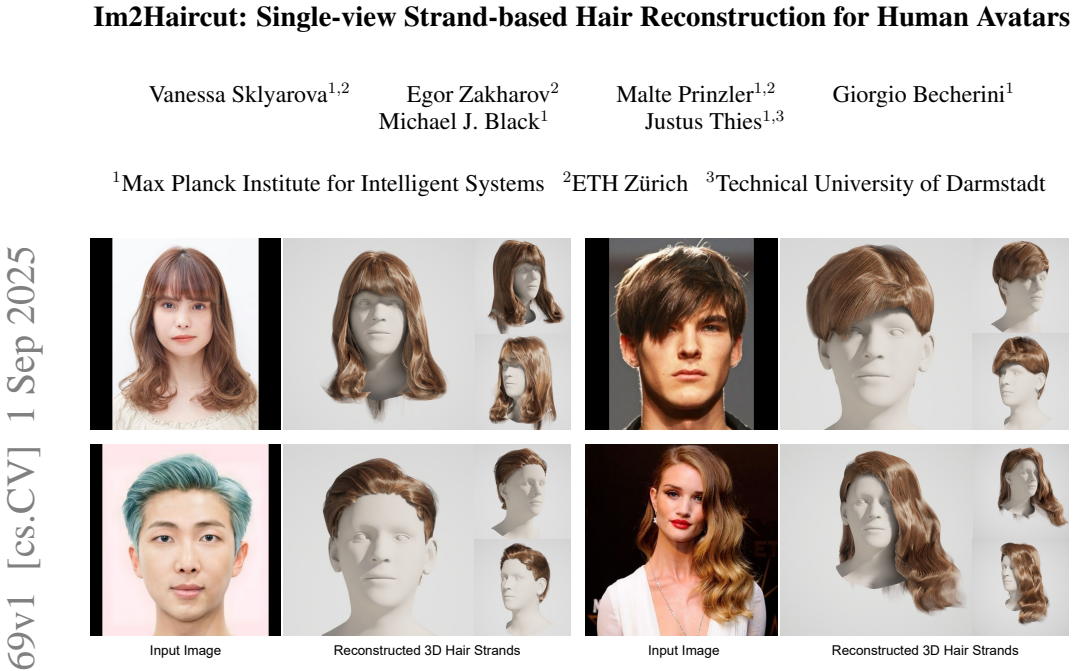
Pith's one-line read A single photograph can be turned into strand-level 3D hair geometry in about ten minutes, with plausible occluded inner and back structure.
desk verdict The hybrid synthetic+real training scheme is a real step forward for single-view strand hair, but the synthetic 3D quantitative comparison is contaminated by PCA leakage on the test set, so the reported superiority is not yet proven. read the letter →
The pith
A machine-rendered reading of the paper's core claim, the machinery that carries it, and where it could break.
The reading
What carries the argument
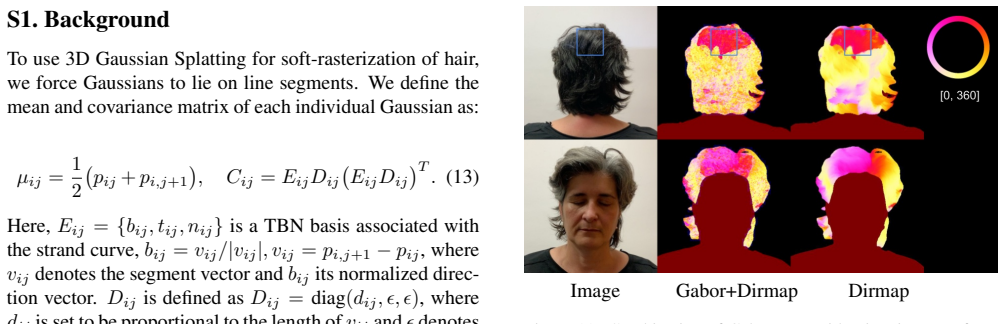
The load-bearing object is the PCA hair map: hair strands are compressed into 64 Fourier-domain PCA coefficients per scalp texel, with the first 10 coefficients forming a coarse branch and the remaining 54 a fine branch. A vision-transformer encoder-decoder predicts these maps, conditioned on orientation, segmentation, depth, and body-mask inputs; strand-aligned 3D Gaussians render the decoded strands differentiably. That renderer is what lets real photographs supervise the prior without 3D ground truth, through segmentation, direction, depth, and penetration losses, and it is also what drives the per-image fine-tuning at inference.
What would settle it
Fit the PCA strand basis on a held-out subset of the synthetic hairstyles and rerun the chamfer evaluation on hairdos excluded from that fit; if the reported errors do not survive, the benchmark is measuring basis memorization rather than reconstruction. Separately, compare against CT or multi-view strand ground truth for real heads to test the real-image claims.
Extended reading notes
Core claim
The central claim is that strand-based hair geometry can be recovered from one image by combining a global, low-dimensional hairstyle prior with local, rendering-based optimization. The prior is a transformer that predicts a 64-coefficient PCA hair map on the scalp UV space, split into 10 coarse coefficients and 54 fine ones; it is trained first on synthetic data with 3D losses, then jointly on real data using differentiable rendering. At test time, the predicted map becomes an initialization that is refined for 400 steps with losses on silhouette, direction, depth, and head penetration. The paper argues that this two-part design—hybrid prior plus inversion—captures detailed visible strand o
Load-bearing premise
The synthetic benchmark numbers assume the test hairstyles were not used to build the compact strand representation; the appendix says that representation was fit on all hairstyles from the same dataset the test set is drawn from.
Editorial extensions
If this is right
- A single photograph is enough to produce a strand-based 3D hairstyle with plausible occluded inner and back geometry, in about 10 minutes on an A100.
- Mixing synthetic 3D supervision with real-image rendering losses improves silhouette coverage and direction accuracy on real portraits compared with synthetic-only training.
- Fine-tuning the prior with differentiable rendering recovers wavy structures and view alignment that pure regression misses.
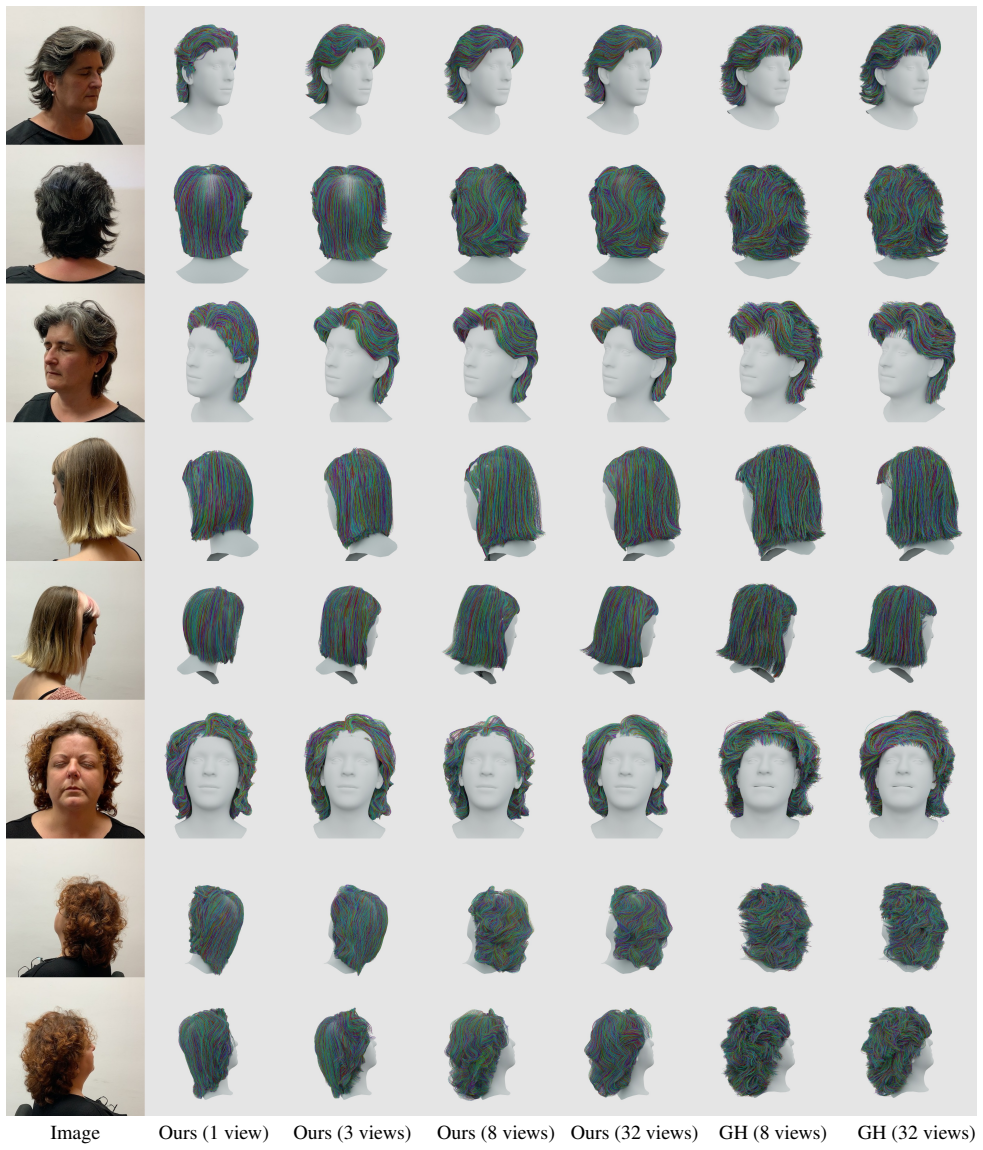
- The same prior supports multi-view reconstruction in about 45 minutes, an order of magnitude faster than the 10-hour direct optimization baseline.
- The resulting strands are exportable to standard CG pipelines and can be simulated, making avatars animatable.
Reading between the lines
- Not claimed by the paper: the PCA-basis overlap means the synthetic benchmark margin is likely optimistic; a held-out basis would test that.
- Not claimed by the paper: the coarse-branch-only gradient rule could generalize as a stabilizer for hybrid training of other structural priors.
- Not claimed by the paper: replacing the off-the-shelf direction estimator with one fine-tuned on real data could further improve backside consistency.
- Not claimed by the paper: prior-space optimization may transfer to other avatar components where full 3D supervision exists only synthetically.
Editorial analysis
A structured set of objections, weighed in public.
Referee Report
Summary. The paper presents Im2Haircut, a method for strand-based 3D hair reconstruction from a single photograph (and, with adaptation, from multiple views). The approach learns a hairstyle prior from a mixture of synthetic PERM data (with 3D supervision) and real Hairstep images (with self-supervised 3D Gaussian Splatting rendering losses). A transformer-based network predicts a 64-component PCA hair map in a coarse-to-fine manner, and at inference time the pretrained model is fine-tuned for 400 steps using rendering-based losses to align with the input image. The method is compared qualitatively and quantitatively against NeuralHDHair, Hairstep, PERM, HairNet, and Hairmony, and the paper claims superior performance in capturing hair orientation, silhouette, and backside consistency.
Significance. If the quantitative claims are validated, the paper would be a useful contribution to single-view hair reconstruction: it combines a learned global hair prior with local optimization, uses both synthetic and real data to reduce the domain gap, and demonstrates applications in multi-view reconstruction and simulation. The pipeline is relatively fast (about 10 minutes on an A100) and the authors state that code will be released. The main weakness is that the headline synthetic comparison is currently compromised by a PCA basis leakage in the evaluation setup, as detailed below.
major comments (2)
- [S2.1, Sec. 5.1, Eq. (1), Table 1] The quantitative synthetic evaluation is undermined by PCA basis leakage. Supplementary S2.1 states that the Incremental PCA basis is computed on 'all hairstyles from the PERM dataset', and Sec. 5.1 evaluates on ten PERM hairstyles. Since Eq. (1) decodes every reconstruction as iDFT(\bar{S} + \gamma^T X), all outputs are constrained to the 64-dimensional subspace spanned by the PERM strands. If the test hairstyles are included in the PCA fit, the representation space already contains the test geometry, which selectively lowers the reported chamfer distances for the proposed method relative to baselines whose output spaces are not so tuned. The reported difference to NeuralHDHair is very small (chamferpts 0.000246 vs 0.000251), so the leakage could change the ranking. Please re-run the PCA basis on the training split only (or use leave-one-out over the ten test hairstyles), report per-hai
- [Table 1, Sec. 5.1] The statistical support for the 'superior performance' claim is weak. The synthetic comparison uses only 10 hairstyles and the real-image comparison uses 50 images, with no error bars, no per-sample distributions, and no significance tests. Given the small effect size in the synthetic chamfer comparison, the claim of superiority would be much more convincing if the authors reported per-hairstyle chamfer values, standard deviations, and a paired test (e.g., Wilcoxon signed-rank or bootstrap confidence intervals). Without this, the quantitative ranking is not established.
minor comments (4)
- [Sec. 5.1, References] The method list refers to 'Hairmony [43]' but the correct reference number is [24]. The reference list contains Hairmony as [24]; please fix the citation.
- [Sec. 5.2, Table 2] The metric 'mask↓' is used in Tables 2 and 3 but is not defined in the main text. Please define the mask error and specify whether it is an L2 distance or IoU-based score.
- [Sec. 5.1, Eq. (12)] The Lundir metric is used in Table 1 but only defined later in Eq. (12). Move the definition earlier or provide a pointer at first use.
- [S3, Table 1] The synthetic evaluation says metrics are computed on 10,000 sampled strands; please clarify the sampling procedure and whether the same strand count is used for all methods. Also, note that the hardware used for the 10-minute timing (A100) differs from the RTX3090 used for Hairstep; a like-for-like timing would improve comparability.
Circularity Check
Synthetic 3D comparison is partially circular: the PCA basis fit on all PERM hairstyles includes the test hairstyles, so Table 1's chamfer advantage partly reflects test-set leakage.
-
fitted input called prediction
[Section S2.1 (strand PCA basis) and Section 5.1 / Table 1 (synthetic quantitative comparison)]
"For basis calculation, we launch the Incremental PCA method on all hairstyles from the PERM [11] dataset. ... We use ten hairstyles and render them from a hemisphere with high-resolution textures to reduce the domain gap between synthetic renders and real images. We launch Hairstep [42], NeuralHDHair [36], and our method on the obtained data, align results in the same space, and calculate the chamfer distance on points and directions between reconstructed and ground-truth 3D hairstyles; see Table 1 for results."
Equation (1) decodes every prediction as iDFT(mean + γ^T X), so all outputs are confined to the 64-dimensional subspace spanned by the PERM strands used to fit X. Since S2.1 fits X on all PERM hairstyles and Section 5.1 evaluates on ten PERM hairstyles from the same dataset, the reconstruction space already contains the test geometry. The chamfer comparison then measures reconstruction inside a test-informed subspace against baselines (NeuralHDHair, Hairstep) whose output spaces were not fit to those same test strands. This selectively lowers chamferpts and chamferangle for Im2Haircut; the 0.000246 vs 0.000251 margin over NeuralHDHair is too small and too confounded to support the quantitative superiority claim. The real-image metrics and qualitative back-view comparisons do not share this
full rationale
The paper's core method is an empirical reconstruction pipeline, not a formal derivation, so most of the chain (transformer coarse/fine branches, Gaussian-splatting losses, single-view inversion) is self-contained and does not reduce to its inputs. The one concrete circular step is the synthetic quantitative evaluation: the PCA basis X in Eq. (1) is fit by Incremental PCA on 'all hairstyles from the PERM dataset' (S2.1), and the 3D test set in Section 5.1 is ten PERM hairstyles. Because Eq. (1) writes every prediction as iDFT(mean + γ^T X), all predictions lie in the subspace spanned by the test strands. This does not by itself make the network output equal to ground truth, but it removes the representation bottleneck for the tested geometry while the baselines are evaluated in their own, not test-tuned, output spaces, biasing the chamfer comparison in Table 1. The qualitative comparisons, real-image metrics (IoU/Lundir on 50 Hairstep images), and ablations are independent of this particular leakage, so the central claim retains independent content; the score is therefore partial, not total. I did not find load-bearing self-citation circularity: references to prior work [11, 38, 33] are used as components or representations, not as an unverified uniqueness theorem forcing the result.
Assumptions & free parameters
free parameters (7)
- PCA basis X =
64 components fit to all 21,054 PERM hairstyles
- PCA coefficient count gamma =
64
- Loss weights (lambda) =
coarse: lambda_PCA=0.1, lambda_dir=0.1, lambda_curv=1, lambda_mask=1e-4; fine: lambda_PCA=10, lambda_dir=0.1, lambda_cur
- Mixing rate r =
0.5
- Visibility weight wij =
3 for visible points, 1 otherwise
- Gaussian width values =
epsilon=0.005 during training, 0.00035 during inversion
- Number of strands =
~10,000 during optimization, 30,000 for visualization
assumptions (5)
- domain assumption PERM synthetic hairstyles are a valid proxy for real hairstyle geometry and statistics
- domain assumption The FLAME head UV parametrization and scalp region describe the hair root space for real subjects
- domain assumption Strand-aligned 3D Gaussian splatting is a faithful differentiable renderer for hair appearance
- domain assumption Off-the-shelf estimators (Depth Pro, SAM, Hairstep direction maps, Deep3DFace) provide errors small enough not to break reconstruction
- standard math Incremental PCA and inverse DFT are standard operations; the chosen 64 components capture strand geometry
Cite this review
Pith. "Pith review of Im2Haircut: Single-view Strand-based Hair Reconstruction for Human Avatars." pith.science (2026). https://pith.science/paper/SKLK4ME3
@misc{pith2026250901469,
  author       = {Pith},
  title        = {Pith review of: Im2Haircut: Single-view Strand-based Hair Reconstruction for Human Avatars},
  year         = {2026},
  howpublished = {\url{https://pith.science/paper/SKLK4ME3}},
  note         = {Machine review of arXiv:2509.01469}
}
read the original abstract
We present a novel approach for 3D hair reconstruction from single photographs based on a global hair prior combined with local optimization. Capturing strand-based hair geometry from single photographs is challenging due to the variety and geometric complexity of hairstyles and the lack of ground truth training data. Classical reconstruction methods like multi-view stereo only reconstruct the visible hair strands, missing the inner structure of hairstyles and hampering realistic hair simulation. To address this, existing methods leverage hairstyle priors trained on synthetic data. Such data, however, is limited in both quantity and quality since it requires manual work from skilled artists to model the 3D hairstyles and create near-photorealistic renderings. To address this, we propose a novel approach that uses both, real and synthetic data to learn an effective hairstyle prior. Specifically, we train a transformer-based prior model on synthetic data to obtain knowledge of the internal hairstyle geometry and introduce real data in the learning process to model the outer structure. This training scheme is able to model the visible hair strands depicted in an input image, while preserving the general 3D structure of hairstyles. We exploit this prior to create a Gaussian-splatting-based reconstruction method that creates hairstyles from one or more images. Qualitative and quantitative comparisons with existing reconstruction pipelines demonstrate the effectiveness and superior performance of our method for capturing detailed hair orientation, overall silhouette, and backside consistency. For additional results and code, please refer to https://im2haircut.is.tue.mpg.de.
Figures


Figures from the paper (23 more)






Reference graph
Works this paper leans on
-
[1]
Mikl ´os Bergou, Max Wardetzky, Stephen Robinson, Basile Audoly, and Eitan Grinspun. Discrete elastic rods. ACM SIGGRAPH 2008 papers, 2008. 2
work page 2008
-
[2]
Aleksei Bochkovskii, Ama ¨el Delaunoy, Hugo Germain, Marcel Santos, Yichao Zhou, Stephan R. Richter, and Vladlen Koltun. Depth pro: Sharp monocular metric depth in less than a second. ArXiv, abs/2410.02073, 2024. 5, 11
arXiv 2024
-
[3]
Single-view hair modeling for portrait manipulation
Menglei Chai, Lvdi Wang, Yanlin Weng, Yizhou Yu, Baining Guo, and Kun Zhou. Single-view hair modeling for portrait manipulation. ACM Transactions on Graphics (TOG), 31:1 – 8, 2012. 2
work page 2012
-
[4]
Autohair.ACM Transactions on Graphics (TOG), 35:1 – 12, 2016
Menglei Chai, Tianjia Shao, Hongzhi Wu, Yanlin Weng, and Kun Zhou. Autohair.ACM Transactions on Graphics (TOG), 35:1 – 12, 2016. 2
work page 2016
-
[5]
A practical and controllable hair and fur model for production path tracing
Matt Jen-Yuan Chiang, Benedikt Bitterli, Chuck Tappan, and Brent Burley. A practical and controllable hair and fur model for production path tracing. Computer Graphics Forum, 35,
-
[6]
Blender - a 3D modelling and rendering package
Blender Online Community. Blender - a 3D modelling and rendering package. Blender Foundation, Stichting Blender Foundation, Amsterdam, 2018. 5, 12
work page 2018
-
[7]
Interactive hair simulation on the gpu using admm
Gilles Daviet. Interactive hair simulation on the gpu using admm. ACM SIGGRAPH 2023 Conference Proceedings ,
work page 2023
-
[8]
Accurate 3d face reconstruction with weakly-supervised learning: From single image to image set
Yu Deng, Jiaolong Yang, Sicheng Xu, Dong Chen, Yunde Jia, and Xin Tong. Accurate 3d face reconstruction with weakly-supervised learning: From single image to image set. In IEEE Computer Vision and Pattern Recognition Work- shops, 2019. 5
work page 2019
Show all 45 references
-
[9]
An image is worth 16x16 words: Transformers for image recognition at scale
Alexey Dosovitskiy, Lucas Beyer, Alexander Kolesnikov, Dirk Weissenborn, Xiaohua Zhai, Thomas Unterthiner, Mostafa Dehghani, Matthias Minderer, Georg Heigold, Syl- vain Gelly, Jakob Uszkoreit, and Neil Houlsby. An image is worth 16x16 words: Transformers for image recognition ...
2010 arXiv
-
[10]
Unreal engine
Epic Games. Unreal engine. 12
-
[11]
Perm: A parametric representation for multi-style 3D hair modeling
Chengan He, Xin Sun, Zhixin Shu, Fujun Luan, S ¨oren Pirk, Jorge Alejandro Amador Herrera, Dominik L Michels, Tuan- feng Y Wang, Meng Zhang, Holly Rushmeier, and Yi Zhou. Perm: A parametric representation for multi-style 3D hair modeling. In International Conference on Learnin...
2025
-
[12]
Single- view hair modeling using a hairstyle database
Liwen Hu, Chongyang Ma, Linjie Luo, and Hao Li. Single- view hair modeling using a hairstyle database. ACM Trans- actions on Graphics (Proceedings of SIGGRAPH 2015) , 34 (4):125:1–125:9, 2015. 2, 12
2015
-
[13]
3d gaussian splatting for real-time radiance field rendering
Bernhard Kerbl, Georgios Kopanas, Thomas Leimkuehler, and George Drettakis. 3d gaussian splatting for real-time radiance field rendering. ACM Transactions on Graphics (TOG), 42:1 – 14, 2023. 2
2023
-
[14]
3D gaussian splatting for real-time radiance field rendering
Bernhard Kerbl, Georgios Kopanas, Thomas Leimk ¨uhler, and George Drettakis. 3D gaussian splatting for real-time radiance field rendering. ACM TOG, 42(4), 2023. 3
2023
-
[15]
Berg, Wan-Yen Lo, Piotr Doll ´ar, and Ross B
Alexander Kirillov, Eric Mintun, Nikhila Ravi, Hanzi Mao, Chlo´e Rolland, Laura Gustafson, Tete Xiao, Spencer White- head, Alexander C. Berg, Wan-Yen Lo, Piotr Doll ´ar, and Ross B. Girshick. Segment anything. 2023 IEEE/CVF In- ternational Conference on Computer Vision (ICCV) ...
2023
-
[16]
DeepMVSHair: Deep hair modeling from sparse views
Zhiyi Kuang, Yiyang Chen, Hongbo Fu, Kun Zhou, and Youyi Zheng. DeepMVSHair: Deep hair modeling from sparse views. In SIGGRAPH Asia 2022 Conference Papers, New York, NY , USA, 2022. Association for Computing Ma- chinery. 2
2022
-
[17]
Tianye Li, Timo Bolkart, Michael. J. Black, Hao Li, and Javier Romero. Learning a model of facial shape and ex- pression from 4D scans. ACM Transactions on Graphics, (Proc. SIGGRAPH Asia), 36(6):194:1–194:17, 2017. 4
2017
-
[18]
Mat: Mask-aware transformer for large hole image in- painting
Wenbo Li, Zhe Lin, Kun Zhou, Lu Qi, Yi Wang, and Jiaya Jia. Mat: Mask-aware transformer for large hole image in- painting. In Proceedings of the IEEE/CVF Conference on Computer Vision and Pattern Recognition, 2022. 4
2022
-
[19]
Tangled: Generating 3d hair strands from images with arbitrary styles and viewpoints
Pengyu Long, Zijun Zhao, Min Ouyang, Qingcheng Zhao, Qixuan Zhang, Wei Yang, Lan Xu, and Jingyi Yu. Tangled: Generating 3d hair strands from images with arbitrary styles and viewpoints. arXiv preprint arXiv:2502.06392, 2025. 2
2025 arXiv
-
[20]
Decoupled weight decay regularization
Ilya Loshchilov and Frank Hutter. Decoupled weight decay regularization. In 7th International Conference on Learning Representations, ICLR 2019, New Orleans, LA, USA, May 6-9, 2019. OpenReview.net, 2019. 5, 11
2019
-
[21]
GaussianHair: Hair modeling and rendering with light-aware gaussians
Haimin Luo, Min Ouyang, Zijun Zhao, Suyi Jiang, Longwen Zhang, Qixuan Zhang, Wei Yang, Lan Xu, and Jingyi Yu. GaussianHair: Hair modeling and rendering with light-aware gaussians. arXiv preprint arXiv:2402.10483, 2024. 2, 3
2024 arXiv
-
[22]
Multi-view hair capture using orientation fields
Linjie Luo, Hao Li, Sylvain Paris, Thibaut Weise, Mark Pauly, and Szymon Rusinkiewicz. Multi-view hair capture using orientation fields. 2012 IEEE Conference on Computer Vision and Pattern Recognition, pages 1490–1497, 2012. 2
2012
-
[23]
Light scattering from hu- man hair fibers
Steve Marschner, Henrik Wann Jensen, Mike Cammarano, Steven Worley, and Pat Hanrahan. Light scattering from hu- man hair fibers. ACM SIGGRAPH 2003 Papers, 2003. 2
2003
-
[24]
Hairmony: Fairness-aware hairstyle classification
Givi Meishvili, James Clemoes, Charlie Hewitt, Zafiirah Ho- senie, Xian Xiao, Martin de La Gorce, Tibor Takacs, Tadas 9 Baltrusaitis, Antonio Criminisi, Chyna McRae, Nina Jablon- ski, and Marta Wilczkowiak. Hairmony: Fairness-aware hairstyle classification. In SIGGRAPH Asia 20...
2024
-
[25]
Kim, and Yaser Sheikh
Giljoo Nam, Chenglei Wu, Min H. Kim, and Yaser Sheikh. Strand-accurate multi-view hair capture. In 2019 IEEE/CVF Conference on Computer Vision and Pattern Recognition (CVPR), pages 155–164, 2019. 2
2019
-
[26]
Brice ˜no, and Franc ¸ois X
Sylvain Paris, H ´ector M. Brice ˜no, and Franc ¸ois X. Sillion. Capture of hair geometry from multiple images.ACM Trans- actions on Graphics (TOG), 23:712 – 719, 2004. 2
2004
-
[27]
Kozhushnyan, Wo- jciech Jarosz, Wojciech Matusik, Matthias Zwicker, and Fr´edo Durand
Sylvain Paris, William Chang, Oleg I. Kozhushnyan, Wo- jciech Jarosz, Wojciech Matusik, Matthias Zwicker, and Fr´edo Durand. Hair photobooth: geometric and photometric acquisition of real hairstyles.ACM SIGGRAPH 2008 papers,
2008
-
[28]
H3d-net: Few-shot high-fidelity 3d head reconstruc- tion
Eduard Ramon, Gil Triginer, Janna Escur, Albert Pumarola, Jaime Garcia, Xavier Giro-i Nieto, and Francesc Moreno- Noguer. H3d-net: Few-shot high-fidelity 3d head reconstruc- tion. In Proceedings of the IEEE/CVF International Confer- ence on Computer Vision , pages 5620–5629, 2...
2021
-
[29]
Neural strands: Learning hair geometry and appearance from multi-view im- ages
Radu Alexandru Rosu, Shunsuke Saito, Ziyan Wang, Chen- glei Wu, Sven Behnke, and Giljoo Nam. Neural strands: Learning hair geometry and appearance from multi-view im- ages. In Computer Vision – ECCV 2018: 15th European Conference, 2022. 2, 3
2018
-
[30]
Radu Alexandru Rosu, Keyu Wu, Yao Feng, Youyi Zheng, and Michael J. Black. DiffLocks: Generating 3D hair from a single image using diffusion models. In Proceedings IEEE/CVF Conf. on Computer Vision and Pattern Recogni- tion (CVPR), 2025. 2, 3
2025
-
[31]
Ct2hair: High-fidelity 3d hair modeling using com- puted tomography
Yuefan Shen, Shunsuke Saito, Ziyan Wang, Olivier Maury, Chenglei Wu, Jessica Hodgins, Youyi Zheng, and Giljoo Nam. Ct2hair: High-fidelity 3d hair modeling using com- puted tomography. ACM Trans. Graph., 42(4), 2023. 2
2023
-
[32]
Neural haircut: Prior-guided strand-based hair reconstruction
Vanessa Sklyarova, Jenya Chelishev, Andreea Dogaru, Igor Medvedev, Victor Lempitsky, and Egor Zakharov. Neural haircut: Prior-guided strand-based hair reconstruction. In Proceedings of IEEE International Conference on Computer Vision (ICCV), 2023. 2, 3, 4
2023
-
[33]
Black, and Justus Thies
Vanessa Sklyarova, Egor Zakharov, Otmar Hilliges, Michael J. Black, and Justus Thies. Text-conditioned gen- erative model of 3d strand-based human hairstyles. 2024 IEEE/CVF Conference on Computer Vision and Pattern Recognition (CVPR), pages 4703–4712, 2023. 5, 11
2024
-
[34]
Dr.hair: Reconstructing scalp- connected hair strands without pre-training via differentiable rendering of line segments
Yusuke Takimoto, Hikari Takehara, Hiroyuki Sato, Zi- hao Zhu, and Bo Zheng. Dr.hair: Reconstructing scalp- connected hair strands without pre-training via differentiable rendering of line segments. In Proceedings of the IEEE/CVF Conference on Computer Vision and Pattern Recogn...
2024
-
[35]
OpenGL programming guide: the official guide to learning OpenGL, version 1.2
Mason Woo, Jackie Neider, Tom Davis, and Dave Shreiner. OpenGL programming guide: the official guide to learning OpenGL, version 1.2. Addison-Wesley Longman Publishing Co., Inc., 1999. 6, 14
1999
-
[36]
NeuralHDHair: Automatic high-fidelity hair modeling from a single image using implicit neural rep- resentations
Keyu Wu, Yifan Ye, Lingchen Yang, Hongbo Fu, Kun Zhou, and Youyi Zhengl. NeuralHDHair: Automatic high-fidelity hair modeling from a single image using implicit neural rep- resentations. In Proceedings of the IEEE/CVF Conference on Computer Vision and Pattern Recognition , page...
2022
-
[37]
Monohair: High-fidelity hair modeling from a monocular video
Keyu Wu, Lingchen Yang, Zhiyi Kuang, Yao Feng, Xutao Han, Yuefan Shen, Hongbo Fu, Kun Zhou, and Youyi Zheng. Monohair: High-fidelity hair modeling from a monocular video. In 2023 IEEE/CVF Conference on Computer Vision and Pattern Recognition (CVPR), 2024. 2
2023
-
[38]
Human hair recon- struction with strand-aligned 3d gaussians
Egor Zakharov, Vanessa Sklyarova, Michael Black, Giljoo Nam, Justus Thies, and Otmar Hilliges. Human hair recon- struction with strand-aligned 3d gaussians. In Computer Vi- sion – ECCV 2024: 18th European Conference, Milan, Italy, September 29–October 4, 2024, Proceedings, Par...
2024
-
[39]
Hair-gans: Recovering 3d hair structure from a single image
Meng Zhang and Youyi Zheng. Hair-gans: Recovering 3d hair structure from a single image. ArXiv, abs/1811.06229,
-
[40]
A data-driven approach to four-view image-based hair modeling
Meng Zhang, Menglei Chai, Hongzhi Wu, Hao Yang, and Kun Zhou. A data-driven approach to four-view image-based hair modeling. ACM Transactions on Graphics (TOG), 36:1 – 11, 2017. 2
2017
-
[41]
Modeling hair from an rgb-d camera
Meng Zhang, Pan Wu, Hongzhi Wu, Yanlin Weng, Youyi Zheng, and Kun Zhou. Modeling hair from an rgb-d camera. ACM Transactions on Graphics (TOG), 37:1 – 10, 2018. 2
2018
-
[42]
HairStep: Transfer synthetic to real using strand and depth maps for single-view 3d hair modeling
Yujian Zheng, Zirong Jin, Moran Li, Haibin Huang, Chongyang Ma, Shuguang Cui, and Xiaoguang Han. HairStep: Transfer synthetic to real using strand and depth maps for single-view 3d hair modeling. In 2023 IEEE/CVF Conference on Computer Vision and Pattern Recognition (CVPR), pa...
2023
-
[43]
HairNet: Single-view hair recon- struction using convolutional neural networks
Yi Zhou, Liwen Hu, Jun Xing, Weikai Chen, Han-Wei Kung, Xin Tong, and Hao Li. HairNet: Single-view hair recon- struction using convolutional neural networks. In Computer Vision – ECCV 2018: 15th European Conference, Munich, Germany, September 8-14, 2018, Proceedings, Part XI, ...
2018
-
[44]
Groomgen: A high-quality gen- erative hair model using hierarchical latent representations
Yuxiao Zhou, Menglei Chai, Alessandro Pepe, Markus Gross, and Thabo Beeler. Groomgen: A high-quality gen- erative hair model using hierarchical latent representations. ACM Trans. Graph., 42(6), 2023. 3
2023
-
[45]
Ours same cost
Yuxiao Zhou, Menglei Chai, Daoye Wang, Sebastian Win- berg, Erroll Wood, Kripasindhu Sarkar, Markus Gross, and Thabo Beeler. GroomCap: High-fidelity prior-free hair cap- ture. ACM Trans. Graph., 43(6), 2024. 2, 3 10 S1. Background To use 3D Gaussian Splatting for soft-rasteriz...
2024
Reviewed August 5, 2026 · model on record in the stance chip above.
Discussion (0). Sign in to comment.