REVIEW 3 major objections 5 minor 1 cited by
Measuring Less to Learn More: Quadratic Speedup in learning Nonlinear Properties of Quantum Density Matrices
T0 review · 3 major / 5 minor · reviewed 2026-08-05 · deepseek-v4-flash
Pith's one-line read With purified access to a quantum state, estimating Tr(ρ^k O) costs only O(√k ∥O∥/ϵ) queries—a quadratic, provably optimal speedup over copy-based methods.
desk verdict The upper bound is a real contribution; the matching lower bound is not proven, so treat the optimality claim as open. read the letter →
The pith
A machine-rendered reading of the paper's core claim, the machinery that carries it, and where it could break.
The reading
What carries the argument
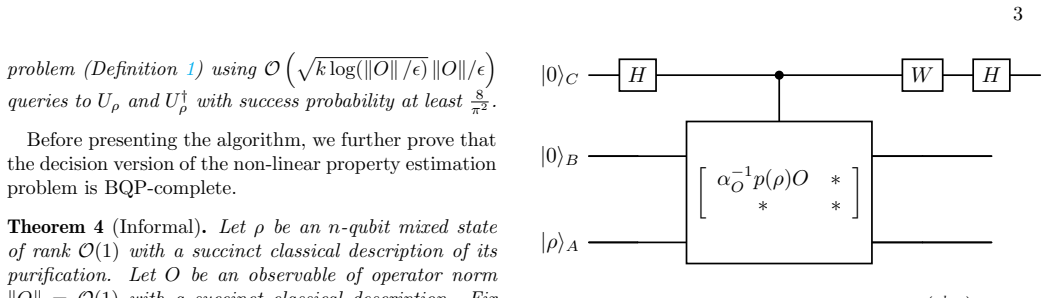
The load-bearing object is a low-degree Chebyshev approximation of the power function x^{k-1}. A classical derivative bound for polynomials shows that a polynomial of degree ℓ bounded on [−1,1] can have slope as large as ℓ² at the boundary but only ℓ/√(1−x²) in the interior; because x^k is steepest at x=1, this asymmetry lets a degree-Θ(√k) polynomial track it to accuracy ϵ. Quantum singular value transformation (QSVT) converts that polynomial into a block encoding of p(ρ)O, with query cost equal to the degree; a Hadamard-test circuit reads out Tr(ρp(ρ)O) and amplitude estimation makes the readout efficient. The identity Tr(ρ^k O) = Tr(ρ · ρ^{k−1}O) is the bridge that allows the polynomial p
What would settle it
Take the two-state family used in the sample lower bound: ρ0=|0⟩⟨0|, ρ1=(1−c/k)|0⟩⟨0|+(c/k)|1⟩⟨1|, O=|0⟩⟨0|, each with an explicit purification unitary. Simulate the paper's Chebyshev-QSVT estimator for increasing k at fixed ϵ and count queries to Uρ. The theorem predicts a Θ(√k) query count; observing a count that grows like k would refute the algorithm's claimed complexity, while a count growing slower than √k would refute the lower bound.
Extended reading notes
Core claim
At the paper's core is a claim about query complexity depending on access model. With sample access to ρ, the cost of estimating Tr(ρ^k O) to additive error ϵ is Θ(k||O||^2/ϵ^2), matching the generalized swap test. With purified query access—a unitary Uρ that prepares a purification of ρ—the cost is Θ(√(k log(||O||/ϵ))||O||/ϵ). The algorithm works by block-encoding p(ρ)O, where p is a polynomial of degree Θ(√(k log(1/ϵ))) that uniformly approximates x^{k-1} on [0,1]; a Hadamard-test circuit plus amplitude estimation then outputs Tr(ρ p(ρ)O), which is ϵ-close to Tr(ρ^k O). The lower bound combines a new degree lower bound for polynomial approximation of x^k with a recent characterization of q
Load-bearing premise
The lower-bound proof assumes that an optimal purified-access estimator must first construct an approximate block encoding of ρ^{k-1} and then estimate an expectation value against it, so the two query costs multiply; the sparse-matrix lower bound is also transferred to all density matrices by containment rather than by construction of an explicit hard full-rank instance.
Editorial extensions
If this is right
- Entropy and norm estimation: Rényi, Tsallis, and Schatten-norm quantities that reduce to Tr(ρ^k) can be computed with O(√k) purified queries instead of O(k) copies.
- Error mitigation: virtual distillation and quantum virtual cooling rely on ratios such as Tr(ρ^k O)/Tr(ρ^k); the paper's algorithm estimates both numerator and denominator with the quadratic speedup and supplies error-propagation bounds for the ratio.
- Classical shadows: replacing amplitude estimation with randomized measurements in the Hadamard-test construction reduces the k-dependence of nonlinear shadow estimation from linear to √k when a purification of ρ is available.
- Quantum metrology: the Krylov-subspace formula for quantum Fisher information contains terms of the form Tr(Oρ^l Oρ^{k-l+1}), which the block-encoding adaptation estimates with the same quadratic improvement.
- Complexity classification: the decision problem for whether Tr(ρ^k O) exceeds a threshold is BQP-complete, so the task captures universal quantum speedups.
Reading between the lines
- The degree-√k phenomenon follows from the fact that polynomials are steepest at the interval boundary; the paper mentions similar boundary-sensitive polynomial methods driving quadratic gains in quantum fast-forwarding and ground-state preparation, so the power-function result is plausibly one instance of a general 'approximate the boundary, then block-encode' principle.
- The Chebyshev truncation error is literally a binomial tail, which suggests exact tail bounds could improve constant factors in the algorithm's degree and might extend the construction to fractional powers or to functions with logarithmic singularities; the paper does not explore these variants.
- Because the algorithm's final step needs a block encoding of O, the practical speedup is clearest when O is a linear combination of few unitaries; for observables defined only through sampling, the encoding overhead would have to be accounted for separately.
Editorial analysis
A structured set of objections, weighed in public.
Referee Report
Summary. The paper studies the estimation of the nonlinear functional Tr(ρ^k O) under two access models. For sample access to ρ, it claims a lower bound of Ω(k||O||²/ε²) copies, matching the generalized swap test. For purified query access via a unitary Uρ that prepares a purification of ρ, it claims matching lower and upper bounds Θ(√(k log(||O||/ε)) ||O||/ε), demonstrating a quadratic speedup over sample access. The upper bound is obtained by block-encoding an optimal Chebyshev approximation to ρ^{k−1}, applying a Hadamard-test-type circuit, and using amplitude estimation. The paper also proves that the decision version of the problem is BQP-complete. The main claims are Theorem 1 (sample lower bound), Theorem 2 (purified-query lower bound), Theorem 3 (matching algorithm), and Theorem 4 (BQP-completeness).
Significance. If the claimed bounds are correct, the separation between sample and purified access to a quantum state is a significant conceptual and technical result, with consequences for entropy estimation, quantum Fisher information, virtual distillation, virtual cooling, and classical shadows. The proposed algorithm is explicit and builds on standard QSVT and Chebyshev approximation tools; the BQP-completeness reduction is clean and self-contained. However, the central optimality claims rest on lower-bound proofs that have serious gaps. The upper bound and BQP-completeness parts are valuable, but the advertised quadratic optimality is not established by the present arguments.
major comments (3)
- [Supplementary, Theorem 8 (main Theorem 2)] The proof multiplies two lower bounds, but query lower bounds cannot be composed this way. Corollary 2 lower-bounds the task of constructing a block encoding of ρ^{k−1}; an algorithm for the scalar estimation problem Tr(ρ^kO) is not required to construct such an encoding first. Even if a two-phase structure were imposed, the queries spent in the first phase are also queries to Uρ and would contribute to the second phase, so at most an additive combination Ω(a)+Ω(b) would follow, not the product. The hard instance of Lemma 11 (A=δ|ν⟩⟨ν| with input |ν⟩) is also not shown to be realizable as ρ^{k−1} for a valid density matrix with its purification; for 0<δ<1 the spectrum {δ,0} cannot be the (k−1)-th power of a trace-one density matrix. Thus Theorem 2 is not established.
- [End Matter, Proof of Theorem 1] The proof gives two separate lower bounds: Ω(k) for fixed ε with O=|0⟩⟨0|, and Ω(||O||²/ε²) via Le Cam. The second part is applied to Tr(ρ_i^kO), but the calculation in Eqs. (10)–(12) concerns Tr(ρ_iO). For the states in Eq. (10), the gap in Tr(ρ_i^kO) is ||O||[(1/2+δ)^k−(1/2−δ)^k], which is of order k2^{-k}δ||O|| for large k; for k larger than about log(||O||/ε) this gap is below the estimation error ε, so the reduction to two-point discrimination fails. Moreover, the theorem asserts a single (ρ,O) requiring the product Ω(k||O||²/ε²), but the two hard instances are different and no product construction is given.
- [Supplementary, Lemma 10 and Corollary 2] The stated Lemma 10 asserts existence of a unitary using Θ(gdeg_ε(f)) queries; the proof of Theorem 8 uses it as a lower bound on any algorithm. The lower-bound half should be stated explicitly, together with its hypotheses (O(1)-sparse A and ||A||≤1−δ). Corollary 2 drops the δ condition and Remark 3 transfers the bound to all density matrices by inclusion; while inclusion is valid for a worst-case lower bound, the transfer does not supply the missing reduction from estimating a scalar expectation to implementing a block encoding, nor does it identify a density-matrix instance that simultaneously realizes the hard cases of both stages.
minor comments (5)
- [Main text, 'Main results'] The sentence 'the query complexity for approximating matrix function ρk is also lower bounded by Ω(k)' should read Ω(√k); otherwise it contradicts Lemma 1/Corollary 1.
- [Main text, proof of Theorem 3] 'Based on Theorem 1' appears to be a typo; the cited degree bound follows from Lemma 1 (or Lemma 7), not from the sample-access lower bound.
- [Supplementary, Algorithm Formulation, Eq. (81)] The probability P(|0⟩_c) is computed without the normalization αO that appears in the main-text circuit and estimator Eq. (2). With the block encoding of p(ρ)O normalized by αO, the probability is (1+Re Tr(ρp(ρ)O)/αO)/2, and the estimator is αO(2P−1). Please reconcile the two derivations.
- [Main text, Definition 1 and Theorem 3] The problem definition does not state how O is accessed. The algorithm assumes an error-free block encoding of O with normalization αO (Corollary 3). Without specifying this access model, Theorem 3 is not well-defined for a general observable O; please add the assumption explicitly (e.g., O is given by an LCU or block encoding).
- [Supplementary, Lemma 10] State the lower-bound half of the 'optimal query complexity' result explicitly. The current wording 'there exists a unitary...' is an upper bound and is insufficient for the later lower-bound argument.
Circularity Check
No significant circularity: the core derivations rely on external QSVT, Montanaro–Shao, and classical approximation theory; self-citations are not load-bearing.
full rationale
The paper's central claims are not circular. The upper bound (Theorem 3) is built from an external QSVT block-encoding result [16] and a self-contained Chebyshev approximation construction (Lemma 7/12), with polynomial-approximation error and amplitude-estimation error combined by a triangle inequality. The sample-access lower bound uses standard Helstrom/Le Cam reductions. The purified-access lower bound invokes the external Montanaro–Shao matrix-function query bound [19] and classical approximation theory (Rivlin), not a result of the present authors. The paper's self-citations (e.g., [9,11,46]) appear in application/comparison contexts and are not load-bearing for the main theorems. The main non-circularity concern is that the proof of Theorem 2 (Supplementary Theorem 8) assumes an optimal estimator must first construct a block encoding of rho^{k-1} and then query it, multiplying independent lower bounds; this is a proof gap about algorithm structure, not a definitional or self-citational reduction, and is therefore a correctness risk rather than a circularity.
Assumptions & free parameters
assumptions (7)
- domain assumption Purified quantum query access: existence of a unitary Uρ that prepares a purification of ρ
- standard math QSVT polynomial transformation (Lemma 5) from Gilyén et al. [16]
- standard math Block encoding of ρ from purification (Lemma 4) from [16]
- standard math Montanaro and Shao query complexity lower bound (Lemma 10) from [19]
- standard math Bernstein's inequality and the Chebyshev vs best approximation error relation (Lemma 9)
- domain assumption Existence of O(1)-sparse hard density matrices for the lower bound
- domain assumption O is block-encodable with an error-free (α_O, b, 0) block encoding
Cite this review
Pith. "Pith review of Measuring Less to Learn More: Quadratic Speedup in learning Nonlinear Properties of Quantum Density Matrices." pith.science (2026). https://pith.science/paper/53ZKYJGS
@misc{pith2026250901571,
  author       = {Pith},
  title        = {Pith review of: Measuring Less to Learn More: Quadratic Speedup in learning Nonlinear Properties of Quantum Density Matrices},
  year         = {2026},
  howpublished = {\url{https://pith.science/paper/53ZKYJGS}},
  note         = {Machine review of arXiv:2509.01571}
}
abstract
A fundamental task in quantum information science is to measure nonlinear functionals of quantum states, such as $\mathrm{Tr}(\rho^k O)$. Intuitively, one expects that computing a $k$-th order quantity generally requires $O(k)$ copies of the state $\rho$, and we rigorously establish this lower bound under sample access to $\rho$. Surprisingly, this limitation can be overcome when one has purified access via a unitary that prepares a purification of $\rho$, a scenario naturally arising in quantum simulation and computation. In this setting, we find a different lower bound of $\Theta(\sqrt{k})$, and present a quantum algorithm that achieves this bound, demonstrating a quadratic advantage over sample-based methods. The key technical innovation lies in a designed quantum algorithm and optimal polynomial approximation theory -- specifically, Chebyshev polynomial approximations tailored to the boundary behavior of power functions. Our results unveil a fundamental distinction between sample and purified access to quantum states, with broad implications for estimating quantum entropies and quantum Fisher information, realizing quantum virtual distillation and cooling, and evaluating other multiple nonlinear quantum observables with classical shadows.
Figures
Forward citations
Cited by 1 Pith paper
-
Information-Theoretic Lower Bounds for Approximating Monomials via Optimal Quantum Tsallis Entropy Estimation
A quantum estimator achieves near-optimal query complexity for integer-order Tsallis entropy, and the same technique yields a new information-theoretic proof that approximating x^n needs polynomials of degree Ω(√n).
Reference graph
Works this paper leans on
-
[1]
Construct the controlled block encoding of ˆp(ρ) := p(ρ)O with normalization factor αO using the quan- tum singular value transformation (QSVT) algo- rithm [16], where p(x) is an optimal approximation of g(x) = xk−1
-
[2]
1 with W = I for estimating the real parts of the nonlinear property function
Implement the quantum circuit as illustrated in Fig. 1 with W = I for estimating the real parts of the nonlinear property function
-
[3]
Apply amplitude estimation [30] to estimate the probability P (0) of the first ancilla qubit in state |0⟩ to error ϵ 2
-
[4]
The final estimation is given by eE := αO(2P (0) − 1)). (2) In step 1, ˆp(ρ) is realized by first constructing a block encoding of p(ρ) with error ϵ/(2 ∥O∥) using degree m =p 2(k − 1) ln(4αO ∥O∥ /ϵ) (see proof below). Then, we can block encode the product of p(ρ) and O, which is a feature enabled by the QSVT framework. Here, we assume an error-free block ...
-
[5]
Moreover, by employing the replica trick, one may approximate the min-entropy S∞(ρ) = − ln ∥ρ∥∞ or the von Neumann entropy S(ρ) = Tr (ρ log ρ) by taking the limit of k → ∞and k → 1, respectively, of which have been widely used in quantum field theory [33, 34] and gravity [35]. Our method also applies to more sophisticated quan- tum information quantities,...
-
[6]
Masanori Ohya and D´ enes Petz. Quantum entropy and its use . Springer Science & Business Media, 2004
work page 2004
-
[7]
Exponential error suppression for near- term quantum devices
B´ alint Koczor. Exponential error suppression for near- term quantum devices. Physical Review X, 11(3):031057, 2021
work page 2021
-
[8]
Vir- tual distillation for quantum error mitigation
William J Huggins, Sam McArdle, Thomas E O’Brien, Joonho Lee, Nicholas C Rubin, Sergio Boixo, K Birgitta Whaley, Ryan Babbush, and Jarrod R McClean. Vir- tual distillation for quantum error mitigation. Physical Review X, 11(4):041036, 2021
work page 2021
Show all 68 references
-
[9]
Quantum virtual cooling
Jordan Cotler, Soonwon Choi, Alexander Lukin, Hrant Gharibyan, Tarun Grover, M Eric Tai, Matthew Rispoli, Robert Schittko, Philipp M Preiss, Adam M Kaufman, et al. Quantum virtual cooling. Physical Review X , 9(3):031013, 2019
2019
-
[10]
Direct estimations of linear and nonlinear func- tionals of a quantum state
Artur K Ekert, Carolina Moura Alves, Daniel KL Oi, Micha l Horodecki, Pawe l Horodecki, and Leong Chuan Kwek. Direct estimations of linear and nonlinear func- tionals of a quantum state. Physical review letters , 88(21):217901, 2002
2002
-
[11]
Measuring polynomial functions of states
Todd A Brun. Measuring polynomial functions of states. arXiv preprint quant-ph/0401067 , 2004
2004 arXiv
-
[12]
Shadow tomography of quantum states
Scott Aaronson. Shadow tomography of quantum states. In Proceedings of the 50th annual ACM SIGACT sympo- sium on theory of computing , pages 325–338, 2018
2018
-
[13]
Predicting many properties of a quantum system from very few measurements
Hsin-Yuan Huang, Richard Kueng, and John Preskill. Predicting many properties of a quantum system from very few measurements. Nature Physics , 16(10):1050– 1057, 2020
2020
-
[14]
A hybrid framework for estimating nonlinear functions of quantum states
You Zhou and Zhenhuan Liu. A hybrid framework for estimating nonlinear functions of quantum states. npj Quantum Information , 10(1):62, 2024
2024
-
[15]
Prin- cipal eigenstate classical shadows
Daniel Grier, Hakop Pashayan, and Luke Schaeffer. Prin- cipal eigenstate classical shadows. In The Thirty Seventh Annual Conference on Learning Theory , pages 2122–
-
[16]
Auxiliary-free replica shadow estimation
Qing Liu, Zihao Li, Xiao Yuan, Huangjun Zhu, and You Zhou. Auxiliary-free replica shadow estimation. arXiv preprint arXiv:2407.20865, 2024
2024
-
[17]
A hierarchy for replica quantum advantage
Sitan Chen, Jordan Cotler, Hsin-Yuan Huang, and Jerry Li. A hierarchy for replica quantum advantage. arXiv 6 preprint arXiv:2111.05874, 2021
2021 arXiv
-
[18]
Exponential separations between learning with and without quantum memory
Sitan Chen, Jordan Cotler, Hsin-Yuan Huang, and Jerry Li. Exponential separations between learning with and without quantum memory. In 2021 IEEE 62nd An- nual Symposium on Foundations of Computer Science (FOCS), pages 574–585. IEEE, 2022
2021
-
[19]
An optimal trade- off between entanglement and copy complexity for state tomography
Sitan Chen, Jerry Li, and Allen Liu. An optimal trade- off between entanglement and copy complexity for state tomography. In Proceedings of the 56th Annual ACM Symposium on Theory of Computing , pages 1331–1342, 2024
2024
-
[20]
Quantum detection and estimation theory
Carl W Helstrom. Quantum detection and estimation theory. Journal of Statistical Physics , 1:231–252, 1969
1969
-
[21]
Quantum singular value transformation and be- yond: exponential improvements for quantum matrix arithmetics
Andr´ as Gily´ en, Yuan Su, Guang Hao Low, and Nathan Wiebe. Quantum singular value transformation and be- yond: exponential improvements for quantum matrix arithmetics. In Proceedings of the 51st annual ACM SIGACT symposium on theory of computing , pages 193– 204, 2019
2019
-
[22]
Faster algorithms via approximation theory
Sushant Sachdeva, Nisheeth K Vishnoi, et al. Faster algorithms via approximation theory. Foundations and Trends® in Theoretical Computer Science, 9(2):125–210, 2014
2014
-
[23]
Approximation theory and approxi- mation practice, extended edition
Lloyd N Trefethen. Approximation theory and approxi- mation practice, extended edition . SIAM, 2019
2019
-
[24]
Quantum and classical query complexities of functions of matrices
Ashley Montanaro and Changpeng Shao. Quantum and classical query complexities of functions of matrices. In Proceedings of the 56th Annual ACM Symposium on The- ory of Computing , pages 573–584, 2024
2024
-
[25]
Convergence of estimates under dimen- sionality restrictions
Lucien LeCam. Convergence of estimates under dimen- sionality restrictions. The Annals of Statistics , pages 38– 53, 1973
1973
-
[26]
Tsybakov
Alexandre B. Tsybakov. Introduction to Nonparametric Estimation. Springer Series in Statistics. Springer, New York, NY, 2009
2009
-
[27]
Many-body topological invariants from random- ized measurements in synthetic quantum matter
Andreas Elben, Jinlong Yu, Guanyu Zhu, Mohammad Hafezi, Frank Pollmann, Peter Zoller, and Benoit Ver- mersch. Many-body topological invariants from random- ized measurements in synthetic quantum matter. Science Advances, 6(15):eaaz3666, 2020
2020
-
[28]
Lanyon, Peter Zoller, Rainer Blatt, and Christian F
Tiff Brydges, Andreas Elben, Petar Jurcevic, Benoit Ver- mersch, Christine Maier, Ben P. Lanyon, Peter Zoller, Rainer Blatt, and Christian F. Roos. Probing renyi en- tanglement entropy via randomized measurements. Sci- ence, 364(6437):260–263, 2019
2019
-
[29]
Mixed- state entanglement from local randomized measurements
Andreas Elben, Richard Kueng, Hsin-Yuan (Robert) Huang, Rick van Bijnen, Christian Kokail, Marcello Dalmonte, Pasquale Calabrese, Barbara Kraus, John Preskill, Peter Zoller, and Beno ˆ ıt Vermersch. Mixed- state entanglement from local randomized measurements. Phys. Rev. Lett....
2020
-
[30]
Inequalities of a
AC Schaeffer. Inequalities of a. markoff and s. bernstein for polynomials and related functions. 1941
1941
-
[31]
Quantum fast- forwarding: Markov chains and graph property testing
Simon Apers and Alain Sarlette. Quantum fast- forwarding: Markov chains and graph property testing. arXiv preprint arXiv:1804.02321 , 2018
2018 arXiv
-
[32]
Nearly- frustration-free ground state preparation
Matthew Thibodeau and Bryan K Clark. Nearly- frustration-free ground state preparation. Quantum, 7:1084, 2023
2023
-
[33]
On solving classes of positive-definite quantum linear systems with quadrati- cally improved runtime in the condition number
Davide Orsucci and Vedran Dunjko. On solving classes of positive-definite quantum linear systems with quadrati- cally improved runtime in the condition number. Quan- tum, 5:573, 2021
2021
-
[34]
A theory of quantum differential equation solvers: limitations and fast-forwarding
Dong An, Jin-Peng Liu, Daochen Wang, and Qi Zhao. A theory of quantum differential equation solvers: limitations and fast-forwarding. arXiv preprint arXiv:2211.05246, 2022
2022 arXiv
-
[35]
Quantum amplitude amplification and estimation
Gilles Brassard, Peter Hoyer, Michele Mosca, and Alain Tapp. Quantum amplitude amplification and estimation. arXiv preprint quant-ph/0005055 , 2000
2000 arXiv
-
[36]
New quantum algorithms for comput- ing quantum entropies and distances
Qisheng Wang, Ji Guan, Junyi Liu, Zhicheng Zhang, and Mingsheng Ying. New quantum algorithms for comput- ing quantum entropies and distances. IEEE Transactions on Information Theory , 2024
2024
-
[37]
Estimat- ing operator norms using covering nets
Fernando GSL Brandao and Aram W Harrow. Estimat- ing operator norms using covering nets. arXiv preprint arXiv:1509.05065, 2015
2015 arXiv
-
[38]
Entanglement en- tropy and quantum field theory.Journal of statistical me- chanics: theory and experiment , 2004(06):P06002, 2004
Pasquale Calabrese and John Cardy. Entanglement en- tropy and quantum field theory.Journal of statistical me- chanics: theory and experiment , 2004(06):P06002, 2004
2004
-
[39]
Evolution of en- tanglement entropy in one-dimensional systems
Pasquale Calabrese and John Cardy. Evolution of en- tanglement entropy in one-dimensional systems. Jour- nal of Statistical Mechanics: Theory and Experiment , 2005(04):P04010, 2005
2005
-
[40]
Quantum corrections to holographic entanglement entropy
Thomas Faulkner, Aitor Lewkowycz, and Juan Malda- cena. Quantum corrections to holographic entanglement entropy. Journal of High Energy Physics , 2013(11):1–18, 2013
2013
-
[41]
Statistical distance and the geometry of quantum states
Samuel L Braunstein and Carlton M Caves. Statistical distance and the geometry of quantum states. Physical Review Letters, 72(22):3439, 1994
1994
-
[42]
Quantum metrol- ogy from a quantum information science perspective
G´ eza T´ oth and Iagoba Apellaniz. Quantum metrol- ogy from a quantum information science perspective. Journal of Physics A: Mathematical and Theoretical , 47(42):424006, 2014
2014
-
[43]
Quantum speed limit for physical processes
M´ arcio M Taddei, Bruno M Escher, Luiz Davidovich, and Ruynet L de Matos Filho. Quantum speed limit for physical processes. Physical review letters, 110(5):050402, 2013
2013
-
[44]
Fisher information and multiparticle entanglement
Philipp Hyllus, Wies law Laskowski, Roland Krischek, Christian Schwemmer, Witlef Wieczorek, Harald We- infurter, Luca Pezz´ e, and Augusto Smerzi. Fisher information and multiparticle entanglement. Physi- cal Review A—Atomic, Molecular, and Optical Physics , 85(2):022321, 2012
2012
-
[45]
Krylov shadow tomogra- phy: Efficient estimation of quantum fisher information
Da-Jian Zhang and DM Tong. Krylov shadow tomogra- phy: Efficient estimation of quantum fisher information. Physical Review Letters, 134(11):110802, 2025
2025
-
[46]
Quantum fisher information from randomized measurements
Aniket Rath, Cyril Branciard, Anna Minguzzi, and Beno ˆ ıt Vermersch. Quantum fisher information from randomized measurements. Physical Review Letters , 127(26):260501, 2021
2021
-
[47]
Purification-based quantum error mitigation of pair-correlated electron simulations
Thomas E O’Brien, G Anselmetti, Fotios Gkritsis, VE Elfving, Stefano Polla, William J Huggins, Oumarou Oumarou, Kostyantyn Kechedzhi, Dmitry Abanin, Ra- jeev Acharya, et al. Purification-based quantum error mitigation of pair-correlated electron simulations. Na- ture Physics, ...
2023
-
[48]
Shadow distillation: Quantum error mitiga- tion with classical shadows for near-term quantum pro- cessors
Alireza Seif, Ze-Pei Cian, Sisi Zhou, Senrui Chen, and Liang Jiang. Shadow distillation: Quantum error mitiga- tion with classical shadows for near-term quantum pro- cessors. PRX Quantum , 4(1):010303, 2023
2023
-
[49]
Lo- calized virtual purification
Hideaki Hakoshima, Suguru Endo, Kaoru Yamamoto, Yuichiro Matsuzaki, and Nobuyuki Yoshioka. Lo- calized virtual purification. Physical Review Letters , 133(8):080601, 2024
2024
-
[50]
Expo- nential distillation of dominant eigenproperties
Bence Bak´ o, Tenzan Araki, and B´ alint Koczor. Expo- nential distillation of dominant eigenproperties. arXiv 7 preprint arXiv:2506.04380, 2025
2025
-
[51]
Nearly query-optimal classical shadow estimation of uni- tary channels
Zihao Li, Changhao Yi, You Zhou, and Huangjun Zhu. Nearly query-optimal classical shadow estimation of uni- tary channels. arXiv preprint arXiv:2410.14538 , 2024
2024
-
[52]
Optimal trace distance and fidelity esti- mations for pure quantum states
Qisheng Wang. Optimal trace distance and fidelity esti- mations for pure quantum states. IEEE Transactions on Information Theory, 2024
2024
-
[53]
Sample-optimal quantum estimators for pure-state trace distance and fi- delity via samplizer
Qisheng Wang and Zhicheng Zhang. Sample-optimal quantum estimators for pure-state trace distance and fi- delity via samplizer. arXiv preprint arXiv:2410.21201 , 2024
2024 arXiv
-
[54]
Quantum principal component analysis
Seth Lloyd, Masoud Mohseni, and Patrick Rebentrost. Quantum principal component analysis. Nature physics, 10(9):631–633, 2014
2014
-
[55]
Cryptographic distinguishability measures for quantum- mechanical states
Christopher A Fuchs and Jeroen Van De Graaf. Cryptographic distinguishability measures for quantum- mechanical states. IEEE Transactions on Information Theory, 45(4):1216–1227, 2002
2002
-
[56]
Classical and quantum computation
Alexei Yu Kitaev, Alexander Shen, and Mikhail N Vya- lyi. Classical and quantum computation . Number 47. American Mathematical Soc., 2002
2002
-
[57]
The theory of quantum information
John Watrous. The theory of quantum information. Cam- bridge university press, 2018
2018
-
[58]
Real analysis
Neal L Carothers. Real analysis. Cambridge University Press, 2000
2000
-
[59]
Lecture notes on quantum algorithms for sci- entific computation
Lin Lin. Lecture notes on quantum algorithms for sci- entific computation. arXiv preprint arXiv:2201.08309 , 2022
2022 arXiv
-
[60]
T.J. Rivlin. Chebyshev Polynomials: From Approxima- tion Theory to Algebra and Number Theory . Pure and Applied Mathematics: A Wiley Series of Texts, Mono- graphs and Tracts. Wiley, 1990
1990
-
[61]
Strengths and weaknesses of quantum computing
Charles H Bennett, Ethan Bernstein, Gilles Brassard, and Umesh Vazirani. Strengths and weaknesses of quantum computing. SIAM journal on Computing , 26(5):1510–1523, 1997
1997
-
[62]
Quantum lower bounds by quantum arguments
Andris Ambainis. Quantum lower bounds by quantum arguments. In Proceedings of the thirty-second annual ACM symposium on Theory of computing , pages 636– 643, 2000
2000
-
[63]
Grand unification of quantum algo- rithms
John M Martyn, Zane M Rossi, Andrew K Tan, and Isaac L Chuang. Grand unification of quantum algo- rithms. PRX quantum , 2(4):040203, 2021. END MATTER Proof of Theorem 1 Theorem 5 (Restated). For algorithms that estimates Tr(ρkO) to additive error ϵ with constant success prob- ...
2021
-
[64]
A polynomial-size (in n) quantum circuit CΓ that prepares a purification |Γ⟩ASR of an m-qubit state ρ via ρ = TrA |Γ⟩ ⟨Γ|ASR , where A is an ancilla register and SR denotes the system on which ρ acts
-
[65]
A succinct classical description of an observable O of operator norm ∥O∥ = O(1); and
-
[66]
The promise is that either Tr(ρkO) ≥ a (YES) or Tr(ρkO) ≤ b (NO)
Thresholds a, b with the promise gap a − b ≥ 1/ poly(n), where n denotes the input length. The promise is that either Tr(ρkO) ≥ a (YES) or Tr(ρkO) ≤ b (NO). Then, NonLineark is BQP-complete. Proof. The containment in BQP [51, 52] is seen by the problem is efficiently solved by...
-
[67]
For any x ∈ (−1, 1): |P ′(x)| ≤ ℓ√ 1−x2 ,
-
[68]
Moreover, the bound at the endpoints is achieved by the Chebyshev polynomial Tℓ(x)
For the endpoints: |P ′(±1)| ≤ℓ2. Moreover, the bound at the endpoints is achieved by the Chebyshev polynomial Tℓ(x). To understand why this inequality is remarkable, consider what it tells us about polynomial derivatives. At first glance, one might expect that if a polynomial...
Reviewed August 5, 2026 · model on record in the stance chip above.
Discussion (0). Sign in to comment.