REVIEW 5 major objections 5 minor 77 references
A gauge theory of complex adaptive systems
T0 review · 5 major / 5 minor · reviewed 2026-08-05 · deepseek-v4-flash
Pith's one-line read The paper builds a gauge theory on simplicial complexes in which non-triviality of principal bundles, classified by cohomology of homotopy groups, models geometric and topological frustration in complex adaptive systems.
desk verdict A broad, ambitious formalism connecting frustration in complex systems to bundle non-triviality, but the central classification theorem has a cohomological degree problem that undercuts its main claim. read the letter →
The pith
A machine-rendered reading of the paper's core claim, the machinery that carries it, and where it could break.
The reading
What carries the argument
The central mechanism is the semidiscrete principal bundle with topological corrections. Local triviality is controlled by 'faced' simplices (top-dimensional simplices of the base); on a common face of several faced simplices, transition maps are pairs (ζ_ij, β_n(S_n)), where ζ_ij is a group element and β_n injects an obstruction S_n∈π_n(G) into G. The obstruction carriers are m-parachutes: contracting two lifted m-simplices turns their boundary into a bouquet of spheres in G; spheres that cannot be contracted define the relative-homotopy obstructions that enter the obstruction forms χ_n. The work of this mechanism is to convert the question 'can local agent interactions be globally synchron
What would settle it
Work with a triangulated annulus (or torus) and structure group S^1. Assign a topological obstruction to a 1-face that lies on a non-contractible loop, so Theorem 42 predicts a non-trivial class in H^1(M;π1(S^1)). Then compute the discrete curvature R(XYZ)=φ(ZX)φ(YZ)φ(XY) and the obstruction forms χ_1, χ_2 explicitly for all 2-simplices. The central claim implies (i) each χ_n is closed but not exact, and (ii) filling in a 2-simplex that kills the 1-cycle in H_1(M) forces the obstruction class to trivialise. A hand-checkable simplicial calculation on a small triangulation would settle both impl
Extended reading notes
Core claim
The central object is a semidiscrete principal G-bundle over a discrete differentiable manifold M, i.e. a simplicial complex. Local triviality is defined only over top-dimensional 'faced' simplices; when a lower-dimensional face belongs to several faced simplices, a section produces several lifted simplices, and identifying them forces the construction of m-parachutes—bouquets of spheres in G obtained by contracting the lifts. Non-contractible spheres give topological obstructions in relative homotopy groups π_m(G,B); the paper restricts them to the image of j_* so they behave like ordinary elements of π_m(G). These obstructions are assembled into π_n(G)-valued obstruction forms χ_n, which t
Load-bearing premise
The construction requires that every top-dimensional simplex of the base can be homotopically retracted onto a single fibre, and that the topological obstructions can be chosen from the image of the natural map from ordinary to relative homotopy groups; without both, the transition maps do not compose and the bundles, obstruction forms, and characteristic classes are not well defined.
Editorial extensions
If this is right
- Local multi-agent interactions automatically determine a principal bundle over the simplicial complex; whether the bundle is trivial is equivalent to whether a global synchronisation of agent states exists.
- If the classification theorem holds, characteristic classes can be computed from data: each common face contributes an element of π_n(G), and the classes live in H^1(π1(G))×...×H^{n-1}(π_{n-1}(G)).
- Connections give a path-dependent notion of 'seeing' another agent's state, so link probabilities in a network model are Wilson-line-like integrals of parallel-transported states over families of paths.
- Flat connections are classified by conjugacy classes of homomorphisms from the fundamental group of the base to G, generalising the classical holonomy classification to the discrete setting.
- The theory interrelates local and global frustration: curvature generates a first Chern class when there is no 2-dimensional topological obstruction, and intrinsic exasperation of order n is an element of H^n(π_n(G)).
Reading between the lines
- The paper leaves implicit a measurable consequence: if the classification theorem is right, one could define a complexity index for a system as the total dimension of H^1(π1(G))×...×H^{n-1}(π_{n-1}(G)); a natural test is to compute how this index behaves under coarse-graining or changing the Vietoris–Rips radius of the agent complex.
- Because flat connections are conjugacy classes of π_1(M)-representations, different metastable states of a complex adaptive system could be represented by inequivalent flat connections; transitions between them would require moving between non-equivalent semidiscrete bundles, a mechanism the paper suggests but does not formulate as a dynamics.
- The constructive 'cascade of geodesics' for assigning structural data hints at a data-driven estimation scheme: sample sections of the bundle, look for persistent homology in the structure group, and use the Hurewicz map to read off π_n(G) obstructions; this is sketched but not implemented.
- For connected Lie structure groups, π_2(G)=0, so the order-2 summand in the classification is automatically trivial; the interesting higher-order frustration would require structure spaces such as classifying spaces of finite groups or groupoids, where π_2 can be non-zero.
Editorial analysis
A structured set of objections, weighed in public.
Referee Report
Summary. The manuscript proposes a gauge-theoretic framework for complex adaptive systems. The base space is a simplicial complex ('discrete differentiable manifold'), and the authors construct 'semidiscrete principal bundles' whose local trivialisations are indexed by faced simplices and whose transition maps carry, in addition to a Lie group action ϵ(G), topological obstructions valued in homotopy groups πₙ(G). These obstructions are packaged into 'obstruction forms' and cohomology classes, which the authors call characteristic classes. The main mathematical claims are: Theorem 42, that obstructions to triviality are classified by H¹(π₁(G)) × ... × H^{n-1}(π_{n-1}(G)); Theorem 46, that the classifying space is the set of 'parachutes' determined by intersections of faced simplices; and various structural results on connections, curvature, holonomy, Bianchi identities, and torsion. Physically, the paper identifies geometric frustration with non-trivial parallel transport ('dynamic exasperation') and topological frustration with non-trivial bundle topology ('intrinsic exasperation'), and proposes toy actions and network models. The paper is explicitly an ansatz-driven programmatic construction, and the authors state in §9 that the link between complexity and bundle non-triviality is 'our main ansatz'.
Significance. If the construction were rigorous and the classification theorems correct, the paper would offer a novel discrete analogue of principal-bundle theory that could formalize geometric and topological frustration in multi-agent systems and connect gauge-theoretic ideas to complex adaptive systems and geometric deep learning. The paper contains creative and potentially useful ingredients: simplicial k-paths with non-abelian ambiguity, the notion of faced-simplex locality, a discrete Ambrose-Singer theorem (Theorem 73), a discrete second Bianchi identity (Theorem 79), and a concrete Chern-class analogue (Remark 80). The appendices on relative homotopy and statistically motivated structure groups are informative. However, the central mathematical objects are not defined with sufficient precision, and the principal classification claim is misindexed and contradicted by the paper's own later Chern-class discussion. As it stands, the paper does not establish the existence of a well-defined gauge theory over discrete spaces, and the advertised classification of non-trivial bundles is not supported.
major comments (5)
- [§4, Definition 41 and Theorem 42] The central classification is misindexed. Definition 41 defines χₙ as a πₙ(G)-valued n-form, so its cohomology class should lie in Hⁿ(M; πₙ(G)). Yet Theorem 42 states that obstructions are determined by H¹(π₁(G)) × ... × H^{n-1}(π_{n-1}(G)), omitting the top-degree term. For a triangulated 2-sphere with G = U(1), the theorem predicts only H¹(S²; Z) = 0 and hence that every such bundle is trivial, ignoring H²(S²; Z), which classifies U(1)-bundles and contains the Hopf bundle. Remark 80 later defines a first Chern class in degree 2 from curvature, directly contradicting Theorem 42. Remark 43 concedes that the obstruction cocycle defined here differs from the standard π_{n-1}-valued n-cocycle; that difference is not a harmless convention but the source of the incorrect classification. The proof's statement that 'the differential resolves the obstruction' is informal and does not supply the
- [§4, Definitions 32–38] A semidiscrete principal bundle is not actually defined as a bundle. The total space is 'a family of simplicial complexes', the projection is specified only on vertices, and the transition maps are elements of (ϵ(G), πₖ(G)) whose second (topological) term, as the text admits, 'in general does not satisfy the cocycle rule'. A principal bundle requires associative transition functions satisfying the cocycle condition; without that, the quotient by the structure group and the associated bundle constructions in §6 are not well-defined. The restriction to Im(j_*) in the relative homotopy long exact sequence is introduced to make the obstructions behave like elements of πₙ(G), but no proof is given that this restriction yields a consistent gluing of local trivialisations. Theorems 42 and 46 therefore lack a well-defined object to classify.
- [§4, paragraph after Definition 34] The local triviality mechanism is assumed rather than established. The construction requires that, for every faced simplex σ, the inclusion of the fibre over a vertex into π⁻¹(σ) be a homotopy equivalence, and that a certain homotopy extension problem 'always has a solution'. This is a substantive existence assumption on the pair (M, G); no conditions on M or G are given. The m-parachute construction, the assignment of elements of πₘ(G), and the definition of obstruction forms all depend on this assumption. If the homotopy extension problem fails, the obstruction forms χₙ and the associated characteristic classes are not defined. The manuscript needs either a proof under explicit hypotheses or a clear statement of this as an ansatz with its domain of validity.
- [§4, Theorem 46 and Definition 44] The 'classifying space' claim is not a mathematical classification. Theorem 46 states that the classifying space is 'the set of parachutes defined by the intersections of faced simplices', with a one-line proof 'This follows from the construction'. No equivalence relation on parachutes is specified, no bijection with isomorphism classes of bundles is proved, and no independence from arbitrary choices (section, trivialisation, geodesic cascade in §5) is demonstrated. Similarly, Definition 44 calls the cohomology classes generated by obstruction forms 'characteristic classes', but the paper does not show that these classes are independent of the chosen connection or of the assignments in the structural data. Without these verifications, the classification and characteristic-class claims remain programmatic.
- [§9, Definitions 93–94] The explanatory content of the complexity claim is partly definitional. 'Dynamic exasperation' is defined as non-trivial parallel transport and 'intrinsic exasperation' as non-triviality of the underlying bundle; the abstract states that 'complexity is modelled as the result of local and topological obstructions'. The paper does acknowledge in §9 that this is 'our main ansatz', which is legitimate for a model. However, as written the abstract and conclusions present this as an outcome of the construction rather than as a modelling choice. The authors should clearly separate the mathematical theorems from the ansatz that identifies complexity with the obstructions, and should not present the identification as a derived consequence.
minor comments (5)
- [§2, Proposition 9] The proof says 'It is easy to see that with these two operations, it is always possible to put each simplex and its inverse in adjacent positions.' This is a nontrivial combinatorial assertion on which the later cohomology and the closure of obstruction forms rest. A detailed proof or a reference should be supplied.
- [§4, Remark 43] Remark 43 concedes that the obstruction cocycle definition differs from the standard π_{n-1}-valued n-cocycle of algebraic topology. This difference should be discussed in the introduction and abstract, since it changes the meaning of the claimed classification and is not a purely formal variation.
- [§5, data-driven assignment] The paragraph proposing persistent homology and the Hurewicz homomorphism to assign elements of πₙ(G) is too optimistic: persistent homology detects Hₙ, and Hurewicz only gives πₙ ≅ Hₙ under strong connectivity assumptions (n-1)-connectedness. Without such assumptions, passing from persistent homology to homotopy classes is not justified.
- [References] Reference [58] (Nash, 'The imbedding problem for Riemannian manifolds') is listed with year 1996; the correct year is 1956. Also, the notation βₙ is introduced in Definition 37 as a map π_k(G) → G, but in Definition 81 βₙ(χₙ) is applied to a cohomology class; the notation should be clarified.
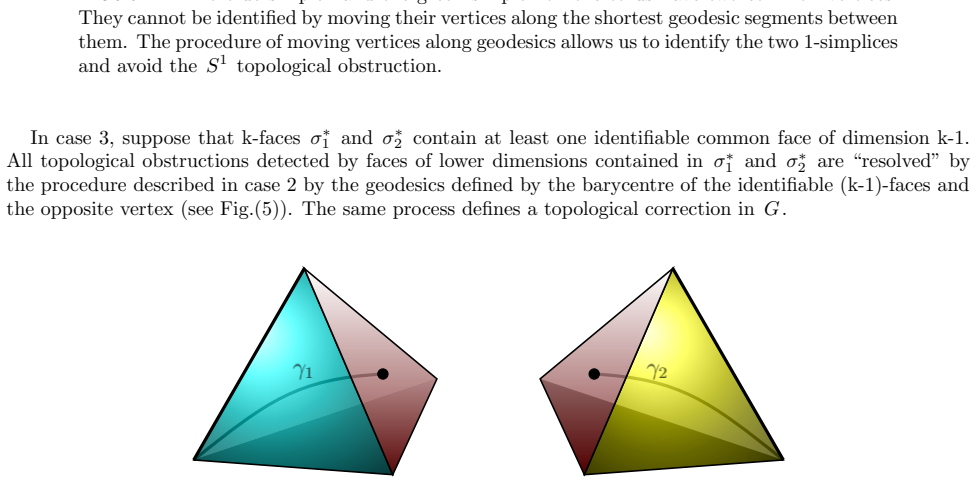
- [Figure 3 and surrounding text] The caption and the paragraph around Figure 3, which discuss homotopic products of boundaries and 'cutting and sewing of the surface', are not clear enough to support the proof of Theorem 42. The operations described do not obviously preserve homotopy type; this part of the proof needs to be rewritten rigorously or removed.
Circularity Check
The obstruction classification and characteristic classes are defined into existence: triviality, obstruction forms, and characteristic classes are mutually definitional, so Theorem 42 restates the assigned structural data; the complexity link is an explicit ansatz.
-
self definitional
[Section 4, Definitions 40–41 and Theorem 42]
"Definition 40. A semidiscrete principal bundle is trivial if it admits sections that are global simplicial isomorphisms, or equivalently, if all the topological terms in the transition maps (ϵ(G), πn(G)) are equal to the identity. ... Theorem 42. The obstructions for the triviality of a semidiscrete principal G-bundle P on M are determined by elements in H 1(π1(G)) × H 2(π2(G)) × . . .× H n−1(πn−1(G))"
Triviality is defined as the vanishing of all topological terms in the transition maps (Definition 40), and the obstruction forms are defined as exactly the sums of those topological obstructions (Definition 41). Therefore Theorem 42, which says that the obstructions for triviality are determined by cohomology classes of the obstruction forms, is a restatement of the definitions. The proof itself relies on 'by construction' statements and on the convention that dχ is set to the identity for top-dimensional faces, i.e. the closedness of the obstruction forms is imposed rather than derived from an independent obstruction theory.
-
self definitional
[Section 4, Remark 43 and Definition 44]
"Remark 43. Our definition of obstruction πn -valued n-forms differs from the standard definition of obstruction co-cycle in algebraic topology [54, 51], which is πn−1 -valued n-cocycle. Definition 44. In view of Theorem (42) we call the cohomology classes on M generated by the obstruction forms on M the characteristic classes of the semidiscrete principal bundle P oven M ."
Characteristic classes are introduced as 'the cohomology classes ... generated by the obstruction forms', i.e. as a relabeling of the obstruction data already assigned to the bundle. The abstract's claim that characteristic classes capture bundle non-triviality is therefore true by definition. Since Remark 43 explicitly departs from the standard π_{n-1}-valued n-cocycle obstruction theory, the characteristic-class content is not imported from or verified against the standard theory; it is the assigned structural data renamed.
1 more flagged steps
-
self definitional
[Section 9, Definition 94 and Abstract]
"Our main ansatz is that emergent phenomena in complex systems are related to the impossibility of performing any globally valid synchronisation (or consistent interpretation) of the internal states of the agents. ... Definition 94. Intrinsic exasperation is determined by a non-trivial underlying fibre bundle and the related topological obstructions. We call exasperation of order n the obstruction elements in Hn(πn(G)) ."
The paper states its central link between complexity and bundle non-triviality as 'our main ansatz' and then defines 'intrinsic exasperation' as bundle non-triviality and 'exasperation of order n' as the obstruction elements. Thus the abstract's statement that 'Complexity is modelled as the result of local and topological obstructions' is stipulated by definition rather than derived from a prior characterization of complexity: the model's output variable is defined to be the obstruction data.
full rationale
Most of the paper is a self-contained formal construction: the definitions of k-paths, integral structures, connections, curvature, parallel transport, and associated bundles are explicit and internally consistent, and the Ambrose-Singer/Bianchi analogues are proved from those definitions without reliance on author-specific citations. No load-bearing self-citation or imported uniqueness theorem occurs. However, the central classification claim does reduce by construction. Theorem 42's obstruction classes are not derived from an independent obstruction theory: Definition 40 makes triviality equivalent to vanishing of the topological terms, Definition 41 defines the obstruction forms as exactly those terms, and the proof of closedness invokes a convention (dχ = identity on top faces) plus the assertion that an extra dimension 'resolves the obstruction'. Definition 44 then names the cohomology of these forms 'characteristic classes', so the statement that characteristic classes capture non-triviality is definitional. The complexity connection is explicitly an ansatz (Section 9) and 'exasperation' is defined as bundle non-triviality/obstruction elements, so the claimed modelling of complexity by obstructions is stipulated rather than derived. Note also that Remark 43 concedes the obstruction forms are nonstandard (π_n-valued n-forms rather than π_{n-1}-valued n-cocycles); whether the resulting indexing is correct is a mathematical-correctness issue, not a circularity. Overall: the formal bundle/connection calculus is honest and non-circular, but the advertised topological classification and its use as a complexity measure are forced by the definitions.
Assumptions & free parameters
assumptions (4)
- domain assumption A discrete differentiable manifold is a simplicial complex, and local means referred to faced simplices.
- ad hoc to paper The covering by faced simplices admits local homotopy triviality: certain homotopy extension problems have solutions, so the bundle over a faced simplex retracts to a fibre.
- ad hoc to paper Topological obstructions are chosen from Im(j_*) in the long exact sequence of relative homotopy groups, effectively making them elements of π_n(G).
- standard math Standard results from simplicial homology, relative homotopy long exact sequences, and Nash isometric embedding are used without reproof.
invented entities (4)
-
Semidiscrete principal bundle with structural group (ϵ(G), π•(G))
-
Obstruction forms χ_n and associated characteristic classes
-
m-parachutes
-
Dynamic and intrinsic exasperation
Cite this review
Pith. "Pith review of A gauge theory of complex adaptive systems." pith.science (2026). https://pith.science/paper/GMPWGZKE
@misc{pith2026250901581,
  author       = {Pith},
  title        = {Pith review of: A gauge theory of complex adaptive systems},
  year         = {2026},
  howpublished = {\url{https://pith.science/paper/GMPWGZKE}},
  note         = {Machine review of arXiv:2509.01581}
}
read the original abstract
We introduce a geometric construction of a gauge field theory of a complex adaptive system. It is based on a suitable simplicial formulation of a discrete geometry that manifests relevant properties valid in the classical differentiable case. Bundles' non-triviality naturally arises from local collective interactions between agents. Key elements of the theory of principal and associated bundles, such as local obstructions for triviality and characteristic classes, are opportunely defined in this context. Complexity is modelled as the result of local and topological obstructions for the triviality of these geometric structures.
Figures


Figures from the paper (2 more)

Reference graph
Works this paper leans on
-
[1]
G. Mihaylov and M. Spallanzani. Emergent behaviour in a system of industrial plants detected via manifold learning. International Journal of Prognostics and health Management; special issue on big data analytics , 7(030), 2016
work page 2016
-
[2]
J. Vannimenus and G. Toulouse. Theory of the frustration effect. II. Ising spins on a square lattice. Journal of Physics C: Solid State Physics , 18(10), 1977
work page 1977
- [3]
-
[4]
G. Parisi. The physical Meaning of Replica Symmetry Breaking. arXiv:cond-mat/0205387, 2002
arXiv 2002
- [5]
- [6]
-
[7]
S. F. Edwards and P. W. Anderson. Theory of spin glasses. Journal of Physics F: Metal Physics , 5(5), 1975
work page 1975
-
[8]
M. Schmidt, F.M. Zimmer, and S. G. Magalhaes. Spin glass induced by infinitesimal disorder in geo- metrically frustrated kagome lattice. Physica A: Statistical Mechanics and its Applications , 438:416–423, 2015
work page 2015
Show all 77 references
-
[9]
M´ ezard and G
M. M´ ezard and G. Parisi. The Bethe lattice spin glass revisited. European Physical Journal B, 20(2):2000
2000
-
[10]
Gilbert, G
I. Gilbert, G. W. Chern, S. Zhang, L. O’Brien, B. Fore, C. Nisoli, and P. Schiffer. Emergent ice rule and magnetic charge screening from vertex frustration in artificial spin ice. Nature Physics, 670(10), 2014
2014
-
[11]
Saccone, K
M. Saccone, K. Hofhuis, Y.-L. Huang, S. Dhuey, Z. Chen, A. Scholl, R. V. Chopdekar, S. van Dijken, and A. Farhan. Cairo lattice: Geometrical frustration and short range correlations. Physical Review Materials, 104402(3), 2019
2019
-
[12]
Hofhuis, C
K. Hofhuis, C. F. Petersen, M. Saccone, S. Dhuey, A. Kleibert, S. van Dijken, and Alan Farhan. Geo- metrical frustration and competing orders in the dipolar trimerized triangular lattice. Physical Review B , 104(014409), 2021
2021
-
[13]
Makarova, V
K. Makarova, V. Strongin, I. Titovets, A. Syrov, I. Zinchenko, V. Samoylov, K. Hofhuis, M. Saccone, A. Makarov, A. Farhan, and K. Nefedev. Low-energy states, ground states, and variable frustrations of the finite-size dipolar Cairo lattices. Physicsl Review E , 103(042129), 2021
2021
-
[14]
A. M. Abakumov, D. Batuk, A. A. Tsirlin, C. Prescher, L. Dubrovinsky, D. V. Sheptyakov, W. Schnelle, J. Hadermann, and G. Van Tendeloo. Frustrated pentagonal Cairo lattice in the non-collinear antiferro- magnet. Physical Review B , 87(024423), 2013
2013
-
[15]
Rojas, O
M. Rojas, O. Rojas, and S. M. de Souza. Frustrated Ising model on the Cairo pentagonal lattice. Physical Review E, 86(051116), 2012. 44 GUEORGUI M. MIHAYLOV 1 AND SERGIO L. CACCIATORI 2
2012
-
[16]
A. A. Tsirlin, I. Rousochatzakis, D. Filimonov, D. Batuk, M. Frontzek, and A. M. Abakumov. Spin- reorientation transitions in the Cairo pentagonal magnet. Physical Review B , 96(094420), 2017
2017
-
[17]
J. Lang, S. Sachdev, and Sebastian Diehl. Replica symmetry breaking in spin glasses in the replica-free Keldysh formalism. SciPost Physics , 17(160), 2024
2024
-
[18]
F. R. De Filippi, A. F. Mello, D. S. Shaikh, M. Sassetti, and N. T. Ziani. Few-Body Precursors of Topological Frustration. Symmetry, 16(1078), 2024
2024
-
[19]
Drisko, T
J. Drisko, T. Marsh, and J. Cumings. Topological frustration of artificial spin ice. Nature Communications, 14009(8), 2017
2017
-
[20]
Mar ` ı, S
V. Mar ` ı, S. M. Giampaolo, and F. Franchini. Fate of local order in topologically frustrated spin chains. Physical Review B , 105(064408), 2022
2022
-
[21]
Topological frustration and the folding of interleukin-1 beta
Gosavi and Shachi et al. Topological frustration and the folding of interleukin-1 beta. Journal of Molecular Biology, 3(357):986–96, 2006
2006
-
[22]
Odavic, T
J. Odavic, T. Haug, G. Torre, A. Hamma, F. Franchini, and S. M. Giampaolo. Complexity of frustration: A new source of non-local non-stabiliserness. SciPost Physics , 15(131), 2023
2023
-
[23]
Sternberg
S. Sternberg. Lectures on Differential Geometry. AMS Chelsea Publishing, 1983
1983
-
[24]
S. M. Salamon. Riemannian Geometry and holonomy groups . Longman Scient. & Tech., Wiley, 1989
1989
-
[25]
J. W. Milnor and J. D. Stasheff. Characteristic Classes. Princeton University Press and University of Tokio Press, 1974
1974
-
[26]
Kaczynski, K
T. Kaczynski, K. Mischaikow, and M. Mrozek. Computational Homology , volume 157. Springer Applied Mathematical Sciences, 2004
2004
-
[27]
ˇZ. Virk. Introduction to Persistent Homology, 2022. Available on https://zalozba.fri.uni-lj.si/ virk2022.pdf
2022
-
[28]
H. Schenck. Algebraic Foundations for Topological Data Analysis. Mathematics of data , 2021
2021
-
[29]
Dey and Y
T. Dey and Y. Wang. Computational Topology for Data Analysis. Cambridge University Press , 2022
2022
-
[30]
Steve Y. Oudot. Persistence Theory: From Quiver Representations to Data Analysis. AMS Applied Mathematics, 2015
2015
-
[31]
D. C. Cohen and L. Vandembroucq. Topological complexity of the Klein bottle. Journal of Applied and Computational Topology, 2(1):199–213, 2016
2016
-
[32]
A. S. Schwarz. The genus of a fiber space. Trudy Moskovskogo Matematicheskogo Obshchestva, 10:217–272, 1961
1961
-
[33]
M. Farber. Topological complexity of motion planning. Discrete & Computational Geometry, 29(2):211– 221, 2003
2003
-
[34]
Y. B. Rudyak. On higher analogs of topological complexity. Topology and its Applications, 157(5):916–920, 2010
2010
-
[35]
Fern´ andez-Ternero, E
D. Fern´ andez-Ternero, E. Macias-Virg´ os, E. Minuz, and J. A. Vilches. Discrete topological complexity. Proceedings of the American Mathematical Society, 146(10):4535–4548, 2018
2018
-
[36]
Simplicial complexity: piecewise linear motion planning in robotics
J.Gonz´ alez. Simplicial complexity: piecewise linear motion planning in robotics. New York Journal of Mathematics, 24:279–292, 2018
2018
-
[37]
R. Or´ us. Tensor networks for complex quantum systems. Nature Review Physics 1 , 1(538), 2019
2019
-
[38]
Hubsch, D
T. Hubsch, D. Minic, K. Nikolic, and S. Pajevic. On the Emergent “Quantum” Theory in Complex Adaptive Systems. Annals of Physics , 464(169641), 2024
2024
-
[39]
Barthel, J
T. Barthel, J. Lu, and G. Friesecke. On the closedness and geometry of tensor network state sets. Letters in Mathematical Physics , 72(112), 2022
2022
-
[40]
Bodnar, F
C. Bodnar, F. Di Giovanni, B. P. Chamberlain, P. Li` o, and M. Bronstein. Neural Sheaf Diffusion: A Topological Perspective on Heterophily and Oversmoothing in GNNs. 2022
2022
-
[41]
M´ ezard
M. M´ ezard. Constraint satisfaction problems and neural networks: A statistical physics perspective.Journal of Physiology-Paris, 1(103):107–113, 2009
2009
-
[42]
Agliari, L
E. Agliari, L. Albanese, A. Barra, and G. Ottaviani. Replica symmetry breaking in neural networks: a few steps toward rigorous results. Journal of Physics A: Mathematical and Theoretical , 53(41), 2020
2020
-
[43]
Bronstein, J
M. Bronstein, J. Bruna, T. Cohen, and P. Veliˇ ckovi´ c.Geometric Deep Learning Grids, Groups, Graphs, Geodesics, and Gauges . arXiv:2104.13478v2, 2021. A GAUGE THEORY OF COMPLEX ADAPTIVE SYSTEMS 45
2021 arXiv
-
[44]
Aslan, D
B. Aslan, D. Platt, and D. Sheard. Group invariant machine learning by fundamental domain projec- tions. Proceedings of the 1st NeurIPS Workshop on Symmetry and Geometry in Neural Representations , 197(PMLR 197):181–218, 2023
2023
-
[45]
Mihaylov
G. Mihaylov. Geometric deep learning - a more radical geometric programme for deep learning. Medium channel - Trusted Data Science at Haleon , https://medium.com/trusted-data-science-haleon/geometric- deep-learning-77e617c16044, 2023
2023
-
[46]
A. N. Hirani. Discrete Exterior Calculus . Corpus ID: 15032612, 2003
2003
-
[47]
Desbrun, A
M. Desbrun, A. N. Hirani, and M. Leokand J. E. Marsden. Discrete Exterior Calculus . CalTech, 2005
2005
-
[48]
J. E. Bergner. Simplicial Sets in Topology, Category Theory, and Beyond. La Matematics, 1:886–912, 2022
2022
-
[49]
Gioan, K
E. Gioan, K. Sol, and G. Subsol. Orientations of simplices determined by orderings on the coordinates of their vertices. Proceedings of the 23rd Canadian Conference on Computational Geometry , 2011
2011
-
[50]
Adams, P
J. Adams, P. Zvengrowski, and P. Laird. Vertex embeddings of regular polytopes. Expositiones Mathemat- icae, 21(4):339–353, 2003
2003
-
[51]
Algebraic topology
Allen Hatcher. Algebraic topology. Cambridge Univ. Press, Cambridge, 2000
2000
-
[52]
Homotopy Theory: Introduction to Algebraic Topology
Brayton Gray. Homotopy Theory: Introduction to Algebraic Topology . Academic Press, New York, 1975
1975
-
[53]
Homotopy Theory
Sze-Tsen Hu. Homotopy Theory. Academic Press, New York, 1959
1959
-
[54]
G. W. Whitehead. Elements of Homotopy Theory . Springer Graduate Texts in Mathematics, 1978
1978
-
[55]
B. A. Dubrovin, S. P. Novikov, and A. T. Fomenko. Modern Geometry— Methods and Applications. Part II: The Geometry and Topology of Manifolds . Gradued Texts in Mathematics. Springer New York, NY, 1 edition, 2012
2012
-
[56]
Lie Groups
Daniel Bump. Lie Groups. Gradued Texts in Mathematics. Springer New York, NY, 2 edition, 2013
2013
-
[57]
On the Vietoris–Rips complexes and a cohomology theory for metric spaces
Jean-Claude Hausmann. On the Vietoris–Rips complexes and a cohomology theory for metric spaces. Prospects in Topology: Proceedings of a conference in honour of William Browder, Annals of Mathematics Studies, 138:175–188, 1995
1995
-
[58]
J. Nash. The imbedding problem for Riemannian manifolds. Annals of Mathematics , 63:20, 1996
1996
-
[59]
Greene and H
R. Greene and H. Jacobowitz. Analytic Isometric Embeddings. Annals of Mathematics , 93:189–204, 1971
1971
-
[60]
Marzantowicz
W. Marzantowicz. A G-Lusternik-Schnirelman category of space with an action of a compact Lie group. Topology, 28:403–412
-
[61]
Dranishnikov
A. Dranishnikov. On topological complexity of twisted products. Topology and its Applications, 179:74–89, 2015
2015
-
[62]
M. Grant. Topological Complexity, Fibrations and Symmetry. Topology and its Applications , 159:88–97, 2012
2012
-
[63]
Naskar and S
B. Naskar and S. Sarkar. On LS-category and topological complexity of some fiber bundles and Dold manifolds. Topology and its Applications, 284, 2020
2020
-
[64]
Daundkar and S
N. Daundkar and S. Sarkar. LS-category and topological complexity of several families of fibre bundles. Homology Homotopy and Applications , 26:273–295, 2024
2024
-
[65]
Fern´ andez-Ternero, E
D. Fern´ andez-Ternero, E. Mac ´ ıas-Virg´ os, and J.A. Vilches. Lusternik-Schnirelmann category of simplicial complexes and finite spaces. Topology and its Applications, 194:37–50, 2015
2015
-
[66]
Fern´ andez-Ternero, E
D. Fern´ andez-Ternero, E. Mac ´ ıas-Virg´ os, E. Minuz, and J. A. Vilches. Simplicial Lusternik-Schnirelmann category. Publicacions Matem` atiques, 63:265–293, 2019
2019
-
[67]
Alabay, A
H. Alabay, A. Borat, E. Cihangirli, and E. D. Erdal. Higher analogues of discrete topological complexity. Revista de la Real Academia de Ciencias Exactas, F ´ ısicas y Naturales, 118, 2024
2024
-
[68]
Franz J. Wegner. Duality in Generalized Ising Models and Phase Transitions without Local Order Param- eters. Journal of Mathematical Physics , 12:2259, 1971
1971
-
[69]
Field Theories of Condensed Matter Physics
Eduardo Fradkin. Field Theories of Condensed Matter Physics . Frontiers In Physics. Addison-Wesley, 1 edition, 1991
1991
-
[70]
Simon, Ady Stern, Michael Freedman, and Sankar Das Sarma
Chetan Nayak, Steven H. Simon, Ady Stern, Michael Freedman, and Sankar Das Sarma. Non-Abelian anyons and topological quantum computation. Rev. Mod. Phys. , 80:1083, 2008
2008
-
[71]
Mahalanobis
P.C. Mahalanobis. On the Generalised Distance in Statistics. Sankhya A, Reprint (1936) , (80 (Suppl 1)):1–7, 2018
1936
-
[72]
J. Milnor. Construction of Universal Bundles I. Annals of Mathematics , 63(2):272–284, 1956
1956
-
[73]
J. Milnor. Construction of Universal Bundles II. Annals of Mathematics , 63(3):430–436, 1956. 46 GUEORGUI M. MIHAYLOV 1 AND SERGIO L. CACCIATORI 2
1956
-
[74]
G. Shiu B. R. Greene, K. Schalm. Dynamical topology change in M theory. J. Math. Phys. , 7(42):3171– 3187, 2001
2001
-
[75]
Topological transitions and enhancon - like geometries in Calabi-Yau compactifications of M theory
Thomas Mohaupt. Topological transitions and enhancon - like geometries in Calabi-Yau compactifications of M theory. Fortsch. Phys., 51:787–792, 2003
2003
-
[76]
Effective supergravity actions for flop transitions
Laur Jarv, Thomas Mohaupt, and Frank Saueressig. Effective supergravity actions for flop transitions. JHEP, 12:047, 2003
2003
-
[77]
Morse-Bott inequalities, topology change and cobordisms to nothing
Ignacio Ruiz. Morse-Bott inequalities, topology change and cobordisms to nothing. JHEP, 06:030, 2025
2025
Reviewed August 5, 2026 · model on record in the stance chip above.
Discussion (0). Sign in to comment.