REVIEW 3 major objections 5 minor 1 cited by
Embodying computation in nonlinear perturbative metamaterials
T0 review · 3 major / 5 minor · reviewed 2026-08-05 · deepseek-v4-flash
Pith's one-line read A nonlinear coordinate transformation lets metamaterials implement any computation expressible as a tight-binding model, from optimization to memory to speech classification.
desk verdict A solid method paper: the modal-derivative mapping to nonlinear metamaterials is genuinely new and benchmarked against full-wave simulations, but the three showcases are uneven and the Born-Oppenheimer assumption is never quantified, especially where it matters most in the speech demo. read the letter →
The pith
A machine-rendered reading of the paper's core claim, the machinery that carries it, and where it could break.
The reading
What carries the argument
The load-bearing object is the pair of localized Wannier functions Ψ_i (basis functions obtained by projecting symmetry-selection functions onto cluster eigenmodes) and Wannier derivatives Ψ'_ij (their sensitivities to deformation, computed from modal derivatives). The nonlinear coordinate transformation built from these objects carries the argument: it produces sparse, geometry-associated tensors in the local basis, making the design problem additive and local, and it renormalizes nonlinear coefficients by accounting for how high-frequency modes 'screen' nonlinear stress. The method's validity rests on a time-scale separation analogous to the Born-Oppenheimer approximation, which the author
What would settle it
Take a geometry with a deliberately small spectral gap, extract the effective nonlinear tensor with and without the Ψ' terms, and compare full nonlinear finite-element transients: if the coordinate-transformed model fails to reproduce the full-wave response at amplitudes where nonlinearity is visible, the central claim is falsified. A simpler physical test: fabricate a small plate-and-bar structure, drive it at amplitudes where the Kerr shift is measurable, and check the predicted frequency shift against the effective coefficient extracted from Eq. 1.
Extended reading notes
Core claim
The central claim is that the mapping between a nonlinear tight-binding model and a metamaterial geometry is made accurate by extending the displacement ansatz to first order in the deformation dependence of the localized basis functions. For each site i, the field is qi(t)Ψ_i(x) plus 1/2 qi(t)qj(t)Ψ'_ij(x), where Ψ'_ij is the sensitivity of basis function i to deformation of coordinate j. Extracting the effective stiffness tensors K, Γ, Λ from this ansatz yields models whose transient and steady-state responses match full nonlinear finite-element simulations, whereas the bare nonlinear model without Ψ' overestimates the Kerr coefficient by roughly a factor of four. Using this map, the paper
Load-bearing premise
The fast modes that screen nonlinear stress are assumed to react instantly to changes in the slow coordinates; if the material's spectrum does not separate those time scales, the extracted nonlinear coefficients are wrong and the designed device will not compute as intended.
Editorial extensions
If this is right
- Designers can target any computation expressible as a local nonlinear tight-binding model; the three demos cover optimization, in-memory computing, and classification.
- The extracted effective model matches full nonlinear simulations for transient and steady-state response, so simulation-based design can be trusted before fabrication.
- Geometric perturbations act locally and additively, so design spaces do not grow exponentially; effective-model extraction runs in linear time and in parallel per site.
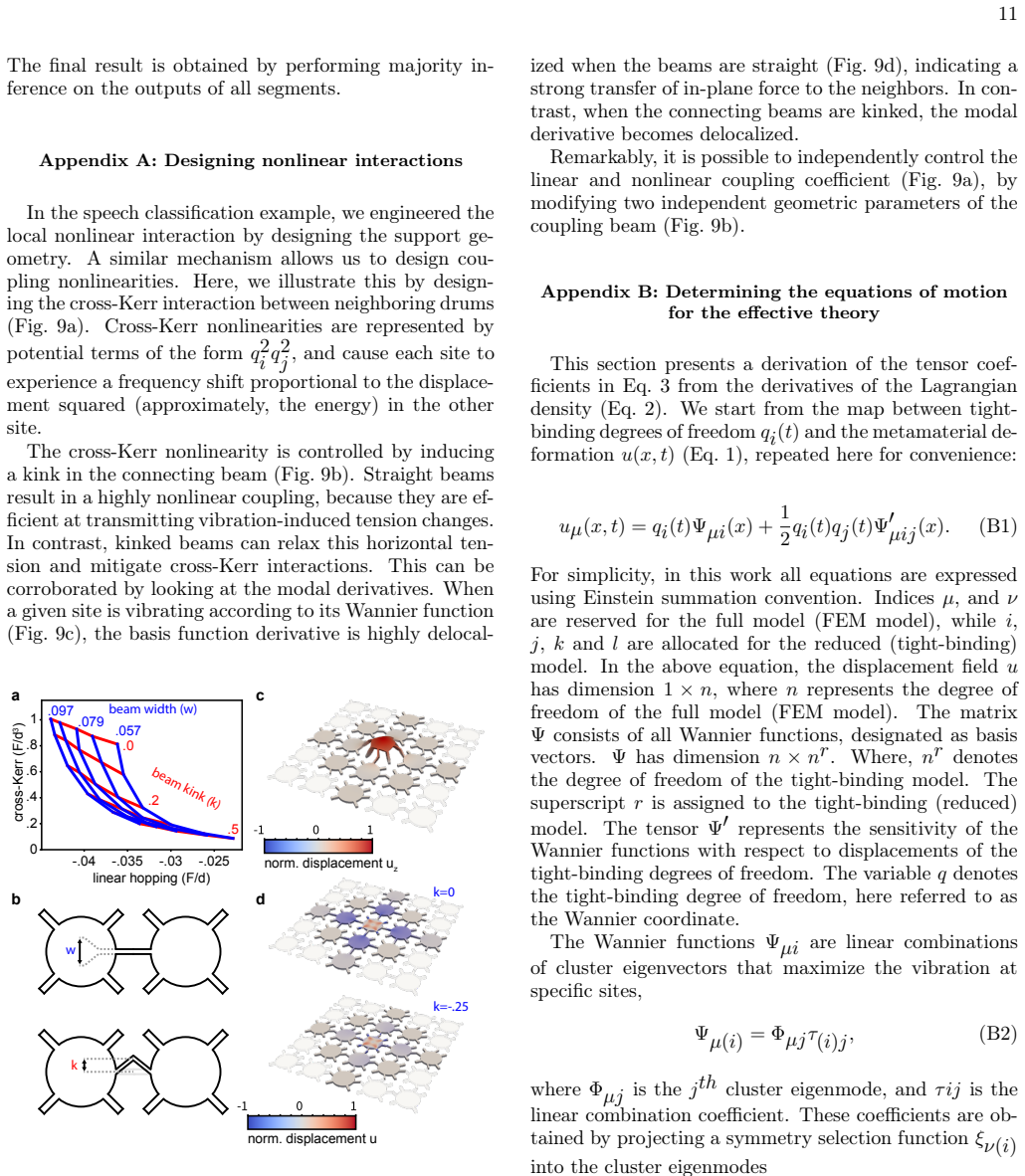
- Nonlinearities can be engineered independently of linear terms: local Kerr strength via support-arm shape, and cross-Kerr plus hopping via kinked versus straight coupling beams.
- The approach extends perturbative metamaterials beyond narrowband operation to quasistatic multistable systems, as demonstrated by the racetrack memory.
Reading between the lines
- A natural next step, not pursued here, is co-optimizing the readout and the geometry, since the pipeline is differentiable; the paper notes this possibility.
- The same screening picture suggests that the coordinate transformation could transfer to optical or acoustic metamaterials wherever a spectral gap separates slow coordinates from fast screening modes.
- If the spectral separation assumption fails, a velocity-dependent coordinate transformation could split the sum- and difference-frequency responses, potentially widening the class of usable geometries.
Editorial analysis
A structured set of objections, weighed in public.
Referee Report
Summary. The paper presents a method for designing nonlinear perturbative metamaterials from tight-binding (TB) models. The central ingredient is the nonlinear coordinate transformation u(x,t) = q_i(t)Ψ_i(x) + (1/2) q_i(t)q_j(t)Ψ′_ij(x), where Ψ_i are localized Wannier-type basis functions and Ψ′_ij are their sensitivities to deformation. The authors show how these objects can be extracted from finite-element clusters with linear-time cost, how the effective nonlinear TB tensors follow from Taylor expansion of the energy, and how the resulting model matches full-wave simulations for a small metasurface (Fig. 2). They then demonstrate three applications: a coherent Ising machine, an elastic racetrack memory, and a reservoir-computing speech classifier. The paper argues that this constitutes a general design pipeline for embodying nonlinear TB computations in metamaterials.
Significance. If the central claim is valid, the paper is a significant advance: it extends perturbative metamaterial design from the linear regime, where it is well established, to nonlinear computation, where the deformation-dependence of the mode basis has been a recognized obstacle. The paper's strengths include direct full-wave validation of the core coordinate-transformation method in Fig. 2, convergence tests with cluster size in Fig. 7, explicit treatment of the Born-Oppenheimer assumption and its limitations in Appendix D, and the demonstration that the extracted TB nonlinear tensors are sparse and local, which is essential for design. The three showcases are ambitious and, for the speech classifier, produce a concrete falsifiable prediction. However, as detailed below, the load-bearing time-scale-separation assumption is not quantitatively validated for any of the three examples, and one of the showcase validations relies on modifying the target model after the fact. With these gaps addressed, the method would be a compelling contribution.
major comments (3)
- [Appendix D, Eq. (D16); Methods D; Fig. 5] The central validity of Eq. (1) rests on a time-scale separation that is asserted but not quantified. Appendix D explicitly states that the Wannier derivatives are computed assuming excluded modes are driven at ω_i and ω_j, whereas the product q_i q_j contains components at ω_i ± ω_j; the error is small only if the excluded modes are spectrally well separated from these combination frequencies. No spectral gap or residual error is reported for any of the three geometries. This matters most for the speech classifier: Methods D states that no full-wave simulation can be conducted, and Fig. 5c is entirely based on TB simulations. The nonlinearity is essential there (error drops from 18% to 3%), and the drive frequency is near resonance (ω_m = 1.085ω_0). To support the paper's central claim, the authors should either quantify the spectral separation for the speech geometry and estimate the r
- [Example 2, Fig. 4] The racetrack demonstration does not validate the target tight-binding model stated in the text. The target model (Eq. 2) contains only nearest-neighbor hopping, on-site Kerr nonlinearity, and the coupling to the compression field. Yet Fig. 4c shows a visible disagreement between the target TB trajectory and the high-fidelity equilibrium continuation; the authors then state that incorporating long-range interactions in the TB model reproduces the trajectory. This means the embodied model differs from the model the design was supposed to realize. Even if the long-range terms are extracted from the geometry rather than fitted to the output, the demonstration would be stronger if the authors either (i) used geometry optimization to suppress these interactions, as suggested in the linear metamaterial literature, or (ii) clearly presented the racetrack as an example where the effective model
- [Example 1, Fig. 3] The coherent Ising machine demonstration uses a frustration-free Ising problem (stated in the text: 'here set to encode a frustration-free problem'). The convergence to a ground state in Fig. 3d is a consistency check of the mapping, but it does not demonstrate the ability to approximate solutions of combinatorial optimization problems, which is the motivation of the section and the abstract. A single small frustrated instance (even with a handful of spins) would substantially strengthen the claim. As written, this example is better described as validating the parametric-oscillator network physics than as showcasing optimization capability.
minor comments (5)
- [Example 2, first paragraph] The sentence 'see [ref] for an experimental realization...' contains a literal '[ref]' placeholder with no reference. This is a missing citation that should be filled before publication.
- [Methods D, last paragraph] The claim 'the regime at which the maximum classification accuracy is achieved is close to that in Fig. 2d in terms of relative nonlinearity' is made without defining 'relative nonlinearity' or providing a quantitative comparison. Please define the measure and give the numbers.
- [Methods B.3, Fig. 7] Typo: 'valye' should be 'value'. Also, the sentence 'Excluding all derivatives essentially eliminates the nonlinear contribution...' is clear, but the factor of 4 and factor of 20 are reported without error bars or confidence intervals; specify the error metric (e.g., relative L2 error) and whether the result is for one representative geometry.
- [Appendix B, Eq. (B14)] The index structure in the term Λ^mr_ijkl q_j q_l appears twice in Eq. (B14) with different dummy indices but the same tensor; please verify and clarify the notation. Also, 'the the kinetic energy' typo in the paragraph before Eq. (B12).
- [General] The paper would benefit from a data/code availability statement. The method relies on a substantial software implementation (FEniCSx, GMSH, custom automation); providing the code or at least a repository would materially improve reproducibility.
Circularity Check
No significant circularity: the effective model is extracted from geometry and benchmarked against full-wave FE; acknowledged limitations (time-scale separation, no full-wave speech check, post-hoc long-range terms) are caveats, not constructional identities.
full rationale
Walked the derivation chain from Eq. (1) through Methods B and D. The Wannier functions Psi_i are computed by projecting local symmetry-selection functions onto cluster eigenmodes (Methods B1), and the Wannier sensitivities Psi'_ij are computed from eigenvector perturbation theory using the deformation-dependent tangent stiffness (Methods D), not fitted to the responses they later predict. The effective tensors K, Gamma, Lambda are obtained by Taylor-expanding the FEM energy in q_i (Methods B2), so the tight-binding model is an independent reduced description of the same geometry. External checks exist: Fig. 2c,d compares the coordinate-transformed perturbative model to full nonlinear wave simulation; Fig. 4 compares the TB model (with long-range interactions) to nonlinear equilibrium continuation on the full FE model; Fig. 3d checks the CIM ground state against a full-wave simulation. No prediction is constructed from the quantity it is compared with. The two passages that might look circular are actually stated limitations. (1) Racetrack long-range interactions: 'we observe a disagreement in the beam trajectories around their minimum displacement positions... This deviation originates in long-range interactions that emerge due to imperfect localizations of the basis functions... Incorporating these long-range interactions in the tight-binding model accurately reproduces the trajectory.' The paper does not state that these parameters were fitted to that trajectory; it attributes them to a known localization mechanism, so this is a possible validation weakness but not an exhibited fit. (2) Appendix D: 'the excluded eigenmodes are driven at the frequencies of oscillation of qi and qj, omega_i and omega_j respectively. However, the term q_i q_j will contain oscillations at omega_i+omega_j and omega_i-omega_j.' This is an explicit limitation of the Born-Oppenheimer-style instantaneous-response assumption, not a self-referential reduction. The speech classifier (Fig. 5) has no full-wave check: 'no high-fidelity simulations can be conducted... the model is expected to be highly accurate in this regime.' This is extrapolation by analogy, not a tautology. Self-citations [6,14,15,17,18] provide background and prior framework, but the present validation is performed here against FE benchmarks, so they are not load-bearing. Score 2 reflects the cluster of self-citations and the unquantified extrapolation, not demonstrated circularity.
Assumptions & free parameters
free parameters (4)
- Damping coefficients per example =
0.05 (Fig 2), 0.001 (Fig 3), 4.0 (Fig 4), Q=60 (Fig 5)
- Speech reservoir parameters lambda_i and alpha_i =
lambda_i in {1,4}, alpha_i in {1,7}
- Racetrack long-range interaction coefficients =
not specified
- Numerical stabilization parameter gamma in Eq. D11 =
comparable to mean diagonal of D_mu_nu
assumptions (6)
- domain assumption Time-scale separation between the tight-binding modes and the modes captured by Wannier derivatives (Born-Oppenheimer approximation).
- domain assumption Second-order truncation of the coordinate transformation (terms beyond qi qj neglected).
- domain assumption Kirchhoff-Saint Venant hyperelastic material model with Lame parameters from E=100 and nu=0.33.
- domain assumption Rayleigh damping is added after discretization as a mass-proportional force.
- domain assumption Wannier functions are exponentially localized, enabling fixed-size cluster computation.
- domain assumption The degenerate parametric oscillator network reduces to an Ising Hamiltonian for the CIM.
Cite this review
Pith. "Pith review of Embodying computation in nonlinear perturbative metamaterials." pith.science (2026). https://pith.science/paper/TQX3XY2Z
@misc{pith2026250901625,
  author       = {Pith},
  title        = {Pith review of: Embodying computation in nonlinear perturbative metamaterials},
  year         = {2026},
  howpublished = {\url{https://pith.science/paper/TQX3XY2Z}},
  note         = {Machine review of arXiv:2509.01625}
}
read the original abstract
Designing metamaterials that carry out advanced computations poses a significant challenge. A powerful design strategy splits the problem into two steps: First, encoding the desired functionality in a discrete or tight-binding model, and second, identifying a metamaterial geometry that conforms to the model. Applying this approach to information-processing tasks requires accurately mapping nonlinearity -- an essential element for computation -- from discrete models to geometries. Here we formulate this mapping through a nonlinear coordinate transformation that accurately connects tight-binding degrees of freedom to metamaterial excitations in the nonlinear regime. This transformation allows us to design information-processing metamaterials across the broad range of computations that can be expressed as tight-binding models, a capability we showcase with three examples based on three different computing paradigms: a coherent Ising machine that approximates combinatorial optimization problems through energy minimization, a mechanical racetrack memory exemplifying in-memory computing, and a speech classification metamaterial based on analog neuromorphic computing.
Figures


Figures from the paper (8 more)



Forward citations
Cited by 1 Pith paper
-
Craig-Bampton-based Quadratic Manifold for Nonlinear Substructuring
A quadratic manifold derived via perturbation analysis extends the Craig-Bampton method to geometrically nonlinear structures, producing an efficient polynomial reduced-order model via Galerkin projection that preserv...
Reference graph
Works this paper leans on
-
[1]
L. J. Kwakernaak and M. van Hecke, Phys. Rev. Lett. 130, 268204 (2023)
work page 2023
-
[2]
A. Rafsanjani, K. Bertoldi, and A. R. Studart, Science Robotics 4, eaav7874 (2019)
work page 2019
-
[3]
M. Mousa and M. Nouh, Proceedings of the National Academy of Sciences121, e2407431121 (2024)
work page 2024
-
[4]
H. Tang, Y. Yang, Z. Liu, W. Li, Y. Zhang, Y. Huang, T. Kang, Y. Yu, N. Li, Y. Tian,et al., Nature630, 84 (2024)
work page 2024
-
[5]
J. Luo, W. Lu, P. Jiao, D. Jang, K. Barri, J. Wang, W. Meng, R. P. Kumar, N. Agarwal, D. K. Hamilton, et al., Materials Today83, 145 (2025)
work page 2025
- [6]
-
[7]
Bordiga, E
G. Bordiga, E. Medina, S. Jafarzadeh, C. Bösch, R. P. Adams, V. Tournat, and K. Bertoldi, Nature Materials 23, 1486 (2024)
2024
-
[8]
J. C. Coulombe, M. C. York, and J. Sylvestre, PloS one 12, e0178663 (2017)
work page 2017
Show all 53 references
-
[9]
Bohte, T
F. Bohte, T. Louvet, V. Maillou, and M. S. Garcia, arXiv preprint arXiv:2504.05802 (2025)
2025 arXiv
-
[10]
T. L. Heugel, O. Zilberberg, C. Marty, R. Chitra, and A. Eichler, Physical Review Research4, 013149 (2022)
2022
-
[11]
Bösch, G
C. Bösch, G. Roeder, M. Serra-Garcia, and R. P. Adams, arXiv preprint arXiv:2506.19136 (2025)
2025 arXiv
-
[12]
de Bos and M
D. de Bos and M. Serra-Garcia, arXiv preprint arXiv:2502.12020 (2025)
2025
-
[13]
Serra-Garcia, Physical Review E100, 042202 (2019)
M. Serra-Garcia, Physical Review E100, 042202 (2019)
2019
-
[14]
Serra-Garcia, V
M. Serra-Garcia, V. Peri, R. Süsstrunk, O. R. Bilal, T. Larsen, L. G. Villanueva, and S. D. Huber, Nature 555, 342 (2018)
2018
-
[15]
K. H. Matlack, M. Serra-Garcia, A. Palermo, S. D. Hu- ber, and C. Daraio, Nature Materials17, 323 (2018)
2018
-
[16]
H. Fan, H. Gao, S. An, Z. Gu, S. Liang, Y. Zheng, and T. Liu, Mechanical Systems and Signal Processing169, 108774 (2022)
2022
-
[17]
S. Jain, P. Tiso, J. B. Rutzmoser, and D. J. Rixen, Computers & Structures188, 80 (2017)
2017
-
[18]
J. B. Rutzmoser, D. J. Rixen, P. Tiso, and S. Jain, Computers & Structures192, 196 (2017)
2017
-
[19]
S. R. Idelsohn and A. Cardona, Computers & Structures 20, 203 (1985)
1985
-
[20]
Suri and M
R. Suri and M. Shimizu, Research in Engineering Design 1, 105 (1989)
1989
-
[21]
Marandi, Z
A. Marandi, Z. Wang, K. Takata, R. L. Byer, and Y. Ya- mamoto, Nature Photonics8, 937 (2014)
2014
-
[22]
Casilli, T
N. Casilli, T. Kaisar, L. Colombo, S. Ghosh, P. X.- L. Feng, and C. Cassella, Physical review letters132, 147301 (2024)
2024
-
[23]
P. L. McMahon, A. Marandi, Y. Haribara, R. Hamerly, C. Langrock, S. Tamate, T. Inagaki, H. Takesue, S. Ut- sunomiya, K. Aihara,et al., Science354, 614 (2016)
2016
-
[24]
Cılasun, W
H. Cılasun, W. Moy, Z. Zeng, T. Islam, H. Lo, A. Vanasse, M. Tan, M. Anees, R. S, A. Kumar,et al., Nature Electronics , 1 (2025)
2025
-
[25]
Hayashi, L
M. Hayashi, L. Thomas, R. Moriya, C. Rettner, and S. S. Parkin, Science320, 209 (2008)
2008
-
[26]
S. S. Parkin, M. Hayashi, and L. Thomas, science320, 190 (2008)
2008
-
[27]
V. T. Pham, N. Sisodia, I. Di Manici, J. Urrestarazu- Larrañaga, K. Bairagi, J. Pelloux-Prayer, R. Guedas, L. D. Buda-Prejbeanu, S. Auffret, A. Locatelli, et al., Science 384, 307 (2024)
2024
-
[28]
Z. Luo, A. Hrabec, T. P. Dao, G. Sala, S. Finizio, J. Feng, S. Mayr, J. Raabe, P. Gambardella, and L. J. Heyder- man, Nature579, 214 (2020)
2020
-
[29]
Y. Song, R. M. Panas, S. Chizari, L. A. Shaw, J. A. Jackson, J. B. Hopkins, and A. J. Pascall, Nature com- munications 10, 882 (2019)
2019
-
[30]
T. Mei, Z. Meng, K. Zhao, and C. Q. Chen, Nature communications 12, 7234 (2021)
2021
-
[31]
T. W. Hughes, I. A. D. Williamson, M. Minkov, and S. Fan, Science Advances5, eaay6946 (2019)
2019
-
[32]
Jaeger, Bonn, Germany: German national research center for information technology gmd technical report 148, 13 (2001)
H. Jaeger, Bonn, Germany: German national research center for information technology gmd technical report 148, 13 (2001)
2001
-
[33]
Maass, T
W. Maass, T. Natschläger, and H. Markram, Neural computation 14, 2531 (2002)
2002
-
[34]
C. Dorn, V. Kannan, U. Dreschler, and D. M. Kochmann, arXiv preprint arXiv:2507.01874 (2025)
2025 arXiv
-
[35]
L. Yuan, M. Xiao, S. Xu, and S. Fan, Physical Review A 96, 043864 (2017)
2017
-
[36]
Jürgensen, S
M. Jürgensen, S. Mukherjee, C. Jörg, and M. C. Rechts- man, Nature Physics19, 420 (2023)
2023
-
[37]
Wang, F.-M
C. Wang, F.-M. Liu, M.-C. Chen, H. Chen, X.-H. Zhao, C. Ying, Z.-X. Shang, J.-W. Wang, Y.-H. Huo, C.-Z. Peng, et al., Science384, 579 (2024)
2024
-
[38]
M. W. Scroggs, I. A. Baratta, C. N. Richardson, and G. N. Wells, Journal of Open Source Software7, 3982 (2022)
2022
-
[39]
M. S. Alnæs, A. Logg, K. B. Ølgaard, M. E. Rognes, and G. N. Wells, ACM Trans. Math. Softw.40 (2014), 10.1145/2566630
2014 doi
-
[40]
DOLFINx: The next gener- ation FEniCS problem solving environment,
I. A. Baratta, J. P. Dean, J. S. Dokken, M. Habera, J. S. Hale, C. N. Richardson, M. E. Rognes, M. W. Scroggs, N. Sime, and G. N. Wells, “DOLFINx: The next gener- ation FEniCS problem solving environment,” (2023)
2023
-
[41]
M. W. Scroggs, J. S. Dokken, C. N. Richardson, and G. N. Wells, ACM Trans. Math. Softw. 48 (2022), 10.1145/3524456
2022 doi
-
[42]
Goedecker, Reviews of Modern Physics 71, 1085 (1999)
S. Goedecker, Reviews of Modern Physics 71, 1085 (1999)
1999
-
[43]
R. B. Nelson, AIAA Journal14, 1201 (1976). 7
1976
-
[44]
Born and R
M. Born and R. Oppenheimer, Annalen der Physik389, 457 (1927)
1927
-
[45]
Arnold and O
M. Arnold and O. Brüls, Multibody System Dynamics 18, 185 (2007)
2007
-
[46]
P. L. C. van der Valk,Model Reduction and Interface Modelling in Dynamic Substructuring, Master’s thesis (2010)
2010
-
[47]
Guttman, The annals of mathematical statistics , 336 (1946)
L. Guttman, The annals of mathematical statistics , 336 (1946)
1946
-
[48]
Gobat, V
G. Gobat, V. Zega, P. Fedeli, C. Touzé, and A. Frangi, Nonlinear Dynamics111, 2991 (2023)
2023
-
[49]
D. A. Ham, L. Mitchell, A. Paganini, and F. Wechsung, Structural and Multidisciplinary Optimization60, 1813 (2019). METHODS A. Material model, parameters and finite element tools We model the material as a Kirchhoff-Saint Venant hyperelastic material model, with the Lagrangian...
2019
-
[50]
Determination of the basis functions To compute the localized basis functions (Wannier functions) Ψi(x) in Eq. 1, we project a local symmetry- selection function ξi(x)—that identifies the site and or- bital corresponding to the Wannier function—on the spectral subspace spanned...
-
[51]
Determination of the effective theory To extract the tight-binding model, we express the fi- nite element displacementu(x) in terms of tight-binding coordinates qi, using Eq. 1. Then, we Taylor-expand the energy, given by the volume integral ofL (u) (Eq. 2) in terms of qi, usi...
-
[52]
d dt ∂T ∂ ˙q − ∂T ∂q # −
Accuracy and validity of the model The accuracy of the extracted tight-binding model de- pends on the size of the cluster used to determine the Wannier functions (Fig. 7b,c). Here we fix the cluster size though a topological distance cutoff; with a radius RC = 0, only the site...
-
[53]
D2 that is mass-orthogonal to all eigenvaluesΦνi
Constraint-based pseudoinverse for the computation of the Wannier derivatives The goal of this section is to numerically compute the part of the solution of Eq. D2 that is mass-orthogonal to all eigenvaluesΦνi. We do so by defining D = Kµν − λ(i)Mµν (D4a) x = dj Φν(i) (D4b) y ...
Reviewed August 5, 2026 · model on record in the stance chip above.
Discussion (0). Sign in to comment.