REVIEW 4 major objections 5 minor 36 references
Explaining Optomechanical Libration Spectra: A Stochastic Simulation Approach
T0 review · 4 major / 5 minor · reviewed 2026-08-05 · deepseek-v4-flash
Pith's one-line read A hidden wobble-spin switch shapes the shoulder-like peaks in optically trapped nanodumbbell spectra.
desk verdict A practical stochastic simulation framework and a plausible mechanism for libration shoulders, but the central quantitative claim rests on a fitted moment of inertia about an order of magnitude below the nominal value; still worth serious refereeing. read the letter →
The pith
A machine-rendered reading of the paper's core claim, the machinery that carries it, and where it could break.
The reading
What carries the argument
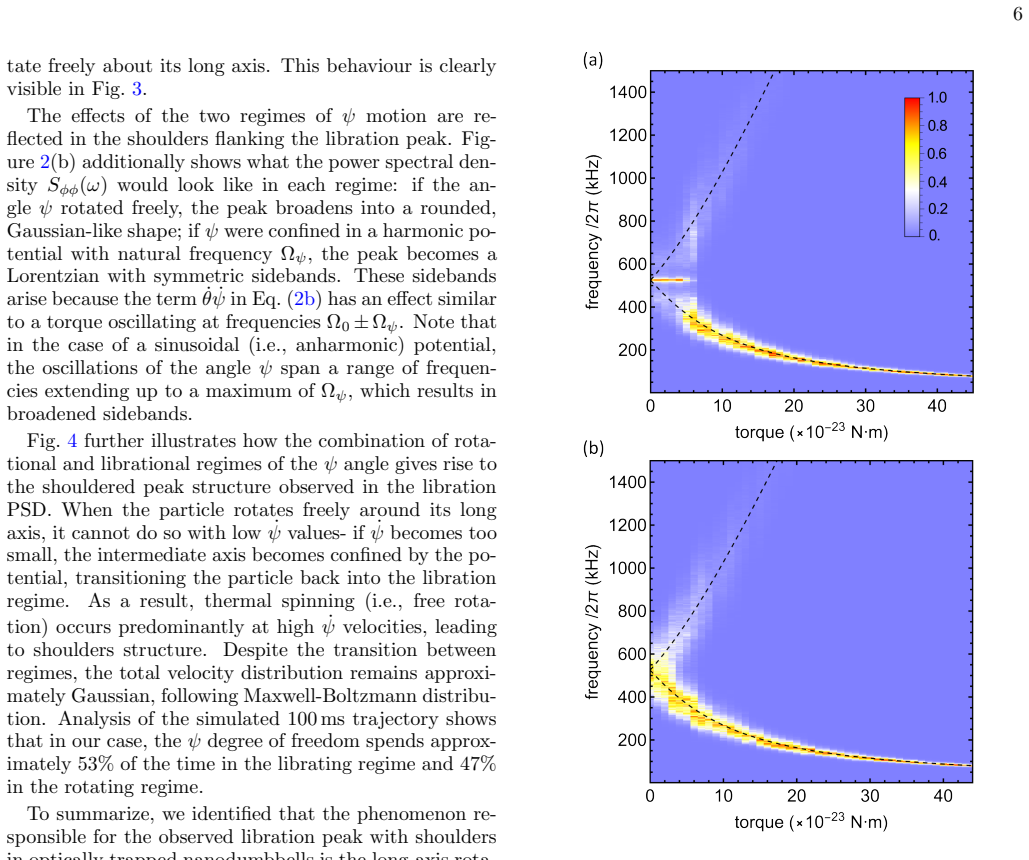
The mechanism is carried by ψ(t), the Euler angle for rotation around the long axis. The model gives ψ a sinusoidal confinement potential U(ψ) = ¼ I3 Ωψ² cos(2ψ), with a depth tuned near ½ kBT, so thermal fluctuations push the particle back and forth across the barrier. The deterministic coupling terms (I3/I1) θ-dot ψ-dot and (I3/I1) φ-dot ψ-dot transfer this switching into the measurable libration power spectral density. The numerical engine is the Ito-Taylor 1.5 scheme applied to six state variables (θ, θ-dot, φ, φ-dot, ψ, ψ-dot) with three independent Wiener noise sources.
What would settle it
Measure the libration PSD of the same nanodumbbell while changing the gas temperature or pressure, which changes the thermal spin energy and the barrier depth relative to kBT: the shoulder spacing should move with sqrt(kBT/I) and the librating/rotating time fraction should shift. If the shoulder spacing stays fixed while the thermal rotation energy is varied, or if an independent measurement gives the nominal order-of-magnitude-larger moment of inertia while the shoulders persist in simulation, the proposed mechanism is falsified.
Extended reading notes
Core claim
This paper claims that the shoulder-like structure flanking the 525 kHz libration peak in an optically levitated silica nanodumbbell is not an experimental artifact or a separate mechanical mode but the fingerprint of the particle's third rotational degree of freedom, ψ, the rotation about the long axis, alternating between two regimes: confined libration in a shallow sinusoidal potential and thermally activated free rotation. Because the two measured libration equations contain coupling terms proportional to ψ-dot, the ψ dynamics are imprinted on the detectable angle φ even though ψ itself is inaccessible. The paper shows that a simulation of the three-angle stochastic equations, solved wit
Load-bearing premise
The fitted effective moment of inertia I1 = 2 × 10⁻³³ kg·m² is roughly an order of magnitude below the value from the nominal 143-nm silica dumbbell; only with this smaller value does thermal spin around the long axis reach about 273 kHz (2π) and produce the observed 180-kHz shoulder spacing. If the true inertia is the nominal one, the shoulders disappear, so the paper's central mechanism leans on this unresolved discrepancy.
Editorial extensions
If this is right
- A shouldered libration peak in a trapped nanodumbbell can be read as a time-share between two regimes of the hidden degree of freedom ψ: the relative widths and heights encode the barrier depth compared with kBT.
- The same stochastic model predicts when an externally applied spinning torque will split the peak into precession and nutation modes: only when the torque overcomes the ψ-confinement barrier, so no separate ad hoc threshold is needed.
- Because the simulation produces full trajectories of all three angles in seconds, it can serve as a fitting and validation tool for rotational optomechanics experiments and for devices like levitated gyroscopes and torque sensors.
- Extending the model to full nonlinear terms and center-of-mass coupling should let the same framework handle high-aspect-ratio particles and structured-light traps, where rotational and translational motion are strongly mixed.
Reading between the lines
- If the fitted order-of-magnitude-small effective inertia is caused by extra noise or COM coupling rather than by particle size, then the same simulation could be used to extract an effective thermal noise amplitude from the shoulder spacing, turning the discrepancy into a diagnostic.
- Varying gas temperature or pressure should continuously morph the peak: a deeper barrier relative to kBT gives clean Lorentzian sidebands, a shallower barrier gives a rounded single peak; this is a direct, testable prediction beyond the reported parameters.
- Time-domain analysis of the simulated switch statistics, such as the lifetime of librating versus rotating intervals, could provide a new experimental route to measuring the ψ-confinement potential directly from the measured libration signal.
Editorial analysis
A structured set of objections, weighed in public.
Referee Report
Summary. The manuscript presents an Ito-Taylor 1.5 stochastic integration framework for simulating the rotational dynamics of an optically levitated, nearly cylindrically symmetric nanodumbbell. The two short-axis libration angles are harmonically confined, while the long-axis angle ψ evolves in a sinusoidal potential and couples to the libration modes through gyroscopic terms. The authors fit I1 and Ωψ, together with a PSD scaling factor and baseline offset, to reproduce the experimental Sϕϕ(ω) of Ref. [15]. They obtain a central libration peak with shoulders, which they attribute to thermally activated transitions between librating and freely rotating regimes of ψ. Counterfactual simulations with harmonic or absent ψ confinement are used to support this interpretation, and the framework is also applied to reproduce the threshold for precession/nutation mode splitting under an applied spin torque.
Significance. If the central mechanism is correct, this paper would provide a fast, practical simulation tool for rotational optomechanics and a unified explanation for the varied libration lineshapes reported in the literature. The use of a standard Ito-Taylor scheme is appropriate, and the counterfactual simulations in Fig. 2(b) are a useful way to expose the role of the ψ potential shape. However, the main physical conclusion is currently conditional on a fitted moment of inertia I1 that is roughly an order of magnitude below the nominal value for the 143-nm silica dumbbell. Because this parameter directly sets the thermal spin rate that produces the shoulders, the explanatory claim is not yet robustly established. The paper would be significantly strengthened by independent constraints on I1, a self-consistency check of the small-angle approximation, and a quantitative fit assessment.
major comments (4)
- [Sec. IV B, Fig. 2(a)] The central mechanism depends on I1 = 2×10^-33 kg·m^2. For the nominal 143-nm silica dumbbell with length-to-diameter ratio 1.8, I1 is approximately 3.6×10^-32 kg·m^2, i.e., roughly 18 times larger. This parameter sets the thermal torque scale in Eq. (13) and the thermal spin rate through (1/2)I3ψdot^2 ≈ (1/2)kBT. The paper itself notes that with nominal I1 the spin rate would be ~2π×87 kHz, far below the fitted ~2π×273 kHz needed for the observed ~2π×180 kHz splitting. The suggested explanations (lower effective density, RIN, elevated local temperature, COM coupling) are not quantified, and RIN or temperature would not change the mechanical inertia in a straightforward way. Unless I1 is independently constrained by particle characterization or by a separate measurement of the ψ dynamics, the mechanism is not robustly identified. Please add an independent estimate, a sensitivity analysis
- [Sec. II and IV B] The small-angle approximation for ϕ and θ is justified by the condition sqrt(kBT/(I1Ω0^2)) << 1. With the fitted I1 = 2×10^-33 kg·m^2 and Ω0 = 2π×525 kHz, this ratio is sqrt(4.14×10^-21/(2×10^-33 × (3.3×10^6)^2)) ≈ 0.44 rad, which is not much smaller than unity. Thus the fitted parameters that produce fast thermal spin also imply large thermal libration amplitudes, undermining the harmonic approximation used to derive Eqs. (2). The manuscript should either evaluate this condition with the fitted parameters and discuss the resulting nonlinear corrections, or find a parameter regime where the approximation is self-consistent.
- [Sec. IV B, Fig. 2] The agreement on the shoulder position is partly built into the fitting procedure. The sideband splitting is δΩ = (I3/I1)ψdot, and ψdot is determined by the same fitted I1 through thermal equilibrium; therefore the ~180 kHz shoulder spacing largely restates the choice of I1 rather than providing an independent prediction. The additional free PSD scale and baseline offset further weaken the quantitative comparison. I recommend reporting a goodness-of-fit metric, confidence intervals for I1 and Ωψ, and a clear demonstration of how the shoulder position and width depend on these parameters away from the best-fit values.
- [Sec. IV C] The statement that the phenomenon responsible for the observed shoulders 'is the long-axis rotation transitioning between librating and rotating regimes' is stronger than the evidence presented. The simulations show that the proposed mechanism can reproduce the shouldered lineshape for a specific fitted parameter set and that two alternative ψ potentials (harmonic or absent) do not. However, this does not exclude other mechanisms such as detection cross-talk, COM coupling, or a distribution of particle asymmetries. I suggest rewording to 'is consistent with' or 'is a plausible mechanism' unless additional discriminating evidence is provided.
minor comments (5)
- [Eq. (3) and surrounding text] As written, U(ψ) = (1/4)I3Ωψ^2 cos(2ψ) has a maximum at ψ = 0, while the text describes confinement around the z-direction. A brief statement defining the zero of ψ and the stable equilibrium point would remove this apparent sign-convention ambiguity.
- [Fig. 4] The histogram would be more informative with axis labels, normalized units, and the fitted normal distribution parameters (mean and standard deviation), so the reader can verify the Maxwell-Boltzmann claim.
- [Sec. III] The Ito-Taylor 1.5 scheme is standard, but the manuscript does not report a time-step convergence or stability check for the present equations. A short paragraph on how Δt was selected and verified would strengthen the numerical claims.
- [General] No data or code availability statement is included. Since this is a simulation paper, releasing the code would substantially increase reproducibility and practical utility.
- [Sec. IV D] The applied spin torque τ is not reported. To make the threshold behavior in Fig. 5 quantitatively comparable to Eq. (15) and to the experiment, the torque values used in the simulations should be stated.
Circularity Check
Shoulder mechanism is realized only in a fitted low-I1 regime; the central explanation is partly a fit, though an independent torque-threshold test provides some support.
-
fitted input called prediction
[Sec. IV B (best-fit parameters) and Sec. IV C (mechanism identification), Eqs. (13), (2a)-(2c), Fig. 2]
"The simulation parameters yielding the best agreement with experimental data were Ωψ = 2π × 220 kHz and I1 = 2×10⁻³³ kg · m2. ... To explain the splitting of libration into two modes with frequencies δΩ apart, the particle would need to be spinning at ψ̇ = δΩ I1/I3 ≈ 2π × 273 kHz [16]. In contrast, using the moment of inertia obtained from the nominal particle diameter and silica density, the expected spinning frequency ... would be only ψ̇ ≈ 2π × 87 kHz."
The central mechanistic claim—that the shoulder features arise from thermally driven transitions between ψ libration and rotation—is realized only because the free parameter I1 was fitted to reproduce the very spectrum being explained. With I1 set ≈10× below the nominal silica-dumbbell value, the thermal spin rate becomes ≈2π×273 kHz, producing the observed ≈180 kHz sideband splitting; with the nominal inertia the spin rate would be only ≈2π×87 kHz and, as the paper notes, the shoulder structure would not appear. The inferred spin rate is itself derived from the same sideband splitting via the spin-splitting relation (Ref. [16]) that the model is meant to test, so the 'identification' of fast thermal rotation as the cause is in part a consistency condition of the fit, not an independent pr
full rationale
The paper is not circular in the self-citation sense: the experimental benchmarks ([14], [15]) are external measurements, and the Sec. IV D threshold simulation is an independent test using parameters fixed by the shoulder fit, giving the mechanism some external falsifiability. However, the paper's central conclusion in Sec. IV C—that the shoulder-like libration peak is caused by the long-axis ψ degree of freedom alternating between librating and rotating regimes—depends critically on two free parameters (I1 and Ωψ) fitted to reproduce that same PSD. In particular, I1 = 2×10⁻³³ kg·m² is about an order of magnitude smaller than the nominal value for a 143 nm silica dumbbell, and this small inertia is what makes the thermal ψ-spin fast enough (~273 kHz) to generate the observed ~180 kHz sidebands. The paper states that with nominal inertia the spin rate would be only ~87 kHz, implying the shoulders would not appear, and it explicitly lists unresolved possible explanations for the mismatch. The counterfactual simulations (harmonic confinement, no confinement) show the qualitative content of the model, but they do not independently fix the fitted parameters. Thus the central explanation is partly a fit; the independent torque-threshold test and emergent regime-transition behavior prevent full circularity, but the mechanism remains conditional on the fitted low-inertia regime.
Assumptions & free parameters
free parameters (4)
- I1 (moment of inertia) =
2e-33 kg m^2
- Omega_psi (confinement frequency of psi) =
2 pi x 220 kHz
- PSD calibration factor and baseline offset =
not specified
- gamma1 = gamma3 (damping rates) =
2 pi x 1.5 kHz
assumptions (5)
- domain assumption Euler equations of motion (Eqs. 2a-2c) with harmonic potentials for theta and phi and sinusoidal potential for psi
- domain assumption White-noise thermal torques with strength sqrt(2 I gamma k_B T) satisfying fluctuation-dissipation (Eqs. 4-5)
- domain assumption Center of mass fixed at trap center
- standard math Ito-Taylor 1.5 scheme (Eq. 11) has strong order 1.5 for the nonlinear SDE system
- domain assumption The measured angle phi is the only experimentally accessible rotational degree of freedom, and the libration channel shows COM cross-talk
Cite this review
Pith. "Pith review of Explaining Optomechanical Libration Spectra: A Stochastic Simulation Approach." pith.science (2026). https://pith.science/paper/2V7MUZMW
@misc{pith2026250901636,
  author       = {Pith},
  title        = {Pith review of: Explaining Optomechanical Libration Spectra: A Stochastic Simulation Approach},
  year         = {2026},
  howpublished = {\url{https://pith.science/paper/2V7MUZMW}},
  note         = {Machine review of arXiv:2509.01636}
}
read the original abstract
We present a practical and computationally effective Ito-Taylor expansion based stochastic simulation framework for modeling rotational optomechanics experiments. By developing a model using this framework, we could capture the nonlinear orientation dynamics of an optically levitated, nearly cylindrically symmetric nanodumbbell. It successfully reproduces and explains shoulder-like features observed in the power spectral density of libration, which we show arising from the interplay between confined libration and thermally driven rotation around the particle symmetry axis.
Figures


Figures from the paper (2 more)

Reference graph
Works this paper leans on
-
[15]
J. A. Zieli´ nska, F. van der Laan, A. Norrman, M. Rim- linger, R. Reimann, L. Novotny, and M. Frimmer. Con- trolling optomechanical libration with the degree of po- larization. Phys. Rev. Lett. , 130:203603, May 2023
work page 2023
-
[1]
Fragment of a simulated trajectory ψ(t)
0.05 0.1 0.15 0.2 0.25 0.3 -60 -40 -20 0 20 time (ms) ψ( rad) Figure 3. Fragment of a simulated trajectory ψ(t). Shaded regions indicate periods of libration, where the intermediate axis oscillates around the z-direction. Unshaded regions cor- respond to the rotational regime, during which the particle spins around its long axis. Figure 4. Histogram of th...
-
[2]
Lev- itodynamics: Levitation and control of microscopic ob- jects in vacuum
Carlos Gonzalez-Ballestero, Markus Aspelmeyer, Lukas Novotny, Romain Quidant, and Oriol Romero-Isart. Lev- itodynamics: Levitation and control of microscopic ob- jects in vacuum. Science, 374(6564):eabg3027, 2021
work page 2021
-
[3]
Searching for new physics using optically levitated sensors
David C Moore and Andrew A Geraci. Searching for new physics using optically levitated sensors. Quantum Science and Technology, 6(1):014008, 2021
2021
- [4]
-
[5]
High-purity quantum optomechanics at room temperature
Lorenzo Dania, Oscar Schmitt Kremer, Johannes Piotrowski, Davide Candoli, Jayadev Vijayan, Oriol Romero-Isart, Carlos Gonzalez-Ballestero, Lukas Novotny, and Martin Frimmer. High-purity quantum optomechanics at room temperature. Nature Physics , pages 1–6, 2025
work page 2025
-
[6]
Spin- cooling of the motion of a trapped diamond
Tom Delord, P Huillery, L Nicolas, and G H´ etet. Spin- cooling of the motion of a trapped diamond. Nature, 580(7801):56–59, 2020
work page 2020
-
[7]
Near- field ghz rotation and sensing with an optically levitated nanodumbbell
Peng Ju, Yuanbin Jin, Kunhong Shen, Yao Duan, Zhu- jing Xu, Xingyu Gao, Xingjie Ni, and Tongcang Li. Near- field ghz rotation and sensing with an optically levitated nanodumbbell. Nano letters , 23(22):10157–10163, 2023
work page 2023
Show all 36 references
-
[8]
Structured transverse orbital an- gular momentum probed by a levitated optomechanical sensor
Yanhui Hu, Jack J Kingsley-Smith, Maryam Nikkhou, James A Sabin, Francisco J Rodr ´ ıguez-Fortu˜ no, Xiaohao Xu, and James Millen. Structured transverse orbital an- gular momentum probed by a levitated optomechanical sensor. Nature Communications, 14(1):2638, 2023
2023
-
[9]
Nanoscale feedback control of six degrees of freedom of a near-sphere
Mitsuyoshi Kamba, Ryoga Shimizu, and Kiyotaka Aikawa. Nanoscale feedback control of six degrees of freedom of a near-sphere. Nature Communications , 14(1):7943, 2023
2023
-
[10]
Simultaneous cavity cooling of all six degrees of freedom of a levitated nanoparticle
A Pontin, H Fu, M Toroˇ s, TS Monteiro, and PF Barker. Simultaneous cavity cooling of all six degrees of freedom of a levitated nanoparticle. Nature Physics , pages 1–6, 2023
2023
-
[11]
Zieli´ nska, Andrei Militaru, Lukas Novotny, and Martin Frimmer
Jialiang Gao, Fons van der Laan, Joanna A. Zieli´ nska, Andrei Militaru, Lukas Novotny, and Martin Frimmer. Feedback cooling a levitated nanoparticle’s libration to below 100 phonons. Phys. Rev. Res., 6:033009, Jul 2024
2024
-
[12]
On-demand assembly of optically levitated nanoparticle arrays in vacuum
Jiangwei Yan, Xudong Yu, Zheng Vitto Han, Tongcang Li, and Jing Zhang. On-demand assembly of optically levitated nanoparticle arrays in vacuum. Photonics Re- search, 11(11):600, 4 2023
2023
-
[13]
Sub-kelvin feedback cooling and heating dynamics of an optically levitated librator
Fons van der Laan, Felix Tebbenjohanns, Ren´ e Reimann, Jayadev Vijayan, Lukas Novotny, and Martin Frimmer. Sub-kelvin feedback cooling and heating dynamics of an optically levitated librator. Phys. Rev. Lett., 127:123605, Sep 2021
2021
-
[14]
Optically levitated rotor at its thermal limit of frequency stability
Fons van der Laan, Ren´ e Reimann, Andrei Militaru, Felix Tebbenjohanns, Dominik Windey, Martin Frimmer, and Lukas Novotny. Optically levitated rotor at its thermal limit of frequency stability. Phys. Rev. A , 102:013505, 8 Jul 2020
2020
-
[16]
J. A. Zieli´ nska, F. van der Laan, A. Norrman, R. Reimann, M. Frimmer, and L. Novotny. Long-axis spinning of an optically levitated particle: A levitated spinning top. Phys. Rev. Lett. , 132:253601, Jun 2024
2024
-
[17]
Parametric feedback cool- ing of rigid body nanodumbbells in levitated optome- chanics
T Seberson and F Robicheaux. Parametric feedback cool- ing of rigid body nanodumbbells in levitated optome- chanics. Physical Review A , 99(1):013821, 2019
2019
-
[18]
Five-dimensional cooling and nonlinear dynam- ics of an optically levitated nanodumbbell
Jaehoon Bang, Troy Seberson, Peng Ju, Jonghoon Ahn, Zhujing Xu, Xingyu Gao, Francis Robicheaux, and Tong- cang Li. Five-dimensional cooling and nonlinear dynam- ics of an optically levitated nanodumbbell. Physical Re- view Research, 2(4):043054, 2020
2020
-
[19]
Numerical Solu- tion of Stochastic Differential Equations, First ed., Vol
Peter E Kloeden and Eckhard Platen. Numerical Solu- tion of Stochastic Differential Equations, First ed., Vol
-
[20]
A computational framework for mean square responses of bidirectional nonlinear systems under correlated stochas- tic excitation
Ankush Gogoi, Satyam Panda, and Budhaditya Hazra. A computational framework for mean square responses of bidirectional nonlinear systems under correlated stochas- tic excitation. J. Sound Vib. , 523:116689, 2022
2022
-
[21]
An Ito–Taylor weak 3.0 method for stochastic dynamics of nonlinear systems
Tapas Tripura, Ankush Gogoi, and Budhaditya Hazra. An Ito–Taylor weak 3.0 method for stochastic dynamics of nonlinear systems. Appl. Math. Model. , 86:115–141, 2020
2020
-
[22]
A mathematically consistent stochas- tic simulation of a 3d pendulum tuned mass damper and tuning
Paul Mucchielli, Ankush Gogoi, Budhaditya Hazra, and Vikram Pakrashi. A mathematically consistent stochas- tic simulation of a 3d pendulum tuned mass damper and tuning. Nonlinear Dyn., 109(2):401–418, 2022
2022
-
[23]
Berlin, Germany: Springer Science & Business Media, 1992
Stochastic Modelling and Applied Probability. Berlin, Germany: Springer Science & Business Media, 1992
1992
-
[24]
A shape memory alloy-tuned mass damper inerter system for passive control of linked-SDOF structural systems under seismic excitation
Nayan Deep Tiwari, Ankush Gogoi, Budhaditya Hazra, and Qinhua Wang. A shape memory alloy-tuned mass damper inerter system for passive control of linked-SDOF structural systems under seismic excitation. J. Sound Vib., 494:115893, 2021
2021
-
[25]
Optically levitated micro gyroscopes with an mhz rotational vaterite rotor
Kai Zeng, Xiangming Xu, Yulie Wu, Xuezhong Wu, and Dingbang Xiao. Optically levitated micro gyroscopes with an mhz rotational vaterite rotor. Microsystems & Nanoengineering, 10(1):78, 2024
2024
-
[26]
Quantum rotations of nanoparticles
Benjamin A Stickler, Klaus Hornberger, and MS Kim. Quantum rotations of nanoparticles. Nature Reviews Physics, 3(8):589–597, 2021
2021
-
[27]
Weisstein
Eric W. Weisstein. Euler angles. From MathWorld–A Wolfram Web Resource
-
[28]
L. D. Landau and E. M. Lifshitz. Mechanics, Third Edition: Volume 1 (Course of Theoretical Physics) . Butterworth-Heinemann, 3 edition, January 1976
1976
-
[29]
Optimal orientation detection of an anisotropic dipolar scatterer
Felix Tebbenjohanns, Andrei Militaru, Andreas Nor- rman, Fons van der Laan, Lukas Novotny, and Martin Frimmer. Optimal orientation detection of an anisotropic dipolar scatterer. Phys. Rev. A , 105:053504, May 2022
2022
-
[30]
Principles of nano- optics
Lukas Novotny and Bert Hecht. Principles of nano- optics. Cambridge university press, 2012
2012
-
[31]
Probability, random signals, and statistics
X Rong Li. Probability, random signals, and statistics . CRC press, 2017
2017
-
[32]
Full rotational control of levitated silicon nanorods
Stefan Kuhn, Alon Kosloff, Benjamin A Stickler, Fer- nando Patolsky, Klaus Hornberger, Markus Arndt, and James Millen. Full rotational control of levitated silicon nanorods. Optica, 4(3):356–360, 2017
2017
-
[33]
Bellando, M
L. Bellando, M. Kleine, Y. Amarouchene, M. Perrin, and Y. Louyer. Giant diffusion of nanomechanical rotors in a tilted washboard potential. Phys. Rev. Lett., 129:023602, Jul 2022
2022
-
[34]
Roto-translational optomechanics
M Rademacher, A Pontin, JMH Gosling, PF Barker, and M Toroˇ s. Roto-translational optomechanics. arXiv preprint arXiv:2507.20905, 2025
2025 arXiv
-
[35]
Kamba and K
M. Kamba and K. Aikawa. Revealing the velocity un- certainties of a levitated particle in the quantum ground state. Physical Review Letters, 131:183602, Oct 2023
2023
-
[36]
Gil, Ari T
Yahong Chen, Fei Wang, Zhen Dong, Yangjian Cai, An- dreas Norrman, Jos´ e J. Gil, Ari T. Friberg, and Tero Set¨ al¨ a. Structure of transverse spin in focused random light. Phys. Rev. A , 104:013516, Jul 2021
2021
Reviewed August 5, 2026 · model on record in the stance chip above.
Discussion (0). Sign in to comment.