REVIEW 3 major objections 5 minor 26 references
REVELIO -- Universal Multimodal Task Load Estimation for Cross-Domain Generalization
T0 review · 3 major / 5 minor · reviewed 2026-08-05 · deepseek-v4-flash
Pith's one-line read Models that read cognitive load from biosignals, eye tracking, and facial expressions in one setting — driving, a memory test, or a video game — lose significant accuracy when moved to another setting, even when signals are fused.
desk verdict A solid multimodal benchmark paper whose gaming labels need validation before the cross-domain claims can carry their full weight. read the letter →
The pith
A machine-rendered reading of the paper's core claim, the machinery that carries it, and where it could break.
The reading
What carries the argument
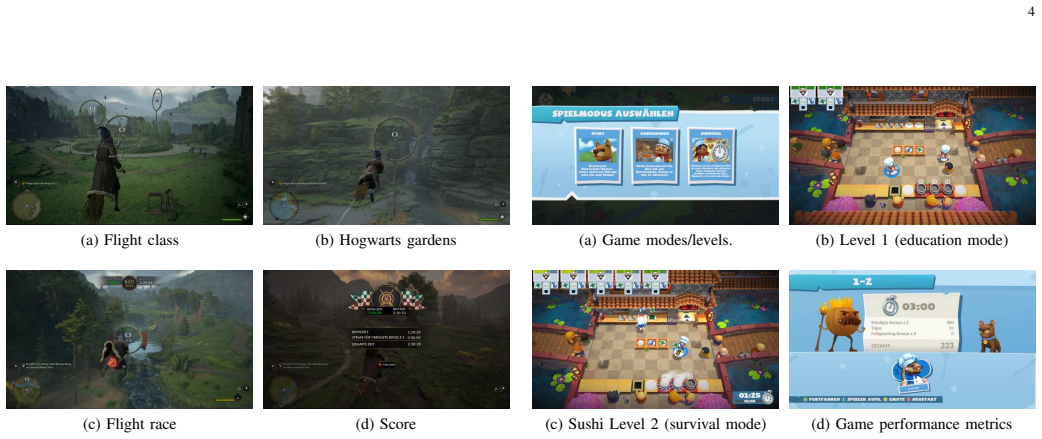
REVELIO, the paper's dataset and evaluation framework. The load-bearing piece is a common protocol: identical Biopac physiological sensors, the same Tobii eye tracker, the same facial-video pipeline, and the same n-back test are recorded across a driving simulator, Overcooked! 2, and Hogwarts Legacy. Each task level is labeled low/high load by design, then verified with performance metrics and post-level NASA-TLX ratings. Subject-wise grouped 5-fold cross-validation plus a full train-on-one/test-on-another matrix, scored by AUROC and Expected Calibration Error, turns 'does it generalize?' into a concrete, reproducible measurement.
What would settle it
Train each architecture on one domain alone — n-back, driving, or gaming — with identical windows, sensors, and splits, then test on the other two. The paper reports clear AUROC drops for these transfers; if an n-back-only model matched gaming-trained models on the gaming test set, the lack of cross-domain generalizability would be refuted. A companion check: if removing task-locked signals (gaze targets, pupil luminance) makes the drop vanish, the failure is cue learning, not load estimation; if the drop persists using only task-general signals (ECG, EDA, respiration), the load-induction labe
Extended reading notes
Core claim
The paper's central claim is that cross-domain generalization, not architecture, is the binding constraint on universal task-load estimation. xLSTM, ConvNeXt, and Transformer encoders, trained with subject-wise cross-validation, reach comparable in-domain accuracy, and multimodal inputs consistently beat unimodal ones across every application subset. But models trained on one domain and tested on another lose accuracy: n-back-trained models do not carry to gaming or driving, and driving-only models excel only in driving. Training on all domains jointly restores accuracy and calibration everywhere. The paper reads the transfer failure as models leaning on task-specific cues for a construct me
Load-bearing premise
The load-bearing premise is that the gaming task levels labeled 'low' and 'high' actually produce different levels of experienced mental load — Overcooked's education mode vs. time-pressured two-cook play, Hogwarts' free flight vs. guided flight and ring race — rather than merely different game content; the paper's own data show gaming performance did not decline with level, and its limitations section concedes models may exploit task-specific cues unrelated to experienced lo
Editorial extensions
If this is right
- Deploying a load detector in a new application without training on that application's data should be expected to fail: single-domain training systematically reduces AUROC elsewhere, so system builders should budget for domain-specific data collection.
- Fusing modalities is the reliable default: biosignals plus eye tracking, augmented by facial action units, gives the most consistent performance across all subsets, whereas every single modality is weak in at least one domain.
- The best signal depends on the task — pupil diameter leads in n-back, eye movement in driving, ECG overall — so modality choice should be validated per deployment context rather than assumed portable.
- Calibration matters as much as accuracy: models trained on diverse data stay well-calibrated on unseen subsets, while single-domain models can be confident-but-wrong off-domain, so ECE should be reported alongside AUROC.
- The n-back can serve as the common reference that makes future cross-domain comparisons meaningful: any new application recorded with the same sensors and an n-back session can be benchmarked head-to-head against these baselines.
Reading between the lines
- The n-back anchor could be pushed further than the paper does: if every future domain is recorded with an n-back session under the same sensors, load levels across domains could be aligned quantitatively instead of by design assumption, making transfer a calibrated measurement rather than a model's opinion.
- Because gaming performance did not decline with task level in the paper's own data, the gaming labels are probably the noisiest of the three domains; weighting training samples by agreement between design, performance, and NASA-TLX ratings could improve transfer and is a cheap experiment the paper does not run.
- A deployment-time extension the paper leaves implicit: instead of always fusing everything, a system could first recognize the domain and then select its best sensors — gaze for driving, pupil for n-back — potentially matching full-fusion accuracy at lower cost, provided the domain itself is detectable.
- The binary low/high split may hide the hardest cases: the paper's own limitations note that overload states are collapsed into 'high'; a continuous-regression variant would test whether universal models fail at the extremes or only at the boundary.
Editorial analysis
A structured set of objections, weighed in public.
Referee Report
Summary. The paper introduces REVELIO, a multimodal cognitive-load dataset that combines an n-back reference task, the existing ADABase driving dataset, and two new video-game scenarios (Overcooked! 2 and Hogwarts Legacy), with synchronized physiological, eye-tracking, facial, and movement signals. The authors train several end-to-end architectures (xLSTM, ConvNeXt, Transformer, LSTM, ResNet) on unimodal and multimodal inputs and evaluate within-domain and cross-domain performance using subject-wise 5-fold cross-validation. They report that multimodal inputs generally outperform unimodal ones, that training on diverse data yields more robust models, and that single-task models transfer poorly to other applications. The main contribution is the dataset plus a broad set of baselines and a data card.
Significance. If the empirical claims hold, this is a useful contribution: it extends cognitive-load benchmarking from laboratory n-back tasks to realistic gaming applications, provides systematic architecture and modality comparisons, uses a leakage-aware evaluation protocol, and reports calibration. The decision to anchor the gaming data to an n-back foundation is methodologically attractive. However, the central empirical claims rest on the validity of the binary low/high task-load labels assigned to the gaming phases, and that validity is not established. Because several reported claims—especially cross-domain generalization and the superiority of multimodal fusion—depend on these labels, the paper's conclusions are proportionate to the evidence only after a label-validity re-analysis. The strengths (subject-wise CV, ECE reporting, reproducible architectural details, a data card) are real and should be credited.
major comments (3)
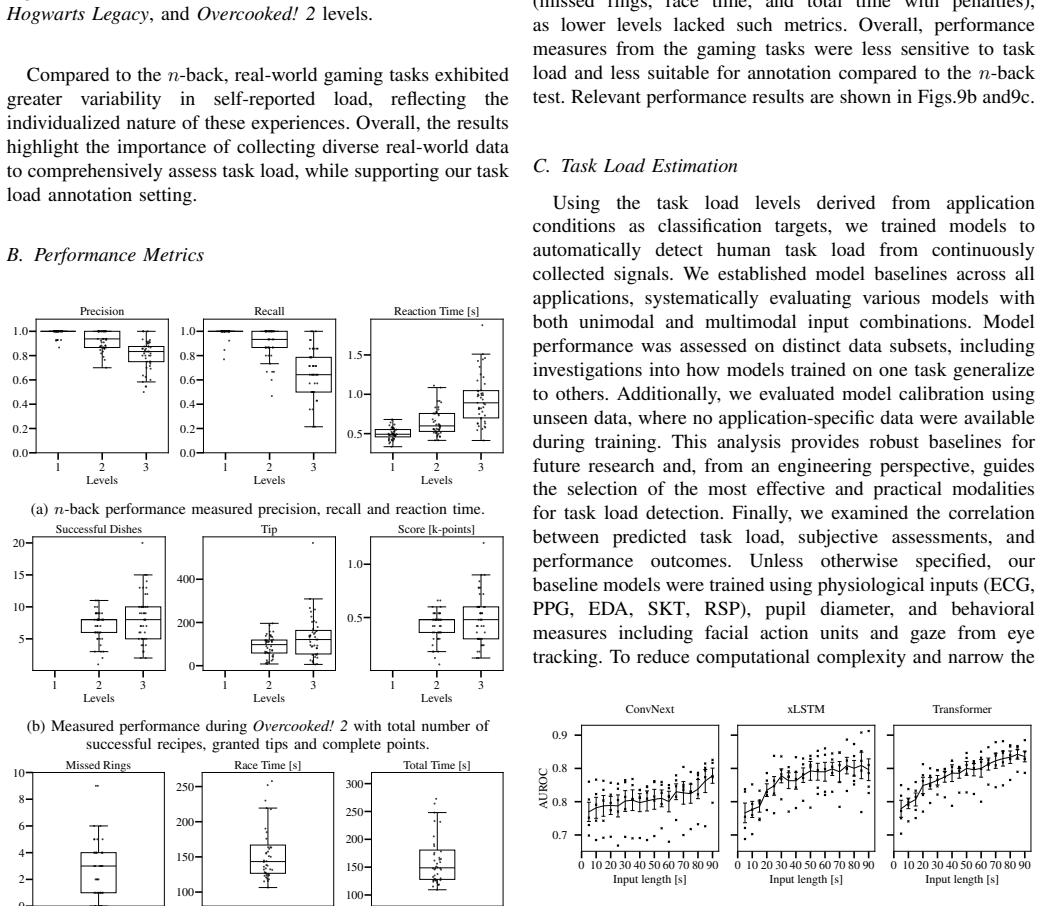
- [Section III-C, Section IV-B, Section V-A] The binary gaming labels are load-bearing. Section III-C1 assigns Overcooked! 2 low load to baseline/education mode and high load to time pressure with two cooks, and Hogwarts Legacy low load to free flight and high load to guided flight/race. However, Section IV-B reports that Overcooked performance 'did not decline with increasing level' (Fig. 9b), and Hogwarts performance data exist only for the race level (Fig. 9c), so the lower-level phases have no objective performance validation. The only supporting evidence is post-hoc NASA-TLX (Fig. 8), with no significance tests or per-participant manipulation checks. Since gaze, head rotation, and facial AUs are exactly the signals that differ between game phases (race vs. free flight, one vs. two cooks), the gaming AUROC values in Table II (e.g., 0.84–0.86 for Eye Comb.) can be achieved by detecting task phase rather than cognitive load. Sect
- [Abstract, Section IV-C, Table II] The claim that 'multimodal approaches consistently outperform unimodal baselines' is not consistently supported by the reported numbers. In Table II, for the Gaming subset the full multimodal combination 'Bio., AUs, ET, Move.' achieves 0.73–0.78 AUROC across architectures, whereas the unimodal 'Eye Comb.' achieves 0.85–0.86; the unimodal 'ET Pupil Diameter' also reaches 0.81–0.82. For n-back, 'Eye Comb.' (0.85–0.86) is comparable to or better than the full multimodal combinations (0.81–0.85). No statistical significance tests or effect sizes are reported, so 'consistently outperform' is an overstatement. Please either qualify the claim to specific modality combinations and domains, or provide pairwise statistical comparisons supporting the superiority claim.
- [Section IV-C3, Fig. 12, Table III] The cross-domain generalization conclusion is conditioned on label equivalence across domains. Since the gaming labels are not validated (see major comment 1), a model trained on n-back or driving and evaluated on gaming may show low AUROC because the gaming 'high load' label does not correspond to n-back/driving load levels, or because the gaming labels encode phase-specific cues. Conversely, the apparent benefit of training on diverse data could reflect learning domain-specific phase structure rather than load. The conclusion that 'single-task models lack cross-domain generalizability' should be restricted to the label operationalization used here, and ideally re-examined after label validation or with an analysis of which features drive transfer. At minimum, the paper should state that the reported transfer results are for task-phase labels, not necessarily for experienced cognitive l
minor comments (5)
- [Fig. 10] Caption uses 'ConvNext' while the text and Table II use 'ConvNeXt'; please make consistent.
- [Section III-D] The ECE equation defines p_i as 'the accuracy in bin i' but then uses c_i as 'the average confidence in bin i'; the notation should be aligned (typically p_i is the empirical accuracy and c_i is the mean confidence).
- [Section III-D] For binary classification the final output should be y ∈ R^{B×1} rather than y ∈ R^{B×C}; as written, C is ambiguous with the input channel dimension.
- [Section IV-B] The interpretation that two-cook management 'did not achieve expected performance gains, suggesting a ceiling effect' is presented as a post-hoc explanation of a null result. Please label it as a hypothesis, not a finding.
- [General] There are several typographical issues (e.g., 'Eskofier' with broken encoding in the author block) and inconsistent capitalization of 'Transformer' vs. 'transformer'. A careful proofread is recommended.
Circularity Check
No construction-level circularity; acknowledged construct-validity caveat is a validity concern, not a circular derivation.
full rationale
The paper's central claims are empirical: multimodal models outperform unimodal baselines and cross-domain transfer degrades. These claims are supported by measured AUROC values, not derived from a fitted parameter or from an equation that reduces to its own input. The low/high task-load labels are an operationalization of task phases into a supervised target; training a model to predict those labels is a standard supervised setup and is not self-definitional in the sense required by the circularity analysis. The paper itself flags the relevant limitation in Section V-A: 'we train on proxy labels of task load derived from level design, performance, and self-reports. This entails threats to construct validity, as models may exploit task or context specific cues unrelated to experienced load.' It also reports in Section IV-B that Overcooked! 2 performance 'did not decline with increasing level' and that Hogwarts Legacy lower levels lacked performance metrics. These passages weaken the construct-validity interpretation of the gaming results, but they are limitations and correctness risks, not instances of X being defined in terms of Y, a fitted input being renamed as a prediction, or a claim resting entirely on a self-citation. The paper's self-citations to Oppelt et al. [15] and Foltyn et al. [45] support dataset extension and preprocessing protocols and are not load-bearing for the main empirical comparisons; the n-back and driving label mappings are additionally grounded in standard n-back literature and in the paper's own reported performance and subjective measures. Accordingly, no enumerated circularity step is present, and the score reflects only the minor, non-load-bearing self-citations.
Assumptions & free parameters
free parameters (2)
- sliding window length =
40 seconds
- binary task load mapping =
low: n=1, baselines, education mode; high: n>=2, time pressure, guided flight/race
assumptions (5)
- domain assumption Task difficulty level is a valid proxy for cognitive load
- domain assumption n-back difficulty induces increasing cognitive load
- ad hoc to paper Gaming phases induce low vs high cognitive load equivalent to n-back
- domain assumption Physiological and behavioral signals contain information about cognitive load
- standard math AUROC and ECE are appropriate evaluation metrics
Cite this review
Pith. "Pith review of REVELIO -- Universal Multimodal Task Load Estimation for Cross-Domain Generalization." pith.science (2026). https://pith.science/paper/CP7KLIY3
@misc{pith2026250901642,
  author       = {Pith},
  title        = {Pith review of: REVELIO -- Universal Multimodal Task Load Estimation for Cross-Domain Generalization},
  year         = {2026},
  howpublished = {\url{https://pith.science/paper/CP7KLIY3}},
  note         = {Machine review of arXiv:2509.01642}
}
abstract
Task load detection is essential for optimizing human performance across diverse applications, yet current models often lack generalizability beyond narrow experimental domains. While prior research has focused on individual tasks and limited modalities, there remains a gap in evaluating model robustness and transferability in real-world scenarios. This paper addresses these limitations by introducing a new multimodal dataset that extends established cognitive load detection benchmarks with a real-world gaming application, using the $n$-back test as a scientific foundation. Task load annotations are derived from objective performance, subjective NASA-TLX ratings, and task-level design, enabling a comprehensive evaluation framework. State-of-the-art end-to-end model, including xLSTM, ConvNeXt, and Transformer architectures are systematically trained and evaluated on multiple modalities and application domains to assess their predictive performance and cross-domain generalization. Results demonstrate that multimodal approaches consistently outperform unimodal baselines, with specific modalities and model architectures showing varying impact depending on the application subset. Importantly, models trained on one domain exhibit reduced performance when transferred to novel applications, underscoring remaining challenges for universal cognitive load estimation. These findings provide robust baselines and actionable insights for developing more generalizable cognitive load detection systems, advancing both research and practical implementation in human-computer interaction and adaptive systems.
Figures


Figures from the paper (14 more)




Reference graph
Works this paper leans on
-
[1]
Workload Assesment Methodology,
D. O’Donnell, “Workload Assesment Methodology,” in Handbook of Perception and Human Performanc . Wiley-Interscience, Oct. 1986, vol. V olume II
work page 1986
-
[2]
G. Orru and L. Longo, “The Evolution of Cognitive Load Theory and the Measurement of Its Intrinsic, Extraneous and Germane Loads: A Review,” in Human Mental Workload: Models and Applications , L. Longo and M. C. Leva, Eds. Cham: Springer International Publishing, 2019, vol. 1012, pp. 23–48
work page 2019
-
[3]
Multimodal behavior and interaction as indicators of cognitive load,
F. Chen, N. Ruiz, E. Choi, J. Epps, M. A. Khawaja, R. Taib, B. Yin, and Y . Wang, “Multimodal behavior and interaction as indicators of cognitive load,” ACM Transactions on Interactive Intelligent Systems , vol. 2, no. 4, pp. 1–36, Dec. 2012
work page 2012
-
[4]
Development of NASA-TLX (Task Load Index): Results of Empirical and Theoretical Research,
S. G. Hart and L. E. Staveland, “Development of NASA-TLX (Task Load Index): Results of Empirical and Theoretical Research,” in Advances in Psychology . Elsevier, 1988, vol. 52, pp. 139–183
work page 1988
-
[5]
M. Georgsson, “NASA RTLX as a Novel Assessment Tool for Determining Cognitive Load and User Acceptance of Expert and User- based Usability Evaluation Methods,” EJBI, vol. 16, no. 2, p. 8, 2020
work page 2020
-
[6]
Instructional control of cognitive load in the training of complex cognitive tasks,
F. G. W. C. Paas and J. J. G. V an Merriënboer, “Instructional control of cognitive load in the training of complex cognitive tasks,” Educational Psychology Review, vol. 6, no. 4, pp. 351–371, Dec. 1994
work page 1994
-
[7]
Instantaneous self-assessment of workload technique (ISA),
Jordan and Brennen, “Instantaneous self-assessment of workload technique (ISA),” 1992
work page 1992
-
[8]
ADABase: A Multimodal Dataset for Cognitive Load Estimation,
M. P . Oppelt, A. Foltyn, J. Deuschel, N. R. Lang, N. Holzer, B. M. Eskofier, and S. H. Y ang, “ADABase: A Multimodal Dataset for Cognitive Load Estimation,” Sensors, vol. 23, no. 1, p. 340, Dec. 2022
work page 2022
Show all 26 references
-
[9]
Measuring Cognitive Load Using In-Game Metrics of a Serious Simulation Game,
N. Sevcenko, M. Ninaus, F. Wortha, K. Moeller, and P . Gerjets, “Measuring Cognitive Load Using In-Game Metrics of a Serious Simulation Game,” Frontiers in Psychology , vol. 12, p. 572437, Mar. 2021
2021
-
[10]
Evaluating usability based on multimodal information: An empirical study,
T. Lin and A. Imamiya, “Evaluating usability based on multimodal information: An empirical study,” in Proceedings of the 8th International Conference on Multimodal Interfaces , ser. Icmi ’06. New Y ork, NY , USA: Association for Computing Machinery, 2006, pp. 364–371
2006
-
[11]
Action Units and Their Cross-Correlations for Prediction of Cognitive Load during Driving,
A. Y uce, H. Gao, G. L. Cuendet, and J.-P . Thiran, “Action Units and Their Cross-Correlations for Prediction of Cognitive Load during Driving,” IEEE Transactions on Affective Computing , vol. 8, no. 2, pp. 161–175, Apr. 2017. 6
2017
-
[12]
Darwin, Deception, and Facial Expression,
P . Ekman, “Darwin, Deception, and Facial Expression,” Annals of the New York Academy of Sciences , vol. 1000, no. 1, pp. 205–221, Dec. 2003
2003
-
[13]
Human Mental Workload: A Survey and a Novel Inclusive Definition,
L. Longo, C. D. Wickens, G. Hancock, and P . A. Hancock, “Human Mental Workload: A Survey and a Novel Inclusive Definition,” Frontiers in Psychology , vol. 13, p. 883321, Jun. 2022
2022
-
[14]
A Review of the Mental Workload Literature,
B. Cain, “A Review of the Mental Workload Literature,” Jul. 2007
2007
-
[15]
Heart Rate V ariability in Psychology: A Review of HRV Indices and an Analysis Tutorial,
T. Pham, Z. J. Lau, S. H. A. Chen, and D. Makowski, “Heart Rate V ariability in Psychology: A Review of HRV Indices and an Analysis Tutorial,” Sensors, vol. 21, no. 12, p. 3998, Jun. 2021
2021
-
[16]
Multimodal Fusion for Objective Assessment of Cognitive Workload: A Review,
E. Debie, R. Fernandez Rojas, J. Fidock, M. Barlow, K. Kasmarik, S. Anavatti, M. Garratt, and H. A. Abbass, “Multimodal Fusion for Objective Assessment of Cognitive Workload: A Review,” IEEE Transactions on Cybernetics , vol. 51, no. 3, pp. 1542–1555, Mar. 2021
2021
-
[17]
The Game Experience Questionnaire,
W. A. Jsselsteijn, Y . A. W. de Kort, and K. Poels, “The Game Experience Questionnaire,” Jan. 2013
2013
-
[18]
Intrinsic motivation and the effects of self- consciousness, self-awareness, and ego-involvement: An investigation of internally controlling styles,
R. W. Plant and R. M. Ryan, “Intrinsic motivation and the effects of self- consciousness, self-awareness, and ego-involvement: An investigation of internally controlling styles,” Journal of Personality , vol. 53, no. 3, pp. 435–449, Sep. 1985
1985
-
[19]
Kurzversion des Big Five Inventory (BFI-K):,
B. Rammstedt and O. P . John, “Kurzversion des Big Five Inventory (BFI-K):,” Diagnostica, vol. 51, no. 4, pp. 195–206, 2005
2005
-
[20]
Datasets for Cognitive Load Inference Using Wearable Sensors and Psychological Traits,
M. Gjoreski, T. Kolenik, T. Knez, M. Luštrek, M. Gams, H. Gjoreski, and V . Pejovi´c, “Datasets for Cognitive Load Inference Using Wearable Sensors and Psychological Traits,” Applied Sciences , vol. 10, no. 11, p. 3843, May 2020
2020
-
[21]
Machine Learning and End-to-End Deep Learning for Monitoring Driver Distractions From Physiological and Visual Signals,
M. Gjoreski, M. Z. Gams, M. Lustrek, P . Genc, J.-U. Garbas, and T. Hassan, “Machine Learning and End-to-End Deep Learning for Monitoring Driver Distractions From Physiological and Visual Signals,” IEEE Access , vol. 8, pp. 70 590–70 603, 2020
2020
-
[22]
Human-Centric Cognitive State Recognition Using Physiological Signals: A Systematic Review of Machine Learning Strategies Across Application Domains,
K. Jin, A. Rubio-Solis, R. Naik, D. Leff, J. Kinross, and G. Mylonas, “Human-Centric Cognitive State Recognition Using Physiological Signals: A Systematic Review of Machine Learning Strategies Across Application Domains,” Sensors, vol. 25, no. 13, p. 4207, Jul. 2025
2025
-
[23]
Time series classification from scratch with deep neural networks: A strong baseline,
Z. Wang, W. Y an, and T. Oates, “Time series classification from scratch with deep neural networks: A strong baseline,” in 2017 International Joint Conference on Neural Networks (IJCNN) . Anchorage, AK, USA: IEEE, May 2017, pp. 1578–1585
2017
-
[24]
Transformers in time series: A survey,
Q. Wen, T. Zhou, C. Zhang, W. Chen, Z. Ma, J. Y an, and L. Sun, “Transformers in time series: A survey,” in Proceedings of the Thirty- Second International Joint Conference on Artificial Intelligence , ser. Ijcai ’23, Macao, P .R.China, 2023
2023
-
[25]
A ConvNet for the 2020s,
Z. Liu, H. Mao, C.-Y . Wu, C. Feichtenhofer, T. Darrell, and S. Xie, “A ConvNet for the 2020s,” arXiv:2201.03545 [cs] , Jan. 2022
2022 arXiv
-
[26]
xLSTM: Extended long short-term memory,
M. Beck, K. Pöppel, M. Spanring, A. Auer, O. Prudnikova, M. Kopp, G. Klambauer, J. Brandstetter, and S. Hochreiter, “xLSTM: Extended long short-term memory,” in Advances in Neural Information Processing Systems, A. Globerson, L. Mackey, D. Belgrave, A. Fan, U. Paquet, J. Tomcz...
2024
Reviewed August 5, 2026 · model on record in the stance chip above.
Discussion (0). Continue with ORCID to comment.