REVIEW 4 major objections 6 minor 59 references
Membrane-Electrode Assemblies for Electrochemical Reduction of CO2 to Ethylene: Design for Minimal Energy Consumption
T0 review · 4 major / 6 minor · reviewed 2026-08-05 · deepseek-v4-flash
Pith's one-line read In copper-based CO2 electrolyzers, ethylene selectivity is set by the local electrical potential inside the cathode catalyst layer, not by how much catalyst surface is present.
desk verdict Useful design-guidance paper that continues the authors' established MEA modeling program, but its headline ECSA/selectivity tradeoff rests on fitted Tafel parameters that are not independently validated. read the letter →
The pith
A machine-rendered reading of the paper's core claim, the machinery that carries it, and where it could break.
The reading
What carries the argument
The central object is the local electrolyte potential distribution in the cathode catalyst layer, computed by a 1-D steady-state continuum model that couples charge conservation, Nernst-Planck ion transport, water transport, gas diffusion, homogeneous buffer chemistry, and concentration-dependent Tafel kinetics for six cathode reactions. The model's load-bearing element is the fitted ordering of charge-transfer coefficients, which makes C2H4 and H2 the reactions most sensitive to potential. The local potential profile determines where in the catalyst layer reactions occur and hence the product split; narrowing or densifying the layer reshapes that profile.
What would settle it
Build two MEAs identical except for a tenfold difference in cathode electrochemically active surface area at fixed copper loading, hold the current density at 0.15 A cm-2, and measure cell voltage and ethylene faradaic efficiency. The paper predicts roughly 7% higher ethylene faradaic efficiency and roughly 150 mV higher cell voltage for the low-surface-area cathode; a substantial deviation in either quantity would undercut the claim that local potential alone drives selectivity. A more direct test would place a reference electrode through the cathode catalyst layer to compare the measured loc
Extended reading notes
Core claim
The central claim is that the local electrolyte potential inside the cathode catalyst layer is the primary driving force for C2H4 formation: a roughly 100 mV increase in local potential raises faradaic efficiency to C2H4 by about 2 percentage points. Because C2H4 and H2 have the largest fitted Tafel charge-transfer coefficients (0.46 and 0.44), high local potential favors both. Design changes that raise local potential - thinner catalyst layer, lower electrochemically active surface area, thicker anion-exchange membrane - therefore raise C2H4 selectivity, while changes that lower cell voltage or increase surface area suppress it. The mechanism is supported by fitting exchange current densiti
Load-bearing premise
The Tafel kinetic parameters, fitted to experimental data at only three cell voltages, are assumed to stay unchanged when catalyst-layer thickness, active surface area, membrane thickness, and conductivity are varied by factors of 2 to 10; the predicted selectivity-versus-voltage tradeoff depends on the fitted ordering of charge-transfer coefficients for ethylene (0.46) and hydrogen (0.44).
Editorial extensions
If this is right
- Halving cathode catalyst-layer thickness is a double benefit in the model: ethylene faradaic efficiency rises about 2% and cell voltage drops 40 mV at fixed current density.
- A tenfold reduction in cathode electrochemically active surface area trades higher selectivity for higher energy cost: ethylene faradaic efficiency rises 7% while cell voltage rises 150 mV, lowering modeled electricity cost from about 1,288 to about 1,076 dollars per tonne of C2H4 at 0.15 A cm-2.
- A 1.5x thicker anion-exchange membrane raises ethylene faradaic efficiency by about 1% but adds roughly 140 mV, and the extra ion-transport resistance can be offset by higher membrane conductivity and water permeability.
- CO2 utilization efficiency and ethylene selectivity pull in opposite directions: lower cell voltage improves CO2 utilization but lowers ethylene faradaic efficiency, so the economically optimal operating window sits near 3-3.5 V.
- If electricity reaches 0.01 dollars per kWh, the modeled pathway approaches roughly 1,000 dollars per tonne of C2H4, close to the current market price; a Nafion-coated copper cathode configuration reported in the supporting information lowers modeled electricity cost to 761 dollars per tonne.
Reading between the lines
- A testable extension: graded catalyst layers with through-thickness variation in ionomer content, porosity, or electrochemically active surface area could decouple high local potential from high average cell voltage, improving both selectivity and energy cost.
- Direct measurement of local potential or pH inside the cathode catalyst layer, for example with embedded reference electrodes or operando spectroscopy, would test the predicted 100 mV-to-2%-FE link independently of the model.
- The cost-competitiveness conclusion depends on electricity at 0.01 dollars per kWh; at the paper's own 0.02 dollars per kWh estimate, the modeled cost rises to about 1,189 dollars per tonne of C2, so the economic claim is contingent on continued electricity price declines.
- The model deliberately excludes long-term salt precipitation and degradation; if those processes change local conductivity or active surface area over time, the optimized designs would need time-dependent reassessment.
Signed reviews
Editorial analysis
A structured set of objections, weighed in public.
Referee Report
Summary. The paper develops a steady-state, one-dimensional multiphysics continuum model of a zero-gap membrane-electrode assembly (MEA) for electrochemical CO2 reduction to ethylene over copper. The model couples charge, species, water, gas/liquid, and heat transport with Tafel kinetics for six cathode products and the oxygen evolution reaction. The kinetic parameters are fitted to experimental total current and product faradaic efficiencies at three cell voltages (3.0, 3.5, 4.0 V). The validated model is then used to predict how cathode catalyst-layer thickness, cathode electrochemically active surface area (ECSA), anion-exchange membrane thickness, conductivity, and other parameters affect polarization, FE to C2H4, CO2 utilization, and electricity cost. The central claim is that the local potential distribution inside the cathode catalyst layer is the primary driver of C2H4 selectivity, so designs that raise local potential (e.g., reducing ECSA or thinning the catalyst layer) increase FE to C2H4 at the price of higher cell voltage. The paper reports, for example, that a tenfold ECSA reduction increases C2H4 FE by 7% and cell voltage by 150 mV, and it uses these results to estimate production costs near the current market price.
Significance. If the central claim is robust, the paper provides a valuable framework for MEA design for CO2-to-ethylene electrolysis, including a comprehensive treatment of transport phenomena and cost estimation. The model is transparently documented, builds on prior work by the same group, and is calibrated against experimental data from three identical MEAs. The design predictions are falsifiable and would be useful for guiding experimental optimization. However, the quantitative conclusions rest on fitted Tafel parameters with no uncertainty analysis or independent validation. The claimed selectivity-potential mechanism is largely imposed by the ordering of the fitted charge-transfer coefficients, and the extrapolation to large ECSA/thickness changes is not verified experimentally. These features limit the current evidentiary weight of the central claim but do not invalidate the framework if the robustness concerns are addressed.
major comments (4)
- [Section 3, Eq. (9), Table S3] The claim that higher local potential increases C2H4 FE is a direct consequence of the fitted Tafel kinetics. With alpha_C2H4=0.46 and alpha_HER=0.44, the C2H4/HER rate ratio necessarily increases with overpotential; the reported 7% FE gain over ~150 mV is essentially the logarithmic outcome of this 0.02 difference. The fit uses only three cell voltages (3.0, 3.5, 4.0 V) with six free alpha values and six exchange current densities. No confidence intervals, identifiability analysis, or sensitivity to the alpha ordering is provided. I request a sensitivity sweep over the alpha differences and a statistical assessment of parameter identifiability to show that the selectivity tradeoff is not an artifact of the fitting.
- [Section 3, Figs. 4-5, Eq. (12)] The design predictions for ECSA and catalyst-layer thickness assume that the per-area Tafel kinetics fitted at the base case remain unchanged when ECSA and thickness vary by factors of 2-10. This assumption is load-bearing because the predicted FE gain (36.4% to 40.2%) and voltage penalty (150 mV) are small relative to the expected changes in the local microenvironment (ionomer distribution, CO2 concentration, pH, and morphology). The authors themselves state in Section 3 that Tafel kinetics may be inadequate for nanoparticle electrodes. The manuscript would be substantially strengthened by comparing the model predictions to independent experiments with varied ECSA/thickness, or by clearly quantifying how sensitive the conclusions are to plausible changes in the kinetic parameters.
- [Section 3, Table 2 and Table S5] The cost-competitiveness argument relies on an 'improved cCL layer' entry with FE to C2H4 of 58.6% and an electricity cost of 761 $/tonne. This result is described only as 'these unpublished results' with no experimental details in the Methods or SI. Since this measurement is outside the model framework and not reproducible from the manuscript, it should either be fully documented (materials, fabrication, operating conditions, error bars) or clearly separated from the model-based analysis. As written, the cost conclusion depends on an unreported experiment.
- [Section 2.5, Eqs. (43) and (51)] The arbitrarily large mass-transfer coefficient k_MT' = 1e7 mol m-3 s-1 with Heaviside functions is used to enforce that relative humidity does not exceed 100%. This numerical regularization may influence the water-management predictions and should be justified or subjected to a sensitivity check. As written, the 100% RH cap is an ad hoc constraint rather than a physically derived boundary condition, and it is not clear that the results are independent of the choice of k_MT'.
minor comments (6)
- [Abstract and Conclusions] The abstract contains grammatical errors that obscure meaning, e.g., 'a tenfold decrease in ECSA results increases the FE to C2H4 by 7% but leads increase cell voltage at a given current density by 150 mV.' Please revise throughout.
- [Eq. (21)] The text says 'sociocentric coefficient'; this should be 'stoichiometric coefficient'.
- [Table 1] The boundary condition table has several typos: 'aCN|cDL' should likely be 'cCH|cDL', the duplicate 'aDL|aCL' entries should be 'cDL|cCL', and the gas pressure is given as '101 atm' but should be '101 kPa' (or 1 atm). The units in the table should be checked.
- [Figure 2] The experimental error bars are mentioned but not defined, and the simulated curves have no uncertainty band. Since the fit is used to draw quantitative conclusions, error bars or a residual table would help.
- [Section 2.7, Eq. (66)] The electricity-cost formula lacks an explicit unit-conversion factor. While the result appears dimensionally plausible, please state the conversion from J or Wh to kWh and verify that the $/tonne values are consistent with the current density, voltage, and FE definitions.
- [Table S5] The permeability values are listed with units of m^-1; the standard unit is m^2. Please correct the table.
Circularity Check
Central C2H4-selectivity mechanism is a restatement of fitted/self-cited Tafel alpha ordering, not an independent prediction.
-
fitted input called prediction
[Eq. (9); Section 3 (Figure 3 discussion); SI S1]
"A higher potential promotes the production of both H2 and C2H4, driven by their large charge-transfer coefficients; for further details, refer to the Supporting Information (SI)."
Eq. (9) makes the partial current of each product k an exponential function of overpotential with fitted alpha_k. With alpha_C2H4=0.46 and alpha_HER=0.44 (Table S3), the C2H4/HER rate ratio must increase with overpotential by exp((0.46-0.44)F eta/RT). Thus the claim that 'potential distribution is the primary driving force' and the quantitative '100 mV -> 2% FE' and '7% FE / 150 mV' results are direct outputs of the fitted alpha ordering, not independent predictions. The paper provides no test at varied ECSA/thickness showing the ordering survives; the model simply propagates the fitted input.
-
self citation load bearing
[SI S1; Table S3]
"Although there are very distinct kinetic parameter fit values reported in the literature, we observed similar relationship between major products (HER, COER, C2H4 ) on the Cu catalyst for the exchange current density ... and charge transfer coefficient ... [22]. We kept the same relations for exchange current density and charge transfer coefficient in our simulation to predict our experimental measurements."
The crucial ordering alpha_C2H4 > alpha_HER is not derived or independently re-fit in this paper; it is imported from the authors' own prior work (ref [22], Bui/Bell/Weber; Table S3 cites ref [30], Weng/Bell/Weber). Since six cathode reactions are fitted to only three cell voltages (3.0, 3.5, 4.0 V) while preserving these prior relations, the load-bearing kinetic sensitivity is a self-citation chain. The central design conclusion (raise local potential to raise C2H4 FE) therefore rests on this self-cited ordering rather than on new experimental validation under the varied conditions.
full rationale
The paper is a genuine multiphysics model with independent transport, pH, and cost content, and its base-case fit to experimental data at 3.0/3.5/4.0 V is legitimate. However, the central claim that local potential is the primary driver of C2H4 selectivity is a direct consequence of the fitted charge-transfer coefficients (alpha_C2H4=0.46 > alpha_HER=0.44) in Eq. (9), an ordering imported from the authors' prior work [22,30]. The ECSA/thickness predictions propagate this fitted input; no experiment or identifiability analysis validates the ordering at the varied conditions. Non-cited transport parameters, pH effects, and energy/cost calculations are independent, so the circularity is partial rather than total.
Assumptions & free parameters
free parameters (3)
- Exchange current densities (i0) for HER, CO, HCOOH, C2H4, C2H5OH, C3H7OH =
HER 5e-8, HCOO- 8e-9, CO 2e-9, C2H4 8e-9, C2H5OH 1e-8, C3H7OH 5e-9 mA/cm2 (Table S3)
- Charge transfer coefficients (alpha) for each product =
HER 0.44, HCOO- 0.33, CO 0.36, C2H4 0.46, C2H5OH 0.43, C3H7OH 0.42 (Table S3)
- OER exchange current densities (acid and base) =
9.4e-8 exp(-(11+pH) kJ/mol / RT) and 1.23e-4 exp(-(11+pH) kJ/mol / RT) mA/cm2 (Table S3)
assumptions (7)
- domain assumption Tafel kinetics with Nernstian pH correction (Eq. 9-10) describe all six cathode reactions across the parameter range explored
- domain assumption CO2 reduction occurs mainly at catalyst surfaces exposed to gas; electrolyte-covered surfaces contribute negligibly
- domain assumption Cation transport (K+) through the AEM is negligible
- standard math Electroneutrality holds in the electrolyte (Eq. 30)
- domain assumption AEM conductivity of CO3 2- and HCOO- forms equals that of HCO3- form; H+ form has 10x lower and OH- form 5x higher conductivity
- ad hoc to paper The arbitrarily large mass-transfer coefficient k_MT' = 1e7 mol m-3 s-1 enforces RH not exceeding 100% (Eq. 43 and 51)
- domain assumption Catalyst layer specific surface area a_s0 = 3 epsilon_s / r_p (Eq. 13), and ECSA variations scale only this geometric area with all other properties fixed
Cite this review
Pith. "Pith review of Membrane-Electrode Assemblies for Electrochemical Reduction of CO2 to Ethylene: Design for Minimal Energy Consumption." pith.science (2026). https://pith.science/paper/IF6JTU3V
@misc{pith2026250901771,
  author       = {Pith},
  title        = {Pith review of: Membrane-Electrode Assemblies for Electrochemical Reduction of CO2 to Ethylene: Design for Minimal Energy Consumption},
  year         = {2026},
  howpublished = {\url{https://pith.science/paper/IF6JTU3V}},
  note         = {Machine review of arXiv:2509.01771}
}
read the original abstract
Membrane-electrode-assembly (MEA) cells with copper (Cu) cathodes show strong potential for electrochemical CO2 reduction to ethylene (C2H4), but achieving high C2H4 selectivity remains a challenge due to competing hydrogen evolution. This selectivity is highly sensitive to the local microenvironment near the Cu catalyst surface. In this study, a 1-D, multiphysics continuum model is utilized to investigate how MEA cell performance and faradaic efficiency (FE) to C2H4 are affected by both component properties and operating conditions, with particular focus on coupled transport and reaction phenomena. Key parameters include cathode electrochemically active surface area (ECSA) and catalyst layer thickness. Halving catalyst layer thickness increases FE to C2H4 by 2% and lowers the cell voltage by 40 mV. In contrast, a tenfold decrease in ECSA results increases the FE to C2H4 by 7% but leads increase cell voltage at a given current density by 150 mV. This tradeoff occurs because the potential distribution within the cathode catalyst layer is the primary driving force for C2H4 formation. Increased cell voltage also raises the energy cost of C2H4 production. This model framework enables techno-economic assessments and identifies key factors that must be optimized to enable economically viable production of C2H4 via electrochemical reduction of CO2.
Figures


Figures from the paper (4 more)


Reference graph
Works this paper leans on
-
[1]
Introduction Electrochemical CO2 reduction (CO2R) provides an option for producing fuels and chemical feedstocks from CO2 emitted from stationary sources using electricity [1–4]. One of the most attractive products of CO2R is ethylene (C2H4), because of its large market size (180 Mt y-1) [5,6] and viability for production via direct electrochemical CO2 re...
-
[2]
Methods A 1-D, steady-state continuum model was developed using COMSOL Multiphysics® software based on our previous CO2R electrolyzer models [28–30]. The computational domain consists of an AEM at the center, anode/cathode catalyst layers (aCL/cCL), and anode and cathode DLs (aDL/cDL), as shown in Figure 1. Governing equations and continuum relationships ...
-
[3]
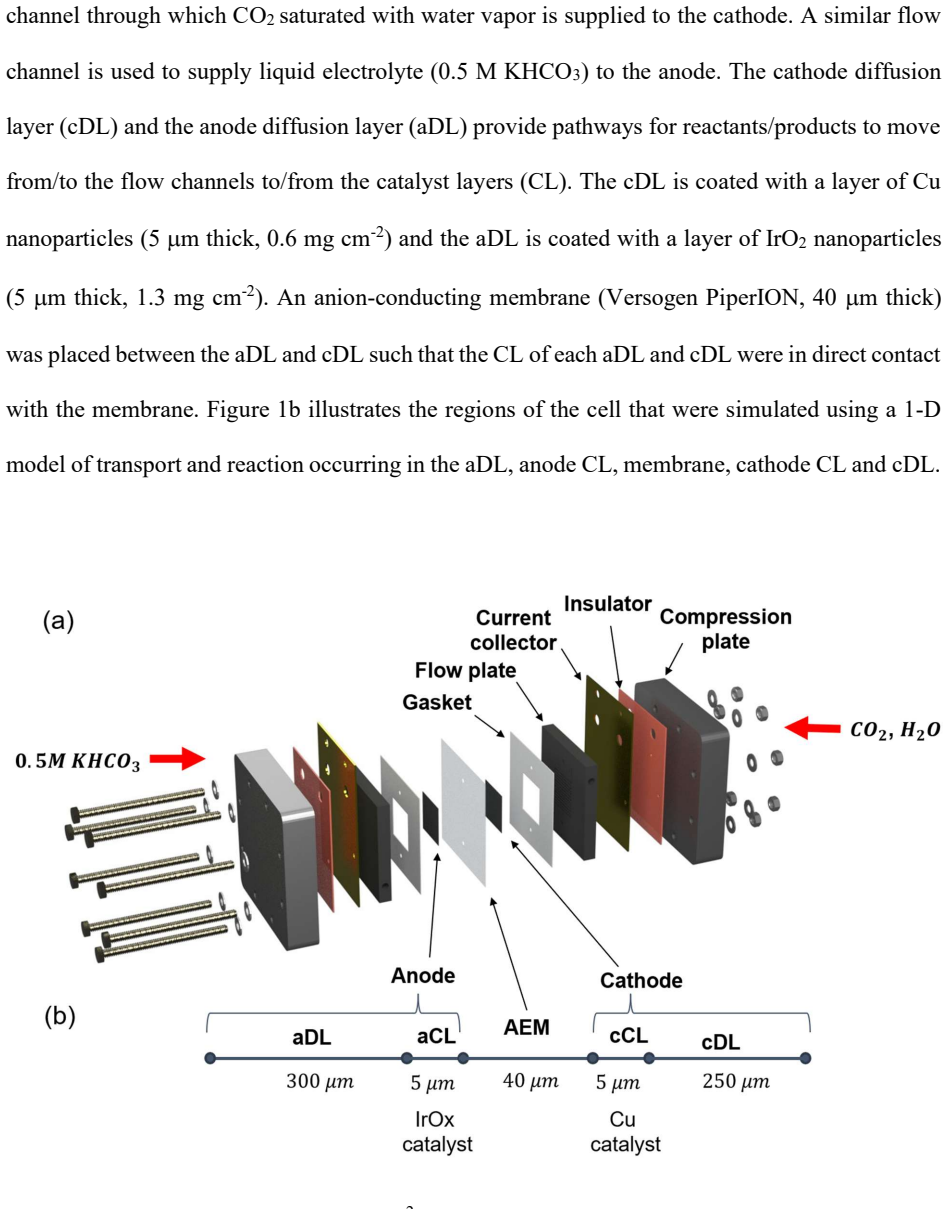
Results and Discussion Figure 1a shows an expanded view of the MEA cell used for the acquisition of experimental data and an illustration of the through-plane 1-D computational domain. The cell consists of a flow 22 channel through which CO2 saturated with water vapor is supplied to the cathode. A similar flow channel is used to supply liquid electrolyte ...
work page 2025
-
[4]
Conclusions A 1-D multiphysics model of an MEA cell for the reduction of CO2 to C2H4 was developed and validated against measured cell performance and product distribution data. The validated model then was exercised to ascertain the impacts of changes of various material properties including the thickness and ECSA of the anode and cathode catalysts layer...
-
[5]
Membrane Electrode Assembly for Electrocatalytic CO2 Reduction: Principle and Application
Z. Zhang, X. Huang, Z. Chen, J. Zhu, B. Endrődi, C. Janáky, D. Deng, “Membrane Electrode Assembly for Electrocatalytic CO2 Reduction: Principle and Application” Angewandte Chemie - International Edition 2023, 62, DOI 10.1002/anie.202302789
-
[6]
Electrochemical CO2 reduction in membrane-electrode assemblies
L. Ge, H. Rabiee, M. Li, S. Subramanian, Y. Zheng, J. H. Lee, T. Burdyny, H. Wang, “Electrochemical CO2 reduction in membrane-electrode assemblies” Chem 2022, 8, 663– 692
work page 2022
-
[8]
Gas diffusion electrodes, reactor designs and key metrics of low-temperature CO2 electrolysers
D. Wakerley, S. Lamaison, J. Wicks, A. Clemens, J. Feaster, D. Corral, S. A. Jaffer, A. Sarkar, M. Fontecave, E. B. Duoss, S. Baker, E. H. Sargent, T. F. Jaramillo, C. Hahn, “Gas diffusion electrodes, reactor designs and key metrics of low-temperature CO2 electrolysers” Nat Energy 2022, 7, 130–143
work page 2022
-
[9]
Global CO2 emissions by year 1940-2024 | Statista,
J. Sisler, S. Khan, A. H. Ip, M. W. Schreiber, S. A. Jaffer, E. R. Bobicki, C. T. Dinh, E. H. Sargent, 2021, American Chemical Society preprint, DOI: 10.1021/acsenergylett.0c02633. [6], “Global CO2 emissions by year 1940-2024 | Statista,” can be found under https://www.statista.com/statistics/276629/global-co2-emissions/(accessed 26 January 2025), n.d
Show all 59 references
-
[10]
Advances and challenges in electrochemical CO2 reduction processes: An engineering and design perspective looking beyond new catalyst materials
S. Garg, M. Li, A. Z. Weber, L. Ge, L. Li, V. Rudolph, G. Wang, T. E. Rufford, “Advances and challenges in electrochemical CO2 reduction processes: An engineering and design perspective looking beyond new catalyst materials” J Mater Chem A Mater 2020, 8, 1511–1544
2020
-
[11]
Multiscale Modeling of CO 2 Electrochemical Reduction on Copper Electrocatalysts: A Review of Advancements, Challenges, and Future Directions
R. Gholizadeh, M. Pavlin, M. Huš, B. Likozar, “ Multiscale Modeling of CO 2 Electrochemical Reduction on Copper Electrocatalysts: A Review of Advancements, Challenges, and Future Directions ” ChemSusChem 2024, DOI 10.1002/cssc.202400898
2024 doi
-
[12]
Constraining CO coverage on copper promotes high-efficiency ethylene electroproduction
J. Li, Z. Wang, C. McCallum, Y. Xu, F. Li, Y. Wang, C. M. Gabardo, C. T. Dinh, T. T. Zhuang, L. Wang, J. Y. Howe, Y. Ren, E. H. Sargent, D. Sinton, “Constraining CO coverage on copper promotes high-efficiency ethylene electroproduction” Nat Catal 2019, 2, 1124–1131
2019
-
[13]
Effect of mass transfer and kinetics in ordered Cu-mesostructures for electrochemical CO2 reduction
H. Song, M. Im, J. T. Song, J. A. Lim, B. S. Kim, Y. Kwon, S. Ryu, J. Oh, “Effect of mass transfer and kinetics in ordered Cu-mesostructures for electrochemical CO2 reduction” Appl Catal B 2018, 232, 391–396
2018
-
[14]
Carbon Monoxide Gas Diffusion Electrolysis that Produces Concentrated C2 Products with High Single-Pass Conversion
D. S. Ripatti, T. R. Veltman, M. W. Kanan, “Carbon Monoxide Gas Diffusion Electrolysis that Produces Concentrated C2 Products with High Single-Pass Conversion” Joule 2019, 3, 240–256. 63
2019
-
[15]
Bridging knowledge gaps in liquid- and vapor-fed CO2 electrolysis through active electrode area
D. Corral, D. U. Lee, V. M. Ehlinger, S. Nitopi, J. E. Avilés Acosta, L. Wang, A. J. King, J. T. Feaster, Y. R. Lin, A. Z. Weber, S. E. Baker, E. B. Duoss, V. A. Beck, C. Hahn, T. F. Jaramillo, “Bridging knowledge gaps in liquid- and vapor-fed CO2 electrolysis through active e...
2022
-
[16]
Mechanism of CO2 Reduction at Copper Surfaces: Pathways to C2 Products
A. J. Garza, A. T. Bell, M. Head-Gordon, “Mechanism of CO2 Reduction at Copper Surfaces: Pathways to C2 Products” ACS Catal 2018, 8, 1490–1499
2018
-
[17]
Improved CO2 reduction activity towards C2+ alcohols on a tandem gold on copper electrocatalyst
C. G. Morales-Guio, E. R. Cave, S. A. Nitopi, J. T. Feaster, L. Wang, K. P. Kuhl, A. Jackson, N. C. Johnson, D. N. Abram, T. Hatsukade, C. Hahn, T. F. Jaramillo, “Improved CO2 reduction activity towards C2+ alcohols on a tandem gold on copper electrocatalyst” Nat Catal 2018, 1...
2018
-
[18]
General Techno-Economic Analysis of CO2 Electrolysis Systems
M. Jouny, W. Luc, F. Jiao, “General Techno-Economic Analysis of CO2 Electrolysis Systems” Ind Eng Chem Res 2018, 57, 2165–2177
2018
-
[19]
De Luna, C
P. De Luna, C. Hahn, D. Higgins, S. A. Jaffer, T. F. Jaramillo, E. H. Sargent, 2019, American Association for the Advancement of Science preprint, DOI: 10.1126/science.aav3506
2019 doi
-
[20]
W. A. Smith, T. Burdyny, D. A. Vermaas, H. Geerlings, 2019, Cell Press preprint, DOI: 10.1016/j.joule.2019.07.009
2019 doi
-
[21]
Ethylene Electrosynthesis: A Comparative Techno-economic Analysis of Alkaline vs Membrane Electrode Assembly vs CO2-CO-C2H4Tandems
J. Sisler, S. Khan, A. H. Ip, M. W. Schreiber, S. A. Jaffer, E. R. Bobicki, C. T. Dinh, E. H. Sargent, “Ethylene Electrosynthesis: A Comparative Techno-economic Analysis of Alkaline vs Membrane Electrode Assembly vs CO2-CO-C2H4Tandems” ACS Energy Lett 2021, 6, 997–1002
2021
-
[22]
Operando cathode activation with alkali metal cations for high current density operation of water-fed zero-gap carbon dioxide electrolysers
B. Endrődi, A. Samu, E. Kecsenovity, T. Halmágyi, D. Sebők, C. Janáky, “Operando cathode activation with alkali metal cations for high current density operation of water-fed zero-gap carbon dioxide electrolysers” Nat Energy 2021, 6, 439–448
2021
-
[23]
Designing anion exchange membranes for CO2 electrolysers
D. A. Salvatore, C. M. Gabardo, A. Reyes, C. P. O’Brien, S. Holdcroft, P. Pintauro, B. Bahar, M. Hickner, C. Bae, D. Sinton, E. H. Sargent, C. P. Berlinguette, “Designing anion exchange membranes for CO2 electrolysers” Nat Energy 2021, 6, 339–348
2021
-
[24]
C. Kim, J. C. Bui, X. Luo, J. K. Cooper, A. Kusoglu, A. Z. Weber, A. T. Bell, “Publisher Correction: Tailored catalyst microenvironments for CO2 electroreduction to multicarbon products on copper using bilayer ionomer coatings (Nature Energy, (2021), 6, 11, (1026- 1034), 10.10...
2021 doi
-
[25]
Continuum Modeling of Porous Electrodes for Electrochemical Synthesis
J. C. Bui, E. W. Lees, L. M. Pant, I. V. Zenyuk, A. T. Bell, A. Z. Weber, “Continuum Modeling of Porous Electrodes for Electrochemical Synthesis” Chem Rev 2022, 122, 11022–11084
2022
-
[26]
Continuous Carbon Dioxide Electroreduction to Concentrated 64 Multi-carbon Products Using a Membrane Electrode Assembly
C. M. Gabardo, C. P. O’Brien, J. P. Edwards, C. McCallum, Y. Xu, C. T. Dinh, J. Li, E. H. Sargent, D. Sinton, “Continuous Carbon Dioxide Electroreduction to Concentrated 64 Multi-carbon Products Using a Membrane Electrode Assembly” Joule 2019, 3, 2777– 2791
2019
-
[27]
A Hybrid Catalyst-Bonded Membrane Device for Electrochemical Carbon Monoxide Reduction at Different Relative Humidities
I. Sullivan, L. Han, S. H. Lee, M. Lin, D. M. Larson, W. S. Drisdell, C. Xiang, “A Hybrid Catalyst-Bonded Membrane Device for Electrochemical Carbon Monoxide Reduction at Different Relative Humidities” ACS Sustain Chem Eng 2019, 7, 16964–16970
2019
-
[28]
Engineering Catalyst-Electrolyte Microenvironments to Optimize the Activity and Selectivity for the Electrochemical Reduction of CO2on Cu and Ag
J. C. Bui, C. Kim, A. J. King, O. Romiluyi, A. Kusoglu, A. Z. Weber, A. T. Bell, “Engineering Catalyst-Electrolyte Microenvironments to Optimize the Activity and Selectivity for the Electrochemical Reduction of CO2on Cu and Ag” Acc Chem Res 2022, 55, 484–494
2022
-
[29]
T. Wang, S. Wei, Y. Zhao, Z. Xiong, J. Zhang, J. Liu, L. Luo, T. Chen, 2025, Elsevier Ltd preprint, DOI: 10.1016/j.ijhydene.2025.01.245
2025 doi
-
[30]
Mass transport in catalytic pores of GDE-based CO2 electroreduction systems
D. Bohra, J. H. Chaudhry, T. Burdyny, E. A. Pidko, W. A. Smith, “Mass transport in catalytic pores of GDE-based CO2 electroreduction systems” ChemRxiv 2020, 1–37
2020
-
[31]
Modeling gas-diffusion electrodes for CO2 reduction
L. C. Weng, A. T. Bell, A. Z. Weber, “Modeling gas-diffusion electrodes for CO2 reduction” Physical Chemistry Chemical Physics 2018, 20, 16973–16984
2018
-
[32]
Towards membrane-electrode assembly systems for CO2 reduction: A modeling study
L. C. Weng, A. T. Bell, A. Z. Weber, “Towards membrane-electrode assembly systems for CO2 reduction: A modeling study” Energy Environ Sci 2019, 12, 1950–1968
2019
-
[33]
A systematic analysis of Cu-based membrane- electrode assemblies for CO2reduction through multiphysics simulation
L. C. Weng, A. T. Bell, A. Z. Weber, “A systematic analysis of Cu-based membrane- electrode assemblies for CO2reduction through multiphysics simulation” Energy Environ Sci 2020, 13, 3592–3606
2020
-
[34]
Exploring CO2 reduction and crossover in membrane electrode assemblies
E. W. Lees, J. C. Bui, O. Romiluyi, A. T. Bell, A. Z. Weber, “Exploring CO2 reduction and crossover in membrane electrode assemblies” Nature Chemical Engineering 2024 1:5 2024, 1, 340–353
2024
-
[35]
Reducing the crossover of carbonate and liquid products during carbon dioxide electroreduction
C. McCallum, C. M. Gabardo, C. P. O’Brien, J. P. Edwards, J. Wicks, Y. Xu, E. H. Sargent, D. Sinton, “Reducing the crossover of carbonate and liquid products during carbon dioxide electroreduction” Cell Rep Phys Sci 2021, 2, DOI 10.1016/j.xcrp.2021.100522
2021
-
[36]
Origin of Hydrogen Incorporated into Ethylene during Electrochemical CO2 Reduction in Membrane Electrode Assembly
W. Choi, S. Park, W. Jung, D. H. Won, J. Na, Y. J. Hwang, “Origin of Hydrogen Incorporated into Ethylene during Electrochemical CO2 Reduction in Membrane Electrode Assembly” ACS Energy Lett 2022, 7, 939–945
2022
-
[37]
Modeling Planar Electrodes and Zero-Gap Membrane Electrode Assemblies for CO2 Electrolysis
V. M. Ehlinger, D. U. Lee, T. Y. Lin, E. B. Duoss, S. E. Baker, T. F. Jaramillo, C. Hahn, “Modeling Planar Electrodes and Zero-Gap Membrane Electrode Assemblies for CO2 Electrolysis” ChemElectroChem 2024, 11, DOI 10.1002/celc.202300566
2024 doi
-
[38]
Along the Channel Gradients Impact on the Spatioactivity of Gas Diffusion Electrodes at High Conversions during CO2Electroreduction
R. Kas, A. G. Star, K. Yang, T. Van Cleve, K. C. Neyerlin, W. A. Smith, “Along the Channel Gradients Impact on the Spatioactivity of Gas Diffusion Electrodes at High Conversions during CO2Electroreduction” ACS Sustain Chem Eng 2021, 9, 1286–1296. 65
2021
-
[39]
Modeling and Upscaling Analysis of Gas Diffusion Electrode-Based Electrochemical Carbon Dioxide Reduction Systems
Z. Yang, D. Li, L. Xing, H. Xiang, J. Xuan, S. Cheng, E. H. Yu, A. Yang, “Modeling and Upscaling Analysis of Gas Diffusion Electrode-Based Electrochemical Carbon Dioxide Reduction Systems” ACS Sustain Chem Eng 2021, 9, 351–361
2021
-
[40]
Parameter sensitivity analysis for CO2 electrochemical reduction electrolyzer
Y. Jiang, T. Bi, M. Cheng, R. Xue, S. Shen, X. Yan, J. Zhang, “Parameter sensitivity analysis for CO2 electrochemical reduction electrolyzer” Int J Hydrogen Energy 2025, 100, 1291–1300
2025
-
[41]
Standard and Reversible Hydrogen Electrodes: Theory, Design, Operation, and Applications
G. Jerkiewicz, “Standard and Reversible Hydrogen Electrodes: Theory, Design, Operation, and Applications” ACS Catal 2020, 10, 8409–8417
2020
-
[42]
Understanding Impacts of Catalyst-Layer Thickness on Fuel-Cell Performance via Mathematical Modeling
I. V. Zenyuk, P. K. Das, A. Z. Weber, “Understanding Impacts of Catalyst-Layer Thickness on Fuel-Cell Performance via Mathematical Modeling” J Electrochem Soc 2016, 163, F691–F703
2016
-
[43]
Transport in Polymer-Electrolyte Membranes
A. Z. Weber, J. Newman, “Transport in Polymer-Electrolyte Membranes” J Electrochem Soc 2004, 151, A311
2004
-
[44]
Along-the-Channel Impacts of Water Management and Carbon-Dioxide Contamination in Hydroxide-Exchange-Membrane Fuel Cells: A Modeling Study
M. R. Gerhardt, L. M. Pant, A. Z. Weber, “Along-the-Channel Impacts of Water Management and Carbon-Dioxide Contamination in Hydroxide-Exchange-Membrane Fuel Cells: A Modeling Study” J Electrochem Soc 2019, 166, F3180–F3192
2019
-
[45]
Effects of electrolyte, catalyst, and membrane composition and operating conditions on the performance of solar-driven electrochemical reduction of carbon dioxide
M. R. Singh, E. L. Clark, A. T. Bell, “Effects of electrolyte, catalyst, and membrane composition and operating conditions on the performance of solar-driven electrochemical reduction of carbon dioxide” Physical Chemistry Chemical Physics 2015, 17, 18924– 18936
2015
-
[46]
Chemical stability of poly(phenylene oxide)-based ionomers in an anion exchange-membrane fuel cell environment
S. Willdorf-Cohen, A. N. Mondal, D. R. Dekel, C. E. Diesendruck, “Chemical stability of poly(phenylene oxide)-based ionomers in an anion exchange-membrane fuel cell environment” J Mater Chem A Mater 2018, 6, 22234–22239
2018
-
[47]
A new method for prediction of binary gas- phase diffusion coefficients
E. N. Fuller, P. D. Schettler, J. C. Giddings, “A new method for prediction of binary gas- phase diffusion coefficients” Ind Eng Chem 1966, 58, 18–27
1966
-
[48]
Electrochemical CO2 Reduction: Tailoring Catalyst Layers in Gas Diffusion Electrodes
K. Junge Puring, D. Siegmund, J. Timm, F. Möllenbruck, S. Schemme, R. Marschall, U. P. Apfel, “Electrochemical CO2 Reduction: Tailoring Catalyst Layers in Gas Diffusion Electrodes” Adv Sustain Syst 2021, 5, 2000088
2021
-
[49]
Microenvironments of Cu catalysts in zero-gap membrane electrode assembly for efficient CO2 electrolysis to C2+ products
W. Choi, Y. Choi, E. Choi, H. Yun, W. Jung, W. H. Lee, H. S. Oh, D. H. Won, J. Na, Y. J. Hwang, “Microenvironments of Cu catalysts in zero-gap membrane electrode assembly for efficient CO2 electrolysis to C2+ products” J Mater Chem A Mater 2022, 10, 10363– 10372
2022
-
[50]
B. Hasa, L. Cherniack, P. Dimitrakellis, C. Bae, F. Jiao, R. Xia, D. Tian, B. H. Ko, S. Overa, “Benchmarking anion-exchange membranes for electrocatalytic carbon monoxide reduction Suitable membrane properties and an active anode catalyst can tune the Faradaic efficiency of li...
2023
-
[51]
L. Ge, H. Rabiee, M. Li, S. Subramanian, Y. Zheng, J. H. Lee, T. Burdyny, H. Wang, 2022, Elsevier Inc. preprint, DOI: 10.1016/j.chempr.2021.12.002
2022 doi
-
[52]
Electroreduction of CO2/CO to C2Products: Process Modeling, Downstream Separation, System Integration, and Economic Analysis
M. Ramdin, B. De Mot, A. R. T. Morrison, T. Breugelmans, L. J. P. Van Den Broeke, J. P. M. Trusler, R. Kortlever, W. De Jong, O. A. Moultos, P. Xiao, P. A. Webley, T. J. H. Vlugt, “Electroreduction of CO2/CO to C2Products: Process Modeling, Downstream Separation, System Integr...
2021
-
[54]
Ex-situ characterisation of gas diffusion layers for proton exchange membrane fuel cells
A. El-Kharouf, T. J. Mason, D. J. L. Brett, B. G. Pollet, “Ex-situ characterisation of gas diffusion layers for proton exchange membrane fuel cells” J Power Sources 2012, 218, 393–404
2012
-
[55]
Effective protonic and electronic conductivity of the catalyst layers in proton exchange membrane fuel cells
C. Y. Du, P. F. Shi, X. Q. Cheng, G. P. Yin, “Effective protonic and electronic conductivity of the catalyst layers in proton exchange membrane fuel cells” Electrochem commun 2004, 6, 435–440
2004
-
[56]
Coupling continuum and pore-network models for polymer-electrolyte fuel cells
I. V. Zenyuk, E. Medici, J. Allen, A. Z. Weber, “Coupling continuum and pore-network models for polymer-electrolyte fuel cells” Int J Hydrogen Energy 2015, 40, 16831–16845
2015
-
[57]
On the micro-, meso- , and macroporous structures of polymer electrolyte membrane fuel cell catalyst layers
T. Soboleva, X. Zhao, K. Malek, Z. Xie, T. Navessin, S. Holdcroft, “On the micro-, meso- , and macroporous structures of polymer electrolyte membrane fuel cell catalyst layers” ACS Appl Mater Interfaces 2010, 2, 375–384
2010
-
[58]
Diffusion: Mass Transfer in Fluid Systems
E. L. Cussler, “Diffusion: Mass Transfer in Fluid Systems” 2009, DOI 10.1017/CBO9780511805134. 67
2009 doi
-
[59]
Low-Pressure Solubility of Gases in Liquid Water
E. Wilhelm, R. Battino, R. J. Wilcock, “Low-Pressure Solubility of Gases in Liquid Water” Chem Rev 1977, 77, 219–262
1977
-
[60]
Coupled Thermal and Water Management in Polymer Electrolyte Fuel Cells
A. Z. Weber, J. Newman, “Coupled Thermal and Water Management in Polymer Electrolyte Fuel Cells” J Electrochem Soc 2006, 153, A2205
2006
-
[61]
Effect of CO2 absorption on ion and water mobility in an anion exchange membrane
J. Peng, A. L. Roy, S. G. Greenbaum, T. A. Zawodzinski, “Effect of CO2 absorption on ion and water mobility in an anion exchange membrane” J Power Sources 2018, 380, 64– 75
2018
Reviewed August 5, 2026 · model on record in the stance chip above.
Discussion (0). Continue with ORCID to comment.