REVIEW 3 major objections 4 minor 51 references
Non-Linear Model-Based Sequential Decision-Making in Agriculture
T0 review · 3 major / 4 minor · reviewed 2026-08-05 · deepseek-v4-flash
Pith's one-line read Model-based nonlinear bandits can identify a near-optimal fertilizer rate in a number of trials that is independent of the size of the action space, and in simulations they beat linear and nonparametric baselines in small-sample agricultura
desk verdict Solid empirical kernel in an applied bandit paper, but the central theory rests on a false lemma and the abstract promises a case study the body does not contain. read the letter →
The pith
A machine-rendered reading of the paper's core claim, the machinery that carries it, and where it could break.
The reading
What carries the argument
The central object is a parametric nonlinear yield-response curve f(x; θ)—Mitscherlich, Michaelis-Menten, quadratic-plateau, or logistic—used inside a bandit update loop. Nonlinear least squares estimates θ from the chosen rates and observed yields; the fitted curve maps to profit Π(x) = p_y f(x; θ) − p_x x, whose maximizer is the recommended fertilizer rate. The named object doing the theoretical work is sequential Rademacher complexity, a measure of how well a function class can track an adaptively chosen Rademacher sequence; the paper bounds it for bounded function classes and uses that bound to instantiate the ViOlin sample-complexity guarantee, which is independent of action-space dimen
What would settle it
Compute the fat-shattering dimension at small α for a simple bounded class, such as all {0,1}-valued functions on an infinite action set; if it grows unboundedly, the generic bound the paper cites is disproved and a class-specific proof is required. Empirically, rerun the five algorithms on the public Midwest corn nitrogen trial data promised in the abstract over repeated simulated seasons; if a linear or kNN-UCB baseline matches or exceeds the profit of the nonlinear model-based methods, the claimed small-sample advantage fails.
Extended reading notes
Core claim
On its own terms, the paper's discovery is that low-dimensional mechanistic yield-response models are not just descriptive tools but can carry the exploration-exploitation loop of a bandit algorithm. When the reward is a parametric nonlinear curve, fitting that curve at each round and choosing the next action by predicted profit—with or without an uncertainty bonus, or with curvature matching as in ViOlin—learns the economically optimal fertilizer rate much faster than treating the input-response relation as linear or as an unstructured nonparametric function. The paper further claims this speed-up is guaranteed: for any function class uniformly bounded by B, the sequential Rademacher comple
Load-bearing premise
The theoretical sample-complexity claim rests on a quoted bound on a complexity measure (fat-shattering dimension) that is asserted to be at most 2B/α for every uniformly bounded function class; that bound is not generally true, and no separate structure-dependent bound is proved for the Mitscherlich, quadratic-plateau, Michaelis-Menten, or logistic families.
Editorial extensions
If this is right
- A practitioner who knows the qualitative shape of the yield response can expect to identify a near-optimal N rate in a number of seasons polynomial in the desired profit gap, not in the number of candidate rates.
- In data-limited regimes around 30 seasons, the simulations show nonlinear model-based algorithms produce lower cumulative regret and higher average profit than LinUCB and kNN-UCB under a well-specified quadratic-plateau response.
- When the model is misspecified but shape-compatible, such as fitting a quadratic plateau to Mitscherlich data, the nonlinear model-based algorithms still beat the linear and nonparametric baselines, though regret increases relative to the well-specified case.
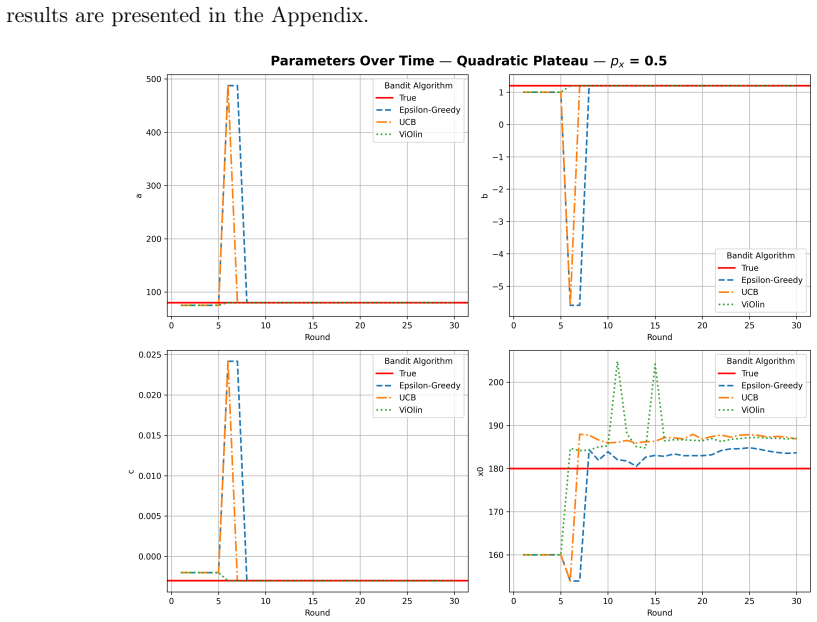
- Estimated parameters such as the plateau threshold and nutrient-efficiency index converge toward their true values as trials accumulate, so recommended rates are traceable to interpretable biological quantities.
- As fertilizer price rises, the algorithms shift toward lower optimal N rates; UCB and ViOlin adapt, while a fast-decaying ε-greedy can lock onto a suboptimal rate in misspecified settings.
Reading between the lines
- The abstract promises an offline replay case study on multi-site corn nitrogen field trials from the U.S. Midwest, but that study does not appear in the supplied full text; the empirical evidence actually reported is simulation-based.
- The dimension-free sample-complexity theorem needs a structure-dependent fat-shattering bound for the specific agronomic families; the generic bounded-class bound used in the proof is not valid for arbitrary bounded classes, so the strength of the guarantee depends on a class-specific repair.
- If the action-space-independence claim can be restored for these parametric families, the same template should transfer to other input decisions with known saturating responses—irrigation, pesticide dose, planting density—and to variable-rate applications across heterogeneous fields.
- The advantage of mechanistic models should be largest at the start of learning and shrink as data accumulate; comparing the model-based methods against kNN-UCB at much longer horizons would clarify when the domain structure stops paying for itself.
Editorial analysis
A structured set of objections, weighed in public.
Referee Report
Summary. The paper develops model-based multi-armed bandit algorithms for agronomic fertilizer decisions, using nonlinear yield-response models (Mitscherlich, Michaelis-Menten, quadratic plateau, logistic) within epsilon-greedy, UCB, and ViOlin frameworks. The authors claim theoretical guarantees: a bound on sequential Rademacher complexity for bounded function classes (Theorem 2) and an ensuing dimension-independent sample complexity for identifying near-optimal fertilizer rates (Corollary 1, Section 6). They also report simulation studies in well-specified and misspecified settings comparing nonlinear model-based methods with LinUCB and kNN-UCB. The abstract additionally promises an offline replay case study on U.S. Midwest corn nitrogen field trials, but the body contains no such empirical study.
Significance. If the theoretical claims were valid, the paper would provide a useful bridge between classical mechanistic agronomic models and modern sequential decision-making, with potential practical value for data-scarce fertilizer management. The simulation framework and closed-form profit-maximizing dose derivations in Table 2 are practical and clearly presented. However, the central theoretical contribution is unsupported because the key lemma used in Theorem 2 is false for general bounded function classes. The promised real-data offline replay case study is absent from the body. With the main advertised guarantees invalidated and a major claimed empirical contribution missing, the manuscript in its current form does not meet the standard for publication.
major comments (3)
- [Appendix A, Eq. (11); Theorem 2] The proof of Theorem 2 relies on the inequality fat_alpha(F) <= ceil(2B/alpha) for every class F uniformly bounded by B. This inequality is false in general. As a counterexample, take F = {-B,B}^X with an infinite input space X and alpha = B/2. With witnesses s_i=0, every subset of any finite subset of X is realized by a function in F, so fat_{B/2}(F) is infinite, while the claimed bound is ceil(2B/(B/2)) = 4. The same construction also contradicts the theorem statement: the sequential Rademacher complexity of this class is at least B for every T, rather than O(B sqrt(log T / T)). Since Theorem 2 is the only bridge to Corollary 1 and the Section 6 claim that sample complexity is polynomial in 1/epsilon and independent of the action-space size, the central theoretical guarantee is not established. A structure-dependent fat-shattering bound for the specific agronomic model classes would be
- [Section 4.1, Theorem 1 vs. Theorem 2] Theorem 1, taken from Dong et al. (2021), requires a bound on the sequential Rademacher complexity of the loss function class induced by the reward function class. Theorem 2 bounds the sequential Rademacher complexity of the reward class F directly. The paper does not show that the loss class (for example, the class of squared-error losses composed with F) inherits the boundedness, fat-shattering, or other regularity conditions used in Theorem 1. Thus even if the boundedness argument in Theorem 2 were correct, the sample-complexity conclusion in Corollary 1 would not follow as written.
- [Abstract / Section 5] The abstract promises an offline replay case study on publicly available multi-site corn nitrogen field trials from the U.S. Midwest. The body contains no such study: Section 5.2 is a synthetic well-specified quadratic-plateau simulation and Section 5.3 is a synthetic misspecified Mitscherlich-to-quadratic-plateau simulation. No real field trial data are analyzed. This is a substantial mismatch between the claimed contribution and the actual content, and the missing case study cannot be evaluated.
minor comments (4)
- [Section 5.2 and Appendix D] The text states that 'similar trends were observed across other values of the fertilizer price' in the well-specified setting, but only one price (px=0.7) is shown in the main text. Some additional results appear in Appendix D, but the main-text assertion would be easier to verify if the corresponding figures were referenced explicitly where the claim is made.
- [Algorithm 4 and Section 3.4] Algorithm 4 uses quantities b∇_x f(θ*, x_t) and b∇²_x f(θ*, x_t), described as estimated by random perturbations or finite differences, but no concrete estimator is specified. In a noisy bandit setting, the behavior of these estimates is important for the algorithm's practical implementation.
- [Throughout] There are minor typographical and formatting issues, such as 'ViOlinalgorithm' without a space in several places (e.g., Section 3.4 and Algorithm 4 title). These do not affect the technical content but should be cleaned up.
- [Section 5.2] The regret definition uses E[Π(x*;θ*) - Π(x_t;θ*)], where the expectation is over the noise and algorithm randomness. The simulation reports sample averages over only 10 replicates. A statement of the standard error or confidence intervals would help assess the variability of the reported regret curves, especially when comparing methods with similar performance.
Circularity Check
No significant circularity: the theoretical claims are instantiations of external results (Dong et al. 2021; Rakhlin et al. 2015a) and the empirical comparisons are simulations against known generative models, not fitted parameters renamed as predictions.
full rationale
The paper's derivation chain is not circular in the sense defined by the review. The sample-complexity claim in Section 4 and Corollary 1 is obtained by taking Dong et al.'s Theorem 1.1 as an external template and plugging in a purported bound on sequential Rademacher complexity from Rakhlin et al. (2015a). This is a direct application of cited results, not a case where the paper defines X in terms of Y or fits a parameter and then reports it as a prediction. The only self-citation, Arya and Yang (2020), appears in a list of algorithms studied previously and is not load-bearing for the paper's theoretical or empirical conclusions. The simulation studies compare algorithms on data generated from explicit mechanistic models (quadratic plateau, Mitscherlich, etc.) with stated true parameters; the model-based methods use nonlinear least squares on the observed data, and no fitted coefficient is later relabeled as an independent prediction. I note separately, as correctness concerns rather than circularity, that the abstract promises an offline replay case study on corn nitrogen field trials that does not appear in the provided body, and that Appendix A's fat-shattering bound fat_alpha(F) <= ceil(2B/alpha) is false for general bounded function classes, which undermines Theorem 2 and Corollary 1. These are evidentiary or mathematical-support failures, not circular reasoning: the claims rest on an external lemma, not on the paper's own outputs. Therefore the appropriate circularity score is 0.
Assumptions & free parameters
free parameters (2)
- Algorithm hyperparameters (epsilon_t, alpha, alpha1, alpha2, k) =
epsilon_t = t^{-1.5}, alpha = 1, alpha1 = 2.0, alpha2 = 640, k = 3
- Initial parameter values for nonlinear least squares (Table 4) =
e.g., Mitscherlich A=100, b=0.01, d=75; Quadratic Plateau a=75, b=1.0, c=-0.002, x0=160
assumptions (4)
- domain assumption Noise is sub-Gaussian (Eq. 2)
- domain assumption Realizability or shape-compatible misspecification: the fitted nonlinear model class contains or approximates the true yield response (Sections 5.2, 5.3)
- domain assumption Regularity conditions from Dong et al. (bounded gradients and Hessians) hold for agronomic models
- ad hoc to paper fat_alpha(F) <= ceil(2B/alpha) for any class F subset of [-B,B]^X
Cite this review
Pith. "Pith review of Non-Linear Model-Based Sequential Decision-Making in Agriculture." pith.science (2026). https://pith.science/paper/UETDQN23
@misc{pith2026250901924,
  author       = {Pith},
  title        = {Pith review of: Non-Linear Model-Based Sequential Decision-Making in Agriculture},
  year         = {2026},
  howpublished = {\url{https://pith.science/paper/UETDQN23}},
  note         = {Machine review of arXiv:2509.01924}
}
read the original abstract
Agricultural decision-making faces a dual challenge: sustaining high yields to meet global food security needs while reducing the environmental impacts of input use, including fertilizer losses and other agrochemical applications such as herbicides, insecticides, and fungicides. Nitrogen inputs are central to this tension. They are indispensable for crop growth yet major drivers of greenhouse gas emissions, nutrient runoff, and escalating production costs. Addressing these intertwined pressures requires adaptive decision-support tools that are statistically principled, economically sustainable and interpretable for practitioners. We develop nonlinear model-based bandit algorithms as a framework for adaptive fertilizer management under uncertainty. Building on classical mechanistic yield-response models, our approach links algorithmic exploration-exploitation strategies directly to interpretable biological processes such as maximum yield and nutrient efficiency. This grounding makes recommendations transparent for practitioners while supporting cost-effective and sustainable input use. Methodologically, we establish regret and sample complexity results for the well-specified nonlinear case, examine robustness under misspecification, and evaluate the proposed methods through profit-oriented simulations and an offline replay case study on publicly available multi-site corn nitrogen field trials from the U.S. Midwest. The results show that incorporating biologically meaningful mechanistic structure enables faster learning and higher profit as evidence accumulates, with flexible nonparametric baselines providing a competitive alternative in pooled and heterogeneous settings. Our findings illustrate how interpretable, uncertainty-aware sequential decision rules can support economically sustainable fertilizer recommendations and contribute to more efficient agricultural input use.
Figures


Figures from the paper (9 more)


Reference graph
Works this paper leans on
-
[1]
Abbasi-Yadkori, Y., P \'a l, D., and Szepesv \'a ri, C. (2011). Improved algorithms for linear stochastic bandits. Advances in neural information processing systems , 24
2011
-
[2]
Agarwal, A., Foster, D. P., Hsu, D., Kakade, S. M., and Langford, J. (2012). Contextual bandit learning with predictable rewards. In Proceedings of the 15th International Conference on Artificial Intelligence and Statistics (AISTATS) , volume 22, pages 19--26
work page 2012
-
[3]
Arya, S. and Yang, Y. (2020). Randomized allocation with nonparametric estimation for contextual multi-armed bandits with delayed rewards. Statistics & Probability Letters , page 108818
work page 2020
-
[4]
Auer, P. and Ortner, R. (2010). UCB revisited: Improved regret bounds for the stochastic multi-armed bandit problem. Periodica Mathematica Hungarica , 61(1-2):55--65
work page 2010
-
[5]
Bastani, H., Bayati, M., and Khosravi, K. (2020). Mostly exploration-free algorithms for contextual bandits. Management Science , 66(2):780--803
work page 2020
-
[6]
Baudry, D., Gautron, R., Kaufmann, E., and Maillard, O. (2021). Optimal T hompson sampling strategies for support-aware cvar bandits. In International Conference on Machine Learning , pages 716--726. PMLR
work page 2021
-
[7]
B \'e langer, G., Walsh, J. R., Richards, J. E., Milburn, P. H., and Ziadi, N. (2000). Comparison of three statistical models describing potato yield response to nitrogen fertilizer. Agronomy Journal , 92(5):902--908
work page 2000
-
[8]
Berry, D. A. and Fristedt, B. (1985). Bandit problems: sequential allocation of experiments (monographs on statistics and applied probability). London: Chapman and Hall , 5:71--87
work page 1985
Show all 51 references
-
[9]
Chu, W., Li, L., Reyzin, L., and Schapire, R. E. (2011). Contextual bandits with linear payoff functions. In Proceedings of the 14th International Conference on Artificial Intelligence and Statistics (AISTATS) , volume 15, pages 208--214
2011
-
[10]
P., and Kakade, S
Dani, V., Hayes, T. P., and Kakade, S. M. (2008). Stochastic linear optimization under bandit feedback. In Conference on Learning Theory (COLT) , pages 355--366
2008
-
[11]
De Bruin, J. L. and Pedersen, P. (2008). Soybean seed yield response to planting date and seeding rate in the upper midwest. Agronomy Journal , 100(3):696--703
2008
-
[12]
S., Sanderson, R., Cardenas, L., Shepherd, A., Chadwick, D., Powell, C., Ellis, J., L \'o pez, S., and France, J
Dhanoa, M. S., Sanderson, R., Cardenas, L., Shepherd, A., Chadwick, D., Powell, C., Ellis, J., L \'o pez, S., and France, J. (2022). Overview and application of the M itscherlich equation and its extensions to estimate the soil nitrogen pool fraction associated with crop yield...
2022
-
[13]
Dobermann, A., Bruulsema, T., Cakmak, I., Gerard, B., Majumdar, K., McLaughlin, M., Reidsma, P., Vanlauwe, B., Wollenberg, L., Zhang, F., et al. (2022). Responsible plant nutrition: A new paradigm to support food system transformation. Global Food Security , 33:100636
2022
-
[14]
Dong, K., Yang, J., and Ma, T. (2021). Provable model-based nonlinear bandit and reinforcement learning: S helve optimism, embrace virtual curvature. Advances in Neural Information Processing Systems , 34:26168--26182
2021
-
[15]
Filippi, S., Cappe, O., Garivier, A., and Szepesv \'a ri, C. (2010). Parametric bandits: T he generalized linear case. In Advances in Neural Information Processing Systems , volume 23, pages 586--594
2010
-
[16]
J., Krishnamurthy, A., Syrgkanis, V., and Agarwal, A
Foster, D. J., Krishnamurthy, A., Syrgkanis, V., and Agarwal, A. (2018). Practical contextual bandits with regression oracles. In Proceedings of the 35th International Conference on Machine Learning (ICML) , pages 1539--1548
2018
-
[17]
Gautron, R., Maillard, O.-A., Preux, P., Corbeels, M., and Sabbadin, R. (2022). Reinforcement learning for crop management support: R eview, prospects and challenges. Computers and Electronics in Agriculture , 200:107182
2022
-
[18]
R., and Gopalan, A
Ghosh, A., Chowdhury, S. R., and Gopalan, A. (2017). Misspecified linear bandits. In Proceedings of the AAAI Conference on Artificial Intelligence , volume 31
2017
-
[19]
Greenewald, K., Krishnamurthy, A., Lattimore, T., Slivkins, A., and Syrgkanis, V. (2021). Adapting to misspecification in contextual bandits. In Proceedings of the 38th International Conference on Machine Learning (ICML) , pages 3832--3842
2021
-
[20]
and Carberry, P
Hochman, Z. and Carberry, P. (2011). Emerging consensus on desirable characteristics of tools to support farmers' management of climate risk in A ustralia. Agricultural Systems , 104(6):441--450
2011
-
[21]
Huang, Q. (2025). Precision agriculture optimization based on multi-armed bandits algorithm: W heat yield optimization under different temperature and precipitation conditions. In ITM Web of Conferences , volume 73, page 01013. EDP Sciences
2025
-
[22]
Jabed, M. A. and Murad, M. A. A. (2024). Crop yield prediction in agriculture: A comprehensive review of machine learning and deep learning approaches, with insights for future research and sustainability. Heliyon
2024
-
[23]
Khairunniza-Bejo, S., Mustaffha, S., and Ismail, W. I. W. (2014). Application of artificial neural network in predicting crop yield: A review. Journal of Food Science and Engineering , 4(1):1
2014
-
[24]
Khaki, S., Wang, L., and Archontoulis, S. V. (2020). A CNN-RNN framework for crop yield prediction. Frontiers in Plant Science , 10:1750
2020
-
[25]
and Zhang, T
Langford, J. and Zhang, T. (2008). The epoch-greedy algorithm for multi-armed bandits with side information. In Advances in Neural Information Processing Systems , pages 817--824
2008
-
[26]
Lattimore, T., Munos, R., and Szepesv \'a ri, C. (2020). Learning with misspecified linear bandit models. In Conference on Learning Theory , pages 1112--1146
2020
-
[27]
and Szepesv \'a ri, C
Lattimore, T. and Szepesv \'a ri, C. (2018). Bandit algorithms. Cambridge University Press
2018
-
[28]
Li, L., Chu, W., Langford, J., and Schapire, R. E. (2010). A contextual-bandit approach to personalized news article recommendation. In Proceedings of the 19th International Conference on World Wide Web , pages 661--670. ACM
2010
-
[29]
Lopez, S., France, J., Gerrits, W., Dhanoa, M., Humphries, D., and Dijkstra, J. (2000). A generalized M ichaelis- M enten equation for the analysis of growth. Journal of animal science , 78(7):1816--1828
2000
-
[30]
Lu, Y., Xu, Z., and Tewari, A. (2021). Bandit algorithms for precision medicine. arXiv preprint arXiv:2108.04782
2021 arXiv
-
[31]
Miguez, F., Archontoulis, S., and Dokoohaki, H. (2018). Nonlinear regression models and applications. Applied statistics in agricultural, biological, and environmental sciences , pages 401--447
2018
-
[32]
and Van Roy, B
Osband, I. and Van Roy, B. (2014). Model-based reinforcement learning and the E luder dimension. Advances in Neural Information Processing Systems , 27
2014
-
[33]
Rakhlin, A., Sridharan, K., and Tewari, A. (2015a). Online learning via sequential complexities. Journal of Machine Learning Research , 16(6):155--186
-
[34]
Rakhlin, A., Sridharan, K., and Tewari, A. (2015b). Sequential complexities and uniform martingale laws of large numbers. Probability theory and related fields , 161:111--153
-
[35]
Reeve, H., Mellor, J., and Brown, G. (2018). The k-nearest neighbour UCB algorithm for multi-armed bandits with covariates. In Algorithmic Learning Theory , pages 725--752. PMLR
2018
-
[36]
and Zeevi, A
Rigollet, P. and Zeevi, A. (2010). Nonparametric bandits with covariates. COLT 2010 , page 54
2010
-
[37]
Robbins, H. (1952). Some aspects of the sequential design of experiments. Bulletin of the American Mathematical Society , 58(5):527--535
1952
-
[38]
D., and Colquhoun, J
Saikai, Y., Mitchell, P. D., and Colquhoun, J. (2018). Multi-armed bandit for experimental plot selection. Technical report, Agricultural and Applied Economics Association
2018
-
[39]
Saikai, Y., Patel, V., and Mitchell, P. D. (2020). Machine learning for optimizing complex site-specific management. Computers and Electronics in Agriculture , 174:105381
2020
-
[40]
R., Fahandezh-Saadi, S., and Zand-Parsa, S
Sepaskhah, A. R., Fahandezh-Saadi, S., and Zand-Parsa, S. (2011). Logistic model application for prediction of maize yield under water and nitrogen management. Agricultural Water Management , 99(1):51--57
2011
-
[41]
A., Hu, G., and Archontoulis, S
Shahhosseini, M., Martinez-Feria, R. A., Hu, G., and Archontoulis, S. V. (2019). Maize yield and nitrate loss prediction with machine learning algorithms. Environmental Research Letters , 14(12):124026
2019
-
[42]
Slivkins, A. (2014). Contextual bandits with similarity information. Journal of Machine Learning Research , 15:2533--2568
2014
-
[43]
Smith, M. J. (2018). Getting value from artificial intelligence in agriculture. Animal Production Science , 60(1):46--54
2018
-
[44]
M., and Seeger, M
Srinivas, N., Krause, A., Kakade, S. M., and Seeger, M. (2010). Gaussian process optimization in the bandit setting: No regret and experimental design. In Proceedings of the International Conference on Machine Learning, 2010
2010
-
[45]
M., and Seeger, M
Srinivas, N., Krause, A., Kakade, S. M., and Seeger, M. W. (2012). Information-theoretic regret bounds for G aussian process optimization in the bandit setting. IEEE transactions on information theory , 58(5):3250--3265
2012
-
[46]
Sun, W., Jiang, N., Krishnamurthy, A., Agarwal, A., and Langford, J. (2019). Model-based RL in contextual decision processes: Pac bounds and exponential improvements over model-free approaches. In Conference on learning theory , pages 2898--2933. PMLR
2019
-
[47]
G., Matson, P
Tilman, D., Cassman, K. G., Matson, P. A., Naylor, R., and Polasky, S. (2002). Agricultural sustainability and intensive production practices. Nature , 418(6898):671--677
2002
-
[48]
Valko, M., Korda, N., Munos, R., Flaounas, I., and Cristianini, N. (2013). Finite-time analysis of kernelised contextual bandits. In Proceedings of the Twenty-Ninth Conference on Uncertainty in Artificial Intelligence , pages 654--663
2013
-
[49]
Wang, K., Kallus, N., and Sun, W. (2023). Near-minimax-optimal risk-sensitive reinforcement learning with CVaR . In International Conference on Machine Learning , pages 35864--35907. PMLR
2023
-
[50]
and Zhu, D
Yang, Y. and Zhu, D. (2002). Randomized allocation with nonparametric estimation for a multi-armed bandit problem with covariates. The Annals of Statistics , (1):100--121
2002
-
[51]
Zhou, D., Li, L., and Gu, Q. (2020). Neural contextual bandits with UCB -based exploration. In International Conference on Machine Learning , pages 11492--11502. PMLR
2020
Reviewed August 5, 2026 · model on record in the stance chip above.
Discussion (0). Continue with ORCID to comment.