REVIEW 4 major objections 5 minor 64 references
Radiative Transfer Modeling of a Shadowed Protoplanetary Disk assisted by a Neural Network
T0 review · 4 major / 5 minor · reviewed 2026-08-05 · deepseek-v4-flash
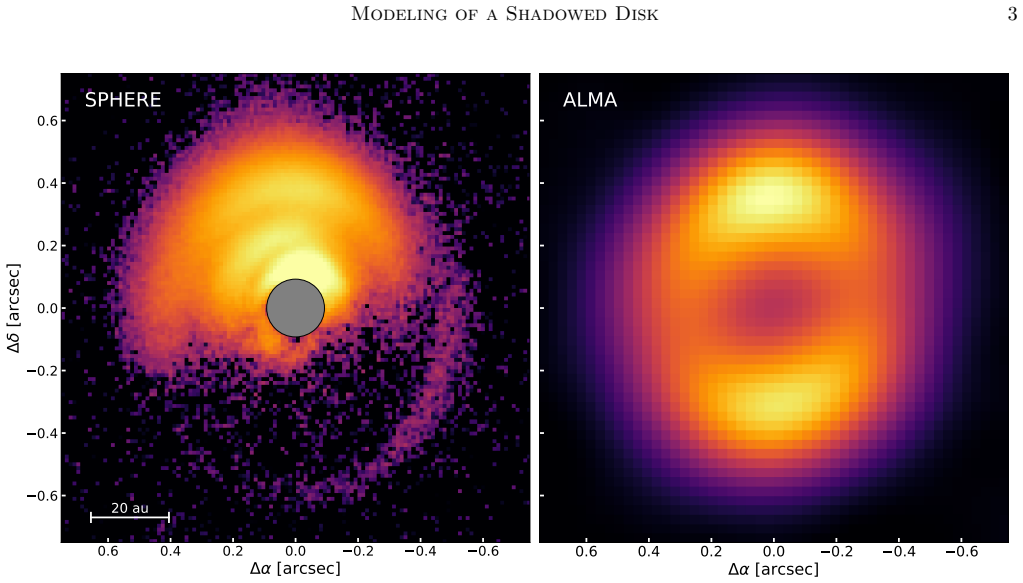
Pith's one-line read The dark southern half of V1098 Sco's disk is a shadow cast by a small inner disk tilted 38 degrees relative to the outer disk.
desk verdict Solid qualitative shadow explanation; quantitative geometry is model-dependent—worth a referee, especially to test the sharp-break vs. warp degeneracy. read the letter →
The pith
A machine-rendered reading of the paper's core claim, the machinery that carries it, and where it could break.
The reading
What carries the argument
The central mechanism is a two-zone disk model split at a sharp break radius Rtilt: an outer large-grain disk and an inner small-grain disk tilted by angles itilt and PAtilt. The model uses a spherical-trigonometry identity, mu = arccos[sin(i_outer) sin(i_tilt) cos(DeltaPA) + cos(i_outer) cos(i_tilt)], to convert the fitted projected inclinations and position-angle difference into the physical 38-degree misalignment. A neural network trained on radiative-transfer images interpolates between expensive model grid points, enabling a Markov-chain Monte Carlo fit to the shadow morphology.
What would settle it
Map CO emission inside roughly 30 au at high angular resolution: the model predicts a more face-on, nearly orthogonal rotating inner component with its redshifted side near position angle -77 degrees, rotating in the same sense as the outer disk. If the inner gas appears aligned with the outer disk, rotates retrograde, or is absent, the 38-degree misalignment claim fails. A deep high-contrast near-infrared search at the separations allowed by the companion mass-radius curve could also find or exclude the warp-driving companion.
Extended reading notes
Core claim
The paper argues that the southern half of the scattered-light image is dark because an inner disk of small dust grains is tilted relative to the outer disk and casts a shadow across it. The outer disk, fitted to millimeter continuum and gas kinematics, is a ring centered at 63 au with a cavity of roughly 40 au, inclined about 40 degrees. The inner disk is more face-on (inclination about 13 degrees) and almost orthogonal in position angle (about 103 degrees), with a break radius of about 23 au. Combining the two orientations through the standard spherical-trigonometry relation for misalignment gives a 38-degree angle between the rotation axes. The faint southern arc is interpreted as the ext
Load-bearing premise
The model assumes the disk is two flat, rigidly tilted zones joined at a single sharp radius, with the faint southern arc coming from the illuminated back side of the outer disk, and that the inner and outer disks rotate in the same sense; if any of these fail, the fitted break radius, tilt angles, and the 38-degree misalignment would shift.
Editorial extensions
If this is right
- V1098 Sco joins a growing class of disks where a scattered-light shadow traces a misaligned inner zone, showing that a seemingly missing half of a disk can be a purely geometric projection.
- The fitted break radius lies inside the millimeter cavity, linking the dusty ring's inner edge with the radius at which the disk is broken and tilted.
- The inferred inner-disk orientation predicts that high-resolution CO observations of the central region should reveal a more face-on, slowly rotating component whose redshifted side lies at position angle about -77 degrees.
- Applying the disk-breaking criterion from the companion-mass relation gives a lower bound on a(M/(1 M_sun + M))^(1/2) of about 1.4 au, pointing to a planet-mass or substellar companion rather than a close equal-mass binary.
- Replacing slow radiative-transfer image generation with neural-network interpolation makes Bayesian fitting of disk morphology practical, a route the paper argues is broadly applicable to other scattered-light disks.
Reading between the lines
- If the shadow interpretation is correct, scattered-light shadows can serve as a direct probe of a hidden inner disk's orientation even when that disk is too faint or too small to image directly.
- The companion mass-radius constraint depends on the assumed aspect ratio at 23 au; a deep high-contrast imaging search at the allowed separations could find or exclude the proposed companion and directly test the warp-driving picture.
- The same-direction rotation assumption is essential: if future kinematic data showed the inner disk counter-rotating relative to the outer disk, the 38-degree misalignment angle would no longer follow from the projected position-angle difference.
- Because the image-threshold comparison deliberately ignores surface brightness, the method may recover misalignment angles robustly even for disks with different grain properties, making it a geometry-focused counterpart to intensity-based fitting.
Editorial analysis
A structured set of objections, weighed in public.
Referee Report
Summary. The paper presents ALMA Band 7 continuum and CO 3-2 observations and VLT/SPHERE H-band scattered-light imaging of the T Tauri star V1098 Sco. The ALMA data reveal an outer dust ring at ~63 au with a large central cavity; the CO kinematics give a stellar mass of ~1 Msun. The SPHERE image shows a large shadow across the southern half of the disk plus a faint southern arc. The authors model the disk with radmc3d, using a two-population dust prescription and a two-zone geometry in which a small-grain inner disk is rigidly tilted at a break radius Rtilt relative to the outer disk. A neural-network emulator is trained on 1024 Sobol-sampled radiative-transfer models and used inside an MCMC to fit five parameters (Rtilt, itilt, PAtilt, H1, beta) against auto-thresholded binary images of the scattered-light morphology. The best fit gives Rtilt=23.4 au, itilt=13.1 deg, PAtilt=102.9 deg, H1=0.048 au, beta=1.092, implying a 38 deg misalignment between the inner and outer disk rotation axes via Eq. (5). The paper then uses Eq. (6) to argue for a companion-induced break and presents the neural-network forward-modeling approach as broadly applicable.
Significance. If the inferred geometry is correct, V1098 Sco becomes a valuable addition to the small sample of protoplanetary disks with a large misalignment shadow, and the 38 deg inner-outer axis misalignment would be an important constraint on disk breaking and companion-driven evolution. The methodological contribution, using a neural-network emulator to make Bayesian radiative-transfer modeling feasible, is timely and is demonstrated with a validation set. The paper's strengths include the step-by-step treatment of ALMA visibilities and kinematics, the open presentation of the model grid, and the explicit recognition that the model description limits the precision. However, the quantitative claims (Rtilt, the misalignment angle, and especially the companion constraint of Eq. 6) rest on the assumed sharp-break geometry and on an ad hoc binary-image likelihood, and one of the numerical inputs to Eq. (6) appears to be inconsistent with the fitted scale height. These issues must be addressed before the quantitative results can be relied on.
major comments (4)
- [§5, Eq. (6)] The text states that the aspect ratio at the inner-disk edge is H/R ≈ 2.7e-3. Using the fitted values from Table 3 in Eq. (3) gives H(23.4 au) ≈ 0.048 × 23.4^1.092 ≈ 1.5 au, so H/R ≈ 0.064, not 2.7e-3. With H/R ≈ 0.064, the right-hand side of Eq. (6) becomes ~108 au rather than the quoted 1.4 au. This changes the companion mass-radius relation in Fig. 15 by an order of magnitude and directly affects the paper's companion constraints. Please re-evaluate this calculation and correct the associated discussion and figure.
- [§4.2, sharp-break assumption] The model family contains only a flat inner disk and a flat outer disk joined at a single break radius Rtilt. The likelihood is computed from binary thresholded masks, which compress all intensity information into bright/dark regions. A continuously warped disk with radially varying inclination and position angle could plausibly produce very similar projected shadow and arc morphologies. No continuous-warp model is computed or compared, even though the CO residuals and the bright inner ring suggest extended structure. Because Rtilt and the misalignment angle enter Eq. (6), the companion constraint is not robust to this model degeneracy. Please test representative smooth-warp profiles, or explicitly demonstrate that the thresholded masks are sensitive to the sharpness of the break, before presenting Rtilt and the 38 deg misalignment as unique physical parameters.
- [§4.2.2, Table 3 and Fig. 12] The quoted 1σ uncertainties (0.2 au in Rtilt, 0.3-0.4 deg in the angles) are formal MCMC widths for a likelihood defined as the sum of squared differences of binary-thresholded images. No noise model is specified for this statistic, and the choice of the triangle threshold is not varied or tested. The manuscript acknowledges that model validity limits the precision, but the abstract and §6 report the numerical values without this caveat. Please add a systematic-error estimate, e.g., by varying the threshold algorithm or threshold parameters and repeating the fit, and phrase the final constraints as conditional on the adopted geometry and thresholding procedure.
- [§4.2, southern arc] The faint southern arc is identified as backside scattering under the sharp-break geometry, and it is used as an 'extra, critical constraint' on the inner disk. However, the arc is ~100 times fainter than the northern disk, and the binary-threshold likelihood may be dominated by the bright northern emission. The paper does not show that the fit actually reproduces the arc region specifically. Please quantify the model-data overlap restricted to the southern arc (e.g., a masked binary overlap or a separate likelihood term for the arc), otherwise the arc-based constraint on the geometry is not established independently of the qualitative image comparison.
minor comments (5)
- [Abstract and §6] Typos: 'over it's' should be 'over its' in the abstract; 'morhpology' should be 'morphology' in §6.
- [Figure 10] The y-axis label 'Mean and Standard Deviation (%)' is ambiguous. Please specify the normalization (e.g., percentage of the mean image intensity or of the peak) and state explicitly how 'hot' pixels were clipped before computing the statistics.
- [Notation] The break radius is 'Rtilt' in the text and Table 2 but 'rtilt' in the appendix figure captions; 'PAtilt' and 'PA tilt' are used inconsistently. Please unify.
- [Figure 13 caption] The dashed ellipse is described as showing the break radius 'at 20 au', but the best-fit Rtilt in Table 3 is 23.4 au. Please correct the caption to the actual value used in the model.
- [§4.2.1] The phrase 'The accuracy of an extrapolation from 5 inputs...' should say 'interpolation', since the network is evaluated inside the parameter boundaries of the grid.
Circularity Check
No significant circularity: the paper's central results are forward-model fits and derived constraints, not restatements of their own inputs.
full rationale
The derivation chain is self-contained forward modeling. The outer-disk geometry and stellar mass are determined independently from ALMA visibilities and CO kinematics (Section 3) and then fixed as inputs to the radiative transfer model; the SPHERE shadow is not an input to those fits. The inner-disk parameters {Rtilt, itilt, PAtilt, H1, beta} are estimated by MCMC against binary-thresholded model/data morphologies (Section 4.2.2), so reproducing the shadow is a fit, not an independent prediction—but this is ordinary parameter estimation, not circularity. Equation (5) is a spherical-trig identity that converts the fitted inclinations and projected position-angle difference into a misalignment angle; it is not an input. Equation (6) applies an external theoretical formula from Nixon et al. (2013) to the fitted Rtilt and misalignment, producing a companion constraint that is a derived consequence of the fit, not a restatement of an input assumption. The cited prior shadow-disk geometries (Benisty et al. 2018; Muro-Arena et al. 2020) are used as an illustrative template, not as a uniqueness theorem or as a justification that forbids alternative geometries. The only self-citation in a load-bearing position, M. Min et al. (2017) for Eq. 5, includes a co-author but supplies a parameter-free mathematical formula rather than a fitted or empirical claim. The paper itself acknowledges that the quoted statistical uncertainties are limited by the validity of the model description, and the possibility of a smooth warp is a model-degeneracy/correctness concern, not a circular step. No fitted parameter is renamed as a prediction, and no central claim reduces to a self-citation chain by construction.
Assumptions & free parameters
free parameters (15)
- Outer disk inclination i_outer =
40.1 +/- 0.25 deg
- Outer disk position angle PA_outer =
-2.0 +/- 0.4 deg
- Stellar mass M* =
0.99 Msun
- Large grain surface density normalization Sigma1_big =
2.2 g/cm^2
- Large grain power law index alpha_big =
1
- Large grain inner radius Rin_big =
~40 au
- Large grain outer radius Rout_big =
~85 au
- Small grain inner radius Rin_small =
0.5 au
- Small grain outer radius Rout_small =
96 au
- Tilt radius Rtilt =
23.4 +/- 0.2 au
- Inner disk inclination itilt =
13.1 +/- 0.4 deg
- Inner disk position angle PAtilt =
102.9 +/- 0.3 deg
- Scale height at 1 au H1 =
0.048 +/- 0.001 au
- Flaring index beta =
1.092 +/- 0.003
- Grain size mass fraction =
10% small, 90% large
assumptions (6)
- domain assumption radmc3d correctly solves the radiative transfer equation for scattering in this protoplanetary disk geometry
- domain assumption The CO velocity field traces a flat Keplerian disk; stellar mass derived with fixed inclination 40.1 deg
- domain assumption Dust opacities for amorphous olivine with 50/50 Mg/Fe and two grain sizes are adequate for scattered light morphology
- ad hoc to paper The auto-thresholding (triangle) algorithm provides binary maps that fairly represent the salient morphology
- domain assumption The Nixon et al. (2013) disk-breaking formula applies to protoplanetary disks in the wave-like regime (alpha < H/R)
- ad hoc to paper The direction of rotation of the inner disk is the same as the outer disk
invented entities (1)
-
Perturbing planetary or substellar companion
Cite this review
Pith. "Pith review of Radiative Transfer Modeling of a Shadowed Protoplanetary Disk assisted by a Neural Network." pith.science (2026). https://pith.science/paper/LQHWQ23I
@misc{pith2026250901937,
  author       = {Pith},
  title        = {Pith review of: Radiative Transfer Modeling of a Shadowed Protoplanetary Disk assisted by a Neural Network},
  year         = {2026},
  howpublished = {\url{https://pith.science/paper/LQHWQ23I}},
  note         = {Machine review of arXiv:2509.01937}
}
read the original abstract
We present observations and detailed modeling of a protoplanetary disk around the T Tauri star, V1098 Sco. Millimeter wavelength data from the Atacama Large Millimeter Array (ALMA) show a ring of large dust grains with a central cavity that is filled with molecular gas. Near-infrared data with the Very Large Telescope (VLT) detect the scattered starlight from the disk surface and reveal a large shadow that extends over it's entire southern half. We model the ALMA continuum and line data to determine the outer disk geometry and the central stellar mass. Using radiative transfer models, we demonstrate that a misaligned inner disk, tilted in both inclination and position angle with respect to the outer disk, can reproduce the salient scattered light features seen with the VLT. Applying an image threshold algorithm to compare disk morphologies and training a neural network on a set of high signal-to-noise models, we forward model the data and determine the inner disk geometry. We find that the rotation axes of the inner and outer disks are misaligned by 38 degrees and constrain the mass and location of a perturbing planetary or substellar companion. The technique of simulation based inference that is illustrated here is broadly applicable for radiative transfer modeling of other objects.
Figures


Figures from the paper (15 more)


Reference graph
Works this paper leans on
-
[1]
, " * write output.state after.block = add.period write newline
ENTRY address archivePrefix author booktitle chapter doi edition editor eprint howpublished institution journal key month number organization pages publisher school series title misctitle type volume year version url label extra.label sort.label short.list INTEGERS output.state before.all mid.sentence after.sentence after.block FUNCTION init.state.consts ...
-
[2]
write newline
" write newline "" before.all 'output.state := FUNCTION format.url url empty "" new.block "" url * "" * if FUNCTION format.eprint eprint empty "" archivePrefix empty "" archivePrefix "arXiv" = new.block " " eprint * " " * new.block " " eprint * " " * if if if FUNCTION format.doi doi empty "" " " doi * " " * if FUNCTION format.pid doi empty eprint empty ur...
-
[3]
thebibliography [1] 20pt to REFERENCES 6pt =0pt \@twocolumntrue 12pt -12pt 10pt plus 3pt =0pt =0pt =1pt plus 1pt =0pt =0pt -12pt =13pt plus 1pt =20pt =13pt plus 1pt \@M =10000 =-1.0em =0pt =0pt 0pt =0pt =1.0em @enumiv\@empty 10000 10000 `\.\@m \@noitemerr \@latex@warning Empty `thebibliography' environment \@ifnextchar \@reference \@latexerr Missing key o...
work page 2017
-
[4]
Andrews , S. M. 2020, title Observations of Protoplanetary Disk Structures , , 58, 483, 10.1146/annurev-astro-031220-010302
-
[5]
Ansdell , M., Gaidos , E., Hedges , C., et al. 2020, title Are inner disc misalignments common? ALMA reveals an isotropic outer disc inclination distribution for young dipper stars , , 492, 572, 10.1093/mnras/stz3361
-
[6]
Astropy Collaboration , Robitaille , T. P., Tollerud , E. J., et al. 2013, title Astropy: A community Python package for astronomy , , 558, A33, 10.1051/0004-6361/201322068
-
[7]
Astropy Collaboration , Price-Whelan , A. M., Sipocz , B. M., et al. 2018, title The Astropy Project: Building an Open-science Project and Status of the v2.0 Core Package , , 156, 123, 10.3847/1538-3881/aabc4f
-
[8]
Astropy Collaboration , Price-Whelan , A. M., Lim , P. L., et al. 2022, title The Astropy Project: Sustaining and Growing a Community-oriented Open-source Project and the Latest Major Release (v5.0) of the Core Package , , 935, 167, 10.3847/1538-4357/ac7c74
Show all 64 references
-
[9]
P., Garufi , A., et al
Avenhaus , H., Quanz , S. P., Garufi , A., et al. 2018, title Disks around T Tauri Stars with SPHERE (DARTTS-S). I. SPHERE/IRDIS Polarimetric Imaging of Eight Prominent T Tauri Disks , , 863, 44, 10.3847/1538-4357/aab846
2018 doi
-
[10]
2023, in Astronomical Society of the Pacific Conference Series, Vol
Bae , J., Isella , A., Zhu , Z., et al. 2023, in Astronomical Society of the Pacific Conference Series, Vol. 534, Protostars and Planets VII, ed. S. Inutsuka , Y. Aikawa , T. Muto , K. Tomida , & M. Tamura , 423, 10.48550/arXiv.2210.13314
-
[11]
R., Lodato , G., & Pringle , J
Bate , M. R., Lodato , G., & Pringle , J. E. 2010, title Chaotic star formation and the alignment of stellar rotation with disc and planetary orbital axes , , 401, 1505, 10.1111/j.1365-2966.2009.15773.x
2010
-
[12]
2012, title A primordial origin for misalignments between stellar spin axes and planetary orbits , , 491, 418, 10.1038/nature11560
Batygin , K. 2012, title A primordial origin for misalignments between stellar spin axes and planetary orbits , , 491, 418, 10.1038/nature11560
2012 doi
-
[13]
2018, title Shadows and asymmetries in the T Tauri disk HD 143006: evidence for a misaligned inner disk , , 619, A171, 10.1051/0004-6361/201833913
Benisty , M., Juh \'a sz , A., Facchini , S., et al. 2018, title Shadows and asymmetries in the T Tauri disk HD 143006: evidence for a misaligned inner disk , , 619, A171, 10.1051/0004-6361/201833913
2018 doi
-
[14]
2023, in Astronomical Society of the Pacific Conference Series, Vol
Benisty , M., Dominik , C., Follette , K., et al. 2023, in Astronomical Society of the Pacific Conference Series, Vol. 534, Protostars and Planets VII, ed. S. Inutsuka , Y. Aikawa , T. Muto , K. Tomida , & M. Tamura , 605, 10.48550/arXiv.2203.09991
-
[15]
2012, title A simple model for the evolution of the dust population in protoplanetary disks , , 539, A148, 10.1051/0004-6361/201118136
Birnstiel , T., Klahr , H., & Ercolano , B. 2012, title A simple model for the evolution of the dust population in protoplanetary disks , , 539, A148, 10.1051/0004-6361/201118136
2012 doi
-
[16]
J., Benisty , M., Perraut , K., et al
Bohn , A. J., Benisty , M., Perraut , K., et al. 2022, title Probing inner and outer disk misalignments in transition disks. Constraints from VLTI/GRAVITY and ALMA observations , , 658, A183, 10.1051/0004-6361/202142070
2022 doi
-
[17]
M., Esplin , T
Carpenter , J. M., Esplin , T. L., Luhman , K. L., Mamajek , E. E., & Andrews , S. M. 2025, title Extending the ALMA Census of Circumstellar Disks in the Upper Scorpius OB Association , , 978, 117, 10.3847/1538-4357/ad8ebc
2025 doi
-
[18]
R., et al
Castro-Ginard , A., Penoyre , Z., Casey , A. R., et al. 2024, title Gaia DR3 detectability of unresolved binary systems , , 688, A1, 10.1051/0004-6361/202450172
2024 doi
-
[19]
M., & Hillenbrand , L
Cody , A. M., & Hillenbrand , L. A. 2018, title The Many-faceted Light Curves of Young Disk-bearing Stars in Upper Sco -- Oph Observed by K2 Campaign 2 , , 156, 71, 10.3847/1538-3881/aacead
2018 doi
-
[20]
2024, title Disk Evolution Study Through Imaging of Nearby Young Stars (DESTINYS): HD 34700 A unveils an inner ring , , 681, A19, 10.1051/0004-6361/202347109
Columba , G., Rigliaco , E., Gratton , R., et al. 2024, title Disk Evolution Study Through Imaging of Nearby Young Stars (DESTINYS): HD 34700 A unveils an inner ring , , 681, A19, 10.1051/0004-6361/202347109
2024 doi
-
[21]
2020, title The frontier of simulation-based inference , Proceedings of the National Academy of Science, 117, 30055, 10.1073/pnas.1912789117
Cranmer , K., Brehmer , J., & Louppe , G. 2020, title The frontier of simulation-based inference , Proceedings of the National Academy of Science, 117, 30055, 10.1073/pnas.1912789117
2020 doi
-
[22]
2006, title Effects of Dust Growth and Settling in T Tauri Disks , , 638, 314, 10.1086/498861
D'Alessio , P., Calvet , N., Hartmann , L., Franco-Hern \'a ndez , R., & Serv \' n , H. 2006, title Effects of Dust Growth and Settling in T Tauri Disks , , 638, 314, 10.1086/498861
2006 doi
-
[23]
1995, title Steps toward interstellar silicate mineralogy
Dorschner , J., Begemann , B., Henning , T., Jaeger , C., & Mutschke , H. 1995, title Steps toward interstellar silicate mineralogy. II. Study of Mg-Fe-silicate glasses of variable composition. , , 300, 503
1995
-
[24]
P., Juhasz , A., Pohl , A., et al
Dullemond , C. P., Juhasz , A., Pohl , A., et al. 2012, title RADMC-3D: A multi-purpose radiative transfer tool , , Astrophysics Source Code Library, record ascl:1202.015
2012
-
[25]
2018, title Signatures of broken protoplanetary discs in scattered light and in sub-millimetre observations , , 473, 4459, 10.1093/mnras/stx2523
Facchini , S., Juh \'a sz , A., & Lodato , G. 2018, title Signatures of broken protoplanetary discs in scattered light and in sub-millimetre observations , , 473, 4459, 10.1093/mnras/stx2523
2018 doi
-
[26]
Facchini , S., Lodato , G., & Price , D. J. 2013, title Wave-like warp propagation in circumbinary discs - I. Analytic theory and numerical simulations , , 433, 2142, 10.1093/mnras/stt877
2013 doi
-
[27]
M., & Kraus , A
Fitton , S., Tofflemire , B. M., & Kraus , A. L. 2022, title Disk Material Inflates Gaia RUWE Values in Single Stars , Research Notes of the American Astronomical Society, 6, 18, 10.3847/2515-5172/ac4bb7
2022 doi
-
[28]
B., & Rasio , F
Ford , E. B., & Rasio , F. A. 2008, title Origins of Eccentric Extrasolar Planets: Testing the Planet-Planet Scattering Model , , 686, 621, 10.1086/590926
2008 doi
-
[29]
W., Lang , D., & Goodman , J
Foreman-Mackey , D., Hogg , D. W., Lang , D., & Goodman , J. 2013, title emcee: The MCMC Hammer , , 125, 306, 10.1086/670067
2013 doi
-
[30]
2020, title VizieR Online Data Catalog: Gaia EDR3 (Gaia Collaboration, 2020) , , VizieR On-line Data Catalog: I/350
Gaia Collaboration . 2020, title VizieR Online Data Catalog: Gaia EDR3 (Gaia Collaboration, 2020) , , VizieR On-line Data Catalog: I/350. Originally published in: 2021A&A...649A...1G 10.26093/cds/vizier.1350
2020 doi
-
[31]
2018, title Evolution of protoplanetary disks from their taxonomy in scattered light: spirals, rings, cavities, and shadows , , 620, A94, 10.1051/0004-6361/201833872
Garufi , A., Benisty , M., Pinilla , P., et al. 2018, title Evolution of protoplanetary disks from their taxonomy in scattered light: spirals, rings, cavities, and shadows , , 620, A94, 10.1051/0004-6361/201833872
2018 doi
-
[32]
2020, title Disk Evolution Study Through Imaging of Nearby Young Stars (DESTINYS): A close low-mass companion to ET Cha , , 642, A119, 10.1051/0004-6361/202038383
Ginski , C., M \'e nard , F., Rab , C., et al. 2020, title Disk Evolution Study Through Imaging of Nearby Young Stars (DESTINYS): A close low-mass companion to ET Cha , , 642, A119, 10.1051/0004-6361/202038383
2020 doi
-
[33]
Gregorio-Hetem , J., Lepine , J. R. D., Quast , G. R., Torres , C. A. O., & de La Reza , R. 1992, title A Search for T Tauri Stars Based on the IRAS Point Source Catalog. I. , , 103, 549, 10.1086/116082
1992 doi
-
[34]
Hunter, J. D. 2007, title Matplotlib: A 2D graphics environment, Computing in Science & Engineering, 9, 90, 10.1109/MCSE.2007.55
2007 doi
-
[35]
1994, title Steps toward interstellar silicate mineralogy
Jaeger , C., Mutschke , H., Begemann , B., Dorschner , J., & Henning , T. 1994, title Steps toward interstellar silicate mineralogy. I. Laboratory results of a silicate glass of mean cosmic composition. , , 292, 641
1994
-
[36]
2023, title Analysing the SEDs of protoplanetary disks with machine learning , , 672, A30, 10.1051/0004-6361/202245461
Kaeufer , T., Woitke , P., Min , M., Kamp , I., & Pinte , C. 2023, title Analysing the SEDs of protoplanetary disks with machine learning , , 672, A30, 10.1051/0004-6361/202245461
2023 doi
-
[37]
2025, title exoALMA
Longarini , C., Lodato , G., Rosotti , G., et al. 2025, title exoALMA. XII. Weighing and Sizing exoALMA Disks with Rotation Curve Modelling , , 984, L17, 10.3847/2041-8213/adc431
2025 doi
-
[38]
2015, title Shadows Cast by a Warp in the HD 142527 Protoplanetary Disk , , 798, L44, 10.1088/2041-8205/798/2/L44
Marino , S., Perez , S., & Casassus , S. 2015, title Shadows Cast by a Warp in the HD 142527 Protoplanetary Disk , , 798, L44, 10.1088/2041-8205/798/2/L44
2015 doi
-
[39]
2017, title Connecting the shadows: probing inner disk geometries using shadows in transitional disks , , 604, L10, 10.1051/0004-6361/201730949
Min , M., Stolker , T., Dominik , C., & Benisty , M. 2017, title Connecting the shadows: probing inner disk geometries using shadows in transitional disks , , 604, L10, 10.1051/0004-6361/201730949
2017 doi
-
[40]
A., Benisty , M., Ginski , C., et al
Muro-Arena , G. A., Benisty , M., Ginski , C., et al. 2020, title Shadowing and multiple rings in the protoplanetary disk of HD 139614 , , 635, A121, 10.1051/0004-6361/201936509
2020 doi
-
[41]
G., & Nixon , C
Nealon , R., Dipierro , G., Alexander , R., Martin , R. G., & Nixon , C. 2018, title Warping a protoplanetary disc with a planet on an inclined orbit , , 481, 20, 10.1093/mnras/sty2267
2018 doi
-
[42]
2013, title Tearing up the disc: misaligned accretion on to a binary , , 434, 1946, 10.1093/mnras/stt1136
Nixon , C., King , A., & Price , D. 2013, title Tearing up the disc: misaligned accretion on to a binary , , 434, 1946, 10.1093/mnras/stt1136
2013 doi
-
[43]
J., J rgensen , J
Ohashi , N., Tobin , J. J., J rgensen , J. K., et al. 2023, title Early Planet Formation in Embedded Disks (eDisk). I. Overview of the Program and First Results , , 951, 8, 10.3847/1538-4357/acd384
2023 doi
-
[44]
E., & Lai , D
Owen , J. E., & Lai , D. 2017, title Generating large misalignments in gapped and binary discs , , 469, 2834, 10.1093/mnras/stx1033
2017 doi
-
[45]
2019, title PyTorch: An Imperative Style, High-Performance Deep Learning Library , arXiv e-prints, arXiv:1912.01703, 10.48550/arXiv.1912.01703
Paszke , A., Gross , S., Massa , F., et al. 2019, title PyTorch: An Imperative Style, High-Performance Deep Learning Library , arXiv e-prints, arXiv:1912.01703, 10.48550/arXiv.1912.01703
-
[46]
J., & Mamajek , E
Pecaut , M. J., & Mamajek , E. E. 2016, title The star formation history and accretion-disc fraction among the K-type members of the Scorpius-Centaurus OB association , , 461, 794, 10.1093/mnras/stw1300
2016 doi
-
[47]
2011, title Scikit-learn: Machine Learning in P ython, Journal of Machine Learning Research, 12, 2825
Pedregosa, F., Varoquaux, G., Gramfort, A., et al. 2011, title Scikit-learn: Machine Learning in P ython, Journal of Machine Learning Research, 12, 2825
2011
-
[48]
2017, title The Circumstellar Disk HD 169142: Gas, Dust, and Planets Acting in Concert? , , 850, 52, 10.3847/1538-4357/aa94c2
Pohl , A., Benisty , M., Pinilla , P., et al. 2017, title The Circumstellar Disk HD 169142: Gas, Dust, and Planets Acting in Concert? , , 850, 52, 10.3847/1538-4357/aa94c2
2017 doi
-
[49]
J., Cuello , N., Pinte , C., et al
Price , D. J., Cuello , N., Pinte , C., et al. 2018, title Circumbinary, not transitional: on the spiral arms, cavity, shadows, fast radial flows, streamers, and horseshoe in the HD 142527 disc , , 477, 1270, 10.1093/mnras/sty647
2018 doi
-
[50]
C., Mac \' as , E., & Sarro , L
Ribas , \'A ., Espaillat , C. C., Mac \' as , E., & Sarro , L. M. 2020, title Modeling protoplanetary disk SEDs with artificial neural networks. Revisiting the viscous disk model and updated disk masses , , 642, A171, 10.1051/0004-6361/202038352
2020 doi
-
[51]
Ruzza , A., Lodato , G., & Rosotti , G. P. 2024, title DBNets: A publicly available deep learning tool to measure the masses of young planets in dusty protoplanetary discs , , 685, A65, 10.1051/0004-6361/202348421
2024 doi
-
[52]
D., & Eisner , J
Sheehan , P. D., & Eisner , J. A. 2017, title Disk Masses for Embedded Class I Protostars in the Taurus Molecular Cloud , , 851, 45, 10.3847/1538-4357/aa9990
2017 doi
-
[53]
2018, title GALARIO: a GPU accelerated library for analysing radio interferometer observations , , 476, 4527, 10.1093/mnras/sty409
Tazzari , M., Beaujean , F., & Testi , L. 2018, title GALARIO: a GPU accelerated library for analysing radio interferometer observations , , 476, 4527, 10.1093/mnras/sty409
2018 doi
-
[54]
2019, title eddy, The Journal of Open Source Software, 4, 1220, 10.21105/joss.01220
Teague, R. 2019, title eddy, The Journal of Open Source Software, 4, 1220, 10.21105/joss.01220
2019 doi
-
[55]
Triaud , A. H. M. J. 2018, in Handbook of Exoplanets, ed. H. J. Deeg & J. A. Belmonte , 2, 10.1007/978-3-319-55333-7_2
2018 doi
-
[56]
P., Ansdell , M., et al
van der Marel , N., Williams , J. P., Ansdell , M., et al. 2018, title New Insights into the Nature of Transition Disks from a Complete Disk Survey of the Lupus Star-forming Region , , 854, 177, 10.3847/1538-4357/aaaa6b
2018 doi
-
[57]
G., Girard , J
van Holstein , R. G., Girard , J. H., de Boer , J., et al. 2020, title Polarimetric imaging mode of VLT/SPHERE/IRDIS. II. Characterization and correction of instrumental polarization effects , , 633, A64, 10.1051/0004-6361/201834996
2020 doi
-
[58]
Villenave , M., Benisty , M., Dent , W. R. F., et al. 2019, title Spatial segregation of dust grains in transition disks. SPHERE observations of 2MASS J16083070-3828268 and RXJ1852.3-3700 , , 624, A7, 10.1051/0004-6361/201834800
2019 doi
-
[59]
R., Duch \^e ne , G., et al
Villenave , M., Stapelfeldt , K. R., Duch \^e ne , G., et al. 2024, title JWST Imaging of Edge-on Protoplanetary Disks. II. Appearance of Edge-on Disks with a Tilted Inner Region: Case Study of IRAS04302+2247 , , 961, 95, 10.3847/1538-4357/ad0c4b
2024 doi
-
[60]
E., et al
Virtanen, P., Gommers, R., Oliphant, T. E., et al. 2020, title SciPy 1.0: Fundamental Algorithms for Scientific Computing in Python , Nature Methods, 17, 261, 10.1038/s41592-019-0686-2
2020 doi
-
[61]
P., & McPartland , C
Williams , J. P., & McPartland , C. 2016, title Measuring Protoplanetary Disk Gas Surface Density Profiles with ALMA , , 830, 32, 10.3847/0004-637X/830/1/32
2016 doi
-
[62]
2003, title Planet Migration and Binary Companions: The Case of HD 80606b , , 589, 605, 10.1086/374598
Wu , Y., & Murray , N. 2003, title Planet Migration and Binary Companions: The Case of HD 80606b , , 589, 605, 10.1086/374598
2003 doi
-
[63]
W., Rogers, W
Zack, G. W., Rogers, W. E., & Latt, S. A. 1977, title Automatic measurement of sister chromatid exchange frequency., Journal of Histochemistry & Cytochemistry, 25, 741, 10.1177/25.7.70454
1977 doi
-
[64]
2019, title Inclined massive planets in a protoplanetary disc: gap opening, disc breaking, and observational signatures , , 483, 4221, 10.1093/mnras/sty3358
Zhu , Z. 2019, title Inclined massive planets in a protoplanetary disc: gap opening, disc breaking, and observational signatures , , 483, 4221, 10.1093/mnras/sty3358
2019 doi
Reviewed August 5, 2026 · model on record in the stance chip above.
Discussion (0). Sign in to comment.