REVIEW 4 major objections 5 minor 29 references
Palette Aligned Image Diffusion
T0 review · 4 major / 5 minor · reviewed 2026-08-05 · deepseek-v4-flash
Pith's one-line read Palette-Adapter conditions text-to-image diffusion on a color palette by encoding it as a sparse histogram, with entropy and distance dials for adherence and a negative-histogram mechanism to suppress unwanted hues.
desk verdict A useful palette-conditioning adapter with a genuine new twist, but the 'consistently outperforms' headline outruns Table 1 and the block-selection choice needs an ablation. read the letter →
The pith
A machine-rendered reading of the paper's core claim, the machinery that carries it, and where it could break.
The reading
What carries the argument
The load-bearing object is the histogram token set — a non-spatial encoding of a color condition as four tokens in a 34×12×10 HSV histogram plus one token for scalar features. This token set is injected at a single, isolated cross-attention block of the U-Net (up_blocks.0.attentions.1, the second attention module of the first upsampling block). Two scalar controls — histogram entropy (the Shannon entropy of the target distribution) and palette-to-histogram distance (a Quadratic-Chi Histogram Distance using CIEDE2000 color differences) — modulate adherence; a negative-histogram variant feeds a user-specified list of unwanted colors as the CFG null condition.
What would settle it
Generate images for 1,000 prompt–palette pairs sampled uniformly from a broad distribution (e.g., COCO captions and random palettes), and compare the average EMD to the target palette for the adapter conditioned at up_blocks.0.attentions.1 versus the same adapter conditioned at the mid-block or a concatenation of the top-3 blocks from the paper's screening table. If any alternative site yields a statistically lower EMD while preserving CLIP score and MusiQ quality on identical seeds, the single-critical-block claim is false. Separately, fixing the entropy and distance scalars to constants and
Extended reading notes
Core claim
The central claim: a color palette can be treated as a sparse histogram and used to condition a frozen text-to-image diffusion model through a single intermediate cross-attention block, with no spatial maps or reference images. The palette is projected into four tokens in a 34×12×10 HSV histogram, fed through decoupled cross-attention layers; a fifth token carries the histogram's entropy and its distance from the image's full histogram. These two scalars constitute a continuous dial between quantized, strictly palette-bound output and naturalistic, color-rich output. A negative-histogram condition, replacing the null in classifier-free guidance, lets users push the image away from unwanted h
Load-bearing premise
The method stakes its color control on one specific internal attention layer of the diffusion model, chosen as the most color-critical from a screen of just 20 prompts paired with 20 palettes; if that layer isn't the most effective for the wide variety of real-world prompts and palettes, color adherence will suffer.
Editorial extensions
If this is right
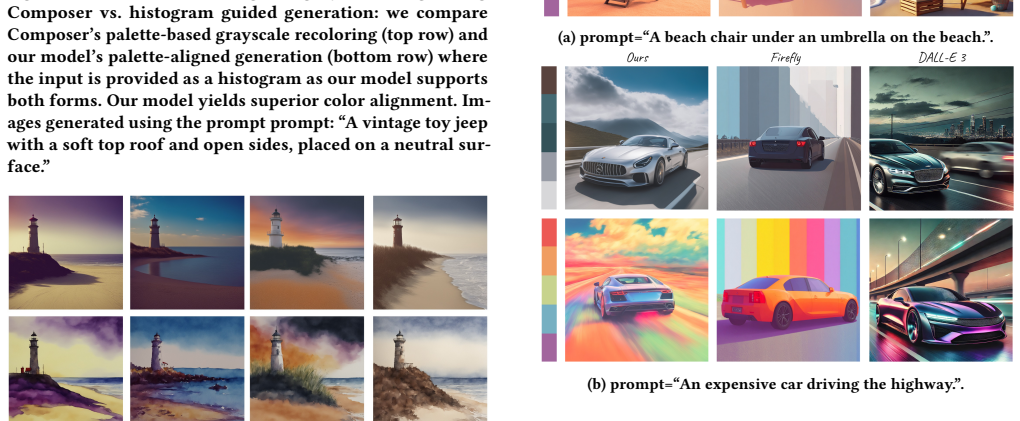
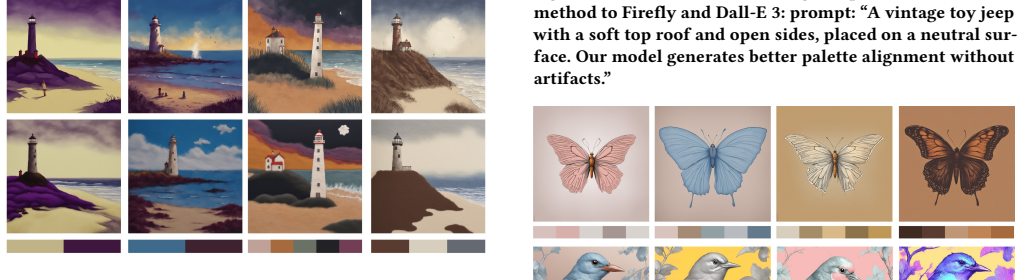
- A user can go from a 3–10 color palette and a text prompt to images that perceptually match those colors, with a single slider controlling how strictly the image stays inside the palette.
- The entropy dial alone can push the same prompt and seed from flat, posterized art to detailed, gradient-rich renders, enabling style exploration without changing the prompt.
- The negative-histogram mechanism lets a user explicitly suppress unwanted hues (for example, yellow bananas or an off-brand color) during generation rather than relying on chance or multiple samples.
- Because the conditioning occupies a single U-Net cross-attention block and the base model stays frozen, the adapter adds only a small parameter overhead and can be dropped into existing SDXL-based pipelines.
- In the reported quantitative and user-study comparisons, the adapter lands on the best Pareto point among palette-conditioning methods for the palette-adherence vs. image-quality tradeoff.
Reading between the lines
- The sparse-histogram framing suggests a general recipe for conditioning a frozen diffusion model on any small discrete set: encode the set as a few tokens, add interpretable scalars (entropy, distance), and train with full-condition augmentation. This could transfer to material palettes, lighting themes, or even musical key/scale constraints in audio diffusion.
- The negative-histogram trick is a concrete instance of a broader principle: in classifier-free guidance, extrapolate from a semantic anti-condition rather than an empty one. The same recipe could suppress whole object classes or styles if the negative condition is supplied through a text or token encoder.
- The two scalar controls are additive to the adapter, so in principle a user could change entropy or distance values at inference on an already-trained adapter without retraining, turning the adapter into a zero-cost style dial for any palette.
- A natural stress test is to scale up the block-selection screen from 20 prompts × 20 palettes to a few thousand diverse pairs; the authors' choice of up_blocks.0.attentions.1 is a claim about that screen, and a larger screen could reveal multiple effective blocks or a different winner.
Editorial analysis
A structured set of objections, weighed in public.
Referee Report
Summary. The paper introduces Palette-Adapter, a method for conditioning SDXL on user-specified color palettes. Palettes are encoded as sparse HSV histograms (34×12×10 bins), and two scalar controls—histogram entropy and palette-to-histogram distance—are injected as an additional token to modulate adherence and color variation. A negative palette condition is introduced for CFG-style suppression of unwanted hues. Training is multi-stage: first all U-Net attention blocks are trained, then a single block (up_blocks.0.attentions.1) is selected based on average EMD over a 20-prompt × 20-palette screen, and finally that block is fine-tuned. Training uses a curated dataset of 2.4M images to balance rare colors. The method is evaluated on 1000 COCO prompts with quantitative metrics (EMD, MUSIQ, CLIP) and a 40-participant user study, reporting favorable adherence–quality trade-offs against T2I-Adapter, FLUX IC Palette, SW-Guidance, and baseline SDXL.
Significance. If the results hold, Palette-Adapter offers a practical and lightweight interface for color control in text-to-image generation, with interpretable scalar controls and a negative-palette mechanism that addresses a real failure mode of CFG. The paper includes a user study, quantitative comparison, and a clear architectural recipe. However, the strength of the central claim is currently undercut by (i) an overstatement in the abstract relative to Table 1, (ii) an unablated architectural commitment to a single attention block selected from a small screen, and (iii) a missing ablation for the curated dataset. These are not fatal to the method's promise, but they need to be addressed before the claims of consistent, generalizable state-of-the-art behavior can be accepted.
major comments (4)
- [Abstract and Table 1] The abstract states the method 'consistently outperforms existing approaches in achieving both strong palette adherence and high image quality.' This is contradicted by Table 1: SW-Guidance achieves the lowest EMD (0.063 vs. 0.1414), and baseline SDXL achieves the highest Koniq (72.118 vs. 70.642), AVA (5.647 vs. 5.619), and CLIP (0.316 vs. 0.311). The narrative in Section 4.2 correctly frames the result as a balance or Pareto improvement, but the abstract and intro overstate the outcome. Please revise the central claim to reflect that the method trades off against these baselines and excels on the harmonic-mean/Pareto criterion.
- [Supplementary §1.2] The entire color-conditioning pathway is committed to a single U-Net attention block, up_blocks.0.attentions.1, chosen from a screen of 20 prompts × 20 palettes using average EMD. This selection is made before the final fine-tuning stage, and there is no ablation after fine-tuning comparing the final single-block adapter against (a) the all-block adapter, (b) top-2/top-3 blocks, or (c) other individual blocks. The 400-sample screen can hide interactions between block efficacy and palette sparsity, saturation, or prompt color associations (e.g., the prototypical-color failure in §3.3). Because the paper claims broad generalization across prompts and palettes, this missing ablation is load-bearing: if up_blocks.0.attentions.1 is suboptimal for a substantial subset of inputs, the method will under- or mis-apply color conditioning. Please add a post-fine-tuning ablation or, failing that, res
- [Section 3.5 and Supplementary §1.1] The curated dataset (2.4M images with 400K rare-color images added to LAION-Art) is listed as a core contribution, and the paper argues it 'improves generalization' and 'ensures better coverage of the color space.' However, no ablation is reported comparing the final model trained on the curated set versus the same architecture trained only on LAION-Art. Without this comparison, the benefit of the curation is not demonstrated. Please provide an ablation measuring palette-adherence or color-coverage metrics on rare-color palettes, or explicitly soften the claim to a design choice rather than a validated improvement.
- [Section 3.2] Reproducibility is hindered by undisclosed parameters. The 'clipped and sharpened variant of CIEDE2000' is referenced but the clip bounds and sharpening exponent are not given. Similarly, the negative-palette weights in Figure 6 are cited (0.07 and 0.3) but no guidance is provided for setting them, and the entropy/distance scalar encoding (how these scalars are normalized or scaled into the token) is not specified. These values are needed to reproduce the method's behavior. Please report them or release code.
minor comments (5)
- [Section 4.2] The 'Reference*' row in Table 1 is computed on PicMonkey palettes, not on the COCO prompts/palettes used for all other rows. The note explains this, but the comparison is apples-to-oranges; consider reporting it only as an absolute reference point, not as a row in the comparative table.
- [Section 3.3, Eq. (1)] The equation for the combined noise prediction uses weight w for the positive condition and (1-w) for the negative condition. It would be clearer to define the recommended range of w (e.g., w=0.5 as default) and how it interacts with the standard CFG scale. The current description is ambiguous about whether this is a convex combination or an extrapolation.
- [Supplementary Table 4] The dropout probabilities table has a slight inconsistency: text embeddings show 80% for both 'Histogram' and 'Palette' columns, which presumably should be 80% for text and 5% for the 'None' case; consider labeling columns more clearly (e.g., 'Color Condition Type' vs. 'Text' rows) to avoid confusion.
- [Figures 4 and 5] The relative-entropy and relative-distance values used in these figures are not stated in the captions. Adding the numeric values (or a colorbar) would make the control mechanism easier to interpret.
- [General] There are minor typos, e.g., 'blanced distribution' in Section 2.4 and '2TI' instead of 'T2I' in Figure 7 and Table 2 captions. Please proofread.
Circularity Check
No significant circularity: the method is evaluated against external benchmarks, and the only self-citations are minor and non-load-bearing.
full rationale
The Palette-Adapter's central claim is an empirical capability claim. The conditioning pathway is trained on external data (LAION-Art plus curated samples), and the headline quantitative results (Table 1) and user study (Table 2) are evaluated against external benchmarks: COCO 2017 validation set and PicMonkey designer-extracted palettes. The only metric-driven architectural selection is the choice of up_blocks.0.attentions.1 as the color-critical block, made via a 20-prompt × 20-palette EMD screen in Supplementary §1.2. This is model selection on a small validation sample, not fitting of the reported test numbers; the final model is subsequently fine-tuned, and its EMD, MusiQ, CLIP, and user-study scores are measured, not optimized. The scalar entropy, distance, and negative-palette controls are user-set at inference and are not fitted parameters renamed as predictions. The two self-citations ([Cohen et al. 2024], [Frenkel et al. 2024]) are cited as inspiration for balanced/multistage conditioning, but the critical-block result is independently tabulated in Table 3, and the headline comparisons do not depend on any theorem or result imported from those papers. The paper's own limitations section acknowledges text/color trade-offs and overlapping entropy/distance scales; these are correctness risks rather than circular reductions. No equation or construction in the paper defines the reported palette-alignment metric in terms of the training objective, so no prediction reduces to its input by construction.
Assumptions & free parameters
free parameters (4)
- HSV histogram binning (34, 12, 10)
- CIEDE2000 clip and sharpening parameters
- Threshold for 'low valued histogram bins' in dataset curation
- Negative palette weights in examples =
0.07 (sofa), 0.3 (apple)
assumptions (6)
- standard math Shannon entropy (Eq 2) is the correct measure of color distribution variety.
- domain assumption A frozen SDXL with IP-Adapter-style decoupled cross-attention can carry palette information through a single intermediate U-Net block.
- domain assumption The curated dataset (2M LAION-Art + 400K rare-color LAION-2B-en images) provides sufficiently balanced color coverage for generalization.
- domain assumption EMD with a sharpened CIEDE2000 bin distance, MUSIQ, and CLIP are valid proxies for palette adherence, perceptual quality, and prompt adherence respectively.
- domain assumption CFG with a manually supplied negative palette (Eq 1) cleanly suppresses unwanted hues without harming semantic coherence.
- domain assumption The entropy and distance scalar controls learned during training remain meaningful at inference when set by users.
Cite this review
Pith. "Pith review of Palette Aligned Image Diffusion." pith.science (2026). https://pith.science/paper/VBVA3NCA
@misc{pith2026250902000,
  author       = {Pith},
  title        = {Pith review of: Palette Aligned Image Diffusion},
  year         = {2026},
  howpublished = {\url{https://pith.science/paper/VBVA3NCA}},
  note         = {Machine review of arXiv:2509.02000}
}
read the original abstract
We introduce the Palette-Adapter, a novel method for conditioning text-to-image diffusion models on a user-specified color palette. While palettes are a compact and intuitive tool widely used in creative workflows, they introduce significant ambiguity and instability when used for conditioning image generation. Our approach addresses this challenge by interpreting palettes as sparse histograms and introducing two scalar control parameters: histogram entropy and palette-to-histogram distance, which allow flexible control over the degree of palette adherence and color variation. We further introduce a negative histogram mechanism that allows users to suppress specific undesired hues, improving adherence to the intended palette under the standard classifier-free guidance mechanism. To ensure broad generalization across the color space, we train on a carefully curated dataset with balanced coverage of rare and common colors. Our method enables stable, semantically coherent generation across a wide range of palettes and prompts. We evaluate our method qualitatively, quantitatively, and through a user study, and show that it consistently outperforms existing approaches in achieving both strong palette adherence and high image quality.
Figures


Figures from the paper (12 more)




Reference graph
Works this paper leans on
-
[3]
This analysis reveals that the up_blocks.0.attentions.1 block, corresponding to the second attention module in the first U-Net upsampling block, exhibits the most significant influence on color fidelity, as indicated by achieving the lowest average EMD. 1.3 Conditioning Dropout During training we mix between full histograms and palettes and described in t...
-
[4]
To identify the layers most critical for color control, we adopt a method inspired by [Cohen et al. 2024; Frenkel et al. 2024]. First, we train the full adapter, which consists of all 11 attention blocks (totaling 70 layers). Subsequently, each attention block is evaluated in isolation: with only one block active and all others off, we perform inference u...
work page 2024
-
[5]
Conditional Balance: Improving Multi-Conditioning Trade-Offs in Image Generation
Conditional Balance: Improving Multi-Conditioning Trade-Offs in Image Generation. arXiv:2412.19853 [cs.CV] https://arxiv.org/abs/2412.19853 Coolors.co
-
[6]
The Super Fast Color Palettes Generator! https://coolors.co/. [Ac- cessed 24-10-2024]. Yarden Frenkel, Yael Vinker, Ariel Shamir, and Daniel Cohen-Or
work page 2024
-
[7]
Implicit Style-Content Separation using B-LoRA
Implicit Style- Content Separation using B-LoRA. arXiv:2403.14572 [cs.CV] https://arxiv.org/abs/ 2403.14572 GeorgeQi
-
[11]
T2I-Adapter: Learning Adapters to Dig out More Controllable Ability for Text-to-Image Diffusion Models. arXiv abs/2302.08453 (2023). Ofir Pele and Michael Werman
arXiv 2023
-
[14]
Analyzing Bias in Diffusion-based Face Generation Models. arXiv abs/2305.06402 (2023). PicMonkey
arXiv 2023
-
[15]
https://www.picmonkey.com/blog/color-combinations- graphic-design
100 Color Combinations for Designs | Examples & Inspiration | Pic- Monkey — picmonkey.com. https://www.picmonkey.com/blog/color-combinations- graphic-design. [Accessed 12-11-2024]. François Pitié, Anil C. Kokaram, and Rozenn Dahyot
work page 2024
Show all 29 references
-
[17]
arXiv abs/2307.01952 (2023)
SDXL: Improving Latent Diffusion Models for High-Resolution Image Synthesis. arXiv abs/2307.01952 (2023). Pylette
2023 arXiv
-
[18]
https://qtiptip.github.io/Pylette/
A Python color extraction library. https://qtiptip.github.io/Pylette/. [Accessed 09-11-2024]. Aditya Ramesh, Prafulla Dhariwal, Alex Nichol, Casey Chu, and Mark Chen
2024
-
[19]
arXiv abs/2204.06125 (2022)
Hierarchical Text-Conditional Image Generation with CLIP Latents. arXiv abs/2204.06125 (2022). Erik Reinhard, Michael Ashikhmin, Bruce Gooch, and Peter Shirley
2022 arXiv
-
[21]
arXiv abs/2112.10752 (2022)
High-Resolution Image Synthesis with Latent Diffusion Models. arXiv abs/2112.10752 (2022). Chitwan Saharia, William Chan, Saurabh Saxena, Lala Li, Jay Whang, Emily L Denton, Kamyar Ghasemipour, Raphael Gontijo Lopes, Burcu Karagol Ayan, Tim Salimans, et al
2022 arXiv
-
[22]
Advances in Neural Information Processing Systems 35 (2022), 36479– 36494
Photorealistic text-to-image diffusion models with deep language understanding. Advances in Neural Information Processing Systems 35 (2022), 36479– 36494. Claude E. Shannon
2022
-
[25]
http://en
Color scheme — Wikipedia, The Free Encyclopedia. http://en. wikipedia.org/w/index.php?title=Color%20scheme&oldid=1247518638. [Accessed 24-10-2024]. Feng Yang, Junjie Ke, Peyman Milanfar, Qifei Wang, and Yilin Wang
2024
-
[26]
arXiv abs/2308.06721 (2023)
IP-Adapter: Text Compatible Image Prompt Adapter for Text-to-Image Diffusion Models. arXiv abs/2308.06721 (2023). Lvmin Zhang, Anyi Rao, and Maneesh Agrawala
2023 arXiv
-
[27]
A dress”. (b) Random images for “A waiting room with a sofa and a table
Adding Conditional Control to Text-to-Image Diffusion Models. arXiv abs/2302.05543 (2023). Palette Aligned Image Diffusion (a) Images generated with different seeds for the prompt “A dress”. (b) Random images for “A waiting room with a sofa and a table. ” (c) Color distributio...
2023 arXiv
-
[1948]
Bell System Technical Journal 27, 3 (1948), 379–423
A Mathematical Theory of Communication. Bell System Technical Journal 27, 3 (1948), 379–423. doi:10.1002/j.1538-7305.1948.tb01338.x Gaurav Sharma, Wencheng Wu, and Edul N Dalal
1948
-
[2001]
IEEE Computer Graphics and Applications 21 (10 2001), 34–41
Color Transfer between Images. IEEE Computer Graphics and Applications 21 (10 2001), 34–41. doi:10.1109/38.946629 Robin Rombach, Andreas Blattmann, Dominik Lorenz, Patrick Esser, and Björn Ommer
2001 doi
-
[2005]
Color Research & Application 30, 1 (2005), 21–30
The CIEDE2000 color- difference formula: Implementation notes, supplementary test data, and math- ematical observations. Color Research & Application 30, 1 (2005), 21–30. Sanzo Wada
2005
-
[2007]
Computer Vision and Image Understanding 107, 1 (2007), 123–137
Automated colour grading using colour distribution transfer. Computer Vision and Image Understanding 107, 1 (2007), 123–137. doi:10.1016/j.cviu.2006.11.011 Special issue on color image processing. Dustin Podell, Zion English, Kyle Lacey, Andreas Blattmann, Tim Dockhorn, Jonas ...
2007 doi
-
[2009]
Fast and robust Earth Mover’s Distances. In Proc. ICCV. 460–467. doi:10.1109/ICCV.2009.5459199 Ofir Pele and Michael Werman
2009
-
[2015]
ACM TOG (Proc
Palette-based Photo Recoloring. ACM TOG (Proc. SIGGRAPH) 34, 4 (July 2015). Rakesh Kumar Chaudhary
2015
-
[2017]
doi:10.1145/3092919.3092926 Huiwen Chang, Ohad Fried, Yiming Liu, Stephen DiVerdi, and Adam Finkelstein
-
[2019]
International Journal of Business Marketing and Management 4, 1 (2019), 4–9
Influence of colour on visual arts. International Journal of Business Marketing and Management 4, 1 (2019), 4–9. Nadav Z. Cohen, Oron Nir, and Ariel Shamir
2019
-
[2022]
arXiv abs/2207.12598 (2022)
Classifier-Free Diffusion Guidance. arXiv abs/2207.12598 (2022). Lianghua Huang, Di Chen, Yu Liu, Yujun Shen, Deli Zhao, and Jingren Zhou
2022 arXiv
-
[2023]
arXiv abs/2302.09778 (2023)
Composer: Creative and Controllable Image Synthesis with Composable Conditions. arXiv abs/2302.09778 (2023). LAION. 2023a. LAION 2B English Aesthetic Dataset. https://huggingface.co/datasets/ laion/laion2B-en-aesthetic LAION. 2023b. laion/laion-art · Datasets at Hugging Face. ...
2023 arXiv
-
[2024]
https://color.adobe.com/create/color-wheel
Adobe Color. https://color.adobe.com/create/color-wheel. [Ac- cessed 24-10-2024]. Elad Aharoni, Yakov Shambik, and Dani Lischinski
2024
-
[2025]
arXiv:2503.19034 [cs.CV] https: //arxiv.org/abs/2503.19034 Chong Mou, Xintao Wang, Liangbin Xie, Yanze Wu, Jian Zhang, Zhongang Qi, Ying Shan, and Xiaohu Qie
Color Conditional Generation with Sliced Wasserstein Guidance. arXiv:2503.19034 [cs.CV] https: //arxiv.org/abs/2503.19034 Chong Mou, Xintao Wang, Liangbin Xie, Yanze Wu, Jian Zhang, Zhongang Qi, Ying Shan, and Xiaohu Qie
-
[6312]
doi:10.1007/978-3-642-15552-9_54 Malsha V
749–762. doi:10.1007/978-3-642-15552-9_54 Malsha V. Perera and Vishal M. Patel
Reviewed August 5, 2026 · model on record in the stance chip above.
Discussion (0). Sign in to comment.