REVIEW 3 major objections 4 minor 1 cited by
Security Analysis of MDI-QKD in Turbulent Free-Space Polarization Channels-A Composite Channel Framework
T0 review · 3 major / 4 minor · reviewed 2026-08-05 · deepseek-v4-flash
Pith's one-line read This paper claims that atmospheric turbulence can be reduced to three closed-form parameters that plug directly into an analytic secret-key-rate formula for free-space MDI-QKD.
desk verdict The composite-channel idea is genuinely useful, but the depolarization formula is internally inconsistent with the paper's own axis-averaging derivation, and the abstract overclaims validation. read the letter →
The pith
A machine-rendered reading of the paper's core claim, the machinery that carries it, and where it could break.
The reading
What carries the argument
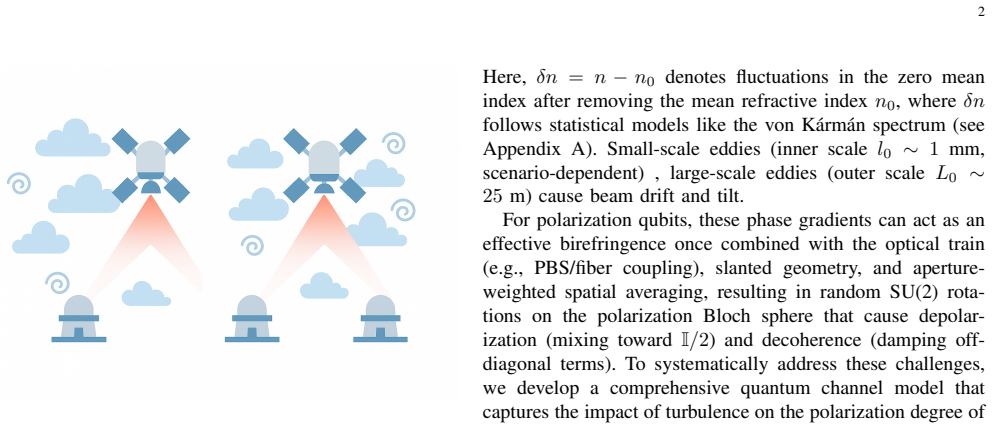
The mechanism is a sequence of four channels, E_composite = E_aperture ∘ E_drift ∘ E_spread ∘ E_phase. The phase channel is the one that touches polarization: each transverse point applies a random SU(2) rotation U(θ, n) = cos(θ/2)I − i sin(θ/2)(n·σ), where the rotation angle θ is Gaussian with variance set by the phase structure function D_φ(r) = 1.09 k² z ⟨C_n²⟩ r^{5/3}, and the axis n is drawn from a von Mises–Fisher/Watson distribution with concentration κ around the propagation direction. Averaging over θ and n converts each point's state into the depolarizing–dephasing form with local factors λ(r) and r̄²(r, κ). The spread, drift, and aperture steps then spatially average these factors
What would settle it
Send a linearly polarized Gaussian beam through a turbulence cell with known path-averaged C_n² in the weak Rytov regime (σ_R² < 1) and measure the depolarization factor from Stokes parameters. In the small-angle limit the paper's model predicts a slope of D_φ/4, while standard isotropic rotation averaging gives D_φ/3; observing D_φ/3, or any mismatch not explained by aperture averaging, would falsify the quantitative key-rate predictions.
Extended reading notes
Core claim
The paper claims that, in the weak-turbulence regime (Rytov variance σ_R² ≤ 1), the full set of atmospheric impairments can be replaced by three closed-form parameters—depolarization factor λ_a^eff, decoherence factor r_{2,a}^eff, and detection probability η_eff—which enter directly into the analytic MDI-QKD secret-key-rate expression R = η_A η_B [(2 − λ_A − λ_B + λ_A λ_B)(1 − H((1 − (1 − λ_A)(1 − λ_B) r̄⁴)/2)) − (1/2) f H((λ_A + λ_B − λ_A λ_B)/2)]. It further claims that this composite depolarizing–dephasing channel remains accurate under clear, overcast, and hazy Hufnagel–Valley profiles and reproduces expected ground-to-satellite uplink behavior: turbulence dominates near the ground, then
Load-bearing premise
The load-bearing premise is that turbulence-induced wavefront phase fluctuations act like an effective birefringence, so the amount of polarization rotation is set by the same variance that describes scalar phase fluctuations; the paper asserts this phase-to-rotation link rather than deriving it from the equations of light propagation, and if the link is wrong by a constant factor, every predicted key rate shifts.
Editorial extensions
If this is right
- With λ_a^eff, r_{2,a}^eff, and η_eff in hand, the secret key rate becomes a closed-form function of distance, aperture, weather, and adaptive-optics strength, enabling rapid parameter sweeps without wave-optics simulations.
- Larger receiver apertures improve key rate and range by collecting more light and averaging over turbulence-induced phase perturbations.
- Adaptive optics extends the usable link range in the paper's simulations—for example, to about 100 km in clear and 50 km in overcast conditions at a 0.7 m aperture.
- Scintillation affects only the detection probability, not the polarization state, so the depolarization and decoherence parameters can be characterized independently of intensity fading.
- The same three-parameter interface can feed directly into the existing decoy-state MDI-QKD security analysis, giving a plug-compatible turbulence model for security proofs.
Reading between the lines
- The three-parameter interface is protocol-agnostic on the polarization side; the same λ_a^eff, r_{2,a}^eff, and η_eff could be substituted into other polarization-encoded QKD protocols, such as BB84 or entanglement-based schemes, without redoing the turbulence modelling.
- Because scintillation provably cancels out of the normalized polarization state, a tabletop turbulence chamber with polarimetric detection could calibrate κ(σ_R²) and test the phase-to-rotation relation before any satellite deployment.
- The paper's most consequential quantitative assumption is the small-angle coefficient linking depolarization to the phase structure function; testing that coefficient against independent averaging calculations is a cheaper and more decisive check than extending the model to strong turbulence.
- The model is memoryless in its parameters, so temporal correlations and adaptive-optics closed-loop lag are not captured; a time-series extension would be needed before relying on the formula for rapidly varying turbulence.
Editorial analysis
A structured set of objections, weighed in public.
Referee Report
Summary. The paper proposes a composite quantum channel model for polarization-encoded free-space MDI-QKD under atmospheric turbulence. It maps turbulence-induced wavefront phase perturbations to random SU(2) polarization rotations, with rotation axes drawn from a von Mises-Fisher/Watson distribution and rotation angles Gaussian with variance equal to the phase structure function D_phi(r). Spatial averaging over Gaussian beam spreading, beam drift, aperture truncation, and scintillation yields three effective closed-form parameters (depolarization factor lambda_eff, decoherence factor r2_eff, detection probability eta_eff), which are inserted into a Devetak-Winter secret-key-rate expression. Numerical simulations for ground-to-satellite uplinks under clear, overcast, and hazy weather and various AO profiles are presented as evidence of the model's accuracy.
Significance. If the model and its derivations were correct, the framework would be useful: it offers a computationally light, closed-form description of turbulence effects on polarization qubits that could support real-time link adaptation and integrate directly with existing MDI-QKD security analyses. However, the current manuscript contains a mathematically load-bearing error in the depolarization-factor derivation, and the claimed numerical validation is not supported by any benchmark against wave-optics or polarimetric data. The central quantitative predictions are therefore not reliable as they stand.
major comments (3)
- [Section II-H.1, Eq. (38); Appendix B, Eq. (78)] The depolarization factor is inconsistent with the paper's own SU(2) rotation model. For an isotropic axis distribution (kappa=0), rotational covariance requires the averaged channel to be an isotropic depolarizing channel with Bloch shrinkage (1+2<cos theta>)/3, giving lambda=(1-exp(-D_phi/2))/3 for Gaussian theta. Eq. (38) instead gives (1-exp(-D_phi/2))/2, a factor 4/3 discrepancy at small D_phi. The source is Eq. (78), which for kappa=0 produces different Bloch shrinkages for x/y and z (z is unaffected), violating rotational covariance. Eq. (39) also gives nonzero lambda in the kappa->infinity aligned limit, where pure dephasing requires lambda=0. Since lambda enters QBER (Eq. 59) and SKR (Eq. 62) multiplicatively, all quantitative SKR values in Section IV are affected.
- [Section IV and Section V] The abstract and Section IV state that numerical simulations 'confirm its accuracy,' but Section V explicitly says: 'We do not include a head-to-head benchmark against wave-optics Monte Carlo; quantifying model bias relative to phase-screen simulations is left for future work.' The figures in Section IV are self-consistency evaluations under the model's own parameters, not validation against wave optics or polarimetric measurements. Moreover, the parameters kappa and alpha are acknowledged as phenomenological, with calibration left to future work. The claim of numerical confirmation is therefore unsupported.
- [Section II-B and II-H.1, Eq. (37)] The mapping from wavefront phase fluctuations to SU(2) polarization rotations is a non-derived modeling assumption. The paper asserts that 'phase gradients can act as an effective birefringence' and sets the rotation-angle variance equal to D_phi(r), but this is not derived from Maxwell/Stokes equations and is not tested against wave-optics or polarimetry. If this mapping is off by a constant factor, all SKR predictions scale accordingly. At minimum, this should be framed as a phenomenological ansatz with a sensitivity analysis or a concrete validation plan, not as a physically established relation.
minor comments (4)
- [Eq. (7) and Eq. (8)] The axis distribution w_kappa(vartheta) already contains a factor sin(vartheta), but Eq. (8) multiplies by another sin(vartheta), so the joint density is not normalized. This likely contributes to the incorrect isotropic average in Appendix B.
- [Appendix D] The sentence 'where eta(r), lambda_a(r), r2_a(r) are defined in the main text, and where eta(r), lambda_a(r), r2_a(r) are defined in the main text' is duplicated and should be corrected.
- [Eq. (31)] Typo: 'vaccum' should be 'vacuum'.
- [Fig. 8 caption] Minor typo: 'hazey' should be 'hazy'.
Circularity Check
No circularity found: the analytic SKR follows from standard MDI-QKD formulas into which independently derived turbulence parameters are inserted; the acknowledged phenomenological constants are calibrated outside SKR, and the self-citation is not load-bearing.
full rationale
The paper's derivation chain is: (i) model turbulence as random SU(2) rotations with Fisher–Watson-distributed axes; (ii) derive local depolarization λ(r) and decoherence r̄²(r,κ) by averaging; (iii) spatially average over Gaussian beam, drift, and aperture to obtain λ_a^eff, r2_a^eff, η_eff; (iv) insert these into the MDI-QKD secret-key-rate formula. I checked for circular reductions. The SKR formula (62) is quoted from [38], which shares authors with this paper, but it is the standard Devetak–Winter form for MDI-QKD decoy states (Eqs. 57–62 and Appendix E); the turbulence parameters enter only as multiplicative factors and the formula does not encode the turbulence model, so the self-citation is not load-bearing. The concentration parameter κ and medium-turbulence interpolant α are explicitly acknowledged as phenomenological ('Our use of κ is phenomenological... a practical calibration κ(σ_R²) may be obtained by fitting least squares to wave optic data sets or on-sky polarimetry'; 'The mixing parameter α = 1−σ_R²/5 is a phenomenological interpolant'), and calibration is suggested against wave-optics/polarimetry data, not against SKR. Hence the SKR is a model consequence, not a fit to itself. No equation is defined in terms of the target quantity. There is an internal inconsistency: Eq. (38) gives λ ≈ D_φ/4 in the isotropic limit, whereas averaging the paper's own SU(2) formula in Appendix B for κ=0 gives λ ≈ D_φ/3. That is a mathematical/physics error, not circularity. The paper also explicitly disclaims a head-to-head benchmark against wave-optics Monte Carlo, further confirming that its 'validation' is not an independent test but this is a limitation, not a circular reduction.
Assumptions & free parameters
free parameters (4)
- kappa (axis concentration) =
not specified
- alpha (medium turbulence interpolant) =
alpha = 1 - sigma_R^2/5
- AO scaling parameters (rho_trk, kappa_w, kappa_phi) =
three profiles in Table I
- Weather HV parameters (A, v, alpha_atm) =
clear/overcast/hazy sets in Table I
assumptions (6)
- ad hoc to paper Wavefront phase gradients act as effective birefringence producing random SU(2) polarization rotations
- ad hoc to paper The rotation angle theta is Gaussian with variance D_phi(r)
- domain assumption Polarization-insensitive receiver and no diattenuation in the optical train
- domain assumption Scintillation cancels in the normalized polarization state
- domain assumption The security analysis equations of [38] (thermal-loss and phase-noise MDI-QKD) are valid and applicable here
- domain assumption Weak turbulence regime sigma_R^2 <= 1 for all quantitative claims
Cite this review
Pith. "Pith review of Security Analysis of MDI-QKD in Turbulent Free-Space Polarization Channels-A Composite Channel Framework." pith.science (2026). https://pith.science/paper/2KZV6WRP
@misc{pith2026250902087,
  author       = {Pith},
  title        = {Pith review of: Security Analysis of MDI-QKD in Turbulent Free-Space Polarization Channels-A Composite Channel Framework},
  year         = {2026},
  howpublished = {\url{https://pith.science/paper/2KZV6WRP}},
  note         = {Machine review of arXiv:2509.02087}
}
read the original abstract
Atmospheric turbulence poses a significant challenge to free-space measurement-device-independent quantum key distribution (FSO MDI-QKD) by inducing polarization decoherence and depolarization, which degrade the secret key rate (SKR). In this paper, we propose a unified depolarizing-dephasing channel model for turbulence-induced polarization decoherence in FSO MDI-QKD. This model consolidates phase perturbations, Gaussian beam spreading, beam drift, aperture truncation, and scintillation into closed-form parameters: depolarization factor, decoherence factor, and detection probability. By mapping turbulence to a von Mises-Fisher/Watson-distributed SU(2) rotation, we derive an analytic SKR expression compatible with existing MDI-QKD security analyses. The model excels in clear, overcast, and hazy weather conditions, offering computational efficiency and experimental verifiability for real-time link adaptation. Numerical simulations, illustrated on a ground-to-satellite free-space link, confirm its accuracy, enabling robust physical layer design for global-scale MDI-QKD networks.
Figures


Figures from the paper (4 more)


Forward citations
Cited by 1 Pith paper
-
Continuous Noise Model for Quantum Circuits
On small stabilizer-code and Grover circuits, coherent Gaussian noise and Pauli noise rank differently under entropy-matched comparison, and a simplified variance-propagation model matches full simulation only in unco...
Reference graph
Works this paper leans on
-
[1]
Quantum cryptography: Public key distribution and coin tossing,
C. H. Bennett and G. Brassard, “Quantum cryptography: Public key distribution and coin tossing,” in Proc. IEEE Int. Conf. Comput., Syst. Signal Process., Bangalore, India, 1984, pp. 175–179
work page 1984
-
[2]
Quantum cryptography based on Bell’s theorem,
A. K. Ekert, “Quantum cryptography based on Bell’s theorem,” Phys. Rev. Lett., vol. 67, no. 6, pp. 661–663, Aug. 1991
work page 1991
-
[3]
Measurement-device-independent quantum key distribution,
H.-K. Lo, M. Curty, and B. Qi, “Measurement-device-independent quantum key distribution,” Phys. Rev. Lett. , vol. 108, no. 13, p. 130503, Mar. 2012
work page 2012
-
[4]
Side-channel-free quantum key distribution,
S. L. Braunstein and S. Pirandola, “Side-channel-free quantum key distribution,” Phys. Rev. Lett. , vol. 108, no. 13, p. 130502, Mar. 2012
work page 2012
-
[5]
Advances in quantum teleportation,
S. Pirandola et al. , “Advances in quantum teleportation,” Nat. Photon. , vol. 9, no. 10, pp. 641–652, Oct. 2015
work page 2015
-
[6]
Satellite-based entanglement distribution over 1200 km,
J. Yin et al. , “Satellite-based entanglement distribution over 1200 km,” Science, vol. 356, no. 6343, pp. 1140–1144, Jun. 2017
work page 2017
-
[7]
A comprehensive design and performance analysis of low Earth orbit satellite quantum communication,
J.-P. Bourgoin et al., “A comprehensive design and performance analysis of low Earth orbit satellite quantum communication,” New J. Phys. , vol. 15, no. 2, p. 023006, Feb. 2013
work page 2013
-
[8]
Analysis of satellite-to-ground quantum key distribution with adaptive optics,
V . Marulanda Acosta et al. , “Analysis of satellite-to-ground quantum key distribution with adaptive optics,” New J. Phys. , vol. 26, no. 4, p. 043034, Feb. 2024
work page 2024
Show all 39 references
-
[9]
Long-distance free-space measurement-device- independent quantum key distribution,
Y . Cao et al. , “Long-distance free-space measurement-device- independent quantum key distribution,” Phys. Rev. Lett. , vol. 125, no. 26, p. 260503, Dec. 2020
2020
-
[10]
Quantum repeaters in space,
C. Liorni, H. Kampermann, and D. Bruß, “Quantum repeaters in space,” New J. Phys. , vol. 23, no. 5, p. 053021, May 2021
2021
-
[11]
Advances in space quantum communications,
J. S. Sidhu et al. , “Advances in space quantum communications,” IET Quantum Commun. , vol. 2, no. 4, pp. 182–217, Dec. 2021
2021
-
[12]
Quantum repeaters: From quantum networks to the quantum internet,
K. Azuma et al. , “Quantum repeaters: From quantum networks to the quantum internet,” Rev. Mod. Phys. , vol. 95, no. 4, p. 045006, Dec. 2023
2023
-
[13]
Atmospheric turbulence effects on an OAM-multiplexed FSO link,
Y . Ren et al. , “Atmospheric turbulence effects on an OAM-multiplexed FSO link,” Opt. Lett. , vol. 38, no. 20, pp. 4062–4065, Oct. 2013
2013
-
[14]
Advances in communications using optical vortices,
J. Wang, “Advances in communications using optical vortices,” Photon. Res., vol. 4, no. 5, pp. B14–B28, Oct. 2016
2016
-
[15]
Atmospheric quantum channels with weak and strong turbulence,
D. Vasylyev, A. A. Semenov, and W. V ogel, “Atmospheric quantum channels with weak and strong turbulence,” Phys. Rev. Lett. , vol. 117, no. 9, p. 090501, Aug. 2016
2016
-
[16]
Free-space quantum links under diverse weather conditions,
D. Vasylyev, A. A. Semenov, and W. V ogel, “Free-space quantum links under diverse weather conditions,” Phys. Rev. A , vol. 96, no. 4, p. 043856, Oct. 2017
2017
-
[17]
Characterization of free- space quantum channels,
D. Vasylyev, A. A. Semenov, and W. V ogel, “Characterization of free- space quantum channels,” in Proc. SPIE, vol. 10771, p. 107710V , Sep. 2018
2018
-
[18]
Polarization measurements through space-to- ground atmospheric propagation paths by using a highly polarized laser source in space,
M. Toyoshima et al. , “Polarization measurements through space-to- ground atmospheric propagation paths by using a highly polarized laser source in space,” Opt. Express, vol. 17, no. 25, pp. 22333–22340, Dec. 2009
2009
-
[19]
Quantum communications in a moderate- to-strong turbulent space,
M. Ghalaii and S. Pirandola, “Quantum communications in a moderate- to-strong turbulent space,” Commun. Phys. , vol. 5, no. 1, p. 38, Feb. 2022
2022
-
[20]
High-speed free-space optical continuous variable quantum key distribution enabled by three-dimensional multi- plexing,
Z. Qu and I. B. Djordjevic, “High-speed free-space optical continuous variable quantum key distribution enabled by three-dimensional multi- plexing,” Opt. Express, vol. 24, no. 26, pp. 29149–29159, Dec. 2016
2016
-
[21]
Influence of turbulence on OAM communications,
M. Malik et al. , “Influence of turbulence on OAM communications,” Opt. Express, vol. 20, no. 12, pp. 13195–13200, Jun. 2012
2012
-
[22]
Changes in the polarization ellipse of random beams in turbulence,
O. Korotkova et al. , “Changes in the polarization ellipse of random beams in turbulence,” Waves Random Complex Media , vol. 15, no. 3, pp. 353–369, Oct. 2005
2005
-
[23]
QBER estimation in QKD systems with polarization encoding,
N. J. Muga, M. F. S. Ferreira, and A. N. Pinto, “QBER estimation in QKD systems with polarization encoding,” J. Lightw. Technol., vol. 29, no. 3, pp. 355–361, Feb. 2011
2011
-
[24]
Turbulence mitigation in an OAM FSO link with adaptive optics,
Y . Ren et al., “Turbulence mitigation in an OAM FSO link with adaptive optics,” Opt. Lett. , vol. 41, no. 11, pp. 2406–2409, Jun. 2016
2016
-
[25]
Approaching Gb/s secret-key rates in an FSO CV-QKD system affected by atmospheric turbulence,
Z. Qu and I. B. Djordjevic, “Approaching Gb/s secret-key rates in an FSO CV-QKD system affected by atmospheric turbulence,” inProc. 43rd Eur . Conf. Opt. Commun. (ECOC) , Gothenburg, Sweden, Sep. 2017
2017
-
[26]
Adaptive-optics mitigation for OAM-QKD in turbulence,
Z. Tao et al., “Adaptive-optics mitigation for OAM-QKD in turbulence,” Opt. Express, vol. 29, no. 20, pp. 31078–31092, Sep. 2021
2021
-
[28]
Beam propagation through atmospheric turbulence using the split-step method,
Y . K. Chahine et al., “Beam propagation through atmospheric turbulence using the split-step method,” NASA, Tech. Rep. NTRS 20200001115, Feb. 2020
2020
-
[29]
L. C. Andrews and R. L. Phillips, Laser Beam Propagation Through Random Media , 2nd ed. Bellingham, W A, USA: SPIE Press, 2005
2005
-
[30]
Physical layer aspects of quantum communications: A survey,
S. Koudia et al. , “Physical layer aspects of quantum communications: A survey,” arXiv:2407.09244 [quant-ph], Jul. 2024. [Online]. Available: https://arxiv.org/abs/2407.09244
2024 arXiv
-
[31]
Spatial-mode diversity and multiplexing for continuous-variable quantum communications,
S. Koudia et al. , “Spatial-mode diversity and multiplexing for continuous-variable quantum communications,” arXiv:2409.04334 [quant-ph], Sep. 2024. [Online]. Available: https://arxiv.org/abs/2409. 04334
2024 arXiv
-
[32]
Diversity and multiplexing in quantum MIMO channels,
J. ur Rehman et al. , “Diversity and multiplexing in quantum MIMO channels,” EPJ Quantum Technol. , vol. 12, p. 18, Feb. 2025
2025
-
[33]
Continuous-variable MDI QKD in free- space channels,
M. Ghalaii and S. Pirandola, “Continuous-variable MDI QKD in free- space channels,” Phys. Rev. A , vol. 108, no. 4, p. 042621, Oct. 2023
2023
-
[34]
Entanglement-based QKD in the daylight and uplink satellite configuration: Proof-of-principle and feasibility,
K. Joarder, J. Szlachetka, and P. Kolenderski, “Entanglement-based QKD in the daylight and uplink satellite configuration: Proof-of-principle and feasibility,” arXiv:2501.17130 [quant-ph] , Jan. 2025. [Online]. Available: https://arxiv.org/abs/2501.17130
2025 arXiv
-
[35]
Daylight entanglement-based QKD with a quantum-dot source,
F. Basso Basset et al. , “Daylight entanglement-based QKD with a quantum-dot source,” Quantum Sci. Technol. , vol. 8, no. 2, p. 025002, Apr. 2023
2023
-
[36]
Performance analysis of OOK-based FSO systems in Gamma–Gamma turbulence with imprecise channel models,
J. Feng, G. Wei, and J. Li, “Performance analysis of OOK-based FSO systems in Gamma–Gamma turbulence with imprecise channel models,” Opt. Commun. , vol. 402, pp. 340–346, Nov. 2017
2017
-
[37]
Statistical verifications and deep-learning predictions for satellite-to-ground quantum atmospheric channels,
P. V . Trinh et al., “Statistical verifications and deep-learning predictions for satellite-to-ground quantum atmospheric channels,” Commun. Phys., vol. 5, no. 1, p. 225, Sep. 2022
2022
-
[38]
Performance analysis of MDI-QKD in thermal-loss and phase-noise channels,
H. Peng et al., “Performance analysis of MDI-QKD in thermal-loss and phase-noise channels,” in Proc. IEEE Int. Conf. Quantum Comput. Eng. (QCE), Aug. 2025. [Online]. Available: https://arxiv.org/abs/2504.16561
2025 arXiv
-
[39]
Satellite-to-ground quantum key distribution,
S.-K. Liao et al., “Satellite-to-ground quantum key distribution,” Nature, vol. 549, pp. 43–47, Sep. 2017
2017
-
[40]
Satellite-relayed intercontinental quantum network,
S.-K. Liao et al. , “Satellite-relayed intercontinental quantum network,” Phys. Rev. Lett. , vol. 120, no. 3, p. 030501, Jan. 2018
2018
Reviewed August 5, 2026 · model on record in the stance chip above.
Discussion (0). Sign in to comment.