REVIEW 3 major objections 5 minor 48 references
This paper compares two dual-comb spectrometers, an 80 MHz stabilized system and a 1 GHz free-running system, and finds they serve complementary roles in high-resolution spectroscopy and real-time trace-gas sensing.
Reviewed by Pith at T0; open to challenge. T0 means a machine referee read the full paper against a public rubric. the ladder, T0–T4 →
A side-by-side comparison of 80 MHz and 1 GHz dual-comb spectrometers demonstrates complementary resolution and speed for NH3, I2, and NO2 sensing.
T0 review reviewed 2026-08-05 challenge →
load-bearing objection A genuinely useful MHz-vs-GHz DCS comparison whose headline numbers for the GHz system need a validation pass, and whose figure cross-referencing is sloppy. the 3 major comments →
NIR/VIS dual-comb spectroscopy comparing high and low repetition rate regimes
The pith
A machine-rendered reading of the paper's core claim, the machinery that carries it, and where it could break.
The reading
Core claim
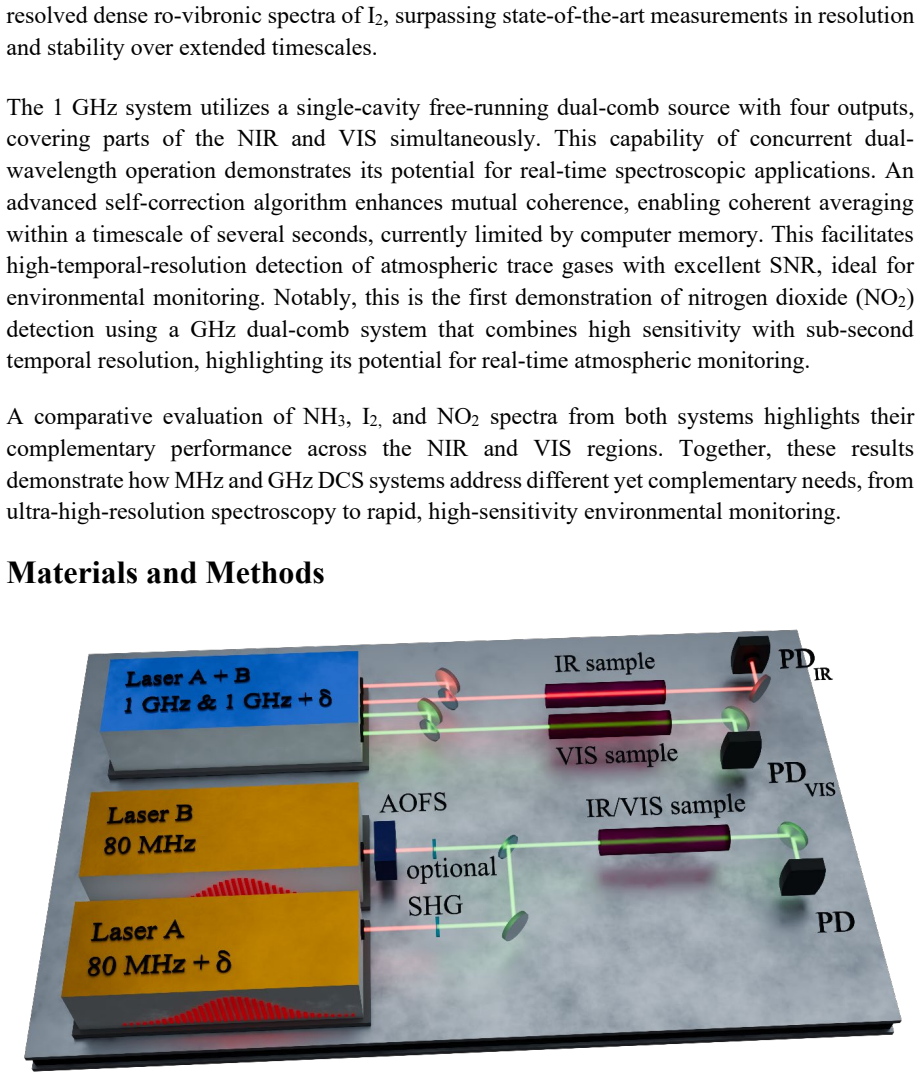
The paper demonstrates that the two repetition-rate regimes of dual-comb spectroscopy solve different problems. With 80 MHz combs and phase-locked feed-forward stabilization, the authors resolve individual comb teeth and record ammonia spectra near 1 µm with 80 MHz resolution, signal-to-noise above 1000, and a noise-equivalent absorption of 1×10⁻⁵ cm⁻¹ after 180 s; in the visible, the system resolves more than 1500 iodine hyperfine lines, matching a published reference atlas. With a free-running single-cavity 1 GHz comb and a digital self-correction routine, they narrow comb lines from 30 MHz to the 0.63 MHz Fourier limit, and detect NH₃ and NO₂ with sub-second integration, reaching noise-eq
What carries the argument
Two mechanisms maintain mutual coherence between the interfering combs. In the 80 MHz system, an acousto-optic frequency shifter driven by a phase-locked feed-forward loop stabilizes the relative carrier-envelope offset—the phase between the pulse envelope and its carrier wave—allowing coherent averaging over many scans; this buys the narrow comb-line width and high SNR. In the 1 GHz system, a self-correction algorithm resamples the recorded time trace to remove timing jitter between successive scans, then compensates phase jitter, so comb lines narrow to the Fourier limit without active electronics. The repetition rate itself is the third central parameter: 80 MHz sets the spectral resoluti
Load-bearing premise
The 1 GHz results depend on the digital correction routine recovering the true timing and phase jitter between successive scans; if that recovery is imperfect, the coherent averaging and the reported noise and line-width numbers would not hold.
What would settle it
Run the 1 GHz system with a known narrow reference line, apply the self-correction algorithm, and check that the recovered line width reaches the 0.63 MHz Fourier limit and the line center stays stable; any residual broadening or drift marks a failure. A complementary test is to deliberately inject a calibrated timing step between scans and verify the routine recovers it to well below one comb-tooth spacing.
If this is right
- For molecular spectroscopy requiring sub-GHz structure, an 80 MHz comb with feed-forward stabilization can produce reference-quality NH₃ and I₂ spectra in minutes rather than the multi-hour scans of conventional Fourier-transform instruments.
- For field monitoring of NH₃ and NO₂, a free-running 1 GHz single-cavity comb with digital correction is sufficient: 1 GHz resolution captures pressure- and Doppler-broadened lines, and sub-second acquisition enables tracking of concentration changes.
- The 1 GHz system's coherent averaging is currently limited by computer memory rather than by comb coherence, so longer averaging should push its noise-equivalent absorption lower.
- The two systems' quality factors, 12.5×10⁶ √Hz and 3.1×10⁶ √Hz, give a quantitative basis for choosing a dual-comb architecture for a given measurement time, bandwidth, and resolution.
- Single-cavity geometry improves intrinsic mutual coherence by an order of magnitude over a dual-cavity GHz design under identical conditions, so future GHz systems can rely on simpler digital correction.
Where Pith is reading between the lines
- Inference: If the self-correction algorithm is as reliable as presented, the same digital approach could be combined with the 80 MHz feed-forward system to correct slow carrier-envelope-offset drift, potentially extending coherent averaging beyond the reported 30-minute limit without a slow feedback loop.
- Inference: The relative-intensity-noise measurements imply that the 80 MHz system's low detuning places its signal where flicker noise dominates, so even with perfect phase lock, its single-shot sensitivity will trail a GHz system; raising the detuning or using balanced detection would be a natural next test.
- Inference: The corrected 0.63 MHz comb-line width of the 1 GHz source suggests that a single-cavity comb with a lower repetition rate could combine the architecture's inherent coherence with higher spectral resolution—an untested middle ground between the two regimes studied here.
- Inference: The reported quality-factor comparison hides the temporal dimension; for an application with a fixed required measurement time, the paper's data suggest GHz systems will often win on SNR per second even though their absolute quality factor is lower.
Editorial analysis
A structured set of objections, weighed in public.
Referee Report
Summary. The manuscript compares two dual-comb spectroscopy (DCS) systems: an 80 MHz repetition-rate system with phase-locked feed-forward stabilization, used for NIR NH3 and visible I2 spectroscopy, and a free-running 1 GHz single-cavity system with a post-processing self-correction algorithm, used for NIR NH3 and visible NO2 and I2 spectroscopy. The authors report comb-resolved 80 MHz resolution spectra with high SNR for the 80 MHz system, and sub-second, high-SNR measurements with 1 GHz resolution for the 1 GHz system. They introduce a DCS 'quality factor' and a comparative table (Table 1) to argue that the two systems have complementary strengths: the 80 MHz system for high-resolution molecular spectroscopy, and the 1 GHz system for real-time trace gas sensing. The paper is an experimental demonstration, with comparisons to HITRAN, an iodine atlas, and literature NO2 cross sections.
Significance. If the reported results are fully supported, the paper would provide a valuable practical comparison of two DCS architectures, including the first comb-resolved spectrum of NH3 near 1 µm at 80 MHz resolution and the first GHz-DCS detection of NO2 with sub-second acquisition. The attention to RIN characterization, Allan deviation, and comparison to external benchmarks is a strength. However, the key performance claims for the 1 GHz system—comb line width of 0.63 MHz, SNR ~200, and NEA values—rest entirely on a self-correction algorithm that is not independently validated in the manuscript, and the quality factor numbers in Table 1 are not reproducible from the stated parameters. These issues currently prevent the central comparative claim from being fully assessed.
major comments (3)
- [Data acquisition & Results, Fig. 2 and Fig. 6] The reported 1 GHz system performance (0.63 MHz comb mode width, SNR ~200, NEA values) is produced by a self-correction algorithm described only as 'similar to [35]'. The manuscript does not provide a quantitative validation of the residual timing/phase errors after correction, e.g., a comparison of the corrected comb line shape to the theoretical Fourier-transform-limited profile, an Allan deviation of corrected line centers, or residual statistics against HITRAN over the full spectral span. The statement that spectra are in 'excellent agreement' is qualitative, and the plotted residuals in Fig. 4 lack a scale or RMS values. Since the entire 'real-time trace gas sensing' pillar of the comparison depends on these corrected measurements, this missing validation is load-bearing. Please provide a quantitative residual/noise analysis or an independent verification (e.g., a reference gas line
- [Discussion and Conclusion, Table 1] The DCS quality factor values in Table 1 are not reproducible from the formula given in the text. Using the stated values for the 1 GHz system (SNR ≈200, spectral coverage ≈11 THz, resolution ≈1 GHz, acquisition time 0.5 s), Q = SNR × (Δν/δν) × √T gives ≈1.6×10⁶ √Hz, not 3.1×10⁶. The 80 MHz entry is similarly difficult to reconcile unless a different SNR or T is assumed, but none is specified. Since the quality factor is used as the central quantitative comparison in the conclusion, please provide the exact formula, all parameter values used, and an example calculation for each system.
- [NIR dual-comb spectroscopy, Table 1] Table 1 lists a 'Measurement time / s' of 100 s for the 80 MHz system, but the NEA IR entry in the same table (and the text) quotes 1×10⁻⁵ cm⁻¹ at 180 s. This inconsistency affects the fair comparison of the two systems. Please harmonize the integration times for the NEA values and the table's measurement time row, and clarify which acquisition time corresponds to each reported NEA.
minor comments (5)
- [Figure references] There are multiple figure cross-referencing errors. In the NIR section, the 80 MHz NH3 spectrum is cited as 'Figure 3 (blue line)', but Figure 3 shows Allan deviation and RIN; it should be Figure 4(a). In the visible section, the 1 GHz iodine spectrum is cited as 'Figure 4(a)', which should be Figure 5(a); subsequently, 'Figures 4(c) and (d)' should be Figure 5(c) and (d). Please correct these citations.
- [Visible dual-comb spectroscopy] The NEA VIS value for the 1 GHz system is given as 1.25×10⁻⁵ cm⁻¹ in the text and 1.2×10⁻⁵ cm⁻¹ in Table 1. Please make these consistent.
- [Results, Fig. 2(e)] The text states that after correction the comb mode 'consists of only a single point with a width of 0.63 MHz.' It would be clearer to specify whether this is the Fourier-transform-limited sinc width (i.e., the RF bin size mapped to the optical domain) or a measured FWHM of a fitted line shape, and to provide the corresponding line-shape fit if one was used.
- [Discussion and Conclusion] The quality factor equation is typeset with garbled Greek symbols (𝛥𝛥𝛥𝛥, 𝛿𝛿𝛥𝛥, etc.). Please use a standard mathematical typesetting convention so the formula is readable.
- [Data availability] The data are available only 'upon reasonable request.' Sharing the raw interferograms or the processed spectra in a public repository would strengthen the reproducibility of the quantitative claims, particularly the self-correction results.
Circularity Check
No significant circularity: the paper is an experimental comparison with external benchmarks; no fitted parameter is renamed as a prediction.
full rationale
The paper's central claims are experimental spectra of NH3, I2, and NO2 compared against external references (HITRAN, Salami iodine atlas, Nizkorodov cross sections). The performance metrics—comb-mode linewidths, SNR, NEA, and the DCS quality factor—are computed directly from measured interferograms using standard Fourier analysis and established definitions (Ref [48]); no parameter is fitted to a subset of data and then presented as a prediction. The 1 GHz system's self-correction algorithm is described as 'similar to [35]', an external MATLAB routine, and is a post-processing step that estimates timing and phase jitter from the interferograms themselves; it does not incorporate the target absorption spectra or force a predetermined linewidth. The resulting line narrowing to the Fourier-transform limit is a measured outcome, not an input of the algorithm's construction. Self-citation of Ref [33] is limited to the description of the feed-forward stabilization technique and reuse of Allan-deviation data; this is independent of the new comparative measurements and does not constitute the sole evidence for any central claim. No uniqueness theorem or ansatz is imported from the authors' prior work. The authors explicitly note limitations (e.g., averaging limited by computer memory, data available upon request) but these are practical caveats, not circular dependencies. Overall, the derivation chain is self-contained against external benchmarks, and no step reduces to its own inputs by construction.
Axiom & Free-Parameter Ledger
axioms (3)
- domain assumption The HITRAN2020 database provides accurate line positions, intensities, and broadening parameters for NH3 in the 1 um region.
- domain assumption The iodine atlas by Salami et al. (Ref. [45]) is an accurate reference for line positions and intensities in the visible.
- domain assumption The self-correction algorithm (Ref. [35]) correctly reconstructs timing and phase errors in dual-comb interferograms for the 1 GHz system.
Cite this review
Pith. "Pith review of NIR/VIS dual-comb spectroscopy comparing high and low repetition rate regimes." pith.science (2026). https://pith.science/paper/IMABRAJA
@misc{pith2026250902159,
  author       = {Pith},
  title        = {Pith review of: NIR/VIS dual-comb spectroscopy comparing high and low repetition rate regimes},
  year         = {2026},
  howpublished = {\url{https://pith.science/paper/IMABRAJA}},
  note         = {Machine review of arXiv:2509.02159}
}
abstract
Dual-comb spectroscopy enables broadband analysis of key molecules with unparalleled frequency resolution and exceptional signal-to-noise ratios across various spectral regions. However, fully harnessing its potential for broadband spectroscopy with high sensitivity and spectral resolution depends critically on selecting the appropriate frequency combs with optimized (comb) parameters tailored to specific applications. This study compares dual-comb spectroscopy systems operating at 80 MHz and 1 GHz repetition rates, in the near infrared and visible spectral regions. The 80 MHz system provides high spectral resolution, ideal for resolving complex spectra, showcased with measurements of NH$_3$ vibrational bands and I$_2$ hyperfine transitions. Utilizing phase-locked feed-forward stabilization, the system delivers excellent signal-to-noise ratios but faces limitations in temporal resolution. The free-running 1 GHz system offers superior temporal resolution and compactness, making it suitable for real-time environmental monitoring in laboratory and field settings. A self-correction algorithm advances the high mutual coherence, enabling high-signal-to-noise measurements without additional electronics. With its 1 GHz resolution, it excels in monitoring NH$_3$ transitions or NO$_2$ lines at high speeds. This work highlights the complementary strengths of these systems for high-resolution spectroscopy and real time trace gas sensing.
Figures

Reference graph
Works this paper leans on
-
[1]
I. Coddington, N. Newbury, and W. Swann, "Dual-comb spectroscopy," Optica 3, 414– 426 (2016)
work page 2016
-
[2]
N. Picqué and T. W. Hänsch, "Frequency comb spectroscopy," Nature Photonics 13, 146–157 (2019)
work page 2019
-
[3]
Adaptive real- time dual-comb spectroscopy,
T. Ideguchi, A. Poisson, G. Guelachvili, N. Picqué, and T. W. Hänsch, "Adaptive real- time dual-comb spectroscopy," Nature Communications 5, 3375 (2014)
work page 2014
-
[4]
Mid- Infrared Time-Resolved Frequency Comb Spectroscopy of Transient Free Radicals,
A. J. Fleisher, B. J. Bjork, T. Q. Bui, K. C. Cossel, M. Okumura, and J. Ye, "Mid- Infrared Time-Resolved Frequency Comb Spectroscopy of Transient Free Radicals," J. Phys. Chem. Lett. 5, 2241–2246 (2014)
work page 2014
-
[5]
Mid-infrared dual frequency comb spectroscopy for combustion analysis from 2.8 to 5 µm,
A. S. Makowiecki, D. I. Herman, N. Hoghooghi, E. F. Strong, R. K. Cole, G. Ycas, F. R. Giorgetta, C. B. Lapointe, J. F. Glusman, J. W. Daily, P. E. Hamlington, N. R. Newbury, I. R. Coddington, and G. B. Rieker, "Mid-infrared dual frequency comb spectroscopy for combustion analysis from 2.8 to 5 µm," Proceedings of the Combustion Institute 38, 1627–1635 (2021)
work page 2021
-
[6]
Dual-comb spectroscopy for high-temperature reaction kinetics,
N. H. Pinkowski, Y. Ding, C. L. Strand, R. K. Hanson, R. Horvath, and M. Geiser, "Dual-comb spectroscopy for high-temperature reaction kinetics," Meas. Sci. Technol. 31, 055501 (2020)
work page 2020
-
[7]
Ultra-resolution photochemical sensing,
L. Fuerst, A. Eber, M. Pal, E. Hruska, C. Hofmann, I. Gordon, M. Schultze, R. Breinbauer, and B. Bernhardt, "Ultra-resolution photochemical sensing," (2025)
work page 2025
-
[8]
Regional trace-gas source attribution using a field-deployed dual frequency comb spectrometer,
S. Coburn, C. B. Alden, R. Wright, K. Cossel, E. Baumann, G.-W. Truong, F. Giorgetta, C. Sweeney, N. R. Newbury, K. Prasad, I. Coddington, and G. B. Rieker, "Regional trace-gas source attribution using a field-deployed dual frequency comb spectrometer," Optica 5, 320–327 (2018)
work page 2018
-
[9]
D. I. Herman, C. Weerasekara, L. C. Hutcherson, F. R. Giorgetta, K. C. Cossel, E. M. Waxman, G. M. Colacion, N. R. Newbury, S. M. Welch, B. D. DePaola, I. Coddington, E. A. Santos, and B. R. Washburn, "Precise multispecies agricultural gas flux determined using broadband open-path dual-comb spectroscopy," Science Advances 7, eabe9765 (2021)
work page 2021
-
[10]
Coherent field sensing of nitrogen dioxide,
A. Eber, L. Fürst, F. Siegrist, A. Kirchner, B. Tschofenig, R. di Vora, A. Speletz, and B. Bernhardt, "Coherent field sensing of nitrogen dioxide," Optics Express 32, 6575–6586 (2024)
work page 2024
-
[11]
GHz repetition rate mid-infrared frequency comb spectroscopy of fast chemical reactions,
N. Hoghooghi, P. Chang, S. Egbert, M. Burch, R. Shaik, S. A. Diddams, P. Lynch, and G. B. Rieker, "GHz repetition rate mid-infrared frequency comb spectroscopy of fast chemical reactions," Optica 11, 876–882 (2024)
work page 2024
-
[12]
T. Mizuno, E. Hase, T. Minamikawa, Y. Tokizane, R. Oe, H. Koresawa, H. Yamamoto, and T. Yasui, "Full-field fluorescence lifetime dual-comb microscopy using spectral mapping and frequency multiplexing of dual-comb optical beats," Science Advances 7, eabd2102 (2021)
work page 2021
-
[13]
Spectrally interleaved, comb-mode-resolved spectroscopy using swept dual terahertz combs,
Y.-D. Hsieh, Y. Iyonaga, Y. Sakaguchi, S. Yokoyama, H. Inaba, K. Minoshima, F. Hindle, T. Araki, and T. Yasui, "Spectrally interleaved, comb-mode-resolved spectroscopy using swept dual terahertz combs," Sci Rep 4, 3816 (2014)
work page 2014
-
[14]
Squeezed dual-comb spectroscopy,
D. I. Herman, M. Walsh, M. K. Kreider, N. Lordi, E. J. Tsao, A. J. Lind, M. Heyrich, J. Combes, J. Genest, and S. A. Diddams, "Squeezed dual-comb spectroscopy," Science 0, eads6292 (2025)
work page 2025
-
[15]
D. J. Jones, S. A. Diddams, J. K. Ranka, A. Stentz, R. S. Windeler, J. L. Hall, and S. T. Cundiff, "Carrier-Envelope Phase Control of Femtosecond Mode-Locked Lasers and Direct Optical Frequency Synthesis," Science 288, 635–639 (2000)
work page 2000
-
[16]
A phase-stable dual-comb interferometer,
Z. Chen, M. Yan, T. W. Hänsch, and N. Picqué, "A phase-stable dual-comb interferometer," Nature Communications 9, 3035 (2018)
work page 2018
-
[17]
Self-Correction Limits in Dual-Comb Interferometry,
N. B. Hebert, V. Michaud-Belleau, J.-D. Deschenes, and J. Genest, "Self-Correction Limits in Dual-Comb Interferometry," IEEE Journal of Quantum Electronics 55, 1–11 (2019)
work page 2019
-
[18]
Graphics card-based real-time processing for dual comb interferometry,
M. Walsh, J. Kasic, K. Cossel, and J. Genest, "Graphics card-based real-time processing for dual comb interferometry," Review of Scientific Instruments 95, 103005 (2024)
work page 2024
-
[19]
Dual-frequency-comb UV spectroscopy with one million resolved comb lines,
A. Muraviev, D. Konnov, S. Vasilyev, and K. L. Vodopyanov, "Dual-frequency-comb UV spectroscopy with one million resolved comb lines," Optica 11, 1486–1489 (2024)
work page 2024
-
[20]
Broadband near-ultraviolet dual comb spectroscopy,
L. Fürst, A. Kirchner, A. Eber, F. Siegrist, R. di Vora, and B. Bernhardt, "Broadband near-ultraviolet dual comb spectroscopy," Optica 11, 471–477 (2024)
work page 2024
-
[21]
Dual-comb spectroscopy in the deep ultraviolet,
J. J. McCauley, M. C. Phillips, R. R. D. Weeks, Y. Zhang, S. S. Harilal, and R. J. Jones, "Dual-comb spectroscopy in the deep ultraviolet," Optica 11, 460–463 (2024)
work page 2024
-
[22]
A. Barbero, C. Blouzon, J. Savarino, N. Caillon, A. Dommergue, and R. Grilli, "A compact incoherent broadband cavity-enhanced absorption spectrometer for trace detection of nitrogen oxides, iodine oxide and glyoxal at levels below parts per billion for field applications," Atmospheric Measurement Techniques 13, 4317–4331 (2020)
work page 2020
-
[23]
Detection of NO 3 in the polluted troposphere by differential optical absorption,
U. Platt, D. Perner, A. M. Winer, G. W. Harris, and J. N. Pitts, "Detection of NO 3 in the polluted troposphere by differential optical absorption," Geophysical Research Letters 7, 89–92 (1980)
work page 1980
-
[24]
R. J. Huang, K. Seitz, T. Neary, C. D. O’Dowd, U. Platt, and T. Hoffmann, "Observations of high concentrations of I2 and IO in coastal air supporting iodine-oxide driven coastal new particle formation," Geophysical Research Letters 37, (2010)
work page 2010
-
[25]
Computational multiheterodyne spectroscopy,
D. Burghoff, Y. Yang, and Q. Hu, "Computational multiheterodyne spectroscopy," Science Advances 2, e1601227 (2016)
work page 2016
-
[26]
Self-corrected chip-based dual-comb spectrometer,
N. B. Hébert, J. Genest, J.-D. Deschênes, H. Bergeron, G. Y. Chen, C. Khurmi, and D. G. Lancaster, "Self-corrected chip-based dual-comb spectrometer," Optics Express 25, 8168–8179 (2017)
work page 2017
-
[27]
Recent Advances and Outlook in Single-Cavity Dual Comb Lasers,
C. Zhang, F. Qu, P. Ou, H. Sun, S. He, and B. Fu, "Recent Advances and Outlook in Single-Cavity Dual Comb Lasers," Photonics 10, 221 (2023)
work page 2023
-
[28]
Coherent cavity-enhanced dual-comb spectroscopy,
A. J. Fleisher, D. A. Long, Z. D. Reed, J. T. Hodges, and D. F. Plusquellic, "Coherent cavity-enhanced dual-comb spectroscopy," Optics Express 24, 10424–10434 (2016)
work page 2016
-
[29]
B. Willenberg, C. R. Phillips, J. Pupeikis, S. L. Camenzind, R. B. Kohlhass, B. Globisch, and U. Keller, "Gigahertz Single-cavity Dual-comb Laser for Rapid Time-domain Spectroscopy: from Few Terahertz to Optical Frequencies," (n.d.)
-
[30]
Single-cavity dual-comb fiber lasers and their applications,
J. Yang, X. Zhao, L. Zhang, and Z. Zheng, "Single-cavity dual-comb fiber lasers and their applications," Frontiers in Physics 10, (2023)
work page 2023
-
[31]
High-sensitivity pump-probe spectroscopy with a dual-comb laser and a PM-Andi supercontinuum,
C. Gruber, J. Pupeikis, S. L. Camenzind, B. Willenberg, F. V. A. Camargo, L. Lang, P. Hamm, A. Rampur, A. Heidt, C. R. Phillips, G. Cerullo, and U. Keller, "High-sensitivity pump-probe spectroscopy with a dual-comb laser and a PM-Andi supercontinuum," Optics Letters 49, 6445–6448 (2024)
work page 2024
-
[32]
Continuous real-time correction and averaging for frequency comb interferometry,
J. Roy, J.-D. Deschênes, S. Potvin, and J. Genest, "Continuous real-time correction and averaging for frequency comb interferometry," Optics Express 20, 21932–21939 (2012)
work page 2012
-
[33]
M. Pal, A. Eber, L. Fürst, E. Hruska, M. Ossiander, and B. Bernhardt, "Phase-Locked Feed-Forward Stabilization for Dual-Comb Spectroscopy. Ultrafast Sci. 2025;5:0098 (2024)
work page 2025
-
[34]
C. R. Phillips, B. Willenberg, A. Nussbaum-Lapping, F. Callegari, S. L. Camenzind, J. Pupeikis, and U. Keller, "Coherently averaged dual-comb spectroscopy with a low-noise and high-power free-running gigahertz dual-comb laser," Optics Express 31, 7103–7119 (2023)
work page 2023
-
[35]
selfCorrectIGMs - File Exchange - MATLAB Central,
"selfCorrectIGMs - File Exchange - MATLAB Central," https://de.mathworks.com/matlabcentral/fileexchange/69759-selfcorrectigms
-
[36]
Mode-resolved, shot noise limited, dual-comb spectroscopy with independent free running lasers,
M. Walsh, P. Chang, F. Emaury, G. Rieker, N. Newbury, F. Giorgetta, S. Diddams, and J. Genest, "Mode-resolved, shot noise limited, dual-comb spectroscopy with independent free running lasers," in Optica Sensing Congress 2023 (AIS, FTS, HISE, Sensors, ES) (2023), Paper JTh1A.1 (Optica Publishing Group, 2023), p. JTh1A.1
work page 2023
-
[37]
Role of ammonia in European air quality with changing land and ship emissions between 1990 and 2030,
S. Aksoyoglu, J. Jiang, G. Ciarelli, U. Baltensperger, and A. S. H. Prévôt, "Role of ammonia in European air quality with changing land and ship emissions between 1990 and 2030," Atmospheric Chemistry and Physics 20, 15665–15680 (2020)
work page 1990
-
[38]
Cavity-enhanced dual-comb spectroscopy,
B. Bernhardt, A. Ozawa, P. Jacquet, M. Jacquey, Y. Kobayashi, T. Udem, R. Holzwarth, G. Guelachvili, T. W. Hänsch, and N. Picqué, "Cavity-enhanced dual-comb spectroscopy," Nature Photonics 4, 55–57 (2010)
work page 2010
-
[39]
A near infrared line list for NH3: Analysis of a Kitt Peak spectrum after 35 years,
E. J. Barton, S. N. Yurchenko, J. Tennyson, S. Béguier, and A. Campargue, "A near infrared line list for NH3: Analysis of a Kitt Peak spectrum after 35 years," Journal of Molecular Spectroscopy 325, 7–12 (2016)
work page 2016
-
[40]
Absorption spectra of ammonia near 1 um,
E. J. Barton, O. L. Polyansky, Sergei. N. Yurchenko, J. Tennyson, S. Civiš, M. Ferus, R. Hargreaves, R. I. Ovsyannikov, A. A. Kyuberis, N. F. Zobov, S. Béguier, and A. Campargue, "Absorption spectra of ammonia near 1 um," Journal of Quantitative Spectroscopy and Radiative Transfer 203, 392–397 (2017)
work page 2017
-
[41]
The HITRAN2020 molecular spectroscopic database,
I. E. Gordon, L. S. Rothman, R. J. Hargreaves, R. Hashemi, E. V. Karlovets, F. M. Skinner, E. K. Conway, C. Hill, R. V. Kochanov, Y. Tan, P. Wcisło, A. A. Finenko, K. Nelson, P. F. Bernath, M. Birk, V. Boudon, A. Campargue, K. V. Chance, A. Coustenis, B. J. Drouin, J. –M. Flaud, R. R. Gamache, J. T. Hodges, D. Jacquemart, E. J. Mlawer, A. V. Nikitin, V. I...
work page 2022
- [42]
-
[43]
S. Maithani, S. Mandal, A. Maity, M. Pal, and M. Pradhan, "High-resolution spectral analysis of ammonia near 6.2 μm using a cw EC-QCL coupled with cavity ring-down spectroscopy," Analyst 143, 2109–2114 (2018)
work page 2018
-
[44]
C. L. Bell, M. Dhib, G. Hancock, G. A. D. Ritchie, J. H. van Helden, and N. J. van Leeuwen, "Cavity enhanced absorption spectroscopy measurements of pressure-induced broadening and shift coefficients in the υ1+υ3 combination band of ammonia," Applied Physics B 94, 327–336 (2009)
work page 2009
-
[45]
A molecular iodine atlas in ascii format,
H. Salami and A. J. Ross, "A molecular iodine atlas in ascii format," Journal of Molecular Spectroscopy 233, 157–159 (2005)
work page 2005
-
[46]
Adaptive dual- comb spectroscopy in the green region,
T. Ideguchi, A. Poisson, G. Guelachvili, T. W. Hänsch, and N. Picqué, "Adaptive dual- comb spectroscopy in the green region," Optics Letters 37, 4847 (2012)
work page 2012
-
[47]
S. A. Nizkorodov, S. P. Sander, and L. R. Brown, "Temperature and Pressure Dependence of High-Resolution Air-Broadened Absorption Cross Sections of NO2 (415-525 nm)," The Journal of Physical Chemistry A 108, 4864–4872 (2004)
work page 2004
-
[48]
Sensitivity of coherent dual-comb spectroscopy,
N. R. Newbury, I. Coddington, and W. Swann, "Sensitivity of coherent dual-comb spectroscopy," Opt. Express, OE 18, 7929–7945 (2010)
work page 2010
This paper was first reviewed by deepseek-v4-flash on August 5, 2026.
discussion (0)
Sign in with ORCID, Apple, or X to comment. Anyone can read and Pith papers without signing in.