REVIEW 6 major objections 4 minor 75 references
Think2Sing: Orchestrating Structured Motion Subtitles for Singing-Driven 3D Head Animation
T0 review · 6 major / 4 minor · reviewed 2026-08-05 · deepseek-v4-flash
Pith's one-line read Singing avatars gain expression from LLM-written motion subtitles
desk verdict A genuinely new subtitle-based intermediate representation plus a large dataset, but the intensity proxy discards absolute amplitude and the evaluation is too thin to back the headline claims. read the letter →
The pith
A machine-rendered reading of the paper's core claim, the machinery that carries it, and where it could break.
The reading
What carries the argument
Motion subtitles are SRT-style text lines of the form '<start> → <end>: <region> <description>', automatically inferred by an LLM through Sing-CoT with acoustic-guided retrieval (AGRA). The motion intensity proxy is a per-landmark normalized amplitude (range [-1, 1]) computed from FLAME landmark displacements relative to neutral, restricted to eyebrows, eyes, and mouth; it carries the argument by converting the mapping problem into intensity prediction per region, which the diffusion model's region-specific mappers supervise with reconstruction, velocity, and acceleration losses. An Intensity2Motion predictor converts the predicted intensities into FLAME expression and jaw parameters.
What would settle it
Capture a small set of singing performances with marker-based 3D motion capture, retrain Think2Sing on the ground-truth FLAME parameters, and check whether the reported LVE/FVE/FID gains over audio-only baselines persist; if the gains vanish, they depend on the monocular label bias.
Extended reading notes
Core claim
Think2Sing's central claim is that an LLM-assisted pipeline can produce 3D head animation for singing that is more realistic, expressive, and emotionally faithful than existing speech-driven and singing-driven methods. The paper attributes the gains to three coordinated choices: (1) motion subtitles, generated by a Singing Chain-of-Thought (Sing-CoT) process with acoustic-guided retrieval augmentation, which give the model explicit, timestamped, region-wise motion instructions; (2) a motion intensity proxy—normalized displacement amplitudes of selected eyebrow, eye, and mouth landmarks—which serves as a spatially disentangled intermediate target easier to learn than dense vertex offsets or c
Load-bearing premise
The pipeline treats FLAME parameters extracted from monocular singing videos by EMOCA v2, and the subtitles derived from hand-set thresholds on those parameters, as ground truth for both training and evaluation; if these labels carry systematic error, the reported quality gains may reflect label bias rather than genuinely better animation.
Editorial extensions
If this is right
- Offline LLM subtitle generation plus real-time (200+ FPS) motion inference makes expressive singing avatars practical for interactive use.
- Users can edit animations by editing the motion-subtitle text, not by tweaking low-level parameters.
- The SingMoSub benchmark (37 hours, 1.79% silence rate) provides a common testbed for future singing-driven head animation work.
- The motion intensity proxy removes the need for dense vertex supervision, shrinking model size (22.14M parameters) relative to most baselines.
- The framework works without pre-defined emotion labels or manual motion annotations, since subtitles are inferred from lyrics and acoustics.
Reading between the lines
- Because the subtitle generator is a general-purpose LLM, its choices encode that LLM's prior about which lyrics trigger which facial motions; swapping or fine-tuning the LLM would plausibly change the animation style, a testable way to modulate expressiveness.
- The same subtitle-plus-intensity-proxy recipe should transfer to speech-driven characters or embodied conversational agents where semantic alignment matters; the AGRA retrieval step could be adapted to any aligned text-acoustic input.
- The hand-set annotation thresholds (AU difference 0.25/0.5, eyelid openness 4–9.5 mm, neck rotation 10°) may not be optimal across identities; per-singer calibration or learned thresholds could improve the dataset and the upper bound on quality.
- The reported gains are aggregated metrics; a controlled user study that isolates lip-sync accuracy, upper-face emotion, and beat alignment against audio-only baselines would clarify which component (subtitles vs intensity proxy vs diffusion) drives human preference.
Editorial analysis
A structured set of objections, weighed in public.
Referee Report
Summary. The paper proposes Think2Sing, a diffusion-based framework for singing-driven 3D head animation. It uses an LLM (Gemini 2.5 Flash) with a singing chain-of-thought and acoustic-guided retrieval (Sing-CoT + AGRA) to generate SRT-style, timestamped motion subtitles from lyrics and audio; these subtitles condition four region-specific mappers that predict a normalized motion-intensity proxy and neck pose, which are then converted to FLAME parameters through an Intensity2Motion predictor. A new 37-hour dataset, SingMoSub, is introduced with FLAME parameters, acoustic descriptors, and automatically annotated motion subtitles. Quantitative and qualitative experiments on SingMoSub claim large improvements over several talking-head baselines in lip synchronization, realism, expressiveness, and music alignment, plus a subtitle-based editing interface.
Significance. The central idea is timely and potentially valuable: using structured, timestamped natural-language motion descriptions as an interpretable intermediate representation for expressive facial animation is a genuine departure from direct audio-to-motion mapping. The dataset with region-wise motion subtitles is a useful asset for the community, and the LLM prompting/reasoning pipeline (AGRA + Sing-CoT) is reusable beyond this paper. The work is not circular: the system is trained to predict ground-truth FLAME from audio/subtitles and evaluated on held-out songs. However, the current evidence does not fully support the strength of the claims. The evaluation lacks error bars and significance tests, several metrics are self-defined, baseline training is modified, and the intensity proxy discards absolute motion amplitude, undermining the emotional-intensity-control claim. With these issues addressed, the contribution could be significant; in its present form the claims outrun the evidence.
major comments (6)
- [§4.2.1, Eq. (5) and Eq. (6)] The per-clip min-max normalization in Eq. (5) makes the motion intensity invariant to positive rescaling of landmark displacement: I(a·ΔL)=I(ΔL) for any a>0. Eq. (6) then maps only this normalized intensity to FLAME coefficients and jaw pose through fϕ, with no audio, subtitle, or scale input. The architecture therefore cannot represent absolute motion amplitude; a louder, higher-pitch, or more emotionally intense passage cannot produce larger facial displacements unless the normalized pattern happens to correlate with amplitude in the training set. This directly weakens the paper's 'emotional fidelity' and 'precise motion intensity control' claims. Please either add a scale channel to the proxy (e.g., per-region RMS displacement or a separate amplitude estimate) or provide a controlled experiment where volume/intensity is varied while the normalized pattern is held fixed, demonstrating
- [§5, Tables 2 and 3] All quantitative results are single-run means with no error bars, confidence intervals, or significance tests, despite the abstract's claim of 'significantly outperforms'. Some headline gaps are large (SND 4.89 vs. 21.19), but several key comparisons are close (e.g., Table 3: Ours vs. GT Sub in FIDfm is 4.8187 vs. 4.7649; LVE 8.3036 vs. 7.8513). The user study also lacks statistical detail. Please report at least three training seeds with standard deviations and appropriate paired significance tests, and describe the user-study protocol more fully.
- [§5.2, Table 2] The baseline comparison protocol is modified in a way that may advantage the proposed method. Vertex-based methods are trained with neck pose zeroed, and FLAME variants have altered output heads. Moreover, the table states that BA is not utilized for methods without neck pose modules, making head-motion alignment comparisons incomplete. These changes are not standard for the cited baselines and could explain part of the performance gap. Please provide an additional comparison under the baselines' original training settings (or a controlled subset where neck motion is minimal) and report the hyperparameter/budget used for each baseline.
- [§5.1.2] The self-defined metrics need validation. Freeze Rate uses a per-sequence mean ground-truth vertex displacement as the 'minimal movement' threshold, which penalizes low-amplitude but natural motions; SND is a sum of two FID values and is not a standard metric. Since these metrics are used to support the main superiority claim, please provide sensitivity analyses to the threshold choices, report correlations with human judgments, and compare against established motion-quality metrics where possible.
- [§4.1.2 Step 3 and Table 4] The validation of LLM-generated subtitles is performed by the same LLM (Gemini 2.5 Flash), and Table 4 reports only LLM pass rates. This self-assessment does not establish subtitle correctness. In Table 3, GT Sub outperforms the full method on LVE, FVE, and FIDfm; the claim that the AGRA+Sing-CoT subtitles are 'comparable' to ground truth is not statistically supported. Please add human evaluation of subtitle correctness and measure the downstream animation metrics when conditioning on generated versus manually curated subtitles, with error bars.
- [§3.1 and §5.1.2] The ground-truth FLAME parameters are obtained from EMOCA v2 monocular reconstruction, and the motion-subtitle thresholds (AU intensity difference 0.25/0.5, eyelid distances 9.5 mm and 4–6 mm, neck rotation 10 degrees) are hand-set without independent validation. Since training and evaluation share the same label source, systematic reconstruction bias could inflate the reported LVE/FVE/FID improvements. Please validate a subset of the dataset with independent 3D capture or manual annotation, and report threshold sensitivity analyses.
minor comments (4)
- [§2.2] Typo: 'the its annotations' should be 'its annotations'.
- [§3.1 and supplementary] Typo: 'preceise' should be 'precise'; 'title right/left' in Fig. 1 should be 'tilt right/left'; 'suffer form' should be 'suffer from'.
- [§5.1.1] The text says 'We use Adam [65]', but reference [65] is the Adan optimizer paper. Please correct the citation or the optimizer name.
- [Figures 1 and 4] The main text and supplementary both contain large pipeline figures; the repeated prompt screenshots in the supplementary should be compressed or reduced. Also, metric notation such as FIDfm, FIDΔfm, and SND should be defined in one place for readers.
Circularity Check
No significant circularity; the derivation chain is self-contained, with only a minor self-referential LLM validation in an auxiliary ablation.
full rationale
The central derivation is not circular. Training uses fixed labels (FLAME from EMOCA v2, motion subtitles from thresholded AU/velocity curves), and inference predicts FLAME parameters on held-out songs, with no fitted parameter being renamed as a prediction. The motion-intensity proxy in Eq. (5)-(6) is a learned, lossy reparameterization: although per-clip min-max normalization discards absolute amplitude and Intensity2Motion cannot recover it, this is a representational limitation, not a circular reduction of the output to the input. The LLM self-validation in Table 4 is self-referential (the LLM scores its own generated subtitles), but it is an auxiliary ablation and the paper's main quantitative claims rest on held-out LVE/FVE/FID metrics and a user study. Self-citations [4] and [66] are contextual or metric-related and are not load-bearing. Overall, no step reduces by construction to its own inputs.
Assumptions & free parameters
free parameters (4)
- AU intensity difference thresholds =
0.25 (slight), 0.5 (strong)
- Eye openness thresholds =
9.5 mm neutral, 4-6 mm squint, <4 mm close
- Neck rotation and duration thresholds =
10 degrees, 0.5 seconds
- Retrieval count k for AGRA =
not reported
assumptions (5)
- domain assumption Monocular EMOCA v2 reconstruction from YouTube/BiliBili videos yields accurate enough FLAME parameters to serve as ground truth.
- domain assumption FLAME expression and pose parameters can represent the singing facial dynamics relevant for this task.
- domain assumption Gemini 2.5 Flash, given the supplied Sing-CoT prompts and retrieved examples, can infer emotionally appropriate and temporally accurate motion subtitles.
- domain assumption The automated threshold-based annotation pipeline produces semantically meaningful motion subtitles.
- domain assumption Pretrained Whisper ASR, CLIP text encodings, and acoustic descriptors provide sufficient conditioning for the diffusion model.
invented entities (2)
-
Motion subtitles (SRT-style region-wise motion descriptions)
-
Motion intensity proxy (normalized per-landmark displacement in [-1,1])
Cite this review
Pith. "Pith review of Think2Sing: Orchestrating Structured Motion Subtitles for Singing-Driven 3D Head Animation." pith.science (2026). https://pith.science/paper/DVT6QXLD
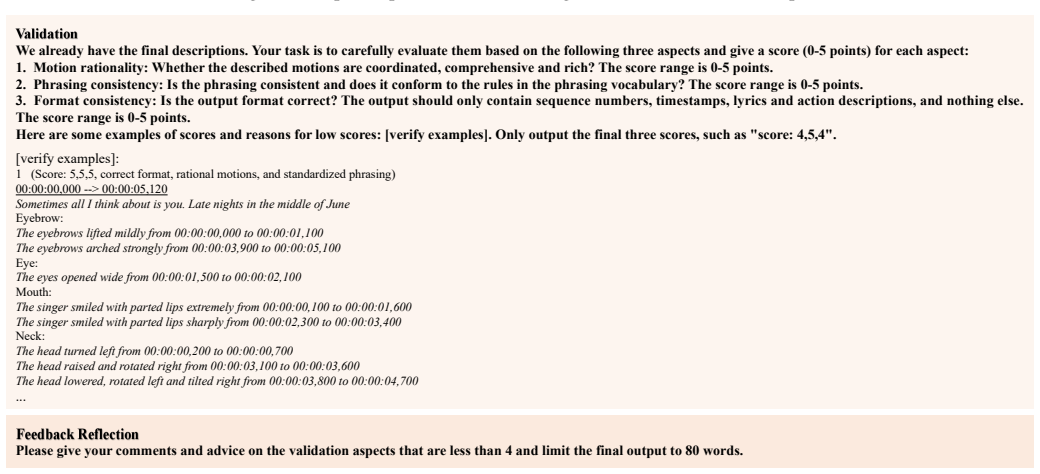
@misc{pith2026250902278,
  author       = {Pith},
  title        = {Pith review of: Think2Sing: Orchestrating Structured Motion Subtitles for Singing-Driven 3D Head Animation},
  year         = {2026},
  howpublished = {\url{https://pith.science/paper/DVT6QXLD}},
  note         = {Machine review of arXiv:2509.02278}
}
read the original abstract
Singing-driven 3D head animation is a challenging yet promising task with applications in virtual avatars, entertainment, and education. Unlike speech, singing involves richer emotional nuance, dynamic prosody, and lyric-based semantics, requiring the synthesis of fine-grained, temporally coherent facial motion. Existing speech-driven approaches often produce oversimplified, emotionally flat, and semantically inconsistent results, which are insufficient for singing animation. To address this, we propose Think2Sing, a diffusion-based framework that leverages pretrained large language models to generate semantically coherent and temporally consistent 3D head animations, conditioned on both lyrics and acoustics. A key innovation is the introduction of motion subtitles, an auxiliary semantic representation derived through a novel Singing Chain-of-Thought reasoning process combined with acoustic-guided retrieval. These subtitles contain precise timestamps and region-specific motion descriptions, serving as interpretable motion priors. We frame the task as a motion intensity prediction problem, enabling finer control over facial regions and improving the modeling of expressive motion. To support this, we create a multimodal singing dataset with synchronized video, acoustic descriptors, and motion subtitles, enabling diverse and expressive motion learning. Extensive experiments show that Think2Sing outperforms state-of-the-art methods in realism, expressiveness, and emotional fidelity, while also offering flexible, user-controllable animation editing.
Figures


Figures from the paper (8 more)


Reference graph
Works this paper leans on
-
[1]
J. Yu, C. W. Chen, and Z. Wang, “3d singing head for music vr: Learning external and internal articulatory synchronicity from IEEE TRANSACTIONS ON VISUALIZA TION AND COMPUTER GRAPHICS 13 Eye: The eyes closed. Eyebrow: The eyebrows frowned markedly. Mouth: The singer smiled with parted lips strongly. Neck: The head swayed to the rhythm. Fig. 9: Visualizati...
work page 2019
-
[2]
SingingHead: A Large-scale 4D Dataset for Singing Head Animation
S. Wu, Y . Li, W. Zhang, J. Jia, Y . Zhu, Y . Yan, G. Zhai, and X. Yang, “Singinghead: A large-scale 4d dataset for singing head animation,” arXiv preprint arXiv:2312.04369 , 2023
work page Pith review arXiv 2023
-
[3]
Musicface: Music-driven expressive singing face synthesis,
P . Liu, W. Deng, H. Li, J. Wang, Y . Zheng, Y . Ding, X. Guo, and M. Zeng, “Musicface: Music-driven expressive singing face synthesis,” Computational Visual Media , vol. 10, no. 1, pp. 119–136, 2024
work page 2024
-
[4]
Let’s chorus: Partner-aware hybrid song-driven 3d head animation,
X. Xie, Z. Huang, W. Xu, P . Xiao, X. Xu, and H. Zhang, “Let’s chorus: Partner-aware hybrid song-driven 3d head animation,” in Proceedings of the Computer Vision and Pattern Recognition Conference, 2025, pp. 5467–5476
work page 2025
-
[5]
Emotional commu- nication in speech and music: The role of melodic and rhythmic contrasts,
L. Quinto, W. F. Thompson, and F. L. Keating, “Emotional commu- nication in speech and music: The role of melodic and rhythmic contrasts,” Frontiers in psychology , vol. 4, p. 184, 2013
work page 2013
-
[6]
Acoustic differences in the speaking and singing voice,
S. R. Livingstone, K. Peck, and F. A. Russo, “Acoustic differences in the speaking and singing voice,” in Proceedings of Meetings on Acoustics, vol. 19, no. 1. Acoustical Society of America, 2013, p. 035080
work page 2013
-
[7]
F. Eyben, G. L. Salomão, J. Sundberg, K. R. Scherer, and B. W. Schuller, “Emotion in the singing voice—a deeperlook at acoustic features in the light ofautomatic classification,” EURASIP Journal on Audio, Speech, and Music Processing , vol. 2015, no. 1, p. 19, 2015
work page 2015
-
[8]
Common cues to emotion in the dynamic facial expressions of speech and song,
S. R. Livingstone, W. F. Thompson, M. M. Wanderley , and C. Palmer, “Common cues to emotion in the dynamic facial expressions of speech and song,” Quarterly Journal of Experimental Psychology, vol. 68, no. 5, pp. 952–970, 2015
work page 2015
Show all 75 references
-
[9]
Occlusion-insensitive talking head video generation via facelet compensation,
Y . Deng, Y . Lu, Y . Xu, Y . Nie, and S. He, “Occlusion-insensitive talking head video generation via facelet compensation,” in Pro- ceedings of the AAAI Conference on Artificial Intelligence , vol. 39, no. 3, 2025, pp. 2726–2734
2025
-
[10]
Singer: Vivid audio-driven singing video generation with multi-scale spectral diffusion model,
Y . Li, Z. Zhou, Z. Wang, W. Xue, W. Luo, and Y . Guo, “Singer: Vivid audio-driven singing video generation with multi-scale spectral diffusion model,” arXiv preprint arXiv:2412.03430 , 2024
2024 arXiv
-
[11]
X-portrait: Expressive portrait animation with hierarchical motion attention,
Y . Xie, H. Xu, G. Song, C. Wang, Y . Shi, and L. Luo, “X-portrait: Expressive portrait animation with hierarchical motion attention,” in ACM SIGGRAPH 2024 Conference Papers , 2024, pp. 1–11
2024
-
[12]
Faceformer: Speech-driven 3d facial animation with transformers,
Y . Fan, Z. Lin, J. Saito, W. Wang, and T. Komura, “Faceformer: Speech-driven 3d facial animation with transformers,” in Pro- ceedings of the IEEE/CVF conference on computer vision and pattern recognition, 2022, pp. 18 770–18 780
2022
-
[13]
Codetalker: Speech-driven 3d facial animation with discrete mo- tion prior,
J. Xing, M. Xia, Y . Zhang, X. Cun, J. Wang, and T.-T. Wong, “Codetalker: Speech-driven 3d facial animation with discrete mo- tion prior,” in Proceedings of the IEEE/CVF Conference on Computer Vision and Pattern Recognition , 2023, pp. 12 780–12 790
2023
-
[14]
Facediffuser: Speech-driven 3d facial animation synthesis using diffusion,
S. Stan, K. I. Haque, and Z. Yumak, “Facediffuser: Speech-driven 3d facial animation synthesis using diffusion,” in Proceedings of the 16th ACM SIGGRAPH Conference on Motion, Interaction and Games , 2023, pp. 1–11
2023
-
[15]
Selftalk: A self-supervised commutative training diagram to comprehend 3d talking faces,
Z. Peng, Y . Luo, Y . Shi, H. Xu, X. Zhu, H. Liu, J. He, and Z. Fan, “Selftalk: A self-supervised commutative training diagram to comprehend 3d talking faces,” in Proceedings of the 31st ACM International Conference on Multimedia , 2023, pp. 5292–5301
2023
-
[16]
Singing emotionally: a study of pre-production, production, and post- production facial expressions,
L. R. Quinto, W. F. Thompson, C. Kroos, and C. Palmer, “Singing emotionally: a study of pre-production, production, and post- production facial expressions,” Frontiers in psychology , vol. 5, p. 262, 2014
2014
-
[17]
Jali: an animator-centric viseme model for expressive lip synchroniza- tion,
P . Edwards, C. Landreth, E. Fiume, and K. Singh, “Jali: an animator-centric viseme model for expressive lip synchroniza- tion,” ACM T ransactions on graphics (TOG), vol. 35, no. 4, pp. 1–11, 2016
2016
-
[18]
A deep learning approach for generalized speech animation,
S. Taylor, T. Kim, Y . Yue, M. Mahler, J. Krahe, A. G. Rodriguez, J. Hodgins, and I. Matthews, “A deep learning approach for generalized speech animation,” ACM T ransactions On Graphics (TOG), vol. 36, no. 4, pp. 1–11, 2017
2017
-
[19]
Dy- namic units of visual speech,
S. L. Taylor, M. Mahler, B.-J. Theobald, and I. Matthews, “Dy- namic units of visual speech,” in Proceedings of the 11th ACM SIGGRAPH/Eurographics conference on Computer Animation , 2012, pp. 275–284
2012
-
[20]
A practical and configurable lip sync method for games,
Y . Xu, A. W. Feng, S. Marsella, and A. Shapiro, “A practical and configurable lip sync method for games,” in Proceedings of Motion on Games, 2013, pp. 131–140
2013
-
[21]
Visemenet: Audio-driven animator-centric speech animation,
Y . Zhou, Z. Xu, C. Landreth, E. Kalogerakis, S. Maji, and K. Singh, “Visemenet: Audio-driven animator-centric speech animation,” ACM T ransactions on Graphics (T oG), vol. 37, no. 4, pp. 1–10, 2018
2018
-
[22]
Capture, learning, and synthesis of 3d speaking styles,
D. Cudeiro, T. Bolkart, C. Laidlaw, A. Ranjan, and M. J. Black, “Capture, learning, and synthesis of 3d speaking styles,” in Pro- ceedings of the IEEE/CVF conference on computer vision and pattern recognition, 2019, pp. 10 101–10 111
2019
-
[23]
Speech- driven 3d face animation with composite and regional facial movements,
H. Wu, S. Zhou, J. Jia, J. Xing, Q. Wen, and X. Wen, “Speech- driven 3d face animation with composite and regional facial movements,” in Proceedings of the 31st ACM International Conference on Multimedia, 2023, pp. 6822–6830
2023
-
[24]
Meshtalk: 3d face animation from speech using cross-modality disentanglement,
A. Richard, M. Zollhöfer, Y . Wen, F. De la Torre, and Y . Sheikh, “Meshtalk: 3d face animation from speech using cross-modality disentanglement,” in Proceedings of the IEEE/CVF international con- ference on computer vision , 2021, pp. 1173–1182
2021
-
[25]
Audio- driven facial animation by joint end-to-end learning of pose and emotion,
T. Karras, T. Aila, S. Laine, A. Herva, and J. Lehtinen, “Audio- driven facial animation by joint end-to-end learning of pose and emotion,” ACM T ransactions on Graphics (T oG), vol. 36, no. 4, pp. 1–12, 2017
2017
-
[26]
Emotional speech-driven animation with content- emotion disentanglement,
R. Danˇ eˇ cek, K. Chhatre, S. Tripathi, Y . Wen, M. Black, and T. Bolkart, “Emotional speech-driven animation with content- emotion disentanglement,” in SIGGRAPH Asia 2023 Conference Papers, 2023, pp. 1–13
2023
-
[27]
Emotalk: Speech-driven emotional disentanglement for 3d face animation,
Z. Peng, H. Wu, Z. Song, H. Xu, X. Zhu, J. He, H. Liu, and Z. Fan, “Emotalk: Speech-driven emotional disentanglement for 3d face animation,” in Proceedings of the IEEE/CVF international conference on computer vision , 2023, pp. 20 687–20 697
2023
-
[28]
Mead: A large-scale audio-visual dataset for emotional talking-face generation,
K. Wang, Q. Wu, L. Song, Z. Yang, W. Wu, C. Qian, R. He, Y . Qiao, and C. C. Loy , “Mead: A large-scale audio-visual dataset for emotional talking-face generation,” in European conference on computer vision. Springer, 2020, pp. 700–717
2020
-
[29]
Ex- pressive 3d facial animation generation based on local-to-global latent diffusion,
W. Song, X. Wang, Y . Jiang, S. Li, A. Hao, X. Hou, and H. Qin, “Ex- pressive 3d facial animation generation based on local-to-global latent diffusion,” IEEE T ransactions on Visualization and Computer Graphics, 2024
2024
-
[30]
Emoface: Audio-driven emotional 3d face animation,
C. Liu, Q. Lin, Z. Zeng, and Y . Pan, “Emoface: Audio-driven emotional 3d face animation,” in 2024 IEEE Conference Virtual Reality and 3D User Interfaces (VR) . IEEE, 2024, pp. 387–397. IEEE TRANSACTIONS ON VISUALIZA TION AND COMPUTER GRAPHICS 14
2024
-
[31]
Emovoca: Speech-driven emotional 3d talking heads,
F. Nocentini, C. Ferrari, and S. Berretti, “Emovoca: Speech-driven emotional 3d talking heads,” in 2025 IEEE/CVF Winter Conference on Applications of Computer Vision (WACV) . IEEE, 2025, pp. 2859– 2868
2025
-
[32]
Learning diverse stochastic human-action generators by learning smooth latent transitions,
Z. Wang, P . Yu, Y . Zhao, R. Zhang, Y . Zhou, J. Yuan, and C. Chen, “Learning diverse stochastic human-action generators by learning smooth latent transitions,” in Proceedings of the AAAI conference on artificial intelligence , vol. 34, no. 07, 2020, pp. 12 281–12 288
2020
-
[33]
Action2motion: Conditioned generation of 3d human motions,
C. Guo, X. Zuo, S. Wang, S. Zou, Q. Sun, A. Deng, M. Gong, and L. Cheng, “Action2motion: Conditioned generation of 3d human motions,” in Proceedings of the 28th ACM international conference on multimedia, 2020, pp. 2021–2029
2020
-
[34]
On human motion prediction using recurrent neural networks,
J. Martinez, M. J. Black, and J. Romero, “On human motion prediction using recurrent neural networks,” in Proceedings of the IEEE conference on computer vision and pattern recognition , 2017, pp. 2891–2900
2017
-
[35]
Action-conditioned 3d human motion synthesis with transformer vae,
M. Petrovich, M. J. Black, and G. Varol, “Action-conditioned 3d human motion synthesis with transformer vae,” in Proceedings of the IEEE/CVF international conference on computer vision , 2021, pp. 10 985–10 995
2021
-
[36]
Temos: Generating diverse human motions from textual descriptions,
——, “Temos: Generating diverse human motions from textual descriptions,” in European Conference on Computer Vision. Springer, 2022, pp. 480–497
2022
-
[37]
Tm2d: Bimodality driven 3d dance generation via music-text integration,
K. Gong, D. Lian, H. Chang, C. Guo, Z. Jiang, X. Zuo, M. B. Mi, and X. Wang, “Tm2d: Bimodality driven 3d dance generation via music-text integration,” in Proceedings of the IEEE/CVF International Conference on Computer Vision , 2023, pp. 9942–9952
2023
-
[38]
Human motion diffusion model,
G. Tevet, S. Raab, B. Gordon, Y . Shafir, D. Cohen-Or, and A. H. Bermano, “Human motion diffusion model,” arXiv preprint arXiv:2209.14916, 2022
2022 arXiv
-
[39]
Human motion diffusion as a generative prior,
Y . Shafir, G. Tevet, R. Kapon, and A. H. Bermano, “Human motion diffusion as a generative prior,” arXiv preprint arXiv:2303.01418 , 2023
2023 arXiv
-
[40]
Text-driven human motion generation with motion masked diffusion model,
X. Chen, “Text-driven human motion generation with motion masked diffusion model,” arXiv preprint arXiv:2409.19686 , 2024
2024 arXiv
-
[41]
Motiondiffuse: Text-driven human motion generation with dif- fusion model,
M. Zhang, Z. Cai, L. Pan, F. Hong, X. Guo, L. Yang, and Z. Liu, “Motiondiffuse: Text-driven human motion generation with dif- fusion model,” IEEE transactions on pattern analysis and machine intelligence, vol. 46, no. 6, pp. 4115–4128, 2024
2024
-
[42]
Talkclip: Talking head generation with text-guided expressive speaking styles,
Y . Ma, S. Wang, Y . Ding, B. Ma, T. Lv , C. Fan, Z. Hu, Z. Deng, and X. Yu, “Talkclip: Talking head generation with text-guided expressive speaking styles,” arXiv preprint arXiv:2304.00334 , 2023
2023 arXiv
-
[43]
Avi-talking: Learning audio-visual instructions for expressive 3d talking face generation,
Y . Sun, W. Chu, H. Zhou, K. Wang, and H. Koike, “Avi-talking: Learning audio-visual instructions for expressive 3d talking face generation,” IEEE Access, vol. 12, pp. 57 288–57 301, 2024
2024
-
[44]
Mmhead: Towards fine-grained multi-modal 3d facial animation,
S. Wu, Y . Li, Y . Yan, H. Duan, Z. Liu, and G. Zhai, “Mmhead: Towards fine-grained multi-modal 3d facial animation,” in Pro- ceedings of the 32nd ACM International Conference on Multimedia , 2024, pp. 7966–7975
2024
-
[45]
The ryerson audio-visual database of emotional speech and song (ravdess): A dynamic, multimodal set of facial and vocal expressions in north american english,
S. R. Livingstone and F. A. Russo, “The ryerson audio-visual database of emotional speech and song (ravdess): A dynamic, multimodal set of facial and vocal expressions in north american english,” PloS one, vol. 13, no. 5, p. e0196391, 2018
2018
-
[46]
Song2face: Synthesizing singing facial animation from audio,
S. Iwase, T. Kato, S. Yamaguchi, T. Yukitaka, and S. Morishima, “Song2face: Synthesizing singing facial animation from audio,” in SIGGRAPH Asia 2020 T echnical Communications, 2020, pp. 1–4
2020
-
[47]
Learning a model of facial shape and expression from 4D scans,
T. Li, T. Bolkart, M. J. Black, H. Li, and J. Romero, “Learning a model of facial shape and expression from 4D scans,” ACM T ransactions on Graphics, (Proc. SIGGRAPH Asia) , vol. 36, no. 6, pp. 194:1–194:17, 2017. [Online]. Available: https://doi.org/10.1145/3130800.3130813
2017
-
[48]
Emoca: Emotion driven monocular face capture and animation,
R. Danˇ eˇ cek, M. J. Black, and T. Bolkart, “Emoca: Emotion driven monocular face capture and animation,” in Proceedings of the IEEE/CVF Conference on Computer Vision and Pattern Recognition , 2022, pp. 20 311–20 322
2022
-
[49]
Learning an animatable detailed 3d face model from in-the-wild images,
Y . Feng, H. Feng, M. J. Black, and T. Bolkart, “Learning an animatable detailed 3d face model from in-the-wild images,” ACM T ransactions on Graphics (T oG), vol. 40, no. 4, pp. 1–13, 2021
2021
-
[50]
Visual speech-aware perceptual 3d facial expression reconstruction from videos,
P . P . Filntisis, G. Retsinas, F. Paraperas-Papantoniou, A. Katsama- nis, A. Roussos, and P . Maragos, “Visual speech-aware perceptual 3d facial expression reconstruction from videos,” arXiv preprint arXiv:2207.11094, 2022
2022 arXiv
-
[51]
Facial action coding system,
P . Ekman and W. V . Friesen, “Facial action coding system,” Envi- ronmental Psychology & Nonverbal Behavior , 1978
1978
-
[52]
Emotion recognition from singing voices using contemporary commercial music and classical styles,
T. Hakanpää, T. Waaramaa, and A.-M. Laukkanen, “Emotion recognition from singing voices using contemporary commercial music and classical styles,” Journal of Voice, vol. 33, no. 4, pp. 501– 509, 2019
2019
-
[53]
The expression of emotion in the singing voice: Acoustic patterns in vocal performance,
K. R. Scherer, J. Sundberg, B. Fantini, S. Trznadel, and F. Eyben, “The expression of emotion in the singing voice: Acoustic patterns in vocal performance,” The Journal of the Acoustical Society of America, vol. 142, no. 4, pp. 1805–1815, 2017
2017
-
[54]
Beyond silent letters: Amplifying llms in emotion recognition with vocal nuances,
Z. Wu, Z. Gong, L. Ai, P . Shi, K. Donbekci, and J. Hirschberg, “Beyond silent letters: Amplifying llms in emotion recognition with vocal nuances,” arXiv preprint arXiv:2407.21315 , 2024
2024 arXiv
-
[55]
Retrieval- augmented generation for knowledge-intensive nlp tasks,
P . Lewis, E. Perez, A. Piktus, F. Petroni, V . Karpukhin, N. Goyal, H. Küttler, M. Lewis, W.-t. Yih, T. Rocktäschel et al. , “Retrieval- augmented generation for knowledge-intensive nlp tasks,” Ad- vances in neural information processing systems , vol. 33, pp. 9459– 9474, 2020
2020
-
[56]
Chain-of-thought prompting elicits reasoning in large language models,
J. Wei, X. Wang, D. Schuurmans, M. Bosma, F. Xia, E. Chi, Q. V . Le, D. Zhou et al. , “Chain-of-thought prompting elicits reasoning in large language models,” Advances in neural information processing systems, vol. 35, pp. 24 824–24 837, 2022
2022
-
[57]
Observer-based measure- ment of facial expression with the facial action coding system,
J. F. Cohn, Z. Ambadar, and P . Ekman, “Observer-based measure- ment of facial expression with the facial action coding system,” The handbook of emotion elicitation and assessment , vol. 1, no. 3, pp. 203–221, 2007
2007
-
[58]
Robust speech recognition via large-scale weak su- pervision,
A. Radford, J. W. Kim, T. Xu, G. Brockman, C. McLeavey , and I. Sutskever, “Robust speech recognition via large-scale weak su- pervision,” in International conference on machine learning . PMLR, 2023, pp. 28 492–28 518
2023
-
[59]
Denoising diffusion probabilistic models,
J. Ho, A. Jain, and P . Abbeel, “Denoising diffusion probabilistic models,” Advances in neural information processing systems , vol. 33, pp. 6840–6851, 2020
2020
-
[60]
Learning transferable visual models from natural language supervision,
A. Radford, J. W. Kim, C. Hallacy , A. Ramesh, G. Goh, S. Agar- wal, G. Sastry , A. Askell, P . Mishkin, J. Clark et al. , “Learning transferable visual models from natural language supervision,” in International conference on machine learning . PmLR, 2021, pp. 8748–8763
2021
-
[61]
Scalable diffusion models with trans- formers,
W. Peebles and S. Xie, “Scalable diffusion models with trans- formers,” in Proceedings of the IEEE/CVF international conference on computer vision, 2023, pp. 4195–4205
2023
-
[62]
Imitator: Personalized speech-driven 3d facial ani- mation,
B. Thambiraja, I. Habibie, S. Aliakbarian, D. Cosker, C. Theobalt, and J. Thies, “Imitator: Personalized speech-driven 3d facial ani- mation,” in Proceedings of the IEEE/CVF international conference on computer vision, 2023, pp. 20 621–20 631
2023
-
[63]
Deeptalk: Dynamic emotion embedding for probabilistic speech- driven 3d face animation,
J. Kim, J. Cho, J. Park, S. Hwang, D. E. Kim, G. Kim, and Y . Yu, “Deeptalk: Dynamic emotion embedding for probabilistic speech- driven 3d face animation,” in Proceedings of the AAAI Conference on Artificial Intelligence , vol. 39, no. 4, 2025, pp. 4275–4283
2025
-
[64]
Gemini 2.5: Pushing the frontier with advanced reasoning, multimodal- ity , long context, and next generation agentic capabilities,
G. Comanici, E. Bieber, M. Schaekermann, I. Pasupat, N. Sachdeva, I. Dhillon, M. Blistein, O. Ram, D. Zhang, E. Rosen et al., “Gemini 2.5: Pushing the frontier with advanced reasoning, multimodal- ity , long context, and next generation agentic capabilities,” arXiv preprint ar...
2025 arXiv
-
[65]
Adan: Adaptive nesterov momentum algorithm for faster optimizing deep models,
X. Xie, P . Zhou, H. Li, Z. Lin, and S. Yan, “Adan: Adaptive nesterov momentum algorithm for faster optimizing deep models,” IEEE T ransactions on Pattern Analysis and Machine Intelligence , vol. 46, no. 12, pp. 9508–9520, 2024
2024
-
[66]
Beat-it: Beat-synchronized multi-condition 3d dance generation,
Z. Huang, X. Xu, C. Xu, H. Zhang, C. Zheng, J. Qin, and S. He, “Beat-it: Beat-synchronized multi-condition 3d dance generation,” in European conference on computer vision . Springer, 2024, pp. 273– 290
2024
-
[67]
Bailando: 3d dance generation by actor-critic gpt with choreographic memory ,
L. Siyao, W. Yu, T. Gu, C. Lin, Q. Wang, C. Qian, C. C. Loy , and Z. Liu, “Bailando: 3d dance generation by actor-critic gpt with choreographic memory ,” in Proceedings of the IEEE/CVF Conference on Computer Vision and Pattern Recognition , 2022, pp. 11 050–11 059
2022
-
[68]
Edge: Editable dance gener- ation from music,
J. Tseng, R. Castellon, and K. Liu, “Edge: Editable dance gener- ation from music,” in Proceedings of the IEEE/CVF conference on computer vision and pattern recognition , 2023, pp. 448–458. Zikai Huang is currently pursuing a Ph.D. de- gree in the School of Computer Science an...
2023
-
[69]
local minima in the velocity curve are identified as candidate boundary points
-
[70]
a pair of successive minima frames i1 and i2 is retained if the AU intensity difference exceeds a predefined threshold τ , thereby filtering out spurious minima unrelated to meaningful expression changes
-
[71]
within the interval (i1, i2), the frame with maximum velocity is designated as the expression onset, representing the most pronounced motion
-
[72]
lower”, “furrow
a subsequent minimum frame i3 after i2 is selected if the AU intensity difference between i2 and i3 exceeds τ , with the frame of maximum velocity in (i2, i3) defining the TABLE 1: Description vocabulary for eyebrows and mouth. Motion <des> Eyebrow lower “lower”, “furrow”, “pul...
-
[73]
Motion rationality: Whether the described motions are coordinated, comprehensive and rich? The score range is 0-5 points
-
[74]
Phrasing consistency: Is the phrasing consistent and does it conform to the rules in the phrasing vocabulary? The score range is 0-5 points
-
[75]
score: 4,5,4
Format consistency: Is the output format correc t? The output should only contain sequence numbers, timestamps, lyrics and action descriptions, and no thing else. The score range is 0-5 points. Here are some examples of scores and reasons for low scores: [verify examples]. Onl...
Reviewed August 5, 2026 · model on record in the stance chip above.
Discussion (0). Sign in to comment.