Gaussian process surrogate with physical law-corrected prior for multi-coupled PDEs defined on irregular geometry
Pith reviewed 2026-05-18 20:23 UTC · model grok-4.3
The pith
Physical law-corrected prior in Gaussian processes enables surrogate modeling of nonlinear multi-coupled PDEs on irregular domains without kernel redesign.
A machine-rendered reading of the paper's core claim, the machinery that carries it, and where it could break.
Core claim
The authors claim that a physical law-corrected prior Gaussian process (LC-prior GP) overcomes the linear operator invariance limitation of existing physics-informed GP methods by embedding the governing physical laws directly into the prior. Combined with POD for dimensionality reduction and RBF-FD for generating training data on irregular domains, this enables accurate and efficient surrogate modeling of nonlinear multi-parameter and multi-coupled PDE systems without requiring kernel redesign for each application.
What carries the argument
The law-corrected prior (LC-prior), which incorporates governing physical laws to adjust the Gaussian process prior and thereby extends applicability to nonlinear and multi-coupled systems.
If this is right
- Surrogate optimization occurs efficiently in the low-dimensional POD coefficient space rather than full-order space.
- The framework applies directly to multi-coupled physical variables on different two-dimensional irregular domains.
- RBF-FD differentiation matrices can be reused across optimization steps without reassembly since they are independent of solution fields.
- Extensive tests demonstrate higher accuracy and efficiency than baseline approaches for nonlinear multi-parameter systems.
Where Pith is reading between the lines
- Similar prior-correction techniques could be tested on time-dependent or three-dimensional parametric PDEs to assess broader scalability.
- The method might connect to uncertainty quantification tasks where embedding physics improves reliability of surrogate predictions across parameter ranges.
- Integration with other low-dimensional representations beyond POD could further reduce costs for very high-dimensional problems.
Load-bearing premise
Governing physical laws can be directly incorporated into the Gaussian process prior in a manner that overcomes the linear operator invariance limitation for nonlinear multi-coupled cases.
What would settle it
Numerical experiments on a nonlinear multi-coupled PDE system defined on an irregular domain where the LC-prior GP maintains low prediction error while standard physics-informed GPs exhibit large errors due to nonlinearity would support the claim; the reverse outcome would falsify it.
Figures






read the original abstract
Parametric partial differential equations (PDEs) serve as fundamental mathematical tools for modeling complex physical phenomena, yet repeated high-fidelity numerical simulations across parameter spaces remain computationally prohibitive. In this work, we propose a physical law-corrected prior Gaussian process (LC-prior GP) for efficient surrogate modeling of parametric PDEs. The proposed method employs proper orthogonal decomposition (POD) to represent high-dimensional discrete solutions in a low-dimensional modal coefficient space, significantly reducing the computational cost of kernel optimization compared with standard GP approaches in full-order spaces. The governing physical laws are further incorporated to construct a law-corrected prior to overcome the limitation of existing physics-informed GP methods that rely on linear operator invariance, which enables applications to nonlinear and multi-coupled PDE systems without kernel redesign. Furthermore, the radial basis function-finite difference (RBF-FD) method is adopted for generating training data, allowing flexible handling of irregular spatial domains. The resulting differentiation matrices are independent of solution fields, enabling efficient optimization in the physical correction stage without repeated assembly. The proposed framework is validated through extensive numerical experiments, including nonlinear multi-parameter systems and scenarios involving multi-coupled physical variables defined on different two-dimensional irregular domains to highlight the accuracy and efficiency compared with baseline approaches.
Editorial analysis
A structured set of objections, weighed in public.
Referee Report
Summary. The manuscript proposes a physical law-corrected prior Gaussian process (LC-prior GP) surrogate for parametric PDEs on irregular geometries. It reduces dimensionality via proper orthogonal decomposition (POD) on modal coefficients, incorporates governing physical laws into the GP prior to address limitations of linear-operator-invariant physics-informed GPs, and thereby claims to handle nonlinear multi-coupled systems without kernel redesign. Training data are generated with radial basis function-finite difference (RBF-FD) discretizations whose differentiation matrices are independent of the solution field, enabling efficient physical correction. Validation consists of numerical experiments on nonlinear multi-parameter and multi-coupled problems defined on two-dimensional irregular domains.
Significance. If the law-corrected prior can be shown to embed nonlinear residuals into the GP without problem-specific linearization or auxiliary parameters, the framework would offer a practical route to physics-informed surrogates for multi-physics systems on complex domains while retaining the computational advantages of POD and mesh-independent differentiation matrices. This would meaningfully extend existing physics-informed GP literature beyond linear operators.
major comments (2)
- [Abstract and method description] Abstract and LC-prior construction: the central claim that the law-corrected prior overcomes linear-operator invariance for nonlinear multi-coupled PDEs without kernel redesign is load-bearing. No equations are supplied showing how the nonlinear residual is applied to the GP mean or covariance (e.g., direct evaluation on POD coefficients versus linearization around the current mean), leaving open whether the correction remains general or reduces to per-problem engineering adjustments.
- [Numerical experiments] Numerical experiments section: the abstract states that the framework is validated through extensive experiments and highlights accuracy and efficiency gains, yet no quantitative error metrics, convergence rates, or explicit comparison tables against baselines are referenced. This absence prevents verification that the claimed advantages are realized for the nonlinear cases.
minor comments (2)
- [Abstract] The abstract would benefit from a single sentence summarizing the key quantitative improvements (e.g., relative L2 errors or speed-up factors) observed in the reported experiments.
- [POD and prior construction] Clarify the precise role of the POD coefficient space in the physical correction step; it is stated to reduce kernel-optimization cost, but the interaction with the law-corrected prior is not fully spelled out.
Simulated Author's Rebuttal
We thank the referee for their thorough review and valuable feedback on our manuscript. We address the major comments point by point below, providing clarifications and indicating revisions made to the manuscript.
read point-by-point responses
-
Referee: [Abstract and method description] Abstract and LC-prior construction: the central claim that the law-corrected prior overcomes linear-operator invariance for nonlinear multi-coupled PDEs without kernel redesign is load-bearing. No equations are supplied showing how the nonlinear residual is applied to the GP mean or covariance (e.g., direct evaluation on POD coefficients versus linearization around the current mean), leaving open whether the correction remains general or reduces to per-problem engineering adjustments.
Authors: We appreciate the referee highlighting the need for explicit mathematical details on the LC-prior. The construction in Section 3 incorporates the nonlinear residual of the governing PDEs directly into the GP prior mean (and covariance via the associated kernel correction), evaluated on the POD modal coefficients without linearization or auxiliary parameters. This is intended to preserve generality for nonlinear multi-coupled systems. To strengthen the presentation, we have added the explicit equations (now labeled (12)–(15)) detailing the residual application to the mean and covariance functions, along with a brief proof sketch confirming no per-problem engineering is required. revision: yes
-
Referee: [Numerical experiments] Numerical experiments section: the abstract states that the framework is validated through extensive experiments and highlights accuracy and efficiency gains, yet no quantitative error metrics, convergence rates, or explicit comparison tables against baselines are referenced. This absence prevents verification that the claimed advantages are realized for the nonlinear cases.
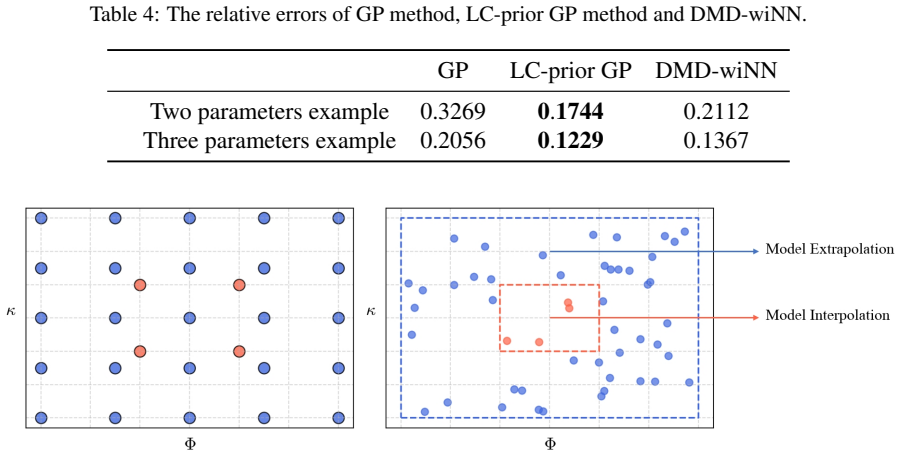
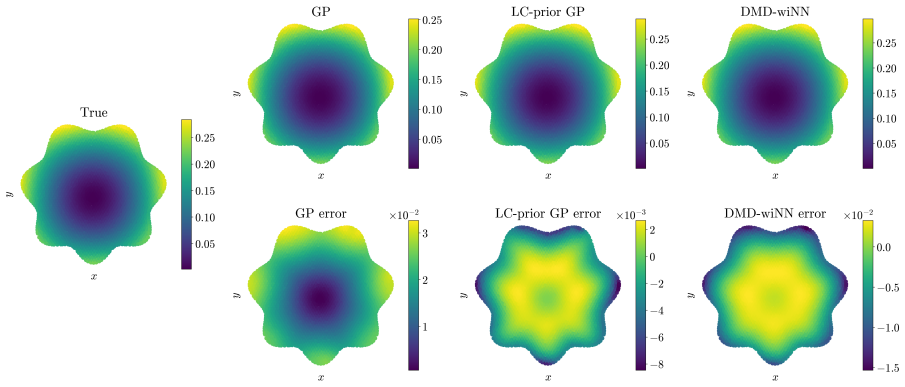
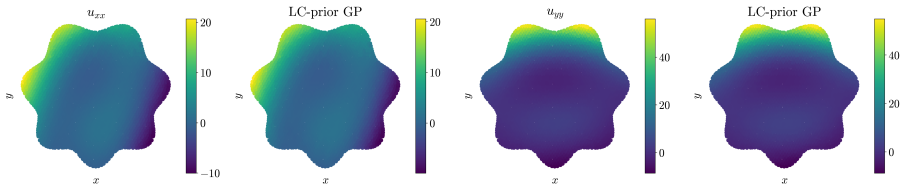
Authors: The numerical experiments in Section 4 report quantitative L2 and maximum errors, convergence rates with respect to training set size, and wall-clock timings, with direct comparisons to standard GP, POD-only, and physics-informed GP baselines; these appear in Tables 1–4 and Figures 5–8 for the nonlinear multi-parameter and multi-coupled test cases. To address the referee’s concern about explicit referencing, we have added summary statements of these metrics and convergence rates to the abstract and expanded the opening paragraph of Section 4 to point readers to the specific tables and figures. revision: yes
Circularity Check
Law-corrected prior adds independent physical information; no reduction to inputs by construction
full rationale
The derivation chain begins with POD to project high-dimensional PDE solutions onto a low-dimensional modal coefficient space, followed by construction of a law-corrected prior that folds in the governing equations to address nonlinear multi-coupled cases. This correction step is described as overcoming linear-operator invariance limitations of prior physics-informed GPs, supplying external physical constraints rather than re-fitting or re-deriving the kernel from the same data used for prediction. RBF-FD differentiation matrices are independent of solution fields, enabling separate optimization in the correction stage. No self-definitional steps, fitted-input predictions, or load-bearing self-citations appear in the abstract or described framework; the central claim retains independent content from the physical laws and is validated on external numerical benchmarks for irregular domains.
Axiom & Free-Parameter Ledger
invented entities (1)
-
law-corrected prior
no independent evidence
Lean theorems connected to this paper
-
IndisputableMonolith/Cost/FunctionalEquation.leanwashburn_uniqueness_aczel unclear?
unclearRelation between the paper passage and the cited Recognition theorem.
The governing physical laws are further incorporated to construct a law-corrected prior to overcome the limitation of existing physics-informed GP methods that rely on linear operator invariance, which enables applications to nonlinear and multi-coupled PDE systems without kernel redesign.
-
IndisputableMonolith/Foundation/BranchSelection.leanbranch_selection unclear?
unclearRelation between the paper passage and the cited Recognition theorem.
˜mk(θ|Law) = mk(θ) + ωk(θ|Law) ... Loss = ||F(MLC(x; θlaw)) − f(x; θlaw)||² + λ ||G...||²
What do these tags mean?
- matches
- The paper's claim is directly supported by a theorem in the formal canon.
- supports
- The theorem supports part of the paper's argument, but the paper may add assumptions or extra steps.
- extends
- The paper goes beyond the formal theorem; the theorem is a base layer rather than the whole result.
- uses
- The paper appears to rely on the theorem as machinery.
- contradicts
- The paper's claim conflicts with a theorem or certificate in the canon.
- unclear
- Pith found a possible connection, but the passage is too broad, indirect, or ambiguous to say the theorem truly supports the claim.
Reference graph
Works this paper leans on
-
[1]
Time Delay ODE/PDE Models: Applications in Biomedical Science and Engineering
WE Schiesser. Time Delay ODE/PDE Models: Applications in Biomedical Science and Engineering. CRC Press, 2019
work page 2019
-
[2]
Tamm: A new topology-aware mapping method for parallel applications on the tianhe-2a su- percomputer
Xinhai Chen, Jie Liu, Shengguo Li, Peizhen Xie, Lihua Chi, and Qinglin Wang. Tamm: A new topology-aware mapping method for parallel applications on the tianhe-2a su- percomputer. In Algorithms and Architectures for Parallel Processing: 18th International Conference, ICA3PP 2018, Guangzhou, China, November 15-17, 2018, Proceedings, Part I 18, pages 242–256...
work page 2018
-
[3]
Ameya D Jagtap, Ehsan Kharazmi, and George Em Karniadakis. Conservative physics- informed neural networks on discrete domains for conservation laws: Applications to for- ward and inverse problems. Computer Methods in Applied Mechanics and Engineering, 365:113028, 2020. 37
work page 2020
-
[4]
Guofei Pang and George Em Karniadakis. Physics-informed learning machines for partial differential equations: Gaussian processes versus neural networks. Emerging frontiers in nonlinear science, pages 323–343, 2020
work page 2020
-
[5]
Computational fluid dynamics, volume 206
John David Anderson and John Wendt. Computational fluid dynamics, volume 206. Springer, 1995
work page 1995
-
[6]
A machine learning framework for data driven acceleration of computations of differential equations
Siddhartha Mishra. A machine learning framework for data driven acceleration of com- putations of differential equations. arXiv preprint arXiv:1807.09519, 2018
work page internal anchor Pith review Pith/arXiv arXiv 2018
-
[7]
Kernel methods are competitive for operator learning
Pau Batlle, Matthieu Darcy, Bamdad Hosseini, and Houman Owhadi. Kernel methods are competitive for operator learning. Journal of Computational Physics, 496:112549, 2024
work page 2024
-
[8]
Operator learning with gaussian processes
Carlos Mora, Amin Yousefpour, Shirin Hosseinmardi, Houman Owhadi, and Ramin Bostanabad. Operator learning with gaussian processes. Computer Methods in Applied Mechanics and Engineering, 434:117581, 2025
work page 2025
-
[9]
Data-driven identi- fication of parametric partial differential equations
Samuel Rudy, Alessandro Alla, Steven L Brunton, and J Nathan Kutz. Data-driven identi- fication of parametric partial differential equations. SIAM Journal on Applied Dynamical Systems, 18(2):643–660, 2019
work page 2019
-
[10]
Tapas Tripura and Souvik Chakraborty. Wavelet neural operator for solving parametric partial differential equations in computational mechanics problems. Computer Methods in Applied Mechanics and Engineering, 404:115783, 2023
work page 2023
-
[11]
Sifan Wang, Hanwen Wang, and Paris Perdikaris. Learning the solution operator of para- metric partial differential equations with physics-informed deeponets. Science advances, 7(40):eabi8605, 2021
work page 2021
-
[12]
Bayesian calibration of computer models
Marc C Kennedy and Anthony O’Hagan. Bayesian calibration of computer models. Journal of the Royal Statistical Society: Series B (Statistical Methodology), 63(3):425– 464, 2001
work page 2001
-
[13]
Xinhai Chen, Rongliang Chen, Qian Wan, Rui Xu, and Jie Liu. An improved data-free surrogate model for solving partial di fferential equations using deep neural networks. Scientific reports, 11(1):19507, 2021
work page 2021
-
[14]
Surrogate modeling of advanced computer simulations using deep gaussian processes
Majdi I Radaideh and Tomasz Kozlowski. Surrogate modeling of advanced computer simulations using deep gaussian processes. Reliability Engineering & System Safety, 195:106731, 2020
work page 2020
-
[15]
Physics-enhanced deep surrogates for partial differential equations
Rapha ¨el Pestourie, Youssef Mroueh, Chris Rackauckas, Payel Das, and Steven G John- son. Physics-enhanced deep surrogates for partial differential equations. Nature Machine Intelligence, 5(12):1458–1465, 2023. 38
work page 2023
-
[16]
Surrogate modeling for bayesian inverse problems based on physics-informed neural networks
Yongchao Li, Yanyan Wang, and Liang Yan. Surrogate modeling for bayesian inverse problems based on physics-informed neural networks. Journal of Computational Physics, 475:111841, 2023
work page 2023
-
[17]
Reduced-order modeling: new ap- proaches for computational physics
David J Lucia, Philip S Beran, and Walter A Silva. Reduced-order modeling: new ap- proaches for computational physics. Progress in aerospace sciences, 40(1-2):51–117, 2004
work page 2004
-
[18]
Multilevel model reduction for uncertainty quantification in computational structural dynamics
Olivier Ezvan, Anas Batou, Christian Soize, and Laurent Gagliardini. Multilevel model reduction for uncertainty quantification in computational structural dynamics. Computational Mechanics, 59(2):219–246, 2017
work page 2017
-
[19]
Adaptive symplectic model order reduction of parametric particle-based vlasov–poisson equation
Jan Hesthaven, Cecilia Pagliantini, and Nicol `o Ripamonti. Adaptive symplectic model order reduction of parametric particle-based vlasov–poisson equation. Mathematics of Computation, 93(347):1153–1202, 2024
work page 2024
-
[20]
A graph convolutional autoencoder approach to model order reduction for parametrized pdes
Federico Pichi, Beatriz Moya, and Jan S Hesthaven. A graph convolutional autoencoder approach to model order reduction for parametrized pdes. Journal of Computational Physics, 501:112762, 2024
work page 2024
-
[21]
Gappy spectral proper orthogonal decomposition
Akhil Nekkanti and Oliver T Schmidt. Gappy spectral proper orthogonal decomposition. Journal of Computational Physics, 478:111950, 2023
work page 2023
-
[22]
Stefania Fresca and Andrea Manzoni. Pod-dl-rom: Enhancing deep learning-based re- duced order models for nonlinear parametrized pdes by proper orthogonal decomposition. Computer Methods in Applied Mechanics and Engineering, 388:114181, 2022
work page 2022
-
[23]
A basis for bounding the errors of proper generalised decom- position solutions in solid mechanics
JP Moitinho de Almeida. A basis for bounding the errors of proper generalised decom- position solutions in solid mechanics. International Journal for Numerical Methods in Engineering, 94(10):961–984, 2013
work page 2013
-
[24]
An overview of the proper generalized decomposition with applications in computational rheology
Francisco Chinesta, Amine Ammar, Adrien Leygue, and Roland Keunings. An overview of the proper generalized decomposition with applications in computational rheology. Journal of Non-Newtonian Fluid Mechanics, 166(11):578–592, 2011
work page 2011
-
[25]
Bruce Moore. Principal component analysis in linear systems: Controllability, observ- ability, and model reduction. IEEE transactions on automatic control, 26(1):17–32, 1981
work page 1981
-
[26]
Interpolatory projection methods for parameterized model reduction
Ulrike Baur, Christopher Beattie, Peter Benner, and Serkan Gugercin. Interpolatory projection methods for parameterized model reduction. SIAM Journal on Scientific Computing, 33(5):2489–2518, 2011
work page 2011
-
[27]
Non-intrusive reduced order modeling of nonlinear problems using neural networks
Jan S Hesthaven and Stefano Ubbiali. Non-intrusive reduced order modeling of nonlinear problems using neural networks. Journal of Computational Physics, 363:55–78, 2018. 39
work page 2018
-
[28]
Reduced-order model with an artificial neural network for aerostructural design optimization
Kyung Hyun Park, Sang Ook Jun, Sung Min Baek, Maeng Hyo Cho, Kwan Jung Yee, and Dong Ho Lee. Reduced-order model with an artificial neural network for aerostructural design optimization. Journal of Aircraft, 50(4):1106–1116, 2013
work page 2013
-
[29]
A model reduction method for parametric dynamical systems defined on complex geometries
Huailing Song, Yuming Ba, Dongqin Chen, and Qiuqi Li. A model reduction method for parametric dynamical systems defined on complex geometries. Journal of Computational Physics, 506:112923, 2024
work page 2024
-
[30]
Rbf-fd formu- las and convergence properties
Victor Bayona, Miguel Moscoso, Manuel Carretero, and Manuel Kindelan. Rbf-fd formu- las and convergence properties. Journal of Computational Physics, 229(22):8281–8295, 2010
work page 2010
-
[31]
The overlapped radial basis function-finite di fference (rbf-fd) method: A generalization of rbf-fd
Varun Shankar. The overlapped radial basis function-finite di fference (rbf-fd) method: A generalization of rbf-fd. Journal of Computational Physics, 342:211–228, 2017
work page 2017
-
[32]
On the role of polynomials in rbf-fd approximations: Ii
Victor Bayona, Natasha Flyer, Bengt Fornberg, and Gregory A Barnett. On the role of polynomials in rbf-fd approximations: Ii. numerical solution of elliptic pdes. Journal of Computational Physics, 332:257–273, 2017
work page 2017
-
[33]
Using compactly supported radial basis functions to solve partial di fferential equations
Robert Schaback and Holger Wendland. Using compactly supported radial basis functions to solve partial di fferential equations. WIT Transactions on Modelling and Simulation, 23, 2024
work page 2024
-
[34]
The proper orthogonal decomposition in the analysis of turbulent flows
Gal Berkooz, Philip Holmes, and John L Lumley. The proper orthogonal decomposition in the analysis of turbulent flows. Annual review of fluid mechanics, 25(1):539–575, 1993
work page 1993
-
[35]
Ngoc Cuong Nguyen and Andrew Rohskopf. Proper orthogonal descriptors for e fficient and accurate interatomic potentials.Journal of Computational Physics, 480:112030, 2023
work page 2023
-
[36]
The korteweg–devries equation: a survey of results
Robert M Miura. The korteweg–devries equation: a survey of results. SIAM review, 18(3):412–459, 1976. 40
work page 1976
discussion (0)
Sign in with ORCID, Apple, or X to comment. Anyone can read and Pith papers without signing in.