REVIEW 3 major objections 7 minor 83 references
Spacetime Wavelet Method for Linear Boundary-Value Problems in Sylvester Matrix Equation Form
T0 review · 3 major / 7 minor · reviewed 2026-08-15 · deepseek-v4-flash
Pith's one-line read A spacetime wavelet discretization turns linear initial-boundary value problems into Sylvester matrix equations solved by Global GMRES with recursive initial guesses, achieving predicted high-order convergence at lower memory cost than…
desk verdict The accuracy results are solid and the recursive initialization is a real small contribution, but the paper's own scaling fits undercut the headline performance claim, so the comparison needs rework before acceptance. read the letter →
The pith
A machine-rendered reading of the paper's core claim, the machinery that carries it, and where it could break.
The reading
What carries the argument
The central objects are the Deslauriers-Dubuc wavelet basis and its derivative connection coefficients $\Gamma$, which discretize derivatives directly in space and time. Applying these operators to a linear PDE puts the discrete system in Sylvester form $AX+XB=C$; semi-orthogonal permutation matrices $P_x$, $P_t$ enforce initial and boundary conditions while keeping the reduced system in the same Sylvester structure. Global GMRES with a Modified Global Arnoldi process, which generates orthogonal matrices rather than vectors, solves the equation, and the paper's recursive algorithm synthesizes coarser-grid solutions into informed initial guesses for finer grids.
What would settle it
Run the method on an advection-dominated linear problem, such as convection-diffusion with $c \gg \nu$, or on a hyperbolic or oscillatory linear PDE, at successive resolution levels while tracking Global GMRES iterations and cumulative wall time against the zero-initial-guess baseline. If iteration counts grow superlinearly with level $j$, or the recursive solver becomes slower than solving directly at $j_{\max}$, the efficiency claim is refuted.
Extended reading notes
Core claim
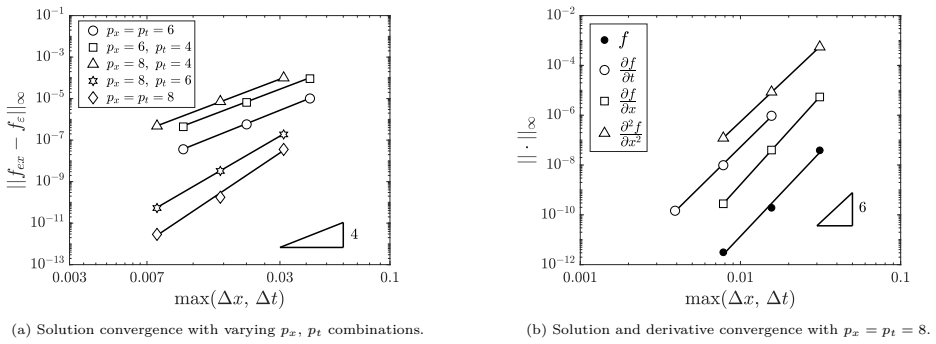
On the paper's own terms, the central claim is that a fully wavelet-based spacetime discretization of linear PDEs produces Sylvester equations that can be solved accurately and efficiently: numerical solutions and derivative approximations converge at the rates predicted by wavelet theory, with user-prescribed error estimates, and the Sylvester form can be solved with Global GMRES rather than the Kronecker-product vectorized system. The recursive wavelet algorithm synthesizes the solution at one resolution level into the initial guess for the next level, reducing the number of Global GMRES iterations and cumulative time to solution compared with starting from zero at the target level. The paper further claims that this Sylvester route outperforms the standard Kronecker-product formulation, which requires storing orders of magnitude more nonzero entries.
Load-bearing premise
The load-bearing premise is that Global GMRES converges quickly enough on the Sylvester systems produced by the spacetime wavelet discretization, without preconditioning and with the fixed restart rule $m=30(j+1)$, across the class of linear PDEs the method claims to target.
Editorial extensions
If this is right
- The discretization provides a built-in a priori error estimate: truncation error is $O(\Delta q^{p-\alpha})$, dictated by the weakest derivative order in the PDE, so users can predict convergence order before solving.
- The full spacetime formulation avoids timestep stability restrictions, sidestepping the explicit/implicit timestep trade-off of conventional semi-discretizations.
- For the diffusion test at level $j=5$, the Sylvester matrices together store roughly 4,449 nonzeros while the equivalent Kronecker product matrix stores 1,267,589 nonzeros, giving a concrete memory advantage.
- The recursive wavelet-synthesized initial-guess procedure reduces Global GMRES iteration counts and cumulative wall time relative to a zero initial guess at every tested resolution level.
- Boundary and initial condition enforcement via permutation matrices preserves well-posedness, with uniqueness guaranteed when the spectra of $A$ and $-B$ are disjoint.
Reading between the lines
- If the convergence behavior is generic, the method could be applied to stiff regimes such as small-diffusion, strong-advection linear problems where explicit timestepping fails, since the spacetime formulation has no visible CFL restriction.
- A natural next step, absent from the paper, would be a convergence theory for Global GMRES on this class of Sylvester systems linking the spectra of $A$ and $B$ to iteration bounds; the paper only provides empirical spectra.
- The recursive initial-guess idea should transfer to nonlinear problems, where prior-level solutions could initialize Newton-like iterations for both the state and the Jacobian.
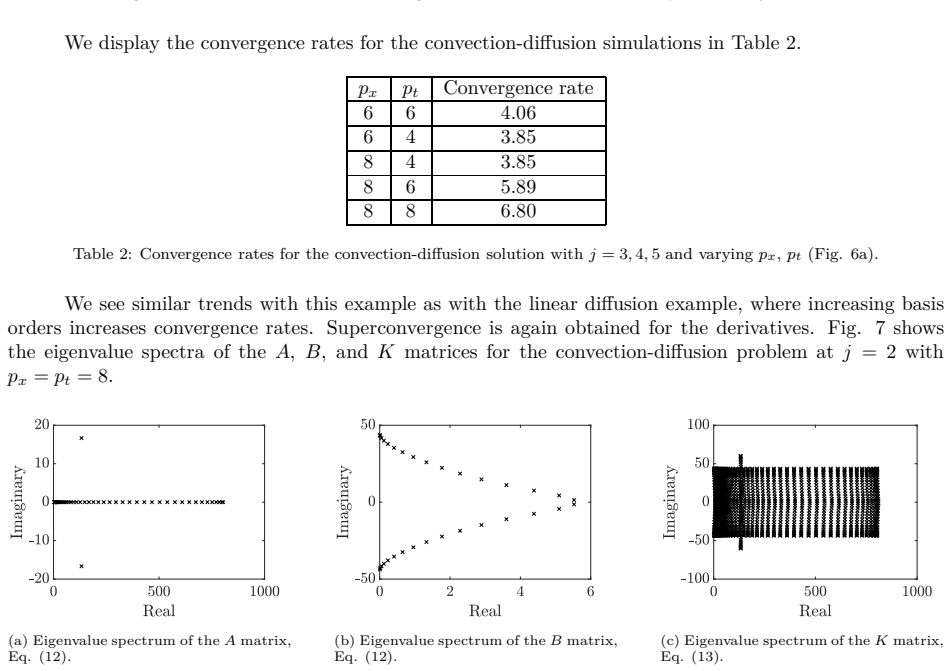
- The K-matrix spectra for the convection-diffusion case show a vertical band absent in the diffusion case, suggesting that advection-dominated limits may hit a performance cliff requiring different restart values or preconditioning; this is a testable boundary of the efficiency claim.
Signed reviews
Editorial analysis
A structured set of objections, weighed in public.
Referee Report
Summary. The paper proposes a spacetime wavelet discretization for linear initial-boundary value problems, based on Deslauriers-Dubuc wavelets and dense wavelet derivative operators. The discretization produces a Sylvester matrix equation, solved here with global GMRES (Gl-GMRES) using a modified global Arnoldi process; boundary and initial conditions are enforced with permutation matrices, and a recursive wavelet-synthesis algorithm supplies initial guesses for successive resolution levels. Verification studies on one-dimensional linear diffusion and convection-diffusion equations with manufactured solutions report high-order convergence rates for both solution and derivative approximations, consistent with the a priori estimates cited from wavelet theory. The paper also claims that the Gl-GMRES Sylvester-form solver outperforms restarted GMRES applied to the Kronecker-product form, and that the recursive initial-guess technique reduces iteration counts and wall time.
Significance. If fully supported, the paper would be a useful practical contribution: it demonstrates an alternative to Kronecker-form spacetime discretizations, where the Sylvester form substantially reduces the number of stored nonzeros, and it provides a simple recursive initialization that accelerates Gl-GMRES. The convergence portion is credible and well executed: manufactured solutions are used, the observed rates match the predicted p-alpha orders, derivative superconvergence is documented, and the algorithms are given in sufficient detail to be reproduced. The main weakness is that the headline performance claim rests on a narrow, confounded comparison in Section 4.3; the authors' own complexity fits suggest a possible crossover at larger problem sizes, so the claim that the Sylvester formulation is 'consistently faster' is not yet established. The convergence results are sound, but the efficiency claim needs additional work before the paper can be accepted as a demonstration of the Sylvester form's superiority.
major comments (3)
- [§4.3, Fig. 8] The claim that Gl-GMRES on the Sylvester form is 'consistently faster' is not supported beyond the tested range. The text reports fitted scalings of approximately O(N^2.5) for Gl-GMRES and slightly below O(N^2) for restarted GMRES on the Kronecker system. If these fits describe the asymptotic behavior, the advantage shown in Fig. 8a must eventually reverse at sufficiently large N. Please provide results at larger N, or present the fits with confidence intervals and an explicit crossover estimate; otherwise the claim should be restricted to the tested problem sizes.
- [§4.3] The performance comparison changes two variables simultaneously: the algebraic formulation (Sylvester versus Kronecker) and the iterative solver (Gl-GMRES versus restarted GMRES). This does not isolate the benefit of the Sylvester form. To substantiate the abstract and conclusion claims that the Sylvester formulation outperforms the Kronecker-product approach, the comparison should either hold the solver fixed across formulations, include a solver appropriate to the vectorized Kronecker system (for example a preconditioned GMRES variant), or be explicitly framed as a comparison of the authors' combined solver choice, not of the algebraic form alone.
- [§3.3 and §4.3] The efficiency and recursive-initialization results depend on the heuristically chosen restart parameter m = 30(j+1) and on the tolerances tol_H = 10^{-8} and residual tolerance 10^{-8}. The paper states that similar results are obtained for other values of m, but gives no sensitivity data and no convergence analysis for the restarted Gl-GMRES iteration. Since the central performance claim relies on this restart rule, please include a sensitivity study (e.g., iteration counts and times for several m values at each level) or a theoretical justification for the rule; otherwise the generality of the conclusions is unclear.
minor comments (7)
- [§4.4, Fig. 9 and Fig. 10] The text states that 'Fig. 9 shows that the number of iterations is drastically attenuated,' but Fig. 9 shows relative time; the iteration counts appear in Fig. 10. Please correct the citation.
- [Fig. 7 caption] The caption for Fig. 7 says the convection-diffusion problem is at j = 2 with px = 6, pt = 4, while the surrounding text states that px = pt = 8 is used for this example. The caption and text should be made consistent.
- [Algorithms 1 and 2] If the modified global Arnoldi loop breaks early because H(z+1,z) < tol_H, the least-squares problem in Algorithm 1 is written for y in R^m and H of size (m+1) x m, while the actual H has smaller dimensions. Please clarify how the reduced H and V are handled during a restart cycle.
- [Tables 1 and 2 and Figs. 3 and 6] The level ranges in the captions are inconsistent: Table 1 and Fig. 3 use j = 3, 4, 5, while Table 2 and Fig. 6 use different ranges (j = 2, 3, 4 in the text). Please harmonize the level ranges in the captions and bodies.
- [Abstract and §2.3] The abstract promises 'user-prescribed error estimates,' but the paper presents a priori asymptotic rates of the form O(delta q^{p-alpha}), not user-specified tolerance-controlled error estimates. Please rephrase to avoid overstating what is demonstrated.
- [Fig. 8b] The vertical axis of Fig. 8b is labeled 'number of operations,' but the text does not define how this quantity is computed. Please specify whether it counts matrix-vector products, flops, or some other measure, and how the fits were obtained.
- [Title, page 1] The title contains a spacing artifact, 'Proble ms'; this should be corrected in the final version.
Circularity Check
No significant circularity: the accuracy and convergence claims are verified against manufactured solutions and external wavelet theory, and the efficiency claims are empirical comparisons rather than construction-equivalent predictions.
full rationale
The paper's derivation chain is self-contained. The spacetime wavelet discretization (Eqs. 3-8) is built from standard Deslauriers-Dubuc multiresolution analysis and connection coefficients from external wavelet literature; the convergence estimate in Eq. (9) is cited to [28,45,56] and is not fitted to the numerical results in Section 4. Accuracy is checked against manufactured analytical solutions (Eqs. 18 and 20), so the reported high-order rates are independent of the method's own assumptions. Boundary-condition enforcement via permutation matrices follows [44], and the Sylvester solution theory (unique solution when spectra of A and -B are disjoint) is cited to [23]. The Gl-GMRES solver and Modified Global Arnoldi algorithm are presented as Algorithms 1-2 from the established literature [53]. Self-citations to [20,45,46,47] identify the MRWT software and the prior nonlinear spacetime discretization on which this linear formulation builds, but the linear reduction to AX+XB=C, the recursive-initial-guess algorithm, and the comparisons in Section 4.3 rest on the paper's own constructed systems and measurements, not on those citations. The restart parameter m=30(j+1) and absence of preconditioning are heuristic choices affecting performance generalization, and the §4.3 complexity fits (Gl-GMRES near O(N^2.5), restarted GMRES below O(N^2)) may indicate a crossover at larger N; these are robustness/correctness caveats, not circular reductions. No equation is defined in terms of a result it is used to prove, and no fitted parameter is renamed as a prediction.
Assumptions & free parameters
free parameters (5)
- restart parameter m =
30(j+1)
- Gl-GMRES residual tolerance =
1e-8
- Arnoldi break tolerance tol_H =
1e-8
- basis orders (px, pt) =
(6,4) diffusion; (8,8) convection-diffusion
- recursive starting level j =
0
assumptions (5)
- standard math Dense wavelet derivative approximation error obeys the bound in Eq. (9), with order p_i - alpha.
- standard math Deslauriers-Dubuc wavelets have sufficient differentiability for first and second derivatives.
- standard math The Sylvester equation AX+XB=C has a unique solution when the spectra of A and -B are disjoint.
- domain assumption Permutation matrix enforcement of Dirichlet conditions yields a well-posed reduced system.
- domain assumption Global GMRES converges for the nonsymmetric Sylvester systems arising here.
Cite this review
Pith. "Pith review of Spacetime Wavelet Method for Linear Boundary-Value Problems in Sylvester Matrix Equation Form." pith.science (2026). https://pith.science/paper/CA2VDF3C
@misc{pith2026250902720,
  author       = {Pith},
  title        = {Pith review of: Spacetime Wavelet Method for Linear Boundary-Value Problems in Sylvester Matrix Equation Form},
  year         = {2026},
  howpublished = {\url{https://pith.science/paper/CA2VDF3C}},
  note         = {Machine review of arXiv:2509.02720}
}
read the original abstract
We present a high-order spacetime numerical method for discretizing and solving linear initial-boundary value problems using wavelet-based techniques with user-prescribed error estimates. The spacetime wavelet discretization yields a system of algebraic equations resulting in a Sylvester matrix equation. We solve this system with a Global Generalized Minimal Residual (GMRES) method in conjunction with a wavelet-based recursive algorithm to improve convergence. We perform rigorous verification studies using linear partial differential equations (PDEs) with both convective and diffusive terms. The results of these simulations show the high-order convergence rates for the solution and derivative approximations predicted by wavelet theory. We demonstrate the utility of solving the Sylvester equation through comparisons to the commonly-used Kronecker product formulation. We show that our recursive wavelet-based algorithm that generates initial guesses for the iterative Global GMRES method improves the performance of the solver.
Figures


Figures from the paper (7 more)




Reference graph
Works this paper leans on
-
[1]
Hawker, Robert B
Reza Abedi, Morgan A. Hawker, Robert B. Haber, and Karel M atouˇ s. An adaptive spacetime dis- continuous Galerkin method for cohesive models of elastody namic fracture. International journal for numerical methods in engineering , 81(10):1207–1241, 2010
2010
-
[2]
Alam, Nicholas K.-R
Jahrul M. Alam, Nicholas K.-R. Kevlahan, and Oleg V. Vasi lyev. Simultaneous space–time adaptive wavelet solution of nonlinear parabolic differential equat ions. Journal of Computational Physics , 214 (2):829–857, 2006
2006
-
[3]
Implicit high-order time marching schemes for the linearized Euler equations
George Arabatzis, Panagiotis Vavilis, Ioannis Toulopo ulos, and John A Ekaterinaris. Implicit high-order time marching schemes for the linearized Euler equations. AIAA journal , 45(8):1819–1826, 2007
2007
-
[4]
A wavelet based space-time adaptive numerical method for partial differential equations
Emmanual Bacry, Stephane Mallat, and George Papanicola ou. A wavelet based space-time adaptive numerical method for partial differential equations. ESAIM: Mathematical Modelling and Numerical Analysis, 26(7):793–834, 1992
1992
-
[5]
A technique for accelerating the con- vergence of restarted GMRES
Allison H Baker, Elizabeth R Jessup, and Thomas Manteuffe l. A technique for accelerating the con- vergence of restarted GMRES. SIAM Journal on Matrix Analysis and Applications , 26(4):962–984, 2005
work page 2005
-
[6]
Trends in large space structure control theo ry: fondest hopes, wildest dreams
Mark Balas. Trends in large space structure control theo ry: fondest hopes, wildest dreams. IEEE Transactions on automatic control , 27(3):522–535, 2003
work page 2003
-
[7]
Richard H. Bartels and George W. Stewart. Solution of the matrix equation AX + XB = C [F4]. Communications of the ACM , 15(9):820–826, 1972
work page 1972
-
[8]
Beattie, Mark Embree, and Danny C
Christopher A. Beattie, Mark Embree, and Danny C. Sorens en. Convergence of polynomial restart Krylov methods for eigenvalue computations. SIAM review , 47(3):492–515, 2005
work page 2005
Show all 83 references
-
[9]
Asynchronous multi-do main variational integrators for nonlinear hyperelastic solids
Michal Beneˇ s and Karel Matouˇ s. Asynchronous multi-do main variational integrators for nonlinear hyperelastic solids. Computer Methods in Applied Mechanics and Engineering , 199(29-32):1992–2013, 2010
1992
-
[10]
S Bertoluzza and G. Naldi. A wavelet collocation method for the numerical solution of partial differential equations. Applied and Computational Harmonic Analysis , 3(1):1–9, 1996
1996
-
[11]
On the adaptive num erical solution of nonlinear partial differ- ential equations in wavelet bases
Gregory Beylkin and James M/ Keiser. On the adaptive num erical solution of nonlinear partial differ- ential equations in wavelet bases. Journal of computational physics , 132(2):233–259, 1997
1997
-
[12]
Convex constrained optimization for large-scale generalized sylvester equations
A Bouhamidi, K Jbilou, and M Raydan. Convex constrained optimization for large-scale generalized sylvester equations. Computational Optimization and Applications , 48(2):233–253, 2011
2011
-
[13]
A note on the numerical approximate solutions for generalized Sylvester matrix equations with applications
Abderrahman Bouhamidi and Khalide Jbilou. A note on the numerical approximate solutions for generalized Sylvester matrix equations with applications . Applied Mathematics and Computation , 206 (2):687–694, 2008
2008
-
[14]
A precon- ditioned block Arnoldi method for large Sylvester matrix eq uations
Abderrahman Bouhamidi, Mustapha Hached, Mohammed Hey ouni, and Khalide Jbilou. A precon- ditioned block Arnoldi method for large Sylvester matrix eq uations. Numerical Linear Algebra with Applications, 20(2):208–219, 2013
2013
-
[15]
Semi-supervised multi-label learning by solving a Sylvester equation
Gang Chen, Yangqiu Song, Fei Wang, and Changshui Zhang. Semi-supervised multi-label learning by solving a Sylvester equation. In Proceedings of the 2008 SIAM International Conference on Da ta Mining, pages 410–419. SIAM, 2008
2008
-
[16]
Matrix preconditioning techniques and applications
Ke Chen. Matrix preconditioning techniques and applications . Number 19. Cambridge University Press, 2005
2005
-
[17]
Meshless methods in solid mechanics , volume 9
Youping Chen, James D Lee, and Azim Eskandarian. Meshless methods in solid mechanics , volume 9. Springer, 2006. 15
2006
-
[18]
A projection method and Krone cker product preconditioner for solving Sylvester tensor equations
Zhen Chen and LinZhang Lu. A projection method and Krone cker product preconditioner for solving Sylvester tensor equations. Science China Mathematics , 55:1281–1292, 2012
2012
-
[19]
O n the ⋆-Sylvester equationAX±X ⋆B⋆ = C
Chun-Yueh Chiang, Eric King-Wah Chu, and Wen-Wei Lin. O n the ⋆-Sylvester equationAX±X ⋆B⋆ = C. Applied Mathematics and Computation , 218(17):8393–8407, 2012
2012
-
[20]
Cochran and Karel Matouˇ s
Cody D. Cochran and Karel Matouˇ s. Spacetime wavelet me thod for the solution of nonlinear partial differential equations. International Journal for Numerical Methods in Engineerin g, 126(13):e70076, 2025
2025
-
[21]
¨Uber die partiellen differenzengleichungen der mathematischen physik
Richard Courant, Kurt Friedrichs, and Hans Lewy. ¨Uber die partiellen differenzengleichungen der mathematischen physik. Mathematische annalen , 100(1):32–74, 1928
1928
-
[22]
A practical method for numerical evaluation of solutions of par- tial differential equations of the heat-conduction type
John Crank and Phyllis Nicolson. A practical method for numerical evaluation of solutions of par- tial differential equations of the heat-conduction type. In Mathematical proceedings of the Cambridge philosophical society, volume 43, pages 50–67. Cambridge University Press, 1947
1947
-
[23]
Arnoldi methods for la rge Sylvester-like observer matrix equations, and an associated algorithm for partial spectrum assignmen t
Biswa Nath Datta and Youcef Saad. Arnoldi methods for la rge Sylvester-like observer matrix equations, and an associated algorithm for partial spectrum assignmen t. Linear Algebra and its Applications , 154: 225–244, 1991
1991
-
[24]
Ten lectures on wavelets
Ingrid Daubechies. Ten lectures on wavelets . SIAM, 1992
1992
-
[25]
De Villiers, Karin M
Johan M. De Villiers, Karin M. Goosen, and Ben M. Herbst. Dubuc–Deslauriers subdivision for finite sequences and interpolation wavelets on an interval. SIAM Journal on Mathematical analysis , 35(2): 423–452, 2003
2003
-
[26]
David L. Donoho. Interpolating wavelet transforms. Preprint, Department of Statistics, Stanford Uni- versity, 2(3):1–54, 1992
1992
-
[27]
F ASTEN: Fast Sylvester equation solver for graph mining
Boxin Du and Hanghang Tong. F ASTEN: Fast Sylvester equation solver for graph mining. In Proceedings of the 24th ACM SIGKDD International Conference on Knowledg e Discovery & Data Mining , pages 1339–1347, 2018
2018
-
[28]
Dubos and N
T. Dubos and N. K.-R. Kevlahan. A conservative adaptive wavelet method for the shallow-water equations on staggered grids. Quarterly Journal of the Royal Meteorological Society , 139(677):1997– 2020, 2013
1997
-
[29]
El Guennouni, Khalide Jbilou, and A.J
A. El Guennouni, Khalide Jbilou, and A.J. Riquet. Block Krylov subspace methods for solving large Sylvester equations. Numerical Algorithms, 29:75–96, 2002
2002
-
[30]
Elleithy, Husain J
Wael M. Elleithy, Husain J. Al-Gahtani, and M. El-Gebei ly. Iterative coupling of BE and FE methods in electrostatics. Engineering Analysis with Boundary Elements , 25:685–695, 2001
2001
-
[31]
The tortoise and the hare restart GMRES
Mark Embree. The tortoise and the hare restart GMRES. SIAM review, 45(2):259–266, 2003
2003
-
[32]
Martin J. Gander. 50 years of time parallel time integra tion. In Multiple shooting and time domain decomposition methods, pages 69–113. Springer, 2015
2015
-
[33]
Gander and Stefan Vandewalle
Martin J. Gander and Stefan Vandewalle. Analysis of the parareal time-parallel time-integration method. SIAM Journal on Scientific Computing , 29(2):556–578, 2007
2007
-
[34]
Van Veen, and Susan C
Fuqiang Gao, Barry D. Van Veen, and Susan C. Hagness. Sen sitivity of the distorted born iterative method to the initial guess in microwave breast imaging. IEEE Transactions on Antennas and Propa- gation, 63(8):3540–3547, 2015
2015
-
[35]
Gardiner, Alan J
Judith D. Gardiner, Alan J. Laub, James J. Amato, and Cle ve B. Moler. Solution of the Sylvester matrix equation AXB T +CXD T =E. ACM Transactions on Mathematical Software (TOMS) , 18(2): 223–231, 1992. 16
1992
-
[36]
A new class of high ly accurate solvers for ordinary differential equations
Andreas Glaser and Vladimir Rokhlin. A new class of high ly accurate solvers for ordinary differential equations. Journal of Scientific Computing , 38(3):368–399, 2009
2009
-
[37]
Finite differenc e method for numerical computation of dis- continuous solutions of the equations of fluid dynamics
Sergei K Godunov and Ihor Bohachevsky. Finite differenc e method for numerical computation of dis- continuous solutions of the equations of fluid dynamics. Matematiˇ ceskij sbornik, 47(3):271–306, 1959
1959
-
[38]
Wavelets and their application for t he solution of partial differential equations in physics
Stefan Goedecker. Wavelets and their application for t he solution of partial differential equations in physics. Max-Planck Institute for Solid State Research, Stuttgart, Germany, 2009
2009
-
[39]
Sˆ onia M. Gomes. Convergence estimates for the wavelet -Galerkin method: superconvergence at the node points. Advances in Computational Mathematics , 4:261–282, 1995
1995
-
[40]
An essay on the application of mathematical analysis to the t heories of electricity and magnetism, volume 3
George Green. An essay on the application of mathematical analysis to the t heories of electricity and magnetism, volume 3. Mayer & M¨ uller, 1889
-
[41]
Eigen v3
Ga¨ el Guennebaud, Beno ˆ ıt Jacob, et al. Eigen v3. http: //eigen.tuxfamily.org, 2010
2010
-
[42]
Gunzburger and Angela Kunoth
Max D. Gunzburger and Angela Kunoth. Space-time adapti ve wavelet methods for optimal control problems constrained by parabolic evolution equations. SIAM journal on control and optimization , 49 (3):1150–1170, 2011
2011
-
[43]
Th´ eorie des ´ equations aux d´ eriv´ees partielles lin´ eaires hyperboliques et du probl` eme de Cauchy
Jacques Hadamard. Th´ eorie des ´ equations aux d´ eriv´ees partielles lin´ eaires hyperboliques et du probl` eme de Cauchy. Acta mathematica, 31(1):333–380, 1908
1908
-
[44]
Sylvester equations a nd the numerical solution of partial fractional differential equations
Matthew Harker and Paul O’Leary. Sylvester equations a nd the numerical solution of partial fractional differential equations. Journal of Computational Physics , 293:370–384, 2015
2015
-
[45]
Adapti ve wavelet algorithm for solving nonlinear initial–boundary value problems with error control
Cale Harnish, Karel Matous, and Daniel Livescu. Adapti ve wavelet algorithm for solving nonlinear initial–boundary value problems with error control. International Journal for Multiscale Computational Engineering, 16(1), 2018
2018
-
[46]
A multiresolution adaptive wavelet method for nonlinear partial differential equations
Cale Harnish, Luke Dalessandro, Karel Matous, and Dani el Livescu. A multiresolution adaptive wavelet method for nonlinear partial differential equations. International Journal for Multiscale Computational Engineering, 19(2), 2021
2021
-
[47]
An adaptive wavelet method for nonlinear partial differential equations with applicat ions to dynamic damage modeling
Cale Harnish, Luke Dalessandro, Karel Matouˇ s, and Dan iel Livescu. An adaptive wavelet method for nonlinear partial differential equations with applicat ions to dynamic damage modeling. Journal of Computational Physics , 479:112002, 2023
2023
-
[48]
Scientific computing: an introductory survey, revised seco nd edition
Michael T Heath. Scientific computing: an introductory survey, revised seco nd edition. SIAM, 2018
2018
-
[49]
Hughes and James R
Thomas J.R. Hughes and James R. Stewart. A space-time fo rmulation for multiscale phenomena. Journal of Computational and Applied Mathematics , 74(1-2):217–229, 1996
1996
-
[50]
Hulbert and Thomas J.R
Gregory M. Hulbert and Thomas J.R. Hughes. Space-time fi nite element methods for second-order hyperbolic equations. Computer methods in applied mechanics and engineering , 84(3):327–348, 1990
1990
-
[51]
Implicitly re started Krylov subspace methods for stable partial realizations
Imad M Jaimoukha and Ebrahim M Kasenally. Implicitly re started Krylov subspace methods for stable partial realizations. SIAM Journal on Matrix Analysis and Applications , 18(3):633–652, 1997
1997
-
[52]
On the wavelet based differentiation ma trix
Leland Jameson. On the wavelet based differentiation ma trix. Journal of Scientific Computing , 8(3): 267–305, 1993
1993
-
[53]
Global FOM and GMRES algorithms for matrix equations
Khalide Jbilou, Abderrahim Messaoudi, and Hassane Sad ok. Global FOM and GMRES algorithms for matrix equations. Applied Numerical Mathematics , 31(1):49–63, 1999
1999
-
[54]
Implicitly restarted global FOM and GMRES f or nonsymmetric matrix equations and Sylvester equations
Yi-Qin Lin. Implicitly restarted global FOM and GMRES f or nonsymmetric matrix equations and Sylvester equations. Applied mathematics and computation , 167(2):1004–1025, 2005. 17
2005
-
[55]
Comparative performance of exponential, implicit, and explicit integrators for stiff systems of ODEs
John Loffeld and Mayya Tokman. Comparative performance of exponential, implicit, and explicit integrators for stiff systems of ODEs. Journal of Computational and Applied Mathematics , 241:45–67, 2013
2013
-
[56]
Kent McCormick and Raymond O. Wells. Wavelet calculus a nd finite difference operators. Mathematics of Computation , 63(207):155–173, 1994
1994
-
[57]
Merkle and Yun-Ho Choi
Charles L. Merkle and Yun-Ho Choi. Computation of low-s peed compressible flows with time-marching procedures. International Journal for Numerical Methods in Engineerin g, 25(2):293–311, 1988
1988
-
[58]
Fundamentals of engineering numerical analysis
Parviz Moin. Fundamentals of engineering numerical analysis . Cambridge University Press, 2010
2010
-
[59]
Naudet and Matthew J
Charles J. Naudet and Matthew J. Zahr. A space-time high -order implicit shock tracking method for shock-dominated unsteady flows. Journal of Computational Physics , 501:112792, 2024
2024
-
[60]
Nazareth
John L. Nazareth. Conjugate gradient method. Wiley Interdisciplinary Reviews: Computational Statis- tics, 1(3):348–353, 2009
2009
-
[61]
Zikoski, and Temistocle Gr enga
Samuel Paolucci, Zachary J. Zikoski, and Temistocle Gr enga. W AMR: An adaptive wavelet method for the simulation of compressible reacting flow. Part II. The pa rallel algorithm. Journal of Computational Physics, 272:842–864, 2014
2014
-
[62]
Zikoski, and Damrongsak Wi rasaet
Samuel Paolucci, Zachary J. Zikoski, and Damrongsak Wi rasaet. W AMR: an adaptive wavelet method for the simulation of compressible reacting flow. Part I. Acc uracy and efficiency of algorithm. Journal of Computational Physics , 272:814–841, 2014
2014
-
[63]
A sp ace–time discontinuous Galerkin method for the solution of the wave equation in the time domain
Steffen Petersen, Charbel Farhat, and Radek Tezaur. A sp ace–time discontinuous Galerkin method for the solution of the wave equation in the time domain. International Journal for Numerical Methods in Engineering, 78(3):275–295, 2009
2009
-
[64]
Computationally efficient multi-time-step method for partitioned time integration of highly nonlinea r structural dynamics
Arun Prakash, Ertugrul Taciroglu, and Keith D Hjelmsta d. Computationally efficient multi-time-step method for partitioned time integration of highly nonlinea r structural dynamics. Computers & Struc- tures, 133:51–63, 2014
2014
-
[65]
Simple regularity criteria for subdivi sion schemes
Olivier Rioul. Simple regularity criteria for subdivi sion schemes. SIAM Journal on Mathematical Analysis, 23(6):1544–1576, 1992
1992
-
[66]
A convergence analysis of GMRES and FOM methods for Sylvester equations
Micka¨ el Robb´ e and Miloud Sadkane. A convergence analysis of GMRES and FOM methods for Sylvester equations. Numerical Algorithms, 30:71–89, 2002
2002
-
[67]
Youcef Saad and Martin H. Schultz. GMRES: A generalized minimal residual algorithm for solving nonsymmetric linear systems. SIAM Journal on scientific and statistical computing , 7(3):856–869, 1986
1986
-
[68]
Iterative methods for sparse linear systems
Yousef Saad. Iterative methods for sparse linear systems . SIAM, 2003
2003
-
[69]
Iterative methods for linear systems of eq uations: A brief historical journey
Yousef Saad. Iterative methods for linear systems of eq uations: A brief historical journey. arXiv preprint arXiv:1908.01083, 2019
1908 arXiv
-
[70]
Block-Arnoldi and Davidson methods fo r unsymmetric large eigenvalue problems
Miloud Sadkane. Block-Arnoldi and Davidson methods fo r unsymmetric large eigenvalue problems. Numerische Mathematik , 64:195–211, 1993
1993
-
[71]
Code verification by th e method of manufactured solutions
Kambiz Salari and Patrick Knupp. Code verification by th e method of manufactured solutions. Technical report, Sandia National Lab.(SNL-NM), Albuquerque, NM (Un ited States); Sandia . . . , 2000
2000
-
[72]
Space-time adapti ve wavelet methods for parabolic evolution problems
Christoph Schwab and Rob Stevenson. Space-time adapti ve wavelet methods for parabolic evolution problems. Mathematics of Computation , 78(267):1293–1318, 2009
2009
-
[73]
On the convergence of restarted Kry lov subspace methods
Valeria Simoncini. On the convergence of restarted Kry lov subspace methods. SIAM Journal on Matrix Analysis and Applications , 22(2):430–452, 2000. 18
2000
-
[74]
Asynchronous space–tim e algorithm based on a domain decomposition method for structural dynamics problems on non-matching me shes
Waad Subber and Karel Matouˇ s. Asynchronous space–tim e algorithm based on a domain decomposition method for structural dynamics problems on non-matching me shes. Computational Mechanics , 57(2): 211–235, 2016
2016
-
[75]
Asynchronous space–tim e domain decomposition method with local- ized uncertainty quantification
Waad Subber and Karel Matouˇ s. Asynchronous space–tim e domain decomposition method with local- ized uncertainty quantification. Computer Methods in Applied Mechanics and Engineering , 325:369–394, 2017
2017
-
[76]
Tezduyar
Kenji Takizawa and Tayfun E. Tezduyar. Space-time fluid -structure interaction methods. Mathematical Models and Methods in Applied Sciences , 22, 2012
2012
-
[77]
Choice o f initial guess in iterative solution of series of systems arising in fluid flow simulations
Damien Tromeur-Dervout and Yuri Vassilevski. Choice o f initial guess in iterative solution of series of systems arising in fluid flow simulations. Journal of Computational Physics , 219(1):210–227, 2006
2006
-
[78]
Tsai, Robert P.K
Angela Y.J. Tsai, Robert P.K. Chan, and Shixiao Wang. Tw o-derivative Runge–Kutta methods for PDEs using a novel discretization approach. Numerical Algorithms, 65:687–703, 2014
2014
-
[79]
Van Loan
Charles F. Van Loan. The ubiquitous Kronecker product. Journal of computational and applied math- ematics, 123(1-2):85–100, 2000
2000
-
[80]
Vasilyev and Christopher Bowman
Oleg V. Vasilyev and Christopher Bowman. Second-gener ation wavelet collocation method for the solution of partial differential equations. Journal of Computational Physics , 165(2):660–693, 2000
2000
-
[81]
Jan G. Verwer. Explicit Runge-Kutta methods for parabo lic partial differential equations. Applied Numerical Mathematics, 22(1-3):359–379, 1996
1996
-
[82]
Improvin g initial guess for the iterative solution of linear equation systems in incompressible flow
Shuai Ye, Yufei Lin, Liyang Xu, and Jiaming Wu. Improvin g initial guess for the iterative solution of linear equation systems in incompressible flow. Mathematics, 8(1):119, 2020
2020
-
[83]
Partial differential equations of applied mathematics
Erich Zauderer. Partial differential equations of applied mathematics . John Wiley & Sons, 2011. 19 Appendices A. Matrices for Boundary/Initial Condition Enforcement Px = ← ··· ⃗0 ··· → In−2 ← ··· ⃗0 ··· → ∈ Rn×(n−2) Pt = ← ··· ⃗0 ··· → Is−1 ∈ Rs×(s−1) XD = ...
2011
Reviewed August 15, 2026 · model on record in the stance chip above.
Discussion (0). Continue with ORCID to comment.