REVIEW 4 major objections 6 minor 59 references
Exploring Fermionic Dark Matter in the Presence of Scalar Leptoquarks
T0 review · 4 major / 6 minor · reviewed 2026-08-15 · deepseek-v4-flash
Pith's one-line read Adding two inert scalar leptoquarks splits the neutral vector-like lepton into two pseudo-Dirac states, suppressing its Z-mediated scattering with nuclei and opening a viable dark-matter window near 1–2.5 TeV.
desk verdict A plausible and new way to rescue VLL dark matter via scalar-leptoquark-induced pseudo-Dirac splitting, but the printed loop formula for that splitting is inconsistent and must be pinned down before the direct-detection claim can be trusted. read the letter →
The pith
A machine-rendered reading of the paper's core claim, the machinery that carries it, and where it could break.
The reading
What carries the argument
The load-bearing object is the one-loop Majorana mass $m_L$ of the neutral vector-like lepton, obtained from a bottom-quark/leptoquark loop and proportional to $m_b y_a y_b^\dagger \sum_{i,j} U_{RS}(i,i)U_{RS}^\dagger(i,j) B_0(m_b^2,0,m_{\Sigma^d_i}^2)$, together with the physical masses $m_{f^0_1}$ and $m_{f^0_2}$ obtained from Eq. (37). Here $B_0$ is the Passarino-Veltman scalar loop integral, and $U_{RS}$ rotates the down-type leptoquark gauge states into mass eigenstates, so the mixing angle $\theta$ controls the size of the splitting. A pseudo-Dirac fermion is a Dirac fermion that has received a small Majorana mass, splitting it into two nearly degenerate Majorana eigenstates; the paper's key observation is that the splitting is typically larger than about 250 keV, the inelastic-scattering threshold that closes the $Z$-mediated direct-detection channel. The companion Dirac-mass correction $\delta m_D$ from the same leptoquark loops also enlarges the charged-neutral splitting in the doublet.
What would settle it
Re-evaluate the one-loop Majorana mass with all flavor and mixing indices carried explicitly at a benchmark point such as $m_{f^0_1}\simeq 1.5$ TeV, $y_a=y_b=1$, $\sin2\theta=1$; if the resulting splitting falls below 250 keV, the direct-detection evasion fails. Experimentally, a search for inelastic up-scattering of $f_1^0$ into $f_2^0$ -- the recoil spectrum and possible de-excitation signal of the heavier state -- would test the claimed splitting independently of the loop calculation.
Extended reading notes
Core claim
The central claim is that two inert scalar leptoquarks -- an $SU(2)_L$ doublet $R$ and an $SU(2)_L$ singlet $S$, both odd under the stabilizing $Z_2$ -- change the nature of the vector-like lepton dark matter candidate. Through one-loop diagrams involving bottom quarks and down-type leptoquarks, the neutral component $f^0$ of the doublet receives a Majorana mass, so the single Dirac state splits into two pseudo-Dirac mass eigenstates $f_1^0$ and $f_2^0$. The lighter state is the dark matter; the splitting is typically above 250 keV across the parameter scan, which is enough to make the $Z$-mediated inelastic transition $f_1^0\to f_2^0$ kinematically forbidden at LUX-ZEPLIN. The same leptoquark couplings open new annihilation and co-annihilation channels that lower the relic density to the Planck-observed value for dark matter masses from about 1 to 2.5 TeV. The parameter space that survives relic-density and indirect-detection constraints also lies below the current LZ and H.E.S.S. limits, with part of it accessible to the next generation of direct-detection experiments.
Load-bearing premise
The direct-detection evasion rests on the loop-generated pseudo-Dirac splitting being genuinely larger than about 250 keV in the claimed parameter region; if the one-loop Majorana-mass calculation has the wrong sign, wrong mixing factors, or wrong loop kinematics, the splitting could be far smaller and the $Z$-mediated scattering would reappear.
Editorial extensions
If this is right
- The minimal pure doublet VLL model is excluded through $Z$-mediated scattering; with the two inert scalar leptoquarks, the model becomes viable for $m_{f^0_1}$ between roughly 1 and 2.5 TeV.
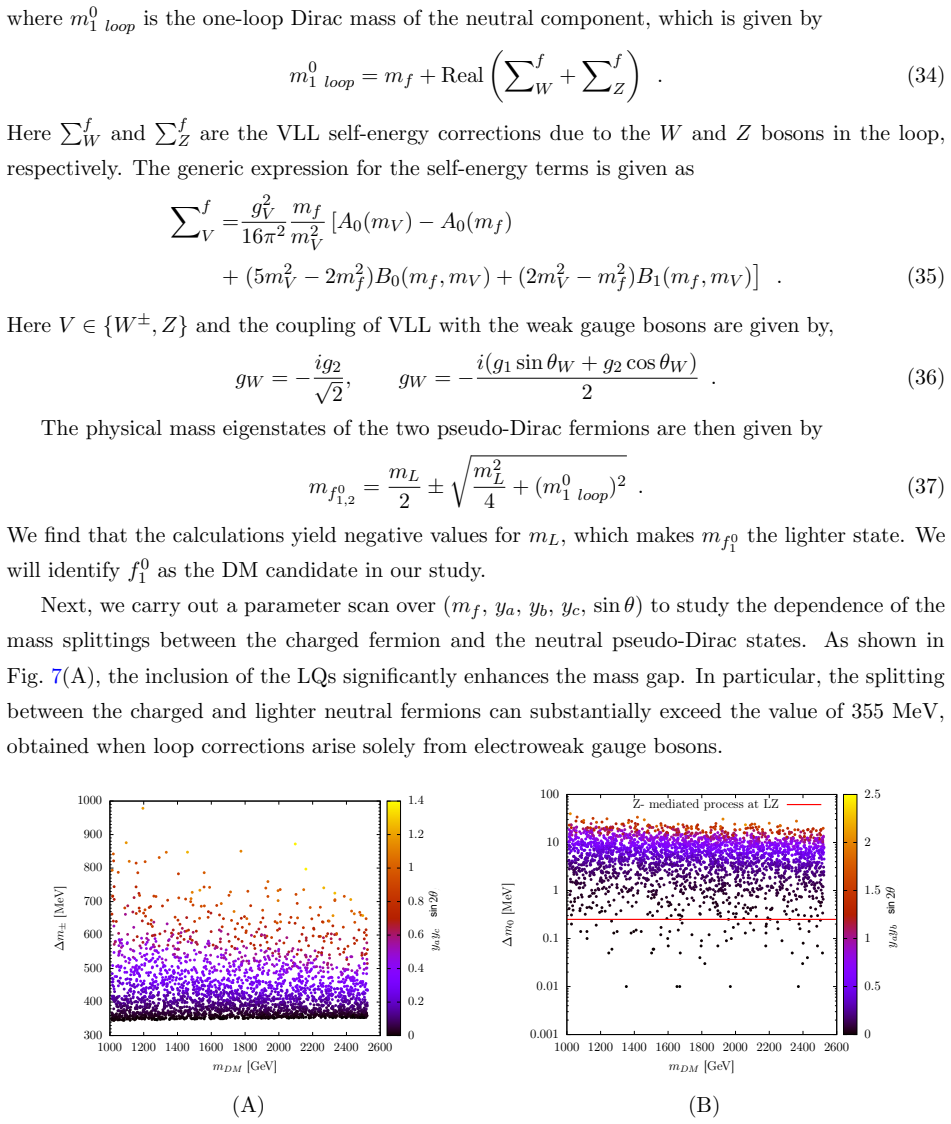
- The loop-induced splitting is typically above 250 keV, putting the model in the inelastic-dark-matter regime and closing the LUX-ZEPLIN scattering channel.
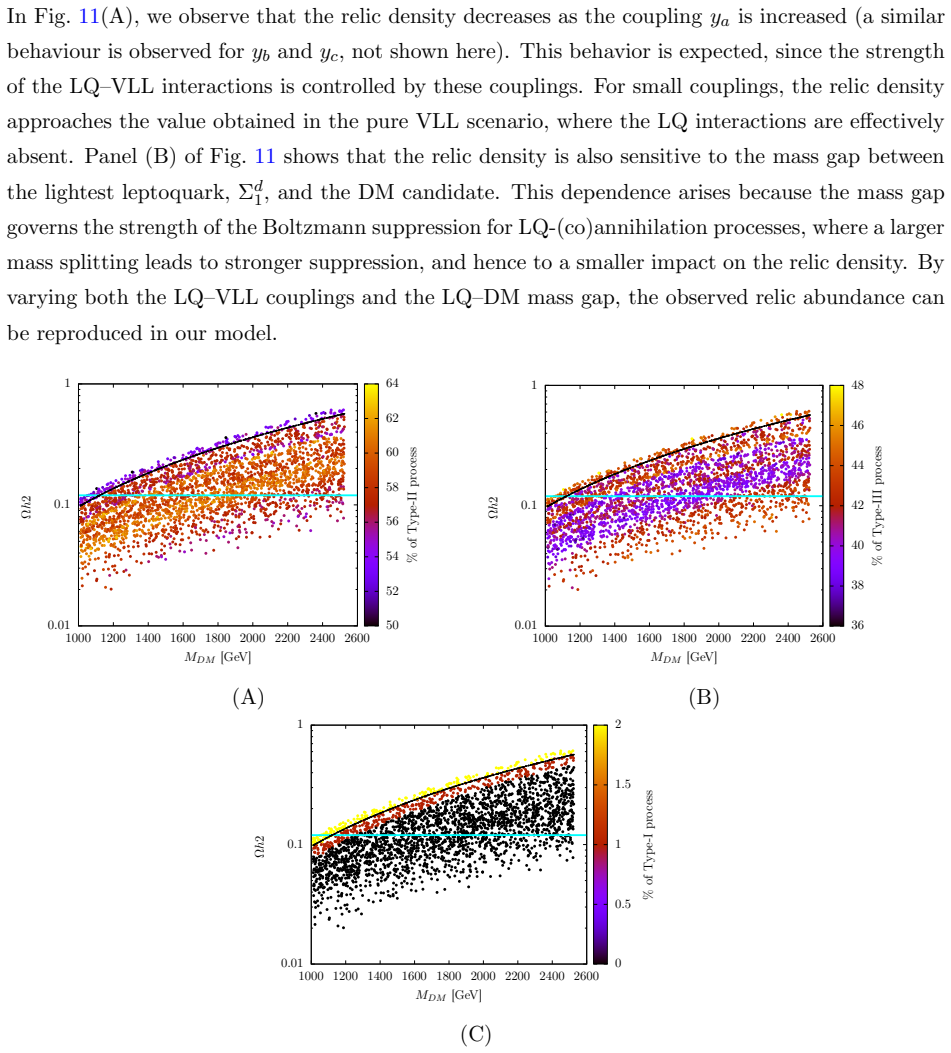
- The new leptoquark-mediated (co)annihilation channels, dominated by co-annihilations among the nearly degenerate dark-sector states, bring the relic density into agreement with the Planck measurement over a wide parameter range.
- The viable parameter space also satisfies the H.E.S.S. bound on the $W^+W^-$ annihilation channel.
- A substantial part of the predicted spin-independent cross-section is below the current LZ limit but within the projected reach of DARWIN, the upgraded LZ, and XENONnT.
Reading between the lines
- The mechanism should generalize: any $Z_2$-odd scalar coupling a vector-like doublet fermion to quarks can generate the same pseudo-Dirac splitting, so the core idea is not tied to the particular leptoquark charges chosen here.
- Because the splitting scales as $y_a y_b \sin2\theta$ and is suppressed by the bottom-quark mass, the model effectively predicts strong third-generation quark couplings for the leptoquarks, which could be probed through associated top/bottom plus missing-energy events at the LHC.
- If the splitting sits only slightly above 250 keV, the heavier pseudo-Dirac state could be excited by up-scattering in direct-detection experiments, producing a distinctive inelastic signature rather than the usual elastic recoil; current and future detectors could search for that signature directly.
Signed reviews
Editorial analysis
A structured set of objections, weighed in public.
Referee Report
Summary. The paper extends the minimal SU(2)_L doublet vector-like lepton (VLL) dark matter model by adding two inert scalar leptoquarks, an SU(2) singlet S and an SU(2) doublet R, both odd under the stabilizing Z2 symmetry. The authors argue that one-loop diagrams involving bottom quarks and the down-type leptoquark mass eigenstates induce a Majorana mass for the neutral VLL component, splitting it into two pseudo-Dirac states; if the splitting exceeds roughly 250 keV, the Z-mediated elastic scattering that excludes the pure VLL model becomes kinematically forbidden. They further show that new (co)annihilation channels involving leptoquarks allow the correct relic abundance for DM masses roughly in the 1-2.5 TeV range, while the predicted spin-independent direct detection cross sections remain below the LUX-ZEPLIN bound. The numerical analysis uses SARAH, SPheno, CalcHEP and micrOMEGAs and applies constraints from vacuum stability, perturbativity, the T parameter, h->γγ, flavour physics and LHC searches.
Significance. If correct, the paper is significant: it offers a radiative, triplet-vev-free mechanism for converting a Z-coupled Dirac VLL into a pseudo-Dirac dark matter candidate, reviving a well-motivated minimal dark matter setup in the TeV range and connecting it to leptoquark and LHC missing-transverse-energy searches. The paper is also useful for its broad treatment of constraints (EWPO, h->γγ, flavour, collider bounds) and for the decomposition of the relic density into Type-I/II/III channels. Credit is due for using standard public codes and for presenting a falsifiable phenomenological profile, including future DARWIN/LZ/XENONnT projections. However, the printed one-loop Majorana-mass formula that anchors the direct-detection evasion claim is not a valid Wick contraction, and no benchmark points or public model files are supplied, so the numerical results cannot currently be verified from the manuscript.
major comments (4)
- [Sec. 5, Eqs. (31) and (32)] The mixing factor in Eqs. (31) and (32), sum_{i,j} U_RS(i,i) U^dagger_RS(i,j) B(... , m_Sigma_i^2), is not a Wick-contracted amplitude: the loop function depends only on i, so summing over j is just a row sum of U^dagger_RS and has no physical meaning. The correct projection of the two Yukawa vertices onto the physical LQ mass eigenstates should produce a factor proportional to U_{iS} U_{iR_d}, i.e. a sin(2theta) [B(m_Sigma_2^2) - B(m_Sigma_1^2)] structure. In particular, for theta -> 0 the printed expression does not vanish, whereas the physical Majorana mass must vanish because y_a and y_b couple to two different unmixed fields and cannot be connected by a single scalar propagator. Since the splitting in Fig. 7(B) and the entire LUX-ZEPLIN evasion argument in Sec. 6.3 are driven by Eq. (32), this is a load-bearing issue; please provide a proper derivation, correct the printed formulas, and confirm that the numerical scans were based on the corrected expression.
- [Sec. 5, Eqs. (32) and (37)] Even after the mixing structure is corrected, the expression mL ~ 6 m_b y_a y_b^dagger ... B0(m_b^2, 0, m_Sigma_i^2) is not numerically meaningful as written: B0 is UV divergent and no subtraction scheme is specified, and the choice of external momentum p^2 = m_b^2 rather than a scale tied to the DM mass is not justified. The statement in the text that mL is negative is also incomplete, because inserting mL < 0 into Eq. (37) gives a negative value for m_{f^0_1}; physical masses require an absolute value or an explicit phase convention, and the mass splitting shown in Fig. 7(B) must be defined consistently with that convention. Please supply the renormalized loop expression and demonstrate that the >250 keV splitting, and hence the direct-detection evasion, survives.
- [Sec. 6, numerical pipeline] The numerical pipeline is described only in general terms ('SARAH ... SPheno ... CalcHEP ... micrOMEGAs') and no benchmark points are provided. Because the printed one-loop formula is inconsistent as written, the reader cannot tell whether Figs. 7, 11, 13 and 15 were generated from Eq. (32) or from a different, correct implementation. Please provide at least one benchmark table with the Lagrangian parameters (m_f, y_a, y_b, y_c, sin(theta), m_Sigma_{d1}, m_Sigma_{d2} - m_Sigma_{d1}) and the corresponding outputs (m_{f^0_1}, Delta m0, Omega h^2, sigma_SI, <sigma v>), and ideally make the model files public. This is necessary to validate the central claims.
- [Sec. 6, scan ranges and Eq. (32)] The scan is restricted to 0.5 <= y_a,b <= 1.5 and 0.5 <= y_c <= 1, and the text motivates these lower bounds by the direct-detection requirement that Delta m0 ~ y_a y_b sin(2theta) exceed the inelastic-scattering threshold. This means the DD-evading region is imposed as a prior rather than emerging as a prediction. Please show explicitly, with the corrected mL formula, how large the allowed parameter region is for smaller Yukawas (e.g., y ~ 0.1-0.3) and how much of the parent parameter space is excluded by LUX-ZEPLIN; otherwise the claim of a 'large parameter space' should be appropriately qualified.
minor comments (6)
- [Sec. 4, Eq. (12)] The vacuum stability conditions as printed, e.g. lambda5 = lambda5 + sqrt(lambda1 + lambda2), appear to be a typographical corruption of the standard conditions lambda5 + 2 sqrt(lambda1 lambda2) > 0 (and similarly for lambda7 and lambda4); please correct these expressions and ensure that the conditions used in the numerical analysis are the correct ones.
- [Sec. 6.1, Eq. (39)] The formula for <sigma v>_eff contains a parenthesis error in the last term: the factors (1 + Delta chi_i)^{3/2} and (1 + Delta chi_j)^{3/2} should be written with explicit brackets, as the current expression is ambiguous.
- [Sec. 6.1, Fig. 12] The decomposition of the effective annihilation rate into Type-I, Type-II and Type-III processes is shown in Fig. 12, but the text does not explain how this decomposition was performed within micrOMEGAs; a short description of the procedure would improve reproducibility.
- [References] References [55] and [59] are incomplete (no arXiv number or journal/volume information); please update them.
- [Sec. 5, Eq. (30)] In Eq. (30), the Higgs-leptoquark coupling g_Sigma_{d1,2} is expressed in terms of the dimensionful parameter mu_RS with no explicit mass-dimensional factor; please clarify the normalization used in Eq. (24) so that the loop amplitude is dimensionless.
- [Sec. 5, Fig. 7(B)] The horizontal threshold at 250 keV that is central to the direct-detection argument is mentioned in the text but is not marked in Fig. 7(B); adding it would make the viability condition immediately visible.
Circularity Check
Direct-detection viability is partly constructed through the y>0.5 scan cut, but the loop-induced pseudo-Dirac splitting and relic/ID computations remain independent.
-
fitted input called prediction
[Section 6 (scan parameter ranges) and Section 6.3 (Direct Detection)]
"In addition, the Yukawa couplings ya,b,c are constrained to be above 0.25 from DD observations. This is because the DD constraint is dependent on the mass splitting ∆m0 between the two light pseudo-Dirac states, which in turn is proportional to the Yukawa couplings (∆m0∝ yayb sin 2θ) ... We therefore restrict ourselves to Yukawa couplings greater than 0.5 in our analysis. ... We find that the entire parameter space consistent with relic density and ID constraints remains below the present exclusion limits."
The scan cut is taken directly from the DD constraint: the paper requires Δm0>250 keV to kinematically forbid Z-mediated scattering and notes Δm0∝y_a y_b sin2θ, so y_a,b,c are restricted to values that guarantee this condition. With that cut imposed, the Z-mediated contribution that excluded the pure VLL is switched off by construction, and the later statement that the scanned parameter space lies below LZ partly restates the input cut rather than predicting it. The circularity is only partial because the LQ-mediated tree-level DD diagrams are computed numerically and independently of this cut, and the relic-density and indirect-detection constraints are not encoded in the same way.
full rationale
The central loop calculation, the one-loop Majorana mass in Eq. (32), the Dirac splitting in Eq. (31), and the resulting pseudo-Dirac spectrum, is a self-contained field-theory computation and is not equivalent to any fitted observable. The relic-density and indirect-detection results are obtained with SARAH/SPheno/CalcHEP/micrOMEGAs and checked against external Planck and H.E.S.S. bounds, so those parts are not circular. There is no load-bearing self-citation chain: the pseudo-Dirac/inelastic-DM mechanism is imported from external references, and the authors' own earlier work is not used to forbid alternatives. The genuinely circular element is the scan design: the Yukawa couplings are restricted to y>0.5 explicitly because the DD constraint requires Δm0>250 keV and Δm0∝y_a y_b sin2θ, and the LQ-DM mass gap is chosen large enough to suppress the LQ-mediated diagrams; the claim that the scanned parameter space lies below LZ therefore partly restates these input cuts. The LQ-mediated DD contribution is still an independent numerical result, and the relic-density consistency is not forced, so the overall score is a moderate 4 rather than a 6 or higher. Separate correctness concerns about the index structure of Eq. (32) and the sign handling of mL in Eq. (37) are technical risks, not circularity, and are not counted in this score.
Assumptions & free parameters
free parameters (7)
- VLL tree-level mass m_f =
scanned as mDM in 1000-2500 GeV
- Yukawa coupling y_a =
scanned 0.5-1.5
- Yukawa coupling y_b =
scanned 0.5-1.5
- Yukawa coupling y_c =
scanned 0.5-1
- LQ mixing angle theta =
0 to 45 degrees (sin 2theta up to 1)
- Lightest down-type LQ mass m_Sigma_d1 =
mDM + 350 GeV to mDM + 1000 GeV
- Down-type LQ mass splitting m_Sigma_d2 - m_Sigma_d1 =
128 GeV
assumptions (4)
- domain assumption An unbroken Z2 symmetry makes the VLL and both leptoquarks odd while all SM fields are even.
- domain assumption The leptoquarks couple only to third-generation quarks.
- standard math One-loop radiative corrections dominate the mass splitting, with higher-order corrections negligible.
- domain assumption The SARAH, SPheno, CalcHEP, and micrOMEGAs numerical implementation faithfully encodes the Lagrangian in Eqs. (5) and (6).
invented entities (3)
-
Vector-like lepton doublet f
independent evidence
-
Scalar leptoquark doublet R
independent evidence
-
Scalar leptoquark singlet S
independent evidence
Cite this review
Pith. "Pith review of Exploring Fermionic Dark Matter in the Presence of Scalar Leptoquarks." pith.science (2026). https://pith.science/paper/7CEYKN2Z
@misc{pith2026250902744,
  author       = {Pith},
  title        = {Pith review of: Exploring Fermionic Dark Matter in the Presence of Scalar Leptoquarks},
  year         = {2026},
  howpublished = {\url{https://pith.science/paper/7CEYKN2Z}},
  note         = {Machine review of arXiv:2509.02744}
}
abstract
We study an extension of the vector-like lepton dark matter model by introducing scalar leptoquarks that modify the properties of the vector-like lepton dark matter candidate, helping it evade stringent direct detection constraints. In the minimal setup, the neutral component of a pure $SU(2)$ doublet vector-like lepton fails to simultaneously account for the observed relic abundance while remaining consistent with current direct detection limits. We show that the addition of the scalar leptoquarks can induce corrections to the mass of the vector-like lepton dark matter, splitting it into two non-degenerate pseudo-Dirac states. This mass splitting can help evade the direct detection bounds naturally. In addition, the extended setup also opens up a larger parameter space of the model that can accommodate the correct relic density.
Figures


Figures from the paper (12 more)






Reference graph
Works this paper leans on
-
[1]
Planck collaboration, Planck 2018 results. VI. Cosmological parameters , Astron. Astrophys. 641 (2020) A6 [ 1807.06209]
arXiv 2020
-
[2]
LUX-ZEPLIN Collaboration collaboration, First dark matter search results from the lux-zeplin (lz) experiment , Phys. Rev. Lett. 131 (2023) 041002
work page 2023
-
[3]
PandaX-4T Collaboration collaboration, Dark matter search results from the pandax-4t commissioning run, Phys. Rev. Lett. 127 (2021) 261802
work page 2021
-
[4]
M. collaboration, Limits to dark matter annihilation cross-section from a combined analysis of magic and fermi-lat observations of dwarf satellite galaxies , Journal of Cosmology and Astroparticle Physics 2016 (2016) 039
2016
-
[5]
Collaboration collaboration, Search for dark matter annihilation signals in the h.e.s.s
H.E.S.S. Collaboration collaboration, Search for dark matter annihilation signals in the h.e.s.s. inner galaxy survey , Phys. Rev. Lett. 129 (2022) 111101
work page 2022
-
[6]
K. Das, T. Li, S. Nandi and S.K. Rai, New signals for vector-like down-type quark in U(1) of E6, Eur. Phys. J. C 78 (2018) 35 [ 1708.00328]
arXiv 2018
-
[7]
A. Joglekar, P. Schwaller and C.E.M. Wagner, A Supersymmetric Theory of Vector-like Leptons, JHEP 07 (2013) 046 [ 1303.2969]
arXiv 2013
-
[8]
O. Lebedev, H.P. Nilles, S. Raby, S. Ramos-Sanchez, M. Ratz, P.K.S. Vaudrevange et al., A Mini-landscape of exact MSSM spectra in heterotic orbifolds , Phys. Lett. B 645 (2007) 88 [hep-th/0611095]
arXiv 2007
Show all 59 references
-
[9]
Martin, Extra vector-like matter and the lightest Higgs scalar boson mass in low-energy supersymmetry, Phys
S.P. Martin, Extra vector-like matter and the lightest Higgs scalar boson mass in low-energy supersymmetry, Phys. Rev. D 81 (2010) 035004 [ 0910.2732]
2010 arXiv
-
[10]
Martin, Raising the Higgs Mass with Yukawa Couplings for Isotriplets in Vector-Like Extensions of Minimal Supersymmetry , Phys
S.P. Martin, Raising the Higgs Mass with Yukawa Couplings for Isotriplets in Vector-Like Extensions of Minimal Supersymmetry , Phys. Rev. D 82 (2010) 055019 [ 1006.4186]
2010 arXiv
-
[11]
Martin and J.D
S.P. Martin and J.D. Wells, Implications of Gauge-Mediated Supersymmetry Breaking with Vector-Like Quarks and a ˜125 GeV Higgs Boson , Phys. Rev. D 86 (2012) 035017 [1206.2956]. 26
2012 arXiv
-
[12]
Chala, R
M. Chala, R. Gr¨ ober and M. Spannowsky,Searches for vector-like quarks at future colliders and implications for composite Higgs models with dark matter , JHEP 03 (2018) 040 [1801.06537]
2018 arXiv
-
[13]
Arkani-Hamed, A.G
N. Arkani-Hamed, A.G. Cohen, E. Katz and A.E. Nelson, The Littlest Higgs , JHEP 07 (2002) 034 [ hep-ph/0206021]
2002 arXiv
-
[14]
Moreau and J.I
G. Moreau and J.I. Silva-Marcos, Flavor physics of the RS model with KK masses reachable at LHC, JHEP 03 (2006) 090 [ hep-ph/0602155]
2006 arXiv
-
[15]
del Aguila and J
F. del Aguila and J. Santiago, Universality limits on bulk fermions , Phys. Lett. B 493 (2000) 175 [hep-ph/0008143]
2000 arXiv
-
[16]
Ellis, R.M
S.A.R. Ellis, R.M. Godbole, S. Gopalakrishna and J.D. Wells, Survey of vector-like fermion extensions of the Standard Model and their phenomenological implications , JHEP 09 (2014) 130 [1404.4398]
2014 arXiv
-
[17]
Alves, G.C
J.M. Alves, G.C. Branco, A.L. Cherchiglia, C.C. Nishi, J.T. Penedo, P.M.F. Pereira et al., Vector-like singlet quarks: A roadmap , Phys. Rept. 1057 (2024) 1 [ 2304.10561]
2024 arXiv
-
[18]
Cohen, J
T. Cohen, J. Kearney, A. Pierce and D. Tucker-Smith, Singlet-Doublet Dark Matter , Phys. Rev. D 85 (2012) 075003 [ 1109.2604]
2012 arXiv
-
[19]
Cirelli, N
M. Cirelli, N. Fornengo and A. Strumia, Minimal dark matter , Nucl. Phys. B 753 (2006) 178 [hep-ph/0512090]
2006 arXiv
-
[20]
S. Dey, P. Ghosh and S.K. Rai, Confronting dark fermion with a doubly charged Higgs in the left–right symmetric model , Eur. Phys. J. C 82 (2022) 876 [ 2202.11638]
2022 arXiv
-
[21]
Bandyopadhyay, M
P. Bandyopadhyay, M. Frank, S. Parashar and C. Sen, Interplay of inert doublet and vector-like lepton triplet with displaced vertices at the LHC/FCC and MATHUSLA , JHEP 03 (2024) 109 [ 2310.08883]
2024 arXiv
-
[22]
P.K. Das, S. Dey, S. Kundu and S.K. Rai, Revisiting the inert scalar dark matter with vector-like quarks, JHEP 05 (2025) 027 [ 2412.17719]
2025 arXiv
-
[23]
Pati and A
J.C. Pati and A. Salam, Lepton Number as the Fourth Color , Phys. Rev. D 10 (1974) 275
1974
-
[24]
Georgi and S.L
H. Georgi and S.L. Glashow, Unity of All Elementary Particle Forces , Phys. Rev. Lett. 32 (1974) 438
1974
-
[25]
Fritzsch and P
H. Fritzsch and P. Minkowski, Unified Interactions of Leptons and Hadrons , Annals Phys. 93 (1975) 193. 27
1975
-
[26]
Allanach, A
B.C. Allanach, A. Dedes and H.K. Dreiner, Bounds on R-parity violating couplings at the weak scale and at the GUT scale , Phys. Rev. D 60 (1999) 075014 [ hep-ph/9906209]
1999 arXiv
-
[27]
Babu and J
K.S. Babu and J. Julio, Two-Loop Neutrino Mass Generation through Leptoquarks , Nucl. Phys. B 841 (2010) 130 [ 1006.1092]
2010 arXiv
-
[28]
Fong, M.C
C.S. Fong, M.C. Gonzalez-Garcia, E. Nardi and E. Peinado, New ways to TeV scale leptogenesis, JHEP 08 (2013) 104 [ 1305.6312]
2013 arXiv
-
[29]
Bauer and M
M. Bauer and M. Neubert, Minimal Leptoquark Explanation for the RD(∗) , RK , and (g− 2)µ Anomalies, Phys. Rev. Lett. 116 (2016) 141802 [ 1511.01900]
2016 arXiv
-
[30]
Thomas and J.D
S.D. Thomas and J.D. Wells, Phenomenology of Massive Vectorlike Doublet Leptons , Phys. Rev. Lett. 81 (1998) 34 [ hep-ph/9804359]
1998 arXiv
-
[31]
LZ collaboration, Dark Matter Search Results from 4.2 Tonne-Years of Exposure of the LUX-ZEPLIN (LZ) Experiment , Phys. Rev. Lett. 135 (2025) 011802 [ 2410.17036]
2025 arXiv
-
[32]
Tucker-Smith and N
D. Tucker-Smith and N. Weiner, Inelastic dark matter , Phys. Rev. D 64 (2001) 043502 [hep-ph/0101138]
2001 arXiv
-
[33]
Bhattacharya, N
S. Bhattacharya, N. Sahoo and N. Sahu, Minimal vectorlike leptonic dark matter and signatures at the LHC , Phys. Rev. D 93 (2016) 115040 [ 1510.02760]
2016 arXiv
-
[34]
Arina, R.N
C. Arina, R.N. Mohapatra and N. Sahu, Co-genesis of Matter and Dark Matter with Vector-like Fourth Generation Leptons, Phys. Lett. B 720 (2013) 130 [ 1211.0435]
2013 arXiv
-
[35]
Frank, P
M. Frank, P. Ghosh, C. Majumdar and S. Senapati, Exploring minimal two component doublet dark matter , 2505.02816
-
[36]
Kannike, Vacuum Stability of a General Scalar Potential of a Few Fields , Eur
K. Kannike, Vacuum Stability of a General Scalar Potential of a Few Fields , Eur. Phys. J. C 76 (2016) 324 [ 1603.02680]
2016 arXiv
-
[37]
Particle Data Group collaboration, Review of particle physics , Phys. Rev. D 110 (2024) 030001
2024
-
[38]
ATLAS collaboration, The quest to discover supersymmetry at the ATLAS experiment , 2403.02455
-
[39]
ATLAS collaboration, A detailed map of Higgs boson interactions by the ATLAS experiment ten years after the discovery , Nature 607 (2022) 52 [ 2207.00092]
2022 arXiv
-
[40]
Djouadi, Squark effects on Higgs boson production and decay at the LHC , Phys
A. Djouadi, Squark effects on Higgs boson production and decay at the LHC , Phys. Lett. B 435 (1998) 101 [ hep-ph/9806315]. 28
1998 arXiv
-
[41]
Kumar, Constraints on a scalar leptoquark from the kaon sector , Phys
G. Kumar, Constraints on a scalar leptoquark from the kaon sector , Phys. Rev. D 94 (2016) 014022 [1603.00346]
2016 arXiv
-
[42]
Varzielas and A
I.d.M. Varzielas and A. Sengupta, Constraining flavoured leptoquarks with LHC and LFV , Nucl. Phys. B 1001 (2024) 116495 [ 2301.04119]
2024 arXiv
-
[43]
Passarino and M.J.G
G. Passarino and M.J.G. Veltman, One Loop Corrections for e+ e- Annihilation Into mu+ mu- in the Weinberg Model , Nucl. Phys. B 160 (1979) 151
1979
-
[44]
Staub, SARAH 4 : A tool for (not only SUSY) model builders , Comput
F. Staub, SARAH 4 : A tool for (not only SUSY) model builders , Comput. Phys. Commun. 185 (2014) 1773 [ 1309.7223]
2014 arXiv
-
[45]
Porod and F
W. Porod and F. Staub, Spheno 3.1: extensions including flavour, cp-phases and models beyond the mssm , Computer Physics Communications 183 (2012) 2458
2012
-
[46]
Belyaev, N.D
A. Belyaev, N.D. Christensen and A. Pukhov, CalcHEP 3.4 for collider physics within and beyond the Standard Model , Comput. Phys. Commun. 184 (2013) 1729 [ 1207.6082]
2013 arXiv
-
[47]
Alguero, G
G. Alguero, G. Belanger, F. Boudjema, S. Chakraborti, A. Goudelis, S. Kraml et al., micrOMEGAs 6.0: N-component dark matter , Comput. Phys. Commun. 299 (2024) 109133 [2312.14894]
2024 arXiv
-
[48]
Griest and D
K. Griest and D. Seckel, Three exceptions in the calculation of relic abundances , Phys. Rev. D 43 (1991) 3191
1991
-
[49]
DAR WINcollaboration, DARWIN: towards the ultimate dark matter detector , JCAP 11 (2016) 017 [ 1606.07001]
2016 arXiv
-
[50]
LZ collaboration, The LUX-ZEPLIN (LZ) Experiment , Nucl. Instrum. Meth. A 953 (2020) 163047 [1910.09124]
2020 arXiv
-
[51]
XENON collaboration, Projected WIMP sensitivity of the XENONnT dark matter experiment, JCAP 11 (2020) 031 [ 2007.08796]
2020 arXiv
-
[52]
ATLAS collaboration, Search for pair production of first-generation scalar leptoquarks at √s = 13 tev with the atlas detector , JHEP 10 (2019) 112 [ 1902.00377]
2019 arXiv
-
[53]
CMS collaboration, Search for pair production of second-generation scalar leptoquarks at √s = 13 tev, Phys. Rev. D 99 (2019) 032014 [ 1808.05082]
2019 arXiv
-
[54]
CMS collaboration, Search for non-resonant effects of leptoquarks in high-mass dilepton tails at√s = 13 tev, 2505.08738. 29
-
[55]
ATLAS collaboration, Atlas results on high-mass dilepton tails and leptoquark exchange at √s = 13 tev,
-
[56]
ATLAS collaboration, Search for electroweak production of supersymmetric states in scenarios with compressed mass spectra at√s = 13 TeV with the ATLAS detector , Phys. Rev. D 97 (2018) 052010 [ 1712.08119]
2018 arXiv
-
[57]
ATLAS collaboration, Searches for electroweak production of supersymmetric particles with compressed mass spectra in√s = 13 TeVpp collisions with the ATLAS detector , Phys. Rev. D 101 (2020) 052005 [ 1911.12606]
2020 arXiv
-
[58]
CMS collaboration, Search for long-lived particles with displaced vertices at √s = 13 tev with the cms detector , 2311.12934
-
[59]
ATLAS collaboration, Search for heavy stable charged particles and displaced signatures at the lhc with the atlas detector , . 30
Reviewed August 15, 2026 · model on record in the stance chip above.
Discussion (0). Continue with ORCID to comment.