REVIEW 4 major objections 5 minor 35 references
Synthetic generation of online social networks through homophily
T0 review · 4 major / 5 minor · reviewed 2026-08-05 · deepseek-v4-flash
Pith's one-line read The paper proposes a homophily-driven generative model that recreates the structural and semantic properties of real microblogging networks without training on real graph data.
desk verdict Useful generator design, but validation is too weak to support the main claim: targets are infeasible at the calibration scale and the reported NED is relative. read the letter →
The pith
A machine-rendered reading of the paper's core claim, the machinery that carries it, and where it could break.
The reading
What carries the argument
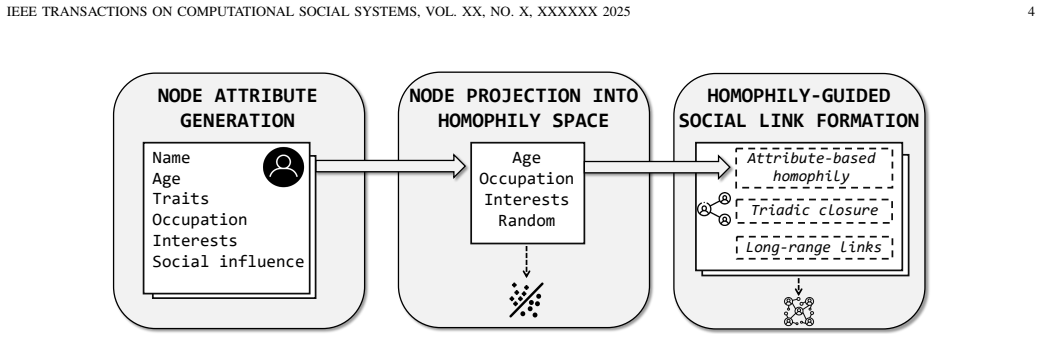
The machinery is a three-phase pipeline. Node attribute generation produces name, age, Big Five traits, occupation, up to five interests, and a power-law social influence score. Projection into homophily space encodes age as a scalar, occupation and interests as semantically ranked ordinal indices built from FastText embeddings, plus a random component, yielding one weighted vector per node. Link formation then has three parts: each node selects n of its k nearest semantic neighbors by a softmax over s(i,j) = α·exp(-d(i,j)) + β·U(0,1); triadic closure adds friend-of-friend links with density-adaptive probability δ(N); and degree-aware distant links are accepted with probability η/(1+log(deg+
What would settle it
Use the winning configuration from Table III to generate a 1,000,000-node graph and compare its degree distribution, reciprocity, and community attribute overlap against Bluesky. The calibration never targets these properties, so a systematic mismatch—for example, a missing power-law tail or communities statistically indistinguishable from random attribute assignment—would falsify the broader realism claim even if the five calibrated metrics match.
Extended reading notes
Core claim
A generative model can produce synthetic microblogging networks that closely match a real platform graph on five structural metrics while also yielding semantically coherent communities. Each synthetic user carries attributes—age, occupation, interests, Big Five personality traits, and a power-law influence score—that are projected into a weighted semantic vector. Directed links are formed by sampling from nearby semantic neighbors using a score that mixes affinity with randomness, supplemented by density-adaptive triadic closure and degree-aware long-range links. A grid search over five hyperparameters calibrates the generator to Bluesky's density, average clustering coefficient, largest-co
Load-bearing premise
The realism claim rests on five global summaries—density, clustering, largest-component fraction, normalized shortest path, and modularity—being enough to capture what makes a social network realistic; if downstream simulations care about properties these five numbers do not measure, a graph can match all five and still be misleading.
Editorial extensions
If this is right
- Synthetic graphs of 1,000 to 1,000,000 nodes can be generated in minutes to hours and reproduce Bluesky's density, clustering, largest-component share, normalized shortest path, and modularity without access to live platform data.
- Because calibration transfers across scales, small synthetic graphs can be used to tune parameters and larger graphs inherit structural fidelity, with normalized error shrinking as network size grows.
- The communities that emerge are modular and attribute-homogeneous, so simulations of echo chambers, influence propagation, or polarization could start from realistic seed topologies that already carry user attributes.
- The size-adaptive formulas for triadic closure and distant-link probability provide a practical template for other synthetic-network generators, and the reported runtimes offer a baseline for future efficiency comparisons.
Reading between the lines
- The paper's realism evidence rests on five aggregate metrics; a stronger test would compare degree distribution shape, reciprocity, and per-community attribute mixing, none of which the calibration targets.
- Because attributes are generated independently and links depend only on current semantic vectors, the method could be extended to temporal dynamics by re-running projection and link formation on drifted attributes; the paper does not attempt this.
- The semantic-index encoding via FastText embeddings and hierarchical clustering is a transferable component that could inject homophily into an existing topology by mapping node labels to semantic indices, though the paper applies it only inside its own generator.
- The grid search optimizes one aggregated normalized distance over five metrics; weighting those metrics differently could change the winning configuration, so the reported superiority over sampling baselines is tied to that aggregation choice.
Editorial analysis
A structured set of objections, weighed in public.
Referee Report
Summary. The paper proposes a synthetic online social network generator based on semantic homophily. Nodes are assigned demographic/behavioral attributes, projected into a weighted vector space, and linked through a combination of local affinity-based selection, triadic closure, and long-range exploratory edges. The generator is calibrated by a grid search over eight hyperparameters targeting five structural metrics of the real Bluesky follower graph (density, average clustering, LCC proportion, normalized shortest path, modularity), and is then evaluated against sampling baselines at network sizes from 10^3 to 10^6 nodes. The authors claim that the framework reliably reproduces real-network structure, outperforms importance-sampling techniques, and yields semantically coherent communities.
Significance. If the claims were substantiated, the generator would be a useful lightweight, attribute-aware baseline for microblogging-network simulation. The combination of homophily-driven local links with triadic closure and long-range exploration is reasonable, and the adaptive scaling functions are thoughtful. The paper also provides useful execution-time data across scales. However, the central validation is compromised: the calibration and evaluation use the same five metrics, the calibration target appears infeasible at the chosen scale, and the homophily evidence is anecdotal. These issues prevent the current version from supporting the abstract's strong claims.
major comments (4)
- [§IV-B, Table III] The calibration at N=10^3 targets Bluesky's full-graph density 8.6e-6 while also targeting LCC=1.0 and clustering=0.262. With N=10^3, density 8.6e-6 corresponds to roughly 8.6 directed edges out of ~10^6 possible, which cannot produce an LCC containing all nodes or an average clustering coefficient of 0.262. The target tuple is mutually infeasible, so the grid search can only rank least-bad configurations; the best NED of 0.852 in Table III is not evidence of fidelity. The paper must either calibrate at a scale where the targets are feasible or use scale-appropriate reference metrics.
- [§IV-B/§IV-C, Figure 3] The evaluation is partly in-sample: the five metrics used for comparison in Figure 3 are exactly the objectives minimized during grid search, and the NED in Figure 3 is computed after min-max normalization across all methods and sizes. The reported NED values are therefore relative rankings, not absolute agreement with Bluesky. To support 'reliably reproduces', the paper should report raw deviations of each metric for the best configuration at each scale, and ideally validate on metrics not used in calibration.
- [§IV-D] The homophily evaluation is qualitative: one synthetic network of N=30 nodes is inspected, and Table IV lists example attributes without any quantitative measure of attribute-community alignment or comparison to baselines or real networks. This does not substantiate the claim that the generated communities are 'semantically coherent' or that the framework captures homophily beyond construction. The paper should report e.g. attribute assortativity, homophily indices, or a statistical comparison of within-community vs cross-community similarity.
- [§IV-C, Figure 2] The density panel appears inconsistent with the claimed match: the dashed line for the full Bluesky graph is near zero, while the plotted synthetic densities appear to be orders of magnitude larger. This is consistent with the infeasible calibration target in §IV-B, but the paper never reconciles the visual discrepancy. The authors should report the actual numeric densities for each scale and explain how a match to 8.6e-6 is achieved or why the plotted values should be interpreted differently.
minor comments (5)
- [§IV-A] The definition of the normalized average shortest path length is incomplete: the text states 'Let P be the set of all node pairs with valid paths...' but no formula or normalization is given. The reference value 0.230 in §IV-B is also not explained (normalized by what?).
- [§IV-B] The grid search description says 34,561 configurations, but the listed parameter counts (4×3×4×4×3×5×3×4) yield 34,560. Please correct.
- [Table III] Decimal separators are inconsistent: several NED values use commas (0,899, 0,900) while others use periods. Use a uniform convention.
- [Algorithm 2 / Eq. (3)] Equation (3) defines ptriadic via δ, but Algorithm 2 line 15 refers to 'δi'. Clarify that δi is the size-adapted δ(N), and ensure the notation matches.
- [General] No code or data availability statement is provided, which is important for a reproducibility-focused evaluation. Also, the figure/abstract text '103–106' should be rendered as 10^3–10^6.
Circularity Check
Calibration and evaluation use the same five structural metrics; the reported low NED is a fitted result, with independent signal only from scale extrapolation and sampling baselines.
-
fitted input called prediction
[Section IV-B (Hyperparameter tuning) -> Section IV-C (Comparative evaluation), Figures 2-3]
"These values are compared with the full Bluesky network metrics (density = 8.6 × 10⁻⁶, average clustering coefficient = 0.262, LCC proportion = 1.0, average shortest path length = 0.230, and modularity = 0.85) through the Normalized Euclidean Distance (NED). ... Figure 3 displays these aggregated distances for our synthetic networks and sampled networks at four size scales ... after min-max normalization across all methods and sizes."
The grid search (IV-B) minimizes NED over exactly the five IV-A metrics (density, clustering, LCC, normalized shortest path, modularity) at N=10^3; IV-C then uses those same metrics and the same NED as evidence of realism. Low NED at the calibration scale is therefore a fit, not a prediction. The scale extrapolation and sampling baselines give partial independent signal, but III-C.3's scale laws were hand-tuned to keep clustering/modularity/shortest-path in range, and Figure 3's NED is min-max normalized across methods/sizes, so displayed values rank fits rather than show absolute agreement. Raw best NED at N=10^3 is 0.852.
full rationale
The principal circularity is the calibration/evaluation identity: the same five structural metrics define both the objective function (NED in the grid search, Section IV-B) and the evidence of realism (Figures 2 and 3, Section IV-C). The claim 'reliably reproduces the structural properties' therefore rests partly on a fitted quantity. The comparison against Forest Fire, Random Walk, PageRank, MHRW, and random node sampling is not circular and does give some independent content, as does generation at scales beyond the calibration scale; however, the scale-dependent hyperparameter laws in Section III-C.3 were explicitly designed to preserve the same metrics, which limits how much those larger scales can be treated as an out-of-sample test. Separately, the target tuple is internally infeasible at N=10^3 (density 8.6e-6 implies about 9 edges, incompatible with LCC proportion 1.0 and clustering 0.262), so the grid search is actually selecting among poor fits; this is a correctness and validity problem rather than a circularity problem, but it compounds the concern. No load-bearing self-citation chain was found: the self-citations ([2], [4]) appear in background and motivation, not as the justification for the central result.
Assumptions & free parameters
free parameters (9)
- affinity_strength_alpha =
0.16 (best config)
- connection_random_weight_beta =
0.06 or 0.00 depending on run
- triadic_prob_base_delta0 =
0.20
- triadic_prob_scale_lambda =
3.5
- triadic_prob_cap_deltacap =
0.42
- distant_prob_base_eta0 =
0.05
- distant_prob_scale_kappa =
0.10
- num_candidates_scale_zeta =
36.0
- scale_adaptation_constants =
0.35, 0.05, 0.25 suppression; 0.22+0.02 log10 N floors
assumptions (7)
- domain assumption Homophily principle: individuals tend to connect with similar others (McPherson et al. [25])
- domain assumption Triadic closure and long-range ties produce realistic social network structure (Lou et al. [26], Ugander et al. [27])
- domain assumption Five structural metrics (density, clustering, LCC, normalized path, modularity) are sufficient to quantify OSN realism
- domain assumption Bluesky follower graph is a representative real-world OSN baseline
- domain assumption FastText semantic similarities produce a meaningful ordinal encoding for occupations and interests
- ad hoc to paper Social influence scores sampled from a power law with hand-set modifiers capture degree heterogeneity
- standard math Standard algorithms (KDTree, softmax, Euclidean distance, Louvain, MHRW) behave as published
Cite this review
Pith. "Pith review of Synthetic generation of online social networks through homophily." pith.science (2026). https://pith.science/paper/QRALEZT2
@misc{pith2026250902762,
  author       = {Pith},
  title        = {Pith review of: Synthetic generation of online social networks through homophily},
  year         = {2026},
  howpublished = {\url{https://pith.science/paper/QRALEZT2}},
  note         = {Machine review of arXiv:2509.02762}
}
read the original abstract
Online social networks (OSNs) have become increasingly relevant for studying social behavior and information diffusion. Nevertheless, they are limited by restricted access to real OSN data due to privacy, legal, and platform-related constraints. In response, synthetic social networks serve as a viable approach to support controlled experimentation, but current generators reproduce only topology and overlook attribute-driven homophily and semantic realism. This work proposes a homophily-based algorithm that produces synthetic microblogging social networks such as X. The model creates a social graph for a given number of users, integrating semantic affinity among user attributes, stochastic variation in link formation, triadic closure to foster clustering, and long-range connections to ensure global reachability. A systematic grid search is used to calibrate five hyperparameters (affinity strength, noise, closure probability, distant link probability, and candidate pool size) for reaching five structural values observed in real social networks (density, clustering coefficient, LCC proportion, normalized shortest path, and modularity). The framework is validated by generating synthetic OSNs at four scales (10^3-10^6 nodes), and benchmarking them against a real-world Bluesky network comprising 4 million users. Comparative results show that the framework reliably reproduces the structural properties of the real network. Overall, the framework outperforms leading importance-sampling techniques applied to the same baseline. The generated graphs capture topological realism and yield attribute-driven communities that align with sociological expectations, providing a realistic, scalable testbed that liberates social researchers from relying on live digital platforms.
Figures


Figures from the paper (2 more)


Reference graph
Works this paper leans on
-
[1]
Opinion dynamics and learning in social networks,
D. Acemoglu and A. Ozdaglar, “Opinion dynamics and learning in social networks,” Dynamic Games and Applications , vol. 1, no. 1, pp. 3–49, mar 2011. [Online]. Available: https://doi.org/10.1007/ s13235-010-0004-1
work page 2011
-
[2]
Influence operations in social networks,
J. Pastor-Galindo, P. Nespoli, J. A. Ruip ´erez-Valiente, and D. Camacho, “Influence operations in social networks,” 2025. [Online]. Available: https://arxiv.org/abs/2502.11827
arXiv 2025
-
[3]
A comparative study of gnns and rule-based methods for synthetic social network generation,
A. O. Davies, N. S. Ajmeri, and T. D. M. E. S. Filho, “A comparative study of gnns and rule-based methods for synthetic social network generation,” IEEE Access, vol. 13, pp. 32 198–32 210, 2025. IEEE TRANSACTIONS ON COMPUTATIONAL SOCIAL SYSTEMS, VOL. XX, NO. X, XXXXXX 2025 11
work page 2025
-
[4]
J. Pastor-Galindo, P. Nespoli, and J. A. Ruip ´erez-Valiente, “Large- language-model-powered agent-based framework for misinformation and disinformation research: Opportunities and open challenges,” IEEE Security & Privacy , vol. 22, no. 3, pp. 24–36, 2024
work page 2024
-
[5]
P. Erd ¨os and A. R ´enyi, “On random graphs i,” Publicationes Mathemat- icae Debrecen, vol. 6, pp. 290–297, 1959
work page 1959
-
[6]
Collective dynamics of ’small-world’ networks,
D. J. Watts and S. Strogatz, “Collective dynamics of ’small-world’ networks,” Nature, vol. 393, pp. 440–442, June 1998
work page 1998
-
[7]
Stochastic blockmodels: First steps,
P. W. Holland, K. B. Laskey, and S. Leinhardt, “Stochastic blockmodels: First steps,” Social Networks, vol. 5, no. 2, pp. 109–137, 1983
work page 1983
-
[8]
Llms generate structurally realistic social networks but overestimate political homophily,
S. Chang, A. Chaszczewicz, E. Wang, M. Josifovska, E. Pierson, and J. Leskovec, “Llms generate structurally realistic social networks but overestimate political homophily,” 2025. [Online]. Available: https://arxiv.org/abs/2408.16629
arXiv 2025
Show all 35 references
-
[9]
Bluesky social platform,
Bluesky, “Bluesky social platform,” https://bsky.app, 2023. [Online]. Available: https://bsky.app
2023
-
[10]
Emergence of scaling in random networks,
A.-L. Barabasi and R. Albert, “Emergence of scaling in random networks,” Science, vol. 286, no. 5439, pp. 509–512, 1999. [Online]. Available: http://www.sciencemag.org/cgi/content/abstract/ 286/5439/509
1999
-
[11]
R. Liao, Y . Li, Y . Song, S. Wang, W. L. Hamilton, D. Duvenaud, R. Urtasun, and R. Zemel, Efficient graph generation with graph recurrent attention networks. Red Hook, NY , USA: Curran Associates Inc., 2019
2019
-
[12]
Chakrabarti, Y
D. Chakrabarti, Y . Zhan, and C. Faloutsos, R-MAT: A Recursive Model for Graph Mining . DBLP, 2004, pp. 442–446. [Online]. Available: https://epubs.siam.org/doi/abs/10.1137/1.9781611972740.43
2004 doi
-
[13]
Community structure and scale-free collections of erd ¨os-r´enyi graphs,
S. Comandur, T. G. Kolda, and A. Pinar, “Community structure and scale-free collections of erd ¨os-r´enyi graphs,” Physical review. E, Sta- tistical, nonlinear, and soft matter physics , vol. 85 5 Pt 2, p. 056109, 2011
2011
-
[14]
A model for the generation of social network graphs,
M. Conti, A. Passarella, and F. Pezzoni, “A model for the generation of social network graphs,” in 2011 IEEE International Symposium on a World of Wireless, Mobile and Multimedia Networks , 2011, pp. 1–6
2011
-
[15]
An empirical assessment of the complexity and realism of synthetic social contact networks,
K. Karra, S. Swarup, and J. Graham, “An empirical assessment of the complexity and realism of synthetic social contact networks,” in 2018 IEEE International Conference on Big Data , 2018, pp. 3959–3967
2018
-
[16]
A synthetic data generator for online social network graphs,
D. F. Nettleton, “A synthetic data generator for online social network graphs,” Social Network Analysis and Mining , vol. 6, no. 1, p. 44, 7
-
[17]
An ideological asymmetry in the diffusion of moralized content on social media among political leaders,
W. J. Brady, J. A. Wills, D. Burkart, and J. T. Jost, “An ideological asymmetry in the diffusion of moralized content on social media among political leaders,” Journal of Personality and Social Psychology , 2019. [Online]. Available: https://psycnet.apa.org/record/2018-63985-001
2019
-
[18]
Social profiling: A review, taxonomy, and challenges,
M. Bilal, A. Gani, M. I. U. Lali, M. Marjani, and N. Malik, “Social profiling: A review, taxonomy, and challenges,” Cyberpsychology, Behavior, and Social Networking , vol. 22, no. 7, pp. 433–450, 2019, pMID: 31074639. [Online]. Available: https://doi.org/10.1089/cyber. 2018.0670
2019
-
[19]
Distribution of social media users by age group worldwide,
Statista, “Distribution of social media users by age group worldwide,” https://www.statista.com/statistics/376128/ social-media-users-by-age-group-worldwide/, 2024, accessed June 2025
2024
-
[20]
An alternative
L. R. Goldberg, “An alternative ”description of personality”: The big-five factor structure,” Journal of Personality and Social Psychology , vol. 59, no. 6, pp. 1216–1229, Dec. 1990
1990
-
[21]
The echo chamber effect on social media,
M. Cinelli, G. D. F. Morales, A. Galeazzi, W. Quattrociocchi, and M. Starnini, “The echo chamber effect on social media,” Proceedings of the National Academy of Sciences , vol. 118, no. 9, p. e2023301118, 2021
2021
-
[22]
Information network or social network? the structure of the twitter follow graph,
S. A. Myers, A. Sharma, P. Gupta, and J. Lin, “Information network or social network? the structure of the twitter follow graph,” in Proceedings of the 23rd International Conference on World Wide Web, ser. WWW ’14 Companion. New York, USA: Association for Computing Machinery, ...
2014
-
[23]
The accuracy com- parison between word2vec and fasttext on sentiment analysis of hotel reviews,
S. Khomsah, R. D. Ramadhani, and S. Wijaya, “The accuracy com- parison between word2vec and fasttext on sentiment analysis of hotel reviews,” Rekayasa Sistem dan Teknologi Informasi , vol. 6, no. 3, pp. 352 – 358, Jun. 2022
2022
-
[24]
Network formation and dynamics among multi-llms,
M. Papachristou and Y . Yuan, “Network formation and dynamics among multi-llms,” 2024. [Online]. Available: https://arxiv.org/abs/2402.10659
2024
-
[25]
Birds of a feather: Homophily in social networks,
M. McPherson, L. Smith-Lovin, and J. M. Cook, “Birds of a feather: Homophily in social networks,” Annual Review of Sociology , vol. 27, no. V olume 27, 2001, pp. 415–444, 2001. [Online]. Available: https: //www.annualreviews.org/content/journals/10.1146/annurev.soc.27.1.415
2001 doi
-
[26]
Learning to predict reciprocity and triadic closure in social networks,
T. Lou, J. Tang, J. Hopcroft, Z. Fang, and X. Ding, “Learning to predict reciprocity and triadic closure in social networks,” ACM Trans. Knowl. Discov. Data , vol. 7, no. 2, Aug. 2013. [Online]. Available: https://doi.org/10.1145/2499907.2499908
2013
-
[27]
The anatomy of the facebook social graph,
J. Ugander, B. Karrer, L. Backstrom, and C. Marlow, “The anatomy of the facebook social graph,” CoRR, vol. abs/1111.4503, 2011. [Online]. Available: http://arxiv.org/abs/1111.4503
2011 arXiv
-
[28]
Walking in facebook: A case study of unbiased sampling of osns,
M. Gjoka, M. Kurant, C. T. Butts, and A. Markopoulou, “Walking in facebook: A case study of unbiased sampling of osns,” in 2010 Proceedings IEEE INFOCOM , 2010, pp. 1–9
2010
-
[29]
Sampling from large graphs,
J. Leskovec and C. Faloutsos, “Sampling from large graphs,” in Proceedings of the 12th ACM SIGKDD International Conference on Knowledge Discovery and Data Mining , ser. KDD ’06. New York, NY , USA: Association for Computing Machinery, 2006, p. 631–636. [Online]. Available: htt...
2006
-
[30]
A spatial model for social networks,
L. H. Wong, P. Pattison, and G. Robins, “A spatial model for social networks,” Physica A: Statistical Mechanics and its Applications, vol. 360, no. 1, pp. 99–120, 2006. [Online]. Available: https://www.sciencedirect.com/science/article/pii/S0378437105004334
2006
-
[31]
Fast algorithm for detecting community structure in networks,
M. E. J. Newman, “Fast algorithm for detecting community structure in networks,” Physical Review E , vol. 69, no. 6, Jun. 2004. [Online]. Available: http://dx.doi.org/10.1103/PhysRevE.69.066133
2004 doi
-
[32]
Fast unfolding of communities in large networks,
V . D. Blondel, J.-L. Guillaume, R. Lambiotte, and E. Lefebvre, “Fast unfolding of communities in large networks,” Journal of Statistical Mechanics: Theory and Experiment , vol. 2008, no. 10, p. P10008, Oct. 2008. [Online]. Available: http://dx.doi.org/10.1088/1742-5468/ 2008/...
2008 doi
-
[33]
Bluesky social dataset,
A. Failla and G. Rossetti, “Bluesky social dataset,” Dec. 2024. [Online]. Available: https://doi.org/10.5281/zenodo.14258401
2024 doi
-
[34]
Practical recommendations on crawling online social networks,
M. Gjoka, M. Kurant, C. T. Butts, and A. Markopoulou, “Practical recommendations on crawling online social networks,” IEEE Journal on Selected Areas in Communications , vol. 29, no. 9, pp. 1872–1892, 2011. Alejandro Buitrago L ´opez is working towards a Ph.D. in Computer Scien...
2011
-
[2016]
Available: https://doi.org/10.1007/s13278-016-0352-y
[Online]. Available: https://doi.org/10.1007/s13278-016-0352-y
Reviewed August 5, 2026 · model on record in the stance chip above.
Discussion (0). Continue with ORCID to comment.