Geodesics of Quantum Feature Maps on the Space of Quantum Operators
Pith reviewed 2026-05-18 19:05 UTC · model grok-4.3
The pith
Quantum feature maps pull back the Riemannian geometry of data manifolds onto subspaces of special unitary operators and supply closed-form expressions for curvature, volume, and harmonic maps.
A machine-rendered reading of the paper's core claim, the machinery that carries it, and where it could break.
Core claim
Assuming a point cloud forms a smooth Riemannian manifold, the authors formally construct the induced Riemannian geometry of a broad class of Hamiltonian quantum feature maps on the subspace of special unitary operators. Starting from first principles they derive analytic and computational formulae for fundamental geometric measurements, including curvature, volume forms, and harmonic maps. The derivations show how changes along paths in the data manifold produce corresponding changes in the geometry of the associated quantum operators.
What carries the argument
The induced Riemannian metric on the subspace of special unitary operators obtained by pulling back the data manifold metric through the Hamiltonian quantum feature map.
If this is right
- Quantum algorithm designers obtain a direct method to compute how distances and angles in the original data are preserved or distorted inside the induced operator space.
- Volume forms derived from the data manifold supply a natural integration measure over the quantum states produced by the feature map.
- Curvature formulas identify where the feature map amplifies or reduces geometric complexity relative to the input data.
- Harmonic maps furnish a variational criterion for selecting feature maps that embed data with minimal distortion.
Where Pith is reading between the lines
- The same pull-back construction may extend to feature maps generated by variational circuits or non-Hamiltonian unitaries.
- Geometry-aware ansatz selection could use the induced curvature to avoid regions of high distortion in quantum machine-learning pipelines.
- Hardware noise models might be inserted into the induced metric to predict how decoherence alters the effective geometry seen by the algorithm.
Load-bearing premise
The input point cloud can be treated as forming or lying on a smooth Riemannian manifold.
What would settle it
Numerical finite-difference estimation of the metric tensor and sectional curvature at points in the feature-map image should reproduce the closed-form expressions given by the paper.
Figures
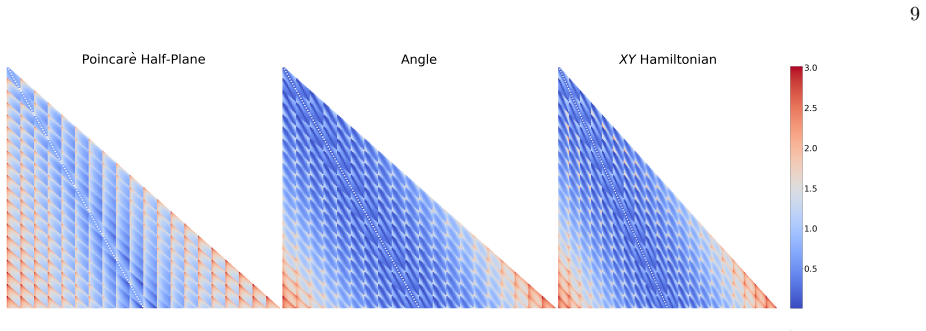
read the original abstract
Recent advancements in the discipline of quantum algorithms have displayed the importance of the geometry of quantum operators. Given this thrust, this paper develops a rigorous geometric framework to analyze how the Riemannian structure of data, under the manifold hypothesis, influences the subspace of quantum gates induced by quantum feature maps. While numerous encoding schemes have been proposed in quantum machine learning, little attention has been given to how data geometry is deformed when mapped into the Lie group of special unitary operators. Addressing this gap, we assume a point cloud forms a smooth Riemannian manifold and formally construct the induced Riemannian geometry of a broad class of Hamiltonian quantum feature maps, which encompasses the majority of derived schemes. Starting from first principles, we derive analytic and, consequently, computational formulae for fundamental geometric measurements, including curvature, volume forms, and harmonic maps, providing tools for systematic deformation analysis. Notably, the derivations of the formulae elucidates how changes along paths in the data manifold interplay to changes in the associated subspace of special unitary operators, thereby indicating a direct geometric effect of data on quantum circuits. This framework establishes the mathematical validity required for principled analysis beyond heuristic ansatz and enables future research into geometry-aware quantum algorithm design.
Editorial analysis
A structured set of objections, weighed in public.
Referee Report
Summary. The paper develops a geometric framework for quantum feature maps by assuming a data point cloud forms a smooth Riemannian manifold and formally constructing the induced Riemannian geometry on the subspace of special unitary operators via a broad class of Hamiltonian quantum feature maps. Starting from first principles, it derives analytic formulae for geodesics, curvature, volume forms, and harmonic maps to analyze how data geometry deforms under these maps and exerts a direct geometric effect on quantum circuits.
Significance. If the derivations are valid, the framework supplies explicit computational tools for geometry-aware analysis of quantum encodings, bridging classical data manifolds with quantum operator spaces and supporting more principled design of quantum machine learning algorithms beyond heuristic choices.
major comments (1)
- [Abstract and §1] Abstract and §1: The assumption that a finite point cloud forms a smooth Riemannian manifold is invoked to induce the Riemannian structure on the quantum operator subspace, but no explicit regularity conditions (such as sampling density, embedding hypotheses, or limiting processes) are stated to justify the existence of a well-defined smooth pullback metric, curvature, or volume form. Without these, the claimed analytic formulae for geodesics and harmonic maps rest on an unverified condition whose failure would render the central geometric constructions undefined.
minor comments (1)
- [Abstract] The abstract refers to 'a broad class of Hamiltonian quantum feature maps' without naming the precise parametrization or Lie-algebra generators used; a short clarifying sentence would improve readability.
Simulated Author's Rebuttal
We thank the referee for their careful reading and constructive feedback. We address the single major comment below and have revised the manuscript to incorporate explicit regularity conditions supporting the manifold assumption.
read point-by-point responses
-
Referee: [Abstract and §1] Abstract and §1: The assumption that a finite point cloud forms a smooth Riemannian manifold is invoked to induce the Riemannian structure on the quantum operator subspace, but no explicit regularity conditions (such as sampling density, embedding hypotheses, or limiting processes) are stated to justify the existence of a well-defined smooth pullback metric, curvature, or volume form. Without these, the claimed analytic formulae for geodesics and harmonic maps rest on an unverified condition whose failure would render the central geometric constructions undefined.
Authors: We agree with the referee that the manuscript would benefit from explicit regularity conditions to justify the smooth induced Riemannian structure. The original text takes the manifold hypothesis as a modeling assumption standard in geometric data analysis, under which the analytic derivations for geodesics, curvature, volume forms, and harmonic maps proceed formally via pullback. To strengthen rigor, we will add a dedicated paragraph in §1 (and cross-reference in §2) specifying the required conditions: the finite point cloud must arise as a sufficiently dense sampling (e.g., an ε-net with ε below the injectivity radius) of an underlying compact smooth Riemannian manifold, the quantum feature map must be a smooth immersion, and the constructions are understood in the continuum limit as the sampling density increases while preserving the manifold topology. These additions clarify that the pullback metric and derived quantities are well-defined precisely when these hypotheses hold, without altering the core analytic formulae. The revision has been prepared. revision: yes
Circularity Check
No significant circularity; derivations follow from stated assumption via independent analytic steps
full rationale
The paper states the manifold hypothesis as an explicit starting assumption for a point cloud and then constructs the induced Riemannian geometry on the subspace of special unitary operators through Hamiltonian quantum feature maps. Analytic formulae for curvature, volume forms, geodesics, and harmonic maps are derived from first principles on the Lie group structure after this assumption, with no reduction of any target result to a fitted parameter, self-citation chain, or definitional equivalence. No load-bearing self-citations, ansatzes smuggled via prior work, or renaming of known empirical patterns are present in the provided derivation outline. The central claims therefore retain independent mathematical content and are self-contained against external benchmarks once the initial regularity assumption is granted.
Axiom & Free-Parameter Ledger
axioms (1)
- domain assumption A point cloud forms a smooth Riemannian manifold.
Lean theorems connected to this paper
-
IndisputableMonolith.Foundation.RealityFromDistinctionreality_from_one_distinction unclear?
unclearRelation between the paper passage and the cited Recognition theorem.
We assume a point cloud forms a smooth Riemannian manifold and formally construct the induced Riemannian geometry of a broad class of Hamiltonian quantum feature maps
-
IndisputableMonolith.Cost.FunctionalEquationwashburn_uniqueness_aczel unclear?
unclearRelation between the paper passage and the cited Recognition theorem.
derive analytic and, consequently, computational formulae for fundamental geometric measurements, including curvature, volume forms, and harmonic maps
What do these tags mean?
- matches
- The paper's claim is directly supported by a theorem in the formal canon.
- supports
- The theorem supports part of the paper's argument, but the paper may add assumptions or extra steps.
- extends
- The paper goes beyond the formal theorem; the theorem is a base layer rather than the whole result.
- uses
- The paper appears to rely on the theorem as machinery.
- contradicts
- The paper's claim conflicts with a theorem or certificate in the canon.
- unclear
- Pith found a possible connection, but the passage is too broad, indirect, or ambiguous to say the theorem truly supports the claim.
Reference graph
Works this paper leans on
-
[1]
Summary This manuscript rigorously established a Riemannian manifold structure on the codomain of a quantum feature map, taken to be a subset of the Lie group SU(2N). Since this subset is only a subgroup in extremely rare scenarios, the establishment required a ground-up approach, work- ing from base-level definitions then showing assumption of lemmas and...
-
[2]
Future Directions It is posited that there is a connection between the geometric structure of an encoding scheme and the per- formance of a quantum-based statistical model. Partic- ularly, the deformation of the geometric structure of an embedded manifold to SU(2N) will indicate performance of a particular task. For instance, as was shown, a flat structur...
work page 2025
-
[3]
Exploiting symmetry in vari- ational quantum machine learning
Johannes Jakob Meyer, Marian Mularski, Elies Gil- Fuster, Antonio Anna Mele, Francesco Arzani, Alissa Wilms, and Jens Eisert. Exploiting symmetry in vari- ational quantum machine learning. PRX quantum , 4(1):010328, 2023
work page 2023
-
[4]
Sukin Sim, Peter D Johnson, and Al´ an Aspuru-Guzik. Expressibility and entangling capability of parameter- ized quantum circuits for hybrid quantum-classical algo- rithms. Advanced Quantum Technologies, 2(12):1900070, 2019
work page 2019
-
[5]
Effect of data encoding on the expressive power of varia- tional quantum-machine-learning models
Maria Schuld, Ryan Sweke, and Johannes Jakob Meyer. Effect of data encoding on the expressive power of varia- tional quantum-machine-learning models. Phys. Rev. A , 103:032430, Mar 2021
work page 2021
-
[6]
The geom- etry of quantum computation
Mark R Dowling and Michael A Nielsen. The geom- etry of quantum computation. arXiv preprint quant- ph/0701004, 2006
-
[7]
Circuit complexity in fermionic field theory
Rifath Khan, Chethan Krishnan, and Sanchita Sharma. Circuit complexity in fermionic field theory. Physical Re- view D, 98(12):126001, 2018
work page 2018
-
[8]
Complex- ity geometry of a single qubit
Adam R Brown and Leonard Susskind. Complex- ity geometry of a single qubit. Physical Review D , 100(4):046020, 2019
work page 2019
-
[9]
Geodesic algorithm for unitary gate design with time-independent hamiltonians
Dylan Lewis, Roeland Wiersema, Juan Carrasquilla, and Sougato Bose. Geodesic algorithm for unitary gate design with time-independent hamiltonians. Physical Review A, 111(5):052618, 2025
work page 2025
-
[10]
Here comes the su (n): multivariate quantum gates and gradients
Roeland Wiersema, Dylan Lewis, David Wierichs, Juan Carrasquilla, and Nathan Killoran. Here comes the su (n): multivariate quantum gates and gradients. Quan- tum, 8:1275, 2024
work page 2024
-
[11]
Ma- chine Learning with Quantum Computers , volume 676
Maria Schuld and Francesco Petruccione. Ma- chine Learning with Quantum Computers , volume 676. Springer Cham, 2 edition, 2021
work page 2021
-
[12]
Parzygnat, Tai-Danae Bradley, Andrew Vlasic, and Anh Pham
Arthur J. Parzygnat, Tai-Danae Bradley, Andrew Vlasic, and Anh Pham. Towards structure-preserving quantum encodings, 2024
work page 2024
-
[13]
Supervised quantum machine learning models are kernel methods, 2021
Maria Schuld. Supervised quantum machine learning models are kernel methods, 2021
work page 2021
-
[14]
Quantum machine learning in feature Hilbert spaces
Maria Schuld and Nathan Killoran. Quantum machine learning in feature Hilbert spaces. Phys. Rev. Lett. , 122(4):040504, 2019
work page 2019
-
[15]
Layerwise learn- ing for quantum neural networks.Quantum Mach
Andrea Skolik, Jarrod R McClean, Masoud Mohseni, Patrick van der Smagt, and Martin Leib. Layerwise learn- ing for quantum neural networks.Quantum Mach. Intell., 3:5, 2021
work page 2021
-
[16]
On the exact continuous mapping of fermions
Andr´ es Montoya-Castillo and Thomas E Markland. On the exact continuous mapping of fermions. Scientific re- ports, 8(1):12929, 2018
work page 2018
-
[17]
Adri´ an P´ erez-Salinas, Alba Cervera-Lierta, Elies Gil- Fuster, and Jos´ e I. Latorre. Data re-uploading for a universal quantum classifier. Quantum, 4:226, February 2020
work page 2020
-
[18]
Fiderer, Hendrik Poulsen Nautrup, Jonas M
Sofiene Jerbi, Lukas J. Fiderer, Hendrik Poulsen Nautrup, Jonas M. K¨ ubler, Hans J. Briegel, and Vedran Dunjko. Quantum machine learning beyond 12 kernel methods. Nat. Commun., 14(1), jan 2023
work page 2023
-
[19]
Lie groups, Lie algebras, and representa- tions
Brian C Hall. Lie groups, Lie algebras, and representa- tions. Springer, 2015
work page 2015
-
[20]
Dequantizing quantum machine learning models using tensor networks
Seongwook Shin, Yong Siah Teo, and Hyunseok Jeong. Dequantizing quantum machine learning models using tensor networks. Physical Review Research, 6(2):023218, 2024
work page 2024
-
[21]
AA Abrikosov Jr, Ennio Gozzi, and D Mauro. Geometric dequantization. Annals of Physics , 317(1):24–71, 2005
work page 2005
-
[22]
Revisiting dequantization and quantum advan- tage in learning tasks
Jordan Cotler, Hsin-Yuan Huang, and Jarrod R Mc- Clean. Revisiting dequantization and quantum advan- tage in learning tasks. arXiv preprint arXiv:2112.00811 , 2021
-
[23]
Dequantizing algorithms to understand quantum advantage in machine learning
Ewin Tang. Dequantizing algorithms to understand quantum advantage in machine learning. Nature Reviews Physics, 4(11):692–693, 2022
work page 2022
-
[24]
Quantum machine learning without any quantum
Ewin Tang. Quantum machine learning without any quantum. University of Washington, 2023
work page 2023
-
[25]
Quantum machine learning tensor network states
Andrey Kardashin, Alexey Uvarov, and Jacob Biamonte. Quantum machine learning tensor network states. Fron- tiers in Physics , 8:586374, 2021
work page 2021
-
[26]
Tensor networks for quantum machine learning
Hans-Martin Rieser, Frank K¨ oster, and Arne Peter Raulf. Tensor networks for quantum machine learning. Proceed- ings of the Royal Society A , 479(2275):20230218, 2023
work page 2023
-
[27]
Tensor network algorithms: A route map
Mari Carmen Ba˜ nuls. Tensor network algorithms: A route map. Annual Review of Condensed Matter Physics, 14(1):173–191, 2023
work page 2023
-
[28]
Lie-algebraic classical simulations for variational quantum computing
Matthew L Goh, Martin Larocca, Lukasz Cincio, Marco Cerezo, and Fr´ ed´ eric Sauvage. Lie-algebraic classical simulations for variational quantum computing. arXiv preprint arXiv:2308.01432, 2023
-
[29]
Riemannian geometry , volume 171
Peter Petersen. Riemannian geometry , volume 171. Springer, 2006
work page 2006
-
[30]
Differential geom- etry and lie groups , volume 12
Jean Gallier and Jocelyn Quaintance. Differential geom- etry and lie groups , volume 12. Springer, 2020
work page 2020
-
[31]
Elements of noncommutative geometry
Jos´ e M Gracia-Bond´ ıa, Joseph C V´ arilly, and H´ ector Figueroa. Elements of noncommutative geometry . Springer Science & Business Media, 2013
work page 2013
-
[32]
J¨ urgen Jost and Jeurgen Jost.Riemannian geometry and geometric analysis, volume 42005. Springer, 2008
work page 2008
-
[33]
Geodesic algorithm for unitary gate de- sign with time-independent hamiltonians
Dylan Lewis, Roeland Wiersema, Juan Carrasquilla, and Sougato Bose. Geodesic algorithm for unitary gate de- sign with time-independent hamiltonians. arXiv preprint arXiv:2401.05973, 2024
-
[34]
Some Riemannian properties of SUn endowed with a bi-invariant metric
Donato Pertici and Alberto Dolcetti. Some Riemannian properties of SUn endowed with a bi-invariant metric. Annali di Matematica Pura ed Applicata (1923-) , pages 1–15, 2024
work page 1923
-
[35]
Paul Renteln. Manifolds, Tensors and Forms. Cambridge University Press, 2014
work page 2014
-
[36]
Curvatures of left invariant metrics on lie groups
John Milnor. Curvatures of left invariant metrics on lie groups. Advances in mathematics, 21(3):293–329, 1976
work page 1976
-
[37]
Lie groups, Lie algebras, and their representations, volume 102
Veeravalli S Varadarajan. Lie groups, Lie algebras, and their representations, volume 102. Springer Science & Business Media, 2013
work page 2013
-
[38]
J¨ urgen Jost.Compact Riemann surfaces: an introduction to contemporary mathematics. Springer, 2006
work page 2006
-
[39]
Dan Shepherd and Michael J. Bremner. Temporally unstructured quantum computation. Proc. R. Soc. A , 465(2105):1413–1439, February 2009
work page 2009
-
[40]
Bremner, Ashley Montanaro, and Dan J
Michael J. Bremner, Ashley Montanaro, and Dan J. Shepherd. Average-case complexity versus approximate simulation of commuting quantum computations. Phys. Rev. Lett., 117:080501, Aug 2016
work page 2016
-
[41]
C´ orcoles, Kristan Temme, Aram W
Vojtˇ ech Havl´ ıˇ cek, Antonio D. C´ orcoles, Kristan Temme, Aram W. Harrow, Abhinav Kandala, Jerry M. Chow, and Jay M. Gambetta. Supervised learning with quantum- enhanced feature spaces. Nature, 567(7747):209–212, 2019
work page 2019
discussion (0)
Sign in with ORCID, Apple, or X to comment. Anyone can read and Pith papers without signing in.