REVIEW 4 major objections 5 minor 107 references
NeuroQD: A Learning-Based Simulation Framework For Quantum Dot Devices
T0 review · 4 major / 5 minor · reviewed 2026-08-05 · deepseek-v4-flash
Pith's one-line read NeuroQD claims that the slow electrostatic solver in quantum-dot device simulation can be replaced by a compact CNN, because the gate-voltage-to-2DEG mapping is a heterostructure-defined blur that transfers from a 2-dot training device to 9
desk verdict NeuroQD is a genuinely useful surrogate for COMSOL electrostatics in Si/SiGe QD devices, but the headline accuracy number covers only the raw potential, not the post-processed charge states the simulator is meant to deliver. read the letter →
The pith
A machine-rendered reading of the paper's core claim, the machinery that carries it, and where it could break.
The reading
What carries the argument
The load-bearing object is the learned blur: the paper models the propagation of the gate-layer potential through the wafer to the 2DEG layer as a fully-convolutional blurring operator whose kernel is set by the heterostructure (Si cap, SiGe spacer, Si quantum well). This operator is realized by a U-Net with skip connections, trained on 18k COMSOL-generated 2DEG potentials for a 2-dot device (augmented to ~148k samples). The generalization step is carried by the translation invariance and input-size agnosticism of the fully convolutional architecture: since the blur kernel does not depend on where a gate sits or how many there are, a model that has learned the local blur on a small device tr
What would settle it
Compare the trained 2-dot U-Net to COMSOL ground truth for a same-heterostructure device in which the gate pitch is doubled; if 2DEG-potential accuracy falls below the >96% bound, the blurring operator is not layout-independent and the transfer claim fails. A complementary check is to vary the 2DEG depth (wafer) by a few nanometers: the blur kernel should change, so accuracy should drop; if it does not, the model is learning something other than the heterostructure-defined blur.
Extended reading notes
Core claim
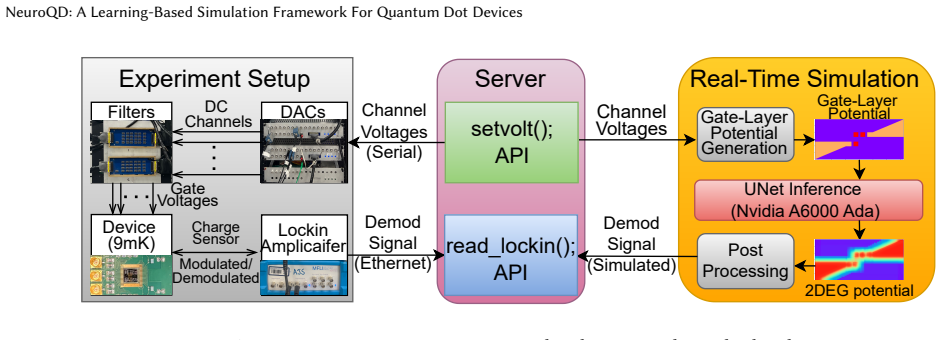
The central discovery is Observation 2: the transformation from the gate-layer potential (the pattern of voltages on the top surface) to the 2DEG potential 59 nm below is a high-order blurring operation, a fully convolutional transformation that is determined by the heterostructure alone and is independent of the gate layout. Because convolutional networks are translation invariant and input-size agnostic, a U-Net trained on a single 2-dot device can infer the 2DEG potential for larger devices built on the same wafer stack. Armed with this surrogate, the paper builds a complete simulator: gate voltages are painted onto gate regions to form the input, the U-Net predicts the 2DEG potential, an
Load-bearing premise
The claim that a two-dot-trained network generalizes to 99 dots rests on the assumption that the layer stack blurs nearby voltages the same way everywhere, so no new global or long-range effect appears when the device grows.
Editorial extensions
If this is right
- Control software and autotuning algorithms can be developed against a realistic device model that answers in milliseconds, the same timescale as the actual set-wait-read loop, so bugs that would destroy a real chip can be caught in simulation.
- The 100% convergence of the surrogate removes the failure mode of the finite-element solver (which failed on roughly 8–10% of test voltage configurations), making exhaustive sweeps of a device's operating range feasible.
- Because runtime scales linearly with the number of dots (up to 99qd in this paper), large 1xN arrays that are currently impractical for COMSOL become simulable for architecture exploration.
- The simulator reproduces measurable device physics (turn-on threshold, Coulomb-peak spacing, charge-stability line slopes), so it can serve as a testbed for tuning procedures before hardware is available.
Reading between the lines
- The blurring-operator claim, if true for 1xN arrays, plausibly extends to 2D dot arrays on the same heterostructure, but the paper does not demonstrate this; 2D layouts introduce corners, more varied cross-coupling, and boundary effects that could violate the strict translation invariance. A natural extension is to train on a 2x2 cell and test on larger 2xN arrays.
- The >96% accuracy is measured on the 2DEG potential itself; accuracy of derived quantities (charge transition positions, sensor currents) could in principle degrade differently. The real-device validation covers a 2-dot region only, so a follow-up would calibrate how potential-space error bounds translate into tuning-relevant observables on larger devices.
- A sharper test of the heterostructure-determinism claim would be to train on one wafer stack and apply to another with the same gate layout but a slightly different 2DEG depth: if the blur kernel is truly stack-defined, accuracy should drop and retraining on a single small device should recover it, confirming the parameterization is minimal.
Editorial analysis
A structured set of objections, weighed in public.
Referee Report
Summary. The paper proposes NeuroQD, a machine-learning surrogate for COMSOL electrostatics simulation of Si/SiGe quantum dot devices. A U-Net is trained on 2-dot COMSOL data to map a gate-layer potential (constructed from gate voltages and layout) to the 2DEG potential, exploiting the observation that this mapping is a fully-convolutional 'blurring' operation. The authors report >96% sMAPE agreement with COMSOL on devices with 2–12 dots, >1000x speedup, apparent generalization to 99-dot devices, and integration into a real-time experimental control stack. The integrated simulator produces turn-on curves, slit-vs-sensor sweeps, Coulomb peaks, and charge stability diagrams that qualitatively match two real devices operated at 9 mK, with comparable charging energies and cross-capacitance slopes. The post-processing chain includes a 2DEG electron-density model, a charge-state integration with an added neighboring-electron energy penalty, and a simulated sensor current.
Significance. If the central claims were fully supported, NeuroQD would be a practically useful tool for architecture research and tuning-software development for spin-qubit arrays, where real-time device-level simulation is currently missing. The paper has genuine strengths: the training is performed on the smallest 2-dot device with a transparent sampling strategy (LHS plus graph-based cross-coupling sampling), the generalization to larger 1xN arrays of the same heterostructure is empirically demonstrated, the speedup is real, and the comparison to two in-house fabricated devices is a step beyond purely synthetic benchmarks. However, the validation currently does not establish the fidelity of the simulator's actual outputs (charge states, sensor currents) because the quantitative accuracy metric is computed on the raw 2DEG potential, while the post-processed observables are compared only qualitatively and depend on hand-set parameters. The significance of the work is therefore conditional on additional end-to-end validation.
major comments (4)
- [§7.1.4, Table 4; §6.3.1] This is a specific technical concern that undermines the central claim of '>96% agreement' as applied to the simulator's actual outputs.
- [§6.3.1, §7.2] This is a load-bearing issue because the only independent physical check of the simulator is the real-device comparison, and the parameters entering that comparison are hand-set.
- [§5.3, §7.1.5] This concerns the central scalability claim and needs either additional evidence or a scope restriction.
- [Table 3, §7.1.3] This is a bias concern in the central accuracy comparison.
minor comments (5)
- [§6.1.2] Typo: 'electrary charge' should be 'elementary charge.'
- [§7.2.4] Typo: 'Figrue 14' should be 'Figure 14.'
- [§3] Typo: 'heterosteucture' should be 'heterostructure.'
- [Figure 16] The COMSOL runtime is an estimate (average per-configuration time multiplied by the number of configurations), not a measured sweep runtime. Please state this clearly in the caption and, if possible, include a measured runtime for a few representative COMSOL configuration runs.
- [§7.1.4] The definition of 'Accuracy = 1 − sMAPE' is nonstandard because sMAPE is already an average over grid points; clarify whether Accuracy is computed per-sample and then averaged, or globally over all points, and how the reported per-category and overall numbers relate to Table 4.
Circularity Check
One disclosed post-processing parameter is fitted to reproduce a feature that is later cited as experimental agreement; the central U-Net generalization claim itself is not circular.
-
fitted input called prediction
[Section 6.3.1 (Charge State Model) and Section 7.2.5 (Charge Stability Diagram)]
"To simulate the triple-point feature observed in charge stability diagrams, we applied a constant energy penalty for each electron already present in neighboring dots when adding an additional electron to the dot."
The neighbor-electron energy penalty is introduced specifically to make the simulated charge stability diagram exhibit the triple-point feature seen in experiments. Section 7.2.5 then cites the resulting 'defined charge state regions ... matching the shapes observed in Devices 1 and 2' as evidence that the simulator reproduces real-device behavior. For the triple-point shape, the agreement is therefore by construction: the feature was put into the post-processing model, not independently predicted by the U-Net potential or derived from COMSOL. Other CSD metrics (charging energy spacing, cross-capacitance slopes) are not fixed by this penalty and retain independent content, so the circularity is partial.
full rationale
The core contribution—training a U-Net on 2-dot COMSOL data and testing on larger COMSOL devices—is a standard surrogate-model evaluation, not circular: the test configurations and device sizes are outside the training set, and the model could have failed. The >96% agreement is measured against the same COMSOL family that produced the training data, but that is a benchmark choice, not a reduction of the prediction to its inputs. The generalization to 99 dots is empirically tested, and the claim that the gate-layer-to-2DEG transformation is layout-independent is a testable physical observation, not a definitional tautology. The real-device comparisons provide external evidence, though qualitative. The one genuine circular step is the constant energy penalty in Section 6.3.1, which is added specifically to reproduce the triple-point feature and later cited as matching experiment; this makes part of the CSD agreement by construction. The V_on parameter may also be chosen to align the turn-on jump, but the paper does not explicitly state that it is fitted, so it is not counted here. No load-bearing self-citation chain or imported uniqueness theorem was found. Overall, the central claim is independent, with one disclosed post-processing fit producing a partial circularity.
Assumptions & free parameters
free parameters (3)
- V_on (turn-on potential) =
not stated in paper
- Neighboring-electron energy penalty =
not stated in paper
- Sensor current conversion scale =
not stated in paper
assumptions (6)
- domain assumption The gate-layer to 2DEG potential transformation is determined by the heterostructure alone and is independent of gate layout.
- domain assumption Gate voltages are confined to the safe range 0 to 1 V for the in-house Si/SiGe devices.
- domain assumption The ideal 2DEG model at T = 0 K with piecewise linear density n2D(V) = (m* e (V - V_on)/(pi hbar^2)) for V >= V_on, else 0, adequately represents device electrostatics.
- domain assumption COMSOL electrostatics solutions are a suitable ground truth for the 2DEG potential in real devices.
- domain assumption The gate-layer to 2DEG transformation is invariant under rotation and reflection of the gate layout.
- standard math U-Net is translation invariant and input-size agnostic.
Cite this review
Pith. "Pith review of NeuroQD: A Learning-Based Simulation Framework For Quantum Dot Devices." pith.science (2026). https://pith.science/paper/2OQFRJZ6
@misc{pith2026250902872,
  author       = {Pith},
  title        = {Pith review of: NeuroQD: A Learning-Based Simulation Framework For Quantum Dot Devices},
  year         = {2026},
  howpublished = {\url{https://pith.science/paper/2OQFRJZ6}},
  note         = {Machine review of arXiv:2509.02872}
}
read the original abstract
Electron spin qubits in quantum dot devices are promising for scalable quantum computing. However, architectural support is currently hindered by the lack of realistic and performant simulation methods for real devices. Physics-based tools are accurate yet too slow for simulating device behavior in real-time, while qualitative models miss layout and wafer heterostructure. We propose a new simulation approach capable of simulating real devices from the cold-start with real-time performance. Leveraging a key phenomenon observed in physics-based simulation, we train a compact convolutional neural network (CNN) to infer the qubit-layer electrostatic potential from gate voltages. Our GPU-accelerated inference delivers >1000x speedup with >96% agreement to the physics-based simulation. Integrated into the experiment control stack, the simulator returns results with millisecond scale latency, reproduces key tuning features, and yields device behaviors and metrics consistent with measurements on devices operated at 9 mK.
Figures


Figures from the paper (13 more)




Reference graph
Works this paper leans on
-
[1]
[n. d.]. COMSOL® Software Version 6.3 Release Highlights. https: //www.comsol.com/release/6.3 [Online; accessed 2025-06-20]
2025
-
[2]
Christopher R Anderson, Mark F Gyure, Sam Quinn, Andrew Pan, Richard S Ross, and Andrey A Kiselev. 2022. High-precision real- space simulation of electrostatically confined few-electron states. AIP Advances 12, 6 (2022)
2022
-
[3]
Hidehiro Asai, Shota Iizuka, Tsutomu Ikegami, Junichi Hattori, Koichi Fukuda, Hiroshi Oka, Kimihiko Kato, Hiroyuki Ota, and Takahiro Mori. 2021. Development of integrated device simulator for quan- tum bit design: self-consistent calculation for quantum transport and qubit operation. In 2021 5th IEEE Electron Devices Technology & Manufacturing Conference ...
2021
-
[4]
Timothy A Baart, Pieter T Eendebak, Christian Reichl, Werner Wegscheider, and Lieven MK Vandersypen. 2016. Computer- automated tuning of semiconductor double quantum dots into the single-electron regime. Applied Physics Letters 108, 21 (2016)
2016
-
[5]
Ali Bakhoda, George L Yuan, Wilson WL Fung, Henry Wong, and Tor M Aamodt. 2009. Analyzing CUDA workloads using a detailed GPU simulator. In 2009 IEEE international symposium on performance analysis of systems and software . IEEE, 163–174
2009
-
[6]
Félix Beaudoin, Pericles Philippopoulos, Chenyi Zhou, Ioanna Kriek- ouki, Michel Pioro-Ladrière, Hong Guo, and Philippe Galy. 2022. Robust technology computer-aided design of gated quantum dots at cryogenic temperature. Applied physics letters 120, 26 (2022)
2022
-
[7]
Nathan Binkert, Bradford Beckmann, Gabriel Black, Steven K Rein- hardt, Ali Saidi, Arkaprava Basu, Joel Hestness, Derek R Hower, Tushar Krishna, Somayeh Sardashti, et al. 2011. The gem5 simulator. ACM SIGARCH computer architecture news 39, 2 (2011), 1–7
2011
-
[8]
Stefan Birner, Tobias Zibold, Till Andlauer, Tillmann Kubis, Matthias Sabathil, Alex Trellakis, and Peter Vogl. 2007. Nextnano: general purpose 3-D simulations. IEEE Transactions on Electron Devices 54, 9 (2007), 2137–2142
2007
Show all 107 references
-
[9]
F Borjans, X Mi, and JR Petta. 2021. Spin digitizer for high-fidelity readout of a cavity-coupled silicon triple quantum dot. Physical Review Applied 15, 4 (2021), 044052
2021
-
[10]
Guido Burkard, Thaddeus D Ladd, Andrew Pan, John M Nichol, and Jason R Petta. 2023. Semiconductor spin qubits. Reviews of Modern Physics 95, 2 (2023), 025003
2023
-
[11]
Zhenyu Cai, Michael A Fogarty, Simon Schaal, Sofia Patomäki, Si- mon C Benjamin, and John JL Morton. 2019. A silicon surface code architecture resilient against leakage errors. Quantum 3 (2019), 212
2019
-
[12]
Anasua Chatterjee, Paul Stevenson, Silvano De Franceschi, Andrea Morello, Nathalie P de Leon, and Ferdinand Kuemmeth. 2021. Semi- conductor qubits in practice. Nature Reviews Physics 3, 3 (2021), 157–177
2021
-
[13]
Shize Che, Seongwoo Oh, Haoyun Qin, Yuhao Liu, Anthony Sigillito, and Gushu Li. 2024. Fast Virtual Gate Extraction For Silicon Quantum Dot Devices. In Proceedings of the 61st ACM/IEEE Design Automation Conference. 1–6
2024
-
[14]
Mingkun Chen, Robert Lupoiu, Chenkai Mao, Der-Han Huang, Jiaqi Jiang, Philippe Lalanne, and Jonathan A Fan. 2022. High speed simulation and freeform optimization of nanophotonic devices with physics-augmented deep learning. ACS Photonics 9, 9 (2022), 3110– 3123
2022
-
[15]
Jesus D Cifuentes, Philip Y Mai, Frédéric Schlattner, H Ekmel Ercan, MengKe Feng, Christopher C Escott, Andrew S Dzurak, and Andre Saraiva. 2023. Path-integral simulation of exchange interactions in cmos spin qubits. Physical Review B 108, 15 (2023), 155413
2023
-
[16]
Jesús D Cifuentes, Tuomo Tanttu, Will Gilbert, Jonathan Y Huang, En- sar Vahapoglu, Ross CC Leon, Santiago Serrano, Dennis Otter, Daniel Dunmore, Philip Y Mai, et al. 2024. Bounds to electron spin qubit variability for scalable CMOS architectures. Nature communications 15, 1 (...
2024
-
[17]
Stefanie Czischek, Victor Yon, Marc-Antoine Genest, Marc-Antoine Roux, Sophie Rochette, Julien Camirand Lemyre, Mathieu Moras, Michel Pioro-Ladrière, Dominique Drouin, Yann Beilliard, et al. 2021. Miniaturizing neural networks for charge state autotuning in quan- tum dots. Mac...
2021
-
[18]
Jana Darulová, SJ Pauka, Nathan Wiebe, Kok W Chan, GC Gardener, Michael J Manfra, Maja C Cassidy, and Matthias Troyer. 2020. Au- tonomous tuning and charge-state detection of gate-defined quantum dots. Physical Review Applied 13, 5 (2020), 054005
2020
-
[19]
Carl De Boor. 1972. On calculating with B-splines. Journal of Ap- proximation theory 6, 1 (1972), 50–62
1972
-
[20]
JP Dodson, Nathan Holman, Brandur Thorgrimsson, Samuel F Neyens, ER MacQuarrie, Thomas McJunkin, Ryan H Foote, LF Edge, SN Coppersmith, and MA Eriksson. 2020. Fabrication process and failure analysis for robust quantum dots in silicon. Nanotechnology 31, 50 (2020), 505001
2020
-
[21]
Jingyu Duan, Michael A Fogarty, James Williams, Louis Hutin, Maud Vinet, and John JL Morton. 2020. Remote capacitive sensing in two-dimensional quantum-dot arrays. Nano Letters 20, 10 (2020), 7123–7128
2020
-
[22]
Jonathan Eastoe, Grayson M Noah, Debargha Dutta, Alessandro Rossi, Jonathan D Fletcher, and Alberto Gomez-Saiz. 2024. Method for efficient large-scale cryogenic characterization of CMOS tech- nologies. IEEE Transactions on Instrumentation and Measurement (2024)
2024
-
[23]
Xiang Fu, Michiel Adriaan Rol, Cornelis Christiaan Bultink, J Van Someren, Nader Khammassi, Imran Ashraf, RFL Vermeulen, JC De Sterke, WJ Vlothuizen, RN Schouten, et al. 2017. An experi- mental microarchitecture for a superconducting quantum processor. In Proceedings of the 50...
2017
-
[24]
Gianluca Galletti, Fabian Paischer, Paul Setinek, William Hornsby, Lorenzo Zanisi, Naomi Carey, Stanislas Pamela, and Johannes Brand- stetter. 2025. 5D Neural Surrogates for Nonlinear Gyrokinetic Simu- lations of Plasma Turbulence. arXiv preprint arXiv:2502.07469 (2025)
2025 arXiv
-
[25]
Xujiao Gao, Erik Nielsen, Richard P Muller, Ralph W Young, An- drew G Salinger, Nathan C Bishop, Michael P Lilly, and Malcolm S Carroll. 2013. Quantum computer aided design simulation and opti- mization of semiconductor quantum dots. Journal of Applied Physics 114, 16 (2013)
2013
-
[26]
Hubert C George, Mateusz T Madzik, Eric M Henry, Andrew J Wagner, Mohammad M Islam, Felix Borjans, Elliot J Connors, Joelle Corrigan, Matthew Curry, Michael K Harper, et al. 2024. 12-spin-qubit arrays fabricated on a 300 mm semiconductor manufacturing line. Nano Letters 25, 2 ...
2024
-
[27]
Will Gilbert, Andre Saraiva, Wee Han Lim, Chih Hwan Yang, Arne Laucht, Benoit Bertrand, Nils Rambal, Louis Hutin, Christopher C Escott, Maud Vinet, et al. 2020. Single-electron operation of a silicon- CMOS 2× 2 quantum dot array with integrated charge sensing.Nano Letters 20, ...
2020
-
[28]
Valentina Gualtieri, Charles Renshaw-Whitman, Vinicius Hernandes, and Eliska Greplova. 2025. QDsim: A user-friendly toolbox for sim- ulating large-scale quantum dot devices. SciPost Physics Codebases (2025), 046
2025
-
[29]
Xingyi Guan, Joseph P Heindel, Taehee Ko, Chao Yang, and Teresa Head-Gordon. 2023. Using machine learning to go beyond poten- tial energy surface benchmarking for chemical reactivity. Nature Computational Science 3, 11 (2023), 965–974
2023
-
[30]
Wonill Ha, Sieu D Ha, Maxwell D Choi, Yan Tang, Adele E Schmitz, Mark P Levendorf, Kangmu Lee, James M Chappell, Tower S Adams, Daniel R Hulbert, et al. 2021. A flexible design platform for Si/SiGe exchange-only qubits with low disorder. Nano Letters 22, 3 (2021), 1443–1448. 1...
2021
-
[31]
Fabian Hader, Sarah Fleitmann, Jan Vogelbruch, Lotte Geck, and Stefan Van Waasen. 2024. Simulation of charge stability diagrams for automated tuning solutions (simcats). IEEE Transactions on Quantum Engineering (2024)
2024
-
[32]
Ronald Hanson, Leo P Kouwenhoven, Jason R Petta, Seigo Tarucha, and Lieven MK Vandersypen. 2007. Spins in few-electron quantum dots. Reviews of modern physics 79, 4 (2007), 1217–1265
2007
-
[33]
Will J Hardy, C Thomas Harris, Yi-Hsin Su, Yen Chuang, Jonathan Moussa, Leon N Maurer, Jiun-Yun Li, Tzu-Ming Lu, and Dwight R Luhman. 2019. Single and double hole quantum dots in strained Ge/SiGe quantum wells. Nanotechnology 30, 21 (2019), 215202
2019
-
[34]
NW Hendrickx, DP Franke, A Sammak, G Scappucci, and M Veldhorst
-
[35]
Nico W Hendrickx, William IL Lawrie, Maximilian Russ, Floor Van Riggelen, Sander L De Snoo, Raymond N Schouten, Amir Sam- mak, Giordano Scappucci, and Menno Veldhorst. 2021. A four-qubit germanium quantum processor. Nature 591, 7851 (2021), 580–585
2021
-
[36]
Toivo Hensgens, Takafumi Fujita, Laurens Janssen, Xiao Li, CJ Van Diepen, Christian Reichl, Werner Wegscheider, Sankar Das Sarma, and Lieven MK Vandersypen. 2017. Quantum simu- lation of a Fermi–Hubbard model using a semiconductor quantum dot array. Nature 548, 7665 (2017), 70–73
2017
-
[37]
Joseph Hickie, Barnaby Van Straaten, Federico Fedele, Daniel Jirovec, Andrea Ballabio, Daniel Chrastina, Giovanni Isella, Georgios Kat- saros, and Natalia Ares. 2024. Automated long-range compensation of an rf quantum dot sensor. Physical Review Applied 22, 6 (2024), 064026
2024
-
[38]
Yanxue Hong, AN Ramanayaka, Ryan Stein, MD Stewart, and JM Pomeroy. 2021. Developing single-layer metal-oxide-semiconductor quantum dots for diagnostic qubits. Journal of Vacuum Science & Technology B 39, 1 (2021)
2021
-
[39]
Guangchong Hu, Wei Wister Huang, Ranran Cai, Lin Wang, Chih Hwan Yang, Gang Cao, Xiao Xue, Peihao Huang, and Yu He
-
[40]
Tsutomu Ikegami, Koichi Fukuda, Junichi Hattori, Hidehiro Asai, and Hiroyuki Ota. 2019. A TCAD device simulator for exotic mate- rials and its application to a negative-capacitance FET. Journal of Computational Electronics 18 (2019), 534–542
2019
-
[41]
Wood, Jake Lishman, Julien Gacon, Simon Martiel, Paul D
Ali Javadi-Abhari, Matthew Treinish, Kevin Krsulich, Christo- pher J. Wood, Jake Lishman, Julien Gacon, Simon Martiel, Paul D. Nation, Lev S. Bishop, Andrew W. Cross, Blake R. Johnson, and Jay M. Gambetta. 2024. Quantum computing with Qiskit. arXiv:2405.08810 [quant-ph] doi:10...
-
[42]
Debdeep Jena. 2022. Quantum physics of semiconductor materials and devices. Oxford University Press
2022
-
[43]
Shui Jiang, Yi-Hua Chung, Chih-Chun Chang, Tsung-Yi Ho, and Tsung-Wei Huang. 2025. BQSim: GPU-accelerated Batch Quantum Circuit Simulation using Decision Diagram. InProceedings of the 30th ACM International Conference on Architectural Support for Program- ming Languages and Op...
2025
-
[44]
J Robert Johansson, Paul D Nation, and Franco Nori. 2012. QuTiP: An open-source Python framework for the dynamics of open quantum systems. Computer physics communications 183, 8 (2012), 1760–1772
2012
-
[45]
N Cody Jones, Rodney Van Meter, Austin G Fowler, Peter L McMahon, Jungsang Kim, Thaddeus D Ladd, and Yoshihisa Yamamoto. 2012. Layered architecture for quantum computing. Physical Review X 2, 3 (2012), 031007
2012
-
[46]
Kalantre, Justyna P
Sandesh S. Kalantre, Justyna P. Zwolak, Stephen Ragole, Xingyao Wu, Neil M. Zimmerman, M. D. Stewart, and Jacob M. Taylor. 2019. Machine learning techniques for state recognition and auto-tuning in quantum dots. npj Quantum Information 5, 1 (21 Jan 2019), 6
2019
-
[47]
Mahmoud Khairy, Zhesheng Shen, Tor M Aamodt, and Timothy G Rogers. 2020. Accel-sim: An extensible simulation framework for validated gpu modeling. In 2020 ACM/IEEE 47th Annual International Symposium on Computer Architecture (ISCA) . IEEE, 473–486
2020
-
[48]
Nader Khammassi, Randy W Morris, Shavindra Premaratne, Florian Luthi, Felix Borjans, Satoshi Suzuki, Robert Flory, Linda Patricia Os- una Ibarra, Lester Lampert, and Anne Y Matsuura. 2022. A scalable microarchitecture for efficient instruction-driven signal synthesis and coher...
2022 arXiv
-
[49]
Yoongu Kim, Weikun Yang, and Onur Mutlu. 2015. Ramulator: A fast and extensible DRAM simulator. IEEE Computer architecture letters 15, 1 (2015), 45–49
2015
-
[50]
Leo P Kouwenhoven, Charles M Marcus, Paul L McEuen, Seigo Tarucha, Robert M Westervelt, and Ned S Wingreen. 1997. Elec- tron transport in quantum dots. Mesoscopic electron transport (1997), 105–214
1997
-
[51]
Jan Krzywda, Weikun Liu, Evert van Nieuwenburg, and Oswin Krause. 2025. QDarts: A quantum dot array transition simulator for finding charge transitions in the presence of finite tunnel cou- plings, non-constant charging energies and sensor dots. SciPost Physics Codebases (2025), 043
2025
-
[52]
Remi Lam, Alvaro Sanchez-Gonzalez, Matthew Willson, Peter Wirns- berger, Meire Fortunato, Ferran Alet, Suman Ravuri, Timo Ewalds, Zach Eaton-Rosen, Weihua Hu, et al. 2023. Learning skillful medium- range global weather forecasting.Science 382, 6677 (2023), 1416–1421
2023
-
[53]
Maxime Lapointe-Major, Olivier Germain, Julien Camirand Lemyre, Dany Lachance-Quirion, Sophie Rochette, Félix Camirand Lemyre, and Michel Pioro-Ladrière. 2020. Algorithm for automated tuning of a quantum dot into the single-electron regime. Physical Review B 102, 8 (2020), 085301
2020
-
[54]
Dylan H Liang, MengKe Feng, Philip Y Mai, Jesus D Cifuentes, An- drew S Dzurak, and Andre Saraiva. 2024. Electronic Correlations in Multielectron Silicon Quantum Dots. In 2024 IEEE 24th International Conference on Nanotechnology (NANO) . IEEE, 527–532
2024
-
[55]
Junyi Liu, Yi Lee, Haowei Deng, Connor Clayton, Gengzhi Yang, and Xiaodi Wu. 2025. RISC-Q: A Generator for Real-Time Quantum Control System-on-Chips Compatible with RISC-V. arXiv preprint arXiv:2505.14902 (2025)
2025 arXiv
-
[56]
Jonathan Long, Evan Shelhamer, and Trevor Darrell. 2015. Fully convolutional networks for semantic segmentation. In Proceedings of the IEEE conference on computer vision and pattern recognition . 3431–3440
2015
-
[57]
Daniel Loss and David DiVincenzo. 1998. Quantum computation with quantum dots. Phys. Rev. A 57 (Jan 1998), 120–126. Issue 1. doi:10.1103/PhysRevA.57.120
1998 doi
-
[58]
Xiangyu Ma, Yuejing Wang, Joshua Zide, and Matthew Doty. 2020. Three-Electrode Device for Applying Two-Dimensional Vector Elec- tric Fields to Single In As Quantum Dots. Physical Review Applied 13, 6 (2020), 064029
2020
-
[59]
Thomas McJunkin, ER MacQuarrie, Leah Tom, SF Neyens, JP Dodson, Brandur Thorgrimsson, J Corrigan, H Ekmel Ercan, DE Savage, MG Lagally, et al. 2021. Valley splittings in Si/SiGe quantum dots with a germanium spike in the silicon well. Physical Review B 104, 8 (2021), 085406
2021
-
[60]
Thomas Walter McJunkin. 2021. Heterostructure modifications, fabri- cation improvements, and measurement automation of Si/SiGe quan- tum dots for quantum computation . The University of Wisconsin- Madison
2021
-
[61]
Michael D McKay, Richard J Beckman, and William J Conover. 2000. A comparison of three methods for selecting values of input variables in the analysis of output from a computer code. Technometrics 42, 1 (2000), 55–61
2000
-
[62]
Andrew J Miller, Will J Hardy, Dwight R Luhman, Mitchell Brick- son, Andrew Baczewski, Chia-You Liu, Jiun-Yun Li, Michael P Lilly, 13 Shize Che, Junyu Zhou, Seong Woo Oh, Jonathan Hess, Noah Johnson, Mridul Pushp, Robert Spivey, Anthony Sigillito, Gushu Li and Tzu-Ming Lu. 202...
2022
-
[63]
AR Mills, DM Zajac, MJ Gullans, FJ Schupp, TM Hazard, and Jason R Petta. 2019. Shuttling a single charge across a one-dimensional array of silicon quantum dots. Nature communications 10, 1 (2019), 1063
2019
-
[64]
Mills, Charles R
Adam R. Mills, Charles R. Guinn, Michael J. Gullans, Anthony J. Sigillito, Mayer M. Feldman, Erik Nielsen, and Jason R. Petta. 2022. Two-qubit silicon quantum processor with operation fidelity exceed- ing 99%. Science Advances 8, 14 (2022), eabn5130
2022
-
[65]
COMSOL Multiphysics. 1998. Introduction to comsol multiphysics ®. COMSOL Multiphysics, Burlington, MA, accessed Feb 9, 2018 (1998), 32
1998
-
[66]
Samuel Neyens, Otto K Zietz, Thomas F Watson, Florian Luthi, Aditi Nethwewala, Hubert C George, Eric Henry, Mohammad Islam, An- drew J Wagner, Felix Borjans, et al. 2024. Probing single electrons across 300-mm spin qubit wafers. Nature 629, 8010 (2024), 80–85
2024
-
[67]
Akito Noiri, Kenta Takeda, Takashi Nakajima, Takashi Kobayashi, Amir Sammak, Giordano Scappucci, and Seigo Tarucha. 2022. Fast universal quantum gate above the fault-tolerance threshold in silicon. Nature 601 (2022), 338–342
2022
-
[68]
Stephan GJ Philips, Mateusz T Mądzik, Sergey V Amitonov, Sander L de Snoo, Maximilian Russ, Nima Kalhor, Christian Volk, William IL Lawrie, Delphine Brousse, Larysa Tryputen, et al. 2022. Universal control of a six-qubit quantum processor in silicon. Nature 609, 7929 (2022), 919–924
2022
-
[69]
Anantha S Rao, Donovan Buterakos, Barnaby van Straaten, Valentin John, Cécile X Yu, Stefan D Oosterhout, Lucas Stehouwer, Giordano Scappucci, Menno Veldhorst, Francesco Borsoi, et al. 2025. Modular autonomous virtualization system for two-dimensional semiconduc- tor quantum do...
2025
-
[70]
Olaf Ronneberger, Philipp Fischer, and Thomas Brox. 2015. U-net: Convolutional networks for biomedical image segmentation. In Med- ical image computing and computer-assisted intervention–MICCAI 2015: 18th international conference, Munich, Germany, October 5-9, 2015, proceeding...
2015
-
[71]
Daniel Sanchez and Christos Kozyrakis. 2013. ZSim: Fast and accu- rate microarchitectural simulation of thousand-core systems. ACM SIGARCH Computer architecture news 41, 3 (2013), 475–486
2013
-
[72]
D Schröer, AD Greentree, L Gaudreau, K Eberl, LCL Hollenberg, JP Kotthaus, and S Ludwig. 2007. Electrostatically defined serial triple quantum dot charged with few electrons. Physical Review B—Condensed Matter and Materials Physics 76, 7 (2007), 075306
2007
-
[73]
Andrii Sokolov, Dmytro Mishagli, Panagiotis Giounanlis, Imran Bashir, Dirk Leipold, Eugene Koskin, Robert Bogdan Staszewski, and Elena Blokhina. 2020. Simulation methodology for electron transfer in CMOS quantum dots. In Computational Science–ICCS 2020: 20th International Conf...
2020
-
[74]
Alessio Spurio Mancini, Davide Piras, Justin Alsing, Benjamin Joachimi, and Michael P Hobson. 2022. CosmoPower: emulating cosmological power spectra for accelerated Bayesian inference from next-generation surveys. Monthly Notices of the Royal Astronomical Society 511, 2 (2022)...
2022
-
[75]
Leandro Stefanazzi, Kenneth Treptow, Neal Wilcer, Chris Stoughton, Collin Bradford, Sho Uemura, Silvia Zorzetti, Salvatore Montella, Gustavo Cancelo, Sara Sussman, et al. 2022. The QICK (Quantum Instrumentation Control Kit): Readout and control for qubits and detectors. Review...
2022
-
[76]
Michael Stein. 1987. Large sample properties of simulations using Latin hypercube sampling. Technometrics 29, 2 (1987), 143–151
1987
-
[77]
Paul Steinacker, Tuomo Tanttu, Wee Han Lim, Nard Dumoulin Stuyck, MengKe Feng, Santiago Serrano, Ensar Vahapoglu, Rocky Y Su, Jonathan Y Huang, Cameron Jones, et al. 2025. Bell inequality vio- lation in gate-defined quantum dots. Nature communications 16, 1 (2025), 3606
2025
-
[78]
Nard Dumoulin Stuyck, Andre Saraiva, Will Gilbert, Jesus Ci- fuentes Pardo, Ruoyu Li, Christopher C Escott, Kristiaan De Greve, Sorin Voinigescu, David J Reilly, and Andrew S Dzurak. 2024. CMOS compatibility of semiconductor spin qubits. arXiv preprint arXiv:2409.03993 (2024)
2024 arXiv
-
[79]
Masahiro Tadokoro, Takashi Nakajima, Takashi Kobayashi, Kenta Takeda, Akito Noiri, Kaito Tomari, Jun Yoneda, Seigo Tarucha, and Tetsuo Kodera. 2021. Designs for a two-dimensional Si quantum dot array with spin qubit addressability. Scientific Reports 11, 1 (2021), 19406
2021
-
[80]
The CUDA-Q development team. [n. d.]. CUDA-Q. https://github. com/NVIDIA/cuda-quantum
-
[81]
I Thorvaldson, D Poulos, CM Moehle, SH Misha, H Edlbauer, J Reiner, H Geng, B Voisin, MT Jones, MB Donnelly, et al . 2025. Grover’s algorithm in a four-qubit silicon processor above the fault-tolerant threshold. Nature Nanotechnology (2025), 1–6
2025
-
[82]
Florian K Unseld, Marcel Meyer, Mateusz T Mądzik, Francesco Borsoi, Sander L de Snoo, Sergey V Amitonov, Amir Sammak, Giordano Scappucci, Menno Veldhorst, and Lieven MK Vandersypen. 2023. A 2D quantum dot array in planar 28Si/SiGe. Applied Physics Letters 123, 8 (2023)
2023
-
[83]
Wilfred G Van der Wiel, Silvano De Franceschi, Jeroen M Elzerman, Toshimasa Fujisawa, Seigo Tarucha, and Leo P Kouwenhoven. 2002. Electron transport through double quantum dots. Reviews of modern physics 75, 1 (2002), 1
2002
-
[84]
Barnaby van Straaten, Federico Fedele, Florian Vigneau, Joseph Hickie, Daniel Jirovec, Andrea Ballabio, Daniel Chrastina, Giovanni Isella, Georgios Katsaros, and Natalia Ares. 2022. All rf-based tun- ing algorithm for quantum devices using machine learning. arXiv preprint arXi...
2022
-
[85]
Barnaby van Straaten, Joseph Hickie, Lucas Schorling, Jonas Schuff, Federico Fedele, and Natalia Ares. 2024. QArray: A GPU-accelerated constant capacitance model simulator for large quantum dot arrays. SciPost Physics Codebases (2024), 035
2024
-
[86]
LMK Vandersypen, H Bluhm, JS Clarke, AS Dzurak, R Ishihara, A Morello, DJ Reilly, LR Schreiber, and M Veldhorst. 2017. Interfacing spin qubits in quantum dots and donors—hot, dense, and coherent. npj Quantum Information 3, 1 (2017), 34
2017
-
[87]
Lieven MK Vandersypen and Mark A Eriksson. 2019. Quantum computing with semiconductor spins. Physics Today 72, 8 (2019), 38–45
2019
-
[88]
Menno Veldhorst, CH Yang, JCCea Hwang, W Huang, JP Dehollain, JT Muhonen, S Simmons, A Laucht, FE Hudson, Kohei M Itoh, et al
-
[89]
Thomas F Watson, SGJ Philips, Erika Kawakami, Daniel R Ward, Pasquale Scarlino, Menno Veldhorst, Donald E Savage, MG Lagally, Mark Friesen, Susan N Coppersmith, et al. 2018. A programmable two-qubit quantum processor in silicon. nature 555, 7698 (2018), 633–637
2018
-
[90]
Aaron J Weinstein, Matthew D Reed, Aaron M Jones, Reed W An- drews, David Barnes, Jacob Z Blumoff, Larken E Euliss, Kevin Eng, Bryan H Fong, Sieu D Ha, et al. 2023. Universal logic with encoded spin qubits in silicon. Nature 615, 7954 (2023), 817–822
2023
-
[91]
Yilun Xu, Gang Huang, Neelay Fruitwala, Abhi Rajagopala, Ravi K Naik, Kasra Nowrouzi, David I Santiago, and Irfan Siddiqi. 2023. QubiC 2.0: An extensible open-source qubit control system capa- ble of mid-circuit measurement and feed-forward. arXiv preprint arXiv:2309.10333 (2023)
2023 arXiv
-
[92]
Xiao Xue, Maximilian Russ, Nodar Samkharadze, Brennan Undseth, Amir Sammak, Giordano Scappucci, and Lieven M. K. Vandersypen
-
[93]
Yuchen Yang, Zhongtao Shen, Xing Zhu, Ziqi Wang, Gengyan Zhang, Jingwei Zhou, Xun Jiang, Chunqing Deng, and Shubin Liu. 2022. FPGA-based electronic system for the control and readout of super- conducting quantum processors. Review of Scientific Instruments 93, 7 (2022)
2022
-
[94]
Jun Yoneda, Kenta Takeda, Tomohiro Otsuka, Takashi Nakajima, Matthieu R Delbecq, Giles Allison, Takumu Honda, Tetsuo Kodera, Shunri Oda, Yusuke Hoshi, et al. 2018. A quantum-dot spin qubit with coherence limited by charge noise and fidelity higher than 99.9%. Nature nanotechno...
2018
-
[95]
David Zajac. 2018. Single Electron Spin Qubits in Sili- con Quantum Dots . Ph. D. Dissertation. Princeton Uni- versity. https://proxy.library.upenn.edu/login?url=https: //www.proquest.com/dissertations-theses/single-electron-spin- qubits-silicon-quantum-dots/docview/2128053747/se-2
2018
-
[96]
DM Zajac, TM Hazard, Xiao Mi, E Nielsen, and Jason R Petta. 2016. Scalable gate architecture for a one-dimensional array of semicon- ductor spin qubits. Physical Review Applied 6, 5 (2016), 054013
2016
-
[97]
DM Zajac, TM Hazard, X Mi, K Wang, and Jason R Petta. 2015. A reconfigurable gate architecture for Si/SiGe quantum dots. Applied Physics Letters 106, 22 (2015)
2015
-
[98]
David M Zajac, Anthony J Sigillito, Maximilian Russ, Felix Borjans, Jacob M Taylor, Guido Burkard, and Jason R Petta. 2018. Resonantly driven CNOT gate for electron spins. Science 359, 6374 (2018), 439– 442
2018
-
[99]
Xin Zhang, Elizaveta Morozova, Maximilian Rimbach-Russ, Daniel Jirovec, Tzu-Kan Hsiao, Pablo Cova Fariña, Chien-An Wang, Stefan D Oosterhout, Amir Sammak, Giordano Scappucci, et al. 2025. Universal control of four singlet–triplet qubits. Nature Nanotechnology 20, 2 (2025), 209–215
2025
-
[100]
Joshua Ziegler, Florian Luthi, Mick Ramsey, Felix Borjans, Guoji Zheng, and Justyna P Zwolak. 2023. Automated extraction of capaci- tive coupling for quantum dot systems. Physical Review Applied 19, 5 (2023), 054077
2023
-
[101]
Justyna P Zwolak, Thomas McJunkin, Sandesh S Kalantre, JP Dodson, ER MacQuarrie, DE Savage, MG Lagally, SN Coppersmith, Mark A Eriksson, and Jacob M Taylor. 2020. Autotuning of double-dot devices in situ with machine learning. Physical review applied 13, 3 (2020), 034075
2020
-
[102]
Justyna P Zwolak and Jacob M Taylor. 2023. Colloquium: Advances in automation of quantum dot devices control. Reviews of modern physics 95, 1 (2023), 011006
2023
-
[103]
#converged
Justyna P Zwolak, Jacob M Taylor, Reed W Andrews, Jared Benson, Garnett W Bryant, Donovan Buterakos, Anasua Chatterjee, Sankar Das Sarma, Mark A Eriksson, Eliška Greplová, et al. 2024. Data needs and challenges for quantum dot devices automation. npj Quantum Information 10, 1 ...
2024
-
[2015]
Nature 526, 7573 (2015), 410–414
A two-qubit logic gate in silicon. Nature 526, 7573 (2015), 410–414
2015
-
[2020]
Nature 577, 7791 (2020), 487–491
Fast two-qubit logic with holes in germanium. Nature 577, 7791 (2020), 487–491
2020
-
[2022]
Nature 601 (2022), 343–347
Quantum logic with spin qubits crossing the surface code threshold. Nature 601 (2022), 343–347. 14 NeuroQD: A Learning-Based Simulation Framework For Quantum Dot Devices
2022
-
[2025]
Intelligent Computing 4 (2025), 0115
Single-Electron Spin Qubits in Silicon for Quantum Computing. Intelligent Computing 4 (2025), 0115
2025
Reviewed August 5, 2026 · model on record in the stance chip above.
Discussion (0). Sign in to comment.