REVIEW 4 major objections 5 minor 64 references
ALMA Reveals an Eccentricity Gradient in the Fomalhaut Debris Disk
T0 review · 4 major / 5 minor · reviewed 2026-08-05 · deepseek-v4-flash
Pith's one-line read This paper claims that Fomalhaut's debris disk is best described by a forced eccentricity that falls steeply with semi-major axis, ef ∝ a^-1.75±0.16, the first eccentricity gradient reported in a debris disk.
desk verdict Fomalhaut's ring really needs a negative eccentricity gradient, but the steepness (-1.75) is not yet closed - the sign looks robust, the magnitude is conditional. read the letter →
The pith
A machine-rendered reading of the paper's core claim, the machinery that carries it, and where it could break.
The reading
What carries the argument
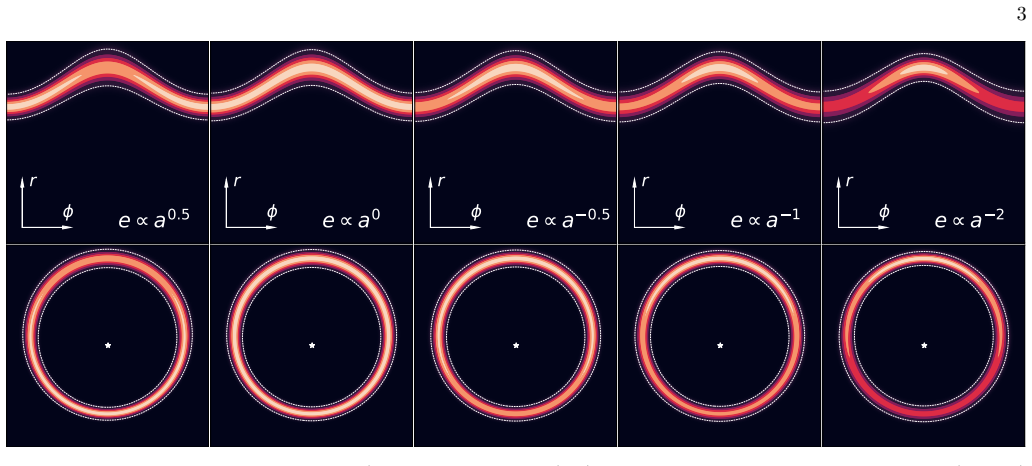
The load-bearing object is a single-Gaussian-ring parametric disk model whose forced eccentricity follows a power law in semi-major axis, ef(a) = ef,0(a/a0)^npow, with aligned pericenters (∂ωf/∂a = 0). The essential identity is the Jacobian j = [1 - e(e + a∂e/∂a)]/√(1 - e²) · (1 - q cos E), with q = (a∂e/∂a)/[1 - e(e + a∂e/∂a)], which converts the eccentricity gradient into surface-density and width asymmetries. This 'Eccentric Velocity Divergence' is what lets the single parameter npow explain both the broad-and-faint pericenter and the narrow-and-bright apocenter seen by the millimeter observations.
What would settle it
Measure the local radial width and surface brightness separately at the two ansae in a deeper millimeter image that also resolves the minor axis. The EVD model with npow = -1.75 predicts a pericenter width about 1.2 times the apocenter width and a fainter, broader pericenter; observing the opposite width asymmetry, or minor-axis emission that no apse-aligned power-law model can reproduce, would rule out the claimed gradient.
Extended reading notes
Core claim
On the paper's own terms, the central discovery is that Fomalhaut's main belt is modeled better by a forced eccentricity profile ef(a) = ef,0(a/a0)^npow with npow = -1.75 ± 0.16 than by any constant-eccentricity model, with or without a free-eccentricity component. The gradient is not a mere curve-fit extra: it simultaneously reproduces two observed asymmetries that a constant eccentricity cannot, namely a pericenter that is broader and fainter and an apocenter that is narrower and brighter. The mechanism behind this, called Eccentric Velocity Divergence, is mass continuity in an apse-aligned eccentric disk: a negative eccentricity gradient converts the orbit packing into exactly those width
Load-bearing premise
The model assumes the belt is a single apse-aligned Gaussian ring with no warp and negligible free eccentricity, while masking out the minor-axis regions where the model is faintest; if a warp or free-eccentricity population is present, the inferred npow ≈ -1.75 could be biased.
Editorial extensions
If this is right
- Future models of Fomalhaut's main belt must treat eccentricity as a radially varying parameter; a single forced eccentricity underfits the data by a large margin.
- The measured slope is steeper than the classical a^-1 expected for a massless disk forced by an internal planet, so either the disk is massive enough for self-gravity to steepen the profile, or the perturber sits closer than the simple gap-carving geometry suggests.
- The 440-Myr N-body integrations show that initially circular disks are disrupted, while initially eccentric disks survive, implying the ring's lopsidedness was present since the protoplanetary disk phase.
- A single unseen planet, either a gap-carver at roughly 109-120 au or a 2:1 resonant-clearing planet at 70-75 au, can sculpt the belt's inner edge and gaps while remaining below current detection limits, making the eccentricity gradient a probe of such planets.
- The lower-resolution archival data also require a negative gradient (npow = -1.16 ± 0.16), so the result does not depend on the highest-resolution image alone.
Reading between the lines
- The EVD relation predicts a quantitative link between the sign of a disk's width asymmetry and the sign of its brightness asymmetry; a survey of resolved eccentric debris disks could measure a population of eccentricity-gradient slopes and test whether values near -1 (single planet) or steeper (self-gravity) dominate.
- Because the fit masks the minor axis and assumes zero warp, an alternative reading of the data is a disk with a mild warp or a wider free-eccentricity distribution; a visibility-domain fit that includes minor-axis emission and allows a warp could separate these.
- If the 'born eccentric' conclusion holds, young debris disks around A-type stars should show steeper eccentricity gradients than old disks, since long-term planet-disk interactions would tend to flatten or re-process the primordial profile; this is a testable age trend with deeper imaging.
- The small apocenter over-subtraction noted in the residuals suggests the true profile may be even steeper or non-Gaussian; a two-sided radial-width model on deeper data could determine whether the -1.75 slope is absorbing an asymmetric radial profile.
Editorial analysis
A structured set of objections, weighed in public.
Referee Report
Summary. This paper fits high-resolution ALMA 1.32 mm continuum images of Fomalhaut with parametric RADMC-3D models in which the forced eccentricity varies as e_f ∝ a^{n_pow}, and reports n_pow = -1.75 ± 0.16 in the 'General' model. The model is preferred over constant-eccentricity models with free eccentricity (Proper 1, Δχ²=70) and over n_pow=-1 with free eccentricity (Proper 2, Δχ²=21.5), with a visibility-domain check. The paper interprets the preferred model as evidence for 'Eccentric Velocity Divergence,' proposes single-planet 'Gap' and 'Resonant' scenarios, and uses REBOUND simulations to argue that an initially eccentric disk survives 440 Myr.
Significance. If the steep negative gradient is real, this is the first reported eccentricity gradient in a debris disk and a potentially valuable diagnostic of planet-disk interactions. The parametric model is physically motivated, the EVD kinematic identity in §2 is clearly derived, the public code release supports reproducibility, and the MCMC/visibility comparisons are extensive. However, the headline steepness is not yet established at the claimed confidence: the free-eccentricity subspace is not explored, the lower-resolution verification gives a shallower slope, and the Δχ² significance conversion is statistically questionable. The sign of the gradient is likely robust; the magnitude and the quantitative 'first gradient' claim need further work.
major comments (4)
- [§3.4.2, Eq. (4), Table 1] The General model fixes e_p=0; Proper 1 and Proper 2 fix n_pow=0 or -1. The general case with both e_p and n_pow free is explicitly deferred to future work. Since e_p and w_r are degenerate (the Proper fits show wide w_r posteriors), and a free-eccentricity population can produce qualitatively similar pericenter broadening and apocenter brightening, the fitted n_pow=-1.75 may be biased. This is the central load-bearing gap. Fit the full model with e_p free and n_pow free, or provide injection-recovery tests showing that n_pow is unbiased under e_p>0, before claiming a quantitative gradient.
- [§3.4.3, Eq. (7)] The quoted 6.7σ and 2.6σ preferences use a chi-square CDF with Npar=9 degrees of freedom. General, Proper 1, and Proper 2 are not nested models and have the same number of free parameters, so this p-value conversion is not valid. Report an appropriate model-comparison criterion (e.g., BIC/AIC, cross-validation, or a genuinely nested sequence with a full model) instead. Without this, the statistical preference for the General model is overstated.
- [§3.4.1 vs Appendix B and Table 1] The Verify fit to the lower-resolution data gives n_pow=-1.16±0.16, about 2.6σ shallower than the high-resolution -1.75. Section 3.5 acknowledges the high-resolution value is 4.6σ from -1 while the low-resolution value is consistent with -1. Thus the sign of the gradient is robust, but the magnitude is not established. The abstract and §6 present -1.75 as the headline result; they should be conditioned on resolution and on the unmodeled e_p subspace.
- [§3.3, Appendix A, Eq. (6)] The fitting mask selects primary beam response >0.66 and projected radius <200 au, i.e., the bright ansae. The residual maps show the model is fainter than the data along the minor axes, which are excluded from the fit. Appendix A tests only one alternative mask and reports a worse apocentre fit without providing Δχ² or the resulting parameter changes. Demonstrate that n_pow and the model preference are robust to mask choice, or quantify how the mask affects the inference.
minor comments (5)
- [Abstract and References] The abstract cites 'Lynch & Lovell 2022' while the body and reference list use Lynch & Lovell (2021). Unify the citation.
- [Eq. (7)] Define the incomplete gamma function and use standard regularized notation. The exponent Npar/2 with Npar=9 appears ad hoc for comparing non-nested models.
- [Footnote 5] The second width in the footnote is written 'wr, in = 15.7±0.7 au'; this should presumably be the outer width, wr, out.
- [§6] The sentence 'only scenarios with an initially circular disk are stable/finalise as eccentric disks' contradicts §5.1.2, which finds that circular disks are disrupted. It should read 'initially eccentric'.
- [Fig. 6 and Table 1] The extracted figure annotation appears to show 'npow = 1.1651' with no minus sign, while the axis runs from -1.5 to -0.75; check the sign convention in the figure. Also, Table 1 lists Proper 2 e_p as '<3.6' without the nominal 1.9±0.9% given in the text; make consistent.
Circularity Check
No significant circularity: the eccentricity gradient is a fitted model parameter compared against explicit alternatives, EVD is presented as a kinematic consequence, and planet/stability analyses are framed as consistency checks rather than predictions.
full rationale
The paper's central claim (npow = -1.75 ± 0.16) is obtained by fitting a parametric model to ALMA data with an MCMC likelihood, not by deriving it from the model's assumptions. The EVD effect is explicitly called a consequence of mass continuity in eccentric disks (§2), and its analytic width relations are derived from geometry rather than being a prediction of the fit. The planet scenarios in §4 use the fitted inner-edge eccentricity and standard secular relations (Mustill & Wyatt 2012) to propose consistent architectures; they are not claimed as independent predictions. The REBOUND stability tests initialize eccentric disks with e ∝ a^-1 (stated as 'consistent with our modelling') and compare them to circular initial conditions; the conclusion is about survival/stability, not about deriving the gradient from the simulations. The paper openly defers the fully general ep + npow model and notes the ep–wr degeneracy, but these are model limitations, not circular reasoning. Self-citations (Lynch & Lovell 2021; Lovell & Lynch 2023) provide the parametric model and code, which is openly released (DOI/github), and the ALMA data are external. No load-bearing step reduces to its own input by construction.
Assumptions & free parameters
free parameters (9)
- npow =
-1.75 ± 0.16
- ef,0 =
0.1256 ± 0.0012
- a0 =
138.79 ± 0.12 au
- wr =
13.51 ± 0.29 au
- h =
0.0157 ± 0.0013
- i =
66.44 ± 0.09 deg
- PA =
336.19 ± 0.06 deg
- ωf =
15.2 ± 0.6 deg
- Mdust =
18.70 ± 0.20 x 10^-2 M_Earth
assumptions (8)
- standard math Equations 1-4 (orbit element transformation and Jacobian) are standard celestial mechanics.
- domain assumption Dust is optically thin, with a Dohnanyi -3.5 power-law size distribution and radiative equilibrium temperatures computed by RADMC-3D.
- ad hoc to paper Surface density in semi-major axis is a single Gaussian (Eq. 1).
- ad hoc to paper Apsidal alignment: ∂ωf/∂a = 0, untwisted disk (Eq. 4).
- domain assumption The ALMA image noise is Gaussian with constant σ = 8.0 µJy/beam after primary-beam scaling.
- domain assumption Stellar parameters: M* = 1.9 Msun, age 440 Myr (Mamajek 2012).
- standard math Classical secular forced eccentricity for an internal perturber is ef ∝ a^-1 (Murray & Dermott 1999).
- ad hoc to paper The fitting mask (primary beam > 0.66, projected radius < 200 au) selects the high-SNR ansae.
invented entities (2)
-
Gap planet
-
Resonant planet
Cite this review
Pith. "Pith review of ALMA Reveals an Eccentricity Gradient in the Fomalhaut Debris Disk." pith.science (2026). https://pith.science/paper/4N7UCYSG
@misc{pith2026250902884,
  author       = {Pith},
  title        = {Pith review of: ALMA Reveals an Eccentricity Gradient in the Fomalhaut Debris Disk},
  year         = {2026},
  howpublished = {\url{https://pith.science/paper/4N7UCYSG}},
  note         = {Machine review of arXiv:2509.02884}
}
abstract
We present evidence of a negative eccentricity gradient in the debris disk of the nearby A-type main sequence star, Fomalhaut. Fitting to the high-resolution, archival ALMA 1.32 mm continuum data for Fomalhaut (with a synthesised angular resolution of $0.76{\times}0.55''$; 4-6\,au), we present a model that describes the bulk properties of the disk (semi-major axis, width, and geometry) and its asymmetric morphology. The best-fit model incorporates a forced eccentricity gradient that varies with semi-major axis, $e_f\propto a^{n_\mathrm{pow}}$, a generalized form of the parametric models of Lynch & Lovell 2022, with $n_\mathrm{pow}{=}{-1.75}{\pm}0.16$. We show that this model is statistically preferred to models with constant forced and free eccentricities. In comparison to disk models with constant forced eccentricities, negative eccentricity gradient models broaden disk widths at pericenter versus apocenter, and increase disk surface densities at apocenter versus pericenter, both of which are seen in the Fomalhaut disk, and which we collectively term Eccentric Velocity Divergence. We propose single-planet architectures consistent with the model and investigate the stability of the disk over 440 Myr to planet-disk interactions via N-body modeling. We find that Fomalhaut's ring eccentricity plausibly formed during the protoplanetary disk stage, with subsequent planet-disk interactions responsible for carving the disk morphology.
Figures


Figures from the paper (7 more)


Reference graph
Works this paper leans on
-
[1]
, " * write output.state after.block = add.period write newline
ENTRY address archivePrefix author booktitle chapter doi edition editor eprint howpublished institution journal key month number organization pages publisher school series title misctitle type volume year version url label extra.label sort.label short.list INTEGERS output.state before.all mid.sentence after.sentence after.block FUNCTION init.state.consts ...
-
[2]
write newline
" write newline "" before.all 'output.state := FUNCTION format.url url empty "" new.block "" url * "" * if FUNCTION format.eprint eprint empty "" archivePrefix empty "" archivePrefix "arXiv" = new.block " " eprint * " " * new.block " " eprint * " " * if if if FUNCTION format.doi doi empty "" " " doi * " " * if FUNCTION format.pid doi empty eprint empty ur...
-
[3]
qui ۴˻Pd |vZa=V;0w< .o] r('߽O -XoI1ooN:kn:b t1 =Yuvܤdfj[o >PR DFKy zKYt/Y 7EmU_ nw J i 2PU + ի !Cm&չϨmV ]Ӣ aR U HE r` ծ/H:>N Rr d J
thebibliography [1] 20pt to REFERENCES 6pt =0pt -12pt 10pt plus 3pt =0pt =0pt =1pt plus 1pt =0pt =0pt -12pt =13pt plus 1pt =20pt =13pt plus 1pt \@M =10000 =-1.0em =0pt =0pt 0pt =0pt =1.0em @enumiv\@empty 10000 10000 `\.\@m \@noitemerr \@latex@warning Empty `thebibliography' environment \@ifnextchar \@reference \@latexerr Missing key on reference command E...
2021
-
[4]
2012, , 540, A125, 10.1051/0004-6361/201118581
Acke , B., Min , M., Dominik , C., et al. 2012, , 540, A125, 10.1051/0004-6361/201118581
-
[5]
Allen , R. H. 1963, Star names. Their lore and meaning
work page 1963
-
[6]
Andrews , S. M., Liu , M. C., Williams , J. P., & Allers , K. N. 2008, , 685, 1039, 10.1086/591417
-
[7]
Aumann , H. H. 1985, , 97, 885, 10.1086/131620
-
[8]
Boley , A. C., Payne , M. J., Corder , S., et al. 2012, , 750, L21, 10.1088/2041-8205/750/1/L21
Show all 64 references
-
[9]
V., et al
Booth , M., Schulz , M., Krivov , A. V., et al. 2021, , 500, 1604, 10.1093/mnras/staa3362
2021 doi
-
[10]
Chittidi , J., MacGregor , M., & Lovell m Joshua. 2025,
2025
-
[11]
I., & Murray-Clay , R
Dawson , R. I., & Murray-Clay , R. 2012, , 750, 43, 10.1088/0004-637X/750/1/43
2012 doi
-
[12]
Dohnanyi , J. S. 1969, Journal of Geophysical Research, 10.1029/JB074i010p02531
1969 doi
-
[13]
I., Shannon , A., & Morrison , S
Dong , J., Dawson , R. I., Shannon , A., & Morrison , S. 2020, , 889, 47, 10.3847/1538-4357/ab64f7
2020 doi
-
[14]
2018, , 860, 124, 10.3847/1538-4357/aac6cb
Dong , R., Liu , S.-y., Eisner , J., et al. 2018, , 860, 124, 10.3847/1538-4357/aac6cb
2018 doi
-
[15]
Astrophysics Source Code Library
Dullemond , C. P., Juhasz , A., Pohl , A., et al. 2012, "Astrophysics Source Code Library", ascl:1202.015. 1202.015
2012
-
[16]
R., et al
Faramaz , V., Krist , J., Stapelfeldt , K. R., et al. 2019, arXiv e-prints, arXiv:1909.04162. 1909.04162
2019 arXiv
-
[17]
2021, , 651, A90, 10.1051/0004-6361/202141278
Fedele , D., Toci , C., Maud , L., & Lodato , G. 2021, , 651, A90, 10.1051/0004-6361/202141278
2021 doi
-
[18]
W., Lang , D., & Goodman , J
Foreman-Mackey , D., Hogg , D. W., Lang , D., & Goodman , J. 2013, Publications of the Astronomical Society of the Pacific, 125, 306, 10.1086/670067
2013 doi
-
[19]
2020, Proceedings of the National Academy of Science, 117, 9712, 10.1073/pnas.1912506117
Gaspar , A., & Rieke , G. 2020, Proceedings of the National Academy of Science, 117, 9712, 10.1073/pnas.1912506117
2020 doi
-
[20]
G., Rieke , G
G \'a sp \'a r , A., Wolff , S. G., Rieke , G. H., et al. 2023, Nature Astronomy, 7, 790, 10.1038/s41550-023-01962-6
2023 doi
-
[21]
2010, Communications in Applied Mathematics and Computational Science, 5, 65, 10.2140/camcos.2010.5.65
Goodman , J., & Weare , J. 2010, Communications in Applied Mathematics and Computational Science, 5, 65, 10.2140/camcos.2010.5.65
2010 doi
-
[22]
S., Greaves , J
Holland , W. S., Greaves , J. S., Dent , W. R. F., et al. 2003, , 582, 1141, 10.1086/344819
2003 doi
-
[23]
M., Duch \^e ne , G., & Matthews , B
Hughes , A. M., Duch \^e ne , G., & Matthews , B. C. 2018, , 56, 541, 10.1146/annurev-astro-081817-052035
2018 doi
-
[24]
R., & Clampin , M
Kalas , P., Graham , J. R., & Clampin , M. 2005, , 435, 1067, 10.1038/nature03601
2005 doi
-
[25]
R., Chiang , E., et al
Kalas , P., Graham , J. R., Chiang , E., et al. 2008, Science, 322, 1345, 10.1126/science.1166609
2008 doi
-
[26]
Kennedy , G. M. 2020, Royal Society Open Science, 7, 200063, 10.1098/rsos.200063
2020 doi
-
[27]
M., Lovell , J
Kennedy , G. M., Lovell , J. B., Kalas , P., & Fitzgerald , M. P. 2023, , 524, 2698, 10.1093/mnras/stad2058
2023 doi
- [28]
-
[29]
Kurucz , R. L. 1979, Astrophysical Journal Supplement Series, 40, 1, 10.1086/190589
1979 doi
- [30]
-
[31]
B., Marino , S., Wyatt , M
Lovell , J. B., Marino , S., Wyatt , M. C., et al. 2021, , 506, 1978, 10.1093/mnras/stab1678
2021 doi
-
[32]
B., Wyatt , M
Lovell , J. B., Wyatt , M. C., Kalas , P., et al. 2022, , 10.1093/mnras/stac2782
2022 doi
- [33]
-
[34]
A., Matr \`a , L., Kalas , P., et al
MacGregor , M. A., Matr \`a , L., Kalas , P., et al. 2017, Astrophysical Journal, 842, 8, 10.3847/1538-4357/aa71ae
2017 doi
-
[35]
A., Weinberger , A
MacGregor , M. A., Weinberger , A. J., Loyd , R. O. P., et al. 2021, , 911, L25, 10.3847/2041-8213/abf14c
2021 doi
-
[36]
Mamajek , E. E. 2012, , 754, L20, 10.1088/2041-8205/754/2/L20
2012 doi
- [37]
-
[38]
C., & Dent , W
Matr \`a , L., Pani \'c , O., Wyatt , M. C., & Dent , W. R. F. 2015, Monthly Notices of the Royal Astronomical Society, 447, 3936, 10.1093/mnras/stu2619
2015 doi
-
[39]
A., Kalas , P., et al
Matr \`a , L., MacGregor , M. A., Kalas , P., et al. 2017, , 842, 9, 10.3847/1538-4357/aa71b4
2017 doi
-
[40]
C., Krivov , A
Matthews , B. C., Krivov , A. V., Wyatt , M. C., Bryden , G., & Eiroa , C. 2014, in Protostars and Planets VI, ed. H. Beuther , R. S. Klessen , C. P. Dullemond , & T. Henning , 521, 10.2458/azu_uapress_9780816531240-ch023
2014 doi
-
[41]
P., Waters , B., Schiebel , D., Young , W., & Golap , K
McMullin , J. P., Waters , B., Schiebel , D., Young , W., & Golap , K. 2007, in Astronomical Society of the Pacific Conference Series, Vol. 376, Astronomical Data Analysis Software and Systems XVI, ed. R. A. Shaw , F. Hill , & D. J. Bell , 127
2007
-
[42]
2015, , 799, 41, 10.1088/0004-637X/799/1/41
Morrison , S., & Malhotra , R. 2015, , 799, 41, 10.1088/0004-637X/799/1/41
2015 doi
-
[43]
D., & Dermott , S
Murray , C. D., & Dermott , S. F. 1999, Solar system dynamics
1999
-
[45]
2012, , 419, 3074, 10.1111/j.1365-2966.2011.19948.x
---. 2012, , 419, 3074, 10.1111/j.1365-2966.2011.19948.x
2012
-
[46]
2019, , 630, A142, 10.1051/0004-6361/201935998
Olofsson , J., Milli , J., Th \'e bault , P., et al. 2019, , 630, A142, 10.1051/0004-6361/201935998
2019 doi
-
[47]
R., & Kuchner , M
Pan , M., Nesvold , E. R., & Kuchner , M. J. 2016, Astrophysical Journal, 832, 81, 10.3847/0004-637X/832/1/81
2016 doi
-
[48]
D., Beust , H., Faramaz , V., et al
Pearce , T. D., Beust , H., Faramaz , V., et al. 2021, , 503, 4767, 10.1093/mnras/stab760
2021 doi
-
[49]
D., Krivov , A
Pearce , T. D., Krivov , A. V., Sefilian , A. A., et al. 2024, , 527, 3876, 10.1093/mnras/stad3462
2024 doi
-
[50]
2021, , 507, 1157, 10.1093/mnras/stab2179
Ragusa , E., Fasano , D., Toci , C., et al. 2021, , 507, 1157, 10.1093/mnras/stab2179
2021 doi
-
[51]
Rein , H., & Liu , S. F. 2012, , 537, A128, 10.1051/0004-6361/201118085
2012 doi
-
[52]
2015, , 452, 376, 10.1093/mnras/stv1257
Rein , H., & Tamayo , D. 2015, , 452, 376, 10.1093/mnras/stv1257
2015 doi
-
[53]
2019, Research Notes of the American Astronomical Society, 3, 16, 10.3847/2515-5172/aaff63
---. 2019, Research Notes of the American Astronomical Society, 3, 16, 10.3847/2515-5172/aaff63
2019 doi
-
[54]
Sefilian , A. A. 2024, , 966, 140, 10.3847/1538-4357/ad32d1
2024 doi
-
[55]
A., Kratter , K
Sefilian , A. A., Kratter , K. M., Wyatt , M. C., et al. 2025, arXiv e-prints, arXiv:2505.09578, 10.48550/arXiv.2505.09578
2025 doi
-
[56]
A., Rafikov , R
Sefilian , A. A., Rafikov , R. R., & Wyatt , M. C. 2021, , 910, 13, 10.3847/1538-4357/abda46
2021 doi
- [57]
-
[58]
2000, SAOImage DS9: A utility for displaying astronomical images in the X11 window environment , Astrophysics Source Code Library, record ascl:0003.002
Smithsonian Astrophysical Observatory . 2000, SAOImage DS9: A utility for displaying astronomical images in the X11 window environment , Astrophysics Source Code Library, record ascl:0003.002. 0003.002
2000
-
[59]
R., Holmes , E
Stapelfeldt , K. R., Holmes , E. K., Chen , C., et al. 2004, , 154, 458, 10.1086/423135
2004 doi
-
[60]
Teyssandier , J., & Ogilvie , G. I. 2016, , 458, 3221, 10.1093/mnras/stw521
2016 doi
-
[61]
R., Tremaine , S., & Kazandjian , M
Touma , J. R., Tremaine , S., & Kazandjian , M. V. 2009, , 394, 1085, 10.1111/j.1365-2966.2009.14409.x
2009
-
[62]
Wyatt , M. C. 2008, Annual Review of Astronomy and Astrophysics, 46, 339, 10.1146/annurev.astro.45.051806.110525
2008 arXiv
-
[63]
C., Dermott , S
Wyatt , M. C., Dermott , S. F., Telesco , C. M., et al. 1999, Astrophysical Journal, 527, 918, 10.1086/308093
1999 doi
-
[64]
2023, , 948, L2, 10.3847/2041-8213/acccf8
Yang , H., Fern \'a ndez-L \'o pez , M., Li , Z.-Y., et al. 2023, , 948, L2, 10.3847/2041-8213/acccf8
2023 doi
-
[65]
A., Llop-Sayson , J., et al
Ygouf , M., Beichman , C. A., Llop-Sayson , J., et al. 2024, , 167, 26, 10.3847/1538-3881/ad08c8
2024 doi
Reviewed August 5, 2026 · model on record in the stance chip above.
Discussion (0). Continue with ORCID to comment.