REVIEW 2 major objections 6 minor 113 references
SDSS-V's multi-epoch spectra of 5,185 DA white dwarfs yield 63 double-white-dwarf binary candidates and constrain the Galactic binary fraction to about 9% at separations under 0.4 AU.
Reviewed by Pith at T0; open to challenge. T0 means a machine referee read the full paper against a public rubric. the ladder, T0–T4 →
SDSS-V radial velocity monitoring yields 63 DA double white dwarf binary candidates (43 new), with fitted binary fraction f_bin,0.4 ≈ 9% and separation power-law index α ≈ -0.62.
T0 review reviewed 2026-08-05 challenge →
load-bearing objection A valuable DWD catalog built on solid RV vetting, with population constraints that are conditional on an assumed low-mass binary fraction and should be reframed. the 2 major comments →
Double White Dwarf Binaries in SDSS-V DR19 : A catalog of DA white dwarf binaries and constraints on the binary population
The pith
A machine-rendered reading of the paper's core claim, the machinery that carries it, and where it could break.
The reading
Core claim
Using the radial velocities of 42,176 sub-exposures of 5,185 DA white dwarfs from SDSS-V DR19, the paper identifies 63 DWD binary candidates with eta>3 (where eta measures the significance of the observed velocity variability over spectral noise alone) and maximum velocity shifts exceeding 100 km/s. Forty-three of these are new discoveries. For ten candidates with good phase coverage, the Lomb-Scargle periodogram gives orbital periods, and three match previously published values. Comparing the observed Delta RV_max distribution with mock SDSS-V observations of simulated DWD populations, the authors constrain the fraction of white dwarfs in binaries with separation <0.4 AU to f_bin,0.4 = 9% (
What carries the argument
The analysis is carried by two linked tools. First, a radial-velocity variability statistic eta = -log(1 - P(chi^2 > chi^2_m)) built from the chi-squared scatter of each star's sub-exposure velocities about their weighted mean: a high eta means the star's velocity changed more than measurement noise can explain. Second, a forward model of the survey: masses are drawn from the SDSS DA white dwarf mass distribution, binaries are assigned separations from a power law n(a) proportional to a^alpha, gravitational-wave orbital decay reshapes the present-day separation distribution, mock observations are scheduled with the real SDSS-V cadence and error distribution, and the simulated Delta RV_max hi
Load-bearing premise
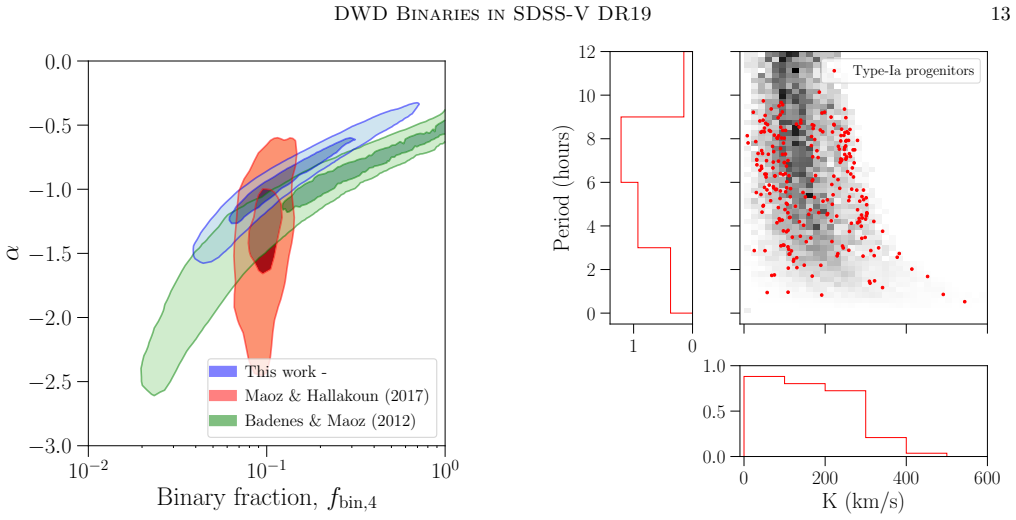
The constraints assume that nearly all very-low-mass white dwarfs (below 0.45 solar masses) live in binaries - 100% below 0.25 solar masses and 70% for 0.25-0.45 - so that 7.5% of all white dwarfs are low-mass binaries; if the true fraction is different, the inferred 9% binary fraction and alpha = -0.62 shift substantially.
What would settle it
Take the volume-limited 100 pc white dwarf sample, obtain high-precision radial velocities at multiple epochs for every DA white dwarf with Teff above 6000 K, and measure orbital periods for all systems whose velocities vary. If the fraction with separations below 0.4 AU deviates from 9%, or if the binarity fraction of low-mass (<0.45 solar masses) white dwarfs is far from the assumed 70-100%, the paper's population constraints would need to be revised.
If this is right
- The roughly 58 real binaries expected after accounting for about five false positives would nearly double the sample of known DWDs available for orbital-solution follow-up.
- The inferred binary fraction f_bin,0.4 = 9% and alpha = -0.62 give a DWD merger rate of about 2 x 10^-12 per year, about five times lower than earlier estimates, mainly because of the different underlying WD mass distribution used.
- At most 10 super-Chandrasekhar DWDs that merge within a Hubble time are predicted in the SDSS-V sample, sharpening the search for Type Ia supernova progenitors.
- Up to five systems in the catalog should be detectable by LISA in its first four years, including one already listed as a LISA verification source; the Galaxy as a whole should host 10,000-20,000 such sources.
Where Pith is reading between the lines
- The same RV-variability approach should transfer directly to other wide-field spectroscopic surveys that take multiple exposures per target, so the yield of DWD discoveries can be expected to grow with survey scale without dedicated binary-targeted observations.
- Because the inferred f_bin and alpha hinge on the assumed binarity of low-mass WDs, independent campaigns measuring the binary fraction of low-mass WDs would tighten the population constraints more than merely collecting additional RV epochs.
- If the Galaxy truly holds 10,000-20,000 LISA-detectable DWDs, LISA will provide a near-complete census of short-period DWDs, allowing a direct test of the formation model beyond the local SDSS sample.
- The catalog already contains rare subtypes - a magnetic wide binary, a ZZ Ceti in a double-lined system, a debris-disk candidate - suggesting that follow-up of the 43 new candidates may uncover more such systems, not just more binaries.
Editorial analysis
A structured set of objections, weighed in public.
Referee Report
Summary. This paper searches SDSS-V DR19 for DA white-dwarf binaries using radial-velocity variations among sub-exposures. CORV stellar-parameter fits provide RV errors calibrated with a pair-subtraction test; candidates are selected by the variability statistic η > 3, tuned against an RV-error-only simulation. The catalog contains 63 DWD candidates (43 new, about 5 expected false positives), with tentative periods for 10 systems, three of which match published orbits. The authors build a forward model of the SDSS-V observation pattern, draw binary populations with fixed binarity rules for low-mass WDs (100% below 0.25 M_sun, 70% at 0.25–0.45 M_sun), sample separations from a power law n(a) ∝ a^α with gravitational-wave orbital decay, and fit the ΔRVmax distribution of η > 3 objects to infer f_bin,0.4 = 0.09^{+0.03}_{-0.01} and α = −0.62 ± 0.10. They validate the pipeline against Badenes & Maoz (2012) and predict ≤ 10 super-Chandrasekhar merger progenitors, ≤ 5 LISA-detectable systems in the sample, and about 10,000–20,000 LISA-detectable Galactic DWDs.
Significance. If it holds, the catalog is a substantial community resource: 63 candidates with systematic RV-variability screening, calibrated errors, a reproducible methodology, and percent-level period recovery for three systems. The pair-subtraction error calibration, the η-threshold calibration, the Badenes–Maoz validation within 2σ, and the public catalog are concrete strengths. The population constraints are the paper's headline claim, and they are conditional on the assumed low-mass WD binary fraction—a dependence the authors themselves demonstrate in §6.2–6.3. The catalog claim does not depend on that assumption; the population claim does. With the conditional framing and the contamination/sampling issues addressed, this would be an important contribution to DWD population studies.
major comments (2)
- [Sec. 5.1–5.3, 6.2–6.3, Figs. 8–9] f_bin,0.4 = 0.09^{+0.03}_{-0.01} and α = −0.62 ± 0.10 are conditional on the hard-coded low-mass WD binarity (100% for m1 < 0.25 M_sun, 70% for 0.25–0.45 M_sun; Brown et al. 2011), which yields 7.5% of WDs as low-mass binaries. The authors' own hot-WD re-fit (T_eff > 12,000 K) gives a 2.8% low-mass binary fraction and shifts the contours to lower f_bin and α (Fig. 9); §6.3 states the volume-limited 100 pc sample implies 3.2% and 'constraints should be similar to Fig. 9'. The quoted errors are statistical only and exclude this demonstrated systematic; §5.3's 'we do not place joint constraints' acknowledges the limitation. Yet the abstract presents f_bin = 9% and α = −0.62 as the main population result, and the SNe-Ia/LISA predictions inherit the same conditioning. Please report results as conditional with a systematic bracketing the hot-WD/volume-limited cases, or fit the low-mass binary
- [Sec. 4.1, Table 1, Sec. 5.1] The sample used for the population fit retains six subdwarf/pre-ELM WD candidates (e.g., Gaia DR3 1017136594580182400, 3076962575704962176, 677695609668436736) that are not WDs under the model's mass–radius prescription, with companions not necessarily WDs. They enter the fitted ΔRVmax distribution, while the forward model assumes WD+WD systems. If these are not DWDs, the inferred f_bin,0.4 overestimates the DWD fraction. Exclude them or model their selection function, and quantify the effect on the contours.
minor comments (6)
- [Table 1] Gaia DR3 1017136594580182400 is labeled J150506.17+325959.4 with η = 79.06, duplicating the η = 12.57 row for that same name; Table 3 lists this source as J085252.86+514246.6 with η = 79.06. The J-name in Table 1 appears to be a copy-paste error; correct it before publication since the catalog is a permanent artifact.
- [Table 2, Sec. 4.2] The caption promises the 'best-fit RV semi-amplitude', but the table has no K column; include K and the false-alarm probability for the seven new tentative periods. Also, J085746.18+034255.3 is a WD+MS binary, so the abstract's '10 binary systems' should be qualified as 10 systems (9 DWDs).
- [Sec. 4.2] The three recovered periods are said to agree with published values 'within a few percent', but 1.69 h versus 1.5623 h is an 8% difference; suggest 'within ~10%' for this system.
- [Sec. 2] Typo: 'over 120,000 WD sub-exposures have been collected for 19,000 WDs and , and this is our parent sample'—stray 'and ,'.
- [Eq. (4), Fig. 9] The transformation to the < 4 AU parameter space depends on smoothing and on how f_bin > 1 points are discarded, as the authors note. The sentence 'they all overlap' should carry a caveat on how sensitive that overlap is to those choices.
- [Sec. 6.3, Abstract] '≤ 10 super-Chandrasekhar binaries' is the 3σ upper limit; the best-fit expectation is about 4. Distinguish expectation from upper limit in the abstract.
Circularity Check
No significant circularity: fbin and α are fitted forward-model parameters, not definitions of the data; the low-mass binary fraction is an external assumption explicitly flagged by the authors, and the self-citations are validated internally.
full rationale
The paper's central population claim is a forward-model fit: fbin,0.4 and α are adjusted so that simulated ΔRVmax histograms match the observed SDSS-V distribution (Sec. 5.1). The fitted parameters are not definitionally tied to the data they constrain; they enter through an assumed power-law separation function and a mock-observation pipeline. The low-mass WD binary fractions (100% below 0.25 M_sun, 70% for 0.25–0.45 M_sun) are external inputs taken from Brown et al. (2011) and Maoz & Hallakoun (2017). They are not derived from the paper's own target result, so this is a modeling assumption rather than a circular step. The authors explicitly acknowledge the conditional nature of their constraints: 'we do not place joint constraints' (Sec. 5.3), and Secs. 6.2–6.3 show that changing the low-mass WD fraction shifts the contours (Fig. 9). This is a robustness limitation, not a reduction of the claim to its input. The predicted numbers of super-Chandrasekhar and LISA-detectable binaries are projections from the same fitted simulation, so they are conditional model outputs rather than independent validations, but they are not used as evidence for the fit and are not equivalent by construction to the observed catalog. Self-citations (CORV from Arseneau et al. 2024, prior SDSS-V studies) are backed by in-paper validation, including the pair-subtraction RV-error check, and do not carry the population constraint. The method is also checked externally by reproducing the Badenes & Maoz (2012) contours in Fig. 6. No equation or fitted parameter is shown to equal its own input by definition.
Axiom & Free-Parameter Ledger
free parameters (6)
- f_bin,0.4 =
0.09 (+0.03, -0.01)
- alpha =
-0.62 ± 0.10
- Low-mass WD binary fraction =
7.5% of all WDs
- beta (mass ratio index) =
0
- amax =
0.4 AU
- eta threshold =
3
axioms (6)
- domain assumption The current separation distribution of DWDs follows Eq. (2)-(3) from Maoz et al. (2012), derived from a constant formation rate and GW decay.
- domain assumption The primary WD mass distribution is that of Kepler et al. (2019) DA WDs, assumed representative of SDSS-V.
- domain assumption Low-mass WDs (<0.45 M_sun) have enhanced binarity: 100% below 0.25 and 70% between 0.25-0.45 M_sun.
- domain assumption Orbits are circular and the photometric primary is the lower-mass WD (or random if neither is <0.35 M_sun).
- domain assumption The SDSS-V observation pattern and RV error distribution in the mock are drawn from the same WDs, making the simulation representative.
- domain assumption For the LISA estimate, the Milky Way WD population is a thin disk with scale height 300 pc, radius 20 kpc, and space density 4.39e-3 pc^-3 (Giammichele et al. 2012).
Cite this review
Pith. "Pith review of Double White Dwarf Binaries in SDSS-V DR19 : A catalog of DA white dwarf binaries and constraints on the binary population." pith.science (2026). https://pith.science/paper/WA5CBNWY
@misc{pith2026250902906,
  author       = {Pith},
  title        = {Pith review of: Double White Dwarf Binaries in SDSS-V DR19 : A catalog of DA white dwarf binaries and constraints on the binary population},
  year         = {2026},
  howpublished = {\url{https://pith.science/paper/WA5CBNWY}},
  note         = {Machine review of arXiv:2509.02906}
}
read the original abstract
The fifth-generation Sloan Digital Sky Survey (SDSS-V) includes the first large-scale spectroscopic survey of white dwarfs (WDs) in the era of Gaia parallaxes. SDSS-V collects multiple exposures per target, making it ideal for binary detection. We present a search for hydrogen atmosphere (DA) double white dwarf (DWD) binaries in this rich dataset. We quantify radial velocity variations between sub-exposures to identify binary candidates, and also measure the orbital period for a subset of DWD binary candidates. We find 63 DWD binary candidates, of which 43 are new discoveries, and we provide tentative periods for 10 binary systems. Using these measurements, we place constraints on the binary fraction of the Galactic WD population with $< 0.4$ AU separations $f_{\mathrm{bin,0.4}} = 9\%$, and the power-law index of the initial separation distribution $\alpha = -0.62$. Using the simulated binary population, we estimate that $\leq 10$ super-Chandrasekhar binaries that merge within a Hubble time are expected in our sample. We predict that $\leq 5$ systems in our sample should be detectable via gravitational waves by LISA (Laser Interferometer Space Antenna), one of which has already been identified as a LISA verification source. We also estimate a total of about 10,000 - 20,000 LISA-detectable DWD binaries in the galaxy. Our catalog of WD+WD binary candidates in SDSS-V is now public, and promises to uncover a large number of exciting DWD systems.
Figures




Reference graph
Works this paper leans on
-
[1]
, " * write output.state after.block = add.period write newline
ENTRY address archivePrefix author booktitle chapter doi edition editor eprint howpublished institution journal key month number organization pages publisher school series title misctitle type volume year version url label extra.label sort.label short.list INTEGERS output.state before.all mid.sentence after.sentence after.block FUNCTION init.state.consts ...
-
[2]
write newline
" write newline "" before.all 'output.state := FUNCTION format.url url empty "" new.block "" url * "" * if FUNCTION format.eprint eprint empty "" archivePrefix empty "" archivePrefix "arXiv" = new.block " " eprint * " " * new.block " " eprint * " " * if if if FUNCTION format.doi doi empty "" " " doi * " " * if FUNCTION format.pid doi empty eprint empty ur...
-
[3]
E )׆gtr =N
thebibliography [1] 20pt to REFERENCES 6pt =0pt -12pt 10pt plus 3pt =0pt =0pt =1pt plus 1pt =0pt =0pt -12pt =13pt plus 1pt =20pt =13pt plus 1pt \@M =10000 =-1.0em =0pt =0pt 0pt =0pt =1.0em @enumiv\@empty 10000 10000 `\.\@m \@noitemerr \@latex@warning Empty `thebibliography' environment \@ifnextchar \@reference \@latexerr Missing key on reference command E...
2021
-
[4]
2022, The Astrophysical Journal Supplement Series, 259, 35, 10.3847/1538-4365/ac4414
Abdurro'uf , Accetta, K., Aerts, C., et al. 2022, The Astrophysical Journal Supplement Series, 259, 35, 10.3847/1538-4365/ac4414
-
[5]
Adamane Pallathadka, G., Chandra, V., Zakamska, N. L., et al. 2024, The Astrophysical Journal, 968, 42, 10.3847/1538-4357/ad3e86
-
[6]
Adamane Pallathadka, G., Chandra, V., Gansicke, B. T., et al. 2025, Double White Dwarf Binaries in SDSS - V DR19 : The discovery of a rare DA + DQ white dwarf binary with 31 hour orbital period, arXiv, 10.48550/arXiv.2507.11618
work page internal anchor Pith review Pith/arXiv arXiv doi:10.48550/arxiv.2507.11618 2025
-
[7]
F., Argudo-Fernández, M., et al
Almeida, A., Anderson, S. F., Argudo-Fernández, M., et al. 2023, The Astrophysical Journal Supplement Series, 267, 44, 10.3847/1538-4365/acda98
-
[8]
2024, The Astrophysical Journal, 963, 17, 10.3847/1538-4357/ad2168
Arseneau, S., Chandra, V., Hwang, H.-C., et al. 2024, The Astrophysical Journal, 963, 17, 10.3847/1538-4357/ad2168
-
[9]
Astropy Collaboration , Robitaille, T. P., Tollerud, E. J., et al. 2013, Astronomy and Astrophysics, 558, A33, 10.1051/0004-6361/201322068
-
[10]
Astropy Collaboration , Price-Whelan, A. M., Sipőcz, B. M., et al. 2018, The Astronomical Journal, 156, 123, 10.3847/1538-3881/aabc4f
-
[11]
Astropy Collaboration , Price-Whelan, A. M., Lim, P. L., et al. 2022, The Astrophysical Journal, 935, 167, 10.3847/1538-4357/ac7c74
-
[12]
2012, The Astrophysical Journal, 749, L11, 10.1088/2041-8205/749/1/L11
Badenes, C., & Maoz, D. 2012, The Astrophysical Journal, 749, L11, 10.1088/2041-8205/749/1/L11
-
[13]
Badenes, C., Mullally, F., Thompson, S. E., & Lupton, R. H. 2009, The Astrophysical Journal, 707, 971, 10.1088/0004-637X/707/2/971
-
[14]
Bellm, E. C., Kulkarni, S. R., Graham, M. J., et al. 2019, Publications of the Astronomical Society of the Pacific, 131, 018002, 10.1088/1538-3873/aaecbe
-
[15]
Bowen, I. S., & Vaughan, A. H. 1973, Applied Optics, 12, 1430, 10.1364/AO.12.001430
-
[16]
Breedt, E., Steeghs, D., Marsh, T. R., et al. 2017, Monthly Notices of the Royal Astronomical Society, 468, 2910, 10.1093/mnras/stx430
-
[17]
Brown, J. M., Kilic, M., Brown, W. R., & Kenyon, S. J. 2011, The Astrophysical Journal, 730, 67, 10.1088/0004-637X/730/2/67
-
[18]
R., Kilic, M., Allende Prieto, C., Gianninas, A., & Kenyon, S
Brown, W. R., Kilic, M., Allende Prieto, C., Gianninas, A., & Kenyon, S. J. 2013, The Astrophysical Journal, 769, 66, 10.1088/0004-637X/769/1/66
-
[19]
Brown, W. R., Kilic, M., Kenyon, S. J., & Gianninas, A. 2016, The Astrophysical Journal, 824, 46, 10.3847/0004-637X/824/1/46
-
[20]
Brown, W. R., Kilic, M., Prieto, C. A., & Kenyon, S. J. 2010, The Astrophysical Journal, 723, 1072, 10.1088/0004-637X/723/2/1072
-
[21]
R., Kilic, M., Kosakowski, A., et al
Brown, W. R., Kilic, M., Kosakowski, A., et al. 2020, The Astrophysical Journal, 889, 49, 10.3847/1538-4357/ab63cd
-
[22]
Burdge, K. B., Coughlin, M. W., Fuller, J., et al. 2020, The Astrophysical Journal Letters, 905, L7, 10.3847/2041-8213/abca91
-
[23]
2020, The Astrophysical Journal, 901, 93, 10.3847/1538-4357/abafbe
Bédard, A., Bergeron, P., Brassard, P., & Fontaine, G. 2020, The Astrophysical Journal, 901, 93, 10.3847/1538-4357/abafbe
-
[24]
Chambers, K. C., Magnier, E. A., Metcalfe, N., et al. 2016, The Pan - STARRS1 Surveys , arXiv, 10.48550/arXiv.1612.05560
-
[25]
Chandra, V., Hwang, H.-C., Zakamska, N. L., & Budavári, T. 2020, Monthly Notices of the Royal Astronomical Society, 497, 2688, 10.1093/mnras/staa2165
-
[26]
Chandra, V., Hwang, H.-C., Zakamska, N. L., et al. 2021, The Astrophysical Journal, 921, 160, 10.3847/1538-4357/ac2145
-
[27]
1931, The Astrophysical Journal, 74, 81, 10.1086/143324
Chandrasekhar, S. 1931, The Astrophysical Journal, 74, 81, 10.1086/143324
doi:10.1086/143324 1931
-
[28]
Chickles, E. T., Burdge, K. B., Chakraborty, J., et al. 2025, The Astrophysical Journal, 987, 206, 10.3847/1538-4357/add34c
-
[29]
Crumpler, N. R., Chandra, V., Zakamska, N. L., et al. 2024, The Astrophysical Journal, 977, 237, 10.3847/1538-4357/ad8ddc
-
[30]
2025, The Astrophysical Journal, 989, 24, 10.3847/1538-4357/ade9a9
---. 2025, The Astrophysical Journal, 989, 24, 10.3847/1538-4357/ade9a9
-
[31]
2022, Astronomy & Astrophysics, 662, A40, 10.1051/0004-6361/202243337
Culpan, R., Geier, S., Reindl, N., et al. 2022, Astronomy & Astrophysics, 662, A40, 10.1051/0004-6361/202243337
-
[32]
D., Baxter, R., Külebi, B., et al
Dobbie, P. D., Baxter, R., Külebi, B., et al. 2012, Monthly Notices of the Royal Astronomical Society, 421, 202, 10.1111/j.1365-2966.2012.20291.x
arXiv 2012
-
[33]
Geier, S., Raddi, R., Gentile Fusillo, N. P., & Marsh, T. R. 2019, Astronomy & Astrophysics, 621, A38, 10.1051/0004-6361/201834236
-
[34]
Geier, S., Østensen, R. H., Nemeth, P., et al. 2017, Astronomy and Astrophysics, 600, A50, 10.1051/0004-6361/201630135
-
[35]
Gentile Fusillo, N. P., Tremblay, P. E., Cukanovaite, E., et al. 2021, Monthly Notices of the Royal Astronomical Society, 508, 3877, 10.1093/mnras/stab2672
-
[36]
P., Tremblay, P.-E., Gänsicke, B
Gentile Fusillo, N. P., Tremblay, P.-E., Gänsicke, B. T., et al. 2019, Monthly Notices of the Royal Astronomical Society, 482, 4570, 10.1093/mnras/sty3016
-
[37]
2012, The Astrophysical Journal Supplement Series, 199, 29, 10.1088/0067-0049/199/2/29
Giammichele, N., Bergeron, P., & Dufour, P. 2012, The Astrophysical Journal Supplement Series, 199, 29, 10.1088/0067-0049/199/2/29
-
[38]
Ginsburg, A., Sipőcz, B. M., Brasseur, C. E., et al. 2019, The Astronomical Journal, 157, 98, 10.3847/1538-3881/aafc33
-
[39]
Gunn, J. E., Siegmund, W. A., Mannery, E. J., et al. 2006, The Astronomical Journal, 131, 2332, 10.1086/500975
doi:10.1086/500975 2006
-
[40]
Gänsicke, B. T., Marsh, T. R., & Southworth, J. 2007, Monthly Notices of the Royal Astronomical Society, 380, L35, 10.1111/j.1745-3933.2007.00343.x
arXiv 2007
-
[41]
Harris, C. R., Millman, K. J., Van Der Walt, S. J., et al. 2020, Nature, 585, 357, 10.1038/s41586-020-2649-2
-
[42]
Heber, U. 2016, Publications of the Astronomical Society of the Pacific, 128, 082001, 10.1088/1538-3873/128/966/082001
-
[43]
Heintz, T. M., Hermes, J. J., El-Badry, K., et al. 2022, The Astrophysical Journal, 934, 148, 10.3847/1538-4357/ac78d9
-
[44]
Hunter, J. D. 2007, Computing in Science & Engineering, 9, 90, 10.1109/MCSE.2007.55
-
[45]
Inight, K., Gänsicke, B. T., Breedt, E., et al. 2021, Monthly Notices of the Royal Astronomical Society, 504, 2420, 10.1093/mnras/stab753
-
[46]
2020, Common envelope evolution, version: 20201201 edn., AAS - IOP astronomy
Ivanova, N., Justham, S., & Ricker, P. 2020, Common envelope evolution, version: 20201201 edn., AAS - IOP astronomy. [2021 collection] (Bristol, UK: IOP Publishing), 10.1088/2514-3433/abb6f0
-
[47]
O., Pelisoli, I., Jordan, S., et al
Kepler, S. O., Pelisoli, I., Jordan, S., et al. 2013, Monthly Notices of the Royal Astronomical Society, 429, 2934, 10.1093/mnras/sts522
-
[48]
O., Pelisoli, I., Koester, D., et al
Kepler, S. O., Pelisoli, I., Koester, D., et al. 2019, Monthly Notices of the Royal Astronomical Society, 486, 2169, 10.1093/mnras/stz960
-
[49]
2020, The Astrophysical Journal, 898, 84, 10.3847/1538-4357/ab9b8d
Kilic, M., Bergeron, P., Kosakowski, A., et al. 2020, The Astrophysical Journal, 898, 84, 10.3847/1538-4357/ab9b8d
-
[50]
Kilic, M., Brown, W. R., Allende Prieto, C., et al. 2012, The Astrophysical Journal, 751, 141, 10.1088/0004-637X/751/2/141
-
[51]
Kilic, M., Brown, W. R., Heinke, C. O., et al. 2016, Monthly Notices of the Royal Astronomical Society, 460, 4176, 10.1093/mnras/stw1277
-
[52]
2021, Monthly Notices of the Royal Astronomical Society, 502, 4972, 10.1093/mnras/stab439
Kilic, M., Bédard, A., & Bergeron, P. 2021, Monthly Notices of the Royal Astronomical Society, 502, 4972, 10.1093/mnras/stab439
-
[53]
Kilic, M., Hermes, J. J., Gianninas, A., et al. 2013, Monthly Notices of the Royal Astronomical Society: Letters, 438, L26, 10.1093/mnrasl/slt151
-
[54]
A., Rix, H.-W., Aerts, C., et al
Kollmeier, J. A., Rix, H.-W., Aerts, C., et al. 2025, Sloan Digital Sky Survey - V : Pioneering Panoptic Spectroscopy , arXiv, 10.48550/arXiv.2507.06989
-
[55]
2022, Monthly Notices of the Royal Astronomical Society, 511, 5936, 10.1093/mnras/stac415
Korol, V., Hallakoun, N., Toonen, S., & Karnesis, N. 2022, Monthly Notices of the Royal Astronomical Society, 511, 5936, 10.1093/mnras/stac415
-
[56]
Kosakowski, A., Dorsch, M., Brown, W. R., et al. 2025, The Astrophysical Journal, 987, 205, 10.3847/1538-4357/add1cf
-
[57]
2018, Monthly Notices of the Royal Astronomical Society, 480, 302, 10.1093/mnras/sty1545
Kupfer, T., Korol, V., Shah, S., et al. 2018, Monthly Notices of the Royal Astronomical Society, 480, 302, 10.1093/mnras/sty1545
-
[58]
Lamberts, A., Blunt, S., Littenberg, T. B., et al. 2019, Monthly Notices of the Royal Astronomical Society, 490, 5888, 10.1093/mnras/stz2834
-
[59]
2019, The Astrophysical Journal, 871, 148, 10.3847/1538-4357/aaf9a1
Li, Z., Chen, X., Chen, H.-L., & Han, Z. 2019, The Astrophysical Journal, 871, 148, 10.3847/1538-4357/aaf9a1
-
[60]
2020, The Astrophysical Journal, 893, 2, 10.3847/1538-4357/ab7dc2
Li, Z., Chen, X., Chen, H.-L., et al. 2020, The Astrophysical Journal, 893, 2, 10.3847/1538-4357/ab7dc2
-
[61]
Liu, Y., Hwang, H.-C., Zakamska, N. L., & Thorstensen, J. R. 2023, Monthly Notices of the Royal Astronomical Society, 522, 2719, 10.1093/mnras/stad1156
-
[62]
Lomb, N. R. 1976, Astrophysics and Space Science, 39, 447, 10.1007/BF00648343
-
[63]
Maoz, D., Badenes, C., & Bickerton, S. J. 2012, The Astrophysical Journal, 751, 143, 10.1088/0004-637X/751/2/143
-
[64]
2017, Monthly Notices of the Royal Astronomical Society, 467, 1414, 10.1093/mnras/stx102
Maoz, D., & Hallakoun, N. 2017, Monthly Notices of the Royal Astronomical Society, 467, 1414, 10.1093/mnras/stx102
-
[65]
2018, Monthly Notices of the Royal Astronomical Society, 476, 2584, 10.1093/mnras/sty339
Maoz, D., Hallakoun, N., & Badenes, C. 2018, Monthly Notices of the Royal Astronomical Society, 476, 2584, 10.1093/mnras/sty339
-
[66]
2012, Publications of the Astronomical Society of Australia, 29, 447, 10.1071/AS11052
Maoz, D., & Mannucci, F. 2012, Publications of the Astronomical Society of Australia, 29, 447, 10.1071/AS11052
doi:10.1071/as11052 2012
-
[67]
2014, Annual Review of Astronomy and Astrophysics, 52, 107, 10.1146/annurev-astro-082812-141031
Maoz, D., Mannucci, F., & Nelemans, G. 2014, Annual Review of Astronomy and Astrophysics, 52, 107, 10.1146/annurev-astro-082812-141031
-
[68]
Marocco, F., Eisenhardt, P. R. M., Fowler, J. W., et al. 2020, CatWISE2020 Catalog , IPAC, 10.26131/IRSA551
-
[69]
2021, The Astrophysical Journal Supplement Series, 253, 8, 10.3847/1538-4365/abd805
---. 2021, The Astrophysical Journal Supplement Series, 253, 8, 10.3847/1538-4365/abd805
-
[70]
Marsh, T. R. 2011, Classical and Quantum Gravity, 28, 094019, 10.1088/0264-9381/28/9/094019
-
[71]
R., Nelemans, G., & Steeghs, D
Marsh, T. R., Nelemans, G., & Steeghs, D. 2004, Monthly Notices of the Royal Astronomical Society, 350, 113, 10.1111/j.1365-2966.2004.07564.x
arXiv 2004
-
[72]
C., Fanson, J., Schiminovich, D., et al
Martin, D. C., Fanson, J., Schiminovich, D., et al. 2005, The Astrophysical Journal, 619, L1, 10.1086/426387
doi:10.1086/426387 2005
-
[73]
Maxted, P. F. L., Marsh, T. R., & Moran, C. K. J. 2002 a , Monthly Notices of the Royal Astronomical Society, 332, 745, 10.1046/j.1365-8711.2002.05368.x
arXiv 2002
-
[74]
---. 2002 b , Monthly Notices of the Royal Astronomical Society, 319, 305, 10.1046/j.1365-8711.2000.03840.x
arXiv 2002
-
[75]
Munday, J., Pelisoli, I., Tremblay, P. E., et al. 2024, Monthly Notices of the Royal Astronomical Society, 532, 2534, 10.1093/mnras/stae1645
-
[76]
2025, Nature Astronomy, 9, 872, 10.1038/s41550-025-02528-4
Munday, J., Pakmor, R., Pelisoli, I., et al. 2025, Nature Astronomy, 9, 872, 10.1038/s41550-025-02528-4
-
[77]
2002, Astronomy & Astrophysics, 386, 957, 10.1051/0004-6361:20020361
Napiwotzki, R., Koester, D., Nelemans, G., et al. 2002, Astronomy & Astrophysics, 386, 957, 10.1051/0004-6361:20020361
-
[78]
Napiwotzki, R., Karl, C. A., Lisker, T., et al. 2020, Astronomy & Astrophysics, 638, A131, 10.1051/0004-6361/201629648
-
[79]
F., Verbunt, F., & Yungelson, L
Nelemans, G., Portegies Zwart, S. F., Verbunt, F., & Yungelson, L. R. 2001 a , Astronomy and Astrophysics, 368, 939, 10.1051/0004-6361:20010049
-
[80]
Nelemans, G., Verbunt, F., Yungelson, L. R., & Portegies Zwart, S. F. 2000, Astronomy and Astrophysics, 360, 1011, 10.48550/arXiv.astro-ph/0006216
This paper was first reviewed by deepseek-v4-flash on August 5, 2026.
discussion (0)
Sign in with ORCID, Apple, or X to comment. Anyone can read and Pith papers without signing in.