Initial results of the TRIUMF ultracold advanced neutron source
Pith reviewed 2026-05-18 20:11 UTC · model grok-4.3
The pith
New ultracold neutron source produces 930000 neutrons in first test and aligns with simulations for full EDM goals
A machine-rendered reading of the paper's core claim, the machinery that carries it, and where it could break.
Core claim
The source produced (9.3 ± 0.8)×10^5 ultracold neutrons during a 60-second exposure at 37 μA proton current. This yield agrees with Monte Carlo simulations of neutron production and transport through the superfluid helium, with indications that conduction of heat through the helium is less restrictive than originally anticipated. The results therefore project that the completed source with liquid deuterium moderator will detect 5.7×10^7 ultracold neutrons under equivalent conditions.
What carries the argument
Comparison between measured ultracold neutron counts and detailed simulations of spallation neutron production, moderation in superfluid helium, and transport to the detector.
Load-bearing premise
The production rate and transport efficiency seen in the short test without the liquid deuterium moderator will scale linearly once the moderator is installed and full liquid levels are reached, without new losses from heat or neutron transport.
What would settle it
A direct count of detected ultracold neutrons after the liquid deuterium moderator is installed and reaches full liquid levels, checked against the predicted total of 5.7×10^7 neutrons for the same 60-second beam exposure.
Figures
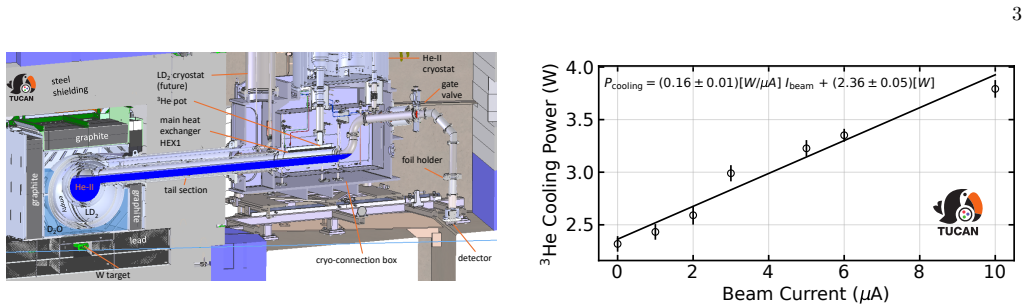


read the original abstract
We report the first results on ultracold neutron production from a new spallation-driven superfluid $^4$He (He-II) source at TRIUMF, which is being prepared for a new, precise measurement of the neutron electric dipole moment. A total of $(9.3 \pm 0.8)\times 10^{5}$ ultracold neutrons were observed at a proton beam current of \SI{37}{\uA}, when the target was irradiated for a period of \SI{60}{\s}. The results are in fair agreement with expectations based on a detailed simulation of neutron transport and ultracold neutron source cryogenics. There is some indication that the new source might not be as limited by the conduction of heat through the He-II as originally expected. The results indicate that the source is likely to make its ultimate production goals, once the liquid deuterium cold moderator system is completed, with the expectation that $5.7\times 10^7$~UCNs would be detected in the same experiment with full liquid levels. This would, for example, correspond to delivery of $1.4\times 10^6$~UCNs delivered to each of two nEDM measurement cells, and a statistical uncertainty of $1\times 10^{-27}~e$cm on the neutron EDM in 280 days of running.
Editorial analysis
A structured set of objections, weighed in public.
Referee Report
Summary. The manuscript reports the first ultracold neutron (UCN) production results from the TRIUMF ultracold advanced neutron source (TUCAN), a spallation-driven superfluid 4He source. A total of (9.3 ± 0.8)×10^5 UCNs were detected during a 60 s irradiation at 37 μA proton current. These data show fair agreement with Monte Carlo simulations of neutron transport and cryogenics. The authors note a qualitative indication that heat conduction through the He-II may be less limiting than modeled and project that, once the liquid deuterium cold moderator is installed and full liquid levels achieved, the source will deliver 5.7×10^7 UCNs, corresponding to 1.4×10^6 UCNs per nEDM cell and enabling a statistical uncertainty of 1×10^{-27} e cm on the neutron EDM in 280 days of running.
Significance. If the measured yield and simulation agreement hold under full operating conditions, this work marks a key milestone toward a high-intensity UCN source for precision fundamental physics. The projected performance would support a competitive next-generation nEDM measurement, improving sensitivity by roughly an order of magnitude over current limits and providing strong constraints on beyond-Standard-Model physics. The direct count with stated uncertainty and the comparison to an independent simulation are positive features; the suggestion of reduced heat limitation, if confirmed quantitatively, could enable higher beam-power operation.
major comments (3)
- [Results] Results section: the statement that the source 'might not be as limited by the conduction of heat through the He-II as originally expected' rests on a qualitative indication rather than quantitative data. A direct comparison of measured versus simulated temperature rise, heat flux, or effective thermal conductivity in the He-II during the 60 s test is needed to support the claim that heat transport will not limit scaling to full liquid levels and continuous operation.
- [Simulation and comparison] Simulation and comparison section: fair agreement is reported between the observed (9.3 ± 0.8)×10^5 UCN yield and the Monte Carlo model, but no quantitative metric (e.g., measured/simulated ratio with uncertainty or goodness-of-fit value) is provided. Without this, it is difficult to assess how reliably the model captures the cold-neutron spectrum and transport effects required for the linear extrapolation to the projected 5.7×10^7 UCNs with the LD2 moderator.
- [Outlook] Outlook and projections: the headline claim that the source will reach its ultimate goals assumes the 60 s test without LD2 moderator and at partial liquid levels scales linearly to steady-state operation with full liquid levels and the LD2 moderator. The manuscript should explicitly discuss possible non-linear effects, such as changes in the cold-neutron spectrum incident on the He-II or steady-state heat removal, that were absent from the initial test and could invalidate the projected yield.
minor comments (2)
- [Abstract] Abstract: the phrase 'fair agreement' would be more informative if accompanied by the measured-to-simulated yield ratio.
- [Figures] Figure captions: ensure all experimental figures explicitly state the beam current, irradiation duration, and any applied cuts or efficiencies used in the UCN count.
Simulated Author's Rebuttal
We thank the referee for their detailed and constructive comments on our manuscript. We have carefully considered each point and provide our responses below. Where appropriate, we have revised the manuscript to address the concerns raised.
read point-by-point responses
-
Referee: [Results] Results section: the statement that the source 'might not be as limited by the conduction of heat through the He-II as originally expected' rests on a qualitative indication rather than quantitative data. A direct comparison of measured versus simulated temperature rise, heat flux, or effective thermal conductivity in the He-II during the 60 s test is needed to support the claim that heat transport will not limit scaling to full liquid levels and continuous operation.
Authors: We acknowledge that our original statement was based on a qualitative assessment from the observed UCN production rate during the short 60 s test, which did not show the expected reduction due to heat buildup. Direct temperature measurements were not available in this initial run. We agree that a quantitative comparison would strengthen the claim. In the revised manuscript, we have modified the statement to emphasize that this is an indication from the yield data and have added a note that quantitative validation will be pursued in future tests with extended irradiation times. This addresses the concern without overstating the current evidence. revision: yes
-
Referee: [Simulation and comparison] Simulation and comparison section: fair agreement is reported between the observed (9.3 ± 0.8)×10^5 UCN yield and the Monte Carlo model, but no quantitative metric (e.g., measured/simulated ratio with uncertainty or goodness-of-fit value) is provided. Without this, it is difficult to assess how reliably the model captures the cold-neutron spectrum and transport effects required for the linear extrapolation to the projected 5.7×10^7 UCNs with the LD2 moderator.
Authors: We appreciate this suggestion for improving the clarity of our comparison. We have now computed the ratio of measured to simulated UCN yield, which is approximately 0.9 with an uncertainty of about 10%, consistent with 'fair agreement'. We will include this quantitative metric and a brief discussion of the uncertainties in the simulation comparison section of the revised manuscript. This will better support the reliability of the model for our projections. revision: yes
-
Referee: [Outlook] Outlook and projections: the headline claim that the source will reach its ultimate goals assumes the 60 s test without LD2 moderator and at partial liquid levels scales linearly to steady-state operation with full liquid levels and the LD2 moderator. The manuscript should explicitly discuss possible non-linear effects, such as changes in the cold-neutron spectrum incident on the He-II or steady-state heat removal, that were absent from the initial test and could invalidate the projected yield.
Authors: We agree that a discussion of potential non-linear effects is important for a balanced presentation. In the revised manuscript, we have expanded the outlook section to explicitly address possible changes in the cold-neutron spectrum due to the addition of the LD2 moderator and considerations for heat removal in steady-state operation. We maintain that the simulation-based projection is our best estimate, but we now highlight the assumptions involved and the need for experimental confirmation as the source is commissioned further. revision: yes
Circularity Check
No significant circularity; central prediction is independent simulation extrapolation validated by measurement
full rationale
The paper measures (9.3 ± 0.8)×10^5 UCNs in a 60 s test at 37 μA and states fair agreement with a pre-existing detailed Monte Carlo simulation of neutron transport and cryogenics. The projected 5.7×10^7 UCNs for full liquid deuterium moderator and liquid levels is obtained by scaling that same independent simulation to the completed geometry and operating conditions; it is not obtained by fitting parameters to the new data or by re-expressing the measured yield. No equations reduce the target yield to the observed count by construction, no load-bearing self-citation chain is invoked, and the simulation is described as external to the present measurement. The extrapolation therefore rests on an independent model whose validity can be checked against external benchmarks rather than on a tautological redefinition of the input datum.
Axiom & Free-Parameter Ledger
axioms (1)
- standard math Standard neutron-nucleus interaction cross sections and superfluid helium phonon/roton spectrum govern UCN production and transport
Lean theorems connected to this paper
-
IndisputableMonolith/Foundation/RealityFromDistinction.leanreality_from_one_distinction unclear?
unclearRelation between the paper passage and the cited Recognition theorem.
The results are in fair agreement with expectations based on a detailed simulation of neutron transport and ultracold neutron source cryogenics... MCNP model... PENTrack simulations... Gorter-Mellink regime
What do these tags mean?
- matches
- The paper's claim is directly supported by a theorem in the formal canon.
- supports
- The theorem supports part of the paper's argument, but the paper may add assumptions or extra steps.
- extends
- The paper goes beyond the formal theorem; the theorem is a base layer rather than the whole result.
- uses
- The paper appears to rely on the theorem as machinery.
- contradicts
- The paper's claim conflicts with a theorem or certificate in the canon.
- unclear
- Pith found a possible connection, but the passage is too broad, indirect, or ambiguous to say the theorem truly supports the claim.
Reference graph
Works this paper leans on
-
[1]
We now describe the conditions and measurement cycle which resulted in the data presented in Fig. 3. The current in Beamline 1A [30] was set to 110 µA. The kicker [31], which diverts beam into Beamline 1U (to- ward the UCN source), was set to select 1 out of 3 pulses when switched on, so that the time-averaged beam cur- rent delivered to the spallation ta...
work page 2000
-
[2]
M. Pospelov and A. Ritz, Electric dipole moments as probes of new physics, Ann. Phys. 318, 119 (2005)
work page 2005
- [3]
-
[4]
T. E. Chupp, P. Fierlinger, M. J. Ramsey-Musolf, and J. T. Singh, Electric dipole moments of atoms, molecules, nuclei, and particles, Rev. Mod. Phys. 91, 015001 (2019)
work page 2019
-
[5]
V. Cirigliano, A. Crivellin, W. Dekens, J. de Vries, M. Hoferichter, and E. Mereghetti, CP Violation in Higgs-Gauge Interactions: From Tabletop Experiments to the LHC, Phys. Rev. Lett. 123, 051801 (2019)
work page 2019
-
[6]
A. Crivellin and F. Saturnino, Correlating tauonic B de- cays with the neutron electric dipole moment via a scalar leptoquark, Phys. Rev. D 100, 115014 (2019)
work page 2019
-
[7]
N. F. Bell, T. Corbett, M. Nee, and M. J. Ramsey- Musolf, Electric dipole moments from postsphaleron baryogenesis, Phys. Rev. D 99, 015034 (2019)
work page 2019
-
[8]
W.-S. Hou, G. Kumar, and S. Teunissen, Discovery prospects for electron and neutron electric dipole mo- ments in the general two Higgs doublet model, Phys. Rev. D 109, L011703 (2024)
work page 2024
- [9]
- [10]
-
[11]
R. Ferro-Hern´ andez, S. Morisi, and E. Peinado, Axion- less strong CP problem solution: The spontaneous CP - violation case, Phys. Rev. D 111, 073009 (2025)
work page 2025
-
[12]
C. Abel, N. J. Ayres, G. Ban, G. Bison, K. Bodek, V. Bondar, M. Daum, M. Fairbairn, V. V. Flambaum, P. Geltenbort, K. Green, W. C. Griffith, M. van der Grinten, Z. D. Gruji´ c, P. G. Harris, N. Hild, P. Iaydjiev, S. N. Ivanov, M. Kasprzak, Y. Kermaidic, K. Kirch, H.- C. Koch, S. Komposch, P. A. Koss, A. Kozela, J. Krem- pel, B. Lauss, T. Lefort, Y. Lemi` ...
work page 2017
-
[13]
C. Abel, S. Afach, N. J. Ayres, C. A. Baker, G. Ban, G. Bison, K. Bodek, V. Bondar, M. Burghoff, E. Chanel, Z. Chowdhuri, P.-J. Chiu, B. Clement, C. B. Craw- ford, M. Daum, S. Emmenegger, L. Ferraris-Bouchez, M. Fertl, P. Flaux, B. Franke, A. Fratangelo, P. Gel- tenbort, K. Green, W. C. Griffith, M. van der Grinten, Z. D. Gruji´ c, P. G. Harris, L. Hayen,...
work page 2020
-
[14]
D. Wurm, D. H. Beck, T. Chupp, S. Degenkolb, K. Fier- linger, P. Fierlinger, H. Filter, S. Ivanov, C. Klau, M. Kreuz, E. Leli` evre-Berna, T. Lins, J. Meichelb¨ ock, T. Neulinger, R. Paddock, F. R¨ ohrer, M. Rosner, A. P. Serebrov, J. T. Singh, R. Stoepler, S. Stuiber, M. Sturm, B. Taubenheim, X. Tonon, M. Tucker, M. v. d. Grinten, and O. Zimmer, The PanE...
work page 2019
-
[15]
N. J. Ayres, G. Ban, L. Bienstman, et al., The design of 7 the n2EDM experiment, Eur. Phys. J C 81, 512 (2021)
work page 2021
-
[16]
D.-T. Wong, M. Hassan, J. Burdine, T. Chupp, S. Clay- ton, C. Cude-Woods, S. Currie, T. Ito, C.-Y. Liu, M. Makela, C. Morris, C. O’Shaughnessy, A. Reid, N. Sachdeva, and F. Uhrich, Characterization of the new ultracold neutron beamline at the lanl ucn facility, Nucl. Instrum. Meth. A 1050, 168105 (2023)
work page 2023
- [17]
-
[18]
T. M. Ito, E. R. Adamek, N. B. Callahan, J. H. Choi, S. M. Clayton, C. Cude-Woods, S. Currie, X. Ding, D. E. Fellers, P. Geltenbort, S. K. Lamoreaux, C.-Y. Liu, S. MacDonald, M. Makela, C. L. Morris, R. W. Pattie, J. C. Ramsey, D. J. Salvat, A. Saunders, E. I. Sharapov, S. Sjue, A. P. Sprow, Z. Tang, H. L. Weaver, W. Wei, and A. R. Young, Performance of t...
work page 2018
- [19]
-
[20]
S. Degenkolb, E. Chanel, S. Baudoin, M.-H. Baurand, D. H. Beck, J. Bl´ e, E. Bourgeat-Lami, Z. Castillo, H. Fil- ter, M. van der Grinten, T. Jenke, M. Jentschel, V. Joyet, E. Leli` evre-Berna, H. Manasawala, T. Neulinger, P. Fier- linger, K. Svirina, X. Tonon, and O. Zimmer, High- Density Ultracold Neutron Source for Low-Energy Particle Physics Experiment...
-
[21]
Z.-C. Yu, S. Malik, and R. Golub, A thin film source of ultra-cold neutrons, Z. Phys. B 62, 137 (1986)
work page 1986
-
[22]
R. Golub and J. Pendlebury, The interaction of Ultra- Cold Neutrons (UCN) with liquid helium and a su- perthermal UCN source, Phys. Lett. A 62, 337 (1977)
work page 1977
-
[23]
C. L. Morris, J. M. Anaya, T. J. Bowles, B. W. Filippone, P. Geltenbort, R. E. Hill, M. Hino, S. Hoedl, G. E. Hogan, T. M. Ito, T. Kawai, K. Kirch, S. K. Lamoreaux, C.- Y. Liu, M. Makela, L. J. Marek, J. W. Martin, R. N. Mortensen, A. Pichlmaier, A. Saunders, S. J. Seestrom, D. Smith, W. Teasdale, B. Tipton, M. Utsuro, A. R. Young, and J. Yuan, Measuremen...
work page 2002
-
[24]
C.-Y. Liu, A. R. Young, and S. K. Lamoreaux, Ultra- cold neutron upscattering rates in a molecular deuterium crystal, Phys. Rev. B 62, R3581 (2000)
work page 2000
- [25]
- [26]
-
[27]
K. K. H. Leung, S. Ivanov, F. M. Piegsa, M. Simson, and O. Zimmer, Ultracold-neutron production and up- scattering in superfluid helium between 1.1 K and 2.4 K, Phys. Rev. C 93, 025501 (2016)
work page 2016
-
[28]
H. Yoshiki, K. Sakai, M. Ogura, T. Kawai, Y. Masuda, T. Nakajima, T. Takayama, S. Tanaka, and A. Yam- aguchi, Observation of ultracold-neutron production by 9-˚A cold neutrons in superfluid helium, Phys. Rev. Lett. 68, 1323 (1992)
work page 1992
- [29]
- [30]
-
[31]
S. Ahmed, T. Andalib, M. Barnes, C. Bidinosti, Y. Bylin- sky, J. Chak, M. Das, C. Davis, B. Franke, M. Gericke, P. Giampa, M. Hahn, S. Hansen-Romu, K. Hatanaka, B. Jamieson, D. Jones, K. Katsika, S. Kawasaki, W. Klassen, A. Konaka, E. Korkmaz, F. Kuchler, L. Kur- chaninov, M. Lang, L. Lee, T. Lindner, K. Madison, J. Mammei, R. Mammei, J. Martin, R. Matsum...
work page 2019
-
[32]
S. Ahmed, E. Altiere, T. Andalib, M. J. Barnes, B. Bell, C. P. Bidinosti, Y. Bylinsky, J. Chak, M. Das, C. A. Davis, F. Fischer, B. Franke, M. T. W. Gericke, P. Giampa, M. Hahn, S. Hansen-Romu, K. Hatanaka, T. Hayamizu, B. Jamieson, D. Jones, K. Katsika, S. Kawasaki, T. Kikawa, W. Klassen, A. Konaka, E. Ko- rkmaz, F. Kuchler, L. Kurchaninov, M. Lang, L. L...
work page 2019
-
[33]
S. Ahmed, E. Altiere, T. Andalib, B. Bell, C. P. Bidinosti, E. Cudmore, M. Das, C. A. Davis, B. Franke, M. Gericke, P. Giampa, P. Gnyp, S. Hansen-Romu, K. Hatanaka, T. Hayamizu, B. Jamieson, D. Jones, S. Kawasaki, T. Kikawa, M. Kitaguchi, W. Klassen, A. Konaka, E. Ko- rkmaz, F. Kuchler, M. Lang, L. Lee, T. Lindner, K. W. Madison, Y. Makida, J. Mammei, R. ...
work page 2019
-
[34]
H. Akatsuka, T. Andalib, B. Bell, J. Berean-Dutcher, N. Bernier, C. Bidinosti, C. Cude-Woods, S. Currie, C. Davis, B. Franke, R. Gaur, P. Giampa, S. Hansen- Romu, M. Hassan, K. Hatanaka, T. Higuchi, C. Gib- son, G. Ichikawa, I. Ide, S. Imajo, T. Ito, B. Jamieson, S. Kawasaki, M. Kitaguchi, W. Klassen, E. Korkmaz, F. Kuchler, M. Lang, M. Lavvaf, T. Lindner...
work page 2023
- [35]
-
[36]
S. Kawasaki, T. Okamura, and the TUCAN collabora- tion, Development of a Helium-3 Cryostat for an Ultra- Cold Neutron Source, IOP Conference Series: Materials Science and Engineering 755, 012140 (2020)
work page 2020
-
[37]
T. Okamura, S. Kawasaki, and the TUCAN collabora- tion, Thermo-fluid analyses for UCN cryogenic system, IOP Conference Series: Materials Science and Engineer- ing 755, 012141 (2020)
work page 2020
-
[38]
W. Schreyer, C. Davis, S. Kawasaki, T. Kikawa, C. Mar- shall, K. Mishima, T. Okamura, and R. Picker, Optimiz- ing neutron moderators for a spallation-driven ultracold- neutron source at TRIUMF, Nucl. Instrum. Meth. A959, 163525 (2020)
work page 2020
- [39]
- [40]
-
[41]
E. Korobkina, R. Golub, B. Wehring, and A. Young, Pro- duction of UCN by downscattering in superfluid He-4, Physics Letters A 301, 462 (2002)
work page 2002
-
[42]
P. Schmidt-Wellenburg, J. Bossy, E. Farhi, M. Fertl, K. K. H. Leung, A. Rahli, T. Soldner, and O. Zimmer, Experimental study of ultracold neutron production in pressurized superfluid helium, Phys. Rev. C 92, 024004 (2015)
work page 2015
-
[43]
W. Schreyer, T. Kikawa, M. Losekamm, S. Paul, and R. Picker, PENTrack—a simulation tool for ultracold neutrons, protons, and electrons in complex electromag- netic fields and geometries, Nucl. Instrum. Meth. A 858, 123 (2017)
work page 2017
-
[44]
S. W. Van Sciver, Helium Cryogenics, 2nd ed., Interna- tional Cryogenics Monograph Series (Springer, 2012)
work page 2012
-
[45]
B. Jamieson, L. Rebenitsch, S. Hansen-Romu, et al. , Characterization of a scintillating lithium glass ultra-cold neutron detector, Eur. Phys. J. A 53, 3 (2017)
work page 2017
-
[46]
V. Arp, R. McCarty, and J. Fox, Hepak,https://htess. com/hepak (2025)
work page 2025
-
[47]
K. K. H. Leung et al. , A next-generation inverse- geometry spallation-driven ultracold neutron source, J. Appl. Phys. 126, 224901 (2019)
work page 2019
-
[48]
S. Sakhiyev, K. Turlybekuly, A. Shaimerdenov, D. Sairanbayev, A. Sabidolda, Zhanibek, Kur- manaliyev, A. Almukhametov, O. Bayakhmetov, R. Kiryanov, E. Korobkina, E. Lychagin, A. Muzychka, V. Nesvizhevsky, C. Teander, and P. K. Tuyen, Concept of the UCN Source at the WWR-K Reactor (AlSUN) (2025), arXiv:2506.18131 [physics.ins-det]
discussion (0)
Sign in with ORCID, Apple, or X to comment. Anyone can read and Pith papers without signing in.