REVIEW 3 major objections 5 minor 46 references
Simulacra Naturae: Generative Ecosystem driven by Agent-Based Simulations and Brain Organoid Collective Intelligence
T0 review · 3 major / 5 minor · reviewed 2026-08-05 · deepseek-v4-flash
Pith's one-line read The paper claims that pre-recorded brain-organoid electrical activity can be replayed as a synchronized, room-scale generative ecosystem in which 131 neurons steer millions of artificial agents and physical instruments without ever being di
desk verdict A thoughtful art-system paper whose most concrete claim — 60 million agents in real time — is unbenchmarked and needs a frame-time test before being accepted. read the letter →
The pith
A machine-rendered reading of the paper's core claim, the machinery that carries it, and where it could break.
The reading
What carries the argument
The central object is the mapping from organoid firing events to agent actions, governed by a master-clock replay of the recording. The paper defines 131 digital agents, each bound to one neuron; a spike forces the corresponding agent to deposit a trail or adjust movement, so stigmergic termites, physarum-style foragers, and boids become a physical rendering of the neural signal. A subset of 27 backbone neurons is wired to 27 solenoids, giving the neural topology a direct tactile voice. The whole network is kept in frame-accurate synchrony by a master-clock program broadcasting row indices over OSC, with MQTT for remote distribution.
What would settle it
Replace the recorded neural stream with a shuffled surrogate that preserves each neuron's spike count but randomizes spike times, and compare the installation's output—agent trail density, audio event density, solenoid strike times, AI diffusion prompts—against the real-data run. If the two are statistically indistinguishable, the claimed coupling to organoid activity is not carrying the experience. A second check is to instrument the simulation and measure actual frame rate and agent count; if 60 million agents cannot be maintained in real time on the described hardware, the deployment claim
Extended reading notes
Core claim
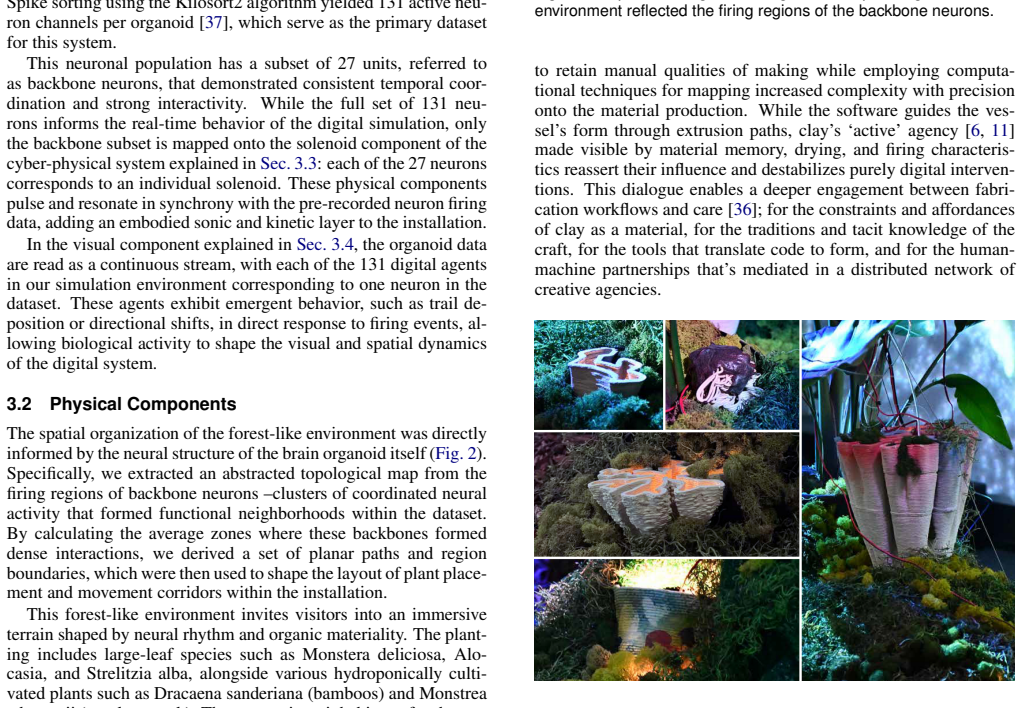
The paper puts forward a concrete, deployed instance of what it calls co-creative visualization: pre-recorded spike trains from lab-grown human brain organoids are stretched from 3 minutes to 90 and broadcast as a master clock that shapes every component of a 9m x 6m environment. Each of 131 spike-sorted neuron channels is bound to one digital agent; a firing event forces that agent to deposit a trail or alter its motion, so termite-style stigmergy, slime-mold foraging, and boid flocking become direct readouts of neural activity. The same clock drives a 16.2-channel generative soundscape, 27 solenoids striking clay vessels, fiber-optic lighting bound to the electrode-array layout, and a real
Load-bearing premise
The argument stands on the assumption that binding each neuron to an agent and making a spike trigger a trail deposit really yields the coherent, aesthetically meaningful emergent patterns described—and that the stated 60-million-agent simulation actually runs in real time on the listed hardware; neither is measured in the paper.
Editorial extensions
If this is right
- A single archived 3-minute organoid recording can be replayed as a 90-minute multisensory installation, which is an ethical and logistical template for bio-art without living tissue.
- Mapping each spike-sorted neuron to one agent injects biological signals into self-organizing simulations while leaving endogenous agent dynamics intact, a generally applicable design pattern.
- The master-clock synchronization over OSC with MQTT fan-out is modular enough to coordinate a node-based visual environment, two rendering systems, an audio environment, and IoT actuators with frame-accurate timing.
- The 27-backbone-neuron-to-solenoid mapping gives neural topology a physical voice, letting a channel count be heard through the resonance of fabricated clay objects.
- Because the design is one-way (no closed-loop stimulation, archived data, reversible plant placement), the installation demonstrates how bio-data can be exhibited while keeping care as a constraint.
Reading between the lines
- A shuffled-spike ablation (same firing rates, randomized timing) would reveal how much of the perceived emergent form actually comes from the organoid signal rather than from the agents' intrinsic self-organization; the paper does not report one.
- The one-to-one neuron-to-agent mapping is a strong design commitment; using population firing rate or burst boundaries—already used for audio—for the visuals too might produce a similar aesthetic, so the specific mapping may be replaceable.
- The 30x slowdown is large enough that visitor-scale perception is likely dominated by the agents' own dynamics; a live-speed variant would clarify what the neural rhythms contribute perceptually.
- Should the planned live closed-loop coupling with organoids be realized, the care ethics would shift: the current one-way, archived-data design is exactly what keeps the ethical situation clean.
Editorial analysis
A structured set of objections, weighed in public.
Referee Report
Summary. Simulacra Naturae describes a media installation that uses pre-recorded 131-channel human brain organoid spike data to drive a multi-sensory environment: a multi-agent simulation (termite, slime mold, and boid layers) rendered in Unity/Processing, a 16.2-channel generative soundscape in Max/MSP, solenoid-actuated ceramic vessels, LED/fiber-optic lighting, and an AI diffusion projection, all synchronized via OSC/MQTT. The paper's contributions are (1) a real-time pipeline claiming more than 50 million GPU agents, (2) a cyber-physical ceramic sound system, (3) a network synchronization architecture, and (4) a qualitative discussion of distributed creative agency, emergence, and care. No quantitative evaluation, user study, or benchmark data is reported.
Significance. If the technical claims hold, the installation is a notable integration of high-density neural data with large-scale agent-based simulation and multisensory cyber-physical art, and it is positioned in a relevant lineage of bio-art and artificial-life practice. The paper is transparent about using pre-recorded organoid data (Sec. 4.3), the one-way influence (no closed-loop stimulation), and the future goal of live integration. The design is not circular: the spike-to-agent mappings are stipulated operationally rather than fitted to the output, so the reader's circularity concern does not land. However, the central real-time performance claim (Contribution 1, Sec. 3.4) is load-bearing and unverified; the spike-to-agent mapping is underspecified; and the qualitative claims about visitor experience and synchronization accuracy are unsupported. These issues need to be addressed before the paper can be accepted.
major comments (3)
- [Sec. 3.4 / Contribution 1] The claim that the Physarum layer 'is capable of simulating a total of 60 million agents split in four species in real-time on a high-end commercial graphics card without throttling the rest of the computations' is load-bearing and unverified. No frame rate, agent-count sweep, GPU utilization, memory bandwidth, output resolution, or frame-time breakdown is reported, and no code is provided. The O(n) asymptotic argument is insufficient: 60M agents per frame at 30 fps implies roughly 1.8B agent-update operations per second, and whether one RTX 4090 sustains this while also running Unity, TouchDesigner, Stable Diffusion, Max/MSP, and solenoid I/O is precisely the quantity at issue. Please provide a frame-time sweep over agent counts (e.g., 10M–60M), GPU/memory utilization, a clear definition of 'real-time' (fps and resolution), and clarify whether 60M is the total across all four species or
- [Sec. 3.4, spike-to-agent mapping] The mapping from organoid spikes to agent behavior is asserted but not specified as a testable transform. For example, 'when a neuron exhibits a spike, the corresponding agent deposits a trail at that instant, overriding its endogenous behavior'—what is the coupling gain, and how does a 131-channel stream modulate a simulation of 60 million agents? The text earlier says 'each of the 131 digital agents in our simulation environment corresponding to one neuron' while the slime-mold layer contains 60 million agents; the relationship between the 131-neuron dataset and the massively parallel Physarum/boid populations is never defined. Moreover, Contribution 1 says 'three behavioral models' but Sec. 3.4 speaks of '60 million agents split in four species.' Please provide explicit parameter ranges or equations for spike-to-trail deposition, sensor angle/distance, movement speed, turn angle, and
- [Sec. 3.6 / Sec. 4.2] The paper makes empirical claims about synchronization and visitor perception without supporting evidence. It states that 'frame-accurate synchronization across subsystems was achieved' (Sec. 3.7) and that 'visitors perceive the co-occurrences and reorient attention' (Sec. 4.2), but no latency/jitter measurements, observation protocol, user study, or expert evaluation is reported. For an arts installation, a formal user study may not be required, but these claims should either be softened to design intentions or documented with measurements. At minimum, report OSC/MQTT latency and jitter values and the synchronization accuracy actually achieved during the Deep Cuts deployment.
minor comments (5)
- [Fig. 6] The diagram header reads '131 x 180,0000' (extra zero); also 'Visuals 1: Termite Simulation' and 'Visuals 2: Slime, Boids Simulation' are inconsistently labeled with the text's three-layer description.
- [Sec. 3.1] The text says recordings capture 'single-unit activity across thousands of electrodes,' but the installed system uses 131 active channels; explain how the subset was chosen and whether the termite layer really has only 131 agents.
- [Sec. 3.5 / abstract] The term '16.2-channel' is used without definition; if it means 16 full-range channels plus 2 subwoofers, state this explicitly.
- [References] Several references have incomplete bibliographic information (e.g., [2], [13], [16], [31] lack full titles or venues), which will need to be completed for final submission.
- [Sec. 3.4] 'Monstrea adansonii' is a typo for Monstera adansonii; also, the phrase '60 million agents split in four species' should be reconciled with the three named behavioral models elsewhere in the paper.
Circularity Check
No circularity: the spike-to-agent mappings are operational interface rules, not derived predictions; self-citations are non-load-bearing, and the unbenchmarked real-time claim is an unsupported performance assertion, not a circular one.
full rationale
The paper's central mappings are stipulated, not derived: 'when a neuron exhibits a spike, the corresponding agent deposits a trail at that instant' (Sec. 3.4) and 'each of the 131 digital agents in our simulation environment corresponding to one neuron in the dataset' (Sec. 3.1). These are operational definitions of an artistic interface, not predictions extracted from data. No parameter is fitted to a subset of observations and then relabeled as a prediction; no equation defines the output in terms of the input beyond these explicit one-way mappings. The 'emergent behavior' language is qualitative and used to describe the installation's aesthetics, not to claim a statistical or predictive relation. The paper's self-citations ([22], [32,33], [34-36]) support prior artworks or fabrication workflows and are not load-bearing for the organoid-to-agent coupling. The real-time 60-million-agent claim (Contribution 1, Sec. 3.4) is unbenchmarked and internally inconsistent with the later '50 thousand agents' boid figure, but that is an unverified performance claim — a correctness risk, not circularity: nothing in the manuscript defines the claimed performance in terms of the spike data. The paper itself flags limitations (footnote 1: pre-recorded data; Sec. 4.3: no live tissue, no closed-loop stimulation, no cognitive attribution), which further confirms the mapping is deliberately one-way and descriptive. There is no self-definitional, fitted-input, self-citation-chain, uniqueness-import, ansatz-smuggling, or renaming pattern that would reduce the claimed result to its inputs.
Assumptions & free parameters
free parameters (3)
- Spike-to-agent trail deposition mapping gain
- Temporal playback slowdown factor =
30
- Backbone neuron functional threshold
assumptions (3)
- domain assumption Organoid spike-sorted data from the Kosik lab are as described in [27,37]
- domain assumption Agent-based models (termites, slime mold, boids) are valid for collective behavior
- domain assumption The described hardware and software stack behave as claimed
Cite this review
Pith. "Pith review of Simulacra Naturae: Generative Ecosystem driven by Agent-Based Simulations and Brain Organoid Collective Intelligence." pith.science (2026). https://pith.science/paper/GKU7UN32
@misc{pith2026250902924,
  author       = {Pith},
  title        = {Pith review of: Simulacra Naturae: Generative Ecosystem driven by Agent-Based Simulations and Brain Organoid Collective Intelligence},
  year         = {2026},
  howpublished = {\url{https://pith.science/paper/GKU7UN32}},
  note         = {Machine review of arXiv:2509.02924}
}
read the original abstract
Simulacra Naturae is a data-driven media installation that explores collective care through the entanglement of biological computation, material ecologies, and generative systems. The work translates pre-recorded neural activity from brain organoids, lab-grown three-dimensional clusters of neurons, into a multi-sensory environment composed of generative visuals, spatial audio, living plants, and fabricated clay artifacts. These biosignals, streamed through a real-time system, modulate emergent agent behaviors inspired by natural systems such as termite colonies and slime molds. Rather than using biosignals as direct control inputs, Simulacra Naturae treats organoid activity as a co-creative force, allowing neural rhythms to guide the growth, form, and atmosphere of a generative ecosystem. The installation features computationally fabricated clay prints embedded with solenoids, adding physical sound resonances to the generative surround composition. The spatial environment, filled with live tropical plants and a floor-level projection layer featuring real-time generative AI visuals, invites participants into a sensory field shaped by nonhuman cognition. By grounding abstract data in living materials and embodied experience, Simulacra Naturae reimagines visualization as a practice of care, one that decentralizes human agency and opens new spaces for ethics, empathy, and ecological attunement within hybrid computational systems.
Figures


Figures from the paper (3 more)


Reference graph
Works this paper leans on
- [1]
-
[2]
S. Anker. Epistemic practices in bio art. 36(6):1389–1394, 2021-11-
work page 2021
-
[3]
Aristotle on technology and nature, 1999
Aristotle. Aristotle on technology and nature, 1999. Translated ex- cerpts and commentary compiled by Joachim Schummer. 2
work page 1999
-
[4]
doi: 10.1007/s00146-021-01152-w 2
-
[5]
P. Beesley, H. Isaacs, P. Ohrstedt, and R. Gorbet, eds. Hylozoic Ground: Liminal Responsive Architecture: Philip Beesley . Riverside Architectural Press, first edition ed., 2010. 2, 7
work page 2010
-
[6]
M. Batty. Cities and Complexity: Understanding Cities with Cellular Automata, Agent-Based Models, and Fractals. MIT, 1. paperback ed ed., 2007. 2
work page 2007
-
[7]
S. Bourgault, P. Wiley, A. Farber, and J. Jacobs. CoilCAM: Enabling Parametric Design for Clay 3D Printing Through an Action-Oriented Toolpath Programming System. In Proceedings of the 2023 CHI Con- ference on Human Factors in Computing Systems , CHI ’23, pp. 1–
work page 2023
-
[8]
J. Bennett. Vibrant Matter. Duke University Press, 2010. doi: 10. 2307/j.ctv111jh6w 3, 6
work page 2010
Show all 46 references
-
[9]
D. J. Haraway. Staying with the Trouble: Making Kin in the Chthu- lucene. Duke University Press, Durham, NC, 2016. 6
2016
-
[10]
Hermann, A
T. Hermann, A. Hunt, and J. G. Neuhoff, eds. The Sonification Hand- book. Logos Verlag, 2011. 5
2011
-
[11]
Camazine, ed
S. Camazine, ed. Self-Organization in Biological Systems. Princeton Studies in Complexity. Princeton Univ. Press, 2. print., and 1. paper- back print ed., 2003. 4, 6
2003
-
[12]
T. Ingold. The Materials of Life. In Making: Anthropology, Archae- ology, Art and Architecture, pp. 17–31. Routledge, 2013. 6, 7
2013
-
[13]
H. H. Ji and G. Wakefield. Entanglement: an immersive art of an engagement with non-conscious intelligence. In S. W. Roh and Y . H. Roh, eds., ISEA2025: 30th International Symposium on Electronic Art – Exhibition Catalogue. Art Center Nabi, 2025. 2
2025
-
[14]
T. Ingold. The textility of making. 34(1):91–102, 2009. doi: 10.1093/ cje/bep042 3
2009
-
[15]
E. Kac. Signs of Life: Bio Art and Beyond. Leonardo. the MIT press,
-
[16]
doi: 10.1145/ 3544548.3580745 3
Association for Computing Machinery, 2023-04-19. doi: 10.1145/ 3544548.3580745 3
2023
-
[17]
printing ed., 2002. 2
2002
-
[18]
J. Jones. Characteristics of Pattern Formation and Evolution in Ap- proximations of Physarum Transport Networks. 16(2):127–153, 2010-
2010
-
[19]
doi: 10.1162/artl.2010.16.2.16202 2, 4
2010 doi
-
[20]
E. Kac. Bio art. 36(6):1367–1376, 2020-11-01. doi: 10.1007/s00146 -020-00958-4 2
2020 doi
-
[21]
C. G. Langton. Computation at the edge of chaos: Phase transitions and emergent computation. 42(1–3):12–37, 1990-06. doi: 10.1016/ 0167-2789(90)90064-V 2, 6
1990
-
[22]
C. G. Langton. Artificial Life. In ARS Electronica Catalog, 1993. 2
1993
-
[23]
B. Latour. Reassembling the Social: An Introduction to Actor- Network-Theory. Clarendon Lectures in Management Studies. Oxford University Press, Oxford ; New York, 2005. 2, 6
2005
-
[24]
A. Lomas. Cellular forms: An artistic exploration of morphogenesis. In ACM SIGGRAPH 2014 Studio on - SIGGRAPH ’14, pp. 1–1. ACM Press, Vancouver, Canada, 2014. doi: 10.1145/2619195.2656282 2
2014
-
[25]
Lucretius Carus
T. Lucretius Carus. The Nature of Things. Norton, 1st ed ed., 1977. 1
1977
-
[26]
Manoudaki, I
N. Manoudaki, I. Paterakis, D. Flatley, R. Millett, and M. Novak. Organoid protonoesis ii. In S. W. Roh and Y . H. Roh, eds.,ISEA2025: 30th International Symposium on Electronic Art – Exhibition Cata- logue, pp. 54–55. Art Center Nabi, 2025. 1
2025
-
[27]
S. Penny. Emergence, Agency, and Interaction—Notes from the Field. 21(3):271–284, 2015-08-01. doi: 10.1162/ARTL a 00167 1, 2
2015 doi
-
[28]
M. Resnick. Turtles, Termites, and Traffic Jams: Explorations in Mas- sively Parallel Microworlds. Complex Adaptive Systems. MIT Press,
-
[29]
printing ed., 2000. 4, 6
2000
-
[30]
C. W. Reynolds. Flocks, Herds, and Schools: A Distributed Behav- ioral Model. 21(4):25–34, 1987-08. doi: 10.1145/37402.37406 4
1987
-
[31]
C. Roads. Microsound. MIT Press, 1. paperback ed ed., 2004. 5
2004
-
[32]
Sharf, T
T. Sharf, T. van der Molen, S. M. K. Glasauer, E. Guzman, A. P. Buc- cino, G. Luna, Z. Cheng, M. Audouard, K. G. Ranasinghe, K. Kudo, S. S. Nagarajan, K. R. Tovar, L. R. Petzold, A. Hierlemann, P. K. Hansma, and K. S. Kosik. Functional neuronal circuitry and oscilla- tory dyna...
2022
-
[33]
Sheldrake
M. Sheldrake. Entangled Life: How Fungi Make Our Worlds, Change Our Minds & Shape Our Futures . Random House, random house trade paperback edition ed., 2021. 2
2021
-
[34]
Simondon
G. Simondon. On the Mode of Existence of Technical Objects . Uni- vocal Publishing, Minneapolis, MN, 2017. 6
2017
-
[35]
D. W. Thompson. On Growth and Form . Dover Publications, the complete revised edition ed., 1992. 2
1992
-
[36]
Todorovic
V . Todorovic. Reimagining life (forms) with generative and bio art. 36(6):1323–1329, 2020-03-04. doi: 10.1007/s00146-020-00937-9 2
2020 doi
-
[37]
M. Toka. The edge of chaos. In Hybrid Science Experimentation . EXP. Experimental Photo Festival, Barcelona, Spain (online), 2021. Group exhibition curated by Felicita Russo and Maciej Zapi´or. 2
2021
-
[38]
M. Toka. The edge of chaos. In SYMADES ’22. California NanoSys- tems Institute, Santa Barbara, CA, USA, 6 2022. Group exhibition curated by Marko Peljhan. 2
2022
-
[39]
M. Toka. Crafting the Computational: Artistic Production, Genera- tive Systems, and Digital Fabrication. In Designing Interactive Sys- tems Conference, pp. 24–29. ACM, 2024-07. doi: 10.1145/3656156. 3665122 4
2024 doi
-
[40]
M. Toka, S. Bourgault, C. Friedman-Gerlicz, and J. Jacobs. An Adapt- able Workflow for Manual-Computational Ceramic Surface Ornamen- tation. In Proceedings of the 36th Annual ACM Symposium on User Interface Software and Technology , UIST ’23, pp. 1–15. Associa- tion for Comput...
2023 doi
-
[41]
M. Toka, D. Frost, S. Bourgault, A. Farber, C. Friedman-Gerlicz, R. Lee, E. Paek, P. Wiley, and J. Jacobs. Practice-driven Software De- velopment: A Collaborative Method for Digital Fabrication Systems Research in a Residency Program. In Designing Interactive Systems Conferenc...
2024 doi
-
[42]
Van Der Molen, A
T. Van Der Molen, A. Spaeth, M. Chini, S. Hernandez, G. A. Kaurala, H. E. Schweiger, C. Duncan, S. McKenna, J. Geng, M. Lim, J. Bar- tram, A. Dendukuri, Z. Zhang, J. Gonzalez-Ferrer, K. Bhaskaran- Nair, L. J. Blauvelt, C. R. Harder, L. R. Petzold, D.-M. Alam El Din, J. Laird, ...
2023
-
[43]
Wakefield and H
G. Wakefield and H. H. Ji. Infranet: A geospatial data-driven neuro- evolutionary artwork. In 2019 IEEE VIS Arts Program (VISAP) , pp. 1–7. IEEE, 2019-10. doi: 10.1109/VISAP.2019.8900903 2
2019
-
[44]
Weinstock
M. Weinstock. The Architecture of Emergence: The Evolution of Form in Nature and Civilisation. Wiley, 1. publ ed., 2010. 2
2010
-
[45]
Wright and A
M. Wright and A. Freed. Open SoundControl: A New Protocol for Communicating with Sound Synthesizers. In Proceedings of the 1997 International Computer Music Conference, pp. 101–104, 1997. 6
1997
-
[46]
Z.-W. Wu, H. Qu, and K. Zhang. A survey of recent practice of arti- ficial life in visual art. Artificial Life, 30(1):106–135, 2024. doi: 10. 1162/artl a 00433 2
2024
Reviewed August 5, 2026 · model on record in the stance chip above.
Discussion (0). Sign in to comment.