REVIEW 3 major objections 5 minor 112 references
The equation of state for neutron stars with speed of sound constraints via Bayesian inference
T0 review · 3 major / 5 minor · reviewed 2026-08-05 · deepseek-v4-flash
Pith's one-line read Enforcing the speed-of-sound limit on neutron-star matter pins the nuclear skewness coefficient Qsat to −69.50^{+16.52}_{−31.93} MeV, with uncertainties several times smaller than heavy-ion experiments provide.
desk verdict Competent Bayesian EOS inference whose headline Q_sat error bars mostly reflect the boundary of a cubic ansatz under a causality cut, not a model-independent measurement; still worth a serious referee. read the letter →
The pith
A machine-rendered reading of the paper's core claim, the machinery that carries it, and where it could break.
The reading
What carries the argument
A Taylor-expanded meta-model carries the argument: the energy per nucleon of symmetric nuclear matter and the symmetry-energy coefficient are each expanded in x = (n_b/n_0 − 1)/3 to third order, with coefficients Esat, Ksat, Qsat and Esym, Lsym, Ksym, Qsym. Three coefficients are fixed to empirical finite-nucleus values; the rest are sampled under flat priors by a nested-sampling Bayesian engine with NICER mass–radius posteriors as the likelihood. Low-density priors — crust–core transition density 0.05–0.11 fm^−3, subsaturation symmetry energy 26–30 MeV — link Lsym and Ksym; the high-density prior c_s^2/c^2 ≤ 1 rejects superluminal EOSs. Qsat governs stiffness, so the filter collapses its po
What would settle it
Re-run the identical Bayesian fit with a fourth-order term (x^4) added to the expansions of esat and esym while keeping the same priors and likelihoods; if the Qsat posterior shifts by more than its quoted 1σ width, the truncation — not the data — is setting the value. Independently, a heavy-ion measurement of Qsat with uncertainty below roughly ±20 MeV that falls outside the −101 to −53 MeV window would directly contradict the inferred range.
Extended reading notes
Core claim
Claim: Qsat, the skewness of the energy per nucleon in symmetric nuclear matter, is the parameter most strongly correlated with the speed of sound, and enforcing the causal bound c_s^2/c^2 ≤ 1 collapses its posterior. With only NICER mass–radius data the posterior is nearly flat (16.27^{+111.26}_{−60.30} MeV); adding the sound-speed cap pulls it to −75.69^{+22.20}_{−27.34} MeV; the full constraint set fixes Qsat = −69.50^{+16.52}_{−31.93} MeV, with errors a few times smaller than heavy-ion measurements. Read sympathetically: causality, not heavy-ion data, does the constraining work; the low-density priors mostly tighten the symmetry-energy parameters; studies omitting the causal check leave
Load-bearing premise
The inference rests on a Taylor expansion truncated at third order in density and second order in isospin asymmetry, evaluated up to roughly six times saturation density (where the expansion variable x ≈ 1.7); the paper itself cautions that such high-density extrapolations may lack microscopic physical foundations, so if the omitted higher-order terms matter at those densities, the sharp Qsat value is an artifact of the functional form, not a property of nuclear matter.
Editorial extensions
If this is right
- The coefficient governing how fast symmetric matter stiffens sits near −70 MeV, so EOSs that stiffen too quickly just above saturation density are excluded; surviving stars have central densities near 6 n0.
- The speed-of-sound cap alone cuts the inferred maximum mass by about 10% (from roughly 2.31 to 2.12 M_sun), so causality is a first-order constraint, not a technicality.
- The radius of a 2.0 M_sun star (about 11.4 km) is the observable most sensitive to the high-density coefficients and shrinks by roughly 0.4 km when the causal limit is imposed, while the 1.4 M_sun radius (about 11.9 km) is fixed by the 2–3 n0 region and barely moves.
- The inferred tidal deformability Λ1.4 ≈ 304 falls inside the band allowed by GW170817, so the EOS family passes the gravitational-wave constraint.
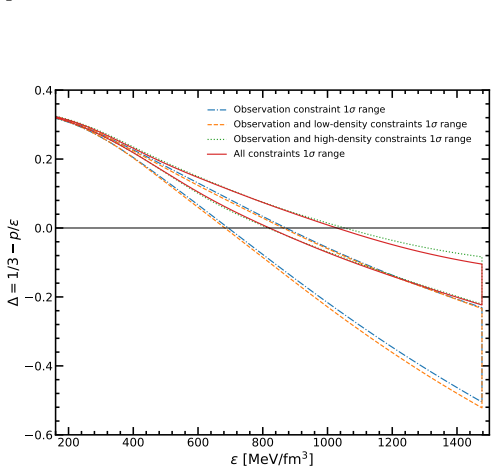
- With causality enforced, the trace anomaly 1/3 − P/ϵ approaches zero toward the stellar center, nudging dense matter toward the conformal limit as perturbative-QCD arguments anticipate.
Reading between the lines
- A cross-check likely to come soon: whether the same narrowing of Qsat survives when the causal cap is applied to other EOS parametrizations, such as piecewise polytropes, mean-field models, or χEFT-informed expansions. If it does, −70 MeV becomes a property of matter; if not, it is a property of the Taylor family.
- The posterior predicts R2.0 near 11.4 km; a future precision radius measurement of a 2 M_sun pulsar outside roughly 11.1–11.8 km would pressure the whole coefficient set, since R2.0 is the observable most tied to high-density behavior.
- The near-linear Lsym–Ksym degeneracy created by the low-density priors could be broken by an independent measurement of the crust–core transition density or pressure, from cooling, oscillations, or neutron-skin experiments, which would also sharpen the poorly constrained Qsym.
- With Qsat negative and Qsym large and positive, proton fractions in neutron-star interiors are implied to rise steeply above 2 n0; if so, the direct-Urca threshold should lie near 1.6–1.8 M_sun, a claim testable through neutron-star cooling observations.
Editorial analysis
A structured set of objections, weighed in public.
Referee Report
Summary. This paper performs a Bayesian inference for a four-parameter meta-model equation of state of neutron-star matter. The energy per nucleon is expanded in a Taylor series in x=(n_b-n_0)/3n_0 up to third order for both symmetric nuclear matter and the symmetry energy, and the isospin asymmetry is treated quadratically. The free parameters are Q_sat, L_sym, K_sym, and Q_sym; flat priors are used. The likelihood uses NICER mass-radius data for PSR J0030+0451 and PSR J0740+6620, and the parameter space is further trimmed by hard constraints on the crust-core transition density, the symmetry energy at 0.11 fm^{-3}, and the causal limit c_s^2/c^2 \le 1. The headline result is Q_sat = -69.50_{-31.93}^{+16.52} MeV, with L_sym = 34.32_{-11.85}^{+13.66} MeV, K_sym = -58.45_{-89.46}^{+88.47} MeV, and Q_sym = 302.28_{-231.89}^{+251.62} MeV. The paper also reports radii, maximum mass, and tidal deformability for the inferred EOS, and stresses the role of the speed-of-sound constraint in narrowing Q_sat.
Significance. The analysis is clearly structured, uses publicly available tools (CompactObject, UltraNest), and transparently reports priors, posteriors, and the effect of each constraint separately. If the Taylor expansion used in the meta-model were convergent at the densities probed, the Q_sat result would be an interesting step toward constraining the isoscalar skewness from astrophysical data, and the comparison with heavy-ion collision determinations would be meaningful. The paper also usefully highlights that causal-limit filtering can dramatically alter posterior ranges, a cautionary point for the field. However, the central quantitative claim is not established as a physical measurement of nuclear matter because the inference is dominated by the hard causality boundary of a third-order expansion evaluated at x \approx 1.9. The paper itself acknowledges this model dependence in \S II.A and \S III. The value of the work is therefore primarily methodological and cautionary rather than a definitive empirical constraint on Q_sat.
major comments (3)
- [Eq. (3), Table II, Section III] The central claim of an empirical Q_sat constraint rests on a Taylor expansion in x truncated at third order (Eq. 3) and a parabolic delta expansion (Eq. 1). The posterior EOSs reach central densities n_max \approx 1.04 fm^{-3} (Table II, Fig. 3), i.e., x=(n/n0-1)/3 \approx 1.9. At this x, the omitted x^4 term is of order x times the retained x^3 term, so with an unknown coefficient it can be as large as the Q_sat term itself. The posterior interval Q_sat=-69.5^{+16.5}_{-31.9} MeV is therefore conditional on the absence of x^4 and higher terms, and the abstract's comparison with heavy-ion collision uncertainties is not a comparison of nuclear-matter constraints but of model-family projections. The paper concedes this in \S II.A ('high-density extrapolations may lack microscopic physical foundations') and \S III ('strongly dependent on the EOS model'). This load-bearing issue should be ad
- [Section II.C, Table I (High-density limit)] The causal constraint is implemented as a hard filter c_s^2/c^2 \le 1 on the truncated EOS. Table I shows that adding this filter changes Q_sat from 16.27^{+111.26}_{-60.30} MeV (observation-only) to -75.69^{+22.20}_{-27.34} MeV (observation + high-density), while the observation-only posterior is very broad. Thus the narrow final interval is essentially the projection of the region where the cubic ansatz remains causal up to n_max, not a likelihood-driven measurement. The abstract's wording that Q_sat is 'constrained to -69.50' with uncertainties much smaller than heavy-ion experiments should be softened to state explicitly that this is a model-conditional bound under the cubic meta-model. Reporting the prior/posterior ratio or evidence for the causal cut would help quantify how much of the constraint comes from the boundary rather than from the NICER data.
- [Section II.C and Section III (low-density cuts)] The low-density constraints -- 26 MeV < e_sym(0.11 fm^{-3}) < 30 MeV and 0.05 fm^{-3} < n_t < 0.11 fm^{-3} -- are taken from nuclear density functional analyses [58,59] and are applied as hard priors. The quoted L_sym = 34.32^{+13.66}_{-11.85} MeV is therefore conditional on those specific empirical windows, not an independent measurement. The abstract and conclusions should say this explicitly. In addition, \S II.C states that the chosen e_sym window 'aligns well' with chi-EFT values of 24-28 MeV (Ref. [87]); the window (26-30 MeV) overlaps only partially, and this discrepancy should be discussed rather than glossed over.
minor comments (5)
- [Abstract] The abstract says the symmetry energy at subsaturation density and the crust-core transition density constrain 'the low-density behavior of EOS, i.e. L_sym'. These constraints also restrict K_sym and Q_sym, as the paper itself shows; please adjust the wording.
- [Section II.A, Eq. (3)] The Taylor expansion for e_sat has no linear x term because saturation is imposed. This should be stated explicitly to avoid confusion about the missing first-order term.
- [Fig. 4 and Table I] The labels 'Low-density limit' and 'High-density limit' are misleading because both rows include the observation likelihood. Use 'Observation + low-density' and 'Observation + high-density' for clarity. Also, 'All limitations' reads awkwardly; consider 'All constraints'.
- [Section III, discussion of Fig. 1] The text states that increasing Q_sat 'slightly increases' the magnitude of K_sym, but Fig. 1 is only shown for Q_sat = -100 MeV. Provide a panel or quantitative statement to support this claim.
- [Section II.C] The phrase 'novel empirical bounds on the speed of sound' is a misnomer: causality c_s^2/c^2 \le 1 is a theoretical requirement, not an empirical bound. Please revise the wording.
Circularity Check
No circularity: Qsat and the other coefficients are inferred from independent NICER likelihoods, a causality filter, and published nuclear-structure windows; the self-citations provide prior inputs, not re-imported conclusions.
full rationale
The inference chain is a standard Bayesian parameter estimation: flat priors on Qsat, Lsym, Ksym, Qsym are updated with NICER mass–radius likelihoods and with additional hard constraints (crust–core transition density, subsaturation symmetry energy, and the causal bound cs^2 <= 1). Qsat is not defined in terms of the final posterior, nor is it fitted to a target Qsat value: Table I shows the posterior moves from 16.27 MeV under observation-only constraints to -75.69 MeV when the causality filter is added and to -69.50 MeV under all constraints, demonstrating that the causality cut acts as an external physical filter rather than as a re-imported input. The self-citations [46,58,59] supply empirical windows (nt in 0.05–0.11 fm^-3 and esub in 26–30 MeV) from earlier published thermodynamic/DFT-based calculations; these are external, falsifiable inputs and are not invoked as uniqueness theorems, so they do not make the inference circular. The paper's own caveats—that high-density extrapolations of the meta-model may lack microscopic foundations and that the narrow Qsat range shows strong EOS-model dependence—are robustness and prior-ansatz limitations, not circularity. No equation or cited step reduces a predicted quantity to an input by construction.
Assumptions & free parameters
free parameters (4)
- Qsat =
-69.50 MeV
- Lsym =
34.32 MeV
- Ksym =
-58.45 MeV
- Qsym =
302.28 MeV
assumptions (6)
- ad hoc to paper The energy per nucleon is expanded as esat(x)=Esat+1/2 Ksat x^2+1/6 Qsat x^3 and esym(x)=Esym+Lsym x+1/2 Ksym x^2+1/6 Qsym x^3, with O(x^4) neglected.
- ad hoc to paper The isospin asymmetry expansion is truncated at delta^2 (parabolic symmetry energy), neglecting O(delta^4).
- domain assumption The crust is described by the SLy4 equation of state.
- domain assumption Values Esat=-15.9 MeV, Ksat=230 MeV, Esym=31.6 MeV are fixed from empirical finite-nucleus data.
- domain assumption The speed of sound must satisfy c_s^2/c^2 <= 1 up to the maximum mass.
- domain assumption The NICER mass-radius measurements are encoded into a likelihood using the reported central values and 1-sigma errors.
Cite this review
Pith. "Pith review of The equation of state for neutron stars with speed of sound constraints via Bayesian inference." pith.science (2026). https://pith.science/paper/5MJJALDB
@misc{pith2026250903069,
  author       = {Pith},
  title        = {Pith review of: The equation of state for neutron stars with speed of sound constraints via Bayesian inference},
  year         = {2026},
  howpublished = {\url{https://pith.science/paper/5MJJALDB}},
  note         = {Machine review of arXiv:2509.03069}
}
abstract
The parametrized equation of state (EOS) of neutron stars is investigated by Bayesian inference method with various constraints from both nuclear physics and modern astronomical observations. The expansion coefficients correspond to the properties of symmetric nuclear matter and the density dependence of the symmetry energy. The empirical values of the symmetry energy at subsaturation density and the density of crust-core phase transition are considered to limit the low-density behavior of EOS, i.e. $L_{\mathrm{sym}} $, while the speed of sound of neutron star matter and mass-radius observations of millisecond pulsars PSR J0030+0451 and PSR J0740+6620 are adopted to eliminate the high-order expansion coefficients, such as $Q_{\mathrm{sat}}$ and $Q_{\mathrm{sym}} $. Finally, our analysis reveals that the skewness coefficient $Q_{\mathrm{sat}}$ of the energy per nucleon in symmetric nuclear matter (SNM) exhibits the strongest correlation with the speed of sound, constrained to $Q_{\mathrm{sat}} = -69.50_{-31.93}^{+16.52} \, \mathrm{MeV}$, whose uncertainties are much smaller than those of the experiments of heavy-ion collisions. The symmetry energy parameters are determined as follows: slope $L_{\mathrm{sym}} = 34.32_{-11.85}^{+13.66} \, \mathrm{MeV}$, curvature $K_{\mathrm{sym}} = -58.45_{-89.46}^{+88.47} \, \mathrm{MeV}$, and skewness $Q_{\mathrm{sym}} = 302.28_{-231.89}^{+251.62} \, \mathrm{MeV}$. Additionally, the radii of canonical ($1.4 \, M_{\odot}$) and massive ($2.0 \, M_{\odot}$) neutron stars are predicted as $R_{1.4} = 11.85_{-0.15}^{+0.06} \, \text{km}$ and $R_{2.0} = 11.42_{-0.35}^{+0.23} \, \text{km}$, respectively, with a maximum mass of $M_{\mathrm{max}} = 2.12_{-0.05}^{+0.11} \, M_{\odot}$. The tidal deformability is $\Lambda_{1.4} = 303.57_{-45.22}^{+47.95}$ at $1.4 \, M_\odot$, which is consistent with the analysis of the GW170817 event.
Figures


Figures from the paper (6 more)



Reference graph
Works this paper leans on
- [87]
-
[1]
H. T. Cromartie, E. Fonseca, S. M. Ransom, et al., Nature Astronomy 4, 72 (2020)
2020
-
[2]
P. B. Demorest, T. Pennucci, S. M. Ransom, M. S. E. Roberts, and J. W. T. Hessels, Nature 467, 1081 (2010)
2010
-
[3]
Antoniadis, P
J. Antoniadis, P. C. C. Freire, N. Wex, T. M. Tauris, R. S. Lynch,et al., Science 340, 1233232 (2013)
2013
-
[4]
R. W. Romani, D. Kandel, A. V. Filippenko, T. G. Brink, and W. Zheng, The Astrophysical Journal Letters 934, L17 (2022)
2022
-
[5]
B. P. Abbott, R. Abbott, T. D. Abbott, F. Acernese, K. Ackley, et al., The Astrophysical Journal Letters 848, L12 (2017)
2017
-
[6]
B. P. Abbott, R. Abbott, T. D. Abbott, F. Acernese, K. Ackley, et al. (LIGO Scientific 25 Collaboration and Virgo Collaboration), Phys. Rev. Lett. 119, 161101 (2017)
2017
-
[7]
T. E. Riley, A. L. Watts, S. Bogdanov, P. S. Ray, R. M. Ludlam, et al., The Astrophysical Journal Letters 887, L21 (2019)
2019
Show all 112 references
-
[8]
M. C. Miller, F. K. Lamb, A. J. Dittmann, S. Bogdanov, Z. Arzoumanian, et al., The Astrophysical Journal Letters 887, L24 (2019)
2019
-
[9]
T. E. Riley, A. L. Watts, P. S. Ray, S. Bogdanov, S. Guillot,et al., The Astrophysical Journal Letters 918, L27 (2021)
2021
-
[10]
M. C. Miller, F. K. Lamb, A. J. Dittmann, S. Bogdanov, Z. Arzoumanian, et al., The Astrophysical Journal Letters 918, L28 (2021)
2021
-
[11]
Huang, J
K. Huang, J. Hu, Y. Zhang, and H. Shen, The Astrophysical Journal 904, 39 (2020)
2020
-
[12]
S. De, D. Finstad, J. M. Lattimer, D. A. Brown, E. Berger, and C. M. Biwer, Phys. Rev. Lett. 121, 091102 (2018)
2018
-
[13]
Annala, T
E. Annala, T. Gorda, A. Kurkela, and A. Vuorinen, Phys. Rev. Lett. 120, 172703 (2018)
2018
-
[14]
E. R. Most, L. R. Weih, L. Rezzolla, and J. Schaffner-Bielich, Phys. Rev. Lett. 120, 261103 (2018)
2018
-
[15]
Raaijmakers, T
G. Raaijmakers, T. E. Riley, A. L. Watts, S. K. Greif, S. M. Morsink,et al., The Astrophysical Journal Letters 887, L22 (2019)
2019
-
[16]
P. T. H. Pang, I. Tews, M. W. Coughlin, M. Bulla, C. Van Den Broeck, and T. Dietrich, The Astrophysical Journal Letters 922, L14 (2021)
2021
-
[17]
Jiang, S.-P
J.-L. Jiang, S.-P. Tang, Y.-Z. Wang, Y.-Z. Fan, and D.-M. Wei, The Astrophysical Journal 892, 1 (2020)
2020
-
[18]
Jaminon and C
M. Jaminon and C. Mahaux, Phys. Rev. C 40, 354 (1989)
1989
-
[19]
J. Hu, Y. Zhang, E. Epelbaum, U.-G. Meiß ner, and J. Meng, Phys. Rev. C 96, 034307 (2017)
2017
-
[20]
C. Wang, J. Hu, Y. Zhang, and H. Shen, The Astrophysical Journal 897, 96 (2020)
2020
-
[21]
Akmal, V
A. Akmal, V. R. Pandharipande, and D. G. Ravenhall, Phys. Rev. C 58, 1804 (1998)
1998
-
[22]
J. R. Stone, J. Miller, R. Koncewicz, P. Stevenson, and M. Strayer, Phys. Rev. C 68, 034324 (2003)
2003
-
[23]
S.-P. Wang, R. Wang, J.-T. Ye, and L.-W. Chen, Ph C 109, 054623 (2024)
2024
-
[24]
Duan and M
M. Duan and M. Urban, Phys. Rev. C 110, 065806 (2024)
2024
-
[25]
Bender, P.-H
M. Bender, P.-H. Heenen, and P.-G. Reinhard, Rev. Mod. Phys. 75, 121 (2003). 26
2003
-
[26]
Gonzalez-Boquera, M
C. Gonzalez-Boquera, M. Centelles, X. Vi˜ nas, and L. Robledo, Physics Letters B 779, 195 (2018)
2018
-
[27]
Vi˜ nas, C
X. Vi˜ nas, C. Gonzalez-Boquera, M. Centelles, C. Mondal, and L. M. Robledo, Symmetry 13, 1613 (2021)
2021
-
[28]
Zhang, J
Y. Zhang, J. Hu, and P. Liu, Phys. Rev. C 97, 015805 (2018)
2018
-
[29]
J. Hu, S. Bao, Y. Zhang, K. Nakazato, K. Sumiyoshi, and H. Shen, Progress of Theoretical and Experimental Physics 2020, 043D01 (2020)
2020
-
[30]
Huang, J
K. Huang, J. Hu, Y. Zhang, and H. Shen, Nucl. Phys. Rev. 39, 135 (2022)
2022
-
[31]
Huang, H
K. Huang, H. Shen, J. Hu, and Y. Zhang, Phys. Rev. D 109, 043036 (2024)
2024
-
[32]
B. Y. Sun, W. H. Long, J. Meng, and U. Lombardo, Phys. Rev. C 78, 065805 (2008)
2008
-
[33]
Z. Zhu, A. Li, J. Hu, and H. Sagawa, Phys. Rev. C 94, 045803 (2016)
2016
-
[34]
Z. W. Liu, Z. Qian, R. Y. Xing, J. R. Niu, and B. Y. Sun, Phys. Rev. C 97, 025801 (2018)
2018
-
[35]
Lindblom, Phys
L. Lindblom, Phys. Rev. D 82, 103011 (2010)
2010
-
[36]
M. F. O’Boyle, C. Markakis, N. Stergioulas, and J. S. Read, Phys. Rev. D 102, 083027 (2020)
2020
-
[37]
Margueron, R
J. Margueron, R. Hoffmann Casali, and F. Gulminelli, Phys. Rev. C 97, 025805 (2018)
2018
-
[38]
Margueron, R
J. Margueron, R. Hoffmann Casali, and F. Gulminelli, Phys. Rev. C 97, 025806 (2018)
2018
-
[39]
Zhang, B.-A
N.-B. Zhang, B.-A. Li, and J. Xu, The Astrophysical Journal 859, 90 (2018)
2018
-
[40]
Cai and B.-A
B.-J. Cai and B.-A. Li, The European Physical Journal A 61, 55 (2025)
2025
-
[41]
Xie and B.-A
W.-J. Xie and B.-A. Li, Journal of Physics G: Nuclear and Particle Physics48, 025110 (2021)
2021
-
[42]
B.-A. Li, A. Ramos, G. Verde, and I. Vida˜ na, The European Physical Journal A 50, 9 (2014)
2014
-
[43]
Li and X
B.-A. Li and X. Han, Physics Letters B 727, 276 (2013)
2013
-
[44]
Oertel, M
M. Oertel, M. Hempel, T. Kl¨ ahn, and S. Typel, Rev. Mod. Phys. 89, 015007 (2017)
2017
-
[45]
Oyamatsu and K
K. Oyamatsu and K. Iida, Phys. Rev. C 75, 015801 (2007)
2007
-
[46]
Bao and H
S. Bao and H. Shen, Phys. Rev. C 89, 045807 (2014)
2014
-
[47]
J. M. Lattimer and M. Prakash, The Astrophysical Journal 550, 426 (2001)
2001
-
[48]
Abrahamyan, Z
S. Abrahamyan, Z. Ahmed, H. Albataineh, K. Aniol, D. S. Armstrong, et al. (PREX Col- laboration), Phys. Rev. Lett. 108, 112502 (2012)
2012
-
[49]
C. J. Horowitz, Z. Ahmed, C.-M. Jen, A. Rakhman, P. A. Souder, et al., Phys. Rev. C 85, 032501 (2012). 27
2012
-
[50]
Adhikari, H
D. Adhikari, H. Albataineh, D. Androic, K. Aniol, D. S. Armstrong, et al. (PREX Collabo- ration), Phys. Rev. Lett. 126, 172502 (2021)
2021
-
[51]
B. T. Reed, F. J. Fattoyev, C. J. Horowitz, and J. Piekarewicz, Phys. Rev. Lett. 126, 172503 (2021)
2021
-
[52]
Roca-Maza, M
X. Roca-Maza, M. Centelles, X. Vi˜ nas, and M. Warda, Phys. Rev. Lett.106, 252501 (2011)
2011
-
[53]
Piekarewicz, Phys
J. Piekarewicz, Phys. Rev. C 104, 024329 (2021)
2021
-
[54]
Adhikari, H
D. Adhikari, H. Albataineh, D. Androic, K. A. Aniol, D. S. Armstrong, et al. (CREX Col- laboration), Phys. Rev. Lett. 129, 042501 (2022)
2022
-
[55]
Reinhard, X
P.-G. Reinhard, X. Roca-Maza, and W. Nazarewicz, Phys. Rev. Lett. 129, 232501 (2022)
2022
-
[56]
Zhang and L.-W
Z. Zhang and L.-W. Chen, Phys. Rev. C 108, 024317 (2023)
2023
-
[57]
J. M. Lattimer, Particles 6, 30 (2023)
2023
-
[58]
Bao and H
S. Bao and H. Shen, Phys. Rev. C 91, 015807 (2015)
2015
-
[59]
S. Bao, J. Hu, Z. Zhang, and H. Shen, Phys. Rev. C 90, 045802 (2014)
2014
-
[60]
A complete survey from the CompactObject perspective on equation of state cross-comparison using observational and nuclear experimental constraints,
J. Cartaxo, C. Huang, T. Malik, S. Sourav, W.-L. Yuan, T. Zhou, X. Liu, and C. Providˆ encia, “A complete survey from the CompactObject perspective on equation of state cross-comparison using observational and nuclear experimental constraints,” (2025), arXiv:2506.03112 [nucl-th]
2025
-
[61]
Relativistic mean-field predictions for dense matter equation of state and application to neutron stars,
L. Passarella, J. Margueron, and G. Pagliara, “Relativistic mean-field predictions for dense matter equation of state and application to neutron stars,” (2025), arXiv:2503.23028 [nucl- th]
2025 arXiv
-
[62]
Huang, G
C. Huang, G. Raaijmakers, A. L. Watts, L. Tolos, and C. Providˆ encia, Monthly Notices of the Royal Astronomical Society 529, 4650 (2024)
2024
-
[63]
Huang, L
C. Huang, L. Tolos, C. Providˆ encia, and A. Watts, Monthly Notices of the Royal Astronom- ical Society 536, 3262 (2024)
2024
-
[64]
Xie and B.-A
W.-J. Xie and B.-A. Li, The Astrophysical Journal 899, 4 (2020)
2020
-
[65]
Malik and C
T. Malik and C. Providˆ encia, Phys. Rev. D 106, 063024 (2022)
2022
-
[66]
Carvalho, M
V. Carvalho, M. Ferreira, T. Malik, and C. Providˆ encia, Phys. Rev. D 108, 043031 (2023)
2023
-
[67]
J. Zhou, J. Xu, and P. Papakonstantinou, Phys. Rev. C 107, 055803 (2023)
2023
-
[68]
B.-A. Li, X. Grundler, W.-J. Xie, and N.-B. Zhang, Phys. Rev. D 110, 103040 (2024)
2024
-
[69]
Ferreira and C
M. Ferreira and C. Providˆ encia, Journal of Cosmology and Astroparticle Physics 2021, 011 (2021). 28
2021
-
[70]
Fujimoto, K
Y. Fujimoto, K. Fukushima, and K. Murase, Phys. Rev. D 98, 023019 (2018)
2018
-
[71]
W. Zhou, J. Hu, Y. Zhang, and H. Shen, The Astrophysical Journal 950, 186 (2023)
2023
-
[72]
Han, S.-P
M.-Z. Han, S.-P. Tang, and Y.-Z. Fan, The Astrophysical Journal 950, 77 (2023)
2023
-
[73]
W. Zhou, H. Shen, J. Hu, and Y. Zhang, Phys. Rev. D 110, 043017 (2024)
2024
-
[74]
Guo, J.-Y
L.-J. Guo, J.-Y. Xiong, Y. Ma, and Y.-L. Ma, The Astrophysical Journal 965, 47 (2024)
2024
-
[75]
Clark, I
J. Clark, I. S. Heng, M. Pitkin, and G. Woan, Phys. Rev. D 76, 043003 (2007)
2007
-
[76]
¨Ozel, G
F. ¨Ozel, G. Baym, and T. G¨ uver, Phys. Rev. D 82, 101301 (2010)
2010
-
[77]
E. V. Chimanski, R. V. Lobato, A. R. Goncalves, and C. A. Bertulani, Particles 6, 198 (2023)
2023
-
[78]
M. V. Beznogov and A. R. Raduta, The Astrophysical Journal 966, 216 (2024)
2024
-
[79]
M. V. Beznogov and A. R. Raduta, Phys. Rev. C 110 (2024), 10.1103/physrevc.110.035805
2024 doi
-
[80]
Malik, M
T. Malik, M. Ferreira, B. K. Agrawal, and C. Providˆ encia, The Astrophysical Journal 930, 17 (2022)
2022
-
[81]
Relativistic description of the neutron star equation of state,
C. Providˆ encia, T. Malik, M. B. Albino, and M. Ferreira, “Relativistic description of the neutron star equation of state,” in Nuclear Theory in the Age of Multimessenger Astronomy (CRC Press, 2024) p. 111–143
2024
-
[82]
J.-J. Li, Y. Tian, and A. Sedrakian, Physics Letters B 865, 139501 (2025)
2025
-
[83]
Fan, M.-Z
Y.-Z. Fan, M.-Z. Han, J.-L. Jiang, D.-S. Shao, and S.-P. Tang, Phys. Rev. D 109, 043052 (2024)
2024
-
[84]
C. Y. Tsang, M. B. Tsang, W. G. Lynch, R. Kumar, and C. J. Horowitz, Nature Astronomy 8, 328–336 (2024)
2024
-
[85]
Malik, B
T. Malik, B. K. Agrawal, and C. Providˆ encia, Phys. Rev. C 106 (2022)
2022
-
[86]
P. Char, C. Mondal, F. Gulminelli, and M. Oertel, Phys. Rev. D 108, 103045 (2023)
2023
-
[88]
J.-J. Li, Y. Tian, and A. Sedrakian, Phys. Rev. C 111, 055804 (2025)
2025
-
[89]
Compactobject: An open- source python package for full-scope neutron star equation of state inference,
C. Huang, T. Malik, J. Cartaxo, S. Sourav, W. Yuan, et al., “Compactobject: An open- source python package for full-scope neutron star equation of state inference,” (2024), arXiv:2411.14615 [astro-ph.HE]
2024 arXiv
-
[90]
Vinciguerra, T
S. Vinciguerra, T. Salmi, A. L. Watts, D. Choudhury, T. E. Riley, et al., The Astrophysical Journal 961, 62 (2024)
2024
-
[91]
Salmi, D
T. Salmi, D. Choudhury, Y. Kini, T. E. Riley, S. Vinciguerra, et al., The Astrophysical 29 Journal 974, 294 (2024)
2024
-
[92]
Huang, J
K. Huang, J. Hu, Y. Zhang, and H. Shen, The Astrophysical Journal 935, 88 (2022)
2022
-
[93]
Zhang and B.-A
N.-B. Zhang and B.-A. Li, The Astrophysical Journal 879, 99 (2019)
2019
-
[94]
Zhang and B.-A
N.-B. Zhang and B.-A. Li, The Astrophysical Journal 893, 61 (2020)
2020
-
[95]
Zhang and B.-A
N.-B. Zhang and B.-A. Li, The Astrophysical Journal 902, 38 (2020)
2020
-
[96]
Zhang and B.-A
N.-B. Zhang and B.-A. Li, The Astrophysical Journal 921, 111 (2021)
2021
-
[97]
Kubis, Phys
S. Kubis, Phys. Rev. C 76, 025801 (2007)
2007
-
[98]
J. M. Lattimer and M. Prakash, Phys. Rep. 442, 109 (2007)
2007
-
[99]
Douchin and P
F. Douchin and P. Haensel, Astronomy & Astrophysics 380, 151 (2001)
2001
-
[100]
R. C. Tolman, Phys. Rev. 55, 364 (1939)
1939
-
[101]
J. R. Oppenheimer and G. M. Volkoff, Phys. Rev. 55, 374 (1939)
1939
-
[102]
Hinderer, B
T. Hinderer, B. D. Lackey, R. N. Lang, and J. S. Read, Phys. Rev. D 81, 123016 (2010)
2010
-
[103]
J. S. Read, L. Baiotti, J. D. E. Creighton, J. L. Friedman, B. Giacomazzo, et al., Phys. Rev. D 88, 044042 (2013)
2013
-
[104]
Xie and B.-A
W.-J. Xie and B.-A. Li, The Astrophysical Journal 883, 174 (2019)
2019
-
[105]
Buchner, The Journal of Open Source Software 6, 3001 (2021)
J. Buchner, The Journal of Open Source Software 6, 3001 (2021)
2021
-
[106]
Cai and L.-W
B.-J. Cai and L.-W. Chen, Nuclear Science and Techniques 28, 185 (2017)
2017
-
[107]
Chen, Science China Physics, Mechanics and Astronomy 54, 124 (2011)
L. Chen, Science China Physics, Mechanics and Astronomy 54, 124 (2011)
2011
-
[108]
B.-A. Li, P. G. Krastev, D.-H. Wen, and N.-B. Zhang, The European Physical Journal A 55, 117 (2019)
2019
-
[109]
Li, B.-J
B.-A. Li, B.-J. Cai, W.-J. Xie, and N.-B. Zhang, Universe 7, 182 (2021)
2021
-
[110]
Fujimoto, K
Y. Fujimoto, K. Fukushima, L. D. McLerran, and M. Prasza lowicz, Phys. Rev. Lett. 129, 252702 (2022)
2022
-
[111]
Traversi, P
S. Traversi, P. Char, and G. Pagliara, The Astrophysical Journal 897, 165 (2020)
2020
-
[112]
Altiparmak, C
S. Altiparmak, C. Ecker, and L. Rezzolla, The Astrophysical Journal Letters 939, L34 (2022). 30
2022
Reviewed August 5, 2026 · model on record in the stance chip above.
Discussion (0). Continue with ORCID to comment.