REVIEW 3 major objections 8 minor 17 references
Silicon-monoxide flames: the nucleation and condensation of silica fume
T0 review · 3 major / 8 minor · reviewed 2026-08-05 · deepseek-v4-flash
Pith's one-line read Brownian collisions, not nucleation, set the final size distribution of silica fume particles formed in silicon-monoxide flames.
desk verdict Real parameter corrections and clean control-run demos make this the most usable silica-fume simulation so far, but the paper's own CNT equations give a sub-molecular critical nucleus exactly when the claimed chain reaction triggers, so the quantitative claims need a fix before I'd trust them. read the letter →
The pith
A machine-rendered reading of the paper's core claim, the machinery that carries it, and where it could break.
The reading
What carries the argument
The machinery is classical homogeneous nucleation theory for SiO2 droplets—critical radius r_min = 2γv_c/(k_B T ln S_e) and nucleation rate J = J0 exp[-16πγ^3v_c^2/(3(k_B T)^3(ln S_e)^2)], with the revised pre-factor J0 that depends on vapour concentration and includes an inverse-supersaturation factor—coupled to a free-molecular condensation law dr_p/dt = A(C_SiO2 - C_sat)√T and a particle energy equation that feeds latent heat back into the gas. Together these close a positive feedback loop: condensation heats the gas, higher temperature raises J and the condensation rate, which releases more latent heat and shifts SiO oxidation toward more SiO2. Brownian motion enters through a stochastic
What would settle it
Measure particle number density, size distribution, gas temperature, and gas-phase SiO2 concentration versus time in a well-characterised, premixed SiO/CO flame. The paper's mechanism predicts a sudden burst of particles at the time when Se first approaches the critical value given by Eqs. (18)-(19), a subsequent temperature jump, and a Brownian-coagulation-driven decay of particle number; if particles appear substantially earlier or later than the predicted critical supersaturation, or if the number density does not decay with the coagulation rate implied by Brownian relative velocities, the
Extended reading notes
Core claim
The central discovery is a two-part statement about silica fume formation. First, coalescence due to Brownian motion is the dominant process controlling the final particle size distribution: in the reference stoichiometric case, removing Brownian motion leaves the final particle number four orders of magnitude higher and the distribution stuck at the smallest sizes, whereas with it the average particle grows roughly two orders of magnitude in radius. Second, particle nucleation in furnace-relevant conditions is a thermal chain reaction: once the first critical SiO2 nuclei appear, condensation onto them releases latent heat, the temperature rises, and higher temperature increases both the nuc
Load-bearing premise
The calculation assumes that silica molecules first cluster into tiny liquid-like droplets at the rate predicted by classical nucleation theory; if the real birth process is stepwise polymerisation instead, the predicted timing of the particle burst and the final particle sizes could change.
Editorial extensions
If this is right
- Final particle size is controlled by how long the gas stays above the silica melting temperature: faster cooling freezes the distribution at smaller sizes, slower cooling lets Brownian coalescence coarsen it.
- The particle burst is a sharp, predictable event near 1 ms under stoichiometric conditions; a sudden temperature rise and near-complete gas-to-particle transfer should be observable when the first nuclei form.
- Quantitative predictions of silica fume quality require the temperature-dependent surface energy and saturation-pressure relation used here; earlier constant-saturation simulations suppressed the supersaturation peak by roughly ten orders of magnitude and missed the burst.
- For three-dimensional furnace simulations, the Lagrangian swarm formulation reproduces the Eulerian bin solution while using less CPU time, and spends resources only where particles exist.
- The broadness of the measured furnace PSD is consistent with the model: parcels with different equivalence ratios follow different cooling histories and thus different coagulation times, so a real furnace distribution is an ensemble of premixed curves.
Reading between the lines
- The chain-reaction picture implies a test: a well-mixed SiO/CO flame should show a sharp jump in gas temperature and particle number at the predicted burst time; high-speed diagnostics on a laboratory burner could confirm or shift the nucleation pre-factor.
- The paper leaves implicit that residence time above the melting temperature is a tunable furnace parameter; one could deliberately design post-flame cooling to hit a target silica fume size rather than simply accepting the distribution.
- If particle birth is actually stepwise polymerisation rather than droplet nucleation, the predicted critical-radius scaling with surface energy and supersaturation would fail; measuring the onset supersaturation and particle number density over a range of temperatures would discriminate the two pictures.
- A direct corollary for renewable reductants: since water vapour changes CO/SiO reactivity, switching reducing agents alters the supply rate of SiO2 and hence the timing and strength of the burst; correlating moisture content of the reductant with measured fume PSD would test the mechanism.
Editorial analysis
A structured set of objections, weighed in public.
Referee Report
Summary. The paper presents zero-dimensional simulations of SiO combustion and subsequent SiO2 nucleation/condensation in silicon-furnace flames, with both Lagrangian and Eulerian particle-tracking frameworks. The authors identify Brownian coalescence as the dominant control on the final particle size distribution, and report that latent-heat release from condensation triggers a runaway chain reaction of nucleation and condensation once the first particles form, lasting until the SiO2 supersaturation ratio falls to unity. They use literature values for surface energy, saturation pressure, and nucleation pre-factors, compare results against a zero-latent-heat control and against Brownian-diffusion theory, and finally compare simulated PSDs with industrial measurements.
Significance. If the reported mechanisms are correct, the paper provides a new, parameter-light explanation for the timing of particle bursts and for the broad particle size distributions observed in silica-fume furnaces, with direct practical relevance for switching from fossil to bio-based reductants. The work is commendable for not fitting parameters to the measured PSD: the nucleation and thermophysical inputs are taken from independent sources, and the Brownian-motion expression is derived and tested against the Einstein relation. The chain reaction is isolated by a zero-latent-heat control, and the Brownian-coalescence effect is demonstrated by a direct sensitivity run. However, two load-bearing issues described below — the internal validity of the CNT critical-radius formula at the extreme supersaturations reached, and the apparent inconsistency in the Brownian velocity update — cast doubt on the quantitative predictions as currently presented.
major comments (3)
- [Sec. 5.4 / Eq. (18)] In the reference case, the supersaturation ratio Se is stated to peak roughly ten orders of magnitude above the constant-Csat case (Sec. 5.4, Fig. 12). For T ≈ 2000 K, γ = 0.307 J m−2, vc = 4.5×10⁻²⁹ m3, Eq. (18) gives rmin = 2γvc/(kBT ln Se) ≈ 0.04 nm at Se ≈ 10^10. This is below the SiO2 molecular radius Rmol = (3vc/4π)^(1/3) ≈ 0.22 nm, i.e. the critical cluster would contain ~0.006 molecules. Equation (21) then removes a sub-molecular mass per nucleation event, and Eq. (19) uses a continuum surface energy for a 'droplet' smaller than one molecule. The nucleation model is therefore internally inconsistent exactly at the conditions where the chain reaction is triggered. The dismissal in Sec. 1 of Ulrich's similar finding as 'not directly useful' makes this omission more serious. Please compute and report rmin in the actual simulations, or replace the CNT source with a molecular-cluster/
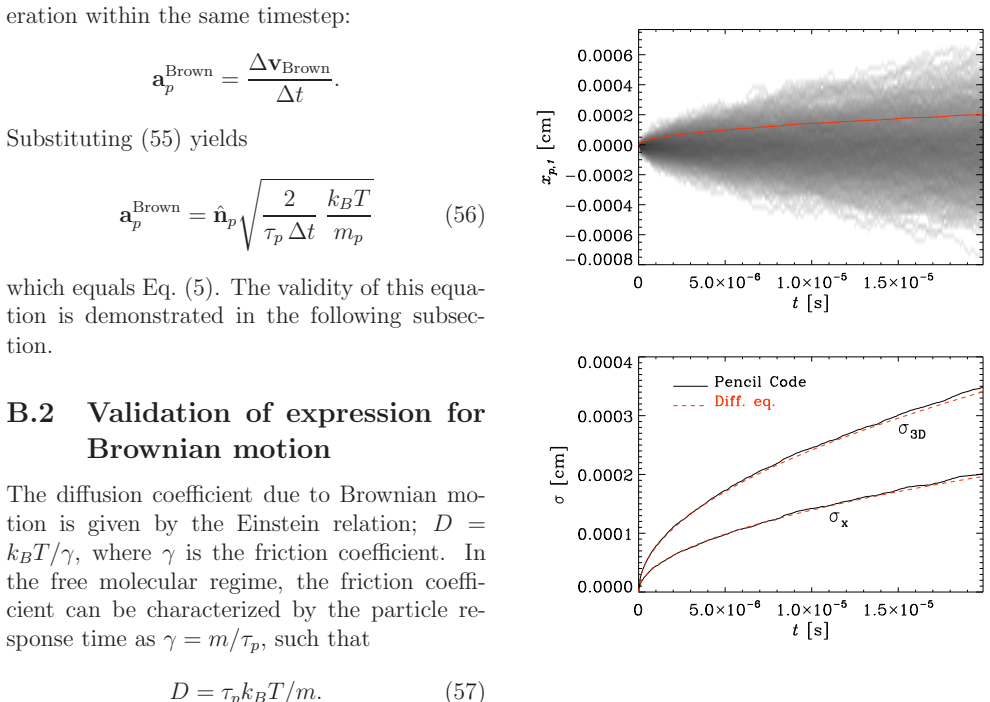
- [Eq. (8) and Appendix B] Equation (8) states vp = u + aBrown τp, with aBrown given by Eq. (5). However, the Langevin integration in Appendix B shows that the Brownian velocity increment over a time step is ΔvBrown = aBrown Δt (Eq. (55)). As written, vrel = aBrown τp scales as 1/√Δt and diverges as the time step is refined. Since the collection probability in Eq. (11) is proportional to |vi − vj|, the coagulation rate becomes numerically resolution-dependent, which directly affects the central claim about Brownian coalescence. The validation in Fig. 14 cannot be consistent with Eq. (8) unless the code uses aBrown Δt in the velocity update. Please clarify whether Eq. (8) is a typo and confirm the implemented velocity update.
- [Sec. 2.2] The authors write that 'the detailed physical chemistry of this process is not well known' and then apply a droplet/CNT approximation. This is an honest limitation, but in combination with the extreme Se values of the reference case (major comment 1) the droplet approximation operates outside its range of validity at the very moment nucleation begins. This is not merely an uncertainty about polymerization chemistry; it is a model-internal consistency problem. A statement of this limitation should accompany Eqs. (18)–(19), and the paper should either justify that the chain-reaction mechanism persists with an admissible nucleation model or revise the nucleation source.
minor comments (8)
- [Appendix C.2] The text says 'in the continuum regime, i.e. when the particles are much larger than the mean free path (Kn ≫ 1)'. The Knudsen number is Kn = λ/rp, so the continuum regime is Kn ≪ 1; the inequality should be inverted.
- [Sec. 5.4] The statement that the constant-Csat case has a peak supersaturation 'roughly ten orders of magnitude smaller than for the reference case' would be more useful if the actual peak values were reported, since the sub-molecular rmin concern depends on the precise magnitude.
- [Eq. (37)] The coefficient aop is called an 'opacity' but it functions as a cooling-rate multiplier. A brief explanation of its intended physical meaning would avoid confusion, especially since Fig. 11 shows the final PSD is sensitive to it.
- [Table 2] The units and meaning of the Nphys column are unclear for the Lagrangian rows (values like '2.7' and '3.0' with a column header '[10 11]'). Please clarify.
- [Fig. 10] The measured particle size distribution is shown without error bars or a description of the uncertainty in the Malvern measurement. A brief statement would help the reader judge the comparison.
- [Sec. 3.3] The enthalpy of vaporization is taken from shock-vaporization experiments (ΔH = 7.06×10^5 J/mol), but the text does not discuss possible temperature dependence of ΔH over the 1700–2500 K range. A sentence on this would be helpful.
- [References] Ref. 23 is a web database URL without a stable author/date. Please replace it with a citable source for the optical constants of SiO2 at high temperature.
- [Fig. 14 caption] The caption says 'The lower pair of lines corresponds to the full three-dimensional displacement, while the lower pair is for the displacement in the x-direction' — the second phrase should presumably be 'the upper pair' or 'the other pair'.
Circularity Check
No significant circularity: the nucleation/condensation parameters come from external literature, the measured PSD is used only as a rough comparison, and the chain reaction and Brownian-coalescence results emerge from the dynamical equations rather than being encoded as inputs.
full rationale
The paper's derivation chain is self-contained and does not reduce to its inputs by construction. The nucleation model (Eqs. 18-19) uses classical Becker-Doring/Oxtoby theory with the surface energy from Kingery (Eq. 31), the saturation pressure from Clausius-Clapeyron with literature values (Eqs. 35-36), and the pre-exponential factor from Oxtoby/Becker-Doring (Eqs. 32-33); none of these parameters is fitted to the target particle size distribution. The measured PSD from a real furnace (Sec. 5.3) is used only as a rough visual comparison ('the difference is not dramatic'), not as a calibration target, so there is no fitted-input-called-prediction pattern. The central chain-reaction claim is an emergent feedback: Sec. 5.2 explicitly derives it from 'Eqs. (9) and (19)' combined with latent-heat release and SiO-oxidation equilibrium shifts, and the sensitivity run with zero latent heat (Fig. 9) shows the mechanism is not an assertion but a computed consequence. Similarly, the conclusion that Brownian coalescence controls the PSD is supported by a controlled comparison in Sec. 5.4 where turning off Brownian motion leaves a factor-of-10^4 larger particle number 'clearly due to the lack of any coalescence'; this is a dynamical sensitivity result, not a definitional equivalence, since the no-Brownian case still has the same nucleation/condensation. Validations are performed against external benchmarks: the Brownian displacement is checked against the Einstein relation (Appendix B), the non-Si chemistry against the Davis mechanism (Sec. 4.2), and Lagrangian against Eulerian particle tracking (Sec. 4.1). The self-citations to Li et al. and Babkovskaia et al. are implementation/method citations (super-droplet collection, code equations), not load-bearing uniqueness theorems or hidden ansaetze; the underlying collection scheme originates with Shima et al. and the droplet approximation is stated explicitly as a modeling choice in Sec. 2.2 rather than smuggled in via citation. The paper's own caveat that 'the detailed physical chemistry of this process is not well known' and that a droplet approximation is being applied is a frank model limitation; the separate concern that the CNT critical radius becomes sub-molecular at the extreme supersaturation ratios of the reference case is a physical-validity issue, not a circularity, because the predicted burst timing and PSD are not equal by construction to the model input parameters. Overall, no specific reduction of a clai
Assumptions & free parameters
free parameters (5)
- Cooling rate opacity a_op =
1 (reference)
- Latent heat of vaporization Delta-H =
7.06e5 J/mol
- Surface energy parameters gamma_0, gamma_T =
0.307 J/m2, 3.1e-5 J/m2/K
- Imaginary refractive index k =
0.005
- Nuclei mass threshold rho_ynucl,thresh =
10^-11
assumptions (6)
- domain assumption Classical nucleation theory (Eqs. 18-19) with the Oxtoby pre-exponential factor gives the rate of SiO2 particle birth.
- ad hoc to paper Silica fume particles can be treated as liquid droplets with bulk SiO2 melting/boiling temperatures; coalescence requires T > 1833 K.
- domain assumption Particles and gas are in instantaneous thermal equilibrium; latent heat enters the gas immediately.
- domain assumption Condensation is free-molecular for all particle sizes; continuum and Fuchs-Sutugin corrections are not implemented.
- domain assumption The Panjwani and Olsen reaction mechanism, with NOx reactions removed, describes SiO/CO oxidation under furnace conditions.
- domain assumption Super-droplet collection probability uses Eij = 1 and the Shima collection scheme.
Cite this review
Pith. "Pith review of Silicon-monoxide flames: the nucleation and condensation of silica fume." pith.science (2026). https://pith.science/paper/J7AHQMET
@misc{pith2026250903106,
  author       = {Pith},
  title        = {Pith review of: Silicon-monoxide flames: the nucleation and condensation of silica fume},
  year         = {2026},
  howpublished = {\url{https://pith.science/paper/J7AHQMET}},
  note         = {Machine review of arXiv:2509.03106}
}
read the original abstract
Silica fume is a valuable by-product from the silicon and ferrosilicon production. It is therefore important to understand the impact on the silica fume quality when converting the furnace feed from fossil-based to renewable reduction materials. Using self-consistent numerical simulations of the nucleation and condensation process, we present a detailed study of the silica fume formation process. It is found that the most critical physical effect that determines the final particle size distribution is coalescence due to Brownian motion. Furthermore, it is crucial to use appropriate thermophysical parameters in order to reproduce reliable particle size distributions. Contrary to what has been done in previous studies on the same topic, this is now done by using reasonable expressions for surface energy, saturation pressure and the nucleation pre-exponential factor. It is also found that under conditions relevant to furnaces, the liberation of latent heat leads to an explosive chain reaction of particle nucleation and condensation when the first particles nucleate and start growing due to condensation. This process continues until the relative saturation pressure of silicon dioxide is reduced to unity. Finally, it is found that the Lagrangian approach for particle tracking is more flexible and accurate, and also more CPU efficient, than the Eulerian approach.
Figures


Figures from the paper (11 more)



Reference graph
Works this paper leans on
-
[1]
Nachrichten aus der Chemie 2011, 59, 955–958
(1) Friede, B.; Fidjestøl Microsilica – Ein Staub macht Karriere (Microsilica – A dust makes career). Nachrichten aus der Chemie 2011, 59, 955–958. (2) Friede, B.; Gaillou, E. Die Vielfalt des Siliciumdioxids (The Variety of Silica). Chemie in unserer Zeit 2018, 52, 84–89. (3) Schei, A.; Tuset, J. K.; Tveit, H. Produc- tion of High Silicon Alloys ; TAPIR forlag,
work page 2011
-
[6]
(28) Mizele, J.; Dandurand, J. L.; Schott, J. Determination of the surface energy of amorphous silica from solubility measure- ments in microprobes. Surface Sceince 1985, 162,
work page 1985
-
[15]
(33) Lothe, J.; Pound, G. M. Reconsidera- tions of nucleation theory. J. Chem. Phys. 1962, 36, 2080–2085. (34) Becker, R.; D¨ oring, W. Kinetische Behandlung der Keimbildung in ¨ ubers¨ attigten D¨ ampfen.Annalen der Physik 1935, 416, 719–752. (35) Oxtoby, D. W. Homogeneous nucleation: theory and experiment. J. Phys. Condens. Matter 1992, 4, 7627–7650. 23...
work page 1962
-
[16]
Simulation of aerosol nucleation and growth in a turbulent mixing layer
(37) Zhou, K.; Attili, A.; Alshaarawi, A.; Bisetti, F. Simulation of aerosol nucleation and growth in a turbulent mixing layer. Physics of Fluids 2014, 26, 065106. (38) Kraus, R. G.; Stewart, S. T.; Swift, D. C.; Bolme, C. A.; Smith, R. F.; Hamel, S.; Hammel, B. D.; Spaulding, D. K.; Hicks, D. G.; Eggert, J. H.; Collins, G. W. Shock vaporization of silica...
work page 2014
-
[547]
(31) Popel, S. I.; Sokolov, V. I.; Esin, O. A. Surface tension of binary melts in MeO- SiO2 systems. Zh. Fiz. Khim. 1969, 43,
work page 1969
-
[1821]
Y.; Brandenburg, A.; Haugen, N
(19) Li, X. Y.; Brandenburg, A.; Haugen, N. E. L.; Svensson, G. Eulerian and la- grangian approaches to multidimensional condensation and collection. J. Adv. Mod- eling Earth Systems 2017, 9, 1116–1137. (20) Shima, S.; Kusano, K.; Kawano, A.; Sugiyama, T.; Kawahara, S. The super- droplet method for the numerical sim- lulation of clouds and precipitation: ...
work page 2017
-
[1969]
(27) Jachimowski, C. J.; McLain, A. G. A chemical kinetic mechanism for the igni- tion of Silane/Hydrogen mixtures. NASA Technical Paper 1983, 2129,
work page 1983
-
[1984]
(25) Babkovskaia, N.; Haugen, N. E. L.; Bran- denburg, A. A high-order public domain code for direct numerical simulations of turbulent combustion. J. Comput. Phys. 2011, 230, 1–12. (26) Hirschfelder, J. O.; Curtiss, C. F.; Bird, R. B. Molecular Theory of Gases and Liquids; John Wiley & Sons, Inc.: New York,
work page 2011
Show all 17 references
-
[1998]
(4) Ulrich, G. D. Theory of particle for- mation and growth in oxide synthesis flames. Combustion Science and Technol- ogy 1971, 4, 47–57. (5) Gonzalez-Farina, R. Modelling the mecha- nisms of microsilica particle formation and growth. Ph.D. thesis, University of Ox- ford,
1971
-
[2000]
H.; Bertrand, P
(30) Overbury, S. H.; Bertrand, P. A.; Somor- jai, G. A. The Surface Composition of Bi- nary Systems Prediction of Surface Phase Diagrams of Solid Solutions. Chemical re- views 1975, 75,
1975
-
[2002]
G.; Joshi, A
(41) Davis, S. G.; Joshi, A. V.; Wang, H.; Egol- fopoulos, F. An optimized kinetic model of H2/CO combustion. Proceedings of the Combustion Institute 2005, 30, 1283–
2005
-
[2012]
(14) Panjwani, B.; Olsen, J. E. Combustion and mechanism for NOx formation in fer- rosilicon electric arc furnaces. Proceedings of the European combusion meeting 2013, (15) Brede, I. Parameters Contributing to the Formation of NOx in the Silicon Furnace: The effect of the charg...
2013
-
[2013]
M.; Please, C
(17) Sloman, B. M.; Please, C. P.; van Gorder, R. A.; Valderhaug, A. M.; Birke- land, R. G.; Wegge, H. A heat and mass transfer model of a silicon pilot furnace. Metallurgical and meterials transactions B 2017, 48B,
2017
-
[2020]
M.; Gorder, R
(6) Gonzalez-Farina, R.; Munch, A.; Oliver, J. M.; Gorder, R. A. V. Modeling microsilica particle formation and growth due to the combustion reaction of silicon monoxide with oxygen. SIAM J. Appl. Math. 2020, 80, 1003–1033. (7) Vachaparambil, K. J.; Panjwani, B.; Olsen, J. E. ...
2020
-
[2664]
Y.; Mehlig, B.; Svensson, G.; Bran- denburg, A.; Haugen, N
(18) Li, X. Y.; Mehlig, B.; Svensson, G.; Bran- denburg, A.; Haugen, N. E. L. Collision fluctuations of lucky droplets with super- droplets. J. Atmosph. Sci. 2022, 79,
2022
-
[3175]
(32) Kingery, W. D. Surface tension of some liquid oxides and their temperature coeffi- cients. J. Am. Ceramic Soc. 1959, 42,
1959
-
[3990]
E.; Ra- souli, A.; Tranell, G
(8) Andersen, V.; Einarsrud, K. E.; Ra- souli, A.; Tranell, G. Silica Fume Forma- tion in Different Gas Atmospheres. Indus- trial & Engineering Chemistry Research 2023, 62, 4246–4259. (9) Cusano, G.; Gonzalo, M. R.; Farrell, F.; Rainer Remus, S. R.; Sancho, L. D. Best Available...
2023
Reviewed August 5, 2026 · model on record in the stance chip above.
Discussion (0). Continue with ORCID to comment.