REVIEW 3 major objections 6 minor 25 references
PI3DETR: Parametric Instance Detection of 3D Point Cloud Edges With a Geometry-Aware 3DETR
T0 review · 3 major / 6 minor · reviewed 2026-08-15 · deepseek-v4-flash
Pith's one-line read PI3DETR predicts parametric 3D edge curves directly from point clouds in a single forward pass, reporting lower Chamfer and Hausdorff distances than prior work on the ABC dataset.
desk verdict A clean end-to-end transformer for multi-type parametric curve detection, but the SOTA-on-ABC claim needs a matched benchmark and more than one baseline. read the letter →
The pith
A machine-rendered reading of the paper's core claim, the machinery that carries it, and where it could break.
The reading
What carries the argument
The load-bearing mechanism is the geometry-aware matcher coupled with type-specific parametric losses. For every decoder query the model predicts all four curve types—four control points for a cubic Bézier curve, midpoint/direction/length for a line, center/normal/radius for a circle, and start/mid/end points for an arc—then a Hungarian assignment pairs predictions with ground truth by minimizing a match cost equal to the negative class probability plus the parameter loss of the ground-truth class. The parameter losses are invariant to curve direction (Bézier and arc control points can be read forward or backward) and to vector sign (line direction and circle normal are compared in both orientations), so the same matching machinery handles differently parameterized primitives. A Chamfer distance loss on 64 sampled points per curve and class-weighted cross-entropy complete the training objective; optional Snap & Fit snaps predicted curves to the input cloud and refits them, and an IoU filter removes duplicates.
What would settle it
Run both PI3DETR and NerVE on a test split drawn from the original unfiltered ABC data, or on the exact test set used by NerVE's authors, and compute Chamfer and Hausdorff distances under the same protocol; if PI3DETR's margin over NerVE shrinks substantially or reverses, the state-of-the-art claim is an artifact of the filtered benchmark. A simpler check: the paper reports excluding 77 of 924 test samples from NerVE's CAD metrics because fitting failed; evaluating NerVE on those 77 samples by any proxy, such as its raw PWL output, would test whether the exclusion is neutral.
Extended reading notes
Core claim
The paper's central claim is that instance-level parametric curve detection from point clouds can be solved as an end-to-end set-prediction problem, without any intermediate geometric representation. PI3DETR extends the 3DETR architecture: a set-aggregation module downsamples the input to 2,048 points and extracts features, a transformer encoder-decoder produces query embeddings, and prediction heads regress the parameters of all four curve types from every query. A geometry-aware matcher assigns predicted curves to ground truth using a cost that combines class probability and a type-specific parameter loss—order-invariant for Bézier curves and arcs, sign-invariant for line segments and circles—and only the matched ground-truth type receives gradient. With optional Snap & Fit and IoU-filter post-processing, the model reports a Chamfer distance of 0.0024 and a Hausdorff distance of 0.0635 on its ABC test split, and the authors state this sets a new state-of-the-art, surpassing the NerVE baseline while also remaining valid on all test samples even as input density drops or noise is added.
Load-bearing premise
The claim that PI3DETR surpasses prior work rests on the assumption that the filtered ABC subset—models whose curves match the four supported types, contain at most 100 curves, and exclude manually removed bevel-heavy and circle-only shapes—is a fair benchmark, and that the released NerVE checkpoint, trained on a different data distribution and without arc support, is directly comparable on this subset.
Editorial extensions
If this is right
- Because the output is already parametric, downstream users get curve instances—Bézier, line, circle, arc—directly, removing the separate fitting stage that earlier pipelines need.
- The model keeps producing valid curves at all tested input densities down to 4,096 points, where a large fraction of NerVE's outputs fail to convert to CAD curves, suggesting usefulness for sparse LiDAR data.
- Under added Gaussian noise, PI3DETR's Hausdorff distance remains the best among the compared settings and its Chamfer distance becomes best at the highest noise level tested, which matters for real sensor scans.
- End-to-end inference plus Snap & Fit runs in about 0.19 seconds at 32,768 points with 256 queries, putting parametric edge detection in a range where near-real-time robotic use is conceivable.
- The mAP of 0.809 on the ABC test split provides a detection-oriented metric alongside geometric distances, allowing future methods to compare both curve quality and instance-level detection.
Reading between the lines
- The paper filters ABC to models whose curves match the four supported types, with at most 100 curves per model, and manually removes bevel-heavy and circle-only shapes; on unfiltered ABC data the reported margin over NerVE could shrink, since the baseline was not trained or evaluated on this filtered distribution.
- The matcher and losses treat class as a switch: each query predicts every type and only the matched class is graded. This suggests the same framework could be extended to additional primitives, such as ellipses, splines, or helix segments, by adding a head and a class-specific parameter loss.
- The reported mAP uses a fixed Chamfer threshold of 0.005 to define true positives; comparisons across papers will only be meaningful if this threshold and the point-sampling density are kept constant.
- The real-world demonstration is qualitative; a quantitative benchmark with scanned CAD models and ground-truth wireframes would test whether the ABC-trained model transfers to sensor noise and occlusion in a measurable way.
Signed reviews
Editorial analysis
A structured set of objections, weighed in public.
Referee Report
Summary. The paper proposes PI3DETR, an end-to-end transformer-based framework that directly predicts 3D parametric curve instances (cubic Bézier curves, line segments, circles, and arcs) from raw point clouds. It extends 3DETR with a geometry-aware matching strategy, specialized loss functions, and optional post-processing (Snap & Fit, IoU Filter). The authors evaluate on the ABC dataset, comparing against NerVE (both CAD and PWL outputs), and report lower Chamfer and Hausdorff distances, along with robustness experiments under varying point density and noise, and qualitative results on real scanned data. The paper claims state-of-the-art performance on ABC and generalizability to real sensor data.
Significance. If the results hold, the paper makes a useful contribution by unifying multiple parametric curve types in a single forward pass, avoiding multi-stage pipelines. The architecture is a reasonable extension of 3DETR, the ablations are thorough, and the authors are transparent about excluding invalid baseline predictions (which favors the baseline). The main limitation is that the state-of-the-art claim rests on a custom-filtered ABC subset and a single baseline checkpoint, so the significance of the quantitative comparison is not yet firmly established.
major comments (3)
- [Sec. 3.1, Appendix A, Abstract, Conclusion] The test set is a private filtered subset of ABC, not the standard split used by prior work. The paper retains only models whose curves can be represented as the four supported types, discards models with more than 100 curves, manually removes bevel-heavy and circle-only models, and uses the first five chunks. Consequently, the claim of "state-of-the-art on the ABC dataset" is not supported by comparison on the same benchmark used by NerVE, PIE-NET, or DEF. Please either evaluate on the exact test split used by NerVE, or explicitly frame the result as "on our filtered ABC subset" throughout the abstract and conclusion.
- [Sec. 3.1, Sec. 4.1, Baseline settings] The comparison with NerVE relies on a single released checkpoint, and the paper does not demonstrate that the checkpoint's training distribution matches the custom test subset. The manuscript mentions that PI3DETR uses triangle point picking while NerVE relied on mesh vertices, yet the baseline is fed the same triangle-sampled point clouds. If NerVE was trained on vertex clouds, the reported gap may reflect distribution shift rather than algorithmic superiority. Please provide evidence that NerVE's preprocessing is consistent with its training setup, or quantify sensitivity of the baseline to point sampling strategy.
- [Sec. 4, Metrics] Because no prior method uses the same curve classes, the evaluation protocol is newly defined (aggregated point-set Chamfer/Hausdorff distances with 0.01-interval sampling, and a custom mAP with CD threshold 0.005). This makes cross-method comparison with NerVE's PWL and CAD outputs difficult to interpret, as the metric may favor methods that produce denser point coverage. Please validate the metric against established edge-detection metrics (e.g., the precision/recall or F-score reported in NerVE) on the same test set, or at least report those standard metrics for both methods.
minor comments (6)
- [Appendix B.2] The class labels in the Chamfer loss description are swapped: "if ci = 4 (B´ezier)" and "if ci = 2 (arc)" contradict the definition in Sec. 3.1 where ci = 1 is Bézier and ci = 4 is arc.
- [Sec. 4.2] The text says noise levels range "from s/1e3 to s/5e2", but Table 3 also includes η = s/2e2; the range should be corrected to "s/1e3 to s/2e2".
- [Table 2 caption] The caption says "from 32,768 to 4,086", but the table values go to 4,096; the typo should be fixed.
- [Eq. (2)] There is a stray comma in the term "Lhybrid( ˆCj, Ci, )" in Eq. (2) and in the corresponding supplementary Eq. (7).
- [General] The paper does not state whether code or trained checkpoints will be released; a statement on release would improve reproducibility.
- [Conclusion] The phrase "lowering CD on the ABC dataset by almost half compared to NerVE" is ambiguous: compared to NerVE CAD the reduction is much larger than half, while compared to NerVE PWL it is roughly half; please specify which baseline is meant.
Circularity Check
No circularity: PI3DETR's predictions are supervised on held-out ABC ground truth with standard losses; the SOTA comparison raises benchmark-fairness questions, not circular reasoning.
full rationale
The claimed derivation chain is a standard supervised-learning pipeline: the geometry-aware matcher (Eq. 1), parameter losses (Eqs. 2-4), and total loss including Chamfer distance (Eq. 5) all compare predictions against ground-truth curves from a held-out subset, with no fitted parameter being renamed as a prediction and no target quantity feeding back into the inputs. The evaluation metrics (CD/HD/mAP) are applied to a separate test partition, so using CD in both training and evaluation is conventional, not circular. The only self-citations ([19,20] for the real-world scanning protocol) are external experimental procedures, not load-bearing theoretical premises, and no uniqueness theorem or ansatz is imported from the authors' own prior work. The strongest concern—that the ABC subset is custom-filtered and the NerVE comparison uses a single out-of-distribution checkpoint—is a benchmark-fairness and correctness issue, not a circularity issue, and therefore does not affect the circularity score.
Assumptions & free parameters
free parameters (3)
- IoU Filter threshold =
0.6
- IoU Filter distance tolerance =
0.01
- Cross-entropy class weights =
[0.048, 0.403, 0.096, 0.231, 0.222]
assumptions (4)
- domain assumption The first five ABC chunks and the filtering protocol (models <=100 curves, only the four curve types, manual removal of bevel-heavy shapes) produce a test set representative of the ABC benchmark for this task.
- domain assumption Sharp edges in CAD models can be faithfully represented by cubic Bezier curves, line segments, circles, and arcs.
- domain assumption Chamfer and Hausdorff distances between uniformly sampled curve points are valid measures of curve detection quality.
- domain assumption The released NerVE checkpoint is directly comparable on this filtered subset, despite being trained on a different data distribution and not supporting arcs.
Cite this review
Pith. "Pith review of PI3DETR: Parametric Instance Detection of 3D Point Cloud Edges With a Geometry-Aware 3DETR." pith.science (2026). https://pith.science/paper/AFMCDZMH
@misc{pith2026250903262,
  author       = {Pith},
  title        = {Pith review of: PI3DETR: Parametric Instance Detection of 3D Point Cloud Edges With a Geometry-Aware 3DETR},
  year         = {2026},
  howpublished = {\url{https://pith.science/paper/AFMCDZMH}},
  note         = {Machine review of arXiv:2509.03262}
}
read the original abstract
We present PI3DETR, an end-to-end framework that directly predicts 3D parametric curve instances from raw point clouds, avoiding the intermediate representations and multi-stage processing common in prior work. Extending 3DETR, our model introduces a geometry-aware matching strategy and specialized loss functions that enable unified detection of differently parameterized curve types, including cubic B\'ezier curves, line segments, circles, and arcs, in a single forward pass. Optional post-processing steps further refine predictions without adding complexity. This streamlined design improves robustness to noise and varying sampling densities, addressing critical challenges in real world LiDAR and 3D sensing scenarios. PI3DETR sets a new state-of-the-art on the ABC dataset and generalizes effectively to real sensor data, offering a simple yet powerful solution for 3D edge and curve estimation.
Figures


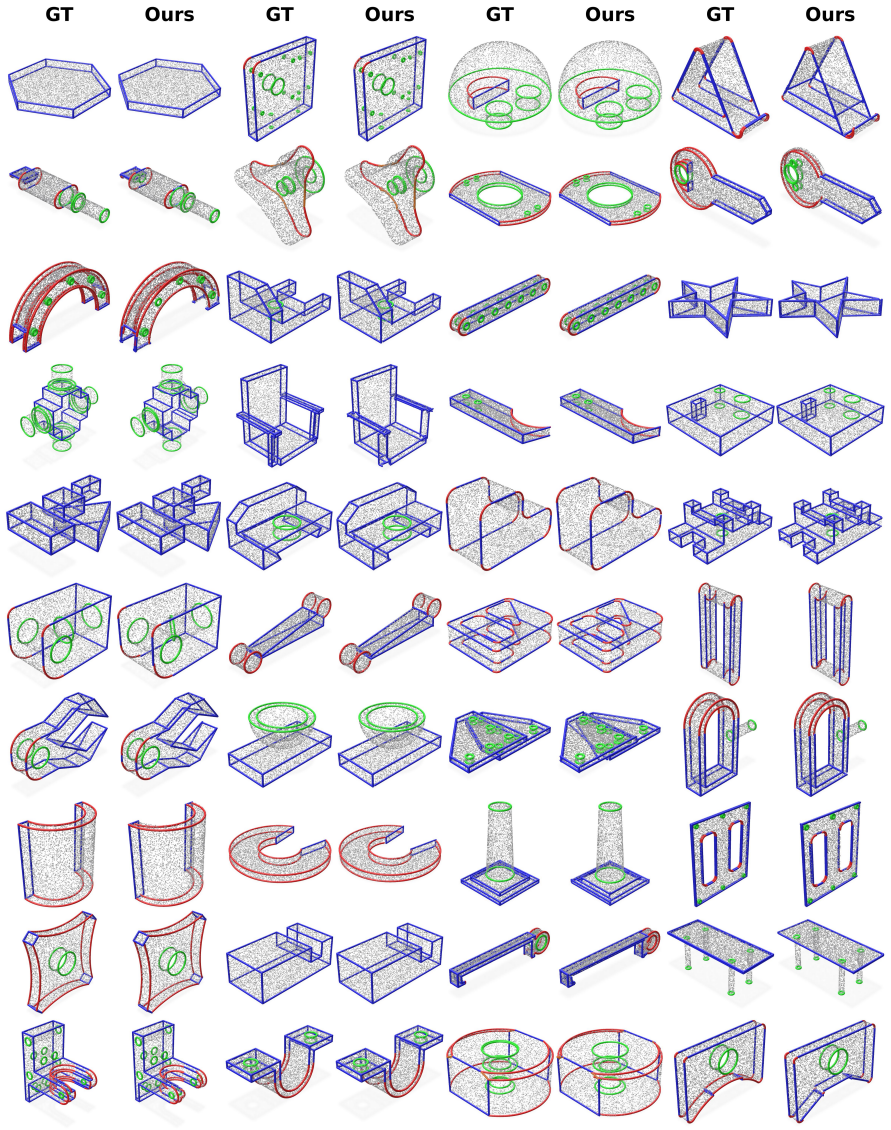
Figures from the paper (6 more)


Reference graph
Works this paper leans on
-
[1]
Deep learning using rectified linear units (relu)
Abien Fred Agarap. Deep learning using rectified linear units (relu). arXiv preprint arXiv:1803.08375, 2018. 5
arXiv 2018
-
[2]
Jimmy Lei Ba, Jamie Ryan Kiros, and Geoffrey E Hin- ton. Layer normalization. arXiv preprint arXiv:1607.06450,
-
[3]
End-to- end object detection with transformers
Nicolas Carion, Francisco Massa, Gabriel Synnaeve, Nicolas Usunier, Alexander Kirillov, and Sergey Zagoruyko. End-to- end object detection with transformers. In European confer- ence on computer vision, pages 213–229. Springer, 2020. 2, 3, 4, 5, 1
work page 2020
-
[4]
4d spatio-temporal convnets: Minkowski convolutional neural networks
Christopher Choy, JunYoung Gwak, and Silvio Savarese. 4d spatio-temporal convnets: Minkowski convolutional neural networks. In Proceedings of the IEEE/CVF conference on computer vision and pattern recognition, pages 3075–3084,
- [5]
-
[6]
Complexgen: Cad reconstruction by b-rep chain complex generation
Haoxiang Guo, Shilin Liu, Hao Pan, Yang Liu, Xin Tong, and Baining Guo. Complexgen: Cad reconstruction by b-rep chain complex generation. ACM Transactions on Graphics (TOG), 41(4):1–18, 2022. 2, 3
work page 2022
-
[7]
Polyroad: Polyline transformer for topological road-boundary detec- tion
Yuan Hu, Zhibin Wang, Zhou Huang, and Yu Liu. Polyroad: Polyline transformer for topological road-boundary detec- tion. IEEE Transactions on Geoscience and Remote Sensing, 62:1–12, 2024. 4, 1
work page 2024
-
[8]
Jean senel lart, and alexander rush
Guillaume Klein, Yoon Kim, and Yuntian Deng. Jean senel lart, and alexander rush. 2017. opennmt: Open source toolkit for neural machine translation. Proceedings of ACL 2017, System Demonstrations, pages 67–72, 2017. 3
work page 2017
Show all 25 references
-
[9]
Abc: A big cad model dataset for geometric deep learning
Sebastian Koch, Albert Matveev, Zhongshi Jiang, Francis Williams, Alexey Artemov, Evgeny Burnaev, Marc Alexa, Denis Zorin, and Daniele Panozzo. Abc: A big cad model dataset for geometric deep learning. In Proceedings of the IEEE/CVF conference on computer vision and pattern re...
2019
-
[10]
The hungarian method for the assignment problem
Harold W Kuhn. The hungarian method for the assignment problem. Naval research logistics quarterly , 2(1-2):83–97,
-
[11]
{PC}2wf: 3d wireframe reconstruction from raw point clouds
Yujia Liu, Stefano D’Aronco, Konrad Schindler, and Jan Dirk Wegner. {PC}2wf: 3d wireframe reconstruction from raw point clouds. In International Conference on Learning Representations, 2021. 2
2021
-
[12]
Decoupled weight de- cay regularization
Ilya Loshchilov and Frank Hutter. Decoupled weight de- cay regularization. In International Conference on Learning Representations, 2019. 5
2019
-
[13]
Def: Deep estimation of sharp geometric features in 3d shapes
Albert Matveev, Ruslan Rakhimov, Alexey Artemov, Gleb Bobrovskikh, Vage Egiazarian, Emil Bogomolov, Daniele Panozzo, Denis Zorin, and Evgeny Burnaev. Def: Deep estimation of sharp geometric features in 3d shapes. ACM Transactions on Graphics, 41(4), 2022. 2, 3, 4, 5, 6, 1
2022
-
[14]
An end-to- end transformer model for 3d object detection
Ishan Misra, Rohit Girdhar, and Armand Joulin. An end-to- end transformer model for 3d object detection. In Proceed- ings of the IEEE/CVF international conference on computer vision, pages 2906–2917, 2021. 1, 3, 4, 7
2021
-
[15]
Pytorch: An im- perative style, high-performance deep learning library
Adam Paszke, Sam Gross, Francisco Massa, Adam Lerer, James Bradbury, Gregory Chanan, Trevor Killeen, Zeming Lin, Natalia Gimelshein, Luca Antiga, et al. Pytorch: An im- perative style, high-performance deep learning library. Ad- vances in neural information processing systems ...
2019
-
[16]
Pointnet++: Deep hierarchical feature learning on point sets in a metric space
Charles Ruizhongtai Qi, Li Yi, Hao Su, and Leonidas J Guibas. Pointnet++: Deep hierarchical feature learning on point sets in a metric space. Advances in neural information processing systems, 30, 2017. 1, 2, 3, 5
2017
-
[17]
U- net: Convolutional networks for biomedical image segmen- tation
Olaf Ronneberger, Philipp Fischer, and Thomas Brox. U- net: Convolutional networks for biomedical image segmen- tation. In International Conference on Medical image com- puting and computer-assisted intervention , pages 234–241. Springer, 2015. 2
2015
-
[18]
Dropout: a simple way to prevent neural networks from overfitting
Nitish Srivastava, Geoffrey Hinton, Alex Krizhevsky, Ilya Sutskever, and Ruslan Salakhutdinov. Dropout: a simple way to prevent neural networks from overfitting. The journal of machine learning research, 15(1):1929–1958, 2014. 5
1929
-
[19]
Surface sampling for optimal viewpoint generation
Vanessa Staderini, Tobias Gl ¨uck, Philipp Schneider, Roberto Mecca, and Andreas Kugi. Surface sampling for optimal viewpoint generation. In IEEE 13th International Confer- ence on Pattern Recognition Systems, pages 1–7, 2023. 8
2023
-
[20]
Visual quality inspection planning: A model- based framework for generating optimal and feasible inspec- tion poses
Vanessa Staderini, Tobias Gl ¨uck, Philipp Schneider, and An- dreas Kugi. Visual quality inspection planning: A model- based framework for generating optimal and feasible inspec- tion poses. In IEEE International Conference on Intelligent Robots and Systems, pages 10799–10806, 2024. 8
2024
-
[21]
Attention is all you need
Ashish Vaswani, Noam Shazeer, Niki Parmar, Jakob Uszko- reit, Llion Jones, Aidan N Gomez, Łukasz Kaiser, and Illia Polosukhin. Attention is all you need. Advances in neural information processing systems, 30, 2017. 1, 3, 4, 5
2017
-
[22]
Point2primitive: Cad reconstruc- tion from point cloud by direct primitive prediction
Cheng Wang, Xinzhu Ma, Bin Wang, Shixiang Tang, Yuan Meng, and Ping Jiang. Point2primitive: Cad reconstruc- tion from point cloud by direct primitive prediction. arXiv preprint arXiv:2505.02043, 2025. 2, 3
2025
-
[23]
Pie-net: Parametric inference of point cloud edges
Xiaogang Wang, Yuelang Xu, Kai Xu, Andrea Tagliasac- chi, Bin Zhou, Ali Mahdavi-Amiri, and Hao Zhang. Pie-net: Parametric inference of point cloud edges. Advances in neu- ral information processing systems, 33:20167–20178, 2020. 2, 3, 6, 1
2020
-
[24]
Ec-net: an edge-aware point set consoli- dation network
Lequan Yu, Xianzhi Li, Chi-Wing Fu, Daniel Cohen-Or, and Pheng-Ann Heng. Ec-net: an edge-aware point set consoli- dation network. In Proceedings of the European conference on computer vision (ECCV), pages 386–402, 2018. 2
2018
-
[25]
Nerve: Neural volumetric edges for parametric curve extraction from point cloud
Xiangyu Zhu, Dong Du, Weikai Chen, Zhiyou Zhao, Yinyu Nie, and Xiaoguang Han. Nerve: Neural volumetric edges for parametric curve extraction from point cloud. In Pro- ceedings of the IEEE/CVF Conference on Computer Vision and Pattern Recognition, pages 13601–13610, 2023. 2, 3,...
2023
Reviewed August 15, 2026 · model on record in the stance chip above.
Discussion (0). Continue with ORCID to comment.