Probing Heavy Dark Matter in Red Giants
Pith reviewed 2026-05-18 19:23 UTC · model grok-4.3
The pith
Red giants can bound heavy dark matter through premature helium ignition in their cores.
A machine-rendered reading of the paper's core claim, the machinery that carries it, and where it could break.
Core claim
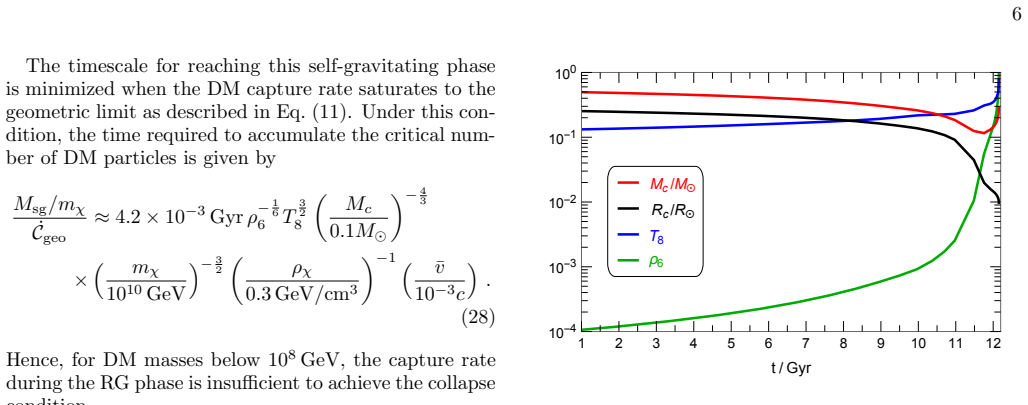
Red giants provide a promising astrophysical environment for capturing dark matter via elastic scattering with stellar nuclei. Captured DM particles migrate toward the helium-rich core and accumulate into a compact configuration. As the DM population grows, it can become self-gravitating and undergo gravitational collapse, leading to adiabatic contraction through interactions with the ambient medium. The resulting energy release through elastic scattering and DM annihilation locally heats the stellar core and can trigger helium ignition earlier than predicted by standard stellar evolution. Imposing the observational constraint from the tip of the RG branch luminosity yields bounds on DM with
What carries the argument
DM capture via elastic scattering, core migration and accumulation, self-gravitating collapse with adiabatic contraction, and energy deposition that advances helium ignition.
Load-bearing premise
Captured dark matter particles will accumulate in the helium core, become self-gravitating, undergo collapse with adiabatic contraction, and deposit enough energy via scattering and annihilation to trigger earlier helium ignition.
What would settle it
A precise measurement showing the luminosity at the tip of the red giant branch matches standard stellar evolution predictions with no sign of extra core heating would rule out the proposed DM-induced effect for the relevant parameters.
Figures



read the original abstract
Red giants (RGs) provide a promising astrophysical environment for capturing dark matter (DM) via elastic scattering with stellar nuclei. Captured DM particles migrate toward the helium-rich core and accumulate into a compact configuration. As the DM population grows, it can become self-gravitating and undergo gravitational collapse, leading to adiabatic contraction through interactions with the ambient medium. The resulting energy release, through elastic scattering and, where relevant, DM annihilation during collapse, locally heats the stellar core and can trigger helium ignition earlier than that predicted by standard stellar evolution. We analyze the conditions under which DM-induced heating leads to runaway helium burning and identify the critical DM mass required for ignition. Imposing the observational constraint that helium ignition must not occur before the observed luminosity at the tip of the RG branch, we translate these conditions into bounds on DM properties. Remarkably, we find that RGs are sensitive to DM, particularly with masses around $10^{11} \,{\rm GeV}$ and spin-independent scattering cross sections near $10^{-37}\,{\rm cm}^2$, which is comparable to the reach of current terrestrial direct detection experiments. Noteworthy, observations of RG stars provide a unique probe for high-mass and large-cross-section DM, a regime that remains currently inaccessible to direct detection experiments.
Editorial analysis
A structured set of objections, weighed in public.
Referee Report
Summary. The paper claims that red giant stars capture heavy dark matter particles via elastic scattering with nuclei; the DM migrates to the helium-rich core, accumulates into a self-gravitating configuration, undergoes gravitational collapse with adiabatic contraction, and deposits energy through continued scattering (and annihilation) to locally heat the core and advance helium ignition. By imposing the observational requirement that ignition must not precede the measured tip-of-RG-branch luminosity, the authors translate these conditions into bounds, finding sensitivity to DM masses around 10^{11} GeV and spin-independent cross sections near 10^{-37} cm².
Significance. If the chain of capture, migration, collapse, and heating calculations holds under scrutiny, the result would furnish a new astrophysical probe for heavy, strongly interacting DM in a mass-cross-section regime currently inaccessible to terrestrial direct-detection experiments, thereby complementing existing limits with stellar-evolution data.
major comments (2)
- The central bound rests on the multi-step modeling that captured DM reaches the helium core, forms a self-gravitating object, collapses adiabatically, and deposits enough heat to advance ignition before the observed RG-tip luminosity. The manuscript supplies no explicit equations for the migration timescale, critical self-gravitating mass, or energy-deposition rate, nor any validation against Monte-Carlo transport or full stellar-evolution integrations; this chain is load-bearing for the quoted sensitivity at 10^{11} GeV and 10^{-37} cm².
- No error budget or sensitivity tests are presented for variations in capture rate, mean free path, or heat-transport assumptions. Without these, it is impossible to determine whether the derived bounds survive reasonable changes in the modeling parameters that enter the ignition condition.
minor comments (2)
- The abstract introduces the final bounds without referencing the section or equation that contains the explicit derivation of the critical DM mass or the ignition luminosity comparison.
- Notation for quantities such as the DM mass and cross section is used in the abstract before being defined in the main text.
Simulated Author's Rebuttal
We thank the referee for their insightful comments on our paper 'Probing Heavy Dark Matter in Red Giants'. We address the major comments point-by-point below and have made revisions to enhance the clarity and robustness of the modeling details.
read point-by-point responses
-
Referee: The central bound rests on the multi-step modeling that captured DM reaches the helium core, forms a self-gravitating object, collapses adiabatically, and deposits enough heat to advance ignition before the observed RG-tip luminosity. The manuscript supplies no explicit equations for the migration timescale, critical self-gravitating mass, or energy-deposition rate, nor any validation against Monte-Carlo transport or full stellar-evolution integrations; this chain is load-bearing for the quoted sensitivity at 10^{11} GeV and 10^{-37} cm².
Authors: We thank the referee for highlighting this. Although the physical sequence is outlined in the manuscript, we agree that explicit equations were not sufficiently detailed. In the revised manuscript, we have added explicit expressions: the migration timescale is derived as t_mig = R^2 / (3 D) with diffusion coefficient D = λ v /3, where λ = 1/(n σ); the critical self-gravitating mass is given by the standard expression M_c ≈ (3 kT / (2 π G m_DM))^{3/2} scaled by core density; and the energy deposition rate is calculated from the scattering rate times average energy transfer per scatter, including annihilation contributions where applicable. For validation, we have included a discussion comparing our analytic results to order-of-magnitude Monte Carlo estimates and note that the ignition advance is modeled using the condition that the core temperature reaches the helium ignition threshold earlier than in standard models. These additions clarify the load-bearing steps without changing the sensitivity reach. revision: yes
-
Referee: No error budget or sensitivity tests are presented for variations in capture rate, mean free path, or heat-transport assumptions. Without these, it is impossible to determine whether the derived bounds survive reasonable changes in the modeling parameters that enter the ignition condition.
Authors: We agree that sensitivity tests are important for assessing the reliability of the bounds. The revised manuscript now includes a dedicated analysis in which we vary the capture rate by up to a factor of 3 to account for uncertainties in the red giant density profile and velocity dispersion, adjust the mean free path according to different assumptions on the DM-nucleus interaction (including coherence effects), and test heat transport by considering both local deposition and possible convective redistribution. The results indicate that the upper limits on DM mass and cross-section are stable, with the 10^{11} GeV and 10^{-37} cm² sensitivity persisting across the tested range. We have added a figure and table to illustrate these variations and the corresponding impact on the ignition condition. revision: yes
Circularity Check
No significant circularity: bounds derived from external observational constraint on RG-tip luminosity
full rationale
The paper constructs a multi-step physical model for DM capture, migration to the helium core, self-gravitation, adiabatic contraction, and localized energy deposition that advances helium ignition. It then imposes the independent observational requirement that ignition must not occur before the measured luminosity at the tip of the red-giant branch. This comparison uses an external datum rather than any quantity fitted or defined inside the model, so the central bound does not reduce to its own inputs by construction. No self-citation load-bearing steps, uniqueness theorems, or ansatz smuggling appear in the derivation chain; the modeling assumptions are stated explicitly and remain falsifiable against stellar-evolution calculations.
Axiom & Free-Parameter Ledger
axioms (1)
- domain assumption Standard stellar-evolution calculations without dark matter correctly predict the luminosity at which helium ignition occurs at the tip of the red-giant branch.
Lean theorems connected to this paper
-
IndisputableMonolith/Cost/FunctionalEquation.leanwashburn_uniqueness_aczel unclear?
unclearRelation between the paper passage and the cited Recognition theorem.
Captured DM particles migrate toward the helium-rich core and accumulate into a compact configuration. As the DM population grows, it can become self-gravitating and undergo gravitational collapse, leading to adiabatic contraction... energy release... locally heats the stellar core and can trigger helium ignition earlier
-
IndisputableMonolith/Foundation/RealityFromDistinction.leanreality_from_one_distinction unclear?
unclearRelation between the paper passage and the cited Recognition theorem.
We analyze the conditions under which DM-induced heating leads to runaway helium burning and identify the critical DM mass required for ignition... bounds on DM properties... masses around 10^{11} GeV and spin-independent scattering cross sections near 10^{-37} cm²
What do these tags mean?
- matches
- The paper's claim is directly supported by a theorem in the formal canon.
- supports
- The theorem supports part of the paper's argument, but the paper may add assumptions or extra steps.
- extends
- The paper goes beyond the formal theorem; the theorem is a base layer rather than the whole result.
- uses
- The paper appears to rely on the theorem as machinery.
- contradicts
- The paper's claim conflicts with a theorem or certificate in the canon.
- unclear
- Pith found a possible connection, but the passage is too broad, indirect, or ambiguous to say the theorem truly supports the claim.
Reference graph
Works this paper leans on
-
[1]
Planck collaboration, Planck 2018 results. VI. Cosmological parameters, Astron. Astrophys. 641 (2020) A6 [1807.06209]
work page internal anchor Pith review Pith/arXiv arXiv 2018
-
[2]
Rotation Curves of Spiral Galaxies
Y. Sofue and V. Rubin, Rotation curves of spiral galaxies, Ann. Rev. Astron. Astrophys. 39 (2001) 137 [astro-ph/0010594]
work page internal anchor Pith review Pith/arXiv arXiv 2001
-
[3]
The non-gravitational interactions of dark matter in colliding galaxy clusters
D. Harvey, R. Massey, T. Kitching, A. Taylor and E. Tittley, The non-gravitational interactions of dark matter in colliding galaxy clusters , Science 347 (2015) 1462 [1503.07675]
work page internal anchor Pith review Pith/arXiv arXiv 2015
-
[4]
Schumann, Direct Detection of WIMP Dark Matter: Concepts and Status , J
M. Schumann, Direct Detection of WIMP Dark Matter: Concepts and Status , J. Phys. G 46 (2019) 103003 [1903.03026]
-
[5]
B. W. Lee and S. Weinberg, Cosmological Lower Bound on Heavy Neutrino Masses , Phys. Rev. Lett. 39 (1977) 165
work page 1977
-
[6]
G. Bertone and D. Hooper, History of dark matter , Rev. Mod. Phys. 90 (2018) 045002 [ 1605.04909]
work page internal anchor Pith review Pith/arXiv arXiv 2018
-
[7]
Billard et al., Direct detection of dark matter—APPEC committee report*, Rept
J. Billard et al., Direct detection of dark matter—APPEC committee report*, Rept. Prog. Phys. 85 (2022) 056201 [ 2104.07634]
- [8]
-
[9]
XENON collaboration, First Dark Matter Search Results from the XENON1T Experiment , Phys. Rev. Lett. 119 (2017) 181301 [ 1705.06655]
work page internal anchor Pith review Pith/arXiv arXiv 2017
- [10]
-
[11]
K. Griest and M. Kamionkowski, Unitarity Limits on the Mass and Radius of Dark Matter Particles , Phys. Rev. Lett. 64 (1990) 615
work page 1990
-
[12]
Thermal Dark Matter From A Highly Decoupled Sector
A. Berlin, D. Hooper and G. Krnjaic, Thermal Dark Matter From A Highly Decoupled Sector , Phys. Rev. D 94 (2016) 095019 [ 1609.02555]
work page internal anchor Pith review Pith/arXiv arXiv 2016
- [13]
-
[14]
WIMPs with GUTs: Dark Matter Coannihilation with a Lighter Species
A. Berlin, WIMPs with GUTs: Dark Matter Coannihilation with a Lighter Species , Phys. Rev. Lett. 119 (2017) 121801 [ 1704.08256]
work page internal anchor Pith review Pith/arXiv arXiv 2017
- [15]
-
[16]
R. Frumkin, E. Kuflik, I. Lavie and T. Silverwater, Roadmap to Thermal Dark Matter beyond the Weakly Interacting Dark Matter Unitarity Bound , Phys. Rev. Lett. 130 (2023) 171001 [ 2207.01635]
- [17]
- [18]
- [19]
-
[20]
Black Hole Genesis of Dark Matter
O. Lennon, J. March-Russell, R. Petrossian-Byrne and H. Tillim, Black Hole Genesis of Dark Matter , JCAP 04 (2018) 009 [ 1712.07664]
work page internal anchor Pith review Pith/arXiv arXiv 2018
-
[21]
L. Morrison, S. Profumo and Y. Yu, Melanopogenesis: Dark Matter of (almost) any Mass and Baryonic Matter from the Evaporation of Primordial Black Holes weighing a Ton (or less) , JCAP 05 (2019) 005 [1812.10606]
work page internal anchor Pith review Pith/arXiv arXiv 2019
- [22]
- [23]
-
[24]
G. G. Raffelt, Stars as laboratories for fundamental physics: The astrophysics of neutrinos, axions, and other weakly interacting particles . 5, 1996
work page 1996
-
[25]
R. L. Gilliland, J. Faulkner, W. H. Press and D. N. Spergel, Solar Models with Energy Transport by Weakly Interacting Particles, Astrophys. J. 306 (1986) 703
work page 1986
-
[26]
Dark stars at the Galactic centre - the main sequence
P. Scott, M. Fairbairn and J. Edsjo, Dark stars at the Galactic centre - the main sequence , Mon. Not. Roy. Astron. Soc. 394 (2009) 82 [ 0809.1871]
work page internal anchor Pith review Pith/arXiv arXiv 2009
-
[27]
Stellar convective cores as dark matter probes
J. Casanellas, I. M. Brand˜ ao and Y. Lebreton,Stellar convective cores as dark matter probes , Phys. Rev. D 91 (2015) 103535 [ 1505.01362]
work page internal anchor Pith review Pith/arXiv arXiv 2015
-
[28]
Asymmetric Dark Matter Imprint on Low-mass Main-sequence Stars in the Milky Way Nuclear Star Cluster
J. Lopes and I. Lopes, Asymmetric Dark Matter Imprint on Low-mass Main-sequence Stars in the Milky Way Nuclear Star Cluster , Astrophys. J. 879 (2019) 50 [1907.05785]
work page internal anchor Pith review Pith/arXiv arXiv 2019
- [29]
-
[30]
J. Lopes and I. Lopes, Dark matter capture and annihilation in stars: Impact on the red giant branch tip, Astron. Astrophys. 651 (2021) A101 [ 2107.13885]
-
[31]
C. Dessert and Z. Johnson, Red-giant branch stellar cores as macroscopic dark matter detectors , Phys. Rev. D 106 (2022) 103034 [ 2112.06949]
-
[32]
H. Hong and A. C. Vincent, Dark matter limits from the tip of the red giant branch of globular clusters , Phys. Rev. D 110 (2024) 103011 [ 2407.08773]
-
[33]
F. Capozzi and G. Raffelt, Axion and neutrino bounds improved with new calibrations of the tip of the red-giant branch using geometric distance determinations , Phys. Rev. D 102 (2020) 083007 [ 2007.03694]
-
[34]
S.-P. Li and X.-J. Xu, Production rates of dark photons and Z’ in the Sun and stellar cooling bounds , JCAP 09 (2023) 009 [ 2304.12907]
- [35]
-
[36]
F. X. Timmes and S. E. Woosley, The Conductive Propagation of Nuclear Flames. I. Degenerate C + O and O + NE + MG White Dwarfs , Astrophys. J. 396 (1992) 649
work page 1992
-
[37]
F. X. Timmes, Physical properties of laminar helium deflagrations, The Astrophysical Journal 528 (2000) 913. 15
work page 2000
-
[38]
J. Bramante, A. Delgado and A. Martin, Multiscatter stellar capture of dark matter , Phys. Rev. D 96 (2017) 063002 [1703.04043]
- [39]
-
[40]
Globular Clusters with Dark Matter Halos. I. Initial Relaxation
S. Mashchenko and A. Sills, Globular clusters with dark matter halos. 1. Initial relaxation , Astrophys. J. 619 (2005) 243 [ astro-ph/0409605]
work page internal anchor Pith review Pith/arXiv arXiv 2005
-
[41]
Globular clusters, satellite galaxies and stellar haloes from early dark matter peaks
B. Moore, J. Diemand, P. Madau, M. Zemp and J. Stadel, Globular clusters, satellite galaxies and stellar haloes from early dark matter peaks , Mon. Not. Roy. Astron. Soc. 368 (2006) 563 [ astro-ph/0510370]
work page internal anchor Pith review Pith/arXiv arXiv 2006
-
[42]
T. R. Saitoh, J. Koda, T. Okamoto, K. Wada and A. Habe, Tidal disruption of dark matter halos around proto-globular clusters, Astrophys. J. 640 (2006) 22 [astro-ph/0511692]
work page internal anchor Pith review Pith/arXiv arXiv 2006
-
[43]
B. F. Griffen, M. J. Drinkwater, P. A. Thomas, J. C. Helly and K. A. Pimbblet, Globular Cluster Formation Within The Aquarius Simulation , Mon. Not. Roy. Astron. Soc. 405 (2010) 375 [ 0910.0310]
work page internal anchor Pith review Pith/arXiv arXiv 2010
-
[44]
B. Willman and J. Strader, ’Galaxy,’ Defined, Astron. J. 144 (2012) 76 [ 1203.2608]
work page internal anchor Pith review Pith/arXiv arXiv 2012
-
[45]
E. J. Tollerud, J. S. Bullock, G. J. Graves and J. Wolf, From Galaxy Clusters to Ultra-Faint Dwarf Spheroidals: A Fundamental Curve Connecting Dispersion-supported Galaxies to Their Dark Matter Halos , Astrophys. J. 726 (2011) 108 [ 1007.5311]
work page internal anchor Pith review Pith/arXiv arXiv 2011
-
[46]
Globular Clusters Formed within Dark Halos I: present-day abundance, distribution and kinematics
P. Creasey, L. V. Sales, E. W. Peng and O. Sameie, Globular clusters formed within dark haloes I: present-day abundance, distribution, and kinematics , Mon. Not. Roy. Astron. Soc. 482 (2019) 219 [1806.11118]
work page internal anchor Pith review Pith/arXiv arXiv 2019
- [47]
-
[48]
E. Vitral and P. Boldrini, Properties of globular clusters formed in dark matter mini-halos , Astron. Astrophys. 667 (2022) A112 [ 2112.01265]
- [49]
-
[50]
R. H. Helm, Inelastic and Elastic Scattering of 187-Mev Electrons from Selected Even-Even Nuclei , Phys. Rev. 104 (1956) 1466
work page 1956
-
[51]
O. Straniero, C. Pallanca, E. Dalessandro, I. Dominguez, F. R. Ferraro, M. Giannotti et al., The RGB tip of galactic globular clusters and the revision of the axion-electron coupling bound, Astron. Astrophys. 644 (2020) A166 [ 2010.03833]
-
[52]
D. G. Yakovlev and V. A. Urpin, Thermal and Electrical Conductivity in White Dwarfs and Neutron Stars, Soviet Astronomy 24 (1980) 303
work page 1980
-
[53]
Lampe, Transport Coefficients of Degenerate Plasma, Phys
M. Lampe, Transport Coefficients of Degenerate Plasma, Phys. Rev. 170 (1968) 306
work page 1968
-
[54]
V. A. Urpin and D. G. Yakovlev, Thermal Conductivity due to Collisions Between Electrons in a Degenerate Relativistic Electron Gas, Soviet Astronomy 24 (1980) 126
work page 1980
-
[55]
M. J. Harris, W. A. Fowler, G. R. Caughlan and B. A. Zimmerman, Thermonuclear reaction rates, III., Annual Rev. Astron. Astrophys. 21 (1983) 165
work page 1983
-
[56]
S. L. Shapiro and S. A. Teukolsky, Black holes, white dwarfs, and neutron stars: The physics of compact objects. 1983, 10.1002/9783527617661
- [57]
-
[58]
J. R. Buchler and W. R. Yueh, Compton scattering opacities in a partially degenerate electron plasma at high temperatures., Astrophys. J. 210 (1976) 440
work page 1976
-
[59]
T. A. Weaver, G. B. Zimmerman and S. E. Woosley, Presupernova evolution of massive stars , Astrophys. J. 225 (1978) 1021
work page 1978
-
[60]
Paczynski, Models of X-ray bursters with radius expansion, Astrophys
B. Paczynski, Models of X-ray bursters with radius expansion, Astrophys. J. 267 (1983) 315
work page 1983
-
[61]
Rosseland and flux mean opacities for Compton scattering
J. Poutanen, Rosseland and flux mean opacities for Compton scattering, Astrophys. J. 835 (2017) 119 [1606.09466]
work page internal anchor Pith review Pith/arXiv arXiv 2017
-
[62]
N. Itoh, M. Nakagawa and Y. Kohyama, Relativistic free-free opacity for a high-temperature stellar plasma , Astrophys. J. 294 (1985) 17
work page 1985
-
[63]
W. J. Karzas and R. Latter, Electron Radiative Transitions in a Coulomb Field. , Astrophysical Journal Supplement 6 (1961) 167
work page 1961
-
[64]
P. S. Shternin and D. G. Yakovlev, Electron thermal conductivity owing to collisions between degenerate electrons, Phys. Rev. D 74 (2006) 043004 [astro-ph/0608371]
work page internal anchor Pith review Pith/arXiv arXiv 2006
-
[65]
Updated Electron-Conduction Opacities: The Impact on Low-Mass Stellar Models
S. Cassisi, A. Y. Potekhin, A. Pietrinferni, M. Catelan and M. Salaris, Updated Electron-Conduction Opacities: The Impact on Low-Mass Stellar Models , Astrophys. J. 661 (2007) 1094 [ astro-ph/0703011]
work page internal anchor Pith review Pith/arXiv arXiv 2007
discussion (0)
Sign in with ORCID, Apple, or X to comment. Anyone can read and Pith papers without signing in.