REVIEW 2 major objections 6 minor 68 references
Reading Between the Signs: Predicting Future Suicidal Ideation from Adolescent Social Media Texts
T0 review · 2 major / 6 minor · reviewed 2026-08-15 · deepseek-v4-flash
Pith's one-line read Model predicts teen suicidal ideation from pre-crisis forum posts
desk verdict Novel task framing and clean experiments, but the 0.73 balanced accuracy is computed against the authors' own detector's labels, so the real-world claim is weaker than it looks. read the letter →
The pith
A machine-rendered reading of the paper's core claim, the machinery that carries it, and where it could break.
The reading
What carries the argument
The central object is EARLY-SIB, a two-stream transformer architecture for whole-history sequence classification. One stream passes each prior interaction (title plus body for posts, body for replies) through BERTje and collects the CLS vectors; a bidirectional LSTM then processes these vectors in order, followed by an attention layer and mean pooling. The second stream concatenates all of a user's titles and tags into one string, encodes it with a second BERTje, and uses the CLS vector; the two streams are combined in a fully connected layer that outputs the future-SIB probability. The architecture matters because more than half of user histories exceed the input limits of standard BERT models, while truncating to the most recent posts hurts performance; a 30-interaction window covers over 90% of users, and the title-and-tag stream carries a large share of the signal.
What would settle it
Re-run the user-level prediction with expert-annotated user labels on a held-out set of the same forum, and compare balanced accuracy with the 0.73 obtained from model-inferred labels; a large drop would show the reported signal is partly an artifact of the detection model. Alternatively, stratify the detection model's false negatives and check whether the early-prediction signal is concentrated in users whose SIB posts the detector got wrong.
Extended reading notes
Core claim
The central claim is that future suicidal disclosure is already legible in a user's pre-disclosure language, and a sequence model can read it. EARLY-SIB encodes each prior interaction with a Dutch BERT model, BERTje, runs the resulting per-interaction representations through a bidirectional LSTM with attention, and fuses them with a second BERT stream over the user's post titles and tags before classifying the user as future-SIB or not. On the Kindertelefoon forum it reaches balanced accuracy 0.73 ± 0.02 with recall 0.71 ± 0.07, outperforming the earlier architecture it adapts (0.67 ± 0.04) and clearly beating zero-shot language-model baselines. SHAP analysis indicates the model spreads its attention across many interactions, and the most influential interaction typically occurs within ten days of the first SIB post.
Load-bearing premise
The result rests on trusting the machine-generated labels that decide which users count as having future suicidal ideation; if the detection model systematically misses or invents SIB posts, the reported balanced accuracy is not measuring real suicidal ideation, a limitation the authors acknowledge.
Editorial extensions
If this is right
- If the balanced accuracy transfers to other platforms, moderators of youth forums could be alerted to at-risk users based only on pre-disclosure posts, potentially reaching adolescents who never seek clinical care.
- Precision is only about 0.10 on the highly imbalanced data, so most flagged users would be false positives under this model alone; any deployed system would need human review and a clear privacy and stigma protocol.
- The model's dependence on titles and tags means self-chosen metadata is a substantial part of the early risk signal, not just the body text.
- Because the model receives no SIB content at input, the task directly tests whether warning signs are distributed across ordinary interactions rather than concentrated in a single explicit post.
Reading between the lines
- A natural test is to rebuild the user-level labels with expert annotation or clinical records; if balanced accuracy drops far below 0.73, the reported performance is partly an artifact of the detection model's own errors rather than a true early-warning signal.
- The SHAP result that risk is spread across many interactions suggests lightweight keyword or single-post screeners will underperform sequence models like EARLY-SIB, a concrete architectural constraint for any future deployment.
- The same pre-disclosure framing could be applied to other delayed disclosures, such as self-harm, eating disorders, or substance use, where ordinary online activity may precede the first explicit admission.
- Since the most predictive interactions cluster in the days just before first SIB disclosure, the practical utility of the approach depends on fast, near-real-time processing; a latency-aware deployment study would test whether the lead time is actionable.
Signed reviews
Editorial analysis
A structured set of objections, weighed in public.
Referee Report
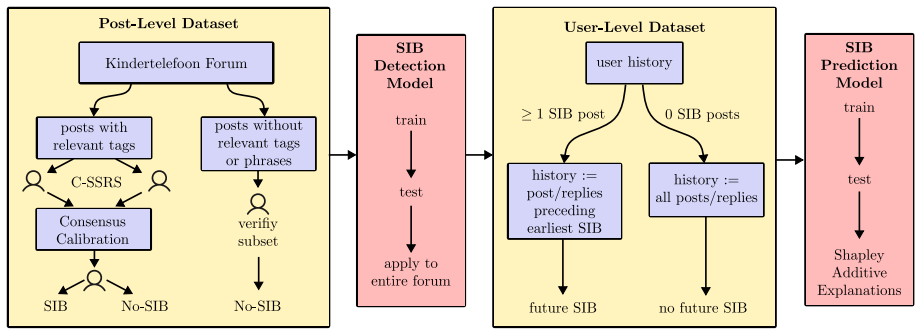
Summary. This paper introduces Early-SIB, a transformer-based model to predict whether a user on a Dutch adolescent forum (Kindertelefoon) will write a post containing suicidal ideation or behavior (SIB), using only the user's preceding posts and replies that do not contain SIB. The authors create a post-level annotated dataset (569 SIB, 1,438 No-SIB posts), train a LLaMA-3-8B sequence classifier to detect SIB posts, apply it to the entire forum to pseudo-label users, and then train Early-SIB on the user-level pseudo-labels. They report a balanced accuracy of 0.73 for early prediction, alongside ablation studies and SHAP-based explanations. The paper frames the work as moving suicide prediction earlier than prior methods, which typically rely on explicit disclosure.
Significance. The task and framing are novel, and the engineering is careful: the authors provide code, a restricted-access dataset, a well-designed post-level annotation protocol with high inter-annotator agreement, and a thorough ablation study. The ethical discussion is thoughtful and the deployment concerns (precision vs. intervention) are addressed explicitly. However, the central evaluation is undermined by the fact that the user-level labels are generated by the authors' own post-level detector and no independent validation is provided. If the label-noise issue is resolved, the approach would be a meaningful step toward early detection of suicidal ideation in social media. As it stands, the reported 0.73 balanced accuracy remains an internal assessment of predicting the detector's output, rather than a verified prediction of future SIB.
major comments (2)
- [Section 3.2 / Figure 3] The user-level target is defined by the authors' own fine-tuned LLaMA-3-8B post-level classifier, which is applied to all forum posts. This creates a self-referential evaluation: the EARLY-SIB model is trained and assessed against labels produced by a sibling model. The post-level confusion matrix (Figure 3, left) shows a false positive rate of 0.03 (row-normalized for actual No-SIB posts). With a low base rate of SIB users (284/7,540 = 3.8%), this per-post FPR implies that a substantial number of users labeled SIB are false positives; for a user with the median 3 pre-SIB posts, the probability of at least one false-positive post label is 1 - (0.97)^3 ≈ 0.087. Moreover, false negatives leave true SIB posts in the input history, violating the paper's central no-self-disclosure assumption. The Limitations section acknowledges that labels were inferred, but it does not quantify the label noise or bound its effect on the 0.73 balanced accuracy, which is a load-bearing claim. I recommend adding an independent user-level validation set (e.g., a random sample of users manually labeled for SIB disclosure) or a sensitivity analysis that simulates plausible label noise.
- [Section 5.1 / Table 1] The post-level detection model's F1 is reported on a test set with 28% SIB prevalence, which is very different from the full-forum distribution. The paper does not report precision and recall of the detection model under the actual base rate, nor does it evaluate the user-level labels against any ground truth. Because the early-prediction model is trained and evaluated on the same pseudo-labels, the 0.73 balanced accuracy may reflect the detector's systematic biases (e.g., over-flagging certain topics) rather than the true signal of future SIB. The authors should either (a) construct a human-annotated user-level test set, or (b) provide a detailed analysis of the detector's performance on a random sample of the full forum, including the user-level false positive and false negative rates. Without this, the central claim is not supported.
minor comments (6)
- [Table 3] The rows are all labeled 'BTL' with only numeric values, so it is unclear which components are included or removed in each ablation. Please use checkmarks or explicit labels (e.g., 'No LSTM') for each row.
- [Abstract] The phrase 'meaningful addition to traditional methods' is stronger than the evidence supports, given the very low precision (0.10) at the reported operating point in Table 2. Consider tempering the claim or adding an explicit discussion of the precision/base-rate trade-off.
- [Section 3.1] 'C-SRSS' is a typo for 'C-SSRS'.
- [References] The reference for Hadzic et al. in Section 2.3 appears corrupted in the reference list; please fix the author names and formatting.
- [Figure 3] The confusion matrices are row-normalized; presenting also column-normalized values or absolute counts would help assess the effects of class imbalance.
- [Section 6.1] The paper states 'weighted F1-score' without defining the weighting; please specify whether it is macro, micro, or support-weighted.
Circularity Check
No significant circularity: the label-inference limitation is a measurement-validity concern, not a derivation loop.
full rationale
The paper's derivation chain is not circular. Post-level SIB labels come from human annotation following C-SSRS (Section 3.1); a detection model is trained on those labels and then applied to the full forum to produce user-level labels (Section 3.2). EARLY-SIB receives only raw preceding interactions and is trained and evaluated against those user-level labels. No parameter fitted in the detection stage is reused as an input or as the output of the early-prediction model, and the reported balanced accuracy of 0.73 is an empirical result, not a quantity forced by construction. The limitation that user-level labels were inferred by the detection model is a measurement-validity concern (systematic detector errors could mean the system predicts detector output rather than true SIB), and the paper explicitly discloses it: 'user-level labels were inferred using our detection model, and while it has excellent performance, some users will have been misclassified.' This does not make the prediction equivalent to its inputs by definition. The paper also contains no load-bearing self-citations and no imported uniqueness or ansatz from the authors' own prior work. Therefore no circular step can be exhibited. The appropriate verdict is no significant circularity.
Assumptions & free parameters
free parameters (3)
- Class resampling ratio =
0.5 (1:1 majority:minority)
- Context window N =
30
- Classification threshold =
0.5 (default)
assumptions (4)
- domain assumption The detection model's labels for user-level SIB are accurate enough to serve as ground truth
- domain assumption Non-SIB interactions from a user's history contain detectable signals of future SIB
- domain assumption Users who never write an SIB post (according to the detection model) are truly negative
- domain assumption Representation learning from BERTje and LLaMA is suitable for adolescent mental-health language
Cite this review
Pith. "Pith review of Reading Between the Signs: Predicting Future Suicidal Ideation from Adolescent Social Media Texts." pith.science (2026). https://pith.science/paper/FYHS5SAM
@misc{pith2026250903530,
  author       = {Pith},
  title        = {Pith review of: Reading Between the Signs: Predicting Future Suicidal Ideation from Adolescent Social Media Texts},
  year         = {2026},
  howpublished = {\url{https://pith.science/paper/FYHS5SAM}},
  note         = {Machine review of arXiv:2509.03530}
}
read the original abstract
Suicide is a leading cause of death, yet predicting it remains a significant challenge. Risk factors such as depression or substance use are commonly used for prediction, but their predictive performance is often only slightly better than chance. Additionally, many cases go undetected due to a lack of contact with mental health services. Social media, however, offers a unique opportunity, as people often share their thoughts and struggles online in real time. In this work, we propose a novel task and method for early identification: predicting suicidal ideation and behavior (SIB) before a user ever expresses it on an online forum. We introduce Early-SIB, a transformer-based model that sequentially processes the posts a user writes and engages with to predict whether they will write a SIB post. Our model achieves a balanced accuracy of 0.73 in predicting future SIB on a Dutch youth forum, demonstrating that such tools can offer a meaningful addition to traditional methods. Finally, we use Shapley Additive Explanations to make the model's predictions more interpretable.
Figures


Figures from the paper (4 more)


Reference graph
Works this paper leans on
-
[1]
online" 'onlinestring :=
ENTRY address archivePrefix author booktitle chapter edition editor eid eprint eprinttype howpublished institution journal key month note number organization pages publisher school series title type volume year doi pubmed url lastchecked label extra.label sort.label short.list INTEGERS output.state before.all mid.sentence after.sentence after.block STRING...
-
[2]
write newline
" write newline "" before.all 'output.state := FUNCTION n.dashify 't := "" t empty not t #1 #1 substring "-" = t #1 #2 substring "--" = not "--" * t #2 global.max substring 't := t #1 #1 substring "-" = "-" * t #2 global.max substring 't := while if t #1 #1 substring * t #2 global.max substring 't := if while FUNCTION word.in bbl.in capitalize " " * FUNCT...
-
[3]
Falwah Alhamed, Julia Ive, and Lucia Specia. 2024. https://aclanthology.org/2024.clpsych-1.22/ Using Large Language Models ( LLMs ) to Extract Evidence from Pre - Annotated Social Media Data . In Proceedings of the 9th Workshop on Computational Linguistics and Clinical Psychology ( CLPsych 2024) , pages 232--237, St. Julians, Malta. Association for Comput...
work page 2024
-
[4]
American Association of Suicidology . 2023. https://suicidology.org/know-the-signs-how-to-tell-if-someone-might-be-suicidal/ Know the Signs : How To Tell if Someone Might Be Suicidal
work page 2023
-
[5]
American Foundation for Suicide Prevention . 2025. https://afsp.org/risk-factors-protective-factors-and-warning-signs/ Risk factors, protective factors, and warning signs
work page 2025
-
[6]
Erin Belfort, Enrico Mezzacappa, and Katherine Ginnis. 2012. https://doi.org/10.2174/2210676611202030258 Similarities and Differences Among Adolescents Who Communicate Suicidality to Others via Electronic Versus other Means : A Pilot Study . Adolescent Psychiatrye, 2:258--262
-
[7]
Amir Bialer, Daniel Izmaylov, Avi Segal, Oren Tsur, Yossi Levi-Belz, and Kobi Gal. 2022. https://aclanthology.org/2022.coling-1.372/ Detecting Suicide Risk in Online Counseling Services : A Study in a Low - Resource Language . In Proceedings of the 29th International Conference on Computational Linguistics , pages 4241--4250, Gyeongju, Republic of Korea. ...
work page 2022
-
[8]
André Bittar, Sumithra Velupillai, Angus Roberts, and Rina Dutta. 2019. https://doi.org/10.3233/SHTI190179 Text Classification to Inform Suicide Risk Assessment in Electronic Health Records . In MEDINFO 2019: Health and Wellbeing e- Networks for All , pages 40--44. IOS Press
Show all 68 references
-
[9]
Meghan Broadbent, Mattia Medina Grespan, Katherine Axford, Xinyao Zhang, Vivek Srikumar, Brent Kious, and Zac Imel. 2023. https://doi.org/10.3389/fpsyt.2023.1110527 A machine learning approach to identifying suicide risk among text-based crisis counseling encounters . Frontier...
2023
-
[10]
Lei Cao, Huijun Zhang, Ling Feng, Zihan Wei, Xin Wang, Ningyun Li, and Xiaohao He. 2019. https://doi.org/10.18653/v1/D19-1181 Latent Suicide Risk Detection on Microblog via Suicide - Oriented Word Embeddings and Layered Attention . In Proceedings of the 2019 Conference on Empi...
2019 doi
-
[11]
Carson, Brian Mullin, Maria Jose Sanchez, Frederick Lu, Kelly Yang, Michelle Menezes, and Benjamin Lê Cook
Nicholas J. Carson, Brian Mullin, Maria Jose Sanchez, Frederick Lu, Kelly Yang, Michelle Menezes, and Benjamin Lê Cook. 2019. https://doi.org/10.1371/journal.pone.0211116 Identification of suicidal behavior among psychiatrically hospitalized adolescents using natural language ...
2019 doi
-
[12]
Brown, Myfanwy Maple, Michael Singleton, Judy van de Venne, Melinda Moore, and Chris Flaherty
Julie Cerel, Margaret M. Brown, Myfanwy Maple, Michael Singleton, Judy van de Venne, Melinda Moore, and Chris Flaherty. 2019. https://doi.org/10.1111/sltb.12450 How Many People Are Exposed to Suicide ? Not Six . Suicide & Life-Threatening Behavior, 49(2):529--534
2019 doi
-
[13]
Lingfei Cheng, Weijie Song, Yanli Zhao, Hongxin Zhang, Jian Wang, Jingyu Lin, and Jingxu Chen. 2025. https://doi.org/10.1186/s12888-024-06421-8 Relevant factors contributing to risk of suicide among adolescents . BMC Psychiatry, 25(1):1--9. Number: 1 Publisher: BioMed Central
2025 doi
-
[14]
Jenny Chim, Adam Tsakalidis, Dimitris Gkoumas, Dana Atzil-Slonim, Yaakov Ophir, Ayah Zirikly, Philip Resnik, and Maria Liakata. 2024. https://aclanthology.org/2024.clpsych-1.15/ Overview of the CLPsych 2024 Shared Task : Leveraging Large Language Models to Identify Evidence of...
2024
- [15]
-
[16]
Glen Coppersmith, Ryan Leary, Patrick Crutchley, and Alex Fine. 2018. https://doi.org/10.1177/1178222618792860 Natural Language Processing of Social Media as Screening for Suicide Risk . Biomedical Informatics Insights, 10:1178222618792860. Publisher: SAGE Publications Ltd STM
2018 doi
-
[17]
Franklin, Jessica D
Joseph C. Franklin, Jessica D. Ribeiro, Kathryn R. Fox, Kate H. Bentley, Evan M. Kleiman, Xieyining Huang, Katherine M. Musacchio, Adam C. Jaroszewski, Bernard P. Chang, and Matthew K. Nock. 2017. https://doi.org/10.1037/bul0000084 Risk factors for suicidal thoughts and behavi...
2017 doi
-
[18]
Avi Gamoran, Yonatan Kaplan, Almog Simchon, and Michael Gilead. 2021. https://doi.org/10.18653/v1/2021.clpsych-1.12 Using Psychologically - Informed Priors for Suicide Prediction in the CLPsych 2021 Shared Task . In Proceedings of the Seventh Workshop on Computational Linguist...
2021 doi
-
[19]
Manas Gaur, Amanuel Alambo, Joy Prakash Sain, Ugur Kursuncu, Krishnaprasad Thirunarayan, Ramakanth Kavuluru, Amit Sheth, Randy Welton, and Jyotishman Pathak. 2019. https://doi.org/10.1145/3308558.3313698 Knowledge-aware Assessment of Severity of Suicide Risk for Early Interven...
2019
-
[20]
Sujatha Das Gollapalli, Guilherme Augusto Zagatti, and See-Kiong Ng. 2021. https://doi.org/10.18653/v1/2021.clpsych-1.10 Suicide Risk Prediction by Tracking Self - Harm Aspects in Tweets : NUS - IDS at the CLPsych 2021 Shared Task . In Proceedings of the Seventh Workshop on Co...
2021 doi
-
[21]
Middleton
Loitongbam Gyanendro Singh, Junyu Mao, Rudra Mutalik, and Stuart E. Middleton. 2024. https://aclanthology.org/2024.clpsych-1.20/ Extracting and Summarizing Evidence of Suicidal Ideation in Social Media Contents Using Large Language Models . In Proceedings of the 9th Workshop o...
2024
-
[22]
Bakir Hadzic, Mohammed , Parvez, Danner , Michael, Ohse , Julia, Zhang , Yihong, Shiban , Youssef, , and Matthias Rätsch. 2024. https://doi.org/10.1080/18824889.2024.2342624 Enhancing early depression detection with AI : a comparative use of NLP models . SICE Journal of Contro...
2024
-
[23]
Max Hamilton. 1960. https://doi.org/10.1136/jnnp.23.1.56 A RATING SCALE FOR DEPRESSION . Journal of Neurology, Neurosurgery, and Psychiatry, 23(1):56--62
1960 doi
-
[24]
Rezaul Haque, Naimul Islam, Maidul Islam, and Md Manjurul Ahsan. 2022. https://doi.org/10.3390/technologies10030057 A Comparative Analysis on Suicidal Ideation Detection Using NLP , Machine , and Deep Learning . Technologies, 10(3):57. Number: 3 Publisher: Multidisciplinary Di...
2022 doi
-
[25]
David Klonsky, Alexis M
E. David Klonsky, Alexis M. May, and Boaz Y. Saffer. 2016. https://doi.org/10.1146/annurev-clinpsy-021815-093204 Suicide, Suicide Attempts , and Suicidal Ideation . Annual Review of Clinical Psychology, 12:307--330
2016 doi
-
[26]
L Koushik, M Vishruth, and M Anand Kumar. 2024. https://aclanthology.org/2024.clpsych-1.21/ Detecting Suicide Risk Patterns using Hierarchical Attention Networks with Large Language Models . In Proceedings of the 9th Workshop on Computational Linguistics and Clinical Psycholog...
2024
-
[27]
Linehan, Judith L
Marsha M. Linehan, Judith L. Goodstein, Stevan L. Nielsen, and John A. Chiles. 1983. https://doi.org/10.1037/0022-006X.51.2.276 Reasons for staying alive when you are thinking of killing yourself: The Reasons for Living Inventory . Journal of Consulting and Clinical Psychology...
1983 doi
-
[28]
Lundberg and Su-In Lee
Scott M. Lundberg and Su-In Lee. 2017. A unified approach to interpreting model predictions. In Proceedings of the 31st International Conference on Neural Information Processing Systems , NIPS '17, pages 4768--4777, Red Hook, NY, USA. Curran Associates Inc
2017
-
[29]
Pilar López-Úbeda, Flor Miriam Plaza-del Arco, Manuel Carlos Díaz-Galiano, and Maria-Teresa Martín-Valdivia. 2021. https://doi.org/10.3390/app11041838 How Successful Is Transfer Learning for Detecting Anorexia on Social Media ? Applied Sciences, 11(4):1838. Number: 4 Publisher...
2021 doi
-
[30]
Sean MacAvaney, Anjali Mittu, Glen Coppersmith, Jeff Leintz, and Philip Resnik. 2021. https://doi.org/10.18653/v1/2021.clpsych-1.7 Community-level Research on Suicidality Prediction in a Secure Environment : Overview of the CLPsych 2021 Shared Task . In Proceedings of the Seve...
2021 doi
-
[31]
Puneet Mathur, Ramit Sawhney, Shivang Chopra, Maitree Leekha, and Rajiv Ratn Shah. 2020. https://doi.org/10.1007/978-3-030-45442-5_33 Utilizing Temporal Psycholinguistic Cues for Suicidal Intent Estimation . In Advances in Information Retrieval : 42nd European Conference on IR...
2020 doi
-
[32]
McHugh, Amy Corderoy, Christopher James Ryan, Ian B
Catherine M. McHugh, Amy Corderoy, Christopher James Ryan, Ian B. Hickie, and Matthew Michael Large. 2019. https://doi.org/10.1192/bjo.2018.88 Association between suicidal ideation and suicide: meta-analyses of odds ratios, sensitivity, specificity and positive predictive valu...
2019 doi
-
[33]
Elham Mohammadi, Hessam Amini, and Leila Kosseim. 2019. https://doi.org/10.18653/v1/W19-3004 CLaC at CLPsych 2019: Fusion of Neural Features and Predicted Class Probabilities for Suicide Risk Assessment Based on Online Posts . In Proceedings of the Sixth Workshop on Computatio...
2019 doi
-
[34]
Dolores Molina-González, Salud María Jiménez-Zafra, Miguel Ángel García-Cumbreras, and Luis Joaquín García-López
Arturo Montejo-Ráez, M. Dolores Molina-González, Salud María Jiménez-Zafra, Miguel Ángel García-Cumbreras, and Luis Joaquín García-López. 2024. https://doi.org/10.1016/j.cosrev.2024.100654 A survey on detecting mental disorders with natural language processing: Literature revi...
2024
-
[35]
Michelle Morales, Prajjalita Dey, and Kriti Kohli. 2021. https://doi.org/10.18653/v1/2021.clpsych-1.11 Team 9: A Comparison of Simple vs. Complex Models for Suicide Risk Assessment . In Proceedings of the Seventh Workshop on Computational Linguistics and Clinical Psychology : ...
2021 doi
-
[36]
Dolores Molina-González, and Arturo Montejo-Ráez
Alba María Mármol Romero, Adrián Moreno-Muñoz, Flor Miriam Plaza-Del-Arco, M. Dolores Molina-González, and Arturo Montejo-Ráez. 2024. https://aclanthology.org/2024.lrec-main.978/ MentalRiskES : A New Corpus for Early Detection of Mental Disorders in Spanish . In Proceedings of...
2024
-
[37]
National Institute of Mental Health (NIMH) . 2025. https://www.nimh.nih.gov/health/publications/warning-signs-of-suicide Warning Signs of Suicide
2025
-
[38]
Yvette Oortwijn, Thijs Ossenkoppele, and Arianna Betti. 2021. https://aclanthology.org/2021.humeval-1.15/ Interrater Disagreement Resolution : A Systematic Procedure to Reach Consensus in Annotation Tasks . In Proceedings of the Workshop on Human Evaluation of NLP Systems ( Hu...
2021
-
[39]
Sungjoon Park, Kiwoong Park, Jaimeen Ahn, and Alice Oh. 2020. https://doi.org/10.18653/v1/2020.emnlp-main.198 Suicidal Risk Detection for Military Personnel . In Proceedings of the 2020 Conference on Empirical Methods in Natural Language Processing ( EMNLP ) , pages 2523--2531...
2020 doi
-
[40]
Patterson, Henry H
William M. Patterson, Henry H. Dohn, Julian Bird, and Gary A. Patterson. 1983. https://doi.org/10.1016/S0033-3182(83)73213-5 Evaluation of suicidal patients: The SAD PERSONS scale . Psychosomatics, 24(4):343--349
1983 doi
-
[41]
Eugene S. Paykel. 1976. https://doi.org/10.1080/0097840X.1976.9936065 Life Stress , Depression and Attempted Suicide . Journal of Human Stress, 2(3):3--12. Publisher: Taylor & Francis \_eprint: https://doi.org/10.1080/0097840X.1976.9936065
1976
-
[42]
Bastien Perrot, Jean-Benoit Hardouin, Elsa Thiabaud, Anaïs Saillard, Marie Grall-Bronnec, and Gaëlle Challet-Bouju. 2022. https://doi.org/10.1556/2006.2022.00063 Development and validation of a prediction model for online gambling problems based on players' account data . Jour...
2022
-
[43]
Posner, Brent, Lucas, Gould, Stanley, Brown, Fisher, Zelazny, Burke, Oquendo, and Mann. 2010. https://cssrs.columbia.edu/wp-content/uploads/C-SSRS_Pediatric-SLC_11.14.16.pdf Columbia- Suicide Severity Rating Scale ( C - SSRS )
2010
-
[44]
Ali Pourmand, Jeffrey Roberson, Amy Caggiula, Natalia Monsalve, Murwarit Rahimi, and Vanessa Torres-Llenza. 2019. https://doi.org/10.1089/tmj.2018.0203 Social Media and Suicide : A Review of Technology - Based Epidemiology and Risk Assessment . Telemedicine and e-Health, 25(10...
2019
-
[45]
Huachuan Qiu, Lizhi Ma, and Zhenzhong Lan. 2024. https://doi.org/10.18653/v1/2024.emnlp-main.264 PsyGUARD : An Automated System for Suicide Detection and Risk Assessment in Psychological Counseling . In Proceedings of the 2024 Conference on Empirical Methods in Natural Languag...
2024 doi
-
[46]
Kaminsky
Arunima Roy, Katerina Nikolitch, Rachel McGinn, Safiya Jinah, William Klement, and Zachary A. Kaminsky. 2020. https://doi.org/10.1038/s41746-020-0287-6 A machine learning approach predicts future risk to suicidal ideation from social media data . NPJ Digital Medicine, 3:78
2020 doi
-
[47]
Ramit Sawhney, Harshit Joshi, Lucie Flek, and Rajiv Ratn Shah. 2021 a . https://doi.org/10.18653/v1/2021.eacl-main.205 PHASE : Learning Emotional Phase -aware Representations for Suicide Ideation Detection on Social Media . In Proceedings of the 16th Conference of the European...
2021 doi
-
[48]
Ramit Sawhney, Harshit Joshi, Saumya Gandhi, and Rajiv Ratn Shah. 2020. https://doi.org/10.18653/v1/2020.emnlp-main.619 A Time - Aware Transformer Based Model for Suicide Ideation Detection on Social Media . In Proceedings of the 2020 Conference on Empirical Methods in Natural...
2020 doi
-
[49]
Ramit Sawhney, Harshit Joshi, Saumya Gandhi, and Rajiv Ratn Shah. 2021 b . https://doi.org/10.1145/3437963.3441805 Towards Ordinal Suicide Ideation Detection on Social Media . In Proceedings of the 14th ACM International Conference on Web Search and Data Mining , pages 22--30,...
2021
-
[50]
Schafer, Grace Kennedy, Austin Gallyer, and Philip Resnik
Katherine M. Schafer, Grace Kennedy, Austin Gallyer, and Philip Resnik. 2021. https://doi.org/10.1371/journal.pone.0249833 A direct comparison of theory-driven and machine learning prediction of suicide: A meta-analysis . PLoS ONE, 16(4):e0249833
2021 doi
-
[51]
Bhanu Pratap Singh Rawat and Hong Yu. 2022. https://doi.org/10.18653/v1/2022.louhi-1.13 Parameter Efficient Transfer Learning for Suicide Attempt and Ideation Detection . In Proceedings of the 13th International Workshop on Health Text Mining and Information Analysis ( LOUHI )...
2022 doi
-
[52]
Elke Smith, Jan Peters, and Nils Reiter. 2024. https://doi.org/10.1371/journal.pdig.0000605 Automatic detection of problem-gambling signs from online texts using large language models . PLOS Digital Health, 3(9):e0000605. Publisher: Public Library of Science
2024 doi
-
[53]
Kim Stene-Larsen and Anne Reneflot. 2019. https://doi.org/10.1177/1403494817746274 Contact with primary and mental health care prior to suicide: A systematic review of the literature from 2000 to 2017 . Scandinavian Journal of Public Health, 47(1):9--17. Publisher: SAGE Public...
2019 doi
- [54]
-
[55]
Fuchiang R Tsui, Lingyun Shi, Victor Ruiz, Neal D Ryan, Candice Biernesser, Satish Iyengar, Colin G Walsh, and David A Brent. 2021. https://doi.org/10.1093/jamiaopen/ooab011 Natural language processing and machine learning of electronic health records for prediction of first-t...
2021 doi
-
[56]
Brent, David Gunnell, Rory C
Gustavo Turecki, David A. Brent, David Gunnell, Rory C. O’Connor, Maria A. Oquendo, Jane Pirkis, and Barbara H. Stanley. 2019. https://doi.org/10.1038/s41572-019-0121-0 Suicide and suicide risk . Nature Reviews Disease Primers, 5(1):1--22. Publisher: Nature Publishing Group
2019 doi
-
[57]
Food and Drug Administration
U.S. Food and Drug Administration . 2012. https://www.fda.gov/regulatory-information/search-fda-guidance-documents/guidance-industry-suicidal-ideation-and-behavior-prospective-assessment-occurrence-clinical-trials Guidance for Industry : Suicidal Ideation and Behavior : Prospe...
2012
-
[58]
Nandita Vijayakumar and Jennifer H Pfeifer. 2020. https://doi.org/10.1016/j.copsyc.2019.08.005 Self-disclosure during adolescence: exploring the means, targets, and types of personal exchanges . Current Opinion in Psychology, 31:135--140
2020 doi
- [59]
-
[60]
Bichen Wang, Yuzhe Zi, Yanyan Zhao, Pengfei Deng, and Bing Qin. 2024. https://aclanthology.org/2024.lrec-main.556/ ESDM : Early Sensing Depression Model in Social Media Streams . In Proceedings of the 2024 Joint International Conference on Computational Linguistics , Language ...
2024
-
[61]
Ning Wang, Luo Fan, Yuvraj Shivtare, Varsha Badal, Koduvayur Subbalakshmi, Rajarathnam Chandramouli, and Ellen Lee. 2021. https://doi.org/10.18653/v1/2021.clpsych-1.9 Learning Models for Suicide Prediction from Social Media Posts . In Proceedings of the Seventh Workshop on Com...
2021 doi
-
[62]
Wasserman, Z
D. Wasserman, Z. Rihmer, D. Rujescu, M. Sarchiapone, M. Sokolowski, D. Titelman, G. Zalsman, Z. Zemishlany, and V. Carli. 2012. https://doi.org/10.1016/j.eurpsy.2011.06.003 The European Psychiatric Association ( EPA ) guidance on suicide treatment and prevention . European Psy...
2012 doi
-
[63]
World Health Organization . 2024. https://www.who.int/news-room/fact-sheets/detail/suicide Suicide
2024
-
[64]
Kimia Zandbiglari, Shobhan Kumar, Muhammad Bilal, Amie Goodin, and Masoud Rouhizadeh. 2025. https://doi.org/10.1016/j.jbi.2024.104755 Enhancing suicidal behavior detection in EHRs : A multi-label NLP framework with transformer models and semantic retrieval-based annotation . J...
2025
-
[65]
Zhenwen Zhang, Jianghong Zhu, Zhihua Guo, Yu Zhang, Zepeng Li, and Bin Hu. 2024. https://doi.org/10.2196/58259 Natural Language Processing for Depression Prediction on Sina Weibo : Method Study and Analysis . JMIR Mental Health, 11:e58259--e58259
2024 doi
-
[66]
Mittal, Margo D
Qiu-Yue Zhong, Leena P. Mittal, Margo D. Nathan, Kara M. Brown, Deborah Knudson González, Tianrun Cai, Sean Finan, Bizu Gelaye, Paul Avillach, Jordan W. Smoller, Elizabeth W. Karlson, Tianxi Cai, and Michelle A. Williams. 2019. https://doi.org/10.1007/s10654-018-0470-0 Use of ...
2019 doi
-
[67]
Ayah Zirikly, Philip Resnik, Özlem Uzuner, and Kristy Hollingshead. 2019. https://doi.org/10.18653/v1/W19-3003 CLPsych 2019 Shared Task : Predicting the Degree of Suicide Risk in Reddit Posts . In Proceedings of the Sixth Workshop on Computational Linguistics and Clinical Psyc...
2019 doi
-
[68]
Hamad Zogan, Imran Razzak, Xianzhi Wang, Shoaib Jameel, and Guandong Xu. 2022. https://doi.org/10.1007/s11280-021-00992-2 Explainable depression detection with multi-aspect features using a hybrid deep learning model on social media . World Wide Web, 25(1):281--304. Company: S...
2022 doi
Reviewed August 15, 2026 · model on record in the stance chip above.
Discussion (0). Continue with ORCID to comment.