REVIEW 3 major objections 5 minor 4 cited by
The paper claims that the largest cosmic shear dataset yet assembled—270 million galaxies across 13,000 square degrees—constrains the structure-growth parameter S8 to 0.805 ± 0.019, in agreement with the Planck CMB measurement at 1.9σ.
Reviewed by Pith at T0; open to challenge. T0 means a machine referee read the full paper against a public rubric. the ladder, T0–T4 →
The largest cosmic shear dataset to date yields S8 = 0.805 ± 0.019 and shows baryon modeling, not extra small-scale data, is the current bottleneck.
T0 review reviewed 2026-08-05 challenge →
load-bearing objection Largest cosmic shear dataset to date with a credible S8, but the combined 13k contour's precision rests on an untested independence assumption; worth serious refereeing. the 3 major comments →
The Dark Energy Camera All Data Everywhere cosmic shear project V: Constraints on cosmology and astrophysics from 270 million galaxies across 13,000 deg² of the sky
The pith
A machine-rendered reading of the paper's core claim, the machinery that carries it, and where it could break.
The reading
Core claim
Combining the DECADE northern cap, a newly processed southern cap, and DES Y3 at the likelihood level, with independent intrinsic-alignment parameters per survey, the study measures shear two-point correlation functions and obtains S8 = 0.805 ± 0.019 and Ωm = 0.262(+0.023/−0.036). The three datasets are mutually consistent, and the combined contour matches Planck 2018 within 1.9σ. A second, arguably more consequential discovery is the saturation of lensing-only constraining power: scale cuts reduce baryon contamination to roughly 0.3σ residual bias in the S8–Ωm plane, and modeling baryons explicitly while using all scales adds only about 7% to the figure of merit, since the additional small-
What carries the argument
The analysis is carried by the angular cosmic shear two-point correlation functions ξ±, computed in four tomographic redshift bins per survey. The model chain uses a nonlinear matter power spectrum with a five-parameter intrinsic-alignment model per dataset, and the three surveys are combined by summing log-likelihoods under the assumption of independent sky patches. For the baryon study, the central object is the suppression ratio S(k) = P_bary(k)/P_dmo(k), generated through a halo-model calculation using the profile prescriptions of the BCEmu, Bacco, and HMx models and then emulated for fast sampling. This ratio is what determines both the inferred astrophysical feedback strength and the s
Load-bearing premise
The three sky patches are treated as statistically independent at the likelihood level even though they share the same camera, the same image-processing pipeline, and partly the same redshift-calibration deep fields; if correlated systematics survive, the combined posterior is overconfident and S8 could be biased.
What would settle it
Recompute the DECam 13k posterior using a covariance that includes cross-survey correlations between the three patches—constructed, for instance, by jackknifing the shared redshift-calibration deep fields—and check whether the S8–Ωm contour widens by more than the quoted S8 uncertainty. A second test: if a future spectroscopic redshift calibration that does not rely on those shared fields shifts S8 by more than about 0.02, the independence assumption fails.
If this is right
- If S8 = 0.805 ± 0.019 holds, a lensing-only survey of 13,000 square degrees can match Planck-level precision on the growth parameter, providing a strong low-redshift check on the CMB.
- The inferred ~25% baryon suppression becomes a concrete target for hydrodynamical simulations and for thermal/kinetic Sunyaev-Zeldovich observations.
- For upcoming Stage IV surveys, blind scale cuts may be nearly as informative as explicit baryon marginalization unless external baryon priors are added.
- Adding BAO and supernova data pulls Ωm upward toward the Planck value while leaving S8 essentially unchanged, breaking the geometry-growth degeneracy that plagues lensing-only contours.
- The low goodness-of-fit of the combined ΛCDM fit originates in a few tomographic bin combinations in one survey region and does not shift the cosmology, marking those bins as a useful systematic diagnostic.
Where Pith is reading between the lines
- A direct test of the 7% saturation claim would be to run the same all-scales pipeline on mock catalogs built from two very different baryon-feedback simulations; if the recovered S8 shifts between mocks by more than the statistical error, the lensing data are not fully self-calibrating even at 13,000 square degrees.
- The difference in intrinsic-alignment behavior between the northern cap (a non-zero tidal-torquing amplitude) and the southern cap (consistent with no alignment) suggests alignment properties may vary with environment or survey depth, which could be tested by cross-correlating both shear catalogs with spectroscopic galaxy samples.
- If future surveys adopt external baryon priors from tSZ/kSZ measurements, re-analyzing this same 13k dataset would quantify how much of the missing small-scale information can be recovered; a gain well above 7% would indicate that the reported saturation is specific to lensing-only data rather than fundamental.
- The direction of the lensing-versus-Planck shift—low Ωm, slightly high S8—could indicate a distance-calibration effect rather than a growth effect; the fact that BAO/SNe data remove the Ωm discrepancy supports testing this with deeper photometric redshift calibration in the same footprint.
Editorial analysis
A structured set of objections, weighed in public.
Referee Report
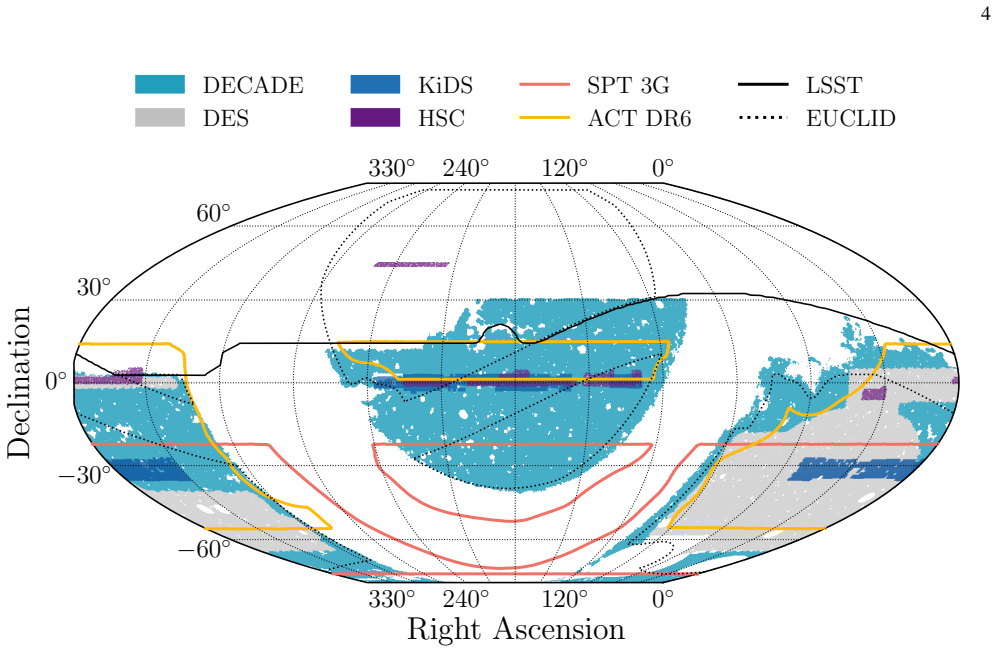
Summary. This paper presents cosmic shear constraints from the combination of three data vectors: DECADE NGC, DECADE SGC, and DES Y3, totaling 270 million galaxies over 13,000 deg^2. Using a DES Y3-style pipeline with TATT intrinsic alignments, HMCode nonlinear power spectrum, and CosmoCov covariance, the authors report a fiducial ΛCDM result S8 = 0.805 ± 0.019, Ωm = 0.262^{+0.023}_{-0.036} (Eq. 7), consistent with Planck 2018 at 1.9σ. They extend the analysis to dynamical dark energy (w0wa and wφ models), finding that lensing adds only modest information beyond BAO+SNe. They then study six baryon suppression models, concluding that scale cuts leave a residual bias of ≈0.3σ in the S8–Ωm plane and that using all scales with explicit baryon modeling improves the figure of merit by only 7%, because the extra small-scale information mostly self-calibrates the baryon model. The data products and likelihoods are publicly released.
Significance. If the central result holds, this is the largest-area, largest-source-count weak lensing analysis to date and one of the most precise S8 constraints from cosmic shear alone. The paper is unusually transparent about goodness of fit, model variations, and the baryon-model dependence of small-scale information. Strengths include the public release of catalogs and likelihoods, the use of a well-tested covariance pipeline, multiple baryon models under a common BaryonForge framework, and explicit checks that posterior shifts from redshift-calibration uncertainties are small. The main scientific value is as a demonstration of what can be extracted from a 13,000 deg^2 lensing dataset before Stage IV surveys, and as a testing ground for the treatment of baryons and intrinsic alignments.
major comments (3)
- [§II.A and Appendix A] The combined 13k constraint is built by multiplying three likelihood blocks with zero cross-covariance, justified by independent sky patches, but the calibration systematics are not independent. Appendix A explicitly states that the NGC and SGC redshift calibration fields are shared, that the pipeline is unable to produce correlated calibration priors, and that the same data products are lacking for DES Y3. The independent Gaussian priors on Δz_i and m_i in Table I therefore do not capture common-mode calibration errors. The Δz_i = 0 test in Appendix A marginalizes over the total per-survey calibration uncertainty but leaves a coherent shift of all three data vectors untested. A shared calibration offset would bias S8/Ωm without changing this diagnostic. This is load-bearing for the 3× FoM gain and the quoted ±0.019 precision. Please quantify the impact of correlated calibration errors,
- [§III.A, Table III] The fiducial DECam 13k ΛCDM fit has p = 0.007, and the p-value only rises to 0.14 after dropping three DECADE NGC bin combinations that were identified in Paper IV and then excluded post hoc from the combined analysis. The authors correctly note that the cosmology posterior is unchanged, but a p-value this low indicates that the model or covariance is not fully capturing the data. Since this same dataset drives the central S8 constraint, the manuscript should provide a more detailed diagnosis: which angular scales/tomographic bin combinations contribute to the low p-value, whether the SGC or DES Y3 blocks show similar residuals, and whether the combined covariance is validated against the residuals. At minimum, the fiducial result should be reported side-by-side with the post-drop result more prominently, and the possibility of an underestimated covariance should be addressed explicitly.
- [§III.C, Figure 5 and Table III] The statement that current scale cuts leave a residual baryon bias of ≈0.3σ is an internal model comparison: 'No baryons, w/ cuts' is compared to 'BCEmu, w/ cuts' on the same lensing data, and the OWLS-AGN-based scale cuts are themselves derived from a simulation model. This is not an external calibration of the baryon suppression. If the true baryon feedback is outside the BCEmu prior or differs in shape from the OWLS-AGN template, the 0.3σ estimate could be larger. The agreement among BCEmu, Bacco, and HMx after widening their astrophysical priors is also agreement of models fitted to the same data, not independent validation. The paper does compare to simulations and tSZ/kSZ results in Figures 13–14, which helps, but the abstract's 'residual bias ≈0.3σ' phrasing should be caveated more explicitly as conditional on the baryon model family and the assumed scale-cut prescription.
minor comments (5)
- [§IV, first bullet] The summary quotes Ωm = 0.268^{+0.023}_{-0.036}, while Eq. (7) and Table III give Ωm = 0.262^{+0.023}_{-0.036}. Please correct this inconsistency.
- [§III.C, Figure 5 caption / text] The text says the FoM improves from 1872 to 1993, a '7%' improvement, but Table III also lists a '13k, no baryons' row with FoM = 2641 for the all-scales analysis. The comparison is clear in context, but the repeated use of 'no baryons' for two different scale-cut choices is confusing; consider relabeling the fiducial scale-cut model as 'No baryons, w/ cuts' throughout.
- [Figure 4 caption] Minor grammar: 'The BFG-BCEmu results matches the BCEmu result' should be 'matches'; also consider clarifying that the comparison is for the suppression ratio S(k), not the cosmology posterior, in the caption.
- [§II.A] The sentence 'The redshift distributions are listed in Figure 8 of Appendix A' is slightly awkward; consider referring to it as 'Figure 8' directly without the appendix cross-reference, or rephrase.
- [Table II] The WL+BAO rows have p-values of 0.013 and 0.010, which are close to the fiducial 13k p-value of 0.007. It would be helpful to state explicitly in the table caption or text whether these low p-values share the same origin as the fiducial ΛCDM low p-value.
Circularity Check
No load-bearing circularity: the central S8/Omega_m constraints are fit to new lensing data, and the baryon-model results are explicitly internal self-calibration rather than predictions forced by the inputs.
full rationale
The paper's central claim, S8 = 0.805 +/- 0.019 and Omega_m = 0.262^{+0.023}_{-0.036} (Eq. 7), is obtained by fitting a standard lensing model to three measured shear correlation-function data vectors. Nothing in the model is defined in terms of the final S8 or Omega_m, and the result is an externally falsifiable measurement compared against Planck, DES Y3, KiDS, and HSC. The combination of NGC, SGC, and DES Y3 is done at the likelihood level with zero cross-covariance (Section II.A). That is an independence assumption that could be wrong -- Appendix A explicitly states that the deep-field redshift-calibration samples are shared across NGC and SGC and that the pipeline 'is unable to produce correlated calibration priors.' But shared calibration fields are a systematic-error/correctness concern, not circularity: the three data vectors are still independent measurements, and the combined posterior is not constructed to equal any calibration input. The baryon-model section is best described as honest self-calibration. The paper fits baryon-suppression parameters on the same small-scale lensing data and then shows that different models agree once priors are widened (Figures 4-6). This is an internal consistency check, and the paper explicitly states that the new small-scale information is used 'solely to self-calibrate the baryon model' and that external probes are needed to access the full statistical power. Comparing two models on the same data is not a prediction from an external benchmark, but it is also not a fit renamed as a prediction. The residual scale-cut bias of ~0.3 sigma is likewise a relative comparison between analysis choices, not a claimed external prediction. The self-citations to Papers I-IV carry the shear catalogue, redshift calibration, and pipeline from the same collaboration. These are load-bearing in the sense that the analysis reuses previously developed tools, but they are not circular: they describe publicly released data products and validated pipelines, and the new SGC data vector is a genuinely new input. The w_phi model and the 1.35 < alpha < 1.45 prior come from Shajib & Frieman (2025), which has overlapping authors. This is a modeling choice with a stated prior, not a result that reduces to its own input; the dynamical-dark-energy conclusions are driven mainly by the external DESI BAO and DES SNe, with lensing providing minor orthogonal improvement. Overall, the central derivation is not equivalent to its inputs by constructio
Axiom & Free-Parameter Ledger
free parameters (5)
- Cosmological parameters Ωm, As, ns, h, Ωb, Ωνh^2 =
Ωm posterior 0.262; others not quoted
- TATT IA amplitudes a1, a2, η1, η2, bTA per data vector =
a2(NGC) > 0 at ~2σ; others unquoted
- Redshift calibration shifts Δz_i (NGC and SGC) =
Gaussian priors, means 0, σ 1.0-1.6×10^-2
- Shear calibration m_i (NGC and SGC) =
Gaussian priors, means -0.9% to -5.7%, σ 0.3-0.8%
- Baryon model parameters (BCEmu: 8; Bacco: up to ~14; HMx: 10) =
not quoted; posteriors shown in Figure 4
axioms (8)
- domain assumption Shear two-point correlations are related to the matter power spectrum through standard weak lensing theory (Eq. 1).
- domain assumption HMCode (Mead et al. 2020) accurately predicts the nonlinear matter power spectrum.
- domain assumption TATT model (Blazek et al. 2019) describes intrinsic alignments in all three datasets.
- domain assumption The three data vectors are statistically independent and can be combined by multiplying their Gaussian likelihoods.
- domain assumption The covariance matrix is fixed and known, computed with CosmoCov.
- domain assumption Baryons are the only statistically significant unmodeled small-scale systematic besides IA.
- domain assumption The halo model with NFW profiles, Tinker mass function and the baryon density profiles of BCEmu/Bacco/HMx maps astrophysical parameters to the suppression S(k).
- domain assumption The theory-informed prior on α in the wφ model is correct.
Cite this review
Pith. "Pith review of The Dark Energy Camera All Data Everywhere cosmic shear project V: Constraints on cosmology and astrophysics from 270 million galaxies across 13,000 deg$^2$ of the sky." pith.science (2026). https://pith.science/paper/OR5T7VU3
@misc{pith2026250903582,
  author       = {Pith},
  title        = {Pith review of: The Dark Energy Camera All Data Everywhere cosmic shear project V: Constraints on cosmology and astrophysics from 270 million galaxies across 13,000 deg$^2$ of the sky},
  year         = {2026},
  howpublished = {\url{https://pith.science/paper/OR5T7VU3}},
  note         = {Machine review of arXiv:2509.03582}
}
read the original abstract
We present constraints on models of cosmology and astrophysics using cosmic shear data vectors from three datasets: the northern and southern Galactic cap of the Dark Energy Camera All Data Everywhere (DECADE) project, and the Dark Energy Survey (DES) Year 3. These data vectors combined consist of 270 million galaxies spread across 13,000 ${\rm deg}^2$ of the sky. We first extract constraints for $\Lambda$CDM cosmology and find $S_8= 0.805^{+0.019}_{-0.019}$ and $\Omega_{\rm m} = 0.262^{+0.023}_{-0.036}$, which is consistent within $1.9 \sigma$ of constraints from the Planck satellite. Extending our analysis to dynamical dark energy models shows that lensing provides some (but still minor) improvements to existing constraints from supernovae and baryon acoustic oscillations. Finally, we study six different models for the impact of baryons on the matter power spectrum. We show the different models provide consistent constraints on baryon suppression, and associated cosmology, once the astrophysical priors are sufficiently wide. Current scale-cut approaches for mitigating baryon contamination result in a residual bias of $\approx 0.3\sigma$ in the $S_8, \Omega_{\rm m}$ posterior. Using all scales with dedicated baryon modeling leads to negligible improvement as the new information is used solely to self-calibrate the baryon model on small scales. Additional non-lensing datasets, and/or calibrations of the baryon model, will be required to access the full statistical power of the lensing measurements. The combined dataset in this work represents the largest lensing dataset to date (most galaxies, largest area) and provides an apt testing ground for analyses of upcoming datasets from Stage IV surveys. The DECADE shear catalogs, data vectors, and likelihoods are made publicly available.
Figures


Forward citations
Cited by 4 Pith papers
-
Primordial Physics in the Nonlinear Universe: Revealing the oscillating halo bias from cosmological collider models
A binning-based IC method yields the first N-body measurements of oscillating halo bias from cosmological collider bispectra, with mass- and assembly-dependent phases fit by peak-background-split theory.
-
Signatures of Suppressed Matter Clustering revealed by Fast Radio Bursts
FRB dispersion measures directly constrain suppression of the matter power spectrum due to feedback at k ~ 0.1-3 h/Mpc, reduce posterior variance by a factor of ~8 at k~1 h/Mpc, and exclude extreme large-scale feedbac...
-
The suppression of the matter power spectrum: strong feedback from X-ray gas mass fractions, kSZ effect profiles, and galaxy-galaxy lensing
A joint fit to X-ray gas fractions and kSZ profiles constrains baryon feedback to suppress the matter power spectrum by 10±2% at k=1 h/Mpc, stronger than fiducial simulations.
-
Line-of-sight shear in SLACS strong lenses II: validation tests with an extended sample
Line-of-sight shear in 45 SLACS lenses is often larger than N-body expectations (mean |γ_LOS| ≈ 0.085–0.11), and adding mass octupoles or checking image properties does not remove the excess.
Reference graph
Works this paper leans on
-
[1]
Baryon suppression of the matter power spectrum Figure 4 presents the baryon suppression of the matter power spectrum predicted by each model. This is shown for our fiducial analysis using the DECam 13k data, and for the extendedanalysiswhichaddsBAOandSNeinformationtothe WLdata. Constraintsfromthetwodifferentdatacombinations are consistent with each other...
work page 2020
-
[2]
Cosmology with scale cuts and with all scales Havingestablishedconcordanceinthebaryonsuppres- sion constraints from different models, we now turn to the effectiveness of scale cuts in mitigating baryon-driven biases in the inferred cosmology. For simplicity, we only consider the BCEmu model for this analysis. We quantify the baryon- drivenbiasbyanalyzingt...
work page 2023
-
[12]
KiDS-1000, bandpowers
-
[16]
KiDS-Legacy, COSEBIs
-
[18]
KiDS-Legacy, bandpowers
-
[19]
DECam 13k, no baryons
-
[23]
DECam 13k, BFG-BCemu
-
[24]
DECam 13k, BFG-Bacco
-
[27]
DECam 13k, BFG-Bacco Wide
-
[28]
DECam 13k, BCemu (w/ cuts)
-
[29]
DECam 13k + Ext, BCemu
-
[30]
DECam 13k + Ext, Bacco
-
[31]
DECam 13k + Ext, HMx
-
[32]
DECam 13k + Ext, BFG-BCemu
-
[33]
DECam 13k + Ext, BFG-Bacco
-
[34]
DECam 13k + Ext, BFG-HMx 0.25 0.50 Ω m 0.5 1.0 σ8 FIG. 7. AllΛCDM constraints from this work, in comparison to external constraints (lines 8-15) and to variations of different baryon models. The gray bands show the1𝜎 and 2𝜎 regions of the fiducial results (line 5, DECam 13k). The numerical constraints are listed in Table III. KiDS-Legacy only quotes const...
work page 1993
-
[2023]
with the halo density profiles assumed by each of these models (HMx, BCEmu, and Bacco). These predictions are derivedusingthe BaryonForge3 codebase(Anbajaganeetal. 2024a), where we have implemented all profiles from these models. Wethenbuildanemulatorforthebaryonsuppression thatspansbothastrophysicalnuisanceparametersandcosmol- ogyparameters. Allhalo-mode...
work page 2019
-
[2025]
or by utilizing more stringent selections on the source galaxy sample (McCullough et al. 2024). The uncertainties from redshift calibration are negligible relative to the other two; though, we note this is also becauseDECADEand DES Y3dataareshallowerthanthedatafromDESY6(Yamamoto &Beckeretal.2025)andtheupcomingLSSTY1release. The calibration uncertainties w...
arXiv 2024
This paper was first reviewed by deepseek-v4-flash on August 5, 2026.
discussion (0)
Sign in with ORCID, Apple, or X to comment. Anyone can read and Pith papers without signing in.