Distributed MIMO With Over-the-Air Phase Calibration Integrated Into the TDD Flow
Pith reviewed 2026-05-18 18:44 UTC · model grok-4.3
The pith
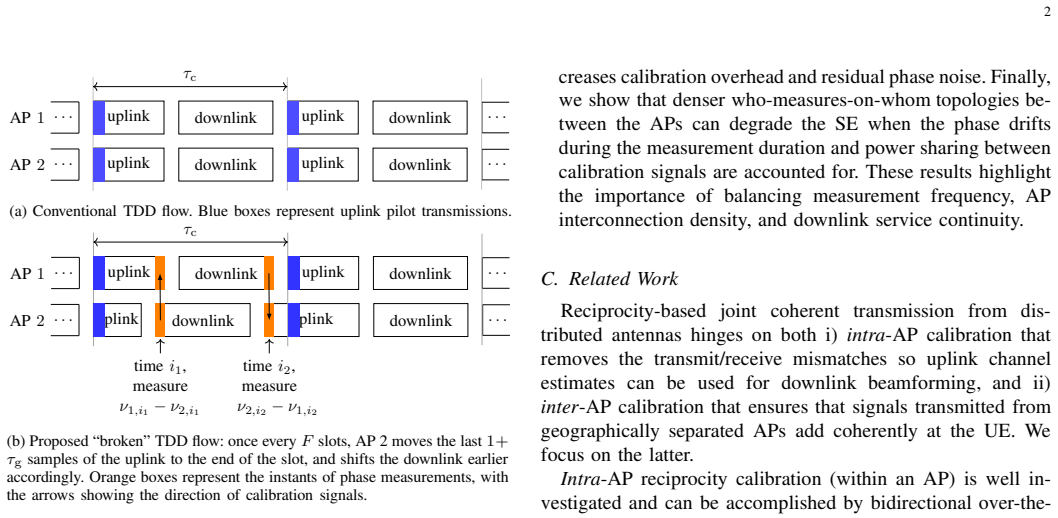
Over-the-air phase calibration integrates into TDD by shifting uplink and downlink switching points to create short measurement segments between access points.
A machine-rendered reading of the paper's core claim, the machinery that carries it, and where it could break.
Core claim
Reciprocity-based joint coherent downlink beamforming from multiple access points requires periodic phase calibration accomplished by bidirectional over-the-air measurements. These measurements integrate into the TDD flow by shifting the uplink and downlink switching points of the slot structure to create short time segments for inter-AP measurements. The technique scales to large networks and allows analytical characterization of the tradeoff between calibration resources and spectral efficiency for conjugate beamforming or zero-forcing beamforming.
What carries the argument
The modified TDD slot structure with shifted uplink and downlink switching points that allocates short segments for bidirectional over-the-air inter-AP phase measurements.
If this is right
- The system achieves phase synchronization for coherent beamforming without allocating dedicated calibration slots.
- Analytical expressions quantify how calibration overhead reduces spectral efficiency under conjugate and zero-forcing beamforming.
- The approach extends to networks with arbitrarily many access points while keeping measurement overhead manageable.
- Overall spectral efficiency exceeds that of schemes relying on separate calibration periods.
Where Pith is reading between the lines
- Similar slot modifications could address synchronization in other distributed wireless systems beyond MIMO.
- The method may reduce total overhead in large-scale cell-free deployments by avoiding extra calibration intervals.
- Hardware validation would reveal whether timing precision in real TDD hardware supports the short measurement windows.
Load-bearing premise
Bidirectional over-the-air measurements between access points provide sufficiently accurate phase estimates despite independent local oscillators and without significant interference or timing misalignment.
What would settle it
If a hardware test of the modified TDD structure shows phase estimation errors large enough to degrade beamforming coherence due to interference or oscillator drift, the integrated calibration approach would fail to deliver the claimed accuracy.
Figures


read the original abstract
Reciprocity-based, joint coherent downlink beamforming from multiple access points (APs) in distributed multiple-input multiple-output (MIMO) with independent local oscillators (LOs) requires the APs to be periodically phase-calibrated (a.k.a. phase-synchronized or phase-aligned). Such phase calibration can be accomplished by bidirectional over-the-air measurements between the APs. In this paper, we show how such over-the-air measurements can be integrated into the time-division duplexing (TDD) flow by appropriately shifting the uplink/downlink switching points of the TDD slot structure, creating short time segments during which APs can measure on one another. We also show how this technique scales to large networks. Furthermore, we analytically characterize the tradeoff between the amount of resources spent on calibration measurements and the resulting spectral efficiency of the system, when conjugate beamforming or zero-forcing beamforming is used. The results demonstrate the feasibility of distributed MIMO with phase-calibration through over-the-air inter-AP measurements integrated into the TDD flow, and the advantage of this design over schemes with dedicated calibration slots.
Editorial analysis
A structured set of objections, weighed in public.
Referee Report
Summary. The paper proposes integrating bidirectional over-the-air phase calibration measurements between access points into the TDD slot structure for distributed MIMO systems by shifting the uplink/downlink switching points to create short inter-AP measurement intervals. It shows that the approach scales to large networks and provides an analytical characterization of the tradeoff between calibration resources and spectral efficiency under conjugate beamforming and zero-forcing precoding, claiming feasibility and advantage over dedicated calibration slots.
Significance. If the derivations and assumptions hold, the work would offer a resource-efficient method for achieving the phase synchronization required for coherent joint transmission in distributed MIMO with independent local oscillators, potentially improving spectral efficiency in large-scale deployments without dedicated calibration overhead. The analytical tradeoff for both beamforming schemes is a positive feature that could guide system design.
major comments (1)
- [Abstract and introduction] The central feasibility claim rests on the assumption that the short measurement segments created by TDD switching-point shifts remain free of interference and yield accurate phase estimates. However, with independent local oscillators, clock drift can cause differential boundary shifts across APs, leading to partial overlaps with user traffic or other transmissions that corrupt the calibration signals. This directly affects the phase estimates used for reciprocity-based beamforming and the subsequent SE-vs-calibration-resource tradeoff analysis; explicit modeling or bounds on timing misalignment are needed to support the claims.
minor comments (1)
- Clarify the exact duration and placement of the shifted measurement segments relative to standard TDD slot parameters to make the integration description more precise.
Simulated Author's Rebuttal
We thank the referee for the constructive feedback and the opportunity to clarify our assumptions. We address the major comment below and have revised the manuscript to strengthen the discussion on practical timing considerations while preserving the core contributions on phase calibration integration and the SE tradeoff analysis.
read point-by-point responses
-
Referee: The central feasibility claim rests on the assumption that the short measurement segments created by TDD switching-point shifts remain free of interference and yield accurate phase estimates. However, with independent local oscillators, clock drift can cause differential boundary shifts across APs, leading to partial overlaps with user traffic or other transmissions that corrupt the calibration signals. This directly affects the phase estimates used for reciprocity-based beamforming and the subsequent SE-vs-calibration-resource tradeoff analysis; explicit modeling or bounds on timing misalignment are needed to support the claims.
Authors: We agree that clock drift from independent LOs represents a relevant practical issue that could affect the integrity of the short calibration intervals created by switching-point shifts. Our system model assumes network-level coordination of the TDD frame structure (via backhaul or a common timing reference, as is standard in distributed MIMO deployments), with the phase calibration specifically targeting RF carrier phase offsets rather than symbol-level timing. To mitigate residual drift, the design incorporates guard periods around the measurement windows. We acknowledge that the original manuscript did not explicitly bound the tolerable drift; we have therefore added a new paragraph in the system model section deriving a simple bound on maximum clock drift rate (based on interval length, symbol duration, and typical oscillator stability of ~1 ppm) to ensure negligible overlap probability. This addition supports the feasibility claim without altering the analytical SE tradeoff derivations for conjugate beamforming and zero-forcing, which remain valid under the refined assumptions. We believe this addresses the concern while keeping the focus on the paper's primary contributions. revision: yes
Circularity Check
No circularity: new TDD slot modification and analytical SE tradeoff derived independently
full rationale
The paper introduces a concrete modification to the TDD slot structure (shifting UL/DL switching points to create inter-AP measurement intervals) and then derives an analytical expression for the resulting spectral-efficiency versus calibration-resource tradeoff under conjugate and zero-forcing beamforming. No step reduces a claimed prediction or first-principles result to a fitted parameter, self-citation, or renamed input by construction. The derivation relies on standard reciprocity and beamforming models plus the newly proposed timing structure; the central feasibility claim is supported by the explicit construction rather than by any load-bearing self-reference or tautological re-labeling. This is the normal case of a self-contained technical proposal.
Axiom & Free-Parameter Ledger
axioms (1)
- domain assumption Bidirectional over-the-air measurements between APs can produce accurate enough phase estimates for coherent joint transmission despite independent LOs.
Lean theorems connected to this paper
-
IndisputableMonolith/Foundation/RealityFromDistinction.leanreality_from_one_distinction unclear?
unclearRelation between the paper passage and the cited Recognition theorem.
We show how such over-the-air measurements can be integrated into the TDD flow by appropriately shifting the uplink/downlink switching points of the TDD slot structure, creating short time segments during which APs can measure on one another.
-
IndisputableMonolith/Cost/FunctionalEquation.leanwashburn_uniqueness_aczel unclear?
unclearRelation between the paper passage and the cited Recognition theorem.
We develop a Kalman filter for tracking the evolution of αi over time. The filter accounts for both measurement noise and phase drift.
What do these tags mean?
- matches
- The paper's claim is directly supported by a theorem in the formal canon.
- supports
- The theorem supports part of the paper's argument, but the paper may add assumptions or extra steps.
- extends
- The paper goes beyond the formal theorem; the theorem is a base layer rather than the whole result.
- uses
- The paper appears to rely on the theorem as machinery.
- contradicts
- The paper's claim conflicts with a theorem or certificate in the canon.
- unclear
- Pith found a possible connection, but the passage is too broad, indirect, or ambiguous to say the theorem truly supports the claim.
Reference graph
Works this paper leans on
-
[1]
Breaking the TDD flow for over -the- air phase synchronization in distributed antenna systems,
K.-H. Ngo and E. G. Larsson, “Breaking the TDD flow for over -the- air phase synchronization in distributed antenna systems, ” in Proc. IEEE Global Commun. Conf. (GLOBECOM) , Taipei, Taiwan, 2025
work page 2025
-
[2]
Cell-free massive MIMO versus small cells,
H. Q. Ngo, A. Ashikhmin, H. Y ang, E. G. Larsson, and T. L. Ma rzetta, “Cell-free massive MIMO versus small cells,” IEEE Trans. Wireless Commun., vol. 16, no. 3, pp. 1834–1850, Mar. 2017
work page 2017
-
[3]
Foundationsof user-centric cell-free massive MIMO,
¨O. T. Demir, E. Bj¨ ornson, and L. Sanguinetti, “Foundationsof user-centric cell-free massive MIMO,” F ound. Trends Signal Process., vol. 14, no. 3-4, pp. 162–472, Jan. 2021
work page 2021
-
[4]
R. Nissel, “Correctly modeling TX and RX chain in (distri buted) massive MIMO—new fundamental insights on coherency,” IEEE Commun. Lett. , vol. 26, no. 10, pp. 2465–2469, Oct. 2022
work page 2022
-
[5]
Phase calibration of distri buted antenna arrays,
E. G. Larsson and J. Vieira, “Phase calibration of distri buted antenna arrays,” IEEE Commun. Lett. , vol. 27, no. 6, pp. 1619–1623, Jun. 2023
work page 2023
-
[6]
Re lative channel reciprocity calibration in MIMO/TDD systems,
F. Kaltenberger, H. Jiang, M. Guillaud, and R. Knopp, “Re lative channel reciprocity calibration in MIMO/TDD systems,” in Proc. Future Netw. Mobil. Summit , Florence, Italy, 2010
work page 2010
-
[7]
Experimental investigation of TDD reci procity-based zero- forcing transmit precoding,
P . Zetterberg, “Experimental investigation of TDD reci procity-based zero- forcing transmit precoding,” EURASIP J. Adv. Signal Process. , vol. 2011, no. 1, p. 137541, Dec. 2010
work page 2011
-
[8]
A framework for over-the-air reci procity calibration for TDD massive MIMO systems,
X. Jiang, A. Decurninge, K. Gopala, F. Kaltenberger, M. G uillaud, D. Slock, and L. Deneire, “A framework for over-the-air reci procity calibration for TDD massive MIMO systems,” IEEE Trans. Wireless Commun., vol. 17, no. 9, pp. 5975–5990, Sep. 2018
work page 2018
-
[9]
Massive MIMO self-calibrati on: Optimal interconnection for full calibration,
X. Luo, F. Y ang, and H. Zhu, “Massive MIMO self-calibrati on: Optimal interconnection for full calibration,” IEEE Trans. V eh. Technol., vol. 68, no. 11, pp. 10 357–10 371, Nov. 2019
work page 2019
-
[10]
Hierarchical-abs olute reci- procity calibration for millimeter-wave hybrid beamformi ng systems,
L. Chen, R. Nie, Y . Chen, and W. Wang, “Hierarchical-abs olute reci- procity calibration for millimeter-wave hybrid beamformi ng systems,” IEEE Trans. Wireless Commun. , vol. 22, no. 5, pp. 3570–3584, May 2023
work page 2023
-
[11]
Argos: practical many-antenna base stations,
C. Shepard, H. Y u, N. Anand, E. Li, T. Marzetta, R. Y ang, a nd L. Zhong, “Argos: practical many-antenna base stations,” in Proc. Annual Int. Conf. Mobil. Comput. Netw. (MobiCom) . New Y ork, NY , USA: Association for Computing Machinery, 2012, p. 53–64
work page 2012
-
[12]
AirSync: Enabling distributed multiuser MIMO with full sp atial multi- plexing,
H. V . Balan, R. Rogalin, A. Michaloliakos, K. Psounis, a nd G. Caire, “AirSync: Enabling distributed multiuser MIMO with full sp atial multi- plexing,” IEEE/ACM Trans. Netw. , vol. 21, no. 6, pp. 1681–1695, Dec. 2013
work page 2013
-
[13]
Scalable synch ronization and reciprocity calibration for distributed multiuser MIM O,
R. Rogalin, O. Y . Bursalioglu, H. Papadopoulos, G. Cair e, A. F. Molisch, A. Michaloliakos, V . Balan, and K. Psounis, “Scalable synch ronization and reciprocity calibration for distributed multiuser MIM O,” IEEE Trans. Wireless Commun., vol. 13, no. 4, pp. 1815–1831, Apr. 2014
work page 2014
-
[14]
AirShare: Di stributed coherent transmission made seamless,
O. Abari, H. Rahul, D. Katabi, and M. Pant, “AirShare: Di stributed coherent transmission made seamless,” in Proc. IEEE Conf. Comput. Commun. (INFOCOM) , Hong Kong, China, 2015, pp. 1742–1750
work page 2015
-
[15]
M. Rashid and J. A. Nanzer, “Frequency and phase synchro nization in distributed antenna arrays based on consensus averaging an d Kalman filtering,” IEEE Trans. Wireless Commun. , vol. 22, no. 4, pp. 2789–2803, Apr. 2023
work page 2023
-
[16]
Online expectation-maximization based frequenc y and phase con- sensus in distributed phased arrays,
——, “Online expectation-maximization based frequenc y and phase con- sensus in distributed phased arrays,” IEEE Trans. Commun., vol. 71, no. 6, pp. 3721–3735, Jun. 2023
work page 2023
-
[17]
M. Rashid, W. R. Torres, T. Chang, and J. A. Nanzer, “A two -tone frequency hopping waveform for decentralized consensus-b ased joint frequency and phase alignment in distributed antenna array s,” IEEE Sensors Lett. , vol. 8, no. 3, pp. 1–4, 2024
work page 2024
-
[18]
Reciprocity calibration o f distributed massive MIMO access points for coherent operation,
J. Vieira and E. G. Larsson, “Reciprocity calibration o f distributed massive MIMO access points for coherent operation,” in Proc. IEEE 32nd Annu. Int. Symp. Personal, Indoor Mobile Radio Commun. (PIM RC), Helsinki, Finland, 2021, pp. 783–787
work page 2021
-
[19]
BeamSync: Over-the-air synchronization for distributed massive MIM O systems,
U. Kunnath Ganesan, R. Sarvendranath, and E. G. Larsson , “BeamSync: Over-the-air synchronization for distributed massive MIM O systems,” IEEE Trans. Wireless Commun., vol. 23, no. 7, pp. 6824–6837, Jul. 2024
work page 2024
-
[20]
Distributed massive MIMO: A diversit y combining method for TDD reciprocity calibration,
C.-M. Chen, S. Blandino, A. Gaber, C. Desset, A. Bourdou x, L. V an der Perre, and S. Pollin, “Distributed massive MIMO: A diversit y combining method for TDD reciprocity calibration,” in Proc. IEEE Global Commun. Conf. (GLOBECOM) , Singapore, 2017
work page 2017
-
[21]
A grad- ual method for channel non-reciprocity calibration in cell -free massive MIMO,
N.-I. Kim, C. W. Y u, S.-E. Hong, J.-H. Na, and B. C. Chung, “A grad- ual method for channel non-reciprocity calibration in cell -free massive MIMO,” IEEE Commun. Lett., vol. 26, no. 11, pp. 2779–2783, Nov. 2022
work page 2022
-
[22]
Y . Cao, P . Wang, K. Zheng, X. Liang, D. Liu, M. Lou, J. Jin, Q. Wang, D. Wang, Y . Huang, X. Y ou, and J. Wang, “Experimental perform ance evaluation of cell-free massive MIMO systems using COTS RRU with OTA reciprocity calibration and phase synchronization,” IEEE J. Sel. Areas Commun. , vol. 41, no. 6, pp. 1620–1634, Jun. 2023
work page 2023
-
[23]
Massive synchrony in distributed anten na systems,
E. G. Larsson, “Massive synchrony in distributed anten na systems,” IEEE Trans. Signal Process. , vol. 72, pp. 855–866, Jan. 2024
work page 2024
-
[24]
Linear massive MIMO precoders in the presence of phase noise—a large-scale analysis,
R. Krishnan, M. R. Khanzadi, N. Krishnan, Y . Wu, A. Grael l i Amat, T. Eriksson, and R. Schober, “Linear massive MIMO precoders in the presence of phase noise—a large-scale analysis,” IEEE Trans. V eh. Techno., vol. 65, no. 5, pp. 3057–3071, May 2016
work page 2016
-
[25]
Simon, Optimal state estimation: Kalman, H infinity, and nonlinear approaches
D. Simon, Optimal state estimation: Kalman, H infinity, and nonlinear approaches. John Wiley & Sons, 2006
work page 2006
-
[26]
On wrapping the Kalman filter and estimating with the SO(2) group,
I. Markovi´ c, J. ´Cesi´ c, and I. Petrovi´ c, “On wrapping the Kalman filter and estimating with the SO(2) group,” in Proc. Int. Conf. Inf. Fusion (FUSION), Heidelberg, Germany, 2016, pp. 2245–2250
work page 2016
-
[27]
Scalabi lity aspects of cell- free massive MIMO,
G. Interdonato, P . Frenger, and E. G. Larsson, “Scalabi lity aspects of cell- free massive MIMO,” in Proc. IEEE Int. Conf. Commun. (ICC) , Shanghai, China, 2019, pp. 1–6
work page 2019
-
[28]
T. L. Marzetta, E. G. Larsson, H. Y ang, and H. Q. Ngo, Fundamentals of massive MIMO . Cambridge University Press, 2016
work page 2016
-
[29]
Local partial zero-forcing precoding for cell-free massive MIMO ,
G. Interdonato, M. Karlsson, E. Bj¨ ornson, and E. G. Lar sson, “Local partial zero-forcing precoding for cell-free massive MIMO ,” IEEE Trans. Wireless Commun., vol. 19, no. 7, pp. 4758–4774, Jul. 2020
work page 2020
-
[30]
Further Advancements for E-UTRA Physical Layer Aspec ts (Release 9),
“Further Advancements for E-UTRA Physical Layer Aspec ts (Release 9),” 3GPP , Tech. Rep. TS 36.814, Mar. 2017
work page 2017
-
[31]
Discret e-time models and performance of phase noise channels,
A. Piemontese, G. Colavolpe, and T. Eriksson, “Discret e-time models and performance of phase noise channels,” IEEE Open J. Commun. Soc. , vol. 5, pp. 2211–2225, Apr. 2024
work page 2024
-
[32]
An upper bound for the chr omatic number of a graph and its application to timetabling problem s,
D. J. A. Welsh and M. B. Powell, “An upper bound for the chr omatic number of a graph and its application to timetabling problem s,” The Computer Journal, vol. 10, no. 1, pp. 85–86, Jan. 1967
work page 1967
-
[33]
Random matrix theory and wirel ess communi- cations,
A. Tulino and S. V erd´ u, “Random matrix theory and wirel ess communi- cations,” F ound. Trends Commun. Inf. Theory , vol. 1, no. 1, pp. 1–182, Jun. 2004
work page 2004
discussion (0)
Sign in with ORCID, Apple, or X to comment. Anyone can read and Pith papers without signing in.