Twisted bilayer graphene as a terahertz plasmonic crystal
Pith reviewed 2026-05-18 20:06 UTC · model grok-4.3
The pith
Minimally twisted bilayer graphene with a network of partial dislocations behaves as a terahertz plasmonic crystal.
A machine-rendered reading of the paper's core claim, the machinery that carries it, and where it could break.
Core claim
The central claim is that twisted bilayer graphene containing a triangular network of partial dislocations hosting topologically protected one-dimensional states acts as a plasmonic crystal. Its band structure is obtained by solving classical equations of motion for charge dynamics along the network links with impedance boundary conditions at the nodes, revealing features such as gapless branches and flat bands.
What carries the argument
Classical equations of motion for charge dynamics on the network links with impedance boundary conditions at the network nodes.
If this is right
- The plasmon dispersion shows multiple gapless branches.
- Flat bands appear in the spectrum.
- Dissipationless modes exist at high-symmetry points.
- The network model is valid in regimes where it approximates the random phase approximation.
- Local scatterers launch plasmon waves that can be observed in nano-imaging.
Where Pith is reading between the lines
- The network formalism may simplify calculations for plasmonics in other materials with similar domain wall networks.
- Adjusting the twist angle could tune the plasmon band structure for specific terahertz applications.
- Experimental confirmation via nano-imaging could validate the classical approximation for these topological states.
Load-bearing premise
The classical equations of motion for charge dynamics on the network links together with impedance boundary conditions at the nodes suffice to capture the dynamics from the topologically protected one-dimensional states.
What would settle it
Observation of the predicted multiple gapless branches and flat bands in the terahertz plasmon dispersion using nano-imaging on minimally-twisted gapped bilayer graphene samples.
Figures


read the original abstract
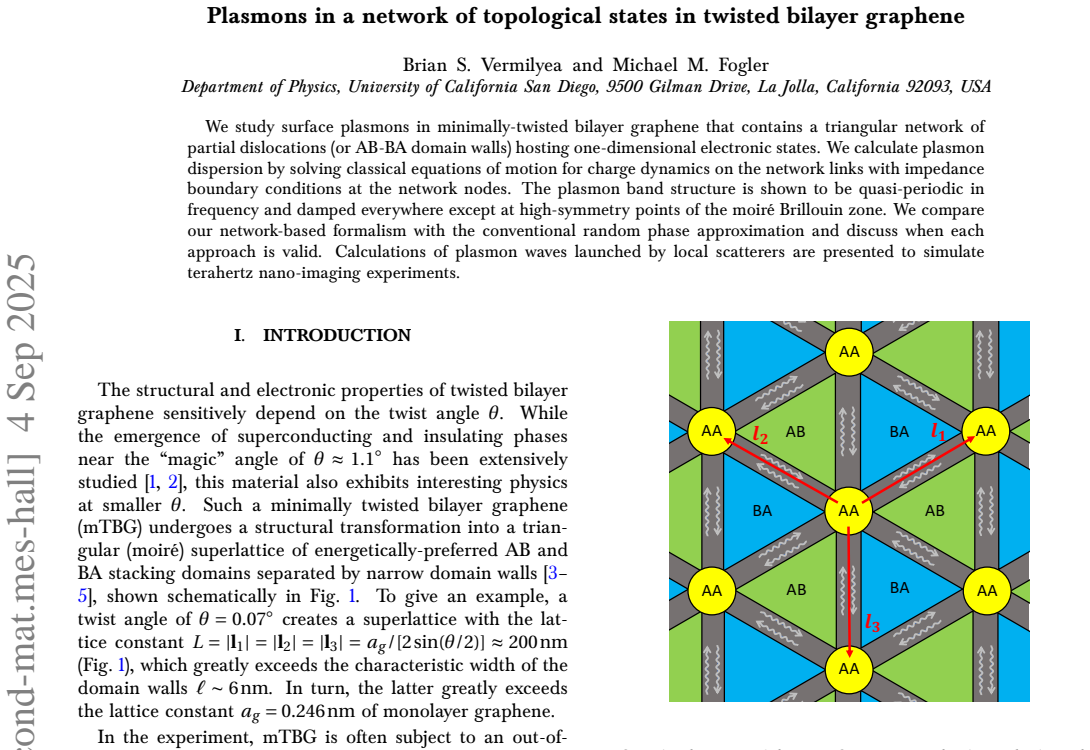
We study surface plasmons in minimally-twisted gapped bilayer graphene that contains a triangular network of partial dislocations (or AB-BA domain walls) hosting topologically protected one-dimensional electronic states. We show that this system behaves as a plasmonic crystal and we calculate its band structure by solving classical equations of motion for charge dynamics on the network links with impedance boundary conditions at the network nodes. The plasmon dispersion exhibits several notable features such as multiple gapless branches, flat bands, and dissipationless modes at high-symmetry points. We compare our network-based formalism with the conventional random phase approximation and discuss when each approach is valid. Calculations of plasmon waves launched by local scatterers are presented to simulate terahertz nano-imaging experiments.
Editorial analysis
A structured set of objections, weighed in public.
Referee Report
Summary. The manuscript studies surface plasmons in minimally-twisted gapped bilayer graphene containing a triangular network of partial dislocations that host topologically protected one-dimensional electronic states. It claims this system behaves as a plasmonic crystal whose band structure is obtained by solving classical equations of motion for charge dynamics on the network links subject to impedance boundary conditions at the nodes. The resulting dispersion shows multiple gapless branches, flat bands, and dissipationless modes at high-symmetry points. The network formalism is compared to the random phase approximation with a discussion of validity regimes, and simulations of waves launched by local scatterers are presented to model terahertz nano-imaging experiments.
Significance. If the central results hold, the work supplies an efficient classical network model for plasmonics in moiré systems with dislocation networks, potentially useful for designing terahertz devices. The reported gapless and dissipationless modes point to possible low-loss propagation channels, while the RPA comparison helps delineate when the simplified network reduction is appropriate versus a fully microscopic treatment.
major comments (2)
- [Section on network model and impedance boundary conditions] The load-bearing step is the reduction of the topologically protected 1D states to classical impedance boundary conditions at the nodes. Because those states are chiral and backscattering-protected, collective response at the three-way junctions can include nonlocal or phase-sensitive contributions that a purely local impedance matching condition does not automatically encode; this directly affects whether the calculated gapless branches and dissipationless modes survive. A concrete test (e.g., comparison of the network dispersion against a microscopic calculation that retains the chiral edge-state wavefunctions) is needed to confirm the reduction preserves the essential topological features.
- [Discussion of network formalism versus RPA] The comparison with RPA is mentioned but supplies no quantitative benchmarks (parameter ranges, error metrics, or dispersion plots showing where the two methods agree or diverge). Without such data it is difficult to assess the regime of validity claimed for the network approach, which is central to the assertion that the classical model captures the essential plasmon dynamics.
minor comments (2)
- [Figure 1 or model schematic] Notation for the impedance at the nodes and the definition of the network links would be clearer if accompanied by a schematic that labels the geometric parameters and the direction of charge flow.
- [Section on numerical simulations] The simulations of plasmon waves excited by local scatterers would benefit from explicit statements of the driving frequency and the spatial resolution assumed, to facilitate direct comparison with nano-imaging experiments.
Simulated Author's Rebuttal
We thank the referee for the thorough review and valuable comments on our manuscript. We address each major comment below and have updated the manuscript to incorporate clarifications and additional data where possible.
read point-by-point responses
-
Referee: The load-bearing step is the reduction of the topologically protected 1D states to classical impedance boundary conditions at the nodes. Because those states are chiral and backscattering-protected, collective response at the three-way junctions can include nonlocal or phase-sensitive contributions that a purely local impedance matching condition does not automatically encode; this directly affects whether the calculated gapless branches and dissipationless modes survive. A concrete test (e.g., comparison of the network dispersion against a microscopic calculation that retains the chiral edge-state wavefunctions) is needed to confirm the reduction preserves the essential topological features.
Authors: We appreciate the referee's emphasis on the topological aspects. The network model encodes the chirality through unidirectional propagation along the domain walls, with the impedance conditions ensuring charge conservation at the nodes without allowing backscattering, consistent with the topological protection. Nonlocal effects are negligible in the long-wavelength terahertz limit relevant to our study. We have revised the manuscript to include a more detailed derivation of the boundary conditions from the chiral 1D states and a discussion of why phase-sensitive contributions do not alter the main features. A full microscopic simulation is computationally demanding and beyond the present scope, but symmetry considerations support the validity of our approach. revision: partial
-
Referee: The comparison with RPA is mentioned but supplies no quantitative benchmarks (parameter ranges, error metrics, or dispersion plots showing where the two methods agree or diverge). Without such data it is difficult to assess the regime of validity claimed for the network approach, which is central to the assertion that the classical model captures the essential plasmon dynamics.
Authors: We agree that quantitative comparisons would strengthen the presentation. In the revised manuscript, we now include dispersion relations from both methods for representative parameter sets, along with estimates of the relative error as a function of wavevector. This shows agreement in the long-wavelength regime and divergence at shorter wavelengths where microscopic details become important, thereby clarifying the validity range of the network formalism. revision: yes
- A direct numerical comparison of the network dispersion to a microscopic calculation that explicitly retains the chiral edge-state wavefunctions
Circularity Check
Derivation is self-contained classical network model with no reduction to inputs by construction
full rationale
The central derivation solves classical charge EOM on network links subject to impedance BCs at nodes to obtain plasmon band structure. This is presented as an effective model for the 1D states rather than a fit or self-definition; the paper explicitly compares the network approach to RPA and discusses validity regimes, providing an independent cross-check. No quoted equations reduce the dispersion relations to fitted parameters, self-citations, or renamed ansatze. The topological protection is invoked to motivate the network but does not enter as a load-bearing uniqueness theorem from the same authors. This is the normal case of an effective classical reduction whose outputs are not forced by the inputs.
Axiom & Free-Parameter Ledger
axioms (2)
- domain assumption Classical equations of motion for charge dynamics on the network links
- domain assumption Impedance boundary conditions at the network nodes
Lean theorems connected to this paper
-
IndisputableMonolith/Foundation/AlexanderDuality.leanalexander_duality_circle_linking unclear?
unclearRelation between the paper passage and the cited Recognition theorem.
We calculate its band structure by solving classical equations of motion for charge dynamics on the network links with impedance boundary conditions at the network nodes.
-
IndisputableMonolith/Cost/FunctionalEquation.leanwashburn_uniqueness_aczel unclear?
unclearRelation between the paper passage and the cited Recognition theorem.
The plasmon dispersion exhibits several notable features such as multiple gapless branches, flat bands, and dissipationless modes at high-symmetry points.
What do these tags mean?
- matches
- The paper's claim is directly supported by a theorem in the formal canon.
- supports
- The theorem supports part of the paper's argument, but the paper may add assumptions or extra steps.
- extends
- The paper goes beyond the formal theorem; the theorem is a base layer rather than the whole result.
- uses
- The paper appears to rely on the theorem as machinery.
- contradicts
- The paper's claim conflicts with a theorem or certificate in the canon.
- unclear
- Pith found a possible connection, but the passage is too broad, indirect, or ambiguous to say the theorem truly supports the claim.
Reference graph
Works this paper leans on
-
[1]
(B17) For qp ℓ ≪ 1, this is proportional to 1/L, where L = ln(A/qp ℓ) ≫ 1 and A = 0.561 [cf
cos πm 3 + 2 ln 3 cos2πm 3 + (−1)m ¸¾ . (B17) For qp ℓ ≪ 1, this is proportional to 1/L, where L = ln(A/qp ℓ) ≫ 1 and A = 0.561 [cf. Eq. (29)]. In practice, it is di ffi cult to make parameter L truly large. For example, if λp /ℓ = 300, then L = 3.3. Nevertheless, as shown in Fig. 12, including these corrections improves the agreement between analytical and...
-
[2]
(D1) and (D2) enforce the boundary conditions given in Eq
The terms on the right-hand-side of Eqs. (D1) and (D2) enforce the boundary conditions given in Eq. (90) of the main text. Note that these six terms are the densities and currents on the six links meeting at a network node. At a given crystal momentum q, we expand the electron density , current, and external potential along each link as na,R(x) = ei q·R ∞...
-
[3]
Y. Cao, V . Fatemi, A. Demir, S. Fang, S. L. T omarken, J. Y. Luo, J. D. Sanchez- Y amagishi, K. Watanabe, T. T aniguchi, E. Kaxi- ras, R. C. Ashoori, and P. Jarillo-Herrero, Nature 556, 80 (2018)
work page 2018
-
[4]
Y. Cao, V . Fatemi, S. Fang, K. Watanabe, T. T aniguchi, E. Kaxi- ras, and P. Jarillo-Herrero, Nature 556, 43 (2018)
work page 2018
-
[5]
N. N. T. Nam and M. Koshino, Physical Review B 96, 075311 (2017)
work page 2017
- [6]
-
[7]
H. Y oo, R. Engelke, S. Carr, S. Fang, K. Zhang, P. Cazeaux, S. H. Sung, R. Hovden, A. W. T sen, T. T aniguchi, K. Watanabe, G.-C. Yi, M. Kim, M. Luskin, E. B. T admor, E. Kaxiras, and P. Kim, Nature Materials 18, 448 (2019)
work page 2019
-
[8]
Y. Zhang, T.- T. T ang, C. Girit, Z. Hao, M. C. Martin, A. Zettl, M. F. Crommie, Y. R. Shen, and F. Wang, Nature 459, 820 (2009)
work page 2009
- [9]
- [10]
- [11]
-
[12]
L. Ju, Z. Shi, N. Nair, Y. Lv, C. Jin, J. V elasco, C. Ojeda- Aristizabal, H. A. Bechtel, M. C. Martin, A. Zettl, J. Analytis, and F. Wang, Nature 520, 650 (2015)
work page 2015
-
[13]
L.-J. Yin, H. Jiang, J.-B. Qiao, and L. He, Nature Communica- tions 7 (2016)
work page 2016
-
[14]
E. H. Hasdeo and J. C. W. Song, Nano Letters 17, 7252 (2017)
work page 2017
- [15]
- [16]
-
[17]
P. Rickhaus, J. Wallbank, S. Slizovskiy , R. Pisoni, H. Overweg, Y. Lee, M. Eich, M.-H. Liu, K. Watanabe, T. T aniguchi, T. Ihn, and K. Ensslin, Nano Letters 18, 6725 (2018)
work page 2018
-
[18]
N. R. Walet and F. Guinea, 2D Materials 7, 015023 (2019)
work page 2019
-
[19]
S. G. Xu, A. I. Berdyugin, P. Kumaravadivel, F. Guinea, R. Kr- ishna Kumar, D. A. Bandurin, S. V . Morozov, W. Kuang, B. T sim, S. Liu, J. H. Edgar, I. V . Grigorieva, V . I. Fal’ko, M. Kim, and A. K. Geim, Nature Communications 10 (2019)
work page 2019
-
[20]
M. Fleischmann, R. Gupta, F. Wullschläger, S. Theil, D. Weck- becker, V . Meded, S. Sharma, B. Meyer, and S. Shallcross, Nano Letters 20, 971 (2019)
work page 2019
- [21]
-
[22]
T. Hou, Y. Ren, Y. Quan, J. Jung, W. Ren, and Z. Qiao, Physical Review B 101, 201403 (2020)
work page 2020
- [23]
-
[24]
B.- Y. Jiang, G.-X. Ni, Z. Addison, J. K. Shi, X. Liu, S. Y. F. Zhao, P. Kim, E. J. Mele, D. N. Basov, and M. M. Fogler, Nano Letters 17, 7080 (2017)
work page 2017
-
[25]
S. S. Sunku, G. X. Ni, B. Y. Jiang, H. Y oo, A. Sternbach, A. S. McLeod, T. Stauber, L. Xiong, T. T aniguchi, K. Watanabe, P. Kim, M. M. Fogler, and D. N. Basov, Science 362, 1153 (2018)
work page 2018
-
[26]
D. K. E fimkin and A. H. MacDonald, Physical Review B 98, 035404 (2018)
work page 2018
-
[27]
C. De Beule, F. Dominguez, and P. Recher, Physical Review Letters 125, 096402 (2020)
work page 2020
-
[28]
Y.-Z. Chou, F. Wu, and S. Das Sarma, Physical Review Re- search 2, 033271 (2020)
work page 2020
- [29]
-
[30]
J. van de Groep, P. Spinelli, and A. Polman, Nano Letters 12, 3138 (2012)
work page 2012
-
[31]
Giamarchi, Quantum Physics in One Dimension (Oxford Uni- versity Press, 2003)
T. Giamarchi, Quantum Physics in One Dimension (Oxford Uni- versity Press, 2003)
work page 2003
- [32]
-
[33]
J. M. Lee, M. Oshikawa, and G. Y. Cho, Physical Review Let- ters 126, 186601 (2021)
work page 2021
-
[34]
Y.-Z. Chou, F. Wu, and J. D. Sau, Physical Review B 104, 045146 (2021)
work page 2021
-
[35]
Datta, Electronic T ransport in Mesoscopic Systems (Cambridge University Press, 1995)
S. Datta, Electronic T ransport in Mesoscopic Systems (Cambridge University Press, 1995)
work page 1995
- [36]
-
[37]
C. G. Montgomery , ed., Principles of Microwave Circuits , IEE electromagnetic waves series No. 25 (IET, Stevenage, 1987)
work page 1987
- [38]
-
[39]
C. L. Kane and M. P. A. Fisher, Physical Review B 46, 15233 (1992)
work page 1992
- [40]
- [41]
-
[42]
Z. Qiao, J. Jung, C. Lin, Y. Ren, A. H. MacDonald, and Q. Niu, Physical Review Letters 112, 206601 (2014)
work page 2014
- [43]
-
[44]
X. Chen, D. Hu, R. Mescall, G. Y ou, D. N. Basov, Q. Dai, and M. Liu, Advanced Materials 31 (2019)
work page 2019
- [45]
-
[46]
P. Gallagher, C.-S. Y ang, T. Lyu, F. Tian, R. Kou, H. Zhang, K. Watanabe, T. T aniguchi, and F. Wang, Science 364, 158 (2019)
work page 2019
-
[47]
J. W. McIver, B. Schulte, F.-U. Stein, T. Matsuyama, G. Jotzu, G. Meier, and A. Cavalleri, Nature Physics 16, 38 (2020)
work page 2020
-
[48]
H. K. Pal, S. Spitz, and M. Kindermann, Physical Review Let- ters 123, 186402 (2019)
work page 2019
- [49]
-
[50]
C. Lewandowski and L. Levitov, Proceedings of the National Academy of Sciences 116, 20869 (2019)
work page 2019
discussion (0)
Sign in with ORCID, Apple, or X to comment. Anyone can read and Pith papers without signing in.