REVIEW 3 major objections 6 minor 66 references
DCVC-MV: Deep Contextual Multiview Video Compression with Efficient Inter-View Prediction
T0 review · 3 major / 6 minor · reviewed 2026-08-05 · deepseek-v4-flash
Pith's one-line read A fully learned multiview codec beats the MV-HEVC reference software by an average of 24.9% on 3-view natural-content test sequences, while keeping the primary view independently decodable.
desk verdict First fully learned multiview video codec with random access and backward compatibility; measured gains on standard CTC are credible, but content-side transfer to wide-baseline/parallax content is unverified. read the letter →
The pith
A machine-rendered reading of the paper's core claim, the machinery that carries it, and where it could break.
The reading
What carries the argument
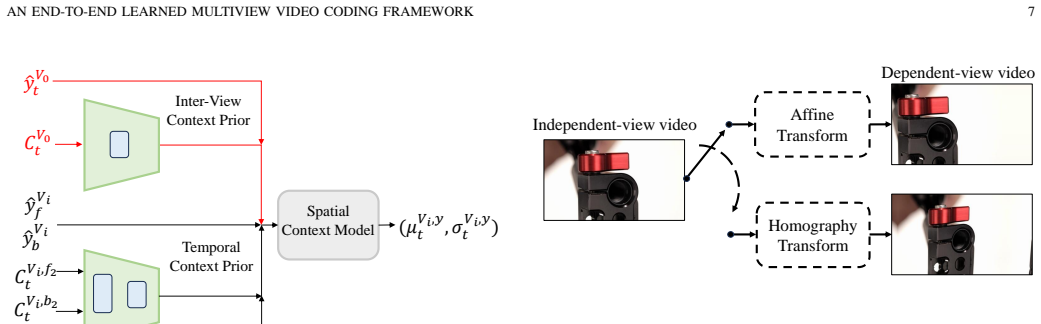
The load-bearing mechanism is the use of the already-decoded independent view as a conditional prior for dependent-view compression, without explicit disparity estimation. Decoded motion-difference features and motion vectors condition the dependent motion encoder and its entropy model; a downsampled decoded content feature is passed through a modified context-mining feature extractor to predict an inter-view context; and both motion and content latent distributions are estimated by a quadtree-partition spatial context model that integrates temporal, inter-view, and hyper priors. This moves inter-view redundancy removal into the feature and latent domain rather than the pixel-disparity domai
What would settle it
Run the trained LMVC codec on a real camera-array multiview sequence with wide baseline, occlusions, and no animation, never seen in training, and compare BD-rate against HTM-16.3 and DCVC-B; if it fails to beat DCVC-B simulcast by a meaningful margin, or fails to beat HTM on natural content, the central compression claim is falsified. Equivalently, ablation of the inter-view content modules on such content should show whether their reported contribution persists outside the synthetic training distribution.
Extended reading notes
Core claim
The paper proposes an end-to-end learned multiview video coding framework, named LMVC in the text and DCVC-MV in the title, built on the single-view B-frame codec DCVC-B. It adds four inter-view modules: feature-based inter-view motion vector prediction, an inter-view motion entropy model, a disparity-free inter-view context prediction module, and an inter-view contextual entropy model. The independent view is compressed exactly as in DCVC-B and can be decoded without any other view, while each dependent view is conditioned on decoded motion features, motion vectors, low-resolution content features, and latent representations from the independent view. Reported results on the MV-HEVC common
Load-bearing premise
The framework's gains rest on training only on synthetic multiview sequences produced by warping single-view videos, plus the premise that downsampling removes inter-view misalignment without explicit disparity estimation; if real camera arrays present wider baselines, parallax, occlusion, or animated content, the inter-view modules' contribution to the compression gain may not transfer.
Editorial extensions
If this is right
- If the reported numbers hold, fully learned multiview codecs can replace MV-HEVC for natural-content 3D and free-viewpoint video, saving roughly 25% of bit rate on average in the 3-view setting.
- The independent view's bitstream remains backward-compatible because it uses unmodified DCVC-B: a single-view decoder can decode it, and dependent-view data never affects its reconstruction.
- Random access is preserved through the hierarchical B-frame structure, so viewers can jump between perspectives without decoding the entire multiview stream.
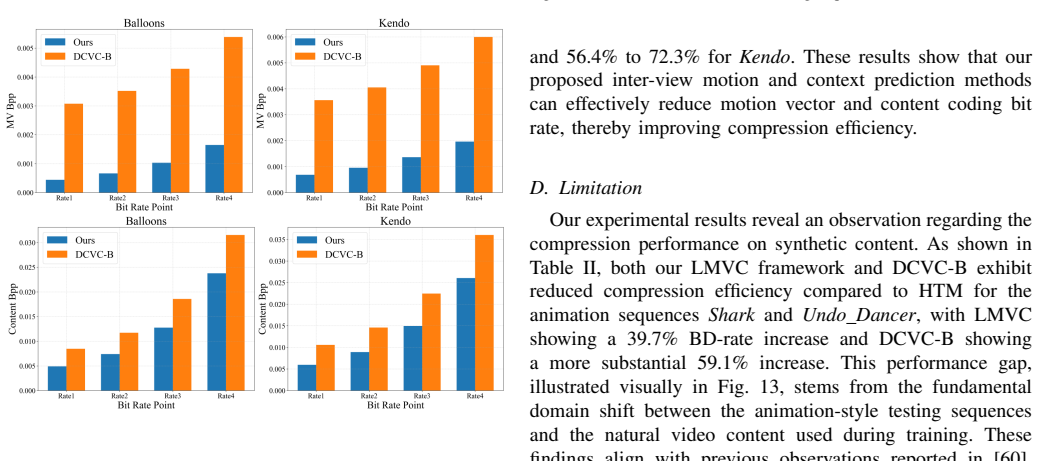
- The gains come from real bit-rate reductions in dependent-view motion and content coding, not from a quality trade-off: on Balloons, motion bit rate falls to between 14.3% and 30.6% of DCVC-B's rate and content bit rate to between 58.0% and 75.4%, depending on the operating point.
- The computational overhead over DCVC-B is modest: encoding time rises from 0.50s to 0.57s per frame, decoding from 0.38s to 0.44s, MACs/pixel from 3004K to 3457K, and model size from 21.40M to 29.13M parameters.
Reading between the lines
- Because training uses only synthetic multiview sequences made by affine- and homography-warping single-view videos, the architecture may need retraining or fine-tuning on real camera-array captures before its gains transfer to wide-baseline, occluded, or parallax-heavy scenes; the paper's own negative results on the Shark and Undo Dancer animation sequences point to this distribution-shift sensiti
- The disparity-free context transfer is not limited to one dependent view in principle: a nearest already-coded view could serve as the independent prior for additional views, though the paper only reports 2-view and 3-view configurations.
- Adding a depth coding layer, which the paper lists as future work, could let inter-view priors condition on warped depth instead of raw downsampled features, potentially recovering performance on occluded regions.
- A testable extension is to add animation-style or synthetic-rendered content to the training set and measure whether the 39.7% BD-rate penalty on Shark shrinks, which would confirm that the failure is purely a training-distribution effect.
Editorial analysis
A structured set of objections, weighed in public.
Referee Report
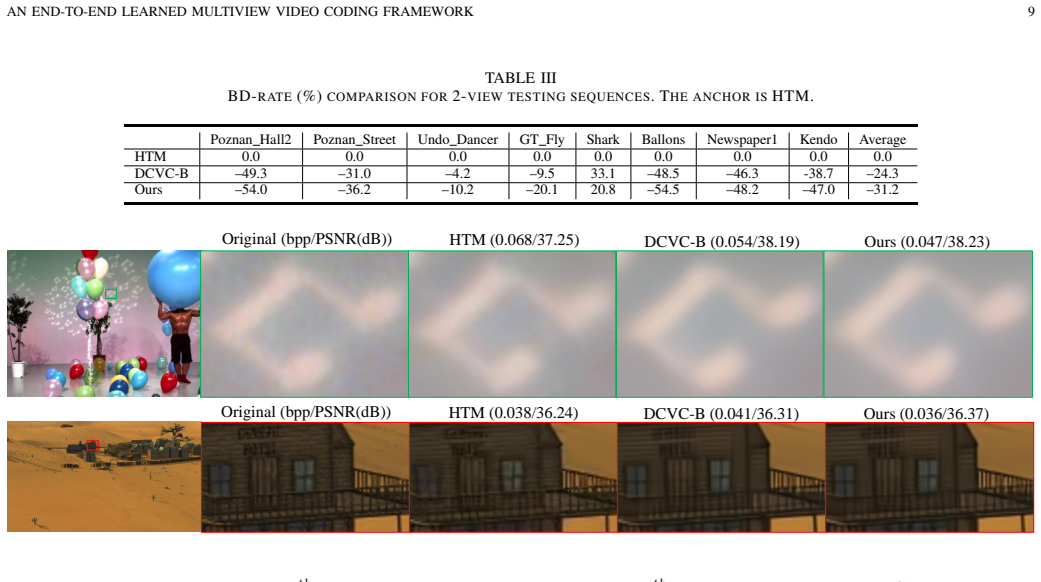
Summary. The paper proposes LMVC, an end-to-end learned multiview video coding framework built on DCVC-B. The independent view is compressed with a frozen DCVC-B codec, and the dependent views extend DCVC-B with four modules: inter-view motion vector prediction (IVMVP), an inter-view motion entropy model (IVMEM), a disparity-free inter-view context prediction module (IVCP), and an inter-view contextual entropy model (IVCEM). Training relies on synthesized multiview sequences obtained by affine and homography warping of single-view videos. Evaluation uses MV-HEVC common test condition sequences in 2-view and 3-view configurations. The paper reports average BD-rate reductions of 24.9% over HTM-16.3 for 3-view and 31.2% for 2-view, with gains over a DCVC-B simulcast anchor. An ablation study attributes an 11.5% BD-rate improvement to the proposed modules, and a per-stream bitrate analysis shows reductions in both motion and content bitrate. The framework preserves backward compatibility and random access.
Significance. If the reported results hold, this is a notable advance: it is one of the first fully end-to-end learned multiview codecs with random access and backward compatibility, and it outperforms both a traditional MV-HEVC reference and a learned simulcast anchor on standard test content. The evaluation is grounded in standard CTC sequences, and the comparison against DCVC-B uses the same frozen independent-view codec, which isolates the contributions of the dependent-view modules. The ablation study and per-stream bitrate analysis are informative. However, the training data are synthetic warps of single-view videos, and the test set consists mostly of narrow-baseline natural content. The generality of the content-side inter-view modules to real wide-baseline camera arrays, with true parallax and occlusions, is not established. The paper's own negative results on animated sequences suggest sensitivity to domain shift. The headline claims should therefore be regarded as conditional on the evaluated content distribution.
major comments (3)
- [Section III.F, Section IV.D, Tables II-III] The dependent-view codec is trained only on affine/homography warps of single-view videos. Such synthetic data cannot generate true parallax, occlusion, or wide-baseline disparity. The content-side modules (IVCP and IVCEM) rely on the premise in Sec. III.D that an H/8 independent-view feature remains useful as inter-view context without explicit disparity compensation. The MV-HEVC CTC test set is predominantly narrow-baseline natural content; the only content-shift stress reported is animation (Shark, Undo Dancer), not geometric baseline. To support the general claim of a multiview codec, please add a wide-baseline or real-camera-array evaluation, or explicitly scope the claims to narrow-baseline content, and report whether the IVCP/IVCEM gains persist under such conditions.
- [Section IV.C, Table V] The ablation table does not state the anchor codec, the view configuration (2-view vs 3-view), the number of test sequences, or the rate points used to compute BD-rate. Since the abstract and Sec. IV.B.1 attribute the overall gain to the four modules, these conditions are necessary for reproducibility and for interpreting the 11.5% figure. Please specify the protocol (e.g., same 3-view set and HTM anchor as Table II) and report per-model BD-rate values on the same sequences.
- [Tables II and III] All BD-rate values are point estimates from a single trained model. Given the large spread across sequences (e.g., 3-view values range from -56.8% to +39.7%), the averages may be sensitive to particular sequences. Please provide error bars, multiple training runs, or at least per-rate-point average RD curves for the headline comparisons, so that the claimed gains over DCVC-B can be assessed with some measure of variability.
minor comments (6)
- [Title/Abstract] The manuscript header and full-text title use 'LMVC', while the arXiv metadata and the provided abstract use 'DCVC-MV'. Please unify the title and abstract across all versions.
- [Throughout] There are several typos and acronym inconsistencies, e.g., 'IVMP' vs 'IVMVP', 'Ballons' for 'Balloons', 'GT F ly' with a stray space. A careful proofreading pass is needed.
- [Section IV.A.2] The text says 'We use AdamW optimizer' but reference [65] is cited as 'Adam: A method for stochastic optimization'. Please update the reference to the AdamW source or correct the optimizer name.
- [Section IV.B.1] The phrase 'more than 10% BD-rate reduction' relative to DCVC-B could be misread as a relative improvement. Please clarify whether this is a percentage-point difference in BD-rate (24.9 vs 14.7) or a relative rate reduction.
- [Section III.D] The choice of H/8 resolution for the inter-view context is motivated by a citation to prior work, but no ablation or quantitative justification is given. Please add a short analysis or ablation on context resolution, or at least discuss the receptive field / alignment limits.
- [Section II.B] The related work discusses [38] as a hybrid INR-based multiview codec, but no experimental comparison is made. A brief sentence explaining why direct comparison is omitted (e.g., different input modalities or evaluation protocols) would help.
Circularity Check
No significant circularity: the reported gains are held-out measurements; the self-cited design premise is empirical, not definitionally forced.
full rationale
The central claim of the paper is an empirical BD-rate comparison on MV-HEVC common test sequences (Table I) that were not used in training. The independent view is compressed with the same frozen DCVC-B codec in both the baseline and the proposed system, so the measured gain isolates the newly added dependent-view modules rather than being an artifact of a fitted parameter. The ablation study (Table V) and the motion/content bitrate decomposition (Fig. 12) provide additional held-out evidence for the contribution of each proposed module. The only passage with a self-citation as a load-bearing design premise is Section III.D, where the paper relies on 'established findings that the downsampling operation can mitigate inter-frame misalignment to a certain extent [60], [62]' to justify the disparity-free low-resolution inter-view context. That premise is an empirical claim about network behavior, not a mathematical identity or a parameter fitted to the test data; its validity is testable through the reported RD results and is not forced by the citation. The paper's own limitation section (Section IV.D) acknowledges distribution shift on animation sequences, which further indicates that the test outcomes are not constructed to always favor the method. No equation in the paper reduces to its own inputs by construction, and no fitted quantity is renamed as a prediction. Wide-baseline generalization is a legitimate correctness/robustness concern, but it is not circularity.
Assumptions & free parameters
free parameters (4)
- Rate-distortion Lagrange multipliers lambda=(85,170,380,840) =
(85, 170, 380, 840)
- Hierarchical temporal-layer weights w=(1.4,1.4,0.7,0.5,0.2) =
(1.4,1.4,0.7,0.5,0.2)
- View-synthesis transform ranges =
not reported
- Architecture hyperparameters of fm0-fm3, fme, fce =
not reported
assumptions (4)
- standard math Arithmetic coding achieves the entropy rate when the learned probability model matches the true latent distribution
- domain assumption Motion similarity exists between neighboring views
- domain assumption Downsampling mitigates inter-frame misalignment, so low-resolution decoded content features suffice as inter-view context
- ad hoc to paper Affine and homography warps of single-view videos are a sufficient proxy for real multiview training data
invented entities (1)
-
Inter-view motion prior and inter-view context prior (Me, Ce feature aggregates)
Cite this review
Pith. "Pith review of DCVC-MV: Deep Contextual Multiview Video Compression with Efficient Inter-View Prediction." pith.science (2026). https://pith.science/paper/DZUU3JZV
@misc{pith2026250903922,
  author       = {Pith},
  title        = {Pith review of: DCVC-MV: Deep Contextual Multiview Video Compression with Efficient Inter-View Prediction},
  year         = {2026},
  howpublished = {\url{https://pith.science/paper/DZUU3JZV}},
  note         = {Machine review of arXiv:2509.03922}
}
read the original abstract
Multiview video is a key format for 3D applications such as free-viewpoint broadcasting and virtual reality, yet its large data volume poses significant challenges for efficient storage and transmission. As deep contextual video compression matures and moves toward standardization, extending such learned codecs to multiview scenarios has become essential for practical deployment---yet this direction remains largely unexplored. In this paper, we propose DCVC-MV, a novel deep contextual multiview video compression framework that satisfies three fundamental requirements. First, it maintains backward compatibility, ensuring that the primary view's bitstream can be decoded independently by a single-view decoder without being affected by other views. Second, it supports random-access capability, enabling flexible switching between different viewing perspectives. Third, it effectively exploits inter-view correlations to achieve high compression efficiency. This is realized through four dedicated components: (1) an inter-view motion feature propagation method, which propagates decoded independent-view motion features as conditions to promote dependent-view motion encoding; (2) an inter-view motion conditional entropy model designed to learn motion conditional priors across views for more accurate probability estimation of motion latent representations; (3) an implicit inter-view context prediction method, which predicts inter-view contexts from low-resolution independent-view content features without explicit disparity estimation; and (4) an inter-view contextual conditional entropy model that learns contextual conditional priors across views to further enhance content compression.
Figures


Figures from the paper (7 more)




Reference graph
Works this paper leans on
-
[38]
Implicit-explicit integrated representations for multi-view video compression,
C. Zhu, G. Lu, B. He, R. Xie, and L. Song, “Implicit-explicit integrated representations for multi-view video compression,” IEEE Transactions on Image Processing , 2025
work page 2025
-
[1]
S. Okubo, K. McCann, and A. Lippmann, “Mpeg-2 requirements, pro- files and performance verification—framework for developing a generic video coding standard,” Signal Processing: Image Communication , vol. 7, no. 3, pp. 201–209, 1995
work page 1995
-
[2]
Mpeg-1 and mpeg-2 video standards,
S. Aramvith and M.-T. Sun, “Mpeg-1 and mpeg-2 video standards,” 2000. AN END-TO-END LEARNED MULTIVIEW VIDEO CODING FRAMEWORK 11
work page 2000
-
[3]
Overview of the stereo and multiview video coding extensions of the h. 264/mpeg-4 avc standard,
A. Vetro, T. Wiegand, and G. J. Sullivan, “Overview of the stereo and multiview video coding extensions of the h. 264/mpeg-4 avc standard,” Proceedings of the IEEE , vol. 99, no. 4, pp. 626–642, 2011
2011
-
[4]
Multiview-video- plus-depth coding based on the advanced video coding standard,
M. M. Hannuksela, D. Rusanovskyy, W. Su, L. Chen, R. Li, P. Aflaki, D. Lan, M. Joachimiak, H. Li, and M. Gabbouj, “Multiview-video- plus-depth coding based on the advanced video coding standard,” IEEE transactions on image processing , vol. 22, no. 9, pp. 3449–3458, 2013
work page 2013
-
[5]
3d high-efficiency video coding for multi-view video and depth data,
K. M ¨uller, H. Schwarz, D. Marpe, C. Bartnik, S. Bosse, H. Brust, T. Hinz, H. Lakshman, P. Merkle, F. H. Rhee, et al., “3d high-efficiency video coding for multi-view video and depth data,” IEEE transactions on image processing , vol. 22, no. 9, pp. 3366–3378, 2013
work page 2013
-
[6]
Overview of the multiview and 3d extensions of high efficiency video coding,
G. Tech, Y . Chen, K. M ¨uller, J.-R. Ohm, A. Vetro, and Y .-K. Wang, “Overview of the multiview and 3d extensions of high efficiency video coding,” IEEE Transactions on Circuits and Systems for Video Technology, vol. 26, no. 1, pp. 35–49, 2015
work page 2015
-
[7]
Efficient prediction structures for multiview video coding,
P. Merkle, A. Smolic, K. Muller, and T. Wiegand, “Efficient prediction structures for multiview video coding,” IEEE Transactions on circuits and systems for video technology , vol. 17, no. 11, pp. 1461–1473, 2007
work page 2007
Show all 66 references
-
[8]
Fast disparity and motion estimation for multi-view video coding,
Y . Kim, J. Kim, and K. Sohn, “Fast disparity and motion estimation for multi-view video coding,” IEEE transactions on consumer electronics , vol. 53, no. 2, pp. 712–719, 2007
2007
-
[9]
Efficient motion and disparity estimation optimization for low complexity multiview video coding,
Z. Pan, Y . Zhang, and S. Kwong, “Efficient motion and disparity estimation optimization for low complexity multiview video coding,” IEEE Transactions on Broadcasting, vol. 61, no. 2, pp. 166–176, 2015
2015
-
[10]
View-adaptive motion estimation and disparity estimation for low complexity multiview video coding,
L. Shen, Z. Liu, T. Yan, Z. Zhang, and P. An, “View-adaptive motion estimation and disparity estimation for low complexity multiview video coding,” IEEE Transactions on Circuits and Systems for Video Technol- ogy, vol. 20, no. 6, pp. 925–930, 2010
2010
-
[11]
Inter-view direct mode for multiview video coding,
X. Guo, Y . Lu, F. Wu, and W. Gao, “Inter-view direct mode for multiview video coding,” IEEE Transactions on Circuits and Systems for Video Technology, vol. 16, no. 12, pp. 1527–1532, 2006
2006
-
[12]
A motion vector prediction method for multi-view video coding,
S. H. Lee, S. H. Lee, J. H. Yang, and N. I. Cho, “A motion vector prediction method for multi-view video coding,” Journal of Visual Communication and Image Representation , vol. 21, no. 7, pp. 677–681, 2010
2010
-
[13]
Encoder- driven inpainting strategy in multiview video compression,
Y . Gao, G. Cheung, T. Maugey, P. Frossard, and J. Liang, “Encoder- driven inpainting strategy in multiview video compression,”IEEE Trans- actions on Image Processing , vol. 25, no. 1, pp. 134–149, 2015
2015
-
[14]
3d video coding using advanced prediction, depth modeling, and encoder control methods,
H. Schwarz, C. Bartnik, S. Bosse, H. Brust, T. Hinz, H. Lakshman, D. Marpe, P. Merkle, K. M ¨uller, H. Rhee, et al., “3d video coding using advanced prediction, depth modeling, and encoder control methods,” in 2012 Picture Coding Symposium , pp. 1–4, IEEE, 2012
2012
-
[15]
Inter-view prediction of motion data in multiview video coding,
H. Schwarz and T. Wiegand, “Inter-view prediction of motion data in multiview video coding,” in 2012 Picture Coding Symposium , pp. 101– 104, IEEE, 2012
2012
-
[16]
Depth-based inter-view prediction of motion vectors for improved multiview video coding,
J. Konieczny and M. Doma ´nski, “Depth-based inter-view prediction of motion vectors for improved multiview video coding,” in 2010 3DTV- Conference: The True Vision-Capture, Transmission and Display of 3D Video, pp. 1–4, IEEE, 2010
2010
-
[17]
Early skip mode decision for mvc using inter-view correlation,
L. Shen, Z. Liu, T. Yan, Z. Zhang, and P. An, “Early skip mode decision for mvc using inter-view correlation,” Signal Processing: Image Communication, vol. 25, no. 2, pp. 88–93, 2010
2010
-
[18]
Disparity-aware reference frame generation network for multiview video coding,
J. Lei, Z. Zhang, Z. Pan, D. Liu, X. Liu, Y . Chen, and N. Ling, “Disparity-aware reference frame generation network for multiview video coding,” IEEE Transactions on Image Processing , vol. 31, pp. 4515–4526, 2022
2022
-
[19]
Deep in-loop filtering via multi-domain correlation learning and partition constraint for multiview video coding,
B. Peng, R. Chang, Z. Pan, G. Li, N. Ling, and J. Lei, “Deep in-loop filtering via multi-domain correlation learning and partition constraint for multiview video coding,” IEEE Transactions on Circuits and Systems for Video Technology, vol. 33, no. 4, pp. 1911–1921, 2022
1911
-
[20]
Tsan: Synthesized view quality enhancement via two-stream attention network for 3d- hevc,
Z. Pan, W. Yu, J. Lei, N. Ling, and S. Kwong, “Tsan: Synthesized view quality enhancement via two-stream attention network for 3d- hevc,” IEEE Transactions on Circuits and Systems for Video Technology, vol. 32, no. 1, pp. 345–358, 2021
2021
-
[21]
Dsic: Deep stereo image compression,
J. Liu, S. Wang, and R. Urtasun, “Dsic: Deep stereo image compression,” in Proceedings of the IEEE/CVF International Conference on Computer Vision, pp. 3136–3145, 2019
2019
-
[22]
Lsvc: A learning- based stereo video compression framework,
Z. Chen, G. Lu, Z. Hu, S. Liu, W. Jiang, and D. Xu, “Lsvc: A learning- based stereo video compression framework,” in Proceedings of the IEEE/CVF Conference on Computer Vision and Pattern Recognition , pp. 6073–6082, 2022
2022
-
[23]
Masic: Deep mask stereo image compression,
X. Deng, Y . Deng, R. Yang, W. Yang, R. Timofte, and M. Xu, “Masic: Deep mask stereo image compression,” IEEE Transactions on Circuits and Systems for Video Technology, vol. 33, no. 10, pp. 6026–6040, 2023
2023
-
[24]
Deep homography for efficient stereo image compression,
X. Deng, W. Yang, R. Yang, M. Xu, E. Liu, Q. Feng, and R. Timofte, “Deep homography for efficient stereo image compression,” in Pro- ceedings of the IEEE/CVF Conference on Computer Vision and Pattern Recognition, pp. 1492–1501, 2021
2021
-
[25]
L3c-stereo: Lossless compression for stereo images,
Z. Huang, Z. Sun, F. Duan, A. Cichocki, P. Ruan, and C. Li, “L3c-stereo: Lossless compression for stereo images,” arXiv preprint arXiv:2108.09422, 2021
2021 arXiv
-
[26]
Camsic: Content-aware masked image modeling transformer for stereo image compression,
X. Zhang, S. Gao, Z. Liu, J. Shao, X. Ge, D. He, T. Xu, Y . Wang, and J. Zhang, “Camsic: Content-aware masked image modeling transformer for stereo image compression,” in Proceedings of the AAAI Conference on Artificial Intelligence , vol. 39, pp. 10239–10247, 2025
2025
-
[27]
Deep stereo image compression with decoder side information using wyner common information,
N. Mital, E. Ozyilkan, A. Garjani, and D. G ¨und¨uz, “Deep stereo image compression with decoder side information using wyner common information,” arXiv preprint arXiv: 2106.11723 , 2021
2021 arXiv
-
[28]
Ffca-net: Stereo image compression via fast cascade alignment of side information,
Y . Xia, Y . Huang, B. Chen, H. Wang, and Y . Wang, “Ffca-net: Stereo image compression via fast cascade alignment of side information,” arXiv preprint arXiv:2312.16963 , 2023
2023 arXiv
-
[29]
Stereoscopic image coding using a global disparity estimation algorithm optimizing the compensation scheme impact,
I. Kadri, G. Dauphin, A. Mokraoui, and Z. Lachiri, “Stereoscopic image coding using a global disparity estimation algorithm optimizing the compensation scheme impact,” in 2020 Signal Processing: Algorithms, Architectures, Arrangements, and Applications (SPA), pp. 69–74, IEEE, 2020
2020
-
[30]
Stereo image compression using recurrent neural network with a convolutional neural network-based occlusion detection,
M. S. K. Gul, H. Suleman, M. B ¨atz, and J. Keinert, “Stereo image compression using recurrent neural network with a convolutional neural network-based occlusion detection,” in 2022 26th International Confer- ence on Pattern Recognition (ICPR) , pp. 126–132, IEEE, 2022
2022
-
[31]
Ecsic: Epipolar cross attention for stereo image compression,
M. W ¨odlinger, J. Kotera, M. Keglevic, J. Xu, and R. Sablatnig, “Ecsic: Epipolar cross attention for stereo image compression,” in Proceedings of the IEEE/CVF Winter Conference on Applications of Computer Vision, pp. 3436–3445, 2024
2024
-
[32]
Bssic: Stereo image compression based on block shift,
Y . Qiao, Y . Zhai, and R. Wang, “Bssic: Stereo image compression based on block shift,” in 2024 International Joint Conference on Neural Networks (IJCNN), pp. 1–7, IEEE, 2024
2024
-
[33]
Deep stereo image compression via bi-directional coding,
J. Lei, X. Liu, B. Peng, D. Jin, W. Li, and J. Gu, “Deep stereo image compression via bi-directional coding,” in Proceedings of the IEEE/CVF Conference on Computer Vision and Pattern Recognition , pp. 19669– 19678, 2022
2022
-
[34]
Low-latency neural stereo streaming,
Q. Hou, F. Farhadzadeh, A. Said, G. Sautiere, and H. Le, “Low-latency neural stereo streaming,” in Proceedings of the IEEE/CVF Conference on Computer Vision and Pattern Recognition , pp. 7974–7984, 2024
2024
-
[35]
Bidirectional stereo image compression with cross-dimensional entropy model,
Z. Liu, X. Zhang, J. Shao, Z. Lin, and J. Zhang, “Bidirectional stereo image compression with cross-dimensional entropy model,” in European Conference on Computer Vision , pp. 480–496, Springer, 2024
2024
-
[36]
Sasic: Stereo image compression with latent shifts and stereo attention,
M. W ¨odlinger, J. Kotera, J. Xu, and R. Sablatnig, “Sasic: Stereo image compression with latent shifts and stereo attention,” in Proceedings of the IEEE/CVF Conference on Computer Vision and Pattern Recognition, pp. 661–670, 2022
2022
-
[37]
Disparity-based stereo image compression with aligned cross-view priors,
Y . Zhai, L. Tang, Y . Ma, R. Peng, and R. Wang, “Disparity-based stereo image compression with aligned cross-view priors,” in Proceedings of the 30th ACM International Conference on Multimedia , pp. 2351–2360, 2022
2022
-
[39]
Ficnet: An end to end network for free-view image coding,
C. Yang, J. Yang, Y . Zhai, and R. Wang, “Ficnet: An end to end network for free-view image coding,” IEEE Transactions on Circuits and Systems for Video Technology, 2024
2024
-
[40]
Bi-directional deep contextual video compression,
X. Sheng, L. Li, D. Liu, and S. Wang, “Bi-directional deep contextual video compression,” IEEE Transactions on Multimedia , 2025
2025
-
[41]
Gan-based multi-view video coding with spatio-temporal epi reconstruction,
C. Lan, H. Yan, C. Luo, and T. Zhao, “Gan-based multi-view video coding with spatio-temporal epi reconstruction,” Signal Processing: Image Communication, vol. 132, p. 117242, 2025
2025
-
[42]
Low complexity neighboring block based disparity vector derivation in 3d-hevc,
J.-W. Kang, Y . Chen, L. Zhang, and M. Karczewicz, “Low complexity neighboring block based disparity vector derivation in 3d-hevc,” in 2014 IEEE International Symposium on Circuits and Systems (ISCAS) , pp. 1921–1924, IEEE, 2014
2014
-
[43]
Motion hooks for the multiview extension of hevc,
Y . Chen, L. Zhang, V . Seregin, and Y .-K. Wang, “Motion hooks for the multiview extension of hevc,” IEEE Transactions on Circuits and Systems for Video Technology, vol. 24, no. 12, pp. 2090–2098, 2014
-
[44]
Multi-view video plus depth representation and coding,
P. Merkle, A. Smolic, K. Muller, and T. Wiegand, “Multi-view video plus depth representation and coding,” in 2007 IEEE international conference on image processing , vol. 1, pp. I–201, IEEE, 2007
2007
-
[45]
Motion and disparity compen- sated coding for multiview video,
M. Flierl, A. Mavlankar, and B. Girod, “Motion and disparity compen- sated coding for multiview video,” IEEE Transactions on Circuits and systems for Video Technology, vol. 17, no. 11, pp. 1474–1484, 2007
2007
-
[46]
A novel rate control technique for multiview video plus depth based 3d video coding,
Y . Liu, Q. Huang, S. Ma, D. Zhao, W. Gao, S. Ci, and H. Tang, “A novel rate control technique for multiview video plus depth based 3d video coding,” IEEE Transactions on Broadcasting , vol. 57, no. 2, pp. 562– 571, 2011. 12 SUBMITTED TO IEEE TRANSACTIONS ON CIRCUITS AND SYSTE...
2011
-
[47]
Low complexity multiview video plus depth coding,
Q. Zhang, P. An, Y . Zhang, L. Shen, and Z. Zhang, “Low complexity multiview video plus depth coding,” IEEE Transactions on Consumer Electronics, vol. 57, no. 4, pp. 1857–1865, 2011
2011
-
[48]
Asymmetric coding of multi-view video plus depth based 3-d video for view rendering,
F. Shao, G. Jiang, M. Yu, K. Chen, and Y .-S. Ho, “Asymmetric coding of multi-view video plus depth based 3-d video for view rendering,” IEEE Transactions on Multimedia , vol. 14, no. 1, pp. 157–167, 2011
2011
-
[49]
Fast mode decision for multiview video coding using mode correlation,
H. Zeng, K.-K. Ma, and C. Cai, “Fast mode decision for multiview video coding using mode correlation,” IEEE transactions on circuits and systems for video technology , vol. 21, no. 11, pp. 1659–1666, 2011
2011
-
[50]
4-d wavelet-based multiview video coding,
W. Yang, Y . Lu, F. Wu, J. Cai, K. N. Ngan, and S. Li, “4-d wavelet-based multiview video coding,” IEEE Transactions on Circuits and Systems for Video Technology, vol. 16, no. 11, pp. 1385–1396, 2006
2006
-
[51]
Fast mode decision for multiview video coding,
L. Shen, T. Yan, Z. Liu, Z. Zhang, P. An, and L. Yang, “Fast mode decision for multiview video coding,” in 2009 16th IEEE International Conference on Image Processing (ICIP) , pp. 2953–2956, IEEE, 2009
2009
-
[52]
Predictive coding of multi-viewpoint image sets,
M. Lukacs, “Predictive coding of multi-viewpoint image sets,” in ICASSP’86. IEEE International Conference on Acoustics, Speech, and Signal Processing, vol. 11, pp. 521–524, IEEE, 1986
1986
-
[53]
Low-complexity advanced residual prediction design in 3d-hevc,
L. Zhang, Y . Chen, X. Li, and S. Xue, “Low-complexity advanced residual prediction design in 3d-hevc,” in 2014 IEEE International Symposium on Circuits and Systems (ISCAS) , pp. 13–16, IEEE, 2014
2014
-
[54]
Highly efficient multiview depth coding based on histogram projection and allowable depth distortion,
Y . Zhang, L. Zhu, R. Hamzaoui, S. Kwong, and Y .-S. Ho, “Highly efficient multiview depth coding based on histogram projection and allowable depth distortion,” IEEE Transactions on Image Processing , vol. 30, pp. 402–417, 2020
2020
-
[55]
Deep multi-domain prediction for 3d video coding,
J. Lei, Y . Shi, Z. Pan, D. Liu, D. Jin, Y . Chen, and N. Ling, “Deep multi-domain prediction for 3d video coding,” IEEE Transactions on Broadcasting, vol. 67, no. 4, pp. 813–823, 2021
2021
-
[56]
Mv-gnn: Multi-view graph neural net- work for compression artifacts reduction,
X. He, Q. Liu, and Y . Yang, “Mv-gnn: Multi-view graph neural net- work for compression artifacts reduction,” IEEE Transactions on Image Processing, vol. 29, pp. 6829–6840, 2020
2020
-
[57]
Deep learning-based perceptual video quality enhancement for 3d synthesized view,
H. Zhang, Y . Zhang, L. Zhu, and W. Lin, “Deep learning-based perceptual video quality enhancement for 3d synthesized view,” IEEE Transactions on Circuits and Systems for Video Technology , vol. 32, no. 8, pp. 5080–5094, 2022
2022
-
[58]
Analysis and optimization of x265 encoder,
Q. Hu, X. Zhang, Z. Gao, and J. Sun, “Analysis and optimization of x265 encoder,” in 2014 IEEE Visual Communications and Image Processing Conference, pp. 502–505, IEEE, 2014
2014
-
[59]
Optical flow estimation using a spatial pyramid network,
A. Ranjan and M. J. Black, “Optical flow estimation using a spatial pyramid network,” in Proceedings of the IEEE/CVF Conference on Computer Vision and Pattern Recognition (CVPR) , pp. 4161–4170, 2017
2017
-
[60]
Temporal context min- ing for learned video compression,
X. Sheng, J. Li, B. Li, L. Li, D. Liu, and Y . Lu, “Temporal context min- ing for learned video compression,” IEEE Transactions on Multimedia , 2022
2022
-
[61]
Neural video compression with diverse contexts,
J. Li, B. Li, and Y . Lu, “Neural video compression with diverse contexts,” in Proceedings of the IEEE/CVF Conference on Computer Vision and Pattern Recognition (CVPR) , pp. 22616–22626, 2023
2023
-
[62]
Spatial decomposition and temporal fusion based inter prediction for learned video compression,
X. Sheng, L. Li, D. Liu, and H. Li, “Spatial decomposition and temporal fusion based inter prediction for learned video compression,” IEEE Transactions on Circuits and Systems for Video Technology , 2024
2024
-
[63]
Common test conditions of 3DV core experiments, document JCT3V-E1100,
D. Rusanovskyy, K. M ¨uller, and A. Vetro, “Common test conditions of 3DV core experiments, document JCT3V-E1100,” Joint Collaborative Team on 3D Video Coding Extension Development (JCT-3V), Vienna , 2013
2013
-
[64]
Video enhance- ment with task-oriented flow,
T. Xue, B. Chen, J. Wu, D. Wei, and W. T. Freeman, “Video enhance- ment with task-oriented flow,”International Journal of Computer Vision, vol. 127, no. 8, pp. 1106–1125, 2019
2019
-
[65]
Adam: A method for stochastic optimization,
D. P. Kingma and J. Ba, “Adam: A method for stochastic optimization,” arXiv preprint arXiv:1412.6980 , 2014. Xihua Sheng (Member, IEEE) received the B.S. degree in automation from Northeastern University, Shenyang, China, in 2019, and the Ph.D. degree in electronic engineering...
2014 arXiv
-
[2018]
He served or serves as an associate editor for IEEE Transactions on Circuits and Systems for Video Technology, IEEE Transactions on Multi- media, IEEE Transactions on Image Processing, and IEEE Transactions on Cybernetics
Reviewed August 5, 2026 · model on record in the stance chip above.
Discussion (0). Continue with ORCID to comment.