REVIEW 2 major objections 4 minor 2 cited by
Two-dimensional coherent spectroscopy of disordered superconductors in the narrow-band and broad-band limits
T0 review · 2 major / 4 minor · reviewed 2026-08-05 · deepseek-v4-flash
Pith's one-line read This paper claims that in the broad-band (delta-function pulse) limit, 2DCS of disordered superconductors measures the dc Kerr susceptibility χ(3)(Ω;Ω,0,0) directly, showing a Higgs-mode resonance at the gap frequency.
desk verdict Broad-band 2DCS as a dc Kerr spectrometer: the formal map is right, the experimental bridge is not yet built. read the letter →
The pith
A machine-rendered reading of the paper's core claim, the machinery that carries it, and where it could break.
The reading
What carries the argument
The general formula for the 2DCS nonlinear current as a frequency integral over χ(3)(ωt; ω, ωt−ωτ−ω, ωτ) weighted by the pulse spectra (Eq. (21)), together with its counterpart for the A1A2² term (Eq. (22)). Evaluating these integrals with monochromatic pulses reproduces the known discrete THG/ac-Kerr spots; evaluating them with delta-function pulses A(ω)∝1/(ω+iη) produces poles that make the signal diverge along ωt=ωτ and ωτ=0, and the remaining integrand is even in the loop frequency, collapsing to χ(3)(Ω;Ω,0,0). The numerical machinery is the diagrammatic classification (QP1–QP5, H1–H3) of the third-order susceptibility with impurity ladder vertices and the Higgs-mode (τ1) vertex within B
What would settle it
Compute the full 2DCS signal for finite-bandwidth pulses by evaluating the integrals in Eqs. (39)–(40) for the same lattice model: if the diagonal/horizontal-line intensity shows no resonance at Ω=2Δ (or its peak temperature does not track 2Δ(T)), the proposed dc-Kerr origin of the NbN peak is falsified. Experimentally, a pulse-bandwidth scan of 2DCS on a dirty NbN film would test the same point directly.
Extended reading notes
Core claim
The paper's central claim is that what a two-dimensional coherent spectroscopy (2DCS) measurement sees depends on the bandwidth of its pulses. For monochromatic (narrow-band) pulses, the 2DCS signal reduces to known third-order susceptibilities: third-harmonic generation χ(3)(3Ω;Ω,Ω,Ω) and ac Kerr effect χ(3)(Ω;Ω,Ω,−Ω). For delta-function (broad-band) pulses, the signal diverges along the diagonal ωt=ωτ and horizontal ωτ=0 lines in the two-frequency plane, and after removing the divergent factor the amplitude along those lines is exactly the dc Kerr susceptibility χ(3)(Ω;Ω,0,0) — a susceptibility in which one photon has zero frequency. Numerically, for a BCS lattice model with self-consisten
Load-bearing premise
The exact mapping from the 2DCS signal to the dc Kerr susceptibility holds only in the idealized delta-function pulse limit and on the diverging lines; realistic finite-bandwidth pulses require a full frequency integral of χ(3) that the paper does not compute, so the predicted Ω=2Δ peak may not survive with real pulses.
Editorial extensions
If this is right
- Narrow-band 2DCS and broad-band 2DCS measure different physics — THG/ac-Kerr versus dc-Kerr — so the same experiment with different pulse widths can separate nonlinear processes that would otherwise be entangled.
- In dirty superconductors, the dc Kerr susceptibility has a genuine resonance at Ω=2Δ, dominated by the Higgs mode, giving a frequency-localized signature that the ac Kerr susceptibility (a threshold) does not provide.
- The temperature dependence of the dc Kerr resonance tracks the gap 2Δ(T), matching the NbN 2DCS peak, while the ac Kerr peak would stay near Tc regardless of probe frequency.
- 2DCS in the broad-band limit offers a practical way to reconstruct χ(3)(Ω;Ω,0,0), a susceptibility that is difficult to access by other techniques.
- Quasiparticle and Higgs contributions compete; in the clean limit the dc Kerr resonance at 2Δ is dominated by quasiparticles, so 2DCS alone cannot uniquely certify the Higgs mode.
Reading between the lines
- A quantitative test follows from the paper's own caveat: evaluating the finite-bandwidth integrals (39)–(40) with realistic pulse shapes — Gaussian or sinc — should reproduce a peak near 2Δ whose amplitude grows as the pulse bandwidth increases; if it does not, the proposed explanation of the NbN peak loses its basis.
- The same pulse-bandwidth dictionary may apply beyond superconductors: in any inversion-symmetric nonlinear medium, delta-pulse 2DCS along the diagonal/horizontal lines should isolate the dc Kerr component, offering a general spectroscopy of 'one-photon plus DC field' mixing.
- The zero-frequency leg of χ(3)(Ω;Ω,0,0) suggests a connection to optically induced DC currents or rectification processes; measuring 2DCS alongside dc photocurrent in the same sample could cross-check the microscopic origin of the resonance.
- Because the H3 diagram dominates only in the dirty regime, the broad-band resonance height versus disorder strength γ is a tunable prediction: one could map the Higgs-versus-quasiparticle crossover by controlled impurity doping.
Editorial analysis
A structured set of objections, weighed in public.
Referee Report
Summary. The paper derives general formulas for two-dimensional coherent spectroscopy (2DCS) in terms of the third-order nonlinear susceptibility for arbitrary pulse envelopes (Eqs. (21),(22)), then specializes to two limits. In the narrow-band (monochromatic) limit, the 2DCS signal at selected points is proportional to χ(3)(3Ω;Ω,Ω,Ω) (THG) and χ(3)(Ω;Ω,Ω,-Ω) (ac Kerr). In the broad-band (delta-function pulse) limit, the signal diverges along the diagonal and horizontal lines; after subtracting the divergent prefactors, one component is proportional to χ(3)(Ω;Ω,0,0), which the authors identify as the dc Kerr susceptibility. The paper numerically evaluates these susceptibilities for a lattice s-wave superconductor with disorder treated by the self-consistent Born approximation, decomposing the results into quasiparticle and Higgs-mode diagrams. It finds a threshold at Ω=2Δ for the ac Kerr susceptibility and a resonance at Ω=2Δ for the dc Kerr susceptibility, with the Higgs mode dominant in the dirty regime. The authors explicitly note that connecting these results to the NbN experiment requires evaluating finite-bandwidth convolution integrals (Eqs. (39),(40)), which is left as a future problem.
Significance. If correct, the identification of the broad-band 2DCS signal with χ(3)(Ω;Ω,0,0) is conceptually useful and goes beyond previous narrow-band analyses; the general pulse-envelope formulas are a useful starting point. The numerical calculations are extensive, and the diagrammatic decomposition allows the Higgs-versus-quasiparticle competition to be assessed. The paper is transparent about its main limitation, the uncomputed finite-bandwidth integral, so the formal claims are not overstated. On the other hand, the experimental relevance to the NbN peak remains conjectural. The derivations leading to Eqs. (34)-(38) are sound (I checked the partial-fraction and principal-value steps), and the omission of code/data is not a blocker for this type of paper.
major comments (2)
- [Sec. VI.B / Sec. VII] The finite-bandwidth convolution is the main gap. Eqs. (36) and (38) are derived for ideal delta-function pulses and give the coefficient of the 1/(ωt-ωτ+2iη) divergence. For realistic finite-bandwidth pulses the signal is the full integral in Eqs. (39)-(40), which the paper does not evaluate. The tentative explanation of the NbN 2DCS peak at Ω=2Δ via the dc Kerr contribution is therefore unsupported unless one shows that this convolution preserves the resonance. The paper explicitly acknowledges this (Sec. VI.B last paragraph; Sec. VII first open issue), so it is not an internal inconsistency, but it is a load-bearing limitation for the experimental discussion. I recommend either softening the abstract/Summary claims or adding a numerical evaluation (or a controlled estimate) of the convolution for a representative pulse.
- [Sec. V, Eqs. (35)-(38)] The identification of χ(3)(Ω;Ω,0,0) as the 'dc Kerr susceptibility' needs clarification of the gauge/coupling convention. Eq. (20) defines χ(3) via functional derivatives with respect to the vector potential A; a zero-frequency A does not correspond to a static electric field (E=0). The zero-frequency 'photon' in this calculation comes from the step-function vector potential that accompanies a delta E pulse, i.e., a momentum kick rather than a dc E field. The conventional dc Kerr effect is defined with a static electric field. Please state explicitly that χ(3)(Ω;Ω,0,0) is the vector-potential (impulsive) dc response and discuss (or cite) its relation to the electric-field dc Kerr coefficient, so that readers do not misapply the result.
minor comments (4)
- [Appendix C] The formulas are lengthy and no code or data are provided. For reproducibility, please consider providing the numerical code or a data repository, or at least a verification of a limiting case (e.g., γ→0 or Ω→0) for the dc Kerr susceptibility.
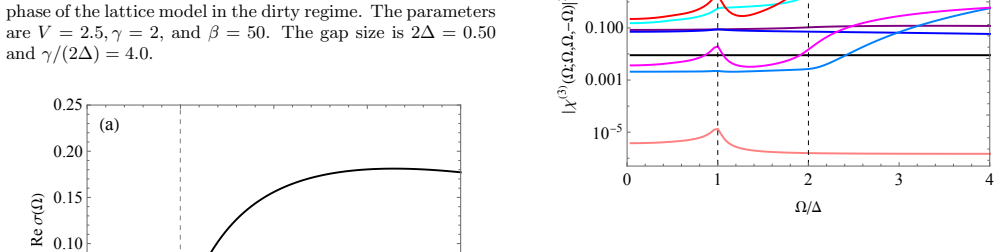
- [Figures 6, 8, 12, 13] The plotted quantity is |χ(3)|², not the actual 2DCS signal. The captions should state that the divergent prefactors and principal-value integrals in Eqs. (39)-(40) are not included.
- [Eqs. (39)-(40)] The sentence 'the frequency integral ... on top of the dc Kerr susceptibility' could be misread; the P∫ terms are the regular part of the same convolution, not a separate additive contribution. Consider rewording for clarity.
- [Table II] In the clean/ac-Kerr column, the entry 'Higgs (off-resonant)' may confuse because Fig. 12 shows the H3 diagram dominates while the resonance at Ω=Δ is quasiparticle-dominated. A footnote distinguishing 'dominant diagram' from 'resonant process' would help.
Circularity Check
No significant circularity: the 2DCS-to-χ(3) relations are derived analytically from the general convolution formula, and the numerical susceptibilities are computed from the model rather than fitted.
full rationale
The paper's central derivation is self-contained. Starting from the general 2DCS convolution formula (Eq. (21)), inserting the δ-function pulse spectra of the broad-band limit yields Eqs. (34) and (37). At the diagonal and horizontal lines, the identity 1/(ω+iη)=P(1/ω)−iπδ(ω), combined with the exchange symmetry of χ(3), selects χ(3)(Ω;0,0,Ω)=χ(3)(Ω;Ω,0,0). This is an analytic identity, not a fitted parameter or a definitional sleight: the dc Kerr susceptibility is not put in by hand, it emerges from the frequency integral. The numerical evaluation solves the BCS gap equation and the self-consistent Born approximation self-consistently (Appendix A), with the impurity and Higgs-mode vertex equations and all susceptibility diagrams written out explicitly in Appendices B and C. The gap Δ, the threshold at 2Δ, and the resonance at 2Δ are outputs of the calculation, not inputs. Citations to the author's previous THG work (Ref. [50]) are used for diagrammatic bookkeeping, but the paper states the actual equations, so the derivation does not reduce to the citation. The acknowledged limitation is that realistic finite-bandwidth pulses require evaluating Eqs. (39)–(40), which is an uncomputed convolution and a potential applicability gap, not a circularity: the delta-pulse limit result stands on its own.
Assumptions & free parameters
free parameters (5)
- V (attractive interaction strength) =
2.5 (in units of t_h)
- γ (disorder scattering rate) =
2 (dirty) / 0.5 (clean)
- β (inverse temperature) =
50
- η (broadening factor) =
0.01
- N (number of k points) =
100x100
assumptions (6)
- domain assumption BCS mean-field decoupling of the pairing interaction
- domain assumption Self-consistent Born approximation for disorder
- domain assumption Inversion symmetry of the lattice, so second-order response vanishes
- standard math Keldysh formalism and Langreth rules
- domain assumption Scale separation of dirty regime, Eq. (1)
- domain assumption Higgs mode propagator via τ1 vertex with ladder impurity corrections
Cite this review
Pith. "Pith review of Two-dimensional coherent spectroscopy of disordered superconductors in the narrow-band and broad-band limits." pith.science (2026). https://pith.science/paper/432BEUIL
@misc{pith2026250903936,
  author       = {Pith},
  title        = {Pith review of: Two-dimensional coherent spectroscopy of disordered superconductors in the narrow-band and broad-band limits},
  year         = {2026},
  howpublished = {\url{https://pith.science/paper/432BEUIL}},
  note         = {Machine review of arXiv:2509.03936}
}
abstract
We theoretically analyze two-dimensional coherent spectroscopy (2DCS) signals for disordered superconductors in two limits: One is the narrow-band limit with sinusoidal pulse waves, and the other is the broad-band limit with delta-function pulses. While the 2DCS signal in the narrow-band limit is related to the third-order nonlinear susceptibilities $\chi^{(3)}(3\Omega; \Omega, \Omega, \Omega)$ (third harmonic generation) and $\chi^{(3)}(\Omega; \Omega, \Omega, -\Omega)$ (ac Kerr effect), we find that in the broad-band limit the signal along the diagonal and horizontal lines in the two-dimensional frequency space is related to another nonlinear susceptibility $\chi^{(3)}(\Omega; \Omega, 0, 0)$ (dc Kerr effect). We numerically evaluate those susceptibilities for a lattice model of superconductors based on the BCS mean-field theory and self-consistent Born approximation for impurities. The 2DCS signals in the narrow-band and broad-band limits show threshold and resonance behaviors at the superconducting-gap frequency, respectively, whose physical origin is discussed in light of quasiparticle and Higgs-mode excitations.
Figures


Figures from the paper (8 more)



Forward citations
Cited by 2 Pith papers
-
Two-dimensional THz spectroscopy in electronic systems: a many-body diagrammatic approach
A many-body diagrammatic theory computes 2D THz spectroscopy maps from third-order nonlinear kernels, separates paramagnetic and diamagnetic processes, and shows propagation through the sample can dominate and mask th...
-
Power attenuation in millimeter-wave and terahertz superconducting rectangular waveguides: linear response, TLS loss, and Higgs-mode nonlinearity
A microscopic framework predicts power attenuation in superconducting rectangular waveguides from 100 GHz to THz, including TLS oxide losses and a predicted Higgs-mode peak in attenuation near the gap frequency.
Reference graph
Works this paper leans on
-
[1]
Mukamel, Principles of Nonlinear Optical Spectroscopy (Oxford University Press, 1995)
S. Mukamel, Principles of Nonlinear Optical Spectroscopy (Oxford University Press, 1995)
1995
-
[2]
The blue and purple markers correspond to the third harmonic generation and ac Kerr susceptibilities, respectively. response, the broad-band pulses are modeled by delta- functions, E(t) = A1δ(t) + A2δ(t + τ ), (30) where the pulse 1 is centered at t = 0, and the pulse 2 is centered at t = −τ . The corresponding vector potential is given by A(t) = A1(t) +A...
-
[3]
Coherent two-dimensional optical spec- troscopy,
M. Cho, “Coherent two-dimensional optical spec- troscopy,” Chem. Rev. 108, 1331 (2008). 20
work page 2008
-
[4]
P. Hamm and M. Zanni, Concepts and Methods of 2D In- frared Spectroscopy(Cambridge University Press, Cam- bridge, 2011)
work page 2011
-
[5]
Co- herent two-dimensional and broadband electronic spec- troscopies,
S. Biswas, J.-W. Kim, X. Zhang, and G. D. Scholes, “Co- herent two-dimensional and broadband electronic spec- troscopies,” Chem. Rev. 122, 4257 (2022)
work page 2022
-
[6]
Two-dimensional electronic spectroscopy,
E. Fresch, F. V. A. Camargo, Q. Shen, C. C. Bellora, T. Pullerits, G. S. Engel, G. Cerullo, and E. Collini, “Two-dimensional electronic spectroscopy,” Nat. Rev. Methods Primers 3, 84 (2023)
work page 2023
-
[7]
Multidimensional terahertz probes of quantum materials,
A. Liu, “Multidimensional terahertz probes of quantum materials,” npj Quant. Mater. 10, 18 (2025)
work page 2025
-
[8]
C. Huang and M. Mootz and L. Luo and I. E. Perakis and J. Wang, “Unlocking Quantum Control and Multi- Order Correlations via Terahertz Two-Dimensional Co- herent Spectroscopy”, arXiv:2507.02116
Show all 77 references
-
[9]
Higgs and Nambu-Goldstone modes in condensed matter physics,
N. Tsuji, I. Danshita, and S. Tsuchiya, “Higgs and Nambu-Goldstone modes in condensed matter physics,” in Encyclopedia of Condensed Matter Physics (Second Edition) (Academic Press, Oxford, 2024) 2nd ed., pp. 174–186
2024
-
[10]
Random-Phase Approximation in the Theory of Superconductivity,
P. W. Anderson, “Random-Phase Approximation in the Theory of Superconductivity,” Phys. Rev. 112, 1900 (1958)
1900
-
[11]
The approach to equilibrium in a pure su- perconductor the relaxation of the Cooper pair density,
A. Schmid, “The approach to equilibrium in a pure su- perconductor the relaxation of the Cooper pair density,” Phys. Kondens. Mater. 8, 129 (1968)
1968
-
[12]
Amplitude/Higgs Modes in Condensed Matter Physics,
D. Pekker and C.M. Varma, “Amplitude/Higgs Modes in Condensed Matter Physics,” Annu. Rev. Condens. Mat- ter Phys. 6, 269 (2015)
2015
-
[13]
Higgs Mode in Superconduc- tors,
R. Shimano and N. Tsuji, “Higgs Mode in Superconduc- tors,” Annu. Rev. Condens. Matter Phys. 11, 103 (2020)
2020
-
[14]
Amplitude Higgs Mode and Admittance in Superconductors with a Moving Condensate,
A. Moor, A. F. Volkov, and K. B. Efetov, “Amplitude Higgs Mode and Admittance in Superconductors with a Moving Condensate,” Phys. Rev. Lett. 118, 047001 (2017)
2017
-
[15]
Infrared Activation of the Higgs Mode by Supercurrent Injection in Superconduct- ing NbN,
S. Nakamura, Y. Iida, Y. Murotani, R. Matsunaga, H. Terai, and R. Shimano, “Infrared Activation of the Higgs Mode by Supercurrent Injection in Superconduct- ing NbN,” Phys. Rev. Lett. 122, 257001 (2019)
2019
-
[16]
Significant contributions of the Higgs mode and impurity-scattering self-energy corrections to the low-frequency complex conductivity in dc-biased super- conducting devices,
T. Kubo, “Significant contributions of the Higgs mode and impurity-scattering self-energy corrections to the low-frequency complex conductivity in dc-biased super- conducting devices,” Phys. Rev. Appl.22, 044042 (2024)
2024
-
[17]
Higgs amplitude mode in optical conductivity in the presence of a su- percurrent: Gauge-invariant formulation with disorder,
K. Wang, R. Boyack, and K. Levin, “Higgs amplitude mode in optical conductivity in the presence of a su- percurrent: Gauge-invariant formulation with disorder,” Phys. Rev. B 111, 144512 (2025)
2025
-
[18]
Opti- cally active Higgs and Leggett modes in multiband pair- density-wave superconductors with Lifshitz invariant,
R. Nagashima, T. Mouilleron, and N. Tsuji, “Opti- cally active Higgs and Leggett modes in multiband pair- density-wave superconductors with Lifshitz invariant,” Phys. Rev. B 112, 024503 (2025)
2025
-
[19]
Current-Enabled Optical Conductivity of Col- lective Modes in Unconventional Superconductors
G. Niederhoff, R. Kataoka, K. Takasan, and N. Tsuji, “Current-Enabled Optical Conductivity of Col- lective Modes in Unconventional Superconductors”, arXiv:2504.06642
-
[20]
Raman scattering by superconducting-gap excitations and their coupling to charge-density waves,
R. Sooryakumar and M. V. Klein, “Raman scattering by superconducting-gap excitations and their coupling to charge-density waves,” Phys. Rev. Lett. 45, 660–662 (1980)
1980
-
[21]
Raman scattering from superconducting gap excitations in the presence of a magnetic field,
R. Sooryakumar and M. V. Klein, “Raman scattering from superconducting gap excitations in the presence of a magnetic field,” Phys. Rev. B 23, 3213–3221 (1981)
1981
-
[22]
Gauge-Invariant Theory of the Dynamical Interaction of Charge Density Waves and Superconductivity,
P. B. Littlewood and C. M. Varma, “Gauge-Invariant Theory of the Dynamical Interaction of Charge Density Waves and Superconductivity,” Phys. Rev. Lett.47, 811– 814 (1981)
1981
-
[23]
Amplitude collective modes in superconductors and their coupling to charge- density waves,
P. B. Littlewood and C. M. Varma, “Amplitude collective modes in superconductors and their coupling to charge- density waves,” Phys. Rev. B 26, 4883 (1982)
1982
-
[24]
Amplitude Higgs mode in the 2 H − NbSe2 superconductor,
M.-A. M´ easson, Y. Gallais, M. Cazayous, B. Clair, P. Rodi` ere, L. Cario, and A. Sacuto, “Amplitude Higgs mode in the 2 H − NbSe2 superconductor,” Phys. Rev. B 89, 060503 (2014)
2014
-
[25]
Higgs-mode radiance and charge-density-wave order in 2H − NbSe2,
R. Grasset, T. Cea, Y. Gallais, M. Cazayous, A. Sacuto, L. Cario, L. Benfatto, and M.-A. M´ easson, “Higgs-mode radiance and charge-density-wave order in 2H − NbSe2,” Phys. Rev. B 97, 094502 (2018)
2018
-
[26]
Pressure- Induced Collapse of the Charge Density Wave and Higgs Mode Visibility in 2 H−TaS2,
R. Grasset, Y. Gallais, A. Sacuto, M. Cazayous, S. Ma˜ nas Valero, E. Coronado, and M.-A. M´ easson, “Pressure- Induced Collapse of the Charge Density Wave and Higgs Mode Visibility in 2 H−TaS2,” Phys. Rev. Lett. 122, 127001 (2019)
2019
-
[27]
Higgs Amplitude Mode in the BCS Superconductors Nb 1−xTixN Induced by Terahertz Pulse Excitation,
R. Matsunaga, Y. I. Hamada, K. Makise, Y. Uzawa, H. Terai, Z. Wang, and R. Shimano, “Higgs Amplitude Mode in the BCS Superconductors Nb 1−xTixN Induced by Terahertz Pulse Excitation,” Phys. Rev. Lett. 111, 057002 (2013)
2013
-
[28]
Light-induced collective pseudospin preces- sion resonating with Higgs mode in a superconductor,
R. Matsunaga, N. Tsuji, H. Fujita, A. Sugioka, K. Makise, Y. Uzawa, H. Terai, Z. Wang, H. Aoki, and R. Shimano, “Light-induced collective pseudospin preces- sion resonating with Higgs mode in a superconductor,” Science 345, 1145 (2014)
2014
-
[29]
Higgs Mode in the d-Wave Super- conductor Bi 2Sr2CaCu2O8+x Driven by an Intense Ter- ahertz Pulse,
K. Katsumi, N. Tsuji, Y. I. Hamada, R. Matsunaga, J. Schneeloch, R. D. Zhong, G. D. Gu, H. Aoki, Y. Gal- lais, and R. Shimano, “Higgs Mode in the d-Wave Super- conductor Bi 2Sr2CaCu2O8+x Driven by an Intense Ter- ahertz Pulse,” Phys. Rev. Lett. 120, 117001 (2018)
2018
-
[30]
Superconducting fluctuations probed by the Higgs mode in Bi 2Sr2CaCu2O8+x thin films,
K. Katsumi, Z. Z. Li, H. Raffy, Y. Gallais, and R. Shimano, “Superconducting fluctuations probed by the Higgs mode in Bi 2Sr2CaCu2O8+x thin films,” Phys. Rev. B 102, 054510 (2020)
2020
-
[31]
Theory of Anderson pseudospin resonance with Higgs mode in superconductors,
N. Tsuji and H. Aoki, “Theory of Anderson pseudospin resonance with Higgs mode in superconductors,” Phys. Rev. B 92, 064508 (2015)
2015
-
[32]
Polarization-resolved terahertz third- harmonic generation in a single-crystal superconductor NbN: Dominance of the Higgs mode beyond the BCS approximation,
R. Matsunaga, N. Tsuji, K. Makise, H. Terai, H. Aoki, and R. Shimano, “Polarization-resolved terahertz third- harmonic generation in a single-crystal superconductor NbN: Dominance of the Higgs mode beyond the BCS approximation,” Phys. Rev. B 96, 020505 (2017)
2017
-
[33]
Phase-resolved Higgs response in super- conducting cuprates,
H. Chu, M.-J. Kim, K. Katsumi, S. Kovalev, R. D. Daw- son, L. Schwarz, N. Yoshikawa, G. Kim, D. Putzky, Z. Z. Li, H. Raffy, S. Germanskiy, J.-C. Deinert, N. Awari, I. Ilyakov, B. Green, M. Chen, M. Bawatna, G. Cristiani, G. Logvenov, Y. Gallais, A. V. Boris, B. Keimer, A. P. S...
2020
-
[34]
Band- selective third-harmonic generation in superconducting MgB2: Possible evidence for the Higgs amplitude mode in the dirty limit,
S. Kovalev, T. Dong, L.-Y. Shi, C. Reinhoffer, T.-Q. Xu, H.-Z. Wang, Y. Wang, Z.-Z. Gan, S. German- skiy, J.-C. Deinert, I. Ilyakov, P. H. M. van Loosdrecht, D. Wu, N.-L. Wang, J. Demsar, and Z. Wang, “Band- selective third-harmonic generation in superconducting MgB2: Possible...
2021
-
[35]
Light-induced enhancement of super- 21 conductivity in iron-based superconductor FeSe0.5Te0.5,
K. Isoyama, N. Yoshikawa, K. Katsumi, J. Wong, N. Shikama, Y. Sakishita, F. Nabeshima, A. Maeda, and R. Shimano, “Light-induced enhancement of super- 21 conductivity in iron-based superconductor FeSe0.5Te0.5,” Commun. Phys. 4, 160 (2021)
2021
-
[36]
Transient Higgs oscillations and high-order nonlinear light-Higgs coupling in a terahertz wave driven NbN superconduc- tor,
Z.-X. Wang, J.-R. Xue, H.-K. Shi, X.-Q. Jia, T. Lin, L.- Y. Shi, T. Dong, F. Wang, and N.-L. Wang, “Transient Higgs oscillations and high-order nonlinear light-Higgs coupling in a terahertz wave driven NbN superconduc- tor,” Phys. Rev. B 105, L100508 (2022)
2022
-
[37]
Near-infrared light-induced superconducting-like state in underdoped YBa 2Cu3Oy studied by c-axis terahertz third-harmonic generation,
K. Katsumi, M. Nishida, S. Kaiser, S. Miyasaka, S. Tajima, and R. Shimano, “Near-infrared light-induced superconducting-like state in underdoped YBa 2Cu3Oy studied by c-axis terahertz third-harmonic generation,” Phys. Rev. B 107, 214506 (2023)
2023
-
[38]
Tracing the dynamics of superconducting order via tran- sient terahertz third-harmonic generation,
M.-J. Kim, S. Kovalev, M. Udina, R. Haenel, G. Kim, M. Puviani, G. Cristiani, I. Ilyakov, T. V. A. G. de Oliveira, A. Ponomaryov, J.-C. Deinert, G. Logvenov, B. Keimer, D. Manske, L. Benfatto, and S. Kaiser, “Tracing the dynamics of superconducting order via tran- sient terahe...
2024
-
[39]
Revealing Novel Aspects of Light- Matter Coupling by Terahertz Two-Dimensional Coher- ent Spectroscopy: The Case of the Amplitude Mode in Superconductors,
K. Katsumi, J. Fiore, M. Udina, R. Romero, D. Barbalas, J. Jesudasan, P. Raychaudhuri, G. Seibold, L. Benfatto, and N. P. Armitage, “Revealing Novel Aspects of Light- Matter Coupling by Terahertz Two-Dimensional Coher- ent Spectroscopy: The Case of the Amplitude Mode in Superc...
2024
-
[40]
Amplitude Mode in a Multigap Superconductor MgB 2 Investigated by Terahertz Two- Dimensional Coherent Spectroscopy,
K. Katsumi, J. Liang, R. Romero, K. Chen, X. Xi, and N. P. Armitage, “Amplitude Mode in a Multigap Superconductor MgB 2 Investigated by Terahertz Two- Dimensional Coherent Spectroscopy,” Phys. Rev. Lett. 135, 036902 (2025)
2025
-
[41]
Observation of cupratelike nonlinear terahertz responses in supercon- ducting infinite-layer nickelates via two-dimensional co- herent spectroscopy,
B. Cheng, D. Cheng, K. Lee, M. Mootz, C. Huang, L. Luo, Z. Chen, Y. Lee, B. Y. Wang, I. E. Perakis, Z.-X. Shen, H. Y. Hwang, and J. Wang, “Observation of cupratelike nonlinear terahertz responses in supercon- ducting infinite-layer nickelates via two-dimensional co- herent spe...
2025
-
[42]
Planckian dissipation, anomalous high temperature THz non-linear response and energy relaxation in the strange metal state of the cuprate superconductors
D. Chaudhuri and D. Barbalas and F. Mahmood and J. Liang and R. Romero III and A. Legros and X. He and H. Raffy and I. Bozovic and N. P. Armitage, “Planckian dissipation, anomalous high temperature THz non-linear response and energy relaxation in the strange metal state of the...
-
[43]
Multidimensional coherent spectroscopy of light-driven states and their collective modes in multiband supercon- ductors,
M. Mootz, L. Luo, C. Huang, J. Wang, and I. E. Perakis, “Multidimensional coherent spectroscopy of light-driven states and their collective modes in multiband supercon- ductors,” Phys. Rev. B 109, 014515 (2024)
2024
-
[44]
Principles of two-dimensional terahertz spec- troscopy of collective excitations: The case of Josephson plasmons in layered superconductors,
A. G´ omez Salvador, P. E. Dolgirev, M. H. Michael, A. Liu, D. Pavicevic, M. Fechner, A. Cavalleri, and E. Demler, “Principles of two-dimensional terahertz spec- troscopy of collective excitations: The case of Josephson plasmons in layered superconductors,” Phys. Rev. B110, 09...
2024
-
[45]
Multidimensional coherent spec- troscopy of correlated lattice systems,
J. Chen and P. Werner, “Multidimensional coherent spec- troscopy of correlated lattice systems,” npj Comput. Mater. 11, 127 (2025)
2025
-
[46]
Higgs mode in two-dimensional coherent spectroscopy of weak-coupling antiferromagnets
J. Chen and N. Tsuji and P. Werner, “Higgs mode in two-dimensional coherent spectroscopy of weak-coupling antiferromagnets”, arXiv:2504.21351
-
[47]
Theory of the Anoma- lous Skin Effect in Normal and Superconducting Metals,
D. C. Mattis and J. Bardeen, “Theory of the Anoma- lous Skin Effect in Normal and Superconducting Metals,” Phys. Rev. 111, 412 (1958)
1958
-
[48]
Quasiclassical Theory on Third-Harmonic Gen- eration in Conventional Superconductors with Paramag- netic Impurities,
T. Jujo, “Quasiclassical Theory on Third-Harmonic Gen- eration in Conventional Superconductors with Paramag- netic Impurities,” J. Phys. Soc. Jpn. 87, 024704 (2018)
2018
-
[49]
Nonlinear optical re- sponse of collective modes in multiband superconductors assisted by nonmagnetic impurities,
Y. Murotani and R. Shimano, “Nonlinear optical re- sponse of collective modes in multiband superconductors assisted by nonmagnetic impurities,” Phys. Rev. B 99, 224510 (2019)
2019
-
[50]
Nonlinear electromagnetic response and Higgs-mode excitation in BCS superconductors with im- purities,
M. Silaev, “Nonlinear electromagnetic response and Higgs-mode excitation in BCS superconductors with im- purities,” Phys. Rev. B 99, 224511 (2019)
2019
-
[51]
Higgs-mode resonance in third harmonic generation in NbN superconductors: Multiband electron-phonon coupling, impurity scatter- ing, and polarization-angle dependence,
N. Tsuji and Y. Nomura, “Higgs-mode resonance in third harmonic generation in NbN superconductors: Multiband electron-phonon coupling, impurity scatter- ing, and polarization-angle dependence,” Phys. Rev. Res. 2, 043029 (2020)
2020
-
[52]
Third harmonic generation from collective modes in dis- ordered superconductors,
G. Seibold, M. Udina, C. Castellani, and L. Benfatto, “Third harmonic generation from collective modes in dis- ordered superconductors,” Phys. Rev. B 103, 014512 (2021)
2021
-
[53]
Nonlinear light– Higgs coupling in superconductors beyond BCS: Effects of the retarded phonon-mediated interaction,
N. Tsuji, Y. Murakami, and H. Aoki, “Nonlinear light– Higgs coupling in superconductors beyond BCS: Effects of the retarded phonon-mediated interaction,” Phys. Rev. B 94, 224519 (2016)
2016
-
[54]
Nonlinear op- tical effects and third-harmonic generation in supercon- ductors: Cooper pairs versus Higgs mode contribution,
T. Cea, C. Castellani, and L. Benfatto, “Nonlinear op- tical effects and third-harmonic generation in supercon- ductors: Cooper pairs versus Higgs mode contribution,” Phys. Rev. B 93, 180507 (2016)
2016
-
[55]
In order to have a difference of several orders of magnitudes between vF W and L, we need at least L ≳ 102a
Typically, in lattice models one has vF ∼ W a. In order to have a difference of several orders of magnitudes between vF W and L, we need at least L ≳ 102a
-
[56]
Scaling Theory of Localization: Absence of Quantum Diffusion in Two Dimensions,
E. Abrahams, P. W. Anderson, D. C. Licciardello, and T. V. Ramakrishnan, “Scaling Theory of Localization: Absence of Quantum Diffusion in Two Dimensions,” Phys. Rev. Lett. 42, 673 (1979)
1979
-
[57]
Anderson Localization in Two Dimensions,
P. A. Lee and D. S. Fisher, “Anderson Localization in Two Dimensions,” Phys. Rev. Lett. 47, 882 (1981)
1981
-
[58]
Rammer, Quantum Field Theory of Non-equilibrium States (Cambridge University Press, Cambridge, 2007)
J. Rammer, Quantum Field Theory of Non-equilibrium States (Cambridge University Press, Cambridge, 2007)
2007
-
[59]
On the theory of superconducting alloys I. The electrodynamics of alloys at absolute zero
A. A. Abrikosov and L. P. Gor’kov, “On the theory of superconducting alloys I. The electrodynamics of alloys at absolute zero”, Sov. Phys. JETP 8, 1090 (1959)
1959
-
[60]
Diagrammatic technique for nonequilib- rium processes
L. V. Keldysh, “Diagrammatic technique for nonequilib- rium processes”, Sov. Phys. JETP 20, 1018 (1965)
1965
-
[61]
Nonequilibrium dynamical mean-field theory and its applications,
H. Aoki, N. Tsuji, M. Eckstein, M. Kollar, T. Oka, and P. Werner, “Nonequilibrium dynamical mean-field theory and its applications,” Rev. Mod. Phys. 86, 779 (2014)
2014
-
[62]
Two-Photon Absorption by Impurity Scatter- ing and Amplitude Mode in Conventional Superconduc- tors,
T. Jujo, “Two-Photon Absorption by Impurity Scatter- ing and Amplitude Mode in Conventional Superconduc- tors,” J. Phys. Soc. Jpn. 84, 114711 (2015)
2015
-
[63]
Magnetoresistance and Hall effect in a disordered two-dimensional electron gas,
B. L. Altshuler, D. Khmel’nitzkii, A. I. Larkin, and P. A. Lee, “Magnetoresistance and Hall effect in a disordered two-dimensional electron gas,” Phys. Rev. B 22, 5142– 5153 (1980)
1980
-
[64]
Number-Phase Fluctuations in Two-Band Superconductors,
A. J. Leggett, “Number-Phase Fluctuations in Two-Band Superconductors,” Prog. Theor. Phys. 36, 901 (1966)
1966
-
[65]
Signatures of nonadiabatic BCS state dynamics in pump-probe conductivity,
H. Krull, D. Manske, G. S. Uhrig, and A. P. Schny- der, “Signatures of nonadiabatic BCS state dynamics in pump-probe conductivity,” Phys. Rev. B 90, 014515 (2014)
2014
-
[66]
Theory of light- induced resonances with collective Higgs and Leggett modes in multiband superconductors,
Y. Murotani, N. Tsuji, and H. Aoki, “Theory of light- induced resonances with collective Higgs and Leggett modes in multiband superconductors,” Phys. Rev. B 95, 104503 (2017)
2017
-
[67]
Optical response of the Leggett mode in multiband superconductors in the linear response regime,
T. Kamatani, S. Kitamura, N. Tsuji, R. Shimano, and T. Morimoto, “Optical response of the Leggett mode in multiband superconductors in the linear response regime,” Phys. Rev. B 105, 094520 (2022). 22
2022
-
[68]
Classification of Lifshitz invariant in multi- band superconductors: An application to Leggett modes in the linear response regime in Kagome lattice models,
R. Nagashima, S. Tian, R. Haenel, N. Tsuji, and D. Manske, “Classification of Lifshitz invariant in multi- band superconductors: An application to Leggett modes in the linear response regime in Kagome lattice models,” Phys. Rev. Res. 6, 013120 (2024)
2024
-
[69]
Role of Higgs and Leggett modes for the third harmonic response in noncentrosym- metric superconductors,
S. Klein and D. Manske, “Role of Higgs and Leggett modes for the third harmonic response in noncentrosym- metric superconductors,” Phys. Rev. B 110, 014510 (2024)
2024
-
[70]
Linear spectroscopy of collective modes and the gap structure in two-dimensional superconductors,
B. A. Levitan, Y. Oreg, E. Berg, M. S. Rudner, and I. Iorsh, “Linear spectroscopy of collective modes and the gap structure in two-dimensional superconductors,” Phys. Rev. Res. 6, 043170 (2024)
2024
-
[71]
Amplitude or Higgs modes in d-wave superconductors,
Y. Barlas and C. M. Varma, “Amplitude or Higgs modes in d-wave superconductors,” Phys. Rev. B 87, 054503 (2013)
2013
-
[72]
Classification and character- ization of nonequilibrium Higgs modes in unconventional superconductors,
L. Schwarz, B. Fauseweh, N. Tsuji, N. Cheng, N. Bit- tner, H. Krull, M. Berciu, G. S. Uhrig, A. P. Schnyder, S. Kaiser, and D. Manske, “Classification and character- ization of nonequilibrium Higgs modes in unconventional superconductors,” Nat. Commun. 11, 287 (2020)
2020
-
[73]
Theory of driven Higgs oscil- lations and third-harmonic generation in unconventional superconductors,
L. Schwarz and D. Manske, “Theory of driven Higgs oscil- lations and third-harmonic generation in unconventional superconductors,” Phys. Rev. B 101, 184519 (2020)
2020
-
[74]
Light quantum control of persist- ing Higgs modes in iron-based superconductors,
C. Vaswani, J. H. Kang, M. Mootz, L. Luo, X. Yang, C. Sundahl, D. Cheng, C. Huang, R. H. J. Kim, Z. Liu, Y. G. Collantes, E. E. Hellstrom, I. E. Perakis, C. B. Eom, and J. Wang, “Light quantum control of persist- ing Higgs modes in iron-based superconductors,” Nat. Commun. 12,...
2021
-
[75]
Spectroscopic signatures of time-reversal symmetry breaking superconductivity,
N. R. Poniatowski, J. B. Curtis, A. Yacoby, and P. Narang, “Spectroscopic signatures of time-reversal symmetry breaking superconductivity,” Commun. Phys. 5, 44 (2022)
2022
-
[76]
Excitons and Plasmons in Superconductors,
A. Bardasis and J. R. Schrieffer, “Excitons and Plasmons in Superconductors,” Phys. Rev. 121, 1050 (1961)
1961
-
[77]
D. C. Langreth, in Linear and Nonlinear Electron Trans- port in Solids, edited by J. T. Devreese and V. E. van Doren (Plenum Press, New York, 1976)
1976
Reviewed August 5, 2026 · model on record in the stance chip above.
Discussion (0). Continue with ORCID to comment.