REVIEW 2 major objections 5 minor 75 references
Hubbard dimer physics and the magnetostructural transition in the correlated cluster material Nb$_3$Cl$_8$
T0 review · 2 major / 5 minor · reviewed 2026-08-05 · deepseek-v4-flash
Pith's one-line read The magnetic transition in Nb3Cl8 is driven by a layer-stacking change that pairs Nb3 trimers into weakly coupled Hubbard dimers, not by charge disproportionation, which the calculations rule out.
desk verdict A solid, honest computational study that convincingly rules out charge disproportionation in Nb3Cl8 and makes a strong case for a Hubbard-dimer picture, but leaves a key gap between the ideal R-3m model and the actual C2/m ground state. read the letter →
The pith
A machine-rendered reading of the paper's core claim, the machinery that carries it, and where it could break.
The reading
What carries the argument
The carrying object is the two-site impurity cluster in DFT+DMFT: a 'dimer of trimers' built from trimer-centered Wannier orbitals, with intratrimer Utr = 1.46 eV, intertrimer Vtr = 0.38 eV, interlayer hopping tLT = 0.13 eV, and in-plane hopping only 0.02 eV. This maps the low-temperature phase onto the exactly solvable Hubbard dimer, whose gap Eg = −2t + V + sqrt((U − V)^2 + 16t^2) and ground state interpolate between a Heitler-London antiferromagnetic state (U >> V) and a bonding-antibonding singlet (U = V). In the atomic-basis calculation the analogous machinery is the three-orbital impurity representing the three Nb d orbitals of one trimer, with Uat ≈ 2.3 eV and Vat_intra ≈ 1.36 eV; wit
What would settle it
A resonant X-ray scattering or core-level absorption experiment on β-Nb3Cl8 below 90 K that resolves the two stacked trimer sites would falsify one side: charge disproportionation predicts an occupation difference of roughly one electron between them, while this paper predicts essentially none. Alternatively, neutron scattering that shows long-range antiferromagnetic order would contradict the proposed strongly-correlated singlet/fluctuation picture.
Extended reading notes
Core claim
The central claim is that the magnetostructural transition in bulk Nb3Cl8 is primarily a stacking transition. In the high-temperature α phase, adjacent layers stagger so interlayer trimer hopping is tiny (0.01 eV); in the low-temperature β phase the stacking shifts so that nearest trimers approach to about 6.1 Å and the hopping grows to about 0.13 eV. This creates paired 'dimers of trimers' along the stacking direction. The authors show, using spin-polarized DFT+U+V and two-site cluster DFT+DMFT, that this dimerization alone — without any trimer breathing mode or charge order — accounts for the insulating gap and the strong suppression of magnetic susceptibility: either through strong antife
Load-bearing premise
The argument stands or falls on whether Nb3Cl8's low-temperature physics is faithfully captured by the two-site dimer model with the computed parameters (Utr=1.46 eV, Vtr=0.38 eV, tLT=0.13 eV), and on the mixed halide Nb3Br4Cl4 standing in for Nb3Cl8 where the LT structure could not be measured directly.
Editorial extensions
If this is right
- β-Nb3Cl8 should be described as a weakly coupled Hubbard dimer system, not a charge-ordered cluster Mott insulator; the R3 breathing structure is energetically unfavourable.
- The stacking change alone opens the insulating gap and quenches local moments, so a symmetry-lowering distortion within the layers is not needed to explain the susceptibility drop.
- Nb3Cl8 sits near the Mott limit, while Nb3Br8 and Nb3I8 lie closer to the interlayer-singlet band-insulator limit, making the family a tunable Mott-to-band platform.
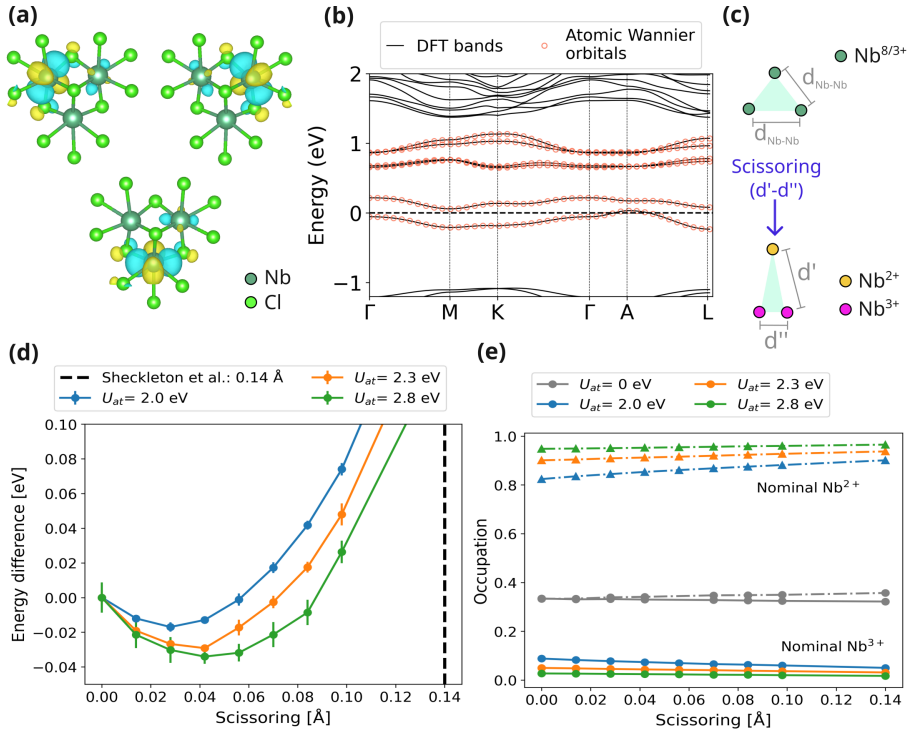
- Intratrimer Coulomb repulsion localizes charge on one Nb atom per trimer (nominal Nb2+/Nb3+), explaining the small scissoring distortion observed in the C2/m structure.
- Because the magnetic transition involves no charge disproportionation, magnetic hysteresis need not be mirrored by hysteresis in electrical conductivity, as observed.
Reading between the lines
- Because the crossover is controlled by the ratio of Coulomb interactions to hopping, pressure, strain, or halogen substitution could push Nb3Br8 or Nb3I8 between Mott-like and singlet behaviour — a testable extension beyond the paper's cRPA point estimates.
- The same 'dimer of trimers' picture may apply to other layered cluster materials with two inequivalent interlayer stackings; a survey of Nb3X8 analogues would show whether the scissoring amplitude universally tracks the computed onsite interaction Uat.
- The authors' comparison of synthesis routes suggests the LT polymorph is sensitive to defects or impurities; a systematic study correlating synthesis conditions with the observed space group could resolve the R3m-versus-C2/m ambiguity.
Signed reviews
Editorial analysis
A structured set of objections, weighed in public.
Referee Report
Summary. The paper combines DFT+U+V, DFT+DMFT, and experimental measurements on Nb3Cl8 and Nb3Cl4Br4 to identify the mechanism of the magnetostructural transition in the cluster compound Nb3Cl8. Using trimer-centered Wannier orbitals for the ideal R-3m low-temperature stacking, the authors find that the proposed trimer-breathing/charge-disproportionation state is energetically unfavorable and does not open a gap in spin-unpolarized calculations. In spin-polarized DFT+U+V they identify a competition between an intratrimer-U-driven Mott state with antiferromagnetic trimer moments and an intertrimer-V-driven bonding/singlet state. DFT+DMFT on a two-trimer cluster shows a continuous crossover between these two insulating limits, with cRPA parameters placing Nb3Cl8 closer to the Mott limit. In an atomic-orbital basis, the same methods find that the single hole/electron per trimer localizes on one Nb atom, driving a scissoring distortion that lowers R-3m to C2/m. The experimental part reports a P-3m1 to C2/m transition in Nb3Cl4Br4 with pronounced interlayer dimerization, magnetic and conductivity data for Nb3Cl8, and room-temperature optical gaps. The central conclusion is that the stacking change, and the resulting interlayer Hubbard-dimer physics, is the primary driver of the magnetic transition, while the intratrimer scissoring is secondary.
Significance. If the central claim holds, the paper resolves a long-standing controversy about the low-temperature phase of Nb3Cl8: it rules out charge disproportionation, connects the Mott and band-insulator descriptions through a continuous crossover, and provides a testable scenario for the C2/m scissoring distortion. The work is valuable for the Nb3X8 family and for cluster-Mott insulators more generally. Strengths include: interaction parameters obtained from cRPA rather than fitted to the target observables; an exact two-site Hubbard-dimer benchmark for the interpretation; charge-self-consistent DFT+DMFT with explicit impurity solvers; and new single-crystal XRD, magnetic, conductivity, and optical data. The paper also makes falsifiable predictions, e.g., synthesis-dependent stability of R-3m vs C2/m and tunability of the Mott-to-band-insulator crossover by pressure or substitution.
major comments (2)
- [Dynamical effects in the R3m phase / Further symmetry lowering in the beta-Nb3Cl8 phase (Figs. 4 and 5)] The central claim that stacking dimerization is the primary driver and that Nb3Cl8 is a set of weakly coupled Hubbard dimers is established for the ideal R-3m structure using delocalized trimer Wannier orbitals (tLT=0.13 eV, tin-plane=0.02 eV). However, the atomic-basis DFT+DMFT for the C2/m scissoring, Fig. 5(e), finds that the unpaired electron localizes on a single Nb atom per trimer (one Nb2+, two Nb3+), which is a qualitatively different low-energy orbital. The manuscript does not show that the effective interlayer hopping tLT and the Hubbard parameters Utr,Vtr still describe the interlayer singlet once intratrimer localization is included, nor that the R-3m molecular-orbital dimer ground state connects continuously to the C2/m localized ground state. Since the experimentally realized LT phase is C2/m (or at least lower than R-3m), the statement that the magnetic transition is prima
- [Experimental section, Crystallography (Table 1, Fig. 7)] The new single-crystal diffraction evidence for the LT stacking and for C2/m symmetry is obtained on Nb3Cl4Br4, not on Nb3Cl8, because Nb3Cl8 could not be cooled sufficiently for XRD. The authors acknowledge this and justify the proxy by the similar room-temperature optical gaps. Yet the measured intratrimer distortion in Nb3Cl4Br4 is much smaller than the 0.14 Å scissoring reported for Nb3Cl8 by Sheckelton et al. (the bond-length difference is close to the experimental uncertainty), whereas the calculation gives 0.04 Å. Thus the experimental part does not independently validate the calculated scissoring amplitude for Nb3Cl8, and the strength of the 'primary vs secondary' conclusion relies on the computational model. The manuscript should state this limitation more prominently and frame the conclusion with the explicit Nb3Cl4Br4 proxy caveat.
minor comments (5)
- [Further symmetry lowering / SI DFT+DMFT] The DFT+U relaxation to C2/m uses a prescribed initial scissoring distortion and a spin initialization with the full moment on one Nb atom; the authors disclose this, but the statement that 'the system relaxes to C2/m symmetry' should clarify that this is a metastable-state search rather than an unbiased global relaxation.
- [SI, DFT+DMFT calculations] The argument that V_intra_at acts as the zero operator within the one-electron-per-trimer subspace is an assumption of the deep-Mott regime; although the calculation supports it, the validity of this subspace restriction for the actual C2/m phase with interlayer hybridization should be discussed.
- [Fig. 4(e,f)] The bonding and antibonding dimer-orbital projections used in the spectral functions are not explicitly defined in the text. A short definition or reference to the Wannier-orbital construction would help reproducibility.
- [Throughout] Typos and inconsistencies: 'occured' -> 'occurred', 'perfom' -> 'perform', 'algin' -> 'align', 'DFT+DFMT' -> 'DFT+DMFT', 'monocromated' -> 'monochromated'. The mixed-halide compound is variously called Nb3Cl4Br4 and Nb3Br4Cl4; use one convention.
- [Experimental, conductivity] The statement that electrical conductivity is not strongly affected by the magnetic transition is based on data above 100 K; below 100 K the conductivity falls below the detection limit. This limitation should be acknowledged.
Circularity Check
No circular derivation: cRPA parameters and exact Hubbard-dimer benchmarks are independent inputs; the two-site cluster assumption is justified by explicit Wannier hoppings and is not a fitted target.
full rationale
The paper's central claim—that interlayer dimerization via stacking change drives the magnetic transition in Nb3Cl8 and that charge disproportionation is inconsistent—is not obtained by fitting the target observables or by defining a result in terms of itself. The interaction parameters (Utr=1.46 eV, Vtr=0.38 eV; Uat=2.33 eV, V_intra_at=1.36 eV) are computed from cRPA, a parameter-free first-principles screening scheme unrelated to the measured susceptibility or structure, and are then treated as fixed inputs. The Hubbard-dimer comparison uses Eq. (3), an exact two-site model result, to interpret the DMFT phase diagram; the DMFT observables (gap, Z, off-diagonal occupation, double occupancy) are calculated self-consistently over a parameter grid, not imposed to match Eq. (3). The two-orbital dimer impurity is justified by explicit numbers (tLT=0.13 eV vs tin-plane=0.02 eV) rather than by the cited prior work alone. The exclusion of charge disproportionation follows from calculated occupation differences remaining small (0.03 electrons at the experimental breathing amplitude) and the energy minimum at zero breathing mode—again a self-consistent DFT+U+V output, not a predetermined conclusion. The scissoring result is driven by cRPA-derived Uat within DFT+DMFT; the SI statement that V_intra_at acts as the zero operator is explicitly restricted to the one-electron-per-trimer subspace and is not the mechanism producing the charge localization. The only self-citation to the authors' own work is Ref. [41], used for the DFT+U+V implementation, and the solid_dmft/triqs software references; these are methodological and non-load-bearing. Concerns about transferring the R3m dimer picture to the experimental C2/m phase, or using Nb3Cl4Br4 as a low-temperature structural proxy, are scientific/evidence issues, not circularity. No step in the derivation reduces by construction to an input quantity.
Assumptions & free parameters
free parameters (1)
- Initial scissoring distortion and spin initialization in DFT+U relaxation =
Small finite scissoring amplitude; magnetic moment initialized on one Nb atom per trimer, opposite on the two trimers
assumptions (6)
- standard math Hubbard dimer exact gap formula Eg = -2t + V + sqrt((U-V)^2 + 16t^2) (Eq. 3)
- domain assumption cRPA-derived Utr=1.46 eV and Vtr=0.38 eV faithfully represent the effective interactions in the low-energy trimer Wannier basis
- domain assumption A two-site impurity cluster (dimer of two trimer orbitals) captures the essential physics; coupling to in-plane neighbors is negligible (tin-plane=0.02 eV vs tLT=0.13 eV)
- domain assumption Double counting is handled by the fully localized limit and intersite double-counting can be neglected
- domain assumption Within the one-electron-per-trimer subspace, the intersite interaction V_intra_at acts as the zero operator and can be dropped
- domain assumption The literature structures (R3m, R3, C2/m) used as inputs to calculations are correct experimental structures
Cite this review
Pith. "Pith review of Hubbard dimer physics and the magnetostructural transition in the correlated cluster material Nb$_3$Cl$_8$." pith.science (2026). https://pith.science/paper/TNBVBRBZ
@misc{pith2026250903988,
  author       = {Pith},
  title        = {Pith review of: Hubbard dimer physics and the magnetostructural transition in the correlated cluster material Nb$_3$Cl$_8$},
  year         = {2026},
  howpublished = {\url{https://pith.science/paper/TNBVBRBZ}},
  note         = {Machine review of arXiv:2509.03988}
}
abstract
We present a combined computational and experimental study of Nb$_3$Cl$_8$, a correlated layered material containing Nb trimers, through the lens of competing intra- and intercluster interactions. Different proposed explanations for its magnetostructural transition such as charge disproportionation, antiferromagnetic quenching, and interlayer singlet formation are investigated in light of the various reported low-temperature structures. Our findings rule out the previously proposed charge-disproportionation, suggest an intricate interplay between Mott physics and the formation of interlayer singlets, and also hint at a possible explanation of the observed intratrimer scissoring distortion. We suggest that the physics of Nb$_3$Cl$_8$ should be understood in the context of weakly coupled Hubbard dimers.
Figures


Figures from the paper (4 more)



Reference graph
Works this paper leans on
-
[1]
Roy, S. B. Mott Insulators : Physics and Applications ; IOP Publishing, 2019
work page 2019
-
[2]
The Magnetic Structure and Electronic Ground States of Mott Insulators GeV 4 S 8 and GaV 4 S 8
M \"u ller, H.; Kockelmann, W.; Johrendt, D. The Magnetic Structure and Electronic Ground States of Mott Insulators GeV 4 S 8 and GaV 4 S 8 . Chem. Mater. 2006, 18, 2174--2180
work page 2006
-
[3]
Kimber, S. A. J.; Senn, M. S.; Fratini, S.; Wu, H.; Hill, A. H.; Manuel, P.; Attfield, J. P.; Argyriou, D. N.; Henry, Paul . F. Charge Order at the Frontier between the Molecular and Solid States in Ba 3 NaRu 2 O 9 . Phys. Rev. Lett. 2012, 108, 217205
work page 2012
-
[4]
Nag, A.; Middey, S.; Bhowal, S.; Panda, S. K.; Mathieu, R.; Orain, J. C.; Bert, F.; Mendels, P.; Freeman, P. G.; Mansson, M. et al. Origin of the Spin-Orbital Liquid State in a Nearly J =0 Iridate Ba 3 ZnIr 2 O 9 . Phys. Rev. Lett. 2016, 116, 097205
work page 2016
-
[5]
Streltsov, S. V.; Cao, G.; Khomskii, D. I. Suppression of Magnetism in Ba 5 AlIr 2 O 11 : Interplay of Hund 's Coupling, Molecular Orbitals, and Spin-Orbit Interaction. Phys. Rev. B 2017, 96, 014434
work page 2017
-
[6]
Elementary Building Blocks for Cluster Mott Insulators
Jayakumar, V.; Hickey, C. Elementary Building Blocks for Cluster Mott Insulators. 2023
work page 2023
-
[7]
Grahlow, F.; Strau , F.; Schmidt, P.; Valenta, J.; Str \"o bele, M.; Scheele, M.; Romao, C. P.; Meyer, H.-J. Ta 4 SBr 11 : A Cluster Mott Insulator with a Corrugated , Van Der Waals Layered Structure . Inorg. Chem. 2024, 63, 19717--19727
work page 2024
-
[8]
Nikolaev, S. A.; Solovyev, I. V.; Streltsov, S. V. Quantum Spin Liquid and Cluster Mott Insulator Phases in the Mo 3 O 8 magnets. npj Quantum Mater. 2021, 6, 1--8
work page 2021
Show all 75 references
-
[9]
Correlated Flat Bands and Quantum Spin Liquid State in a Cluster Mott Insulator
Hu, J.; Zhang, X.; Hu, C.; Sun, J.; Wang, X.; Lin, H.-Q.; Li, G. Correlated Flat Bands and Quantum Spin Liquid State in a Cluster Mott Insulator. Commun. Phys. 2023, 6, 1--8
2023
-
[10]
Liu, B.; Zhang, Y.; Han, X.; Sun, J.; Zhou, H.; Li, C.; Cheng, J.; Yan, S.; Lei, H.; Shi, Y. et al. Possible Quantum-Spin-Liquid State in van Der Waals Cluster Magnet Nb 3 Cl 8 . J. Phys.: Condens. Matter 2024, 36, 155602
2024
-
[11]
G.; Felser, C.; Parkin, S
Xu, Y.; Elcoro, L.; Song, Z.-D.; Vergniory, M. G.; Felser, C.; Parkin, S. S. P.; Regnault, N.; Ma \ n es, J. L.; Bernevig, B. A. Filling-Enforced Obstructed Atomic Insulators. Phys. Rev. B 2024, 109, 165139
2024
-
[12]
Yoon, J.; Lesne, E.; Sklarek, K.; Sheckelton, J.; Pasco, C.; Parkin, S. S. P.; McQueen, T. M.; Ali, M. N. Anomalous Thickness-Dependent Electrical Conductivity in van Der Waals Layered Transition Metal Halide, Nb 3 Cl 8 . J. Phys.: Condens. Matter 2020, 32, 304004
2020
-
[13]
Intrinsic Anomalous Valley Hall Effect in Single-Layer Nb 3 I 8
Peng, R.; Ma, Y.; Xu, X.; He, Z.; Huang, B.; Dai, Y. Intrinsic Anomalous Valley Hall Effect in Single-Layer Nb 3 I 8 . Phys. Rev. B 2020, 102, 035412
2020
-
[14]
Enabling Triferroics Coupling in Breathing Kagome Lattice Nb 3 X 8 ( X = Cl , Br , I ) Monolayers
Feng, Y.; Yang, Q. Enabling Triferroics Coupling in Breathing Kagome Lattice Nb 3 X 8 ( X = Cl , Br , I ) Monolayers. J. Mater. Chem. C 2023, 11, 5762--5769
2023
-
[15]
K.; Pasco, C.; Filippozzi, U.; Parkin, S
Wu, H.; Wang, Y.; Xu, Y.; Sivakumar, P. K.; Pasco, C.; Filippozzi, U.; Parkin, S. S. P.; Zeng, Y.-J.; McQueen, T.; Ali, M. N. The Field-Free Josephson Diode in a van Der Waals Heterostructure. Nature 2022, 604, 653--656
2022
-
[16]
H.; Chae, S.; Kim, B
Oh, S.; Choi, K. H.; Chae, S.; Kim, B. J.; Jeong, B. J.; Lee, S. H.; Jeon, J.; Kim, Y.; Nanda, S. S.; Shi, L. et al. Large-Area Synthesis of van Der Waals Two-Dimensional Material Nb 3 I 8 and Its Infrared Detection Applications. J. Alloy Compd. 2020, 831, 154877
2020
-
[17]
a fer, H.; Schnering, H. G. Metall-Metall-Bindungen bei niederen Halogeniden, Oxyden und Oxydhalogeniden schwerer \
Sch \"a fer, H.; Schnering, H. G. Metall-Metall-Bindungen bei niederen Halogeniden, Oxyden und Oxydhalogeniden schwerer \"U bergangsmetalle Thermochemische und strukturelle Prinzipien . Angew. Chem. 1964, 76, 833--849
1964
-
[18]
N.; Zoennchen, P.; Rotter, H.; Cantow, H
Magonov, S. N.; Zoennchen, P.; Rotter, H.; Cantow, H. J.; Thiele, G.; Ren, J.; Whangbo, M. H. Scanning Tunneling and Atomic Force Microscopy Study of Layered Transition Metal Halides Nb 3 X 8 ( X = Cl , Br , I ). J. Am. Chem. Soc. 1993, 115, 2495--2503
1993
-
[19]
Struktur und elektrochemische Untersuchung von Nb 3 Cl 8
Str \"o bele, M.; Glaser, J.; Lachgar, A.; Meyer, H.-J. Struktur und elektrochemische Untersuchung von Nb 3 Cl 8 . ZAAC 2001, 627, 2002--2004
2001
-
[20]
I.; van Loon, E
Grytsiuk, S.; Katsnelson, M. I.; van Loon, E. G. C. P.; R \"o sner, M. Nb 3 Cl 8 : A Prototypical Layered Mott-Hubbard Insulator. npj Quantum Mater. 2024, 9, 1--13
2024
-
[21]
Gao, S.; Zhang, S.; Wang, C.; Yan, S.; Han, X.; Ji, X.; Tao, W.; Liu, J.; Wang, T.; Yuan, S. et al. Discovery of a Single-Band Mott Insulator in a van Der Waals Flat-Band Compound. Phys. Rev. X 2023, 13, 041049
2023
-
[22]
F.; Han, X.; Li, X.; Liu, Z
Shan, P. F.; Han, X.; Li, X.; Liu, Z. Y.; Yang, P. T.; Wang, B. S.; Wang, J. F.; Liu, H. Y.; Shi, Y. G.; Sun, J. P. et al. Pressure-Induced Metallic State in a van Der Waals Cluster Mott Insulator Nb 3 Cl 8 . Mater. Today Phys. 2023, 38, 101267
2023
-
[23]
Nakamura, R.; Takegami, D.; Fujinuma, K.; Nakamura, M.; Ferreira-Carvalho , M.; Melendez-Sans , A.; Yoshimura, M.; Tsuei, K.-D.; Haraguchi, Y.; Aruga Katori, H. et al. Charge Fluctuations in a Cluster Mott State: Hard x-Ray Photoemission Study on a Breathing Kagome Magnet Nb 3...
2024
-
[24]
Mottness in Two-Dimensional van Der Waals Nb 3 X 8 Monolayers ( X = Cl , Br , and I )
Zhang, Y.; Gu, Y.; Weng, H.; Jiang, K.; Hu, J. Mottness in Two-Dimensional van Der Waals Nb 3 X 8 Monolayers ( X = Cl , Br , and I ). Phys. Rev. B 2023, 107, 035126
2023
-
[25]
Stepanov, E. A. Signatures of a Charge Ice State in the Doped Mott Insulator Nb 3 Cl 8 . 2024
2024
-
[26]
R.; Adler, P.; Dronskowski, R.; Simon, A
Kennedy, J. R.; Adler, P.; Dronskowski, R.; Simon, A. Experimental and Theoretical Electronic Structure Investigations on - Nb 3 Cl 8 and the Intercalated Phase `- NaNb 3 Cl 8 . Inorg. Chem. 1996, 35, 2276--2282
1996
-
[27]
Magnetic--Nonmagnetic Phase Transition with Interlayer Charge Disproportionation of Nb 3 Trimers in the Cluster Compound Nb 3 Cl 8
Haraguchi, Y.; Michioka, C.; Ishikawa, M.; Nakano, Y.; Yamochi, H.; Ueda, H.; Yoshimura, K. Magnetic--Nonmagnetic Phase Transition with Interlayer Charge Disproportionation of Nb 3 Trimers in the Cluster Compound Nb 3 Cl 8 . Inorg. Chem. 2017, 56, 3483--3488
2017
-
[28]
Pressure-Driven Symmetry Breaking and Electron Disproportionation of the Trigonal Nb 3 Cluster in Nb 3 Cl 8
Jiang, Z.; Jiang, D.; Wang, Y.; Li, C.; Liu, K.; Wen, T.; Liu, F.; Zhou, Z.; Wang, Y. Pressure-Driven Symmetry Breaking and Electron Disproportionation of the Trigonal Nb 3 Cluster in Nb 3 Cl 8 . Sci. China Phys. Mech. Astron. 2022, 65, 278211
2022
-
[29]
M.; El Baggari, I.; Bianco, E.; Kourkoutis, L
Pasco, C. M.; El Baggari, I.; Bianco, E.; Kourkoutis, L. F.; McQueen, T. M. Tunable Magnetic Transition to a Singlet Ground State in a 2D van Der Waals Layered Trimerized Kagom \'e Magnet. ACS Nano 2019, 13, 9457--9463
2019
-
[30]
P.; Plumb, K
Sheckelton, J. P.; Plumb, K. W.; Trump, B. A.; Broholm, C. L.; McQueen, T. M. Rearrangement of van Der Waals Stacking and Formation of a Singlet State at T = 90 K in a Cluster Magnet. Inorg. Chem. Front. 2017, 4, 481--490
2017
-
[31]
W.; Jung, T
Kim, J.; Lee, Y.; Choi, Y. W.; Jung, T. S.; Son, S.; Kim, J.; Choi, H. J.; Park, J.-G.; Kim, J. H. Terahertz Spectroscopy and DFT Analysis of Phonon Dynamics of the Layered Van Der Waals Semiconductor Nb 3 X 8 ( X = Cl , I ). ACS Omega 2023, 8, 14190--14196
2023
-
[32]
Observation of Flat and Weakly Dispersing Bands in the van Der Waals Semiconductor Nb 3 Br 8 with Breathing Kagome Lattice
Regmi, S. Observation of Flat and Weakly Dispersing Bands in the van Der Waals Semiconductor Nb 3 Br 8 with Breathing Kagome Lattice. Phys. Rev. B 2023, 108
2023
-
[33]
Molecular Orbital Electronic Instability in the van Der Waals Kagom \'e Semiconductor Nb 3 Cl 8 : Exploring Future Directions
Haraguchi, Y.; Yoshimura, K. Molecular Orbital Electronic Instability in the van Der Waals Kagom \'e Semiconductor Nb 3 Cl 8 : Exploring Future Directions. J. Phys. Soc. Jpn. 2024, 93, 111002
2024
-
[34]
Morin, F. J. Oxides Which Show a Metal-to-Insulator Transition at the N \'e el Temperature. Phys. Rev. Lett. 1959, 3, 34--36
1959
-
[35]
Goodenough, J. B. The Two Components of the Crystallographic Transition in VO 2 . J. Solid State Chem. 1971, 3, 490--500
1971
-
[36]
The Metal-Insulator Transitions of VO 2 : A Band Theoretical Approach
Eyert, V. The Metal-Insulator Transitions of VO 2 : A Band Theoretical Approach. Ann. Phys. 2002, 11, 650--704
2002
-
[37]
Aretz, J.; Grytsiuk, S.; Liu, X.; Feraco, G.; Knekna, C.; Waseem, M.; Dan, Z.; Bianchi, M.; Hofmann, P.; Ali, M. N. et al. From Strong to Weak Correlations in Breathing-Mode Kagome van Der Waals Materials: Nb 3 ( F , Cl , Br , I ) 8 as a Robust and Versatile Platform for Many-...
2025
-
[38]
Role of Magnetic and Structural Symmetry Breaking in Forming the Mott Insulating Gap in Nb 3 Cl 8
Xiong, J.-X.; Zhang, X.; Zunger, A. Role of Magnetic and Structural Symmetry Breaking in Forming the Mott Insulating Gap in Nb 3 Cl 8 . Phys. Rev. B 2025, 111, 155122
2025
-
[39]
Extended DFT + U + V Method with On-Site and Inter-Site Electronic Interactions
Leiria Campo Jr, V.; Cococcioni, M. Extended DFT + U + V Method with On-Site and Inter-Site Electronic Interactions. J. Phys.: Condens. Matter 2010, 22, 055602
2010
-
[40]
Y.; Haule, K.; Oudovenko, V
Kotliar, G.; Savrasov, S. Y.; Haule, K.; Oudovenko, V. S.; Parcollet, O.; Marianetti, C. A. Electronic Structure Calculations with Dynamical Mean-Field Theory. Rev. Mod. Phys. 2006, 78, 865--951
2006
-
[41]
Explicit Demonstration of the Equivalence between DFT + U and the Hartree-Fock Limit of DFT + DMFT
Carta, A.; Timrov, I.; Mlkvik, P.; Hampel, A.; Ederer, C. Explicit Demonstration of the Equivalence between DFT + U and the Hartree-Fock Limit of DFT + DMFT . Phys. Rev. Res. 2025, 7, 013289
2025
-
[42]
u lich . Reihe Modeling and Simulation Band 7; Forschungszentrum, Zentralbibliothek: J \
Pavarini, E., Koch, E., Scalettar, R., Martin, R., Institute for Advanced Simulation , German Research School for Simulation Sciences , Eds. The Physics of Correlated Insulators , Metals , and Superconductors : Lecture Notes of the Autumn School on Correlated Electrons 2017 ; ...
2017
-
[43]
N \'a jera, O.; Civelli, M.; Dobrosavljevi \'c , V.; Rozenberg, M. J. Multiple Crossovers and Coherent States in a Mott-Peierls Insulator. Phys. Rev. B 2018, 97, 045108
2018
-
[44]
Mottness in Obstructed Atomic Insulators without Mott Transition
Jiang, K.; Qi, Z.; Weng, H.; Hu, J. Mottness in Obstructed Atomic Insulators without Mott Transition. Phys. Rev. B 2023, 108, 195102
2023
-
[45]
V.; Takegami, D.; Nakamura, R.; Kovaleva, P
Streltsov, S. V.; Takegami, D.; Nakamura, R.; Kovaleva, P. P.; Poteryaev, A. I.; Nikolaev, S. A.; Xu, H.-H.; Sui, Y.; Yoshimura, M.; Tsuei, K.-D. et al. Beyond a Cluster- Mott State in the Breathing Kagome Lattice of LiZn 2 Mo 3 O 8 . Phys. Rev. B 2025, 111, 085124
2025
-
[46]
Giannozzi, P.; Andreussi, O.; Brumme, T.; Bunau, O.; Buongiorno Nardelli, M.; Calandra, M.; Car, R.; Cavazzoni, C.; Ceresoli, D.; Cococcioni, M. et al. Advanced Capabilities for Materials Modelling with Quantum ESPRESSO . J. Phys.: Condens. Matter 2017, 29, 465901
2017
-
[47]
Miller, G. J. Solid State Chemistry of Nb 3 Cl 8 : Nb 3 TeCl 7 , Mixed Crystal Formation, and Intercalation. J. Alloys Compd. 1995, 217, 5--12
1995
-
[48]
A.; Pal, B.; Hasse, V.; McFarlane, E
Date, M.; Petocchi, F.; Yen, Y.; Krieger, J. A.; Pal, B.; Hasse, V.; McFarlane, E. C.; K \"o rner, C.; Yoon, J.; Watson, M. D. et al. Momentum-Resolved Fingerprint of Mottness in Layer-Dimerized Nb 3 Br 8 . Nat. Commun. 2025, 16, 4037
2025
-
[49]
L.; Cococcioni, M.; Dabo, I
Giannozzi, P.; Baroni, S.; Bonini, N.; Calandra, M.; Car, R.; Cavazzoni, C.; Ceresoli, D.; Chiarotti, G. L.; Cococcioni, M.; Dabo, I. et al. QUANTUM ESPRESSO : A Modular and Open-Source Software Project for Quantum Simulations of Materials. J. Phys.: Condens. Matter 2009, 21, 395502
2009
-
[50]
P.; Burke, K.; Ernzerhof, M
Perdew, J. P.; Burke, K.; Ernzerhof, M. Generalized Gradient Approximation Made Simple. Phys. Rev. Lett. 1996, 77, 3865--3868
1996
-
[51]
A Consistent and Accurate Ab Initio Parametrization of Density Functional Dispersion Correction ( DFT-D ) for the 94 Elements H-Pu
Grimme, S.; Antony, J.; Ehrlich, S.; Krieg, H. A Consistent and Accurate Ab Initio Parametrization of Density Functional Dispersion Correction ( DFT-D ) for the 94 Elements H-Pu . J. Chem. Phys. 2010, 132, 154104
2010
-
[52]
F.; Bennett, J
Garrity, K. F.; Bennett, J. W.; Rabe, K. M.; Vanderbilt, D. Pseudopotentials for High-Throughput DFT Calculations. Comput. Mater. Sci. 2014, 81, 446--452
2014
-
[53]
A.; Yates, J
Mostofi, A. A.; Yates, J. R.; Lee, Y.-S.; Souza, I.; Vanderbilt, D.; Marzari, N. Wannier90: A Tool for Obtaining Maximally-Localised Wannier Functions. Comput. Phys. Commun. 2008, 178, 685--699
2008
-
[54]
Pizzi, G.; Vitale, V.; Arita, R.; Bl \"u gel, S.; Freimuth, F.; G \'e ranton, G.; Gibertini, M.; Gresch, D.; Johnson, C.; Koretsune, T. et al. Wannier90 as a Community Code: New Features and Applications. J. Phys.: Condens. Matter 2020, 32, 165902
2020
-
[55]
I.; Solovyev, I
Anisimov, V. I.; Solovyev, I. V.; Korotin, M. A.; Czy \.z yk, M. T.; Sawatzky, G. A. Density-Functional Theory and NiO Photoemission Spectra. Phys. Rev. B 1993, 48, 16929--16934
1993
-
[56]
E.; Carta, A.; Beck, S.; Hampel, A
Merkel, M. E.; Carta, A.; Beck, S.; Hampel, A. Solid\_dmft: Gray-Boxing DFT + DMFT Materials Simulations with TRIQS . JOSS 2022, 7, 4623
2022
-
[57]
TRIQS : A Toolbox for Research on Interacting Quantum Systems
Parcollet, O.; Ferrero, M.; Ayral, T.; Hafermann, H.; Krivenko, I.; Messio, L.; Seth, P. TRIQS : A Toolbox for Research on Interacting Quantum Systems. Comput. Phys. Commun. 2015, 196, 398--415
2015
-
[58]
Werner, P.; Millis, A. J. Hybridization Expansion Impurity Solver: General Formulation and Application to Kondo Lattice and Two-Orbital Models. Phys. Rev. B 2006, 74, 155107
2006
-
[59]
J.; Lichtenstein, A
Gull, E.; Millis, A. J.; Lichtenstein, A. I.; Rubtsov, A. N.; Troyer, M.; Werner, P. Continuous-Time Monte Carlo Methods for Quantum Impurity Models. Rev. Mod. Phys. 2011, 83, 349--404
2011
-
[60]
TRIQS / CTHYB : A Continuous-Time Quantum Monte Carlo Hybridisation Expansion Solver for Quantum Impurity Problems
Seth, P.; Krivenko, I.; Ferrero, M.; Parcollet, O. TRIQS / CTHYB : A Continuous-Time Quantum Monte Carlo Hybridisation Expansion Solver for Quantum Impurity Problems. Comput. Phys. Commun. 2016, 200, 274--284
2016
-
[61]
Jarrell, M.; Gubernatis, J. E. Bayesian Inference and the Analytic Continuation of Imaginary-Time Quantum Monte Carlo Data. Phys. Rep. 1996, 269, 133--195
1996
-
[62]
J.; Triebl, R.; Zingl, M.; Aichhorn, M
Kraberger, G. J.; Triebl, R.; Zingl, M.; Aichhorn, M. Maximum Entropy Formalism for the Analytic Continuation of Matrix-Valued Green 's Functions. Phys. Rev. B 2017, 96, 155128
2017
-
[63]
Hamann, D. R. Optimized Norm-Conserving Vanderbilt Pseudopotentials. Phys. Rev. B 2013, 88, 085117
2013
-
[64]
J.; Giantomassi, M.; Bousquet, E.; Verstraete, M
van Setten , M. J.; Giantomassi, M.; Bousquet, E.; Verstraete, M. J.; Hamann, D. R.; Gonze, X.; Rignanese, G. M. The PseudoDojo : Training and Grading a 85 Element Optimized Norm-Conserving Pseudopotential Table. Comput. Phys. Commun. 2018, 226, 39--54
2018
-
[65]
Marzari, N.; Vanderbilt, D.; De Vita, A.; Payne, M. C. Thermal Contraction and Disordering of the Al (110) Surface . Phys. Rev. Lett. 1999, 82, 3296--3299
1999
-
[66]
RESPACK : An Ab Initio Tool for Derivation of Effective Low-Energy Model of Material
Nakamura, K.; Yoshimoto, Y.; Nomura, Y.; Tadano, T.; Kawamura, M.; Kosugi, T.; Yoshimi, K.; Misawa, T.; Motoyama, Y. RESPACK : An Ab Initio Tool for Derivation of Effective Low-Energy Model of Material. Comput. Phys. Commun. 2021, 261, 107781
2021
-
[67]
Interface Tool from Wannier90 to RESPACK : Wan2respack
Kurita, K.; Misawa, T.; Yoshimi, K.; Ido, K.; Koretsune, T. Interface Tool from Wannier90 to RESPACK : Wan2respack. Comput. Phys. Commun. 2023, 292, 108854
2023
-
[68]
Aryasetiawan, F.; Imada, M.; Georges, A.; Kotliar, G.; Biermann, S.; Lichtenstein, A. I. Frequency-Dependent Local Interactions and Low-Energy Effective Models from Electronic Structure Calculations. Phys. Rev. B 2004, 70, 195104
2004
-
[69]
Screened Coulomb Interaction in the Maximally Localized Wannier Basis
Miyake, T.; Aryasetiawan, F. Screened Coulomb Interaction in the Maximally Localized Wannier Basis. Phys. Rev. B 2008, 77, 085122
2008
-
[70]
Sheldrick, G. M. Crystal Structure Refinement with SHELXL . Acta Cryst. C 2015, 71, 3--8
2015
-
[71]
V.; Bourhis, L
Dolomanov, O. V.; Bourhis, L. J.; Gildea, R. J.; Howard, J. a. K.; Puschmann, H. OLEX2 : A Complete Structure Solution, Refinement and Analysis Program. J. Appl. Cryst. 2009, 42, 339--341
2009
-
[72]
W.; Hecht, H
Wendlandt, W. W.; Hecht, H. G. Reflectance Spectroscopy ; Interscience Publishers, 1966
1966
-
[73]
An Article on Optics of Paint Layers
Kubelka, P.; Munk, F. An Article on Optics of Paint Layers. Z. Tech. Phys 1931, 12, 259--274
1931
-
[74]
New Contributions to the Optics of Intensely Light-Scattering Materials
Kubelka, P. New Contributions to the Optics of Intensely Light-Scattering Materials. Part I . J. Opt. Soc. Am. 1948, 38, 448--457
1948
-
[75]
urich, Wolfgang-Pauli-Strasse 27, 8093 Z\
Zanatta, A. R. Revisiting the Optical Bandgap of Semiconductors and the Proposal of a Unified Methodology to Its Determination. Sci. Rep. 2019, 9, 11225 mcitethebibliography main.tex0000664000000000000000000024342115056244436011243 0ustar rootroot [journal=jpclcd,manuscript=le...
2019 doi
Reviewed August 5, 2026 · model on record in the stance chip above.
Discussion (0). Continue with ORCID to comment.